Valuation of Inventories: A Cost-Basis Approach
8 – 21
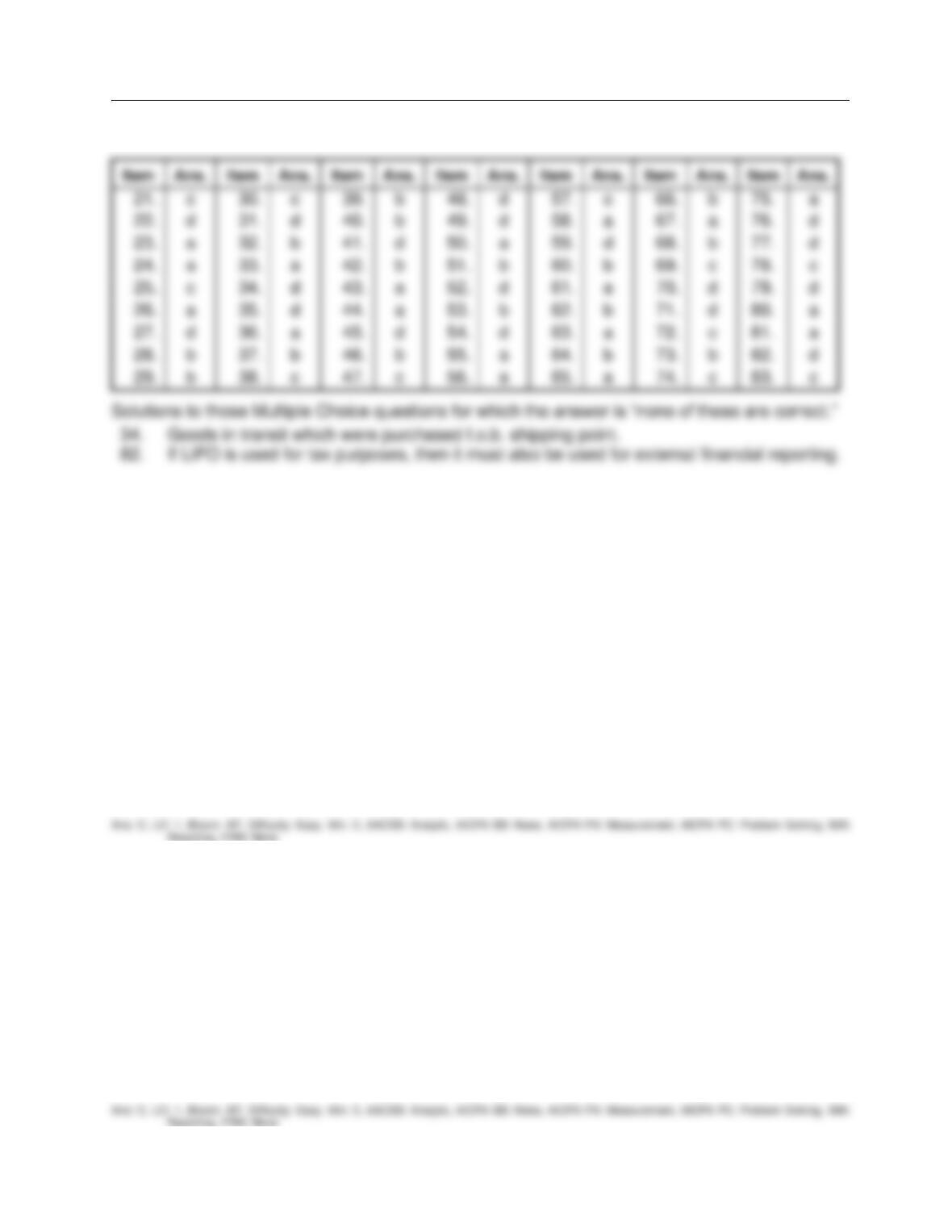
Multiple Choice Answers—Conceptual
MULTIPLE CHOICE—Computational
84. Morgan Manufacturing Company has the following account balances at year end:
Office supplies $ 4,000
Raw materials 27,000
Work-in-process 59,000
Finished goods 97,000
Prepaid insurance 6,000
What amount should Morgan report as inventories in its balance sheet?
a. $97,000.
b. $101,000.
c. $183,000.
d. $187,000.
85. Lawson Manufacturing Company has the following account balances at year end:
Office supplies $ 4,000
Raw materials 27,000
Work-in-process 59,000
Finished goods 109,000
Prepaid insurance 6,000
What amount should Lawson report as inventories in its balance sheet?
a. $109,000.
b. $113,000.
c. $195,000.
d. $199,000.

Test Bank for Intermediate Accounting, Seventeenth Edition
8 – 22
86. Elkins Corporation uses the perpetual inventory and the gross method. On March 1, it
purchased $50,000 of inventory, terms 2/10, n/30. On March 3, Elkins returned goods that
cost $5,000. On March 9, Elkins paid the supplier. On March 9, Elkins should credit
a. purchase discounts for $1,000.
b. inventory for $1,000.
c. purchase discounts for $900.
d. inventory for $900.
87. Malone Corporation uses the perpetual inventory and the gross method. On March 1, it
purchased $80,000 of inventory, terms 2/10, n/30. On March 3, Malone returned goods
that cost $8,000. On March 9, Malone paid the supplier. On March 9, Malone should credit
a. purchase discounts for $1,600.
b. inventory for $1,600.
c. purchase discounts for $1,440.
d. inventory for $1,440.
88. Bell Inc. took a physical inventory at the end of the year and determined that $780,000 of
goods were on hand. In addition, Bell, Inc. determined that $60,000 of goods that were in
transit that were shipped f.o.b. shipping point were actually received two days after the
inventory count and that the company had $90,000 of goods out on consignment. What
amount should Bell report as inventory at the end of the year?
a. $780,000.
b. $860,000.
c. $870,000.
d. $930,000.
89. Bell Inc. took a physical inventory at the end of the year and determined that $840,000 of
goods were on hand. In addition, the following items were not included in the physical
count. Bell, Inc. determined that $96,000 of goods purchased were in transit that were
shipped f.o.b. destination (goods were actually received by the company three days after
the inventory count).The company sold $40,000 worth of inventory f.o.b. destination. What
amount should Bell report as inventory at the end of the year?
a. $840,000.
b. $936,000.
c. $880,000.
d. $976,000.

Valuation of Inventories: A Cost-Basis Approach
8 – 23
90. Risers Inc. reported total assets of $2,400,000 and net income of $320,000 for the current
year. Risers determined that inventory was overstated by $24,000 at the beginning of the
year (this was not corrected). What is the corrected amount for total assets and net
income for the year?
a. $2,400,000 and $320,000.
b. $2,400,000 and $344,000.
c. $2,376,000 and $296,000.
d. $2,424,000 and $344,000.
91. Risers Inc. reported total assets of $6,400,000 and net income of $510,000 for the current
year. Risers determined that inventory was understated by $138,000 at the beginning of
the year and $60,000 at the end of the year. What is the corrected amount for total assets
and net income for the year?
a. $6,460,000 and $570,000.
b. $6,340,000 and $588,000.
c. $6,460,000 and $432,000.
d. $6,400,000 and $510,000.
Hudson, Inc. is a calendar-year corporation. Its financial statements for the years 2021 and 2020
contained errors as follows:
2021 2020
Ending inventory $9,000 overstated $24,000 overstated
Depreciation expense $6,000 understated $18,000 overstated
92. Assume that the proper correcting entries were made at December 31, 2020. By how
much will 2021 income before taxes be overstated or understated?
a. $ 3,000 understated
b. $ 3,000 overstated
c. $ 6,000 overstated
d. $15,000 overstated
Hudson, Inc. is a calendar-year corporation. Its financial statements for the years 2021 and 2020
contained errors as follows:
2021 2020
Ending inventory $9,000 overstated $24,000 overstated
Depreciation expense $6,000 understated $18,000 overstated
93. Assume that no correcting entries were made at December 31, 2020. Ignoring income
taxes, by how much will retained earnings at December 31, 2021 be overstated or
understated?
a. $ 3,000 understated
b. $22,500 overstated
c. $22,500 understated
d. $27,000 understated

Test Bank for Intermediate Accounting, Seventeenth Edition
8 – 24
Hudson, Inc. is a calendar-year corporation. Its financial statements for the years 2021 and 2020
contained errors as follows:
2021 2020
Ending inventory $9,000 overstated $24,000 overstated
Depreciation expense $6,000 understated $18,000 overstated
94. Assume that no correcting entries were made at December 31, 2020, or December 31,
2021 and that no additional errors occurred in 2022. Ignoring income taxes, by how much
will working capital at December 31, 2022 be overstated or understated?
a. $0
b. $ 6,000 overstated
c. $ 6,000 understated
d. $15,000 understated
95. The following information is available for Naab Company for 2020:
Freight-in $ 60,000
Purchase returns 150,000
Selling expenses 460,000
Ending inventory 520,000
The cost of goods sold is equal to 400% of selling expenses. What is the cost of goods
available for sale?
a. $1,840,000.
b. $2,300,000.
c. $2,370,000.
d. $2,360,000.
Winsor Co. records purchases at net amounts. On May 5 Winsor purchased merchandise on
account, $80,000, terms 2/10, n/30. Winsor returned $6,000 of the May 5 purchase and received
credit on account. At May 31 the balance had not been paid.
96. The amount to be recorded as a purchase return is
a. $5,400.
b. $6,120
c. $6,000.
d. $5,880.

Valuation of Inventories: A Cost-Basis Approach
8 – 25
Winsor Co. records purchases at net amounts. On May 5 Winsor purchased merchandise on
account, $80,000, terms 2/10, n/30. Winsor returned $6,000 of the May 5 purchase and received
credit on account. At May 31 the balance had not been paid.
97. By how much should the account payable be adjusted on May 31?
a. $ 0.
b. $1,720.
c. $1,600.
d. $1,480.
The following information was available from the inventory records of Rich Company for January:
Units Unit Cost Total Cost
Balance at January 1 9,000 $9.77 $87,930
Purchases:
January 6 6,000 10.30 61,800
January 26 8,100 10.71 86,751
Sales:
January 7 (7,500)
January 31 (11,100)
Balance at January 31 4,500
98. Assuming that Rich does not maintain perpetual inventory records, what should be the
inventory at January 31, using the weighted-average inventory method, rounded to the
nearest dollar?
a. $47,270.
b. $46,067.
c. $46,170.
d. $46,620.
The following information was available from the inventory records of Rich Company for January:
Units Unit Cost Total Cost
Balance at January 1 9,000 $9.77 $87,930
Purchases:
January 6 6,000 10.30 61,800
January 26 8,100 10.71 86,751
Sales:
January 7 (7,500)
January 31 (11,100)
Balance at January 31 4,500

Test Bank for Intermediate Accounting, Seventeenth Edition
8 – 26
99. Assuming that Rich maintains perpetual inventory records, what should be the inventory
at January 31, using the moving-average inventory method, rounded to the nearest
dollar?
a. $47,270.
b. $46,067.
c. $46,170.
d. $46,620.
100. Niles Co. has the following data related to an item of inventory:
Inventory, March 1 400 units @ $2.10
Purchase, March 7 1,400 units @ $2.20
Purchase, March 16 280 units @ $2.25
Inventory, March 31 520 units
The value assigned to ending inventory if Niles uses LIFO is
a. $1,160.
b. $1,104.
c. $1,092.
d. $1,168.
101. Niles Co. has the following data related to an item of inventory:
Inventory, March 1 400 units @ $2.10
Purchase, March 7 1,400 units @ $2.20
Purchase, March 16 280 units @ $2.25
Inventory, March 31 520 units
The value assigned to cost of goods sold if Niles uses FIFO is
a. $1,160.
b. $1,104.
c. $3,448.
d. $3,392.
102. Emley Company has been using the LIFO method of inventory valuation for 10 years,
since it began operations. Its 2020 ending inventory was $60,000, but it would have been
$90,000 if FIFO had been used. Thus, if FIFO had been used, Emley’s income before
income taxes would have been
a. $30,000 greater over the 10-year period.
b. $30,000 less over the 10-year period.
c. $30,000 greater in 2020.
d. $30,000 less in 2020.

Valuation of Inventories: A Cost-Basis Approach
8 – 27
Transactions for the month of June were:
Purchases Sales
June 1 (balance) 3,200 @ $3.20 June 2 2,400 @ $5.50
3 8,800 @ 3.10 6 6,400 @ 5.50
7 4,800 @ 3.30 9 4,000 @ 5.50
15 7,200 @ 3.40 10 1,600 @ 6.00
22 2,000 @ 3.50 18 5,600 @ 6.00
25 800 @ 6.00
103. Assuming that perpetual inventory records are kept in units only, the ending inventory on
a LIFO basis is
a. $16,440.
b. $16,640.
c. $17,160.
d. $17,880.
Transactions for the month of June were:
Purchases Sales
June 1 (balance) 3,200 @ $3.20 June 2 2,400 @ $5.50
3 8,800 @ 3.10 6 6,400 @ 5.50
7 4,800 @ 3.30 9 4,000 @ 5.50
15 7,200 @ 3.40 10 1,600 @ 6.00
22 2,000 @ 3.50 18 5,600 @ 6.00
25 800 @ 6.00
104. Assuming that perpetual inventory records are kept in dollars, the ending inventory on a
LIFO basis is
a. $16,440.
b. $16,640.
c. $17,160.
d. $17,880.
Transactions for the month of June were:
Purchases Sales
June 1 (balance) 3,200 @ $3.20 June 2 2,400 @ $5.50
3 8,800 @ 3.10 6 6,400 @ 5.50
7 4,800 @ 3.30 9 4,000 @ 5.50
15 7,200 @ 3.40 10 1,600 @ 6.00
22 2,000 @ 3.50 18 5,600 @ 6.00
25 800 @ 6.00
105. Assuming that perpetual inventory records are kept in dollars, the ending inventory on a
FIFO basis is
a. $16,440.
b. $16,640.
c. $17,160.
d. $17,880.

Test Bank for Intermediate Accounting, Seventeenth Edition
8 – 28
Transactions for the month of June were:
Purchases Sales
June 1 (balance) 3,200 @ $3.20 June 2 2,400 @ $5.50
3 8,800 @ 3.10 6 6,400 @ 5.50
7 4,800 @ 3.30 9 4,000 @ 5.50
15 7,200 @ 3.40 10 1,600 @ 6.00
22 2,000 @ 3.50 18 5,600 @ 6.00
25 800 @ 6.00
106. Assuming that perpetual inventory records are kept in units only, the ending inventory on
an average-cost basis, rounded to the nearest dollar, is
a. $16,384.
b. $16,952.
c. $17,160.
d. $17,280.
107. Milford Company had 500 units of “Tank” in its inventory at a cost of $4 each. It
purchased, for $2,800, 300 more units of “Tank”. Milford then sold 400 units at a selling
price of $10 each, resulting in a gross profit of $1,600. The cost flow assumption used by
Milford
a. is FIFO.
b. is LIFO.
c. is weighted average.
d. cannot be determined from the information given.
108. Nichols Company had 500 units of “Dink” in its inventory at a cost of $5 each. It
purchased, for $2,400, 300 more units of “Dink”. Nichols then sold 600 units at a selling
price of $10 each, resulting in a gross profit of $2,100. The cost flow assumption used by
Nichols.
a. is FIFO.
b. is LIFO.
c. is weighted average.
d. cannot be determined from the information given.
109. June Corp. sells one product and uses a perpetual inventory system. The beginning
inventory consisted of 80 units that cost $20 per unit. During the current month, the
company purchased 480 units at $20 each. Sales during the month totaled 360 units for
$43 each. What is the number of units in the ending inventory?
a. 80 units.
b. 120 units.
c. 200 units.
d. 560 units.

Valuation of Inventories: A Cost-Basis Approach
8 – 29
110. June Corp. sells one product and uses a perpetual inventory system. The beginning
inventory consisted of 80 units that cost $20 per unit. During the current month, the
company purchased 480 units at $20 each. Sales during the month totaled 360 units for
$43 each. What is the cost of goods sold using the LIFO method?
a. $1,600.
b. $7,200.
c. $9,600.
d. $15,480.
111. Checkers uses the periodic inventory system. For the current month, the beginning
inventory consisted of 7,200 units that cost $12 each. During the month, the company
made two purchases: 3,000 units at $13 each and 12,000 units at $13.50 each. Checkers
also sold 12,900 units during the month. Using the average cost method, what is the
amount of cost of goods sold for the month?
a. $167,055.
b. $173,700.
c. $161,850.
d. $167,700.
112. Chess Top uses the periodic inventory system. For the current month, the beginning
inventory consisted of 480 units that cost $65 each. During the month, the company made
two purchases: 720 units at $68 each and 360 units at $70 each. Chess Top also sold
1,200 units during the month. Using the average cost method, what is the amount of
ending inventory?
a. $25,200.
b. $81,048.
c. $80,160.
d. $24,314.
113. Checkers uses the periodic inventory system. For the current month, the beginning
inventory consisted of 7,200 units that cost $12 each. During the month, the company
made two purchases: 3,000 units at $13 each and 12,000 units at $13.50 each. Checkers
also sold 12,900 units during the month. Using the FIFO method, what is the ending
inventory?
a. $120,438.
b. $111,600.
c. $125,550.
d. $113,700.

Test Bank for Intermediate Accounting, Seventeenth Edition
8 – 30
114. Chess Top uses the periodic inventory system. For the current month, the beginning
inventory consisted of 480 units that cost $65 each. During the month, the company made
two purchases: 720 units at $68 each and 360 units at $70 each. Chess Top also sold
1,200 units during the month. Using the FIFO method, what is the amount of cost of goods
sold for the month?
a. $81,048.
b. $78,000.
c. $81,960.
d. $80,160.
115. Checkers uses the periodic inventory system. For the current month, the beginning
inventory consisted of 7,200 units that cost $12 each. During the month, the company
made two purchases: 3,000 units at $13 each and 12,000 units at $13.50 each. Checkers
also sold 12,900 units during the month. Using the LIFO method, what is the ending
inventory?
a. $120,438.
b. $111,600.
c. $125,550.
d. $113,700.
116. Chess Top uses the periodic inventory system. For the current month, the beginning
inventory consisted of 480 units that cost $65 each. During the month, the company made
two purchases: 720 units at $68 each and 360 units at $70 each. Chess Top also sold
1,200 units during the month. Using the LIFO method, what is the amount of cost of goods
sold for the month?
a. $81,048.
b. $78,000.
c. $81,960.
d. $80,160.
117. Black Corporation uses the FIFO method for internal reporting purposes and LIFO for
external reporting purposes. The balance in the LIFO Reserve account at the end of 2020
was $280,000. The balance in the same account at the end of 2021 is $420,000. Black’s
Cost of Goods Sold account has a balance of $2,100,000 from sales transactions
recorded during the year. What amount should Black report as Cost of Goods Sold in the
2021 income statement?
a. $1,960,000.
b. $2,100,000.
c. $2,240,000.
d. $2,520,000.

Valuation of Inventories: A Cost-Basis Approach
8 – 31
118. White Corporation uses the FIFO method for internal reporting purposes and LIFO for
external reporting purposes. The balance in the LIFO Reserve account at the end of 2020
was $320,000. The balance in the same account at the end of 2021 is $480,000. White’s
Cost of Goods Sold account has a balance of $2,400,000 from sales transactions
recorded during the year. What amount should White report as Cost of Goods Sold in the
2021 income statement?
a. $2,240,000.
b. $2,240,000.
c. $2,560,000.
d. $2,880,000.
119. Milford Company had 600 units of “Tank” in its inventory at a cost of $6 each. It purchased
900 more units of “Tank” at a cost of $9 each. Milford then sold 1,050 units at a selling
price of $15 each. The LIFO liquidation overstated normal gross profit by
a. $ -0-
b. $450.
c. $900.
d. $1,350.
120. Nichols Company had 600 units of “Dink” in its inventory at a cost of $12 each. It
purchased 900 more units of “Dink” at a cost of $18 each. Nichols then sold 1,050 units at
a selling price of $30 each. The LIFO liquidation overstated normal gross profit by
a. $ -0-
b. $ 900.
c. $1,800.
d. $2,700.
RF Company had January 1 inventory of $300,000 when it adopted dollar-value LIFO. During the
year, purchases were $1,800,000 and sales were $3,000,000. December 31 inventory at year–
end prices was $430,080, and the price index was 112.
121. What is RF Company’s ending inventory?
a. $300,000.
b. $384,000.
c. $394,080.
d. $430,080.
RF Company had January 1 inventory of $300,000 when it adopted dollar-value LIFO. During the
year, purchases were $1,800,000 and sales were $3,000,000. December 31 inventory at year–
end prices was $430,080, and the price index was 112.

Test Bank for Intermediate Accounting, Seventeenth Edition
8 – 32
122. What is RF Company’s gross profit?
a. $1,248,000.
b. $1,294,080.
c. $1,330,380.
d. $2,605,920.
Hay Company had January 1 inventory of $300,000 when it adopted dollar-value LIFO. During
the year, purchases were $1,800,000 and sales were $3,000,000. December 31 inventory at
year-end prices was $379,500, and the price index was 110.
123. What is Hay Company’s ending inventory?
a. $330,000.
b. $345,000.
c. $349,500.
d. $379,500.
Hay Company had January 1 inventory of $300,000 when it adopted dollar-value LIFO. During
the year, purchases were $1,800,000 and sales were $3,000,000. December 31 inventory at
year-end prices was $379,500, and the price index was 110.
124. What is Hay Company’s gross profit?
a. $1,245,000.
b. $1,249,500.
c. $1,279,500.
d. $2,650,500.
Use the following information for questions 125 through 127.
Gross Corporation adopted the dollar-value LIFO method of inventory valuation on December 31,
2019. Its inventory at that date was $1,100,000 and the relevant price index was 100. Information
regarding inventory for subsequent years is as follows:
Inventory at Current
Date Current Prices Price Index
December 31, 2020 $1,284,000 107
December 31, 2021 1,450,000 125
December 31, 2022 1,625,000 130
125. What is the cost of the ending inventory at December 31, 2020 under dollar-value LIFO?
a. $1,200,000.
b. $1,284,000.
c. $1,207,000.
d. $1,177,000.

Valuation of Inventories: A Cost-Basis Approach
8 – 33
126. What is the cost of the ending inventory at December 31, 2021 under dollar-value LIFO?
a. $1,160,000.
b. $1,157,000.
c. $1,164,200.
d. $1,200,000.
127. What is the cost of the ending inventory at December 31, 2022 under dollar-value LIFO?
a. $1,281,200.
b. $1,274,000.
c. $1,250,000.
d. $1,317,000.
128. Wise Company adopted the dollar-value LIFO method on January 1, 2020, at which time
its inventory consisted of 6,000 units of Item A @ $5.00 each and 3,000 units of Item B @
$16.00 each. The inventory at December 31, 2020 consisted of 12,000 units of Item A and
7,000 units of Item B. The most recent actual purchases related to these items were as
follows:
Quantity
Items Purchase Date Purchased Cost Per Unit
A 12/7/20 2,000 $ 6.00
A 12/11/20 10,000 5.75
B 12/15/20 7,000 17.00
Using the double-extension method, what is the price index for 2020 that should be
computed by Wise Company?
a. 108.33%
b. 109.59%
c. 111.05%
d. 220.51%
129. Web World began using dollar-value LIFO for costing its inventory last year. The base
year layer consists of $600,000. Assuming the current inventory at end of year prices
equals $828,000 and the index for the current year is 1.10, what is the ending inventory
using dollar-value LIFO?
a. $828,000.
b. $768,000.
c. $752,727.
d. $910,800.

Test Bank for Intermediate Accounting, Seventeenth Edition
8 – 34
130. Willy World began using dollar-value LIFO for costing its inventory two years ago. The
ending inventory for the past two years in end–of-year dollars was $300,000 and $450,000
and the year-end price indices were 1.0 and 1.2, respectively. Assuming the current
inventory at end of year prices equals $645,000 and the index for the current year is 1.25,
what is the ending inventory using dollar-value LIFO?
a. $532,500.
b. $559,200.
c. $570,000.
d. $566,250.
131. Opera Corp. uses the dollar-value LIFO method of computing its inventory cost. Data for
the past three years is as follows:
Year ended Inventory at Price
December 31. End-of-year Prices Index
2019 $650,000 1.00
2020 1,260,000 1.05
2021 1,350,250 1.10
What is the 2019 inventory balance using dollar-value LIFO?
a. $650,000.
b. $619,040.
c. $1,227,270.
d. $1,350,250.
132. Opera Corp. uses dollar-value LIFO method of computing its inventory cost. Data for the
past three years is as follows:
Year ended Inventory at Price
December 31. End-of-year Prices Index
2019 $ 650,000 1.00
2020 1,260,000 1.05
2021 1,350,250 1.10
What is the 2020 inventory balance using dollar-value LIFO?
a. $1,260,000.
b. $1,285,000.
c. $1,227,500.
d. $1,257,500.
Valuation of Inventories: A Cost-Basis Approach
8 – 35
133. Opera Corp. uses dollar-value LIFO method of computing its inventory cost. Data for the
past three years is as follows:
Year ended Inventory at Price
December 31. End-of-year Prices Index
2019 $ 650,000 1.00
2020 1,260,000 1.05
2021 1,350,250 1.10
What is the 2021 inventory balance using dollar-value LIFO?
a. $1,350,250.
b. $1,285,000.
c. $1,227,500.
d. $1,257,750.
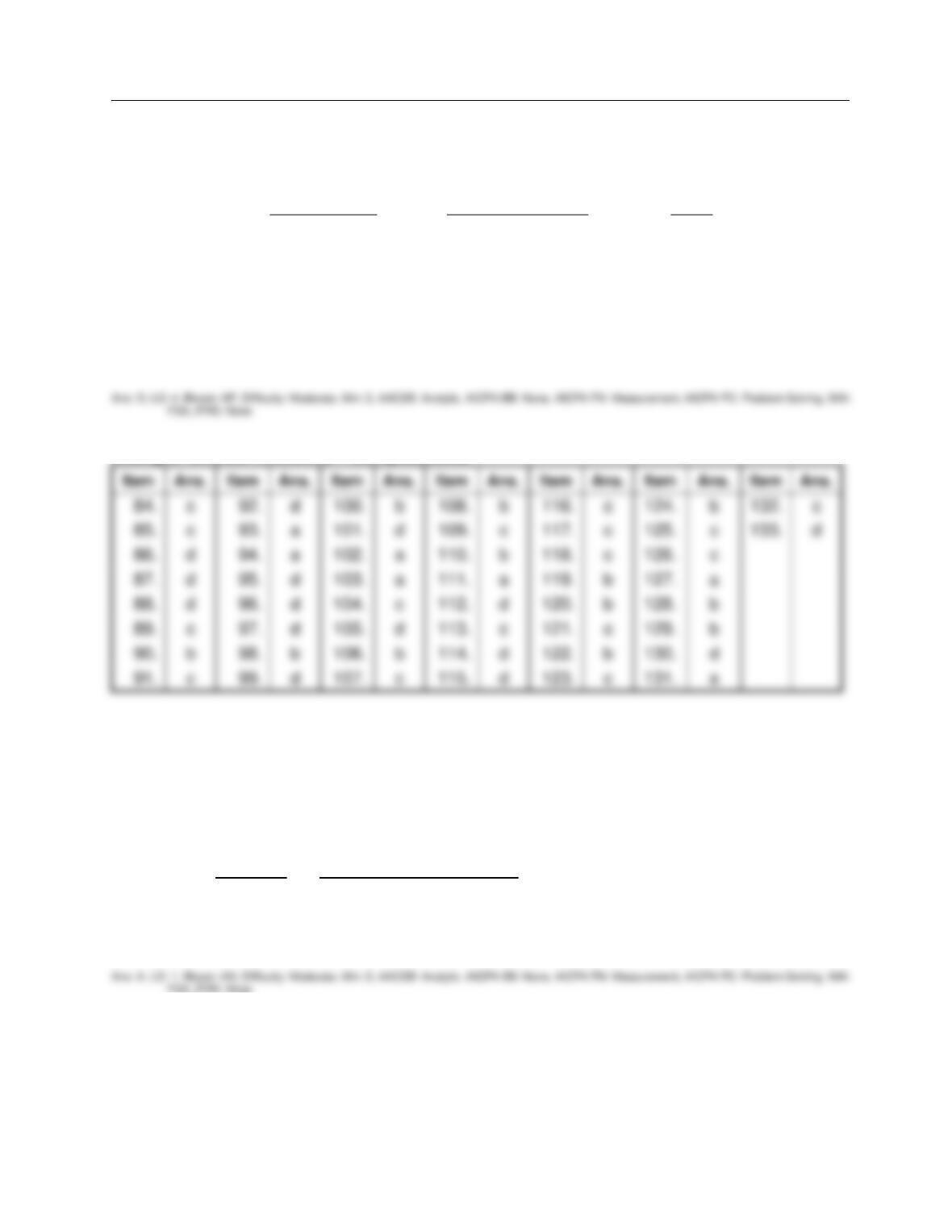
Multiple Choice Answers—Computational
MULTIPLE CHOICE—CPA Adapted
134. How should the following costs affect a retailer’s inventory valuation?
Freight-in Interest on Inventory Loan
a. Increase No effect
b. Increase Increase
c. No effect Increase
d. No effect No effect

Test Bank for Intermediate Accounting, Seventeenth Edition
8 – 36
135. The following information applied to Howe, Inc. for 2020:
Merchandise purchased for resale $410,000
Freight-in 8,000
Freight-out 5,000
Purchase returns 2,000
Howe’s 2020 inventoriable cost was
a. $410,000.
b. $413,000.
c. $416,000.
d. $421,000.
136. The following information was derived from the 2020 accounting records of Perez Co.:
Perez’s Goods
Perez’s Central Warehouse Held by Consignees
Beginning inventory $130,000 $ 14,000
Purchases 625,000 70,000
Freight-in 10,000
Transportation to consignees 5,000
Freight-out 30,000 8,000
Ending inventory 145,000 20,000
Perez’s 2020 cost of sales was
a. $620,000.
b. $650,000.
c. $684,000.
d. $689,000.
137. Dole Corp.‘s accounts payable at December 31, 2020, totaled $900,000 before any
necessary year-end adjustments relating to the following transactions:
• On December 27, 2020, Dole wrote and recorded checks to creditors totaling
$350,000 causing an overdraft of $100,000 in Dole’s bank account at December 31,
2020. The checks were mailed out on January 10, 2021.
• On December 28, 2020, Dole purchased and received goods for $150,000, terms
2/10, n/30. Dole records purchases and accounts payable at net amounts. The invoice
was recorded and paid January 3, 2021.
• Goods shipped f.o.b. destination on December 20, 2020 from a vendor to Dole were
received January 2, 2021. The invoice cost was $65,000.
At December 31, 2020, what amount should Dole report as total accounts payable?
a. $1,462,000.
b. $1,397,000.
c. $1,150,000.
d. $1,050,000.

Valuation of Inventories: A Cost-Basis Approach
8 – 37
138. The balance in Moon Co.’s accounts payable account at December 31, 2020 was
$980,000 before any necessary year–end adjustments relating to the following:
• Goods were in transit to Moon from a vendor on December 31, 2020. The invoice cost
was $40,000. The goods were shipped f.o.b. shipping point on December 29, 2020
and were received on January 4, 2021.
• Goods shipped f.o.b. destination on December 21, 2020 from a vendor to Moon were
received on January 6, 2021. The invoice cost was $25,000.
• On December 27, 2020, Moon wrote and recorded checks to creditors totaling
$30,000 that were mailed on January 10, 2021.
In Moon’s December 31, 2020 balance sheet, the accounts payable should be
a. $1,010,000.
b. $1,020,000.
c. $1,045,000.
d. $1,050,000.
139. Kerr Co.’s accounts payable balance at December 31, 2020 was $1,600,000 before
considering the following transactions:
• Goods were in transit from a vendor to Kerr on December 31, 2020. The invoice price
was $70,000, and the goods were shipped f.o.b. shipping point on December 29,
2020. The goods were received on January 4, 2021.
• Goods shipped to Kerr, f.o.b. shipping point on December 20, 2020, from a vendor
were lost in transit. The invoice price was $50,000. On January 5, 2021, Kerr filed a
$50,000 claim against the common carrier.
In its December 31, 2020 balance sheet, Kerr should report accounts payable of
a. $1,720,000.
b. $1,670,000.
c. $1,650,000.
d. $1,600,000.
140. Walsh Retailers purchased merchandise with a list price of $150,000, subject to trade
discounts of 20% and 10%, with no cash discounts allowable. Walsh should record the
cost of this merchandise as
a. $105,000.
b. $108,000.
c. $117,000.
d. $150,000.

Test Bank for Intermediate Accounting, Seventeenth Edition
8 – 38
141. On June 1, 2020, Penny Corp. sold merchandise with a list price of $70,000 to Linn on
account. Penny allowed trade discounts of 30% and 20%. Credit terms were 2/15, n/40
and the sale was made f.o.b. shipping point. Penny prepaid $1,000 of delivery costs for
Linn as an accommodation. On June 12, 2020, Penny received from Linn a remittance in
full payment amounting to
a. $38,416.
b. $39,788.
c. $39,416.
d. $39,186.
142. Groh Co. recorded the following data pertaining to raw material X during January 2020:
Units
Date Received Cost Issued On Hand
1/1/20 Inventory $2.00 3,200
1/11/20 Issue 1,600 1,600
1/22/20 Purchase 4,000 $2.35 5,600
The moving-average unit cost of X inventory at January 31, 2020 is
a. $2.17.
b. $2.21.
c. $2.25.
d. $2.35.
143. During periods of rising prices, a perpetual inventory system would result in the same
dollar amount of ending inventory as a periodic inventory system under which of the
following inventory cost flow methods?
FIFO LIFO
a. Yes No
b. Yes Yes
c. No Yes
d. No No
144. Hite Co. was formed on January 2, 2020, to sell a single product. Over a two-year period,
Hite’s acquisition costs have increased steadily. Physical quantities held in inventory were
equal to three months‘ sales at December 31, 2020, and zero at December 31, 2021.
Assuming the periodic inventory system, the inventory cost method which reports the
highest amount of each of the following is
Inventory Cost of Sales
December 31, 2020 2021
a. LIFO FIFO
b. LIFO LIFO
c. FIFO FIFO
d. FIFO LIFO