Chapter 8
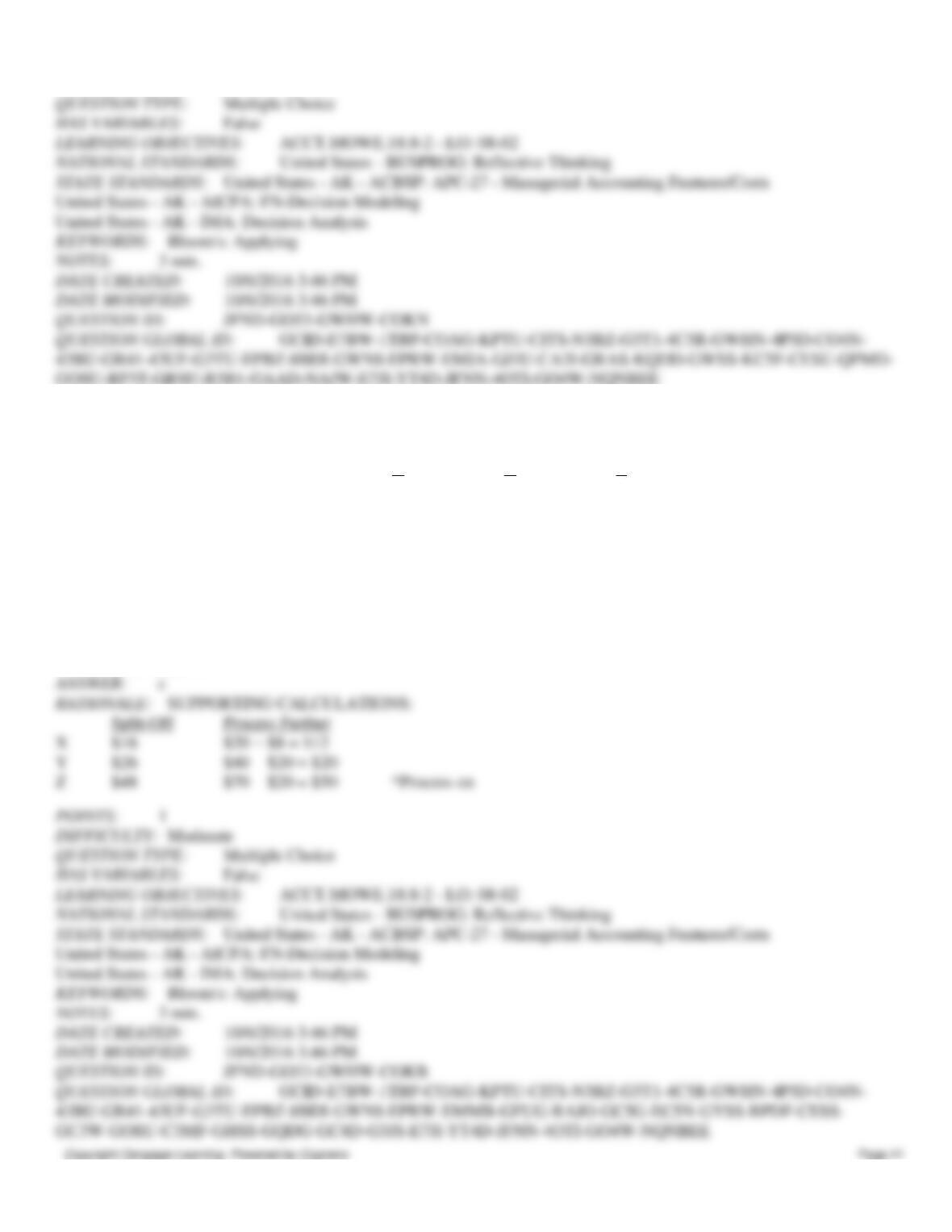
70. Information about three joint products follows:
X Y Z
Anticipated production 12,000 lbs. 8,000 lbs. 7,000 lbs.
Selling price/lb. at split-off $16 $26 $48
Additional processing costs/lb. after split-off
(all variable) $8 $20 $20
Selling price/lb. after further processing $20 $40 $70
The cost of the joint process is $140,000. Which of the joint products should be processed further?
a. X.
b. Y.
c. Z.
d. Both X and Y.
Chapter 8
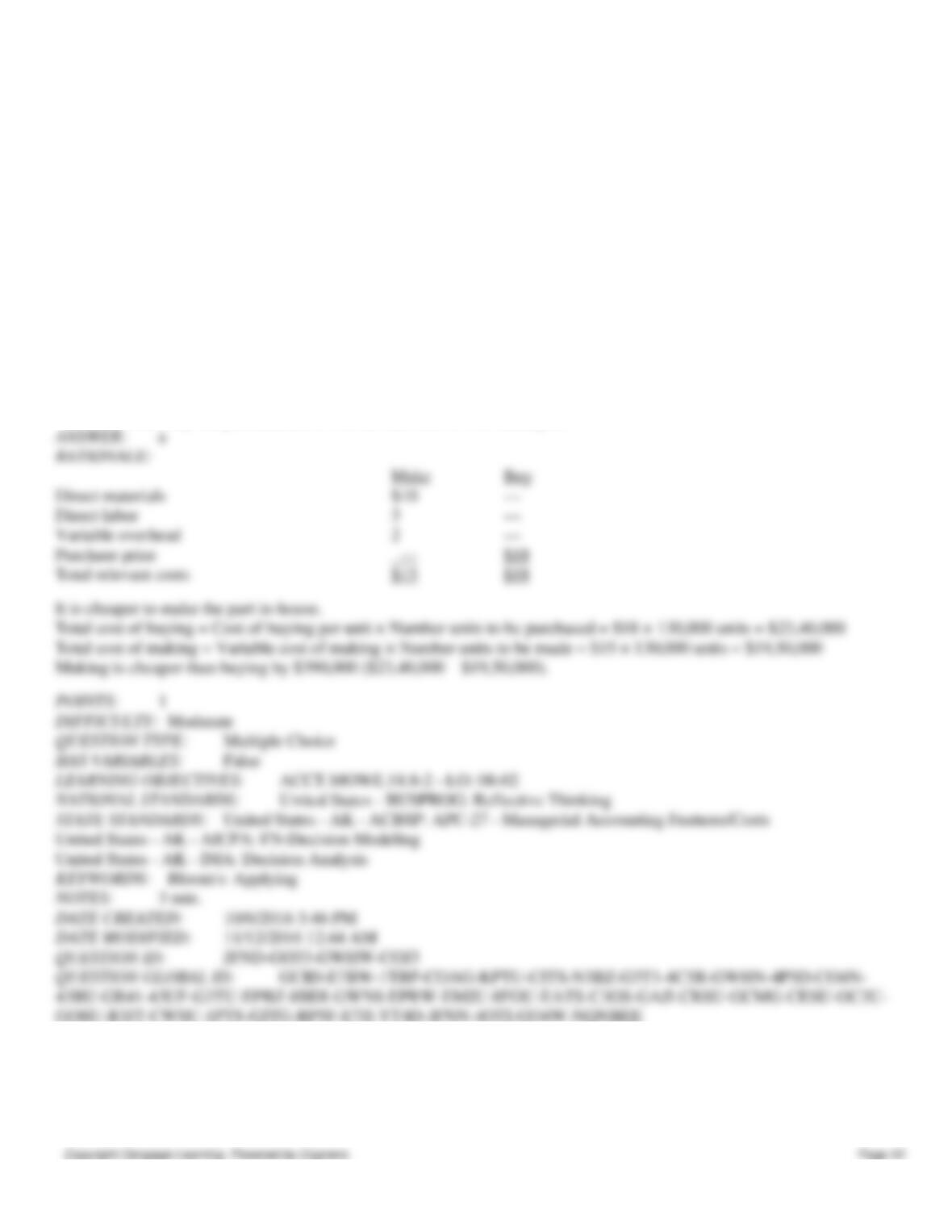
71. Begonia uses part 87A in the production of color printers. Unit manufacturing costs for part 87A are:
Direct materials $10
Direct labor 3
Variable overhead 2
Fixed overhead 4
Begonia uses 130,000 units of 87A per year. Benzyl Company has offered to sell Begonia 130,000 units of 87A per year
for $18. Fixed overhead is unavoidable.
Should Begonia make or buy the part?
a. It should make the part because it will save $390,000 over buying it.
b. It should buy the part because it will save $390,000 over making it.
c. It should make the part because it will save $1,250,000 over buying it.
d. It should buy the part because it will save 1,250,000 over making it.
e. It should buy the part because it will save $340,000 over making it.
72. ColorPro uses part 87A in the production of color printers. Unit manufacturing costs for part 87A are:
Direct materials $8
Chapter 8
Direct labor 2
Variable overhead 1
Fixed overhead 4
ColorPro uses 100,000 units of 87A per year. Filbert Company has offered to sell ColorPro 100,000 units of 87A per year
for $12. Fixed overhead is unavoidable.
Now suppose that ColorPro discovers that other costs will increase by $7,000 per year if the component is purchased
rather than made internally. Should ColorPro make or buy the part?
a. Make the part because it will save $100,000 over buying it.
b. Buy the part because it will save $100,000 over making it.
c. Make the part because it will save $107,000 over buying it.
d. Buy the part because it will save $107,000 over making it.
e. Make the part because it will save $10,000 over buying it.
73. ColorPro uses part 87A in the production of color printers. Unit manufacturing costs for part 87A are:
Direct materials $8
Direct labor 2
Variable overhead 1
Fixed overhead 4
ColorPro uses 100,000 units of 87A per year. Filbert Company has offered to sell ColorPro 100,000 units of 87A per year
for $12. Fixed overhead is unavoidable.
Which of the following is a qualitative factor that might affect ColorPro’s decision?
Chapter 8
a. Filbert has an outstanding reputation for quality.
b. Ordering from Filbert would give ColorPro a chance to see how well Filbert could meet JIT standards for
ColorPro’s other products.
c. Filbert is known for the reliability of its products.
d. Making the part in–house would help ColorPro avoid layoffs of direct and indirect labor.
e. All of these.
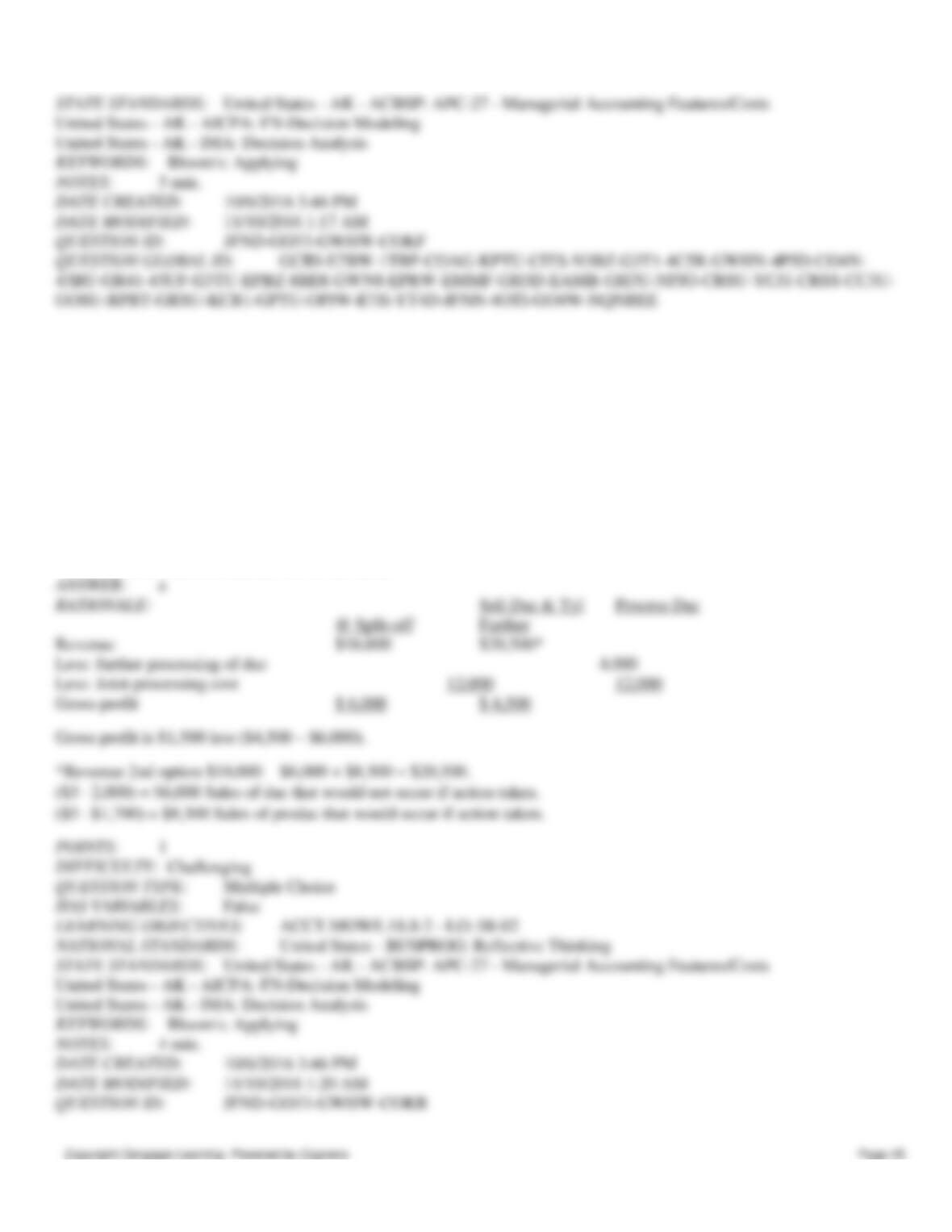
74. Bergamit Company manufactures veterinary products. One joint process involves refining a chemical (dactylyte) into
two chemicals − dac and tyl. One batch of 10,000 gallons of dactylyte can be converted to 4,000 gallons of dac and 6,000
gallons of tyl at a total joint processing cost of $15,000. At the split-off point, dac can be sold for $5 per gallon and tyl can
be sold for $7 per gallon. Bergamit has just learned of a new process to convert dac into prodac. The new process costs
$5,000 and yields 2,500 gallons of prodac for every 3,000 gallons of dac. Prodac sells for $6 per gallon.
What is Bergamit’s profit from refining one batch of dactylyte if both dac and tyl are sold at the split-off point?
a. $47,000
b. $25,000
c. $17,000
d. $36,000
e. $52,000
Chapter 8
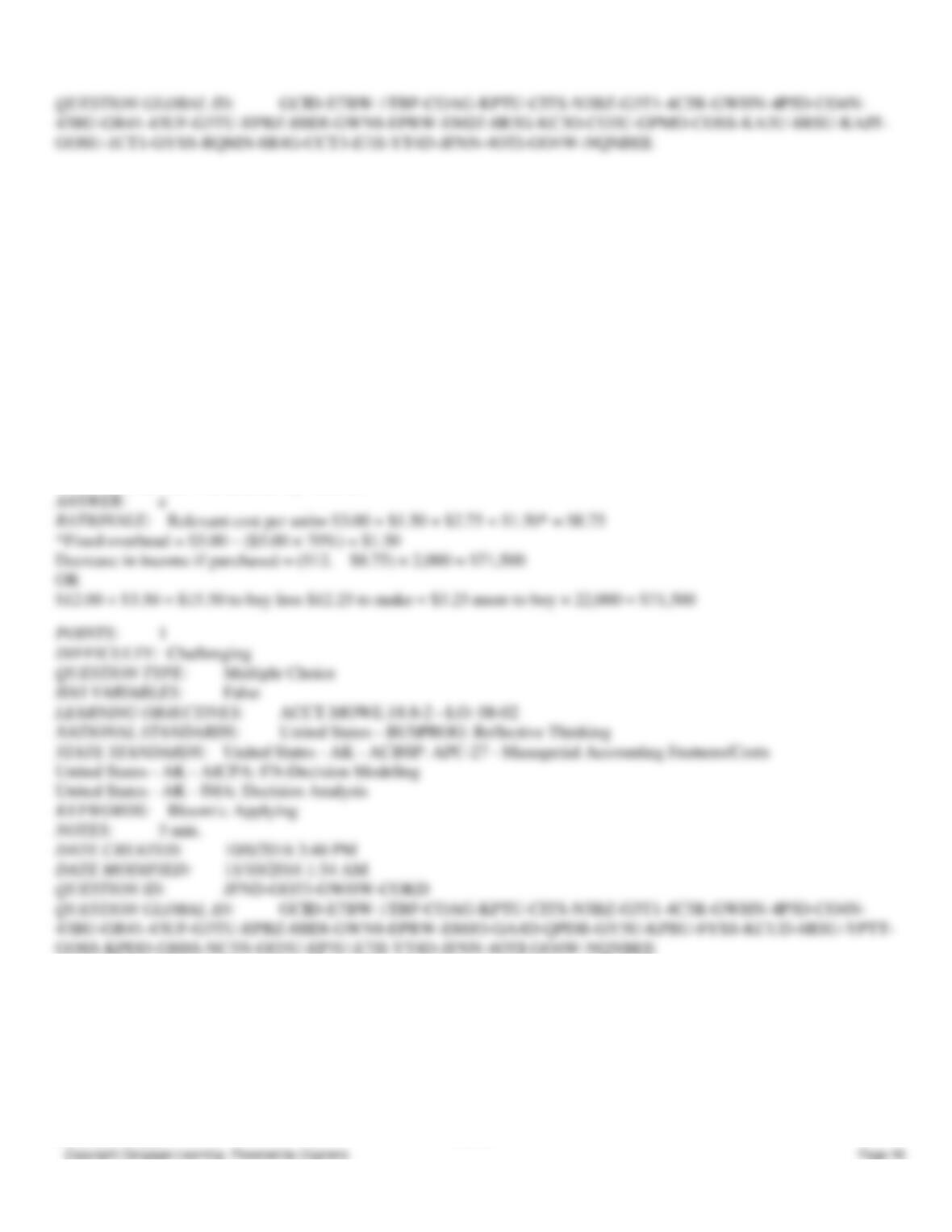
75. Autry Company manufactures veterinary products. One joint process involves refining a chemical (dactylyte) into two
chemicals − dac and tyl. One batch of 5,000 gallons of dactylyte can be converted to 2,000 gallons of dac and 3,000
gallons of tyl at a total joint processing cost of $12,000. At the split-off point, dac can be sold for $3 per gallon and tyl can
be sold for $4 per gallon. Autry has just learned of a new process to convert dac into prodac. The new process costs
$4,000 and yields 1,700 gallons of prodac for every 2,000 gallons of dac. Prodac sells for $5 per gallon.
Should Autry process dac further?
a. No, income will be $1,500 lower.
b. No, income will be $5,000 lower.
c. Yes, income will be $1,500 higher.
d. Yes, income will be $5,000 higher.
e. It doesn’t matter; income will be the same.
Chapter 8
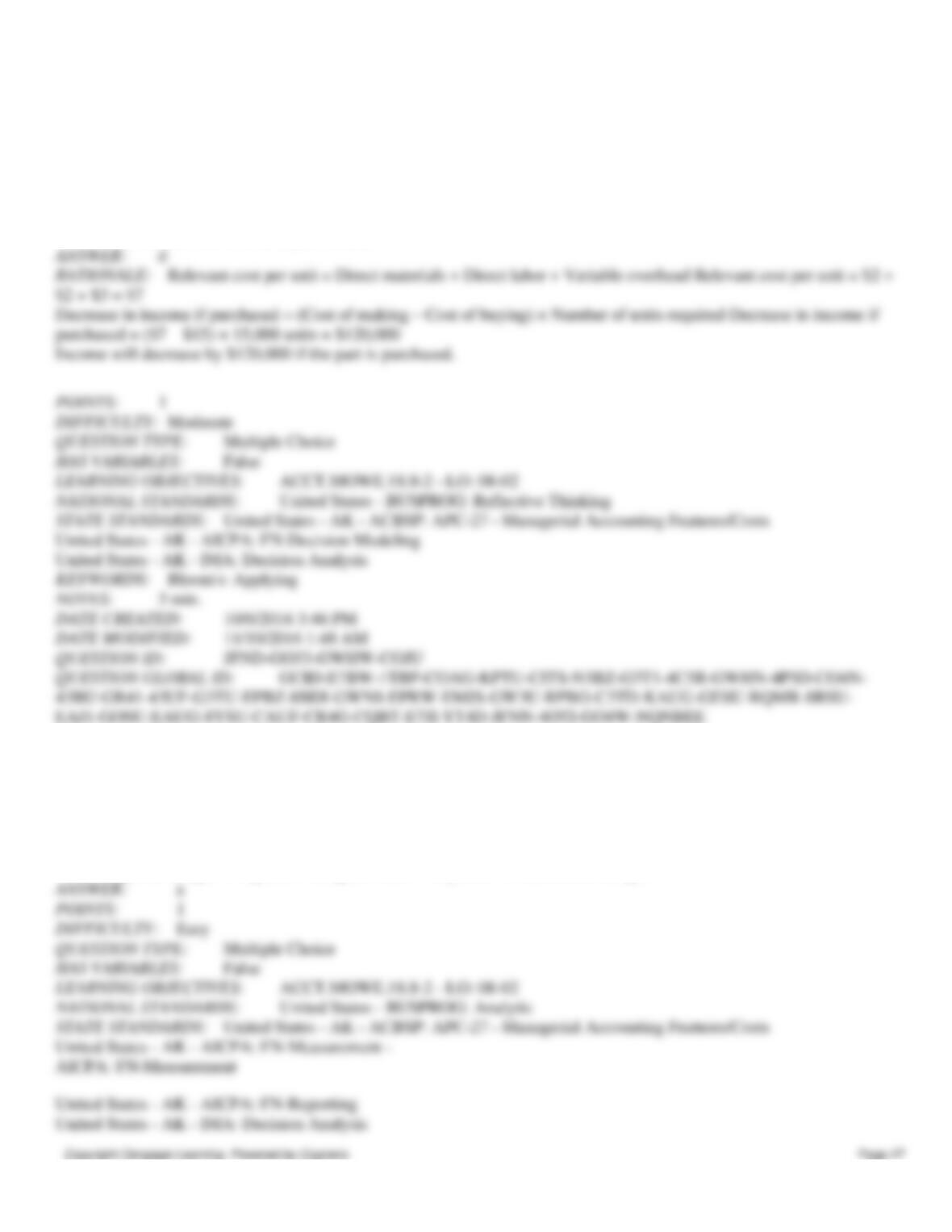
76. Ring Company makes telephones. Currently, Ring makes all components of the telephones in-house. An outside
company has offered to supply one component, part number X76, for $12 each. Ring uses 22,000 of these components per
year. Costs of X76 are as follows:
Direct materials $3.00
Direct labor $1.50
Variable overhead $2.75
Fixed overhead $5.00
Suppose that 30% of the fixed overhead is avoidable if part X76 is not made by Ring. Should Ring purchase the part from
the outside supplier?
a. No, income will decrease by $71,500.
b. No, income will decrease by $15,000.
c. Yes, income will increase by $74,500.
d. No, income will decrease by $10,500.
e. Yes, income will increase by $10,500.
77. Cherry Company makes telephones. Currently, Cherry makes all the components of the telephones in-house. An
outside company has offered to supply one component, part number X76, for $15 each. Cherry uses 15,000 of these
components per year. Costs of X76 are as follows:
Direct materials $2.00
Direct labor $2.00
Variable overhead $3.00
Fixed overhead $6.00
Chapter 8
Assume that all of the fixed overhead is allocated and cannot be avoided. Should Cherry purchase the part from the
outside supplier?
a. Yes, income will increase by $200,500.
b. No, income will decrease by $145,500.
c. Yes, income will increase by $278,500.
d. No, income will decrease by $120,000.
e. Yes, income will increase by $140,200.
78. Which of the following is used to calculate the segment margin?
a. Segment margin = Segment’s sales revenue – Direct fixed costs – Variable costs
b. Segment margin = Segment’s sales revenue + Direct fixed costs + Contribution margin
c. Segment margin = Segment’s sales revenue – Target cost + Contribution margin
d. Segment margin = Segment’s Desired profit – Target cost + Contribution margin
e. Segment margin = Segment’s marginal sales + Step cost + Contribution margin
Chapter 8
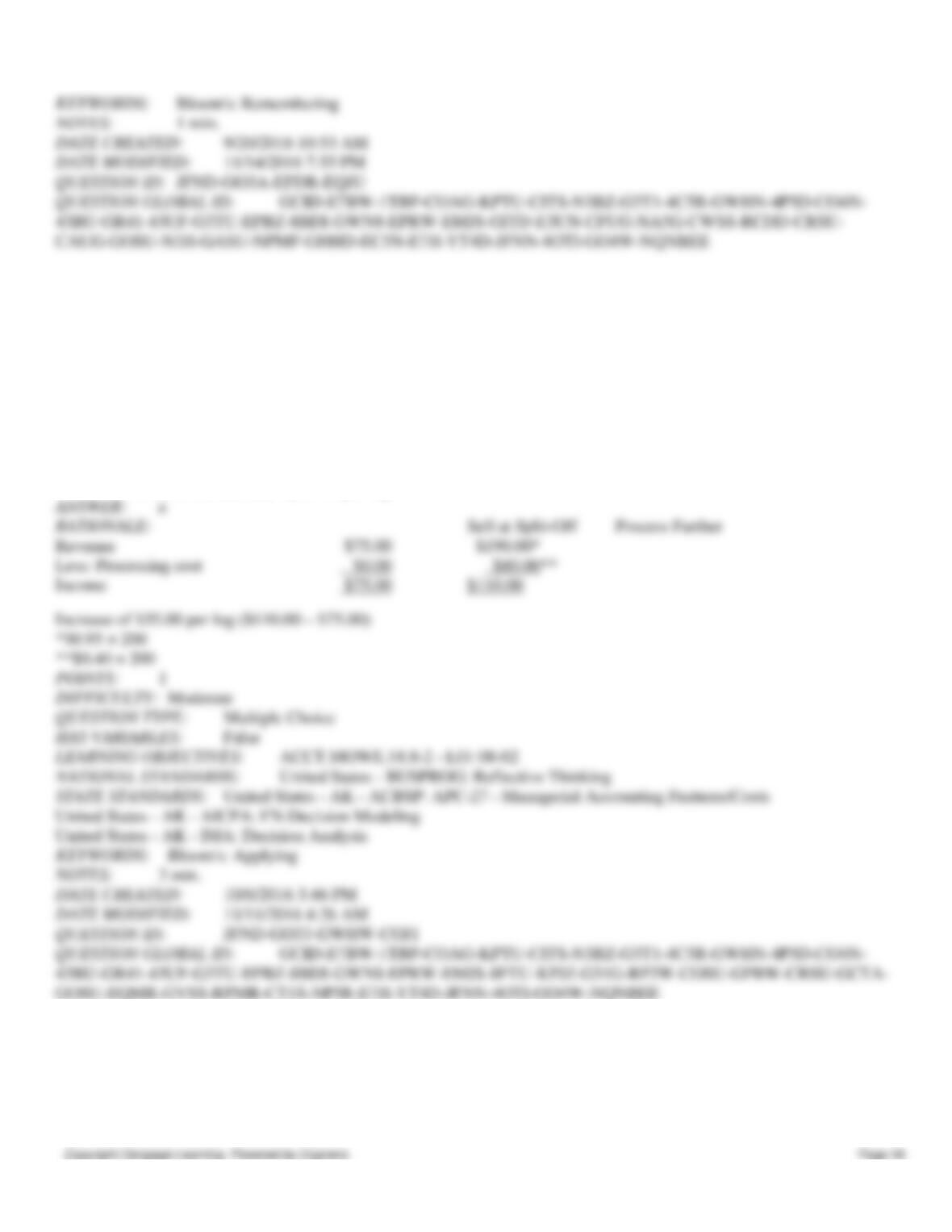
79. Kerrigan Lumber Yard receives 12,000 large trees each year that they process into rough logs. Currently, Kerrigan
sells the rough logs for $75 each. Kerrigan is considering processing the logs further into refined lumber. Each log can be
processed into 200 feet of refined lumber at an additional cost of $0.40 per foot. The refined lumber can be sold for $0.95
per foot.
Should Kerrigan process the rough logs into refined lumber?
a. Yes, income will increase by $35 per log.
b. Yes, income will increase by $110 per log.
c. Yes, income will increase by $75 per log.
d. No, income will decrease by $35 per log.
e. No, income will decrease by $110 per log.
80. Lavandyr Company has two divisions with the following segment margins for the current year: Northern, $300,000
and Southern, $500,000. Common expenses of the company are $75,000. What is Lavandyr Company’s income?
a. $360,000
b. $725,000
c. $215,000
Chapter 8
d. $420,000
81. Primrose Yard receives 15,000 large trees each year that they process into 15,000 rough logs. Currently, Primrose sells
the rough logs for $50 each. Primrose is considering processing the logs further into refined lumber. Each log can be
processed into 350 feet of refined lumber at an additional cost of $0.20 per foot. The refined lumber can be sold for $0.80
per foot.
Assume that the cost of getting the 15,000 large trees falls by half. Should Primrose sell the rough logs at split-off or
process it further?
a. It should process further because the reduction in the cost of trees makes that option more profitable than it was
before.
b. It should sell at split-off because the decrease in cost price will increase the selling price of the logs.
c. It should sell at split-off because the reduction in the cost of the trees is irrelevant.
d. It should process further because the cost reduction will decrease the processing cost.
e. It should process further because the reduction in the cost of the trees is irrelevant.
Chapter 8
82. Memuru Company has the following information pertaining to its two divisions for last year:
Division X Division Y
Variable selling and admin. expenses $ 90,000 $ 100,000
Direct fixed expenses 40,000 75,000
Sales 500,000 600,000
Direct fixed selling and admin. expenses 45,000 80,000
Variable expenses 66,000 85,000
Common expenses are $30,000 for the year.
What is the segment margin for Division Y?
a. $560,000
b. $450,000
c. $320,000
d. $260,000
Chapter 8
83. Which of the following could be considered a segment?
a. division
b. product-line
c. sales territory
d. All of these.
84. Consider the following portion of a segmented income statement for the year just ended. Assume fixed expenses of
Division X include $30,000 of direct expenses and that the discontinuance of the department will not affect the sales of
the other departments nor reduce the common expenses.
Division X
Sales $100,000
Variable costs 60,000
Gross profit $ 40,000
Fixed expenses (direct and selling and administrative) 50,000
Operating income (loss) $ (10,000)
What is X’s divisional segment margin?
a. ($10,000)
b. $40,000
c. $10,000
d. $100,000
Chapter 8
85. Tyler Company has the following information pertaining to its two product lines for last year:
Product A Product B
Variable selling and admin. expenses $38,000 $31,000
Direct fixed expenses 19,500 34,500
Sales 250,000 210,000
Direct fixed selling and admin. expenses 38,000 22,000
Variable expenses 42,000 31,000
Operating income $112,500 $91,500
Common expenses are $105,000 for the year.
What is the segment margin for Product B?
a. $155,000
b. $105,000
c. $85,000
d. $91,500
Chapter 8
86. Nauman Company has the following information pertaining to its two divisions for last year:
Division X Division Y
Variable selling and admin. expenses $ 70,000 $ 90,000
Direct fixed expenses 35,000 100,000
Sales 200,000 400,000
Direct fixed selling and admin. expenses 30,000 70,000
Variable expenses 40,000 100,000
Common expenses are $24,000 for the year.
What is the income for Nauman Company?
a. $65,000
b. $325,000
c. $300,000
d. $41,000
87. Tyler Company has the following information pertaining to its two product lines for last year:
Product A Product B
Variable selling and admin. expenses $38,000 $31,000
Direct fixed expenses 19,500 34,500
Sales 250,000 210,000
Direct fixed selling and admin. expenses 38,000 22,000
Variable expenses 42,000 31,000
Chapter 8
Operating income $112,500 $91,500
Common expenses are $105,000 for the year.
What is the income for Tyler Company?
a. $101,000
b. $120,500
c. $99,000
d. $102,500
88. Grass Valley Mining mines three products. Gold ore sells for $1,000 per ton, variable costs are $400 per ton, and fixed
mining costs are $250,000. Last year the segment margin was $(100,000).
How many tons of gold ore did Grass Valley Mining sell last year?
a. 375 tons
b. 1,000 tons
c. 250 tons
d. 200 tons
Chapter 8
89. Assume the following information for a product line:
Sales $700,000
Variable expenses 185,000
Direct fixed expenses 115,000
Variable selling and administrative expenses 70,000
Direct fixed selling and admin. expenses 90,000
What is the segment margin of the product line?
a. $200,000
b. $325,000
c. $350,000
d. $240,000
90. Assume the following information for a product line:
Chapter 8
Sales $700,000
Variable expenses 185,000
Direct fixed expenses 115,000
Variable selling and administrative expenses 70,000
Direct fixed selling and admin. expenses 90,000
What is the contribution margin of the product line?
a. $400,000
b. $525,000
c. $445,000
d. $515,000
91. Which of the following decisions focuses on whether or not to perform further actions on joint products?
a. The step decision
b. The make-or-buy decision
c. The sell-or-process-further decision
d. The restructuring-order decision
e. The keep-or-drop decision
Chapter 8
92. When managers are considering the optimal product mix, they are most concerned with
a. maximizing revenue.
b. minimizing cost.
c. maximizing profit.
d. minimizing selling and administrative expense.
e. balancing productive capacity.
93. The limitations faced by firms in terms of resources and product demand are called:
a. exceptions.
b. advantages.
c. constraints.
d. cost enhancers.
e. contribution factors.
Chapter 8
94. Which of the following is used to solve product mix problems with multiple constraints?
a. Linear programming
b. Relevant costing
c. Differential costing
d. Mixed cost programming
e. Constant programming
95. Daisy Bath Products, Inc. (DBP) makes a variety of ceramic sinks and tubs. DBP has just developed a line of sinks
and tubs made from a mixture of glass and ceramic. The sinks sell for $200 each and have variable costs of $70. The tubs
sell for $700 and have variable costs of $320. The glass and ceramic sinks and tubs require the use of specialized molding
equipment. The specialized molding equipment has 5,000 hours of capacity per year. A sink uses an average of 5 hours of
specialized molding equipment time; a tub uses an average of 6 hours of specialized molding equipment time.
What is the contribution margin per hour of specialized molding equipment time for sinks?
a. $26
b. $19
c. $30
d. $45
e. $51
Chapter 8
96. Elegance Bath Products, Inc. (EBP) makes a variety of ceramic sinks and tubs. EBP has just developed a line of sinks
and tubs made from a mixture of glass and ceramic. The sinks sell for $150 each and have variable costs of $80. The tubs
sell for $600 and have variable costs of $450. The glass and ceramic sinks and tubs require the use of specialized molding
equipment. The specialized molding equipment has 4,050 hours of capacity per year. A sink uses an average of 2 hours of
specialized molding equipment time; a tub uses an average of 5 hours of specialized molding equipment time
Assume that EBP can sell as many as 1,000 sinks and 500 tubs per year. How many tubs should EBP produce?
a. 1,000
b. 500
c. 410
d. 675
e. 0
Chapter 8
97. Elegance Bath Products, Inc. (EBP) makes a variety of ceramic sinks and tubs. EBP has just developed a line of sinks
and tubs made from a mixture of glass and ceramic. The sinks sell for $150 each and have variable costs of $80. The tubs
sell for $600 and have variable costs of $450. The glass and ceramic sinks and tubs require the use of specialized molding
equipment. The specialized molding equipment has 4,050 hours of capacity per year. A sink uses an average of 2 hours of
specialized molding equipment time; a tub uses an average of 5 hours of specialized molding equipment time.
What is the contribution margin per hour of specialized molding time for tubs?
a. $35
b. $68.33
c. $70
d. $200
e. $30
98. Elegance Bath Products, Inc. (EBP) makes a variety of ceramic sinks and tubs. EBP has just developed a line of sinks
and tubs made from a mixture of glass and ceramic. The sinks sell for $150 each and have variable costs of $80. The tubs
sell for $600 and have variable costs of $450. The glass and ceramic sinks and tubs require the use of specialized molding
equipment. The specialized molding equipment has 4,050 hours of capacity per year. A sink uses an average of 2 hours of
specialized molding equipment time; a tub uses an average of 5 hours of specialized molding equipment time.
Assuming that specialized molding equipment time is the only constrained resource, and that EBP can sell as many tubs
and sinks as it can produce, how many sinks should be sold?
a. 2,050
b. 2,025
c. 0
d. 4,050
e. 810