108) A company purchased a weaving machine for $190,000. The machine has a useful life of 8
years and a residual value of $10,000. It is estimated that the machine could produce 75,000
bolts of woven fabric over its useful life. In the first year, 15,000 bolts were produced. In the
second year, production increased to 19,000 units. Using the units-of-production method, what is
the amount of accumulated depreciation at the end of the second year?
A) $48,133.
B) $45,600.
C) $86,133.
D) $23,750.
E) $81,600.
109) A company purchased a weaving machine for $190,000. The machine has a useful life of 8
years and a residual value of $10,000. It is estimated that the machine could produce 75,000
bolts of woven fabric over its useful life. In the first year, 15,000 bolts were produced. In the
second year, production increased to 19,000 units. Using the units-of-production method, what is
the book value of the machine at the end of the second year?
A) $108,400.
B) $144,400.
C) $81,600.
D) $190,000.
E) $180,000.
110) Revenue expenditures:
A) Are additional costs of plant assets that do not materially increase the asset’s life or its
productive capabilities.
B) Are known as balance sheet expenditures because they relate to plant assets.
C) Extend the asset’s useful life.
D) Substantially benefit future periods.
E) Are debited to asset accounts when incurred.
111) Another name for a capital expenditure is:
A) Revenue expenditure.
B) Asset expenditure.
C) Long-term expenditure.
D) Contributed capital expenditure.
E) Balance sheet expenditure.
112) To capitalize an expenditure is to:
A) Debit an expense account.
B) Credit an expense account.
C) Credit the owner’s capital account.
D) Credit an asset account.
E) Debit an asset account.
113) Extraordinary repairs:
A) Are revenue expenditures.
B) Extend the useful life of an asset beyond its original estimate.
C) Are credited to accumulated depreciation.
D) Are additional costs of plants assets that do not materially increase the asset’s life.
E) Are expensed when incurred.
114) Which of the following is an example of an extraordinary repair?
A) New tires for a truck.
B) Replacement of all florescent light tubes in an office.
C) Carpet cleaning and repair.
D) Replacing the roof on a manufacturing warehouse.
E) Routine machine maintenance.
115) Ordinary repairs meet all of the following criteria except:
A) Are expenditures to keep an asset in good operating condition.
B) Are necessary if an asset is to perform to expectations over its useful life.
C) Extend the useful life of an asset beyond its original estimate by several years.
D) Include cleaning, lubricating, and normal adjusting.
E) Are treated as expenses.
116) Betterments are:
A) Expenditures making a plant asset more efficient or productive.
B) Also called ordinary repairs.
C) Always increase an asset’s life.
D) Revenue expenditures.
E) Credited against the asset account when incurred.
117) An asset’s book value is $18,000 on December 31, Year 5. The asset has been depreciated
at an annual rate of $3,000 on the straight-line method. Assuming the asset is sold on December
31, Year 5 for $15,000, the company should record:
A) A loss on sale of $12,000.
B) A gain on sale of $12,000.
C) Neither a gain nor a loss is recognized on this transaction.
D) A gain on sale of $3,000.
E) A loss on sale of $3,000.
118) Martinez owns an asset that cost $87,000 with accumulated depreciation of $40,000. The
company sells the equipment for cash of $42,000. At the time of sale, the company should
record:
A) A gain on sale of $2,000.
B) A loss on sale of $2,000.
C) A loss on sale of $5,000.
D) A gain on sale of $5,000.
E) A loss on sale of $45,000.
119) Martinez owns machinery that cost $87,000 with accumulated depreciation of $40,000. The
company sells the machinery for cash of $42,000. The journal entry to record the sale would
include:
A) A credit to Accumulated Depreciation of $40,000.
B) A credit to Gain on Sale of $2,000.
C) A credit to Machinery of $47,000.
D) A debit to Cash of $42,000.
E) A debit to Accumulated Depreciation of $47,000.
120) An asset’s book value is $36,000 on January 1, Year 6. The asset is being depreciated $500
per month using the straight-line method. Assuming the asset is sold on July 1, Year 7 for
$25,000, the company should record:
A) Neither a gain or loss is recognized on this type of transaction.
B) A gain on sale of $2,000.
C) A loss on sale of $1,000.
D) A gain on sale of $1,000.
E) A loss on sale of $2,000.
121) Marks Consulting purchased equipment costing $45,000 on January 1, Year 1. The
equipment is estimated to have a salvage value of $5,000 and an estimated useful life of 8 years.
Straight-line depreciation is used. If the equipment is sold on July 1, Year 5 for $20,000, the
journal entry to record the sale will include a:
A) Credit to cash for $20,000.
B) Debit to accumulated depreciation for $22,500.
C) Debit to loss on sale for $10,000.
D) Credit to loss on sale for $10,000.
E) Debit to gain on sale for $2,500.
122) A machine costing $75,000 is purchased on September 1, Year 1. The machine is estimated
to have a salvage value of $10,000 and an estimated useful life of 4 years. Double-declining-
balance depreciation is used. If the machine is sold on December 31, Year 3 for $13,000, the
journal entry to record the sale will include:
A) A credit to gain on sale for $8,000.
B) A debit to loss on sale for $2,625.
C) A credit to accumulated depreciation for $59,375.
D) A debit to loss on sale for $3,042.
E) A credit to gain on sale for $4,979.
123) An asset can be disposed of by all of the following except:
A) Discarding it.
B) Selling it.
C) Exchanging it for another asset.
D) Donating it to charity.
E) Continuing to use it after it is fully depreciated.
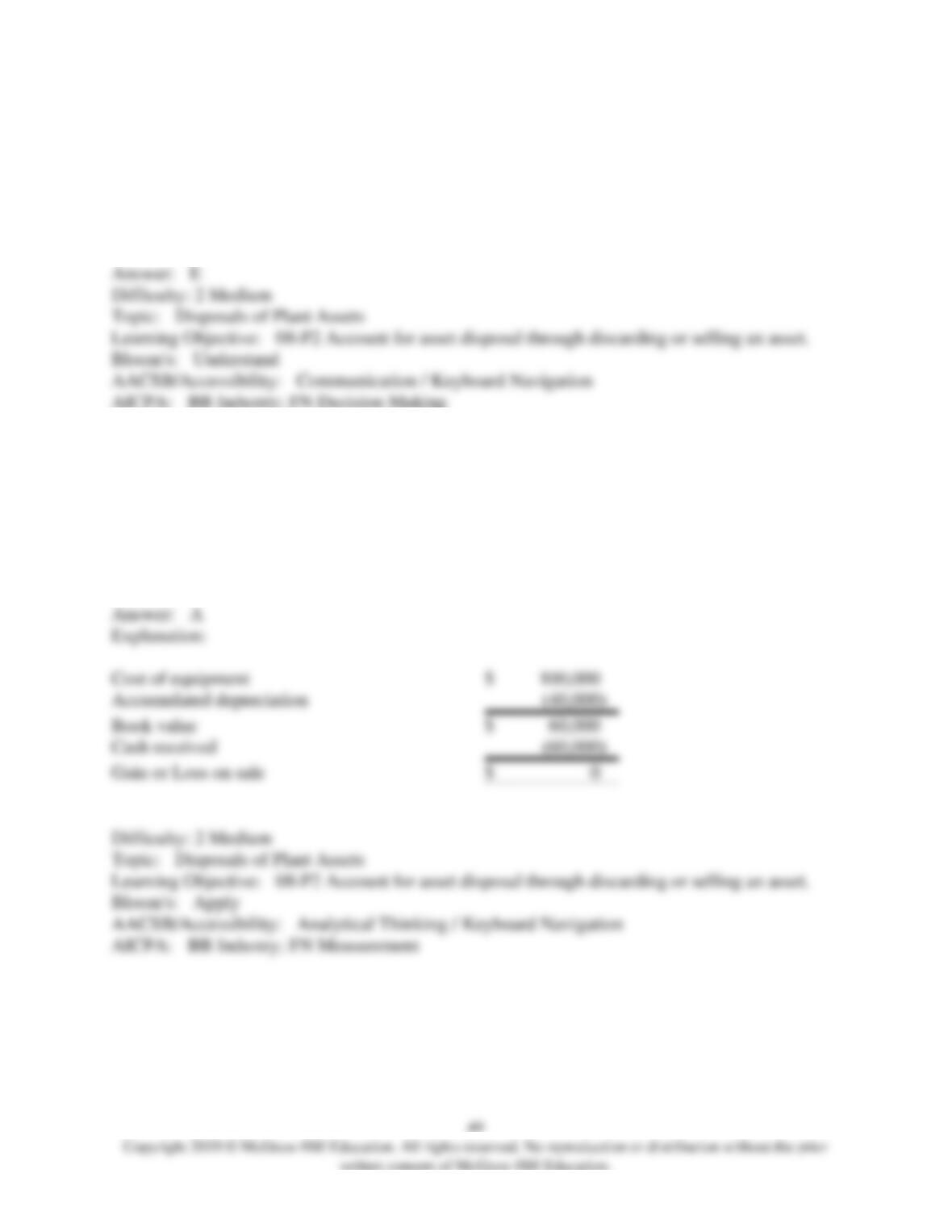
124) A company sold equipment that originally cost $100,000 for $60,000 cash. The
accumulated depreciation on the equipment was $40,000. The company should recognize a:
A) $0 gain or loss.
B) $20,000 gain.
C) $20,000 loss.
D) $40,000 loss.
E) $60,000 gain.
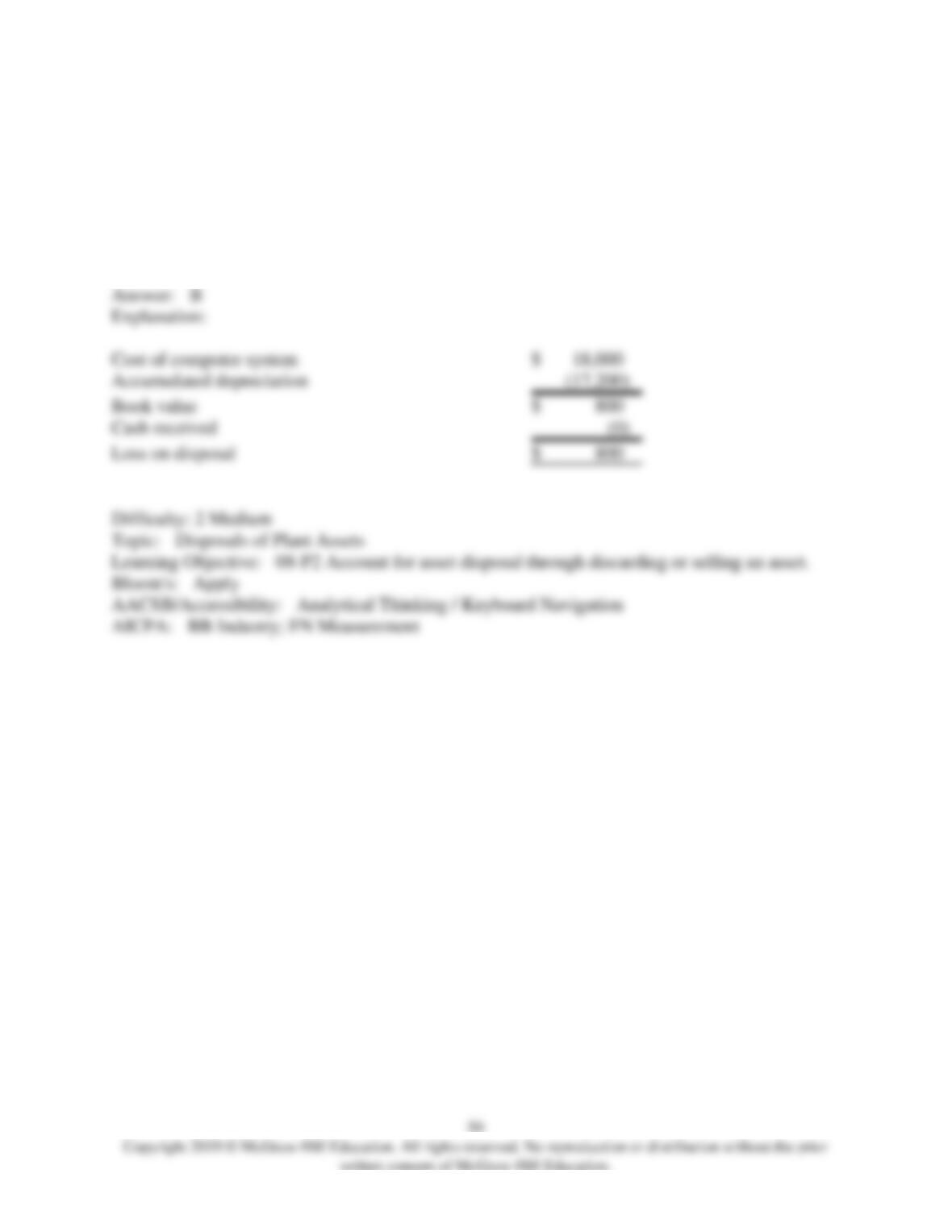
125) A company discarded a computer system originally purchased for $18,000. The
accumulated depreciation was $17,200. The company should recognize a(an):
A) $0 gain or loss.
B) $800 loss.
C) $800 gain.
D) $8,000 loss.
E) $7,200 loss.
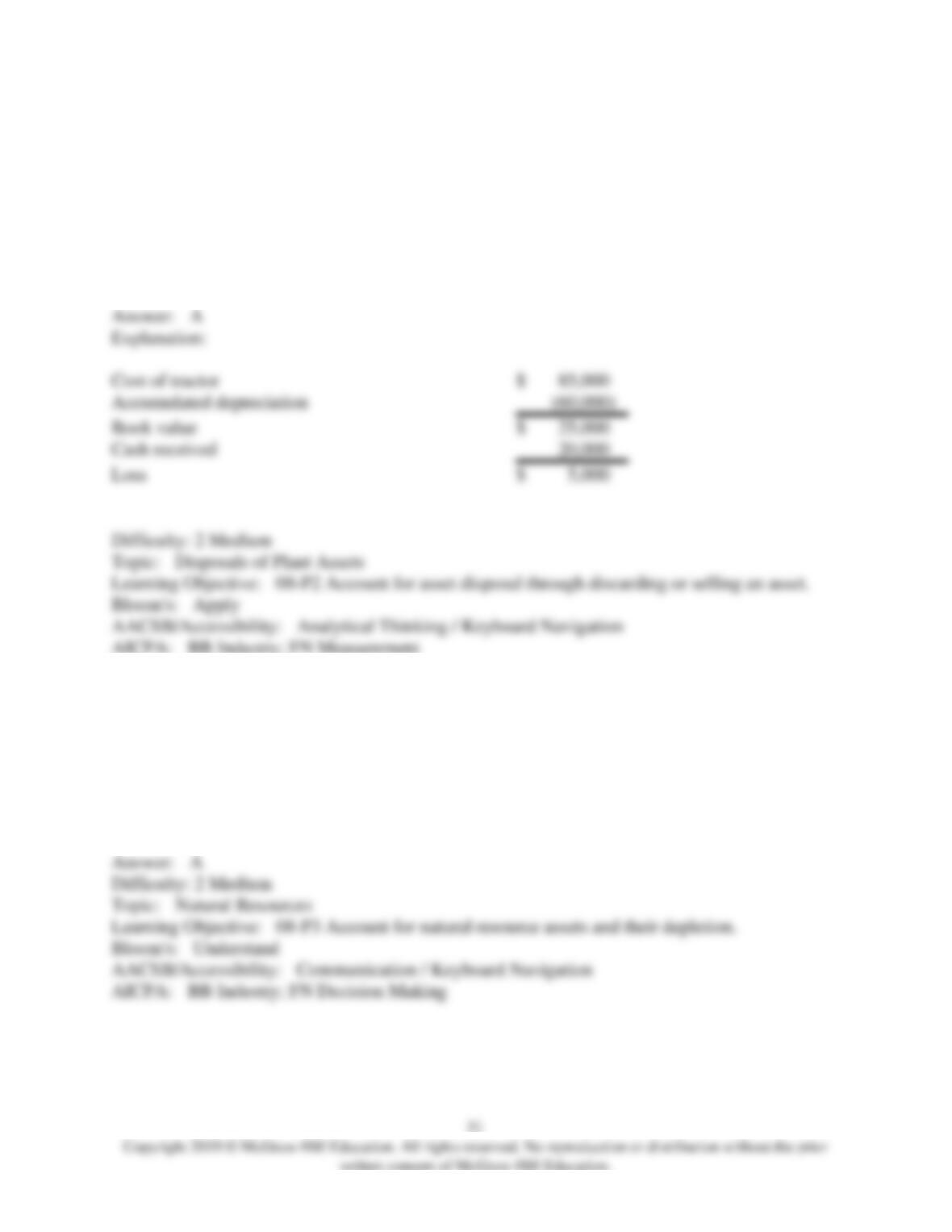
126) A company had a tractor destroyed by fire. The tractor originally cost $85,000 with
accumulated depreciation of $60,000. The proceeds from the insurance company were $20,000.
The company should recognize:
A) A loss of $5,000.
B) A gain of $5,000.
C) A loss of $20,000.
D) A gain of $65,000.
E) A gain of $20,000.
127) Natural resources are:
A) Assets that are physically consumed when used such as standing timber, mineral deposits, and
oil and gas fields.
B) Tangible assets used in the operations of the business.
C) Current liabilities because they are depleted.
D) Not subject to allocation to expense over their useful lives.
E) Depleted using a straight-line method.
128) Which of the following would be classified as a natural resource?
A) Patent on an oil extraction process.
B) Land held as an investment.
C) Land improvements.
D) Diamond mine.
E) Goodwill.
129) Depletion is:
A) The process of allocating the cost of natural resources to the period when it is consumed.
B) Calculated using the double-declining balance method.
C) Also called amortization.
D) An increase in the value of a natural resource when incurred.
E) The process of allocating the cost of intangibles to periods when they are used.
130) A company purchased a tract of land for its natural resources at a cost of $1,500,000. It
expects to mine 2,000,000 tons of ore from this land. The salvage value of the land is expected to
be $250,000. The depletion expense per ton of ore is:
A) $0.75.
B) $0.625.
C) $0.875.
D) $6.00.
E) $8.00.
131) A company purchased a tract of land for its natural resources at a cost of $1,500,000. It
expects to mine 2,000,000 tons of ore from this land. The salvage value of the land is expected to
be $250,000. If 150,000 tons of ore are mined during the first year, the journal entry to record the
depletion is:
A) Debit Depletion Expense $93,750; credit Natural Resources $93,750.
B) Debit Cash $112,500; credit Natural Resources $112,500.
C) Debit Depletion Expense $93,750; credit Accumulated Depletion $93,750.
D) Debit Cash $93,750; credit Accumulated Depletion $93,750.
E) Debit Depletion Expense $112,500; credit Accumulated Depletion $112,500.
132) A company purchased a tract of land for its natural resources at a cost of $1,000,000. It
expects to harvest 5,000,000 board feet of timber from this land. The salvage value of the land is
expected to be $200,000. The depletion expense per board foot of timber is:
A) $0.75.
B) $0.24.
C) $0.20.
D) $0.16.
E) $0.04.
133) A company purchased a mineral deposit for $800,000. It expects this property to produce
120,000 tons of minerals and to have a salvage value of $50,000. In the current year, the
company mined and sold 9,000 tons of minerals. Its depletion expense for the current period
equals:
A) $15,000.
B) $60,000.
C) $150,000.
D) $56,250.
E) $139,500.
134) Intangible assets do not include:
A) Patents.
B) Copyrights.
C) Trademarks.
D) Goodwill.
E) Land held as an investment.
135) Amortization is:
A) The systematic allocation of the cost of an intangible asset to expense over its estimated
useful life.
B) The process of allocating to expense the cost of a plant asset to the accounting periods
benefiting from its use.
C) The process of allocating the cost of natural resources to periods when they are consumed.
D) An accelerated form of expensing an asset’s cost.
E) Also called depletion.
136) Owning a patent:
A) Gives the owner the exclusive right to publish and sell a musical or literary work during the
life of the creator plus 70 years.
B) Gives the owner exclusive rights to manufacture and sell a patented item or to use a process
for 20 years.
C) Gives its owner an exclusive right to manufacture and sell a device or to use a process for 50
years.
D) Indicates that the value of a company exceeds the fair market value of a company’s net assets
if purchased separately.
E) Gives its owner the exclusive right to publish and sell a musical or literary work during the
life of the creator plus 17 years.
137) Holding a copyright:
A) Gives its owner the exclusive right to publish and sell a musical or literary work during the
life of the creator plus 70 years.
B) Gives its owner an exclusive right to manufacture and sell a patented item or to use a process
for 20 years.
C) Gives its owner an exclusive right to manufacture and sell a device or to use a process for 50
years.
D) Indicates that the value of a company exceeds the fair market value of a company’s net assets
if purchased separately.
E) Gives its owner the exclusive right to publish and sell a musical or literary work during the
life of the creator plus 20 years.
138) A leasehold is:
A) A short-term rental agreement.
B) The same as a patent.
C) The rights granted to the lessee by the lessor of a lease.
D) Recorded as revenue expenditure when paid.
E) An asset held as an investment.
139) The specific meaning of goodwill in accounting is:
A) The amount by which a company’s value exceeds the value of its individual assets and
liabilities.
B) Long term assets held as investment.
C) The support of the board of directors for the operating decisions of management.
D) The cost of developing, maintaining, or enhancing the value of a trademark.
E) Rights granted an entity to deliver a product or service under specified conditions.
140) A company’s old machine that cost $40,000 and had accumulated depreciation of $22,000
was traded in on a new machine having an estimated 20-year life with an invoice price of
$45,000. The company also paid $33,000 cash, along with its old machine to acquire the new
machine. If this transaction has commercial substance, the new machine should be recorded at:
A) $40,000.
B) $33,000.
C) $45,000.
D) $18,000.
E) $51,000.
141) Hunter Sailing Company exchanged an old sailboat for a new one. The old sailboat had a
cost of $160,000 and accumulated depreciation of $100,000. The new sailboat had an invoice
price of $270,000. Hunter received a trade in allowance of $70,000 on the old sailboat, which
meant the company paid $200,000 in addition to the old sailboat to acquire the new sailboat. If
this transaction has commercial substance, what amount of gain or loss should be recorded on
this exchange?
A) $0 gain or loss.
B) $10,000 gain.
C) $10,000 loss.
D) $60,000 loss.
E) $70,000 loss.
142) Cliff Company traded in an old truck for a new one. The old truck had a cost of $75,000
and accumulated depreciation of $60,000. The new truck had an invoice price of $125,000.
Huffington was given a $12,000 trade-in allowance on the old truck, which meant they paid
$113,000 in addition to the old truck to acquire the new truck. If this transaction has commercial
substance, what is the recorded value of the new truck?
A) $15,000
B) $75,000
C) $113,000
D) $125,000
E) $128,000