130) Malcom Industries manufactures a silicone paste wax that goes through three processing
departments: cracking, blending, and packing. All raw materials are introduced at the start of
work in the cracking department, with conversion costs being incurred uniformly in each
department. The Work-in-Process inventory account for the cracking department for July
contains the following information:
Work-in-Process Inventory (Cracking Department)
Work-in-Process Inventory (Cracking Department)
Balance, July 1 (35,000 lbs, 4/5 done) $ 63,700
Direct materials (280,000 lbs) 397,600
Conversion costs 189,700
Balance, July 31 (45,000 lbs, 2/3 done) ??
Costs transferred to Blending Dept ??
The beginning balance inventory consists of $43,400 in materials cost. Malcom uses the first-in,
first-out (FIFO) method to account for its operations.
Required: (use 4 decimal places for computations)
(a) What would be the Cracking Department’s inventory balance on July 31?
(b) What would be the cost transferred to the Blending Dept. in July?
102
131) Everglades Furniture uses a process cost system to account for its chair factory. Beginning
inventory consisted of 5,000 units (100% complete as to material, 55% complete as to labor)
with a cost of $124,800 materials and $104,500 conversion. 58,000 units were started into
production during the month with material costs of $1,537,000 and $2,124,375 of conversion
costs. The ending inventory of 6,000 chairs was 100% complete as to materials and 40%
complete as to labor. Everglades uses first-in, first-out (FIFO) costing.
Required: (use 4 decimal places in your calculations)
a. Compute the equivalent units of production for each input.
b. Compute the cost per equivalent unit.
c. Compute the cost transferred out to finished goods.
d. Compute the ending work-in-process inventory balance.
132) Toxo Chemicals produces a solvent in its Glendale plant. Three chemicals are combined at
the start of the process and blended under pressure for a period of time. At the 75% point of
completion, an additional chemical is added. The following information has been gathered:
Chemical Mix Additional Chemical
Conversion Cost Gallons
BWIP $ 5,000 -0- $ 3,000 10,000
Added 65,000 15,000 35,000 100,000
Toxo completed 98,000 gallons during the month. The process engineer informs you that the
beginning WIP was at the 40% completion point, the ending WIP is at 70%. Toxo uses first-in,
first out (FIFO) costing.
Required: (use 4 decimal places in your calculations)
a. Compute the equivalent units of production for each input.
b. Compute the cost per equivalent unit.
c. Compute the cost transferred out to finished goods.
d. Compute the ending work-in-process inventory balance.
133) Racquet Master (RM) Sports manufactures and distributes two types of tennis rackets:
Dominant Drive (DD) and Major Smash (MS). Both types of rackets go through Operations 1
and 3. MS also goes through Operation 2, which adds a layer of graphite for additional strength.
All material is added at the beginning of their respective operations.
The following information relates to a work order from Discount Warehouse, Inc. for 30,000
units of DD (Work order #286) and 8,000 units of MS (Work order #354).
Work order #286 Work order #354
Direct materials:
Operation 1 $ 120,000 $ 80,000
Operation 2 — 20,000
Operation 3 45,000 30,000
Conversion costs:
Operation 1 30,000 15,000
Operation 2 — 25,000
Operation 3 14,793 14,896
Required:
Assume that there are 3,000 units of DD and 2,000 units of MS in Operation 3 at the end of the
reporting period that are 45% and 65% complete, respectively. Compute the ending inventory for
Operation 3.
134) Martin Enterprises uses three operations in sequence to manufacture an assortment of
flower pots. In each operation, the same procedures, time, and costs are used to perform that
operation, regardless of the type of pot being produced. During March, a batch of 500 Clay Pots
and a batch of 800 Porcelain Pots were put through the first operation. All materials for a batch
are introduced at the beginning of the operation for that batch. The costs shown below were
incurred in March for the first operation:
Direct Labor $ 4,450
Manufacturing Overhead 3,600
Direct Materials:
Clay Pots $ 1,200
Porcelain Pots $ 2,400
There were no inventories at the beginning of the month; 400 units of Clay Pots and 600 units of
Porcelain Pots were transferred to the next operation. The ending inventories were 30% and 60%
complete for Clay and Porcelain, respectively.
Required:
What is the total cost of the ending inventory in process for operation #1?
135) Carmen Products makes four models of guitars. All of the models go through the same
assembly line but they differ as to the materials used and the degree of finishing. The Basic
model has a low gloss finish and goes immediately to Packaging upon completion in Assembly.
The Super model and the Premium model go through a Buffing process upon completion in
Assembly. They then go on to Packaging. The Deluxe model is the top of the line and goes first
to Buffing from the Assembly, then to Special Polishing, then to Packaging.
Carmen uses operations costing and allocates conversion costs based on the number of units
processed in each department.
Total Basic Super Premium Deluxe
Units 1,000 500 250 50
Materials $ 97,500 $ 40,000 $ 30,000 $ 20,000 $ 7,500
Conversion costs:
Assembly $ 54,000
Buffing 32,000
Special Polish 3,000
Packaging 9,000
Total $ 98,000
Required:
What is the cost per unit of each of the completed guitars?
136) Sparkle Inc. is a company that produces liquid cleaning products. Sparkle’s management is
trying to decide whether to install a job or process costing system. The manufacturing vice
president has stated that job costing gives the best control because it is possible to assign costs to
specific lots of goods. The controller, however, has stated that job costing requires too much
record keeping. Would a process costing system meet the manufacturing vice president’s control
objectives? Explain.
137) What would happen to the equivalent units, production cost per unit and costs transferred
out for a company using weighted-average if the degree of completion of the ending inventory
were underestimated?
138) Describe the five steps in preparing a production cost report.
139) Explain the major differences between weighted-average costing and FIFO costing.
140) Is cost accumulation easier under a process costing system or a job costing system?
141) What characteristics of the production process would lead a company to use process costing
rather than job costing?
142) The more important individual unit costs are for making decisions, the more likely it is that
process costing will be preferred to job costing. Do you agree?
143) Carlton Electronics manufactures three cell phone models, General, Premium, and Deluxe,
which differ in the components included. Production takes place in two departments, Assembly
and Special Packaging. Batches of General phones are made to service government military
contracts. Premium model phones are specific to corporate contracts. Deluxe model phones are
sold commercially through big-box stores. Explain why operation costing might be a
consideration for Carlton.
111
144) Production and cost data for the month of February for Process A of the Packer
Manufacturing Company follow:
Units in process, February 1 (100% complete with respect to materials;
25% complete with respect to conversion cost) 2,000
New units started in process 8,000
Units completed 7,000
Units in process, February 28 (100% complete with respect to materials;
1/3 complete with respect to conversion cost) 3,000
Work-in-process inventory, February 1:
Materials $ 600
Conversion $ 100
Costs incurred in February:
Materials issued $ 2,560
Conversion $ 1,500
The company uses the weighted-average cost method in its process costing system.
Required:
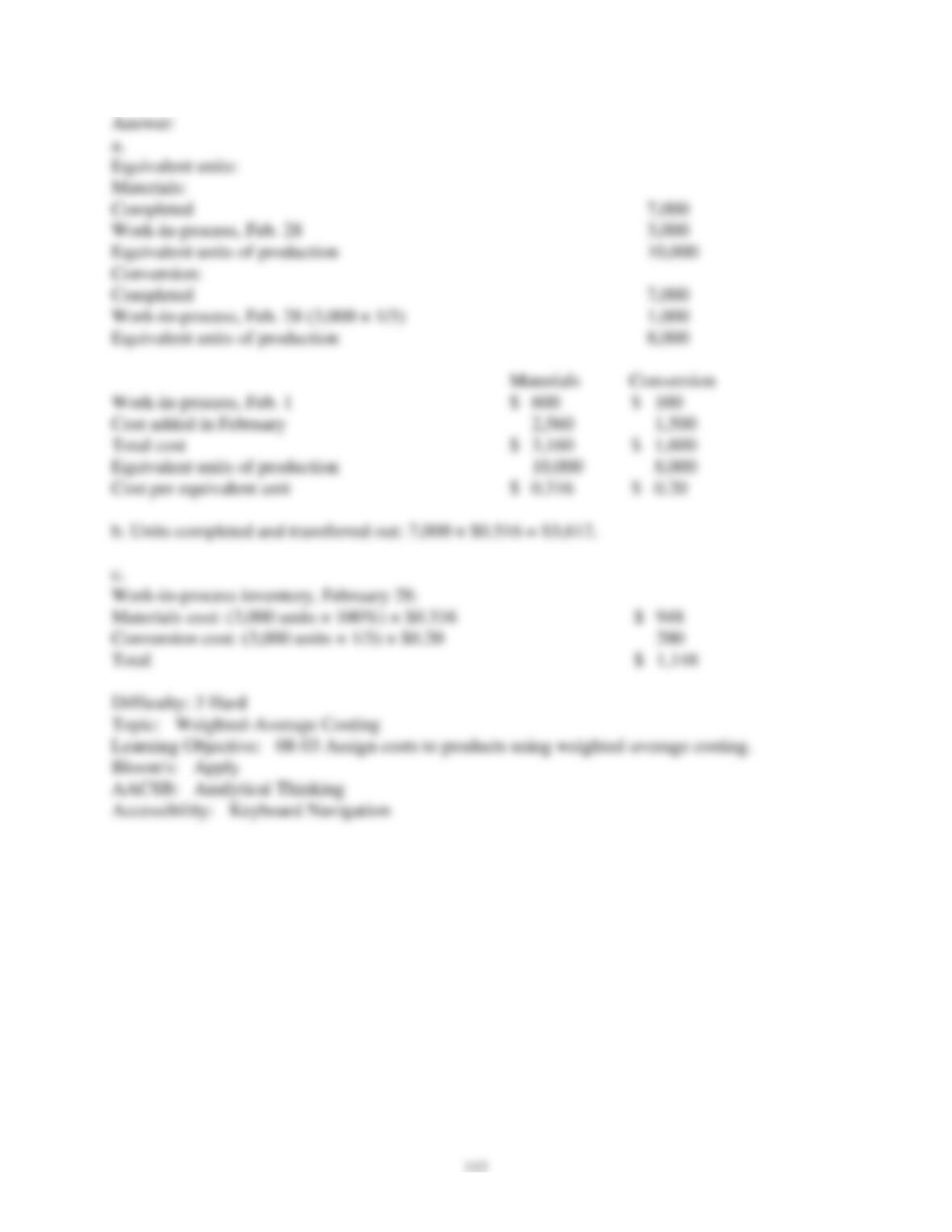
a. Calculate the equivalent units and cost per equivalent unit for February for materials and for
conversion costs (use three decimal places in your calculations).
b. Determine the cost transferred to finished goods.
c. Determine the amount of cost that should be assigned to the ending work-in-process.
113
145) Tiny Villages Inc. uses the weighted-average method in its process costing system. The
following data concern the operations of the company’s first processing department, Extruding,
for a recent month.
Work-in-process, beginning:
Units in process 300
Percent complete with respect to materials 80 %
Percent complete with respect to conversion 70 %
Costs in the beginning inventory:
Materials cost $ 1,368
Conversion cost $ 8,064
Units started into production during the month 11,000
Units completed and transferred out 11,000
Costs added to production during the month:
Materials cost $ 64,948
Conversion cost $ 412,179
Work-in-process, ending:
Units in process 300
Percent complete with respect to materials 80 %
Percent complete with respect to conversion 10 %
Required:
a. Determine the equivalent units of production.
b. Determine the costs per equivalent unit.
c. Determine the cost of ending work-in-process inventory.
d. Determine the cost of the units transferred to the next department.