116) Malcom Industries manufactures a silicone paste wax that goes through three processing
departments: cracking, blending, and packing. All raw materials are introduced at the start of
work in the cracking department, with conversion costs being incurred uniformly in each
department. The Work-in-Process inventory account for the cracking department for July
contains the following information:
Work-in-Process Inventory (Cracking Department)
Balance, July 1 (35,000 lbs, 4/5 done) $ 63,700
Direct materials (280,000 lbs) 397,600
Conversion costs 189,700
Balance, July 31 (45,000 lbs, 2/3 done) ??
Costs transferred to Blending Dept ??
The beginning balance inventory consists of $43,400 in materials cost. Malcom uses the
weighted-average method to account for its operations.
Required:
(Use 4 decimal places for computations.)
(a) What would be the Cracking Department’s inventory balance on July 31?
(b) What would be the cost transferred to the Blending Dept. in July?
82
117) The Safety Chemical Company produces a special kind of body oil that is widely used by
professional sports trainers. The oil is produced in three processes: Refining, Blending, and
Mixing. Raw oil materials are introduced at the beginning of the refining process. A “mountain-
air scent” material is added in the blending process when processing is 50% completed.
The following Work-in-Process account for the Blending Department is available for the month
of July. The July 1 Work-in-Process balance contains $5,920 in material costs and $1.56/unit in
costs transferred in from the Refining Department.
Work-in-Process: Blending
Beginning balance (8,000 gal, 30% complete) $ 22,850
Costs transferred in from Refining (29,000 gal.) 48,200
Materials 20,810
Direct labor 5,748
Overhead 11,600
Ending balance (4,000 gal, 40% complete) ??
The Safety Chemical Company uses weighted-average costing.
Required:
(Use 4 decimal places for computations.)
(a) Compute the equivalent units of production for Blending.
(b) Compute the unit costs in the Blending Department for the month of July.
(c) Compute the costs transferred out to the Mixing Department for July.
(d) Compute the July 31 Work-in-Process Inventory balance.
84
118) The Safety Chemical Company produces a special kind of body oil that is widely used by
professional sports trainers. The oil is produced in three processes: Refining, Blending, and
Mixing. Raw oil materials are introduced at the beginning of the refining process. A “mountain-
air scent” material is added in the blending process when processing is 50% completed.
The following Work-in-Process account for the Refining Department is available for the month
of July. The July 1 Work-in-Process balance contains $1,500 in material costs.
Work-in-Process: Refining
Beginning balance (5,000 gal, 80% complete) $ 6,500
Materials (30,000 gal.) 12,300
Direct labor 14,500
Overhead 21,750
Ending balance (6,000 gal., 2/3 complete) ??
The Safety Chemical Company uses weighted-average costing.
Required:
(Use 4 decimal places for computations.)
(a) Compute the equivalent units of production for Refining for July.
(b) Compute the material cost per unit and the conversion cost per unit for July.
(c) Compute the costs transferred to the Blending Department for July.
(d) Compute the July 31 Work-in-Process Inventory balance.
119) The Rosa Lee Manufacturing Company produces a single product in a single processing
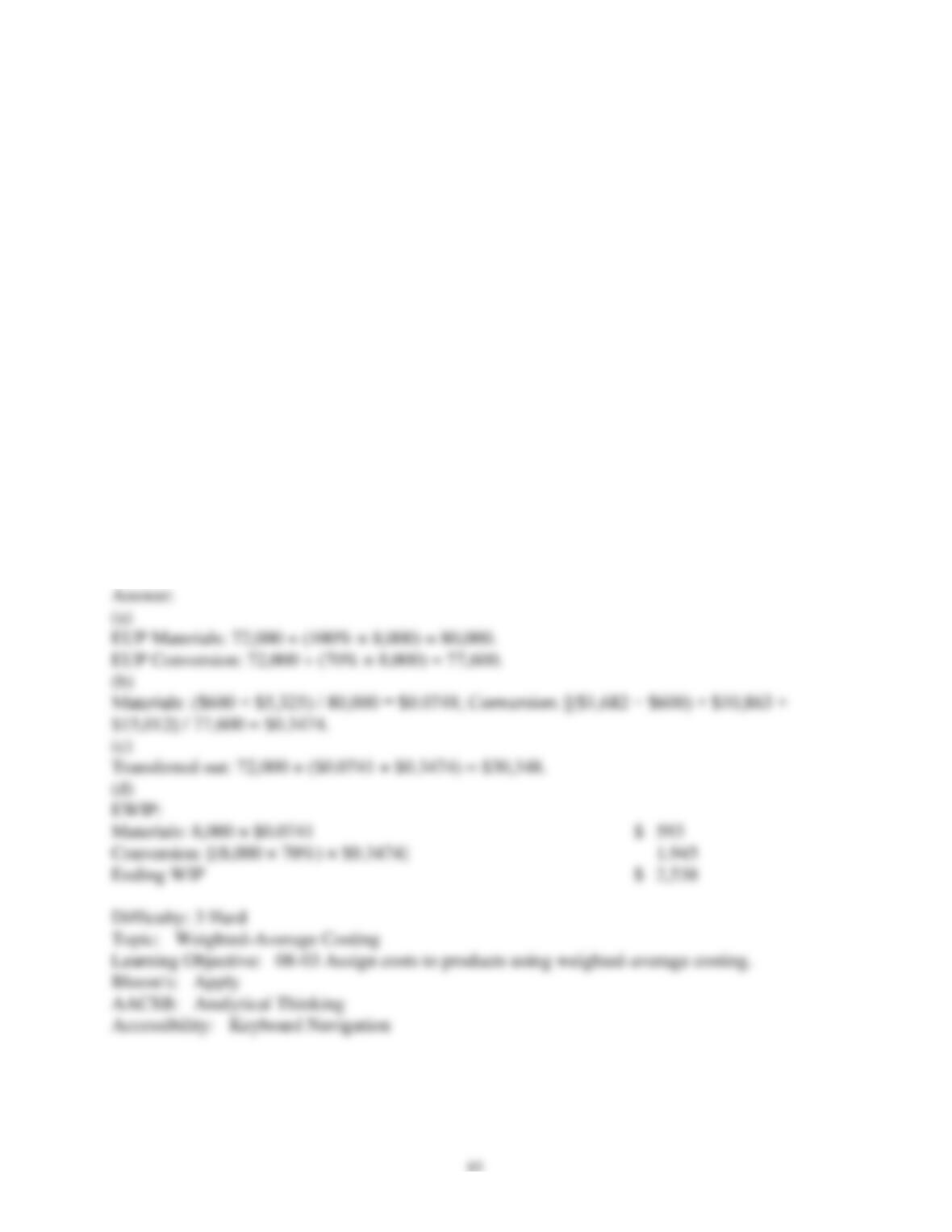
department. The material is added when 25% of the conversion costs have been added.
The Work-in-Process Inventory account on April 30 includes the following information:
Beginning balance $ 1,682 ($600 is materials)
Materials 5,325
Labor 10,863
Overhead 15,012
During the month, the company finished and transferred 72,000 units out of the Work-in-Process
Inventory. 9,000 units were in process at the beginning of the month and were 40% complete.
8,000 units were in process at the end of the month and were 70% complete. The company uses
weighted-average process costing.
Required:
(Use 4 decimal places for computations.)
(a) Compute the equivalent units of production (EUP) for materials and conversion costs in
April.
(b) Compute the unit material costs and unit conversion costs for April.
(c) Compute the total cost transferred out of the Work-in-Process inventory during the month of
April.
(d) Compute the cost of the ending Work-in-Process inventory for April.
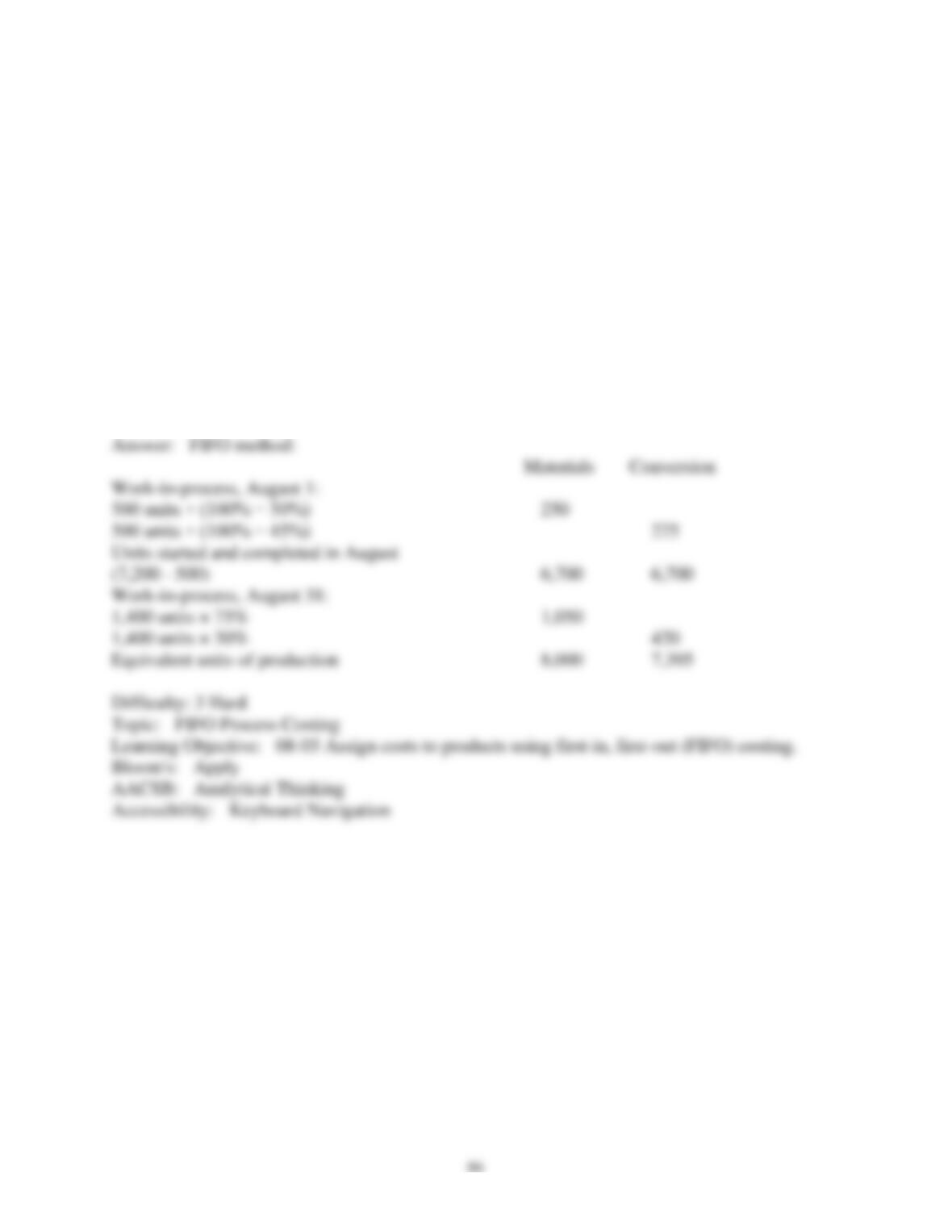
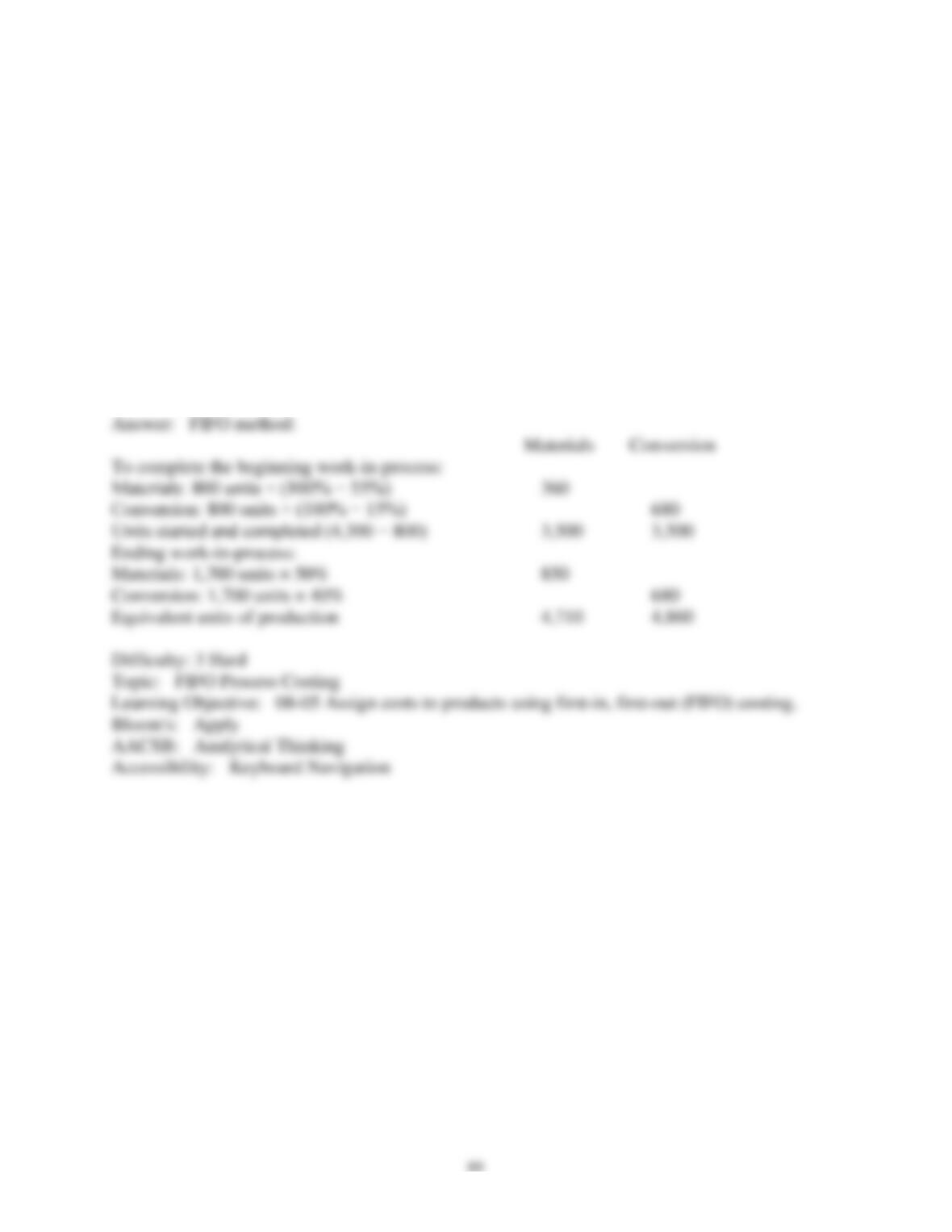
120) Pattern Corporation uses the FIFO method in its process costing. The following data pertain
to its Cutting Department for August.
Percent Complete
Units Materials Conversion
Work-in-process, August 1 500 50 % 45 %
Units started into production during August 8,100
Units completed during August and transferred to the next department 7,200
Work-in-process, August 31 1,400 75 % 30 %
Required:
Compute the equivalent units of production for both materials and conversion costs for the
Cutting Department for August using the FIFO method.
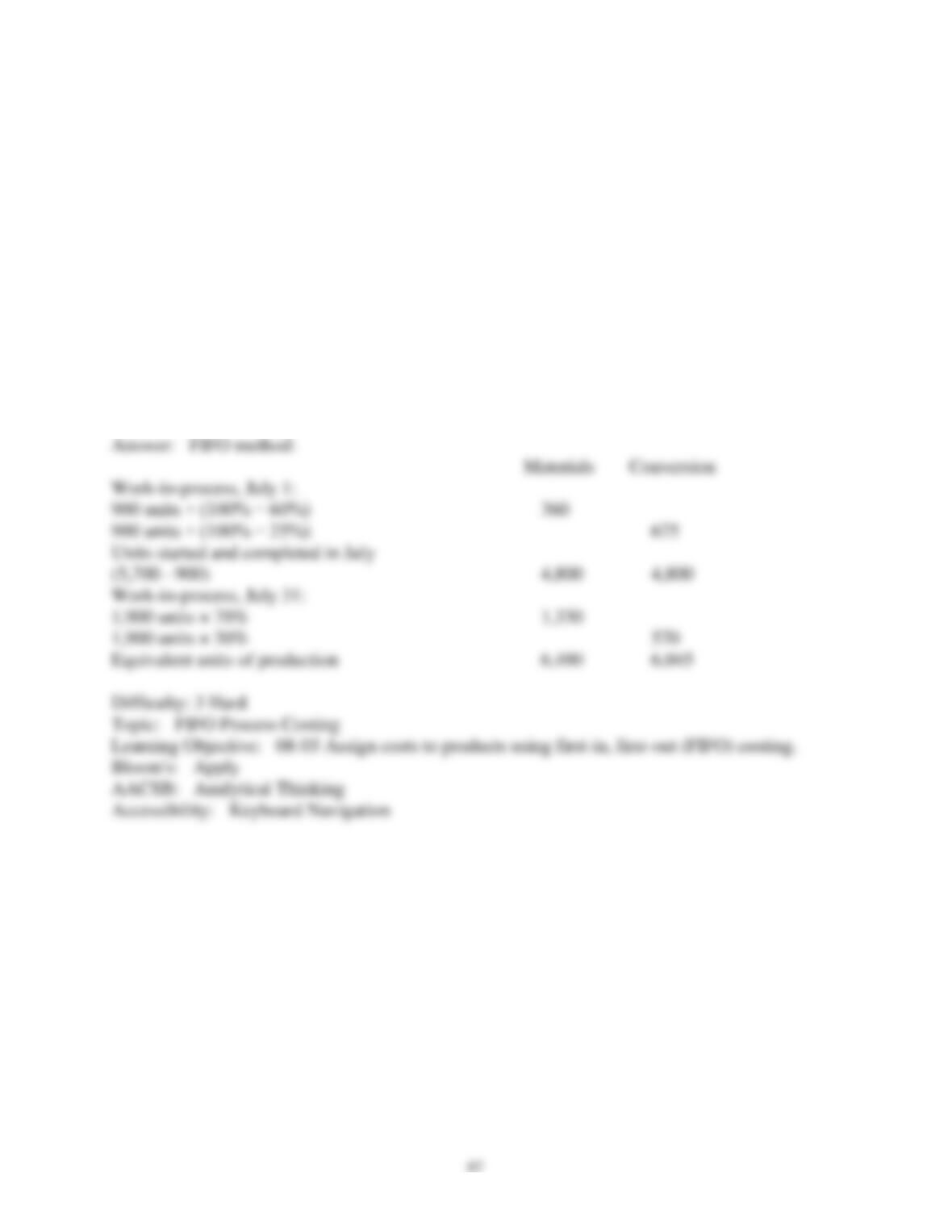
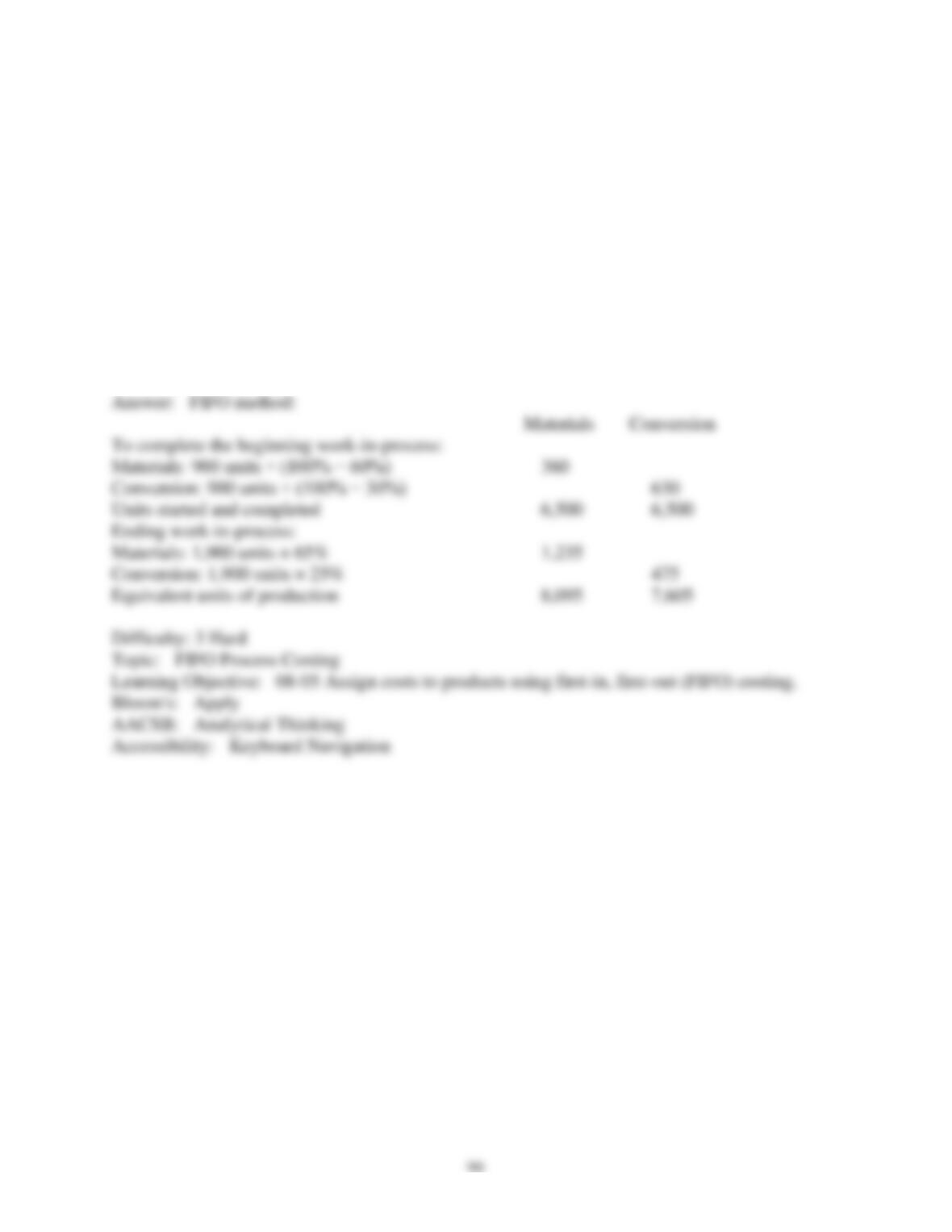
121) The following data pertain to the Grinding Department of Dancer Corporation for July. The
company uses the FIFO method in its process costing.
Percent Complete
Units Materials Conversion
Work-in-process, July 1 900 60 % 25 %
Units started into production during July 6,700
Units completed during July and transferred to the next department 5,700
Work-in-process, July 31 1,900 70 % 30 %
Required:
Compute the equivalent units of production for both materials and conversion costs for the
Grinding Department for July using the FIFO method.
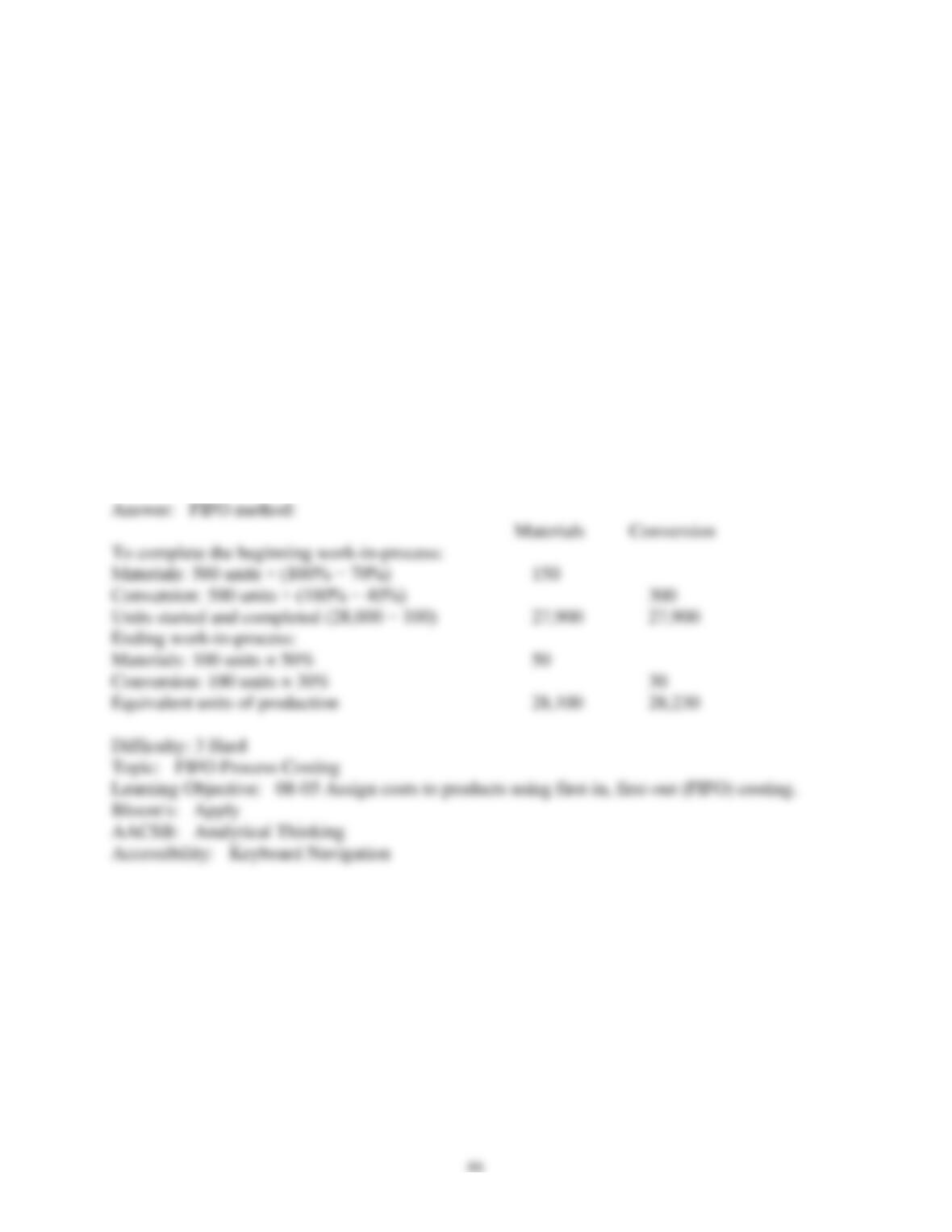
122) Mobility, Inc. uses the FIFO method in its process costing system. The following data
concern the operations of the company’s first processing department, Shaping, for a recent
month.
Work-in-process, beginning:
Units in process 500
Percent complete with respect to materials 70 %
Percent complete with respect to conversion 40 %
Units started into production during the month 28,000
Work-in-process, ending:
Units in process 100
Percent complete with respect to materials 50 %
Percent complete with respect to conversion 30 %
Required:
Using the FIFO method, determine the equivalent units of production for materials and
conversion costs.
123) Galaxy Corporation uses the FIFO method in its process costing. The following data pertain
to its Assembly Department for June.
Units in process, June 1: materials 55% complete,
conversion 15% complete 800
Units started into production during June 5,200
Units completed and transferred to the next department 4,300
Units in process, June 30: materials 50% complete,
conversion 40% complete 1,700
Required:
Determine the equivalent units of production for the Assembly Department for June using the
FIFO method.
124) The following data have been provided by Brice Corporation for the 3-D Printing
Department. The company uses the FIFO method in its process costing.
Units in process, August 1: materials 60% complete, conversion 30% complete 900
Units started into production during August 8,400
Units started and completed during August 6,500
Units completed and transferred to the next department during August 7,400
Units in process, August 31: materials 65% complete, conversion 25% complete 1,900
Required:
Determine the equivalent units of production for the 3-D Printing Department for August using
the FIFO method.
91
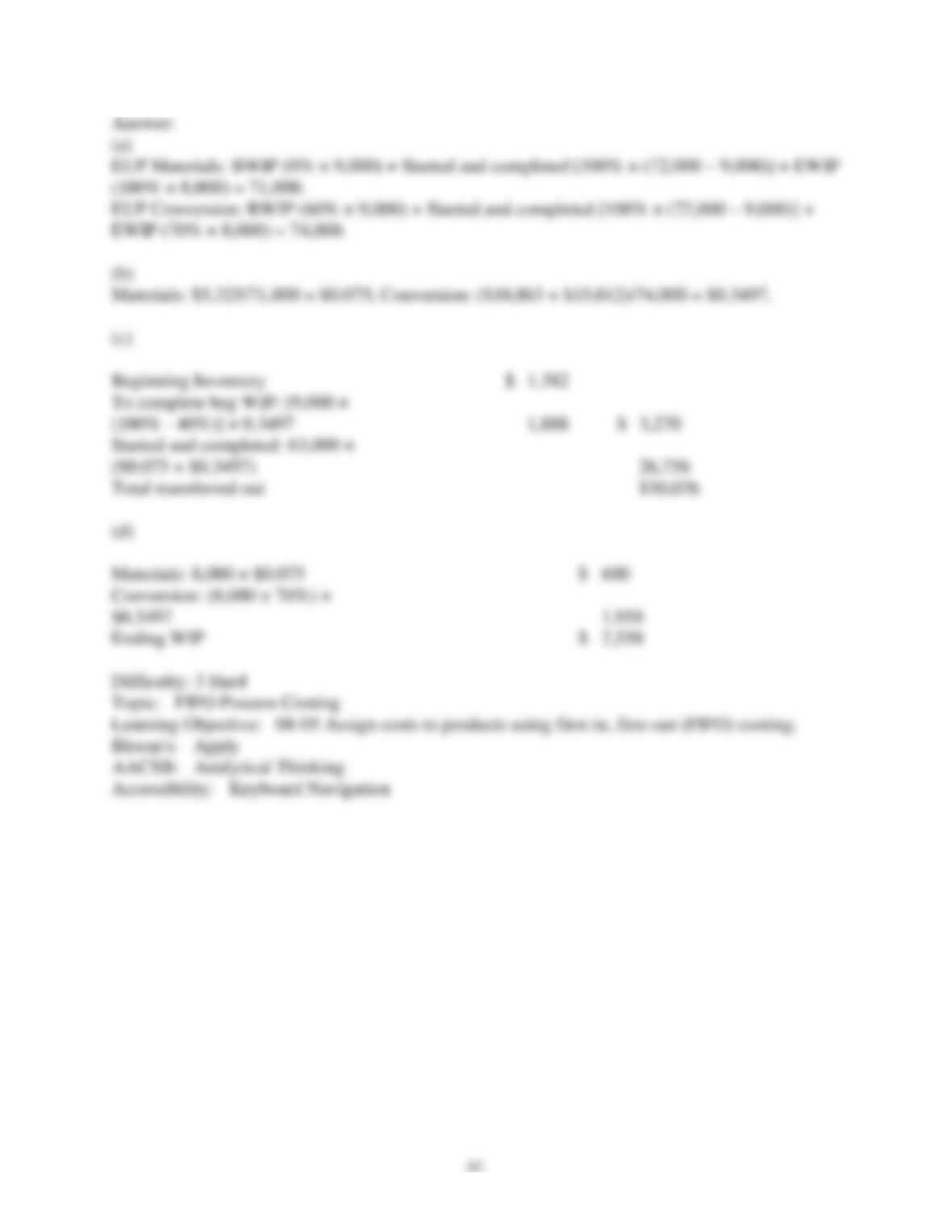
125) The Microprocessor Manufacturing Company produces a single product in a single
processing department. The material is added when 25% of the conversion costs have been
added.
The Work-in-Process Inventory account on April 30 includes the following information:
Beginning balance $ 1,382
Material 5,325
Labor 10,863
Overhead 15,012
During the month, the company finished and transferred 72,000 units out of the Work-in-Process
Inventory. 9,000 units were in process at the beginning of the month, which were 40% complete.
8,000 units were in process at the end of the month, which were 70% complete. The company
uses first-in, first-out (FIFO) process costing.
Required (use 4 decimal places for computations):
(a) Compute the equivalent units of production (EUP) for materials and conversion costs in
April.
(b) Compute the unit material costs and unit conversion costs for April.
(c) Compute the total cost transferred out of the Work-in-Process Inventory during the month of
April.
(d) Compute the cost of the ending inventory for April.
93
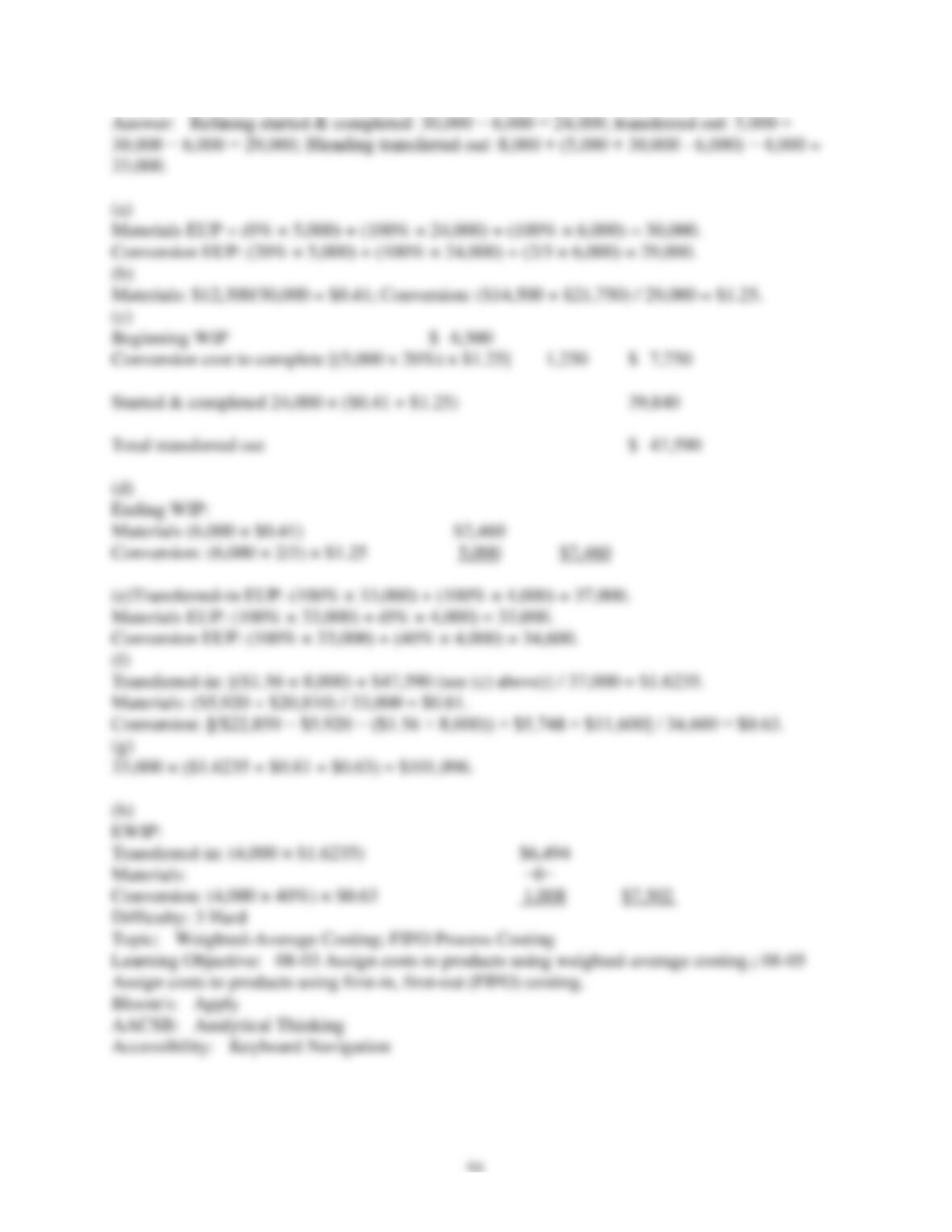
126) The Safety Chemical Company produces a special kind of body oil that is widely used by
professional sports trainers. The oil is produced in three processes: Refining, Blending, and
Mixing. Raw oil materials are introduced at the beginning of the refining process. A “mountain-
air scent” material is added in the blending process when processing is 50% completed.
The following Work-in-Process account for the Refining Department is available for the month
of July. The July 1 Work-in-Process balance contains $1,500 in material costs.
Work-in-Process: Refining
Beginning balance (5,000 gal, 80% complete) $ 6,500
Materials (30,000 gal.) 12,300
Direct labor 14,500
Overhead 21,750
Ending balance (6,000 gal., 2/3 complete) ??
The following Work-in-Process account for the Blending Department is available for the month
of July. The July 1 Work-in-Process balance contains $5,920 in material costs and $1.56/unit in
costs transferred in from the Refining Department.
Work-in-Process: Blending
Beginning balance (8,000 gal, 30% complete) $ 22,850
Costs transferred in from Refining ???
Materials 20,810
Direct labor (725 hours) 5,748
Overhead 11,600
Ending balance (4,000 gal., 40% complete)
The Safety Chemical Company uses first-in, first-out (FIFO) costing for the Refining
Department and weighted-average costing for the Blending Department.
Required (use 4 decimal places for computations):
Part 1: Refining Department
(a) Compute the equivalent units of production for July.
(b) Compute the material cost per unit and the conversion cost per unit for July.
(c) Compute the costs transferred to the Blending Department for July.
(d) Compute the July 31 Work-in-Process Inventory balance.
Part 2: Blending Department
(e) Compute the equivalent units of production.
(f) Compute the unit costs in the Blending Department for the month of July.
(g) Compute the costs transferred out for July.
(h) Compute the July 31 Work-in-Process Inventory balance.
95
127) The Safety Chemical Company produces a special kind of body oil that is widely used by
professional sports trainers. The oil is produced in three processes: Refining, Blending, and
Mixing. Raw oil materials are introduced at the beginning of the refining process. A “mountain-
air scent” material is added in the blending process when processing is 50% completed.
The following Work-in-Process account for the Refining Department is available for the month
of July. The July 1 Work-in-Process balance contains $1,500 in material costs.
Work-in-Process: Refining
Beginning balance (5,000 gallons, 80% complete) $ 7,500
Materials (30,000 gallons) 12,300
Direct labor 14,500
Overhead 21,750
Ending balance (6,000 gallons, 2/3 complete)
The Safety Chemical Company uses first-in, first-out (FIFO) costing.
Required (use 4 decimal places for computations):
(a) Compute the equivalent units of production for Refining for July.
(b) Compute the material cost per unit and the conversion cost per unit for July.
(c) Compute the costs transferred to the Blending Department for July.
(d) Compute the July 31 Work-in-Process Inventory balance.
97
128) The Safety Chemical Company produces a special kind of body oil that is widely used by
professional sports trainers. The oil is produced in three processes: Refining, Blending, and
Mixing. Raw oil materials are introduced at the beginning of the refining process. A “mountain-
air scent” material is added in the blending process when processing is 50% completed.
The following Work-in-Process account for the Blending Department is available for the month
of July. The July 1 Work-in-Process balance contains $10,370 in conversion costs, and
$1.56/unit in costs transferred in from the Refining Department.
Work-in-Process: Blending
Beginning balance (8,000 gal, 30% complete) $ 22,850
Costs transferred in from Refining (29,000 gal.) 48,200
Materials 20,810
Direct labor 5,748
Overhead 11,600
Ending balance (4,000 gal., 40% complete) ??
The Safety Chemical Company uses first-in, first-out (FIFO) costing.
Required (use 4 decimal places for computations):
(a) Compute the equivalent units of production for Blending.
(b) Compute the unit costs in the Blending Department for the month of July.
(c) Compute the costs transferred out to the Mixing Department for July.
(d) Compute the July 31 Work-in-Process Inventory balance.
99
129) Tracker Sports is a manufacturer of sportswear. Tracker produces its products in two
departments.
The information for the current month for Department #2 is as follows:
Beginning work-in-process 20,000 units
Units transferred in from Department #1 40,000 units
Units completed 50,000 units
Ending work-in-process 10,000 units
Beginning WIP transferred in costs $ 50,000
Beginning WIP direct materials $ 12,000
Beginning WIP direct labor $ 3,200
Beginning WIP overhead $ 1,600
Costs transferred in from Department #1 $ 100,000
Direct material added during month $ 60,000
Direct labor during month $ 20,000
Manufacturing overhead applied ???
Beginning WIP was half complete as to conversion costs. Direct materials for Department #2 are
added when the process is 25% complete. Manufacturing overhead is applied at a rate equal to
50 percent of direct labor. Ending WIP was 60 percent complete. Tracker Sports uses first-in,
first-out (FIFO) costing.
Required:
(HINT: use 4 decimal places in your calculations)
a. Compute the equivalent units of production for each input.
b. Compute the cost per equivalent unit.
c. Compute the cost transferred out to finished goods.
d. Compute the ending work-in-process inventory balance.