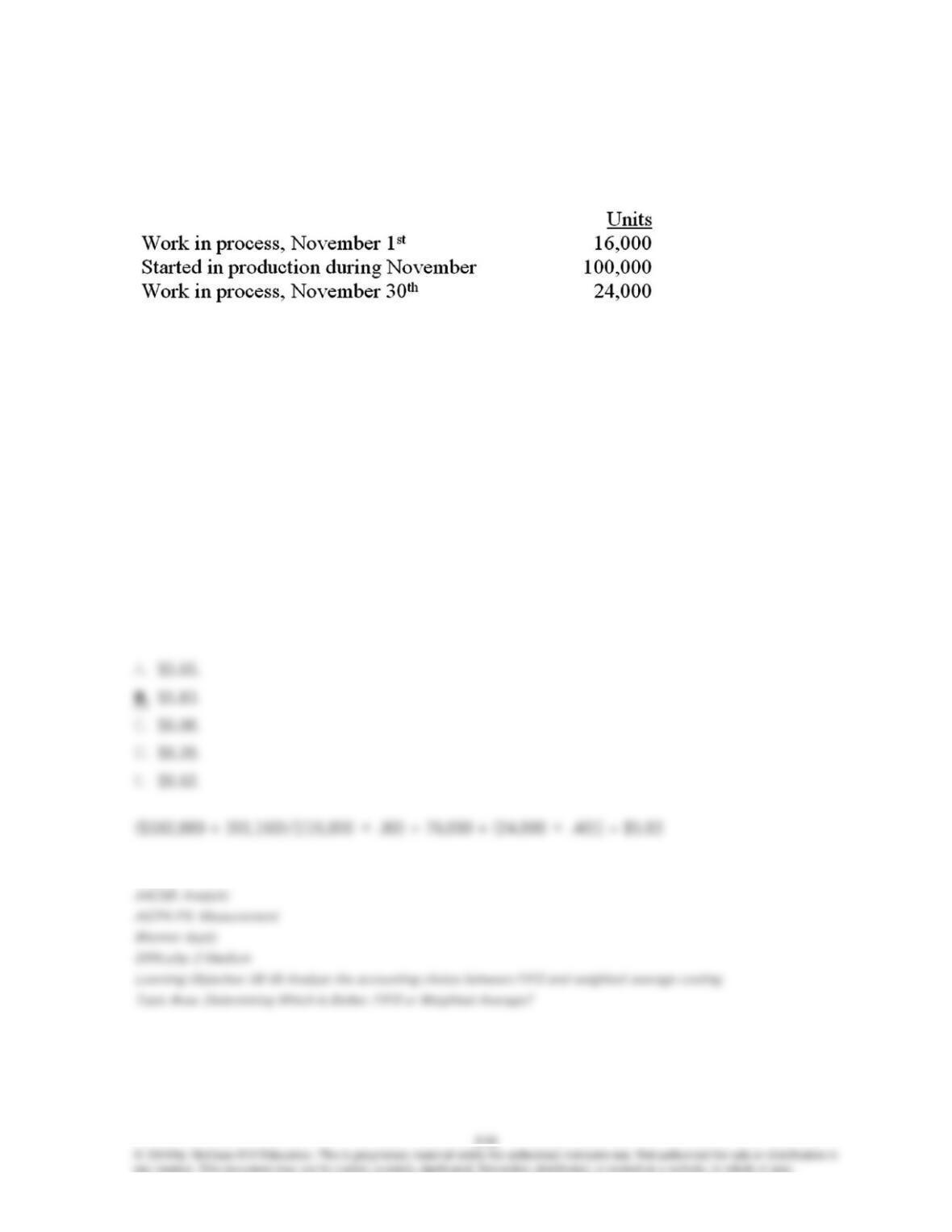
81. Kimbeth Manufacturing uses process costing to control costs in the manufacture of Dust
Sensors for the mining industry. The following information pertains to operations for November.
(CMA Exam adapted)
The beginning inventory was 60% complete as to materials and 20% complete as to conversion
costs. The ending inventory was 90% complete as to materials and 40% complete as to conversion
costs.
Costs pertaining to November are as follows:
Beginning inventory: direct materials, $54,560; direct labor, $20,320; manufacturing overhead,
$15,240.
Costs incurred during the month: direct materials, $468,000; direct labor, $182,880; manufacturing
overhead, $391,160.
What is the equivalent unit cost for the conversion costs assuming Kimbeth uses first-in, first-out
(FIFO) process costing?
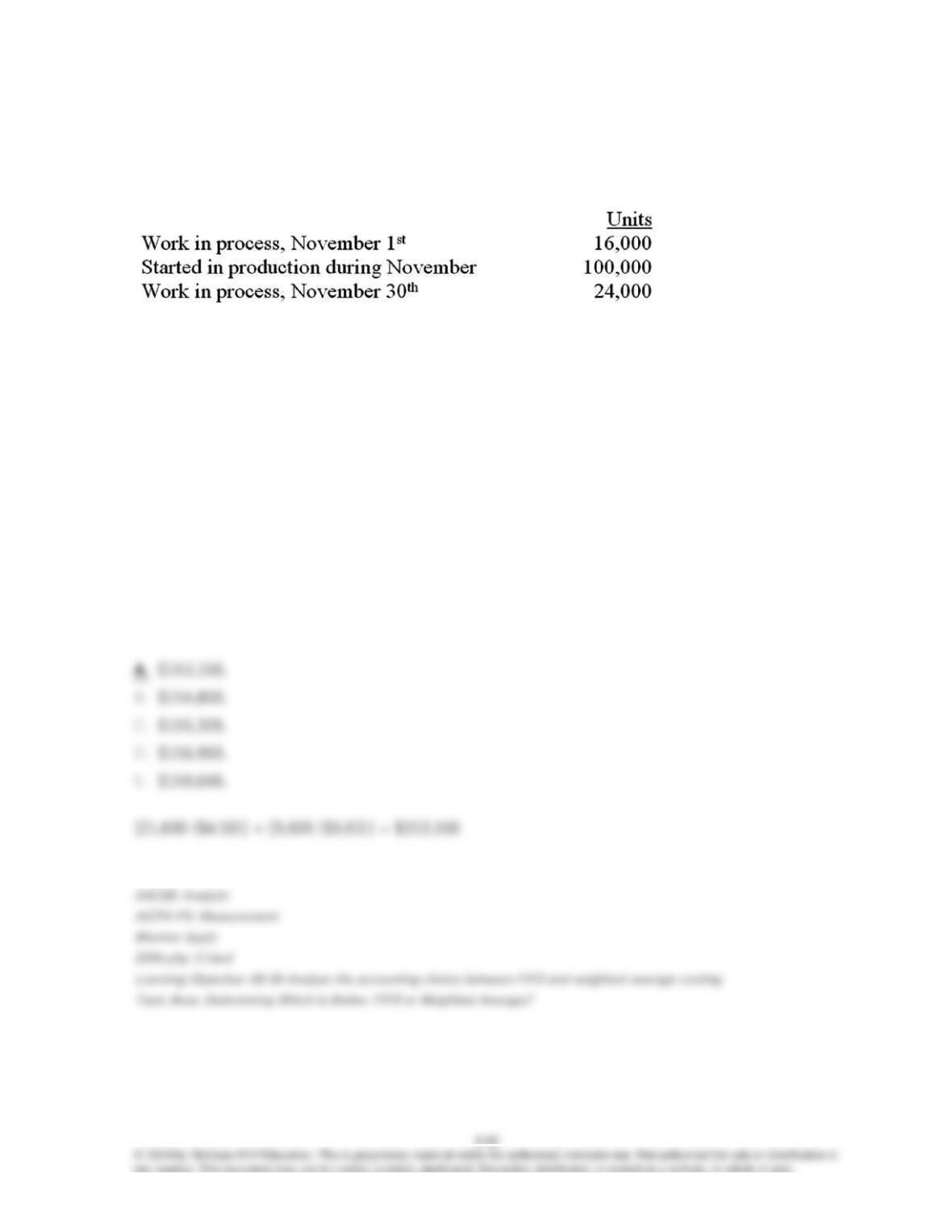
82. Kimbeth Manufacturing uses process costing to control costs in the manufacture of Dust
Sensors for the mining industry. The following information pertains to operations for November.
(CMA Exam adapted)
The beginning inventory was 60% complete as to materials and 20% complete as to conversion
costs. The ending inventory was 90% complete as to materials and 40% complete as to conversion
costs.
Costs pertaining to November are as follows:
Beginning inventory: direct materials, $54,560; direct labor, $20,320; manufacturing overhead,
$15,240.
Costs incurred during the month: direct materials, $468,000; direct labor, $182,880; manufacturing
overhead, $391,160.
What are the total costs in the ending Work-in-Process Inventory assuming Kimbeth uses first-in,
first-out (FIFO) process costing?
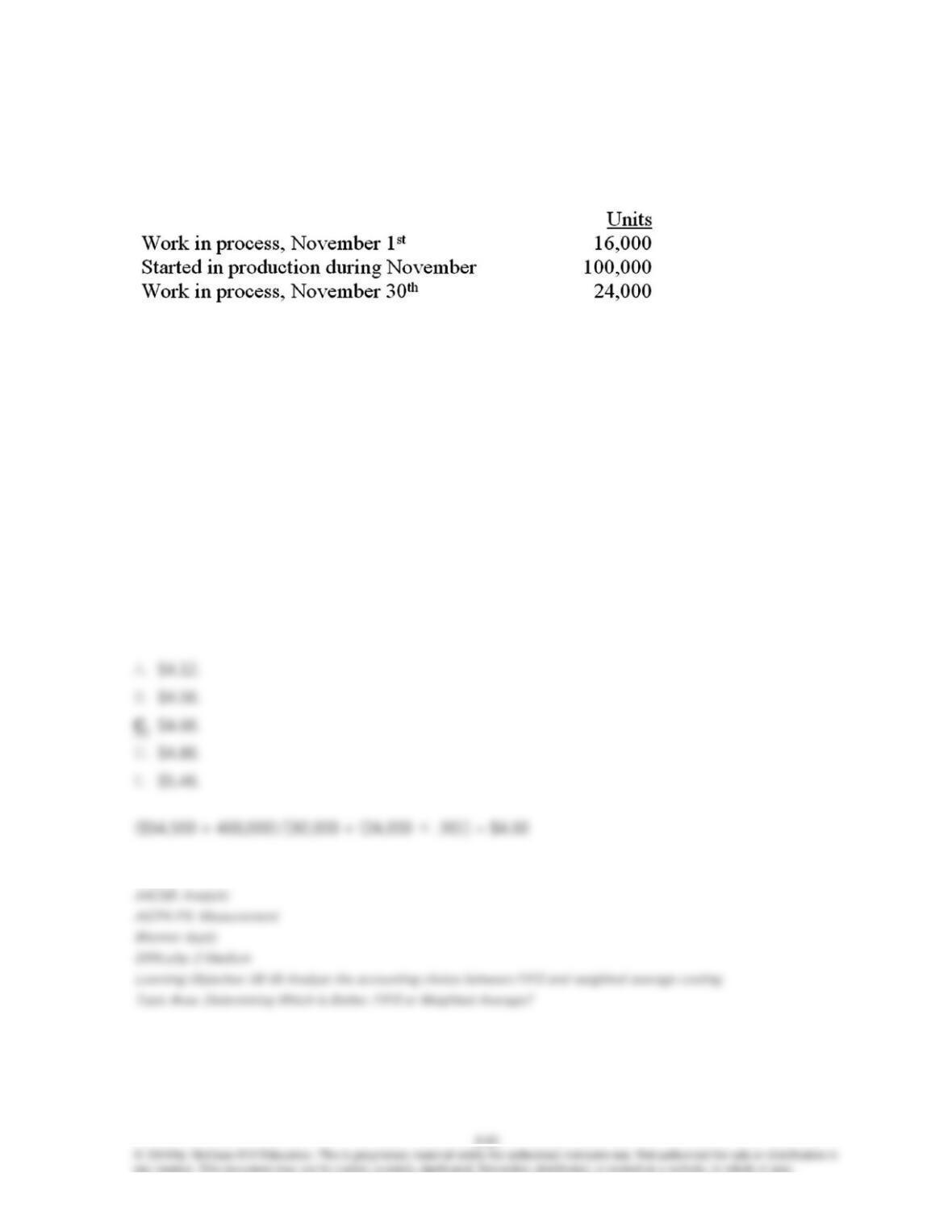
83. Kimbeth Manufacturing uses process costing to control costs in the manufacture of Dust
Sensors for the mining industry. The following information pertains to operations for November.
(CMA Exam adapted)
The beginning inventory was 60% complete as to materials and 20% complete as to conversion
costs. The ending inventory was 90% complete as to materials and 40% complete as to conversion
costs.
Costs pertaining to November are as follows:
Beginning inventory: direct materials, $54,560; direct labor, $20,320; manufacturing overhead,
$15,240.
Costs incurred during the month: direct materials, $468,000; direct labor, $182,880; manufacturing
overhead, $391,160.
What is the equivalent unit cost for materials assuming Kimbeth uses weighted-average process
costing?
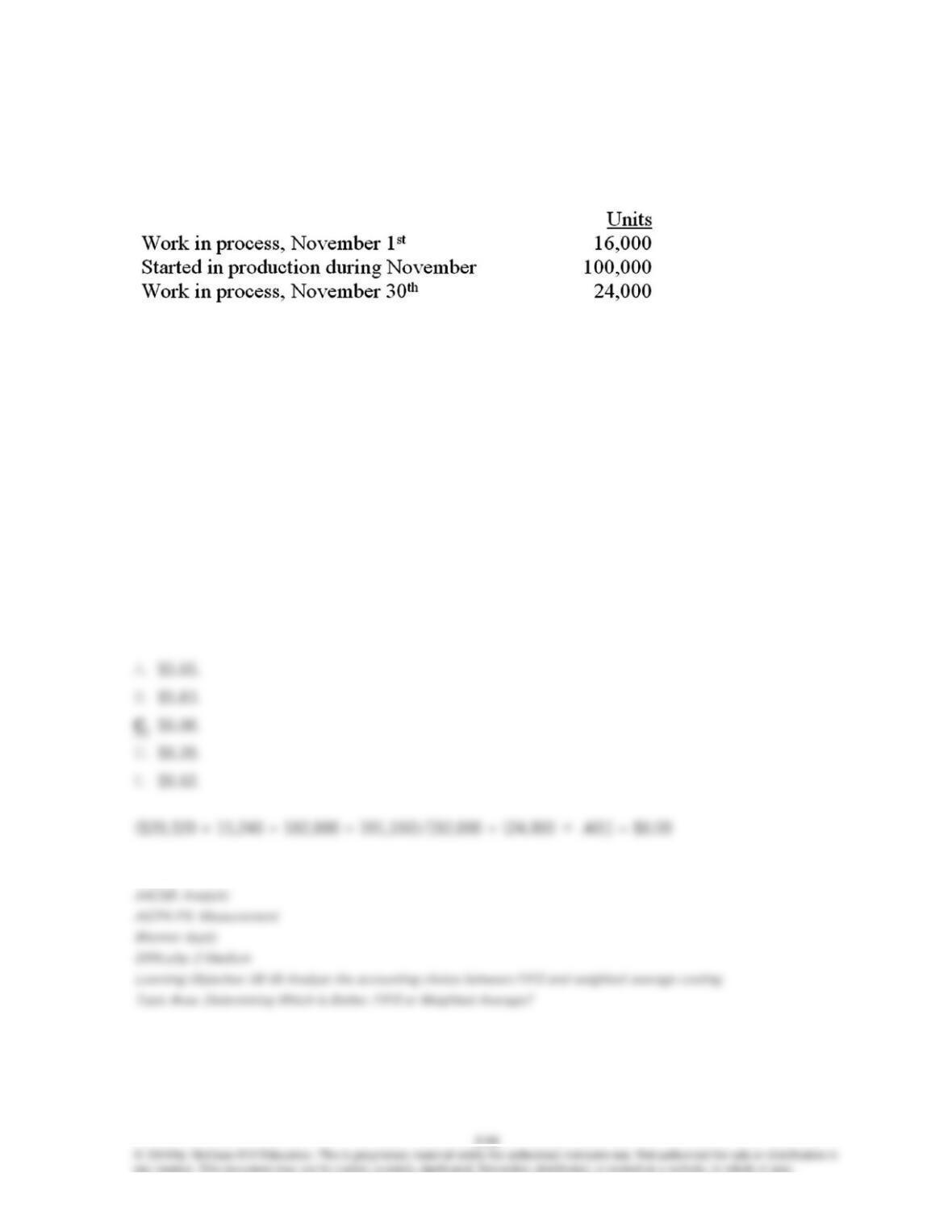
84. Kimbeth Manufacturing uses process costing to control costs in the manufacture of Dust
Sensors for the mining industry. The following information pertains to operations for November.
(CMA Exam adapted)
The beginning inventory was 60% complete as to materials and 20% complete as to conversion
costs. The ending inventory was 90% complete as to materials and 40% complete as to conversion
costs.
Costs pertaining to November are as follows:
Beginning inventory: direct materials, $54,560; direct labor, $20,320; manufacturing overhead,
$15,240.
Costs incurred during the month: direct materials, $468,000; direct labor, $182,880; manufacturing
overhead, $391,160.
What is the equivalent unit cost for the conversion costs assuming Kimbeth uses weighted–
average process costing?
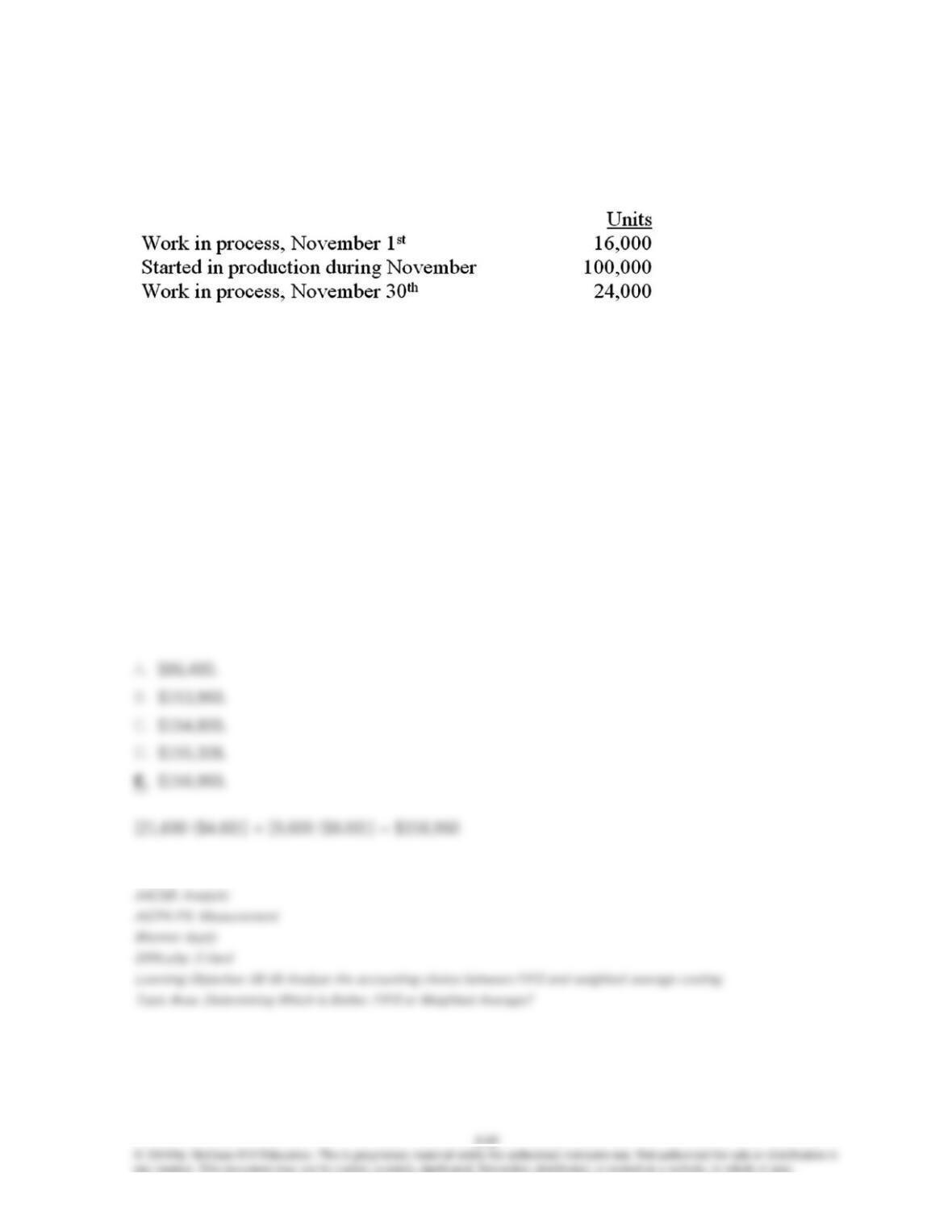
85. Kimbeth Manufacturing uses process costing to control costs in the manufacture of Dust
Sensors for the mining industry. The following information pertains to operations for November.
(CMA Exam adapted)
The beginning inventory was 60% complete as to materials and 20% complete as to conversion
costs. The ending inventory was 90% complete as to materials and 40% complete as to conversion
costs.
Costs pertaining to November are as follows:
Beginning inventory: direct materials, $54,560; direct labor, $20,320; manufacturing overhead,
$15,240.
Costs incurred during the month: direct materials, $468,000; direct labor, $182,880; manufacturing
overhead, $391,160.
What are the total costs in the ending Work–in-Process Inventory assuming Kimbeth uses
weighted-average process costing?
86. In a process costing system, manufacturing overhead applied is usually recorded as a
debit to:
87. A process costing system:
88. A company should use process costing, rather than job order costing, if:
89. Which of the following characteristics applies to process costing, but does not apply to job
order costing?

90. Equivalent units for a process costing system, using the weighted-average method, would
be equal to:
91. The Nichols Company uses the weighted-average method in its process costing system.
The company recorded 29,500 equivalent units for conversion costs for November in a particular
department. There were 6,000 units in the ending work–in-process inventory on November 30,
75% complete with respect to conversion costs. The November 1 work–in-process inventory
consisted of 8,000 units, 50% complete with respect to conversion costs. A total of 25,000 units
were completed and transferred out of the department during the month. The number of units
started during November in the department was:
8-70
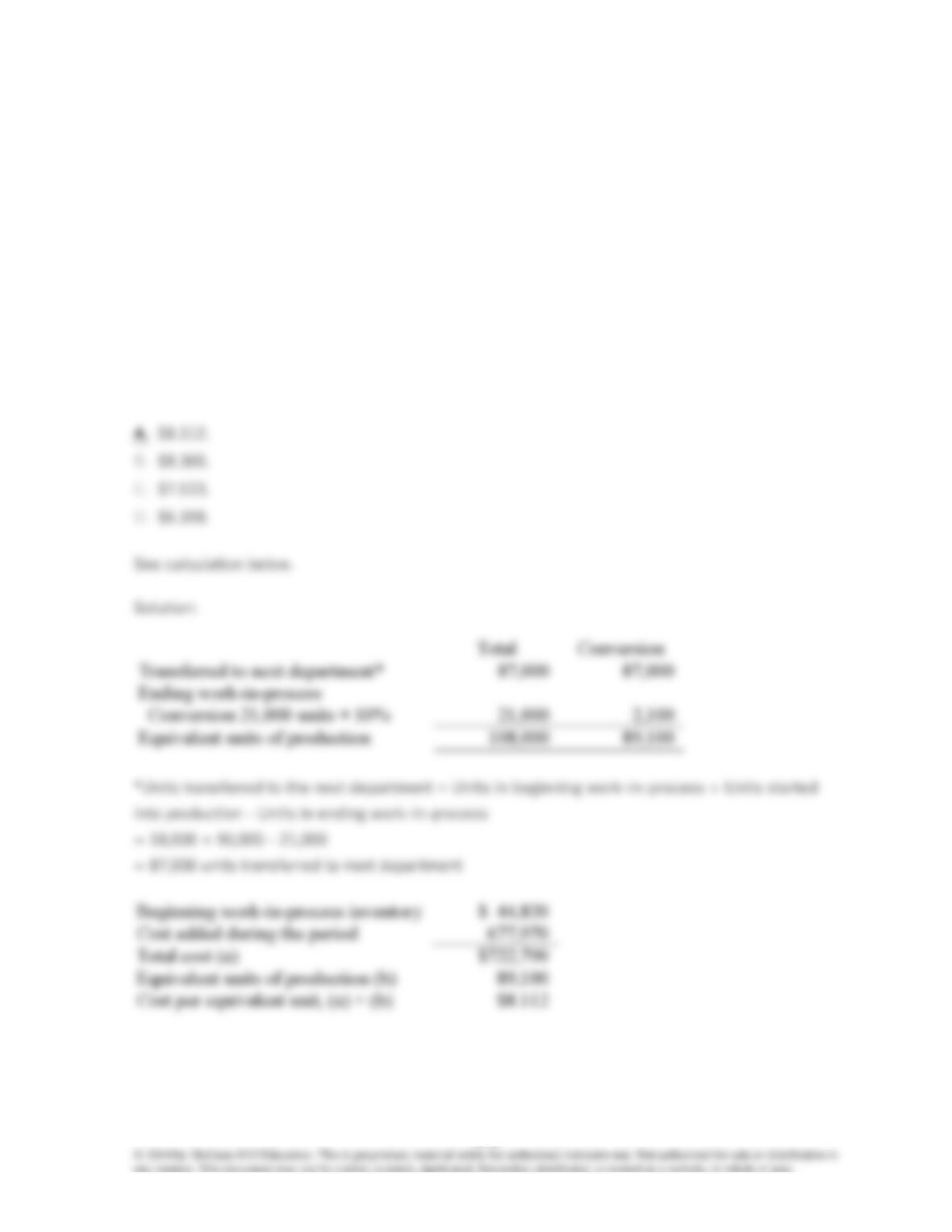
92. Diston Company uses the weighted-average method in its process costing system. The
first processing department, the Welding Department, started the month with 18,000 units in its
beginning work-in–process inventory that were 30% complete with respect to conversion costs.
The conversion cost in this beginning work–in-process inventory was $44,820. An additional
90,000 units were started into production during the month. There were 21,000 units in the ending
work-in-process inventory of the Welding Department that were 10% complete with respect to
conversion costs. A total of $677,970 in conversion costs were incurred in the department during
the month.
What would be the cost per equivalent unit for conversion costs for the month? (Round to three
decimal places.)
8-71
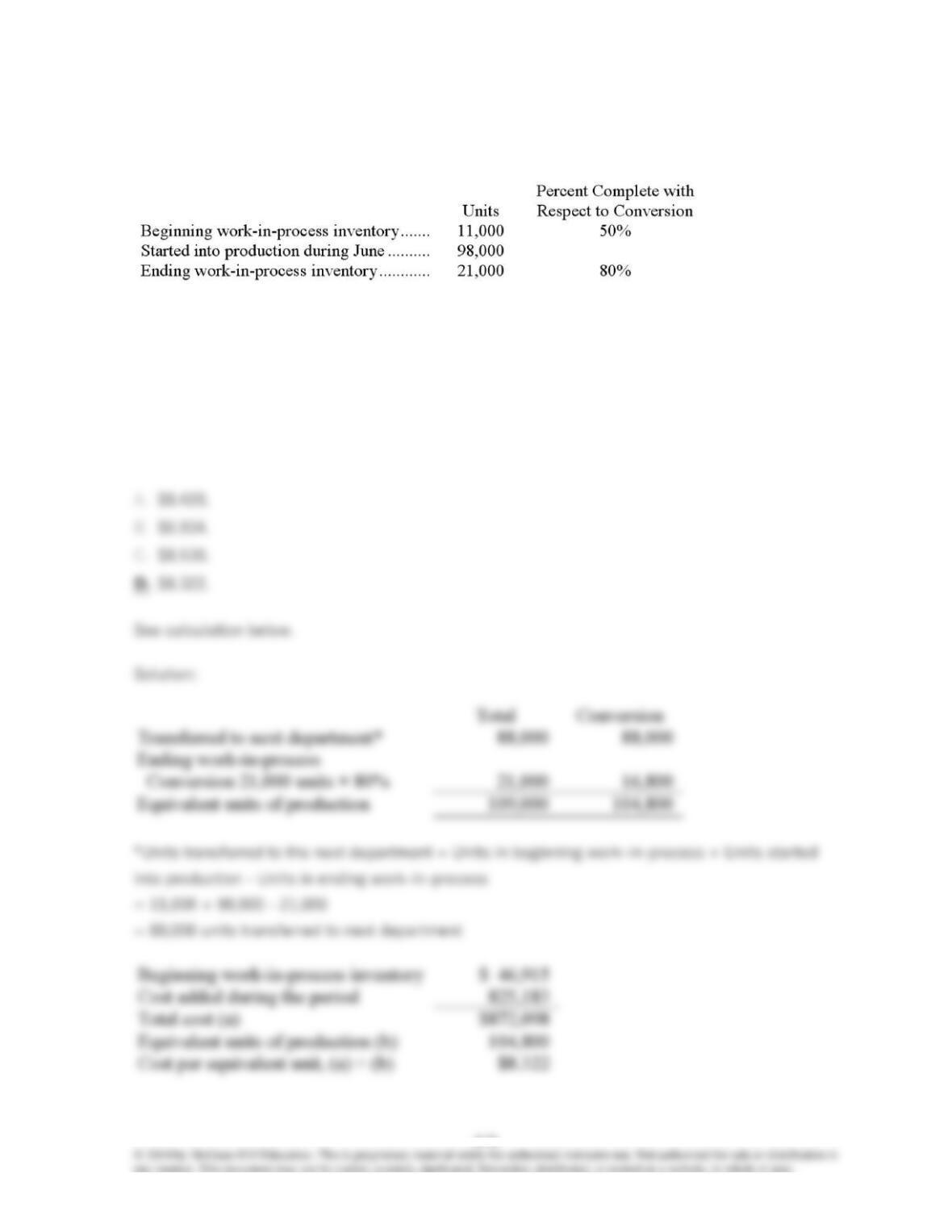
93. Loll Company uses the weighted-average method in its process costing system. Operating
data for the first processing department for the month of June appear below:
According to the company’s records, the conversion cost in beginning work–in–process inventory
was $46,915 at the beginning of June. Additional conversion costs of $825,183 were incurred in
the department during the month.
What was the cost per equivalent unit for conversion costs for the month? (Round to three
decimal places.)
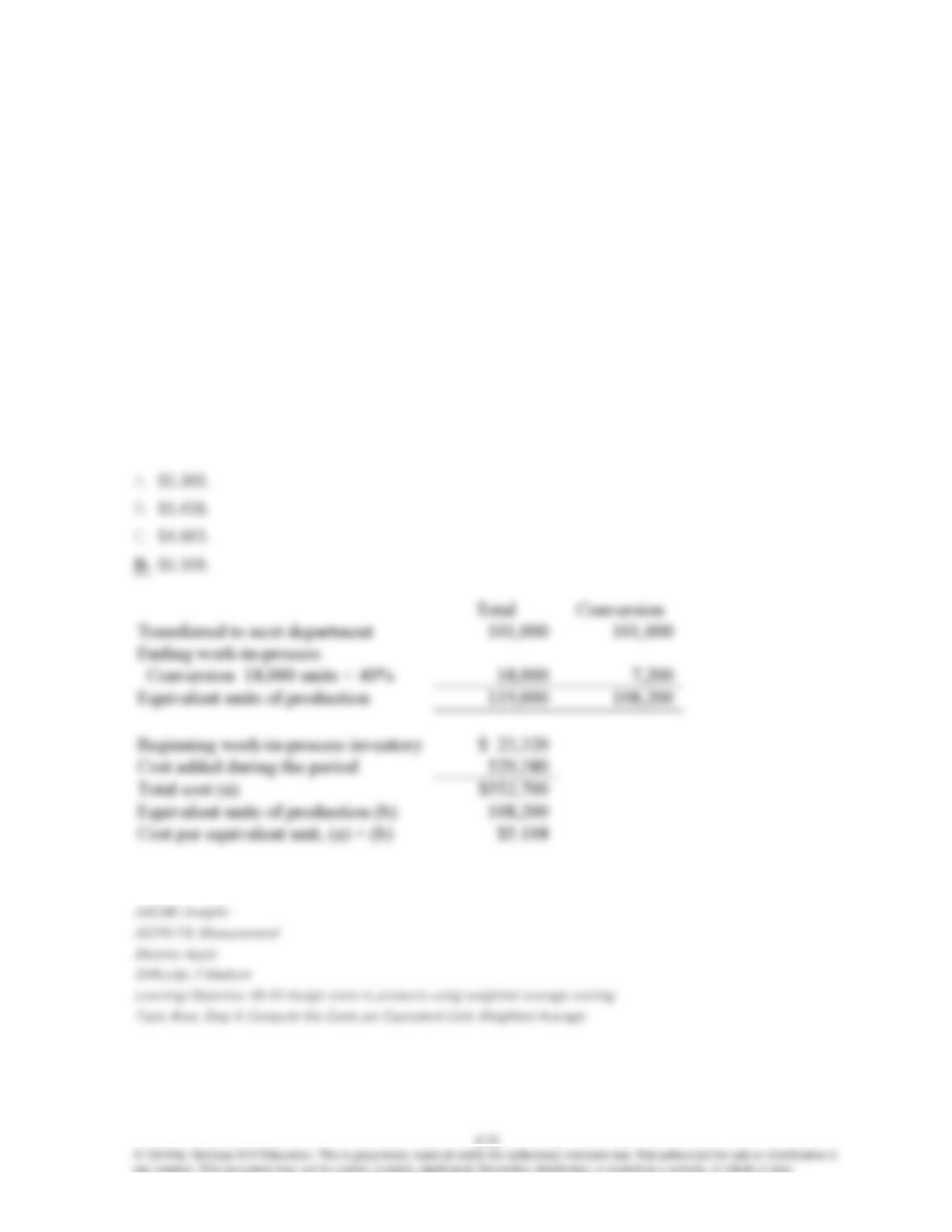
94. Hardouin Company uses the weighted-average method in its process costing system. The
first processing department, the Welding Department, started the month with 22,000 units in its
beginning work-in–process inventory that were 20% complete with respect to conversion costs.
The conversion cost in this beginning work–in-process inventory was $23,320. An additional
97,000 units were started into production during the month and 101,000 units were completed in
the Welding Department and transferred to the next processing department. There were 18,000
units in the ending work-in-process inventory of the Welding Department that were 40% complete
with respect to conversion costs. A total of $529,380 in conversion costs were incurred in the
department during the month.
What would be the cost per equivalent unit for conversion costs for the month? (Round to three
decimal places.)
8-73
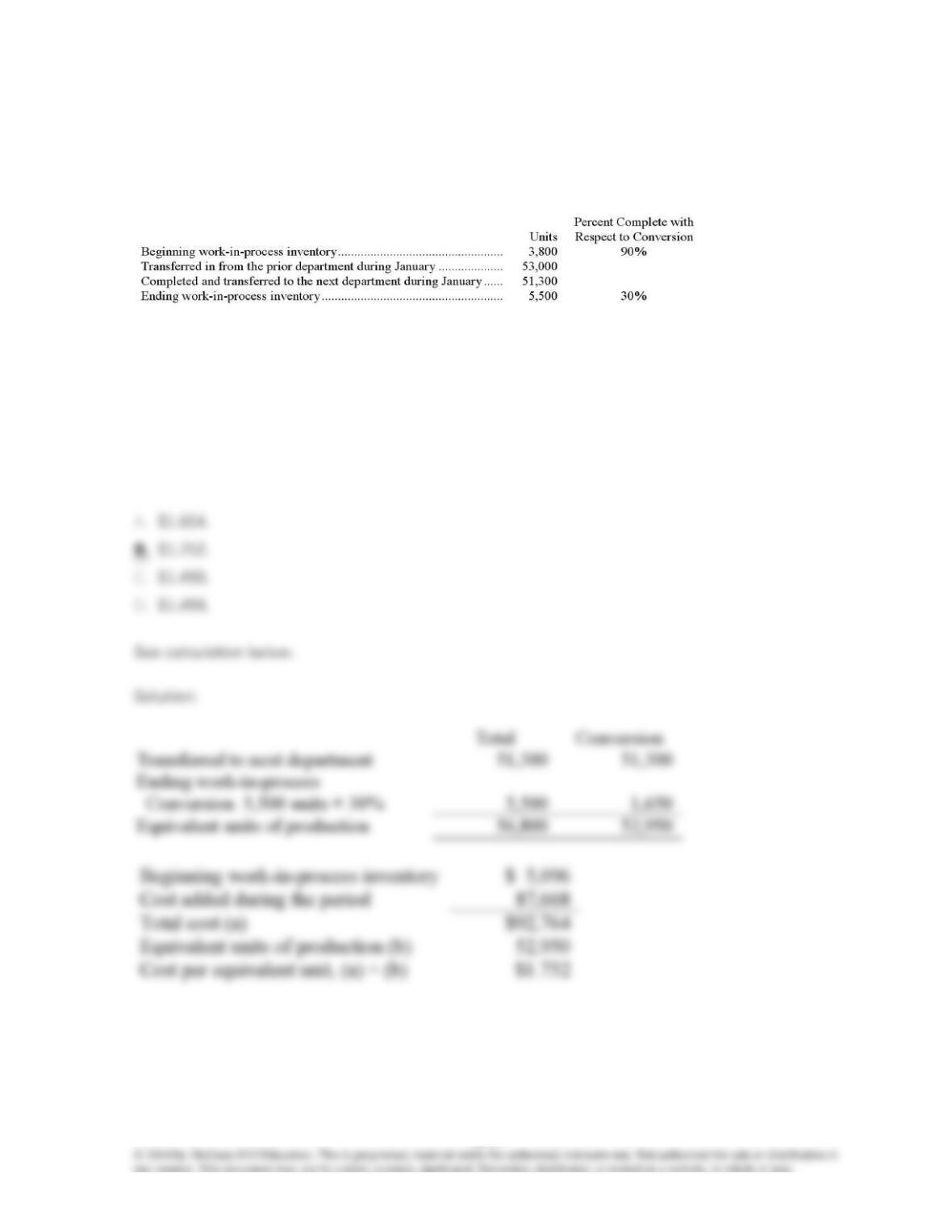
95. Parmentier Company uses the weighted-average method in its process costing system.
The Molding Department is the second department in its production process. The data below
summarize the department’s operations in January.
The accounting records indicate that the conversion cost that had been assigned to beginning
work-in-process inventory was $5,096 and a total of $87,668 in conversion costs were incurred in
the department during January.
What was the cost per equivalent unit for conversion costs for January in the Molding
Department? (Round to three decimal places.)
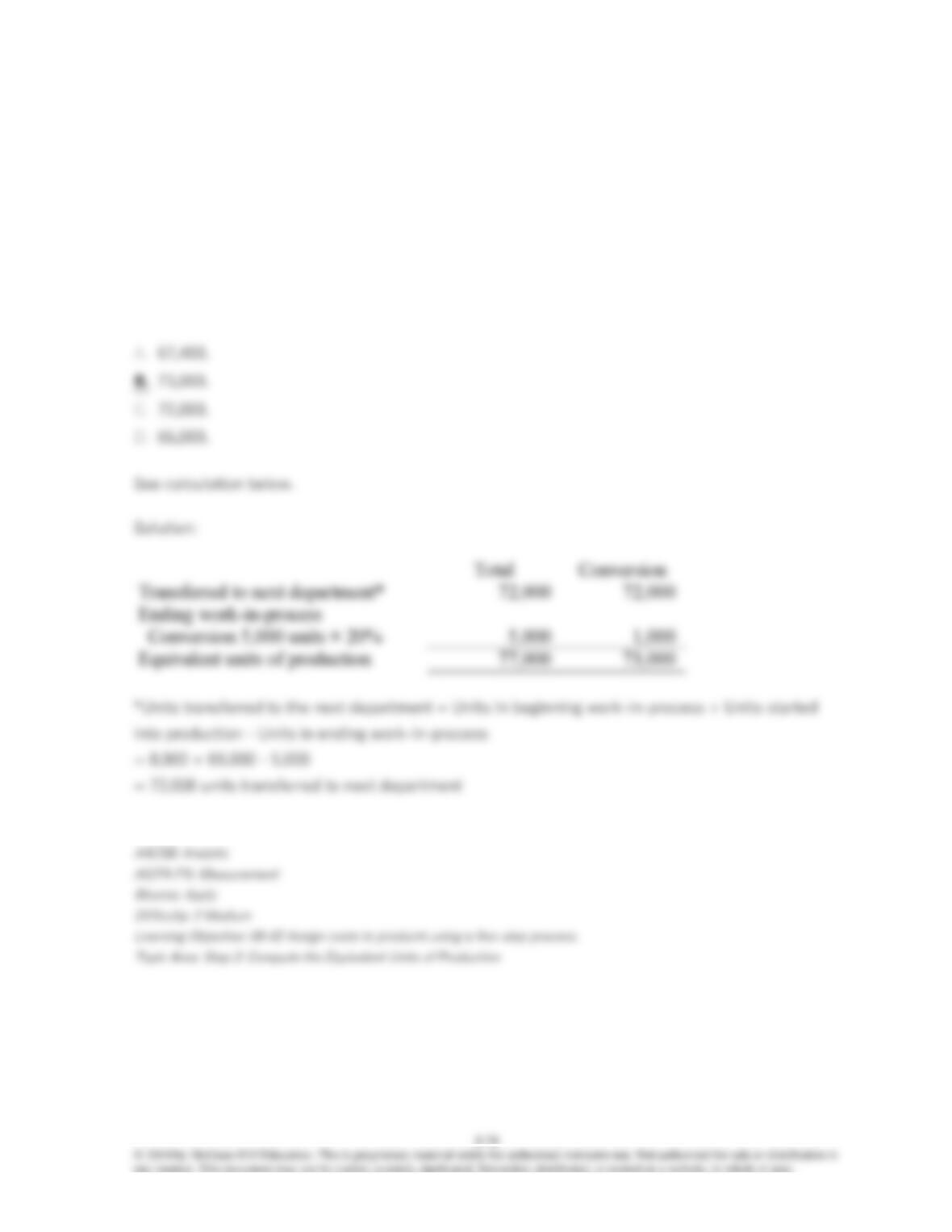
96. Borwan Company uses the weighted-average method in its process costing system. The
Assembly Department started the month with 8,000 units in its beginning work–in-process
inventory that were 70% complete with respect to conversion costs. An additional 69,000 units
were transferred in from the prior department during the month to begin processing in the
Assembly Department. There were 5,000 units in the ending work-in-process inventory of the
Assembly Department that were 20% complete with respect to conversion costs.
What were the equivalent units for conversion costs in the Assembly Department for the month?
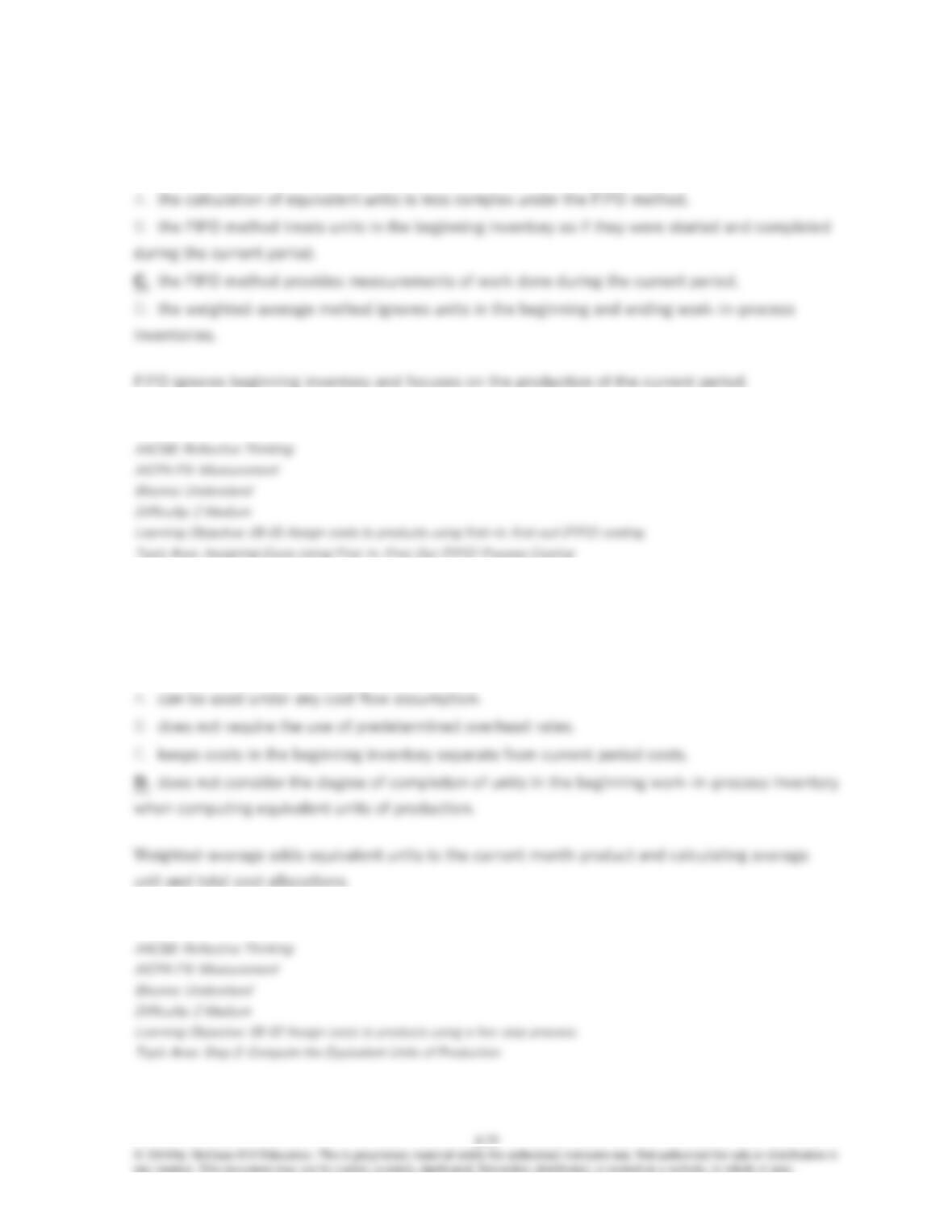
97. The FIFO method provides a major advantage over the weighted-average method in that:
98. The weighted-average method of process costing differs from the FIFO method of process
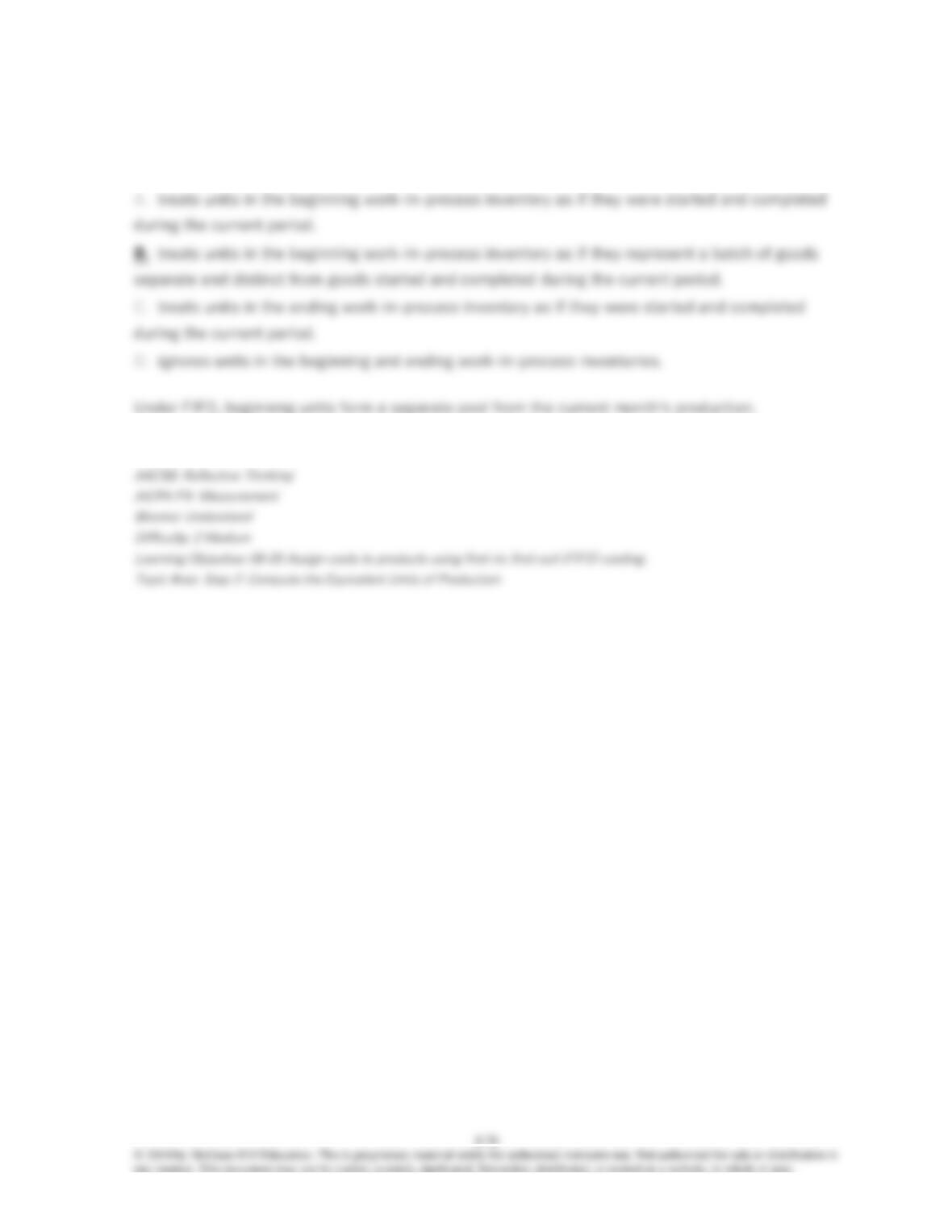
costing in that the weighted-average method:
99. The computation of equivalent units under the FIFO method:
8-77
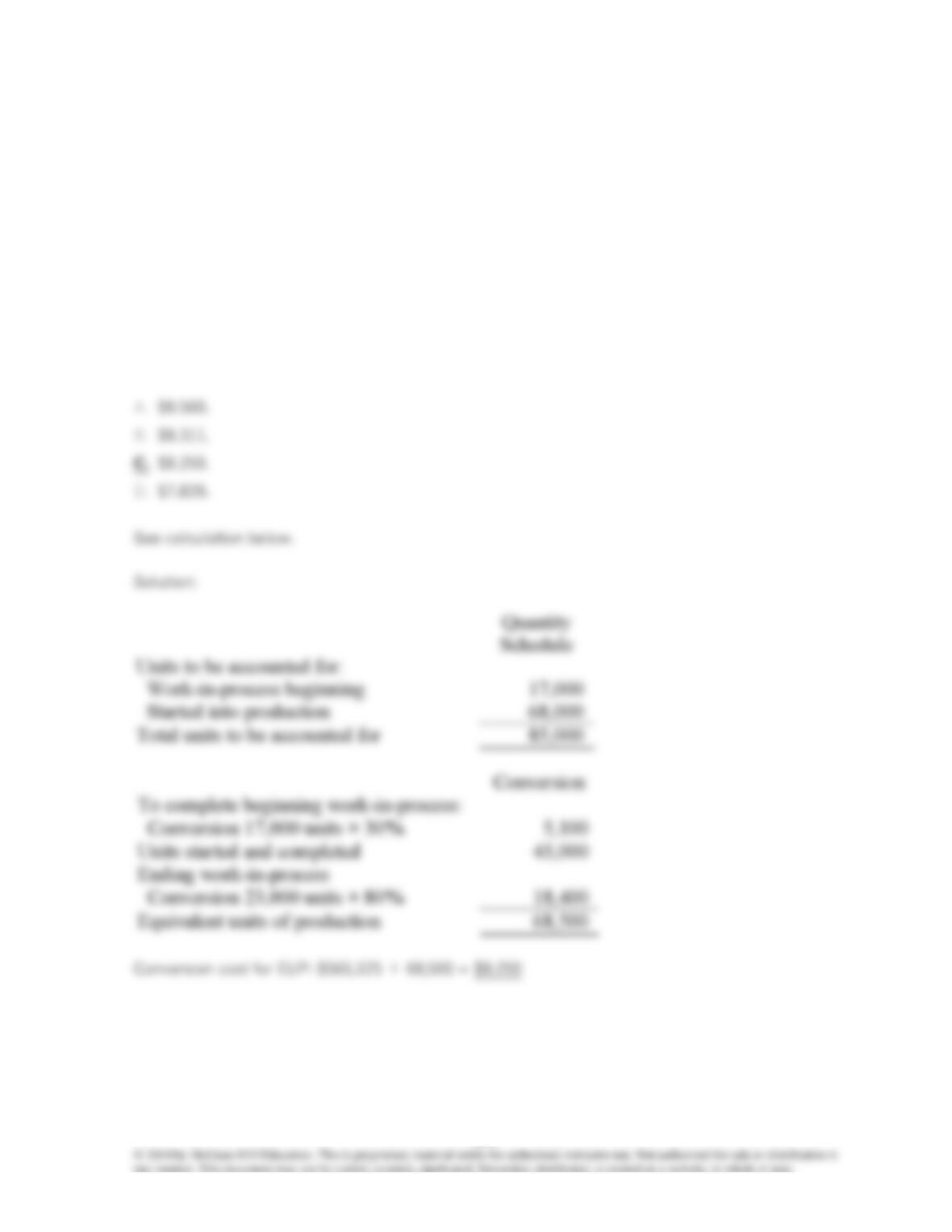
100. Elard Company uses the FIFO method in its process costing system. The first processing
department, the Welding Department, started the month with 17,000 units in its beginning work-
in-process inventory that were 70% complete with respect to conversion costs. The conversion
cost in this beginning work-in-process inventory was $101,150. An additional 68,000 units were
started into production during the month. There were 23,000 units in the ending work-in-process
inventory of the Welding Department that were 80% complete with respect to conversion costs. A
total of $565,125 in conversion costs were incurred in the department during the month.
What would be the cost per equivalent unit for conversion costs? (Round off to three decimal
places.)
8-78
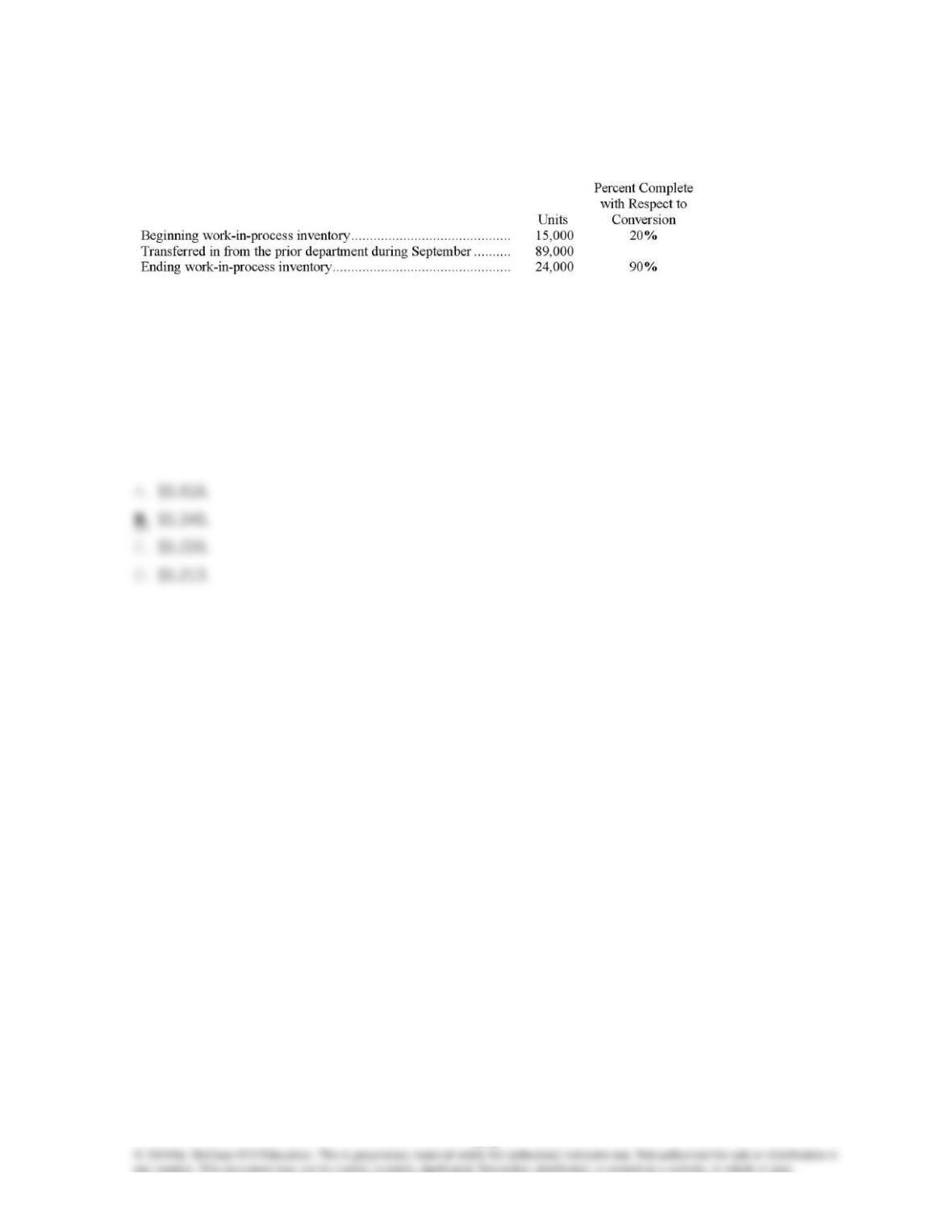
101. Mannarelli Corporation uses the FIFO method in its process costing system. Operating
data for the Casting Department for the month of September appear below:
According to the company’s records, the conversion cost in beginning work–in–process inventory
was $15,660 at the beginning of September. Additional conversion costs of $526,524 were
incurred in the department during the month.
What would be the cost per equivalent unit for conversion costs for September? (Round off to
three decimal places.)
8-80
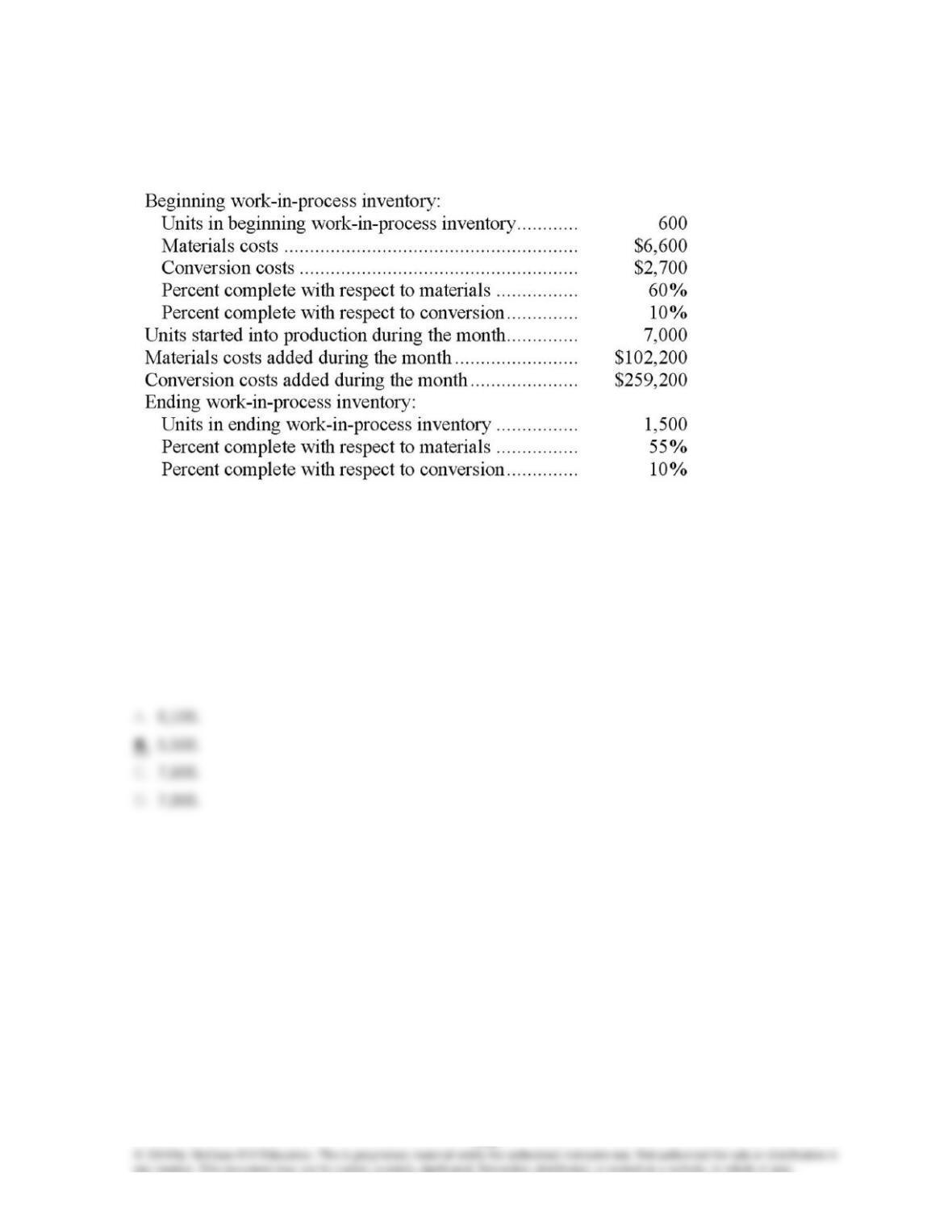
102. Qdynamic Corporation uses the FIFO method in its process costing system. Data
concerning the first processing department for the most recent month are listed below:
Note: Your answers may differ from those offered below due to rounding error. In all cases, select
the answer that is the closest to the answer you computed. To reduce rounding error, carry out all
computations to at least three decimal places.
How many units were started AND completed during the month in the first processing
department?