
Chapter 8 – Variable Costing and the Costs of Quality and Sustainability
8-52
82. White Water Rafting Company manufactures kayaks, which sell for $565 each. The
variable costs of production (per unit) are as follows:
Direct Material $ 200
Direct labor 110
Variable manufacturing overhead 80
Budgeted fixed overhead in 20×1 was $400,000 and budgeted production was 50,000 kayaks.
The year’s actual production was 50,000 units, of which 47,000 were sold. Variable selling
and administrative costs were $5 per unit sold; fixed selling and administrative costs were
$75,000.
Required:
1. Calculate the product cost per kayak under (a) absorption costing and (b) variable
costing.
2. Prepare operating income statements for the year using (a) absorption costing and (b)
variable costing.
3. Reconcile reported operating income under the two methods using the shortcut method.
Chapter 8 – Variable Costing and the Costs of Quality and Sustainability
8-53
Solution:
Chapter 8 – Variable Costing and the Costs of Quality and Sustainability
8-54
83. List and define four types of product quality costs.
Solution:
8-55
84. What is the difference between observable and hidden quality costs? Explain and give at
least one example of each.
Solution:
85. What is the difference between a product’s quality of design and its quality of
conformance?
Solution:
86. What are three strategies of environmental cost management? Define each strategy.
Solution:
87. What is a product’s grade, as a characteristic of quality? Give a service industry example.
88. The following costs were incurred by Home Master, a company that makes washing
machines.
a. The company requires each machine to complete 5 spin cycles before it is boxed and
shipped.
b. The company replaced switches on 10% of machines sold last year.
c. Cost of rewiring the machines that failed the 5-spin cycle test.
d. The company sent its machine inspectors to a two-week training program on the new
model that is to be released this year. It is hoped that this will lower the defect rate on the
new model.
Required: Classify each of these costs as a prevention, appraisal, internal failure, or
external failure cost.
Solution:
8-58
89. Xenon Enterprises (XE) produces two extruding machines that are popular with food
processors: No. 616 and No. 717. Machine No. 616 has an average selling price of $160,000,
whereas No. 717 typically sells for approximately $155,000. The company is extremely
focused on quality and has provided the following information:
No. 616
No. 717
Number of machines produced and sold
180
200
Warranty costs:
Average repair cost per unit
$2,200
$1,400
Percentage of units needing repair
75%
15%
Reliability engineering at $150 per hour
2,600 hours
3,000 hours
Rework at XE’s manufacturing plant:
Average rework cost per unit
$2,900
$2,600
Percentage of units needing rework
40%
30%
Manufacturing inspection at $50 per hour
600 hours
1,000 hours
Transportation costs to customer sites to fix problems
$49,500
$35,000
Quality training for employees
$50,000
$75,000
Required:
a. Classify the preceding costs as prevention, appraisal, internal failure, or external failure.
b. Using the classifications in requirement (1), compute XE’s quality costs for machine
No. 616 in dollars and as a percentage of sales revenues. Also calculate prevention,
appraisal, internal failure, and external failure costs as a percentage of total quality costs.
c. Repeat requirement (b) for machine No. 717.
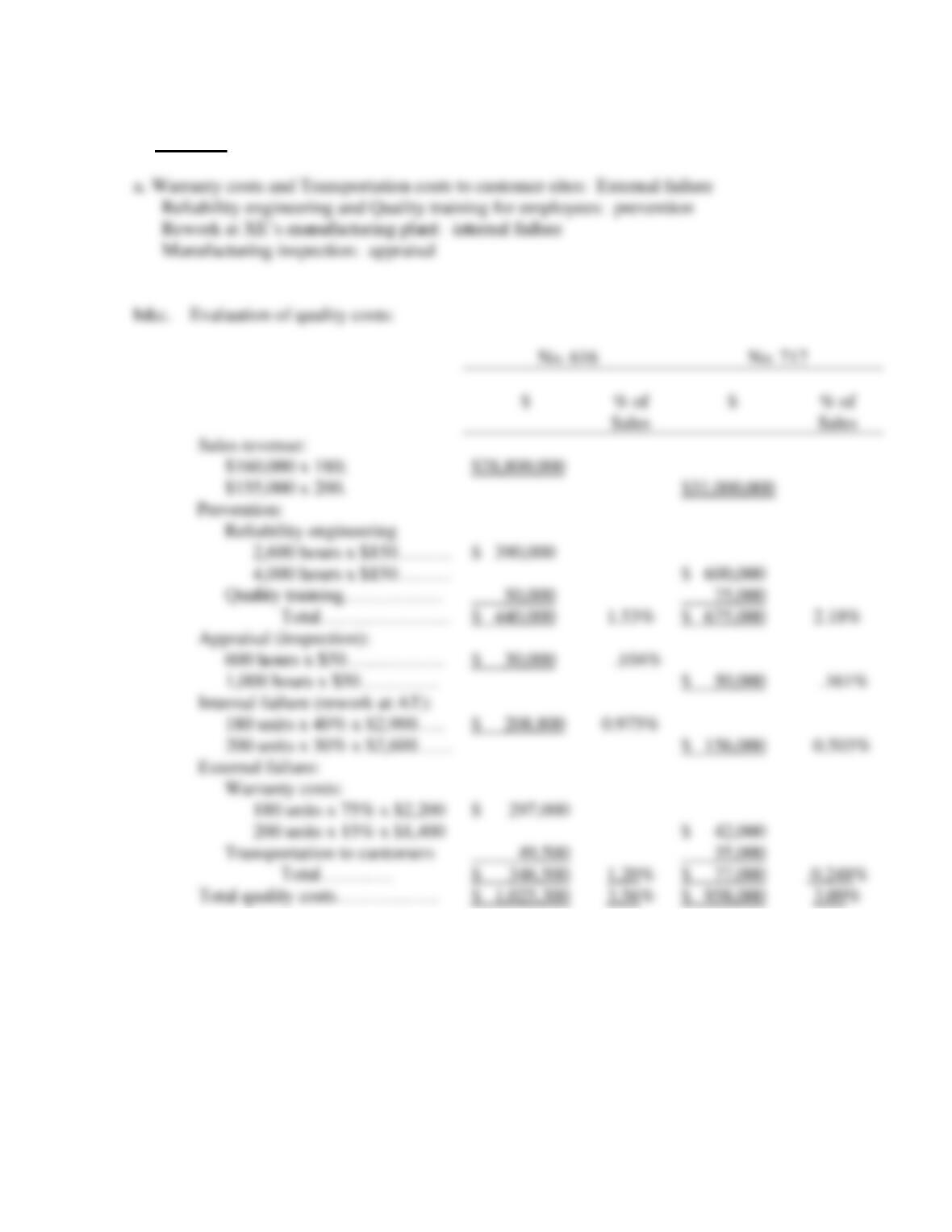
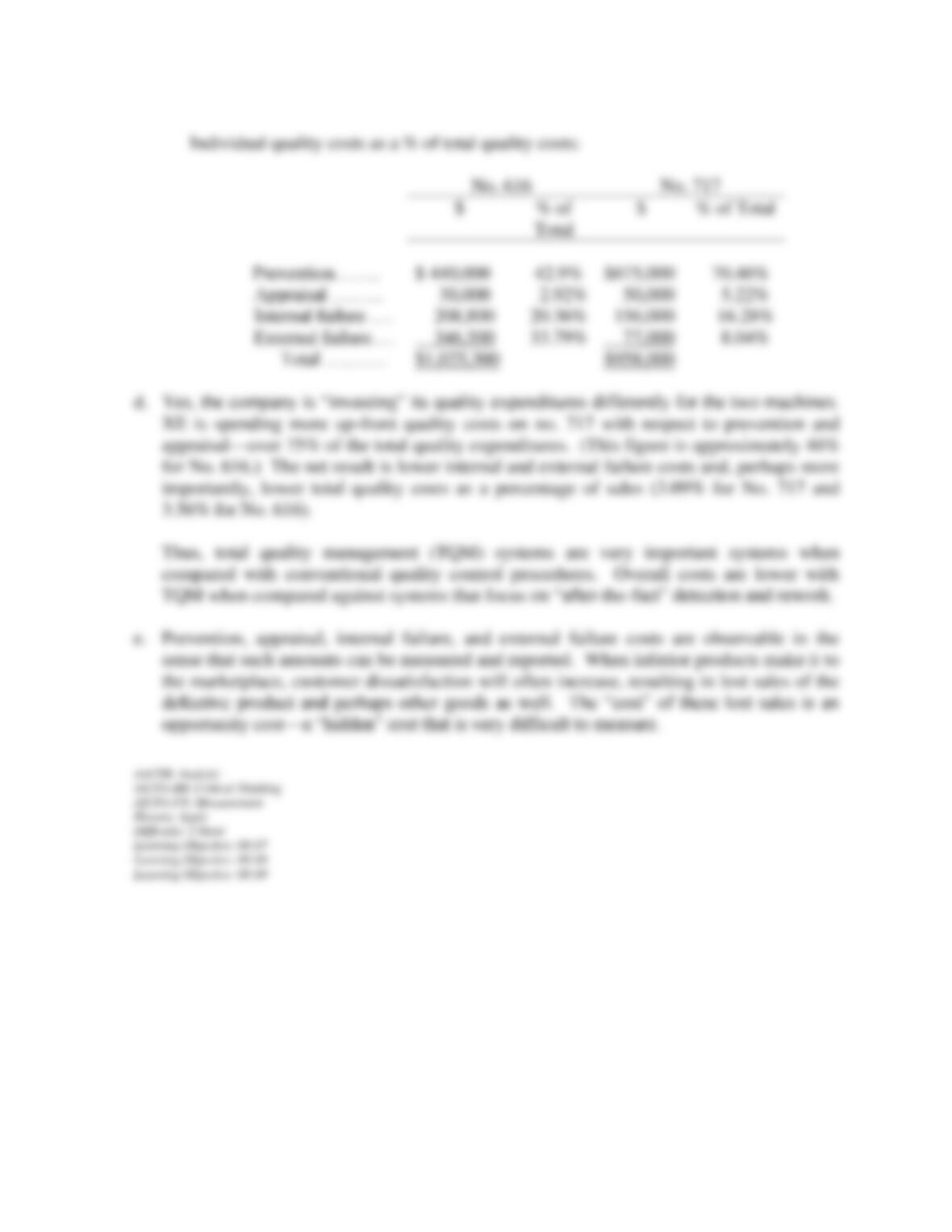
d. Comment on your findings, noting whether the company is “investing” its quality
expenditures differently for the two machines.
e. Quality costs can be classified as observable or hidden. What are hidden quality costs,
and how do these costs differ from observable costs?
Chapter 8 – Variable Costing and the Costs of Quality and Sustainability
8-59
Solution:
Chapter 8 – Variable Costing and the Costs of Quality and Sustainability
8-60
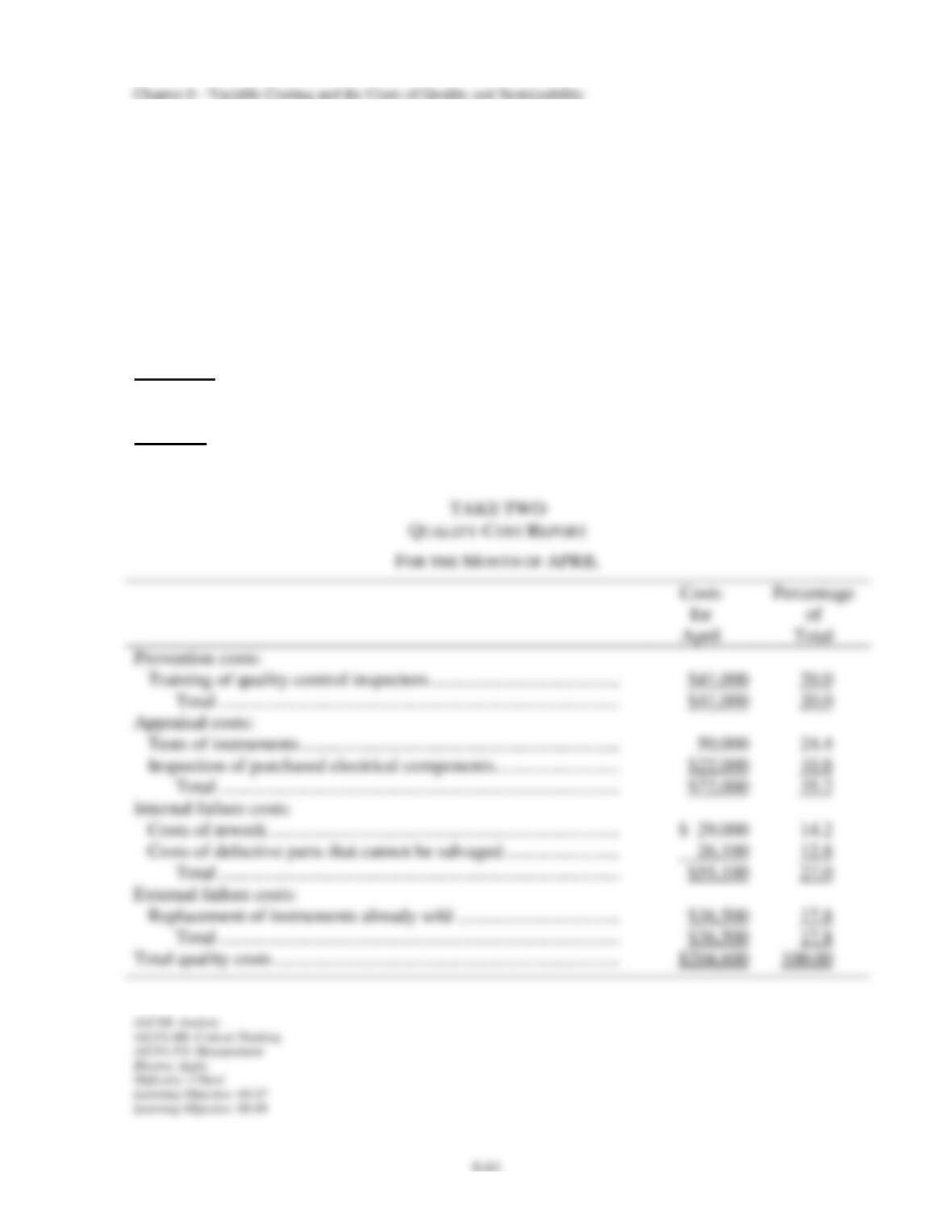
90. Take Two manufactures electrical switches for a variety of purposes. The following costs
related to maintaining product quality were incurred in April.
Training of quality-control inspectors………..
$41,000
Tests of instruments before sale …………………
50,000
Inspection of electrical components purchased from outside suppliers ….
22,000
Costs of rework on faulty instruments …….
29,000
Replacement of instruments already sold, which were still covered by warranty
36,500
Costs of defective parts that cannot be salvaged .
26,100
Required:
Prepare a quality-cost report.
Solution: