13) On October 2, 2014, Allen Jewelry Company accepted a 4-month, 10% note for $2,400 in settlement of an
overdue account receivable. What is the journal entry to record the acceptance of the note?
A)
Notes receivable
2,400
Accounts receivable
2,400
B)
Cash
2,400
Sales revenue
2,400
C)
Notes receivable
2,400
Cash
2,400
D)
Accounts receivable
2,400
Notes receivable
2,400
14) On October 1, 2014, Allen Jewelry Company accepted a 4-month, 10% note for $2,400 in settlement of an
overdue account receivable. If the company accrues interest at year-end only, how much interest revenue should be
accrued on December 31, 2014?
A) $80
B) $60
C) $240
D) $40
15) A note receivable was NOT paid at maturity. Which of the following will be included in the journal entry to
record the dishonoring of the note at maturity?
A) A debit to Cash
B) A debit to Interest expense
C) A debit to Accounts receivable
D) A debit to Uncollectible account expense
16) On January 1, Ajax Company accepted a one-year note for $5,000 at 4% from one of its customers. When the
note matured on December 31, the customer was unable to pay, and Ajax treated it as a dishonored note. How much
interest revenue did Ajax record at December 31?
A) $0
B) $200
C) $800
D) $24
17) Which of the following would be included in the entry to record a dishonored note receivable by the payee?
A) A debit to Accounts receivable
B) A debit to Interest revenue
C) A debit to Notes receivable
D) A credit to Interest expense
18) On March 1, 2014, Bayonne Services made a loan to one of its officers. The officer signed a 6-month note for
$4,000 at 8%. Bayonne generally accrues interest at year–end only, so at the time the note matured, Bayonne had
not accrued any interest revenue. On August 1 when the note matured, the officer settled in full with the company.
How much interest revenue did Bayonne record?
A) $320
B) $4,160
C) $160
D) $4,000
19) On September 1, 2013, Adirondac Marine Supplies made a loan to one of its customers. The customer signed a
6-month note for $1,500 at 10%. How much interest revenue did Adirondac record in the year 2013?
A) $150
B) $125
C) $100
D) $50
20) On September 1, 2013, Adirondac Marine Supplies made a loan to one of its customers. The customer signed a
6-month note for $1,500 at 10%. How much interest revenue did Adirondac record in the year 2014?
A) $150.00
B) $12.50
C) $25.00
D) $50.00
21) On September 1, 2013, Adirondac Marine Supplies made a loan to one of its customers. The customer signed a
6-month note for $1,500 at 10%. How much interest revenue did Adirondac earn over the life of the note?
A) $150
B) $75
C) $25
D) $50
22) On September 1, 2013, Adirondac Marine Supplies made a loan to one of its customers. The customer signed a
6-month note for $1,500 at 10%. When the note matured on March 1, 2014, the customer settled with the company
in full. How much cash did Adirondac collect from the customer?
A) $1,575
B) $75
C) $2,500
D) $1,500
23) On December 1, 2014, Parsons Sales sold machinery to a customer for $2,000. The customer could not pay at
the time of sale, but agreed to pay 9 months later, and signed a 9-month note at 12% interest. How much interest
revenue was earned during the year 2014?
A) $180
B) $75
C) $20
D) $90
24) On December 1, 2014, Parsons Sales sold machinery to a customer for $2,000. The customer could not pay at
the time of sale, but agreed to pay 9 months later, and signed a 9-month note at 12% interest. How much interest
revenue was earned during the year 2015?
A) $180
B) $75
C) $160
D) $90
25) On December 1, 2014, Parsons Sales sold machinery to a customer for $2,000. The customer could not pay at
the time of sale, but agreed to pay 9 months later, and signed a 9-month note at 12% interest. How much interest
revenue was earned for the entire term of the note?
A) $180
B) $75
C) $160
D) $90
26) On December 1, 2014, Parsons Sales sold machinery to a customer for $2,000. The customer could not pay at
the time of sale, but agreed to pay 9 months later, and signed a 9-month note at 12% interest. What was the total
amount of cash collected by Parsons when the note matured?
A) $2,180
B) $2,175
C) $2,160
D) $2,090
27) Total interest accrued on a $7,500, 5%, 3-month note is:
A) $93.75.
B) $375.00.
C) $31.25.
D) $125.00.
28) A six-month note receivable for $4,000 at 12% dated September 1, 2011, has accrued interest revenue of
________ on December 31, 2011.
A) $480
B) $240
C) $160
D) $80
29) On October 1, 2012, Allen Jewelry Company accepted a 4-month, 10% note for $2,400 in settlement of an
overdue account receivable. Please provide the journal entry needed to record the conversion of an Accounts
receivable into a Note receivable.
Note receivable
30) On October 1, 2012, Allen Jewelry Company accepted a 4-month, 10% note for $2,400 in settlement of an
overdue account receivable. If the company accrues interest at year-end only, please provide the journal entry
needed at year-end.
Interest receivable
31) On October 1, 2012, Allen Jewelry Company accepted a 4-month, 10% note for $2,400 in settlement of an
overdue account receivable. Interest revenue was accrued through December 31, 2012. Allen receives the maturity
value of the note (the original principal plus all of the interest) on the due date. What journal entry is needed when
the funds are collected?
Cash
32) On January 1, Ajax Company accepted a one-year note for $5,000 at 4% from one of its customers. When the
note matured on December 31, the customer was unable to pay, and Ajax treated it as a dishonored note. Please
provide the journal entry needed by Ajax.
Accounts receivable
33) On March 1, 2012, Bayonne Services made a loan to one of its officers. The officer signed a 6-month note for
$4,000 at 8%. Please provide the journal entry needed by Bayonne to record the note.
Notes receivable
34) On March 1, 2012, Bayonne Services made a loan to one of its officers. The officer signed a 6-month note for
$4,000 at 8%. Bayonne generally accrues interest at year–end only, so at the time the note matured, Bayonne had
not accrued any interest revenue. On September 1, when the note matured, the officer settled in full with the
company. Please provide the journal entry made by Bayonne when the note was settled.
Cash
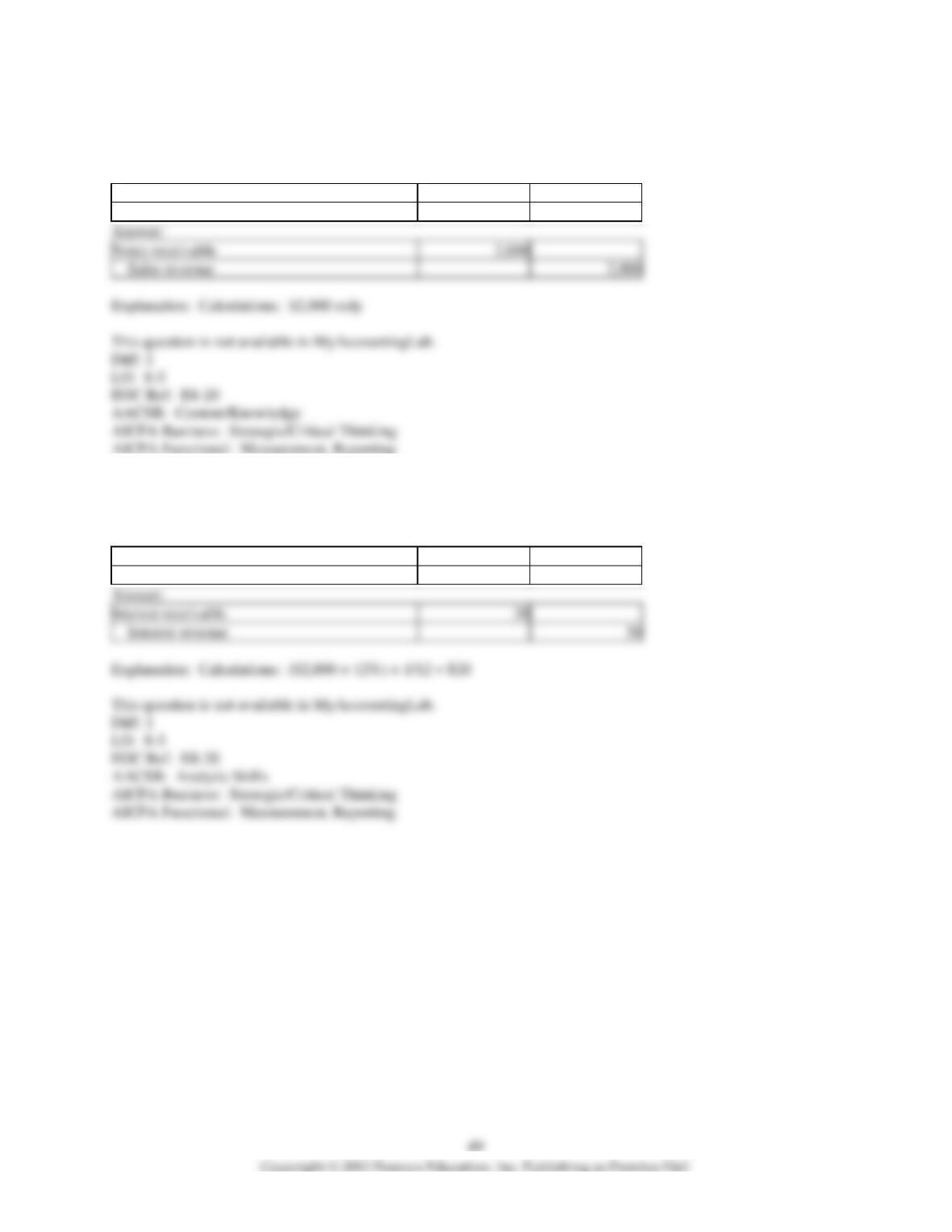
35) On December 1, 2013, Parsons Sales sold machinery to a customer for $2,000. The customer could not pay at
the time of sale, but agreed to pay 9 months later, and signed a 9–month note at 12% interest. Please provide the
journal entry to record the revenue at the time of sale. (You may disregard the entry for cost of goods sold.)
Notes receivable
36) On December 1, 2013, Parsons Sales sold machinery to a customer for $2,000. The customer could not pay at
the time of sale, but agreed to pay 9 months later, and signed a 9–month note at 12% interest. Please provide the
accrual entry needed at December 31, 2013.
Interest receivable
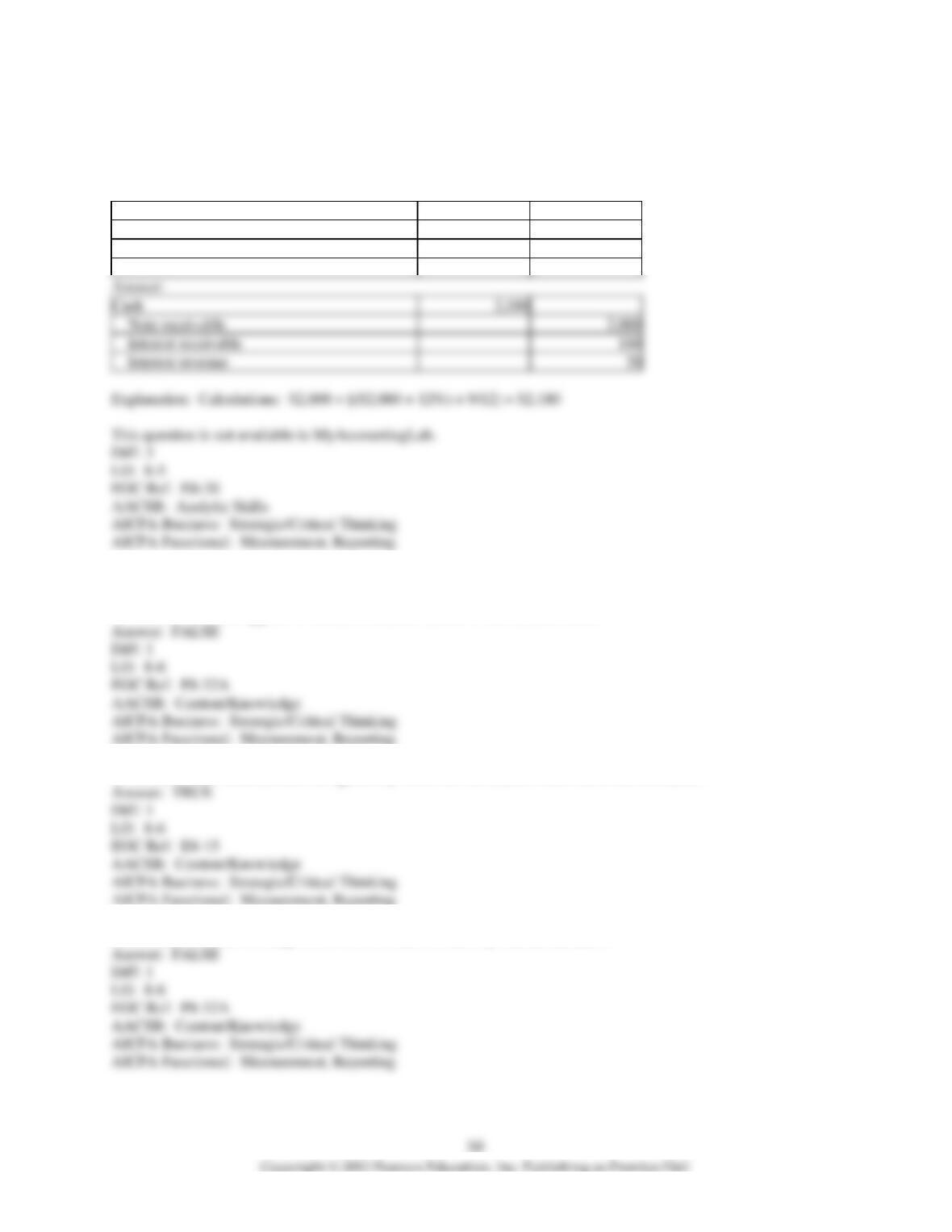
37) On December 1, 2013, Parsons Sales sold machinery to a customer for $2,000. The customer could not pay at
the time of sale, but agreed to pay 9 months later, and signed a 9–month note at 12% interest. Parsons accrues
interest only at year-end. On September 1, Parsons collected the whole amount due. Please provide the journal
entry needed to record the settlement of the note.
Cash
Learning Objective 8-6
1) The acid-test ratio appears in the current assets section of the balance sheet.
2) Accounts receivable amounts are generally shown on the balance sheet net of the allowance.
3) The acid-test ratio is computed as current assets divided by current liabilities.
4) Days’ sales in receivables is the ratio of average net accounts receivable to one day’s sales.
5) An acid–test ratio of at least 1.0 is considered safe.
6) The ratio that indicates how many days, on average, it takes to collect the receivables is known as the days’ sales
in receivables.
7) The acid-test ratio is also known as the quick ratio.
8) The ratio that indicates whether a company could pay all its current liabilities if they were to become due
immediately is known as the acid-test ratio.
9) The number of times per year a company sells goods and collects receivables is known as the accounts receivable
turnover.
10) Barker Sales has a days’ sales in receivables figure of 40 and Xanadu Company has a days’ sales in receivables
of 32. This would suggest that Xanadu is having greater difficulty collecting their accounts receivable than Barker.
11) A company reports Net accounts receivable of $107,460 on its December 31, 2013 balance sheet. The
Allowance for uncollectible accounts has a credit balance of $3,200. What is the balance in Accounts receivable?
A) $104,260
B) $107,460
C) $105,860
D) $110,660
12) Assets are listed on the balance sheet in order of liquidity. Which of the following items reflects the normal
order of liquidity?
A) Cash, Inventory, Notes receivable, Accounts receivable
B) Notes Receivable, Inventory, Accounts receivable, Cash
C) Cash, Accounts receivable, Inventory, Notes receivable
D) Plant assets, Inventory, Notes receivable, Cash
13) Which of the following is TRUE of the proper balance sheet treatment of the Allowance for uncollectible
accounts?
A) The Allowance for uncollectible accounts is reported as a current liability.
B) The Allowance for uncollectible accounts is reported as a current expense.
C) The Allowance for uncollectible accounts is reported as a separate line item under current assets.
D) Accounts receivable is shown under current assets, net of the allowance for uncollectible accounts.
14) A company has Net sales of $1,700,000, Beginning net receivables of $240,000 and Ending net receivables of
$180,000. What is Days’ sales in accounts receivable? (Please round to the nearest whole dollar.)
A) 50 days
B) 48 days
C) 45 days
D) 41 days
15) Target allows customers to use MasterCard. They report sales of $24,000 for the week. MasterCard charges
Target a 3% fee. The journal entry for this transaction would be:
A)
Sales
24,000
Bankcard discount expense
720
Cash
24,720
B)
Cash
24,000
Bankcard discount expense
720
Sales
24,720
C)
Cash
23,280
Bankcard discount expense
720
Sales
24,000
D) None of the above.
16) Which of the following is included in the numerator of the acid-test ratio?
A) Cash plus inventory
B) Accounts receivable and inventory
C) Cash, accounts receivable and short-term investments
D) All current assets
17) Which of the following is included in the denominator of the acid-test ratio?
A) All current liabilities except accounts payable
B) Total liabilities
C) Total current liabilities
D) Total current assets
18) A company has the following account balances. What is the acid-test ratio? (Please round to two decimal
places.)
Cash
$60,000
Short-term investments
75,000
Net current receivables
140,000
Inventory
145,000
Total current liabilities
395,000
A) .91
B) .94
C) 1.06
D) .70
19) A company has the following account balances. What is the acid-test ratio? (Please round to two decimal
places.)
Cash
$50,000
Short-term investments
85,000
Net current receivables
120,000
Inventory
145,000
Total current liabilities
275,000
A) .93
B) 1.45
C) .64
D) 1.76
20) Which of the following describes the key significance of the acid ratio?
A) It measures a company’s ability to pay its current liabilities by using its current assets.
B) It measures the profitability of a company.
C) It reflects how much long-term debt a company has.
D) It indicates how much cash could be realized by selling off all the inventory.
21) Which of the following is TRUE of days’ sales in receivables?
A) Days’ sales in receivables measures how many days it takes to order and receive inventory.
B) Days’ sales in receivables measures how frequently during the year the accounts receivable are collected.
C) Days’ sales in receivables measures how many days it takes to sell inventory.
D) Days’ sales in receivables measures how slowly the inventory is depreciated.
22) A company has Net sales of $850,000, Beginning net receivables of $230,000 and Ending net receivables of
$190,000. What is the days’ sales in accounts receivable? (Please round to nearest whole day.)
A) 82 days
B) 99 days
C) 93 days
D) 90 days
23) The accounts receivable turnover ratio measures:
A) how well a company can pay its current liabilities with its current assets.
B) how many days it takes, on average, to collect receivables.
C) how many days it takes, on average, to sell the inventory.
D) the number of times per year a company sells goods and collects receivables.
24) The days’ sales in receivables measures:
A) how well a company can pay its current liabilities with its current assets.
B) how many days it takes, on average, to collect receivables.
C) how many days it takes, on average, to sell the inventory.
D) the number of times per year a company sells goods and collects receivables.
25) The acid-test ratio measures:
A) how well a company can pay its current liabilities with its most liquid current assets.
B) how many days it takes, on average, to collect receivables.
C) how many days it takes, on average, to sell the inventory.
D) the number of times per year a company sells goods and collects receivables.
26) Martin Sales provides the following information:
Net credit sales $500,000
Net accounts receivable, beginning of year 23,500
Net accounts receivable, end of year 18,000
How much is the accounts receivable turnover ratio? (Please round to the nearest whole number.)
A) 0.24
B) 13.00
C) 27.00
D) 24.00
1) When a business is holding a note receivable and wishes to collect cash prior to the maturity date of the note, the
business may sell the note to a bank or a financial broker. This process is called discounting a note.
2) When a business discounts a note receivable to a bank or financial broker, the business will generally receive
either more or less than the maturity value of the note.
3) A business is holding a note receivable and wishes to cash it in before its maturity date by selling it to a bank. If
the business receives more than the maturity value of the note, the difference is treated as:
A) Interest revenue.
B) Sales revenue.
C) Gain on sale of property, plant & equipment.
D) Interest expense.
4) A business is holding a note receivable and wishes to cash it in before its maturity date by selling it to a bank. If
the business receives less than the maturity value of the note, the difference is treated as:
A) Interest revenue.
B) Sales revenue.
C) Gain on sale of property, plant & equipment.
D) Interest expense.
5) ABC receives a $9,000, 8%, 2-month note. The maturity value is:
A) $720.
B) $120.
C) $9,120.
D) $9,720.
6) Tarheel Services is holding a note receivable from one of its customers and wishes to collect the cash earlier than
the maturity date of the note. The note is for $1,000 and carries a rate of 4%. Tarheel sells the note to a bank for
$950. Please provide the journal entry which Tarheel makes to record this transaction.
Cash
7) Tarheel Services is holding a note receivable from one of its customers and wishes to collect the cash earlier than
the maturity date of the note. The note is for $1,000 and carries a rate of 4%. Tarheel sells the note to a bank for
$1,080. Please provide the journal entry with Tarheel makes to record this transaction.
Cash