6) After a subsidiary’s financial statements become consolidated into the parent company‘s statements,
the subsidiary’s statements remain available to the public.
7) After the work sheet is complete, the consolidated amount for each account represents the total asset,
liability, and equity amounts controlled by the parent corporation.
8) A noncontrolling interest arises in all consolidations, regardless of the parent’s level of ownership.
9) When a U.S. company owns a foreign subsidiary, a foreign-currency translation adjustment is
calculated using the subsidiary’s balance sheet.
10) A U.S. company sells merchandise on account to a German company. The German company must
settle the transaction in U. S. dollars.
11) When rates of return are high in a country with a stable economy, international investors buy stocks
and bonds of that country. This activity decreases the country’s exchange rate.
12) When the exchange rate of nation A‘s currency rises relative to another nation’s currency, the
currency of nation A is said to have strengthened.
13) Losses and gains from translation adjustments eventually are transferred to accumulated other
comprehensive income in the stockholders’ equity section of the balance sheet.
14) Goodwill occurs when a parent company:
A) pays less to acquire a subsidiary company than the fair market value of the subsidiary’s net assets.
B) pays less to acquire a subsidiary company than the book value of the subsidiary’s net assets.
C) pays more to acquire a subsidiary company than the fair market value of the subsidiary’s net assets.
D) pays more to acquire a subsidiary company than the book value of the subsidiary’s net assets.
15) Consolidated financial statements are prepared when a company owns ________ of the common
stock of another company.
A) between 20% and 50%
B) 50% or more
C) more than 50%
D) more than 90%
16) A noncontrolling interest arises when:
A) a parent company excludes the subsidiary company from the consolidated financial statements.
B) a parent company owns less than 100% of the stock of a subsidiary.
C) a subsidiary company is not included in the consolidated financial statements.
D) a subsidiary company represents less than 20% of the value of the consolidated company.
17) A consolidated balance sheet excludes:
A) a subsidiary’s stockholders’ equity.
B) a parent company’s Investment in Subsidiary account.
C) intercompany note receivable and note payable.
D) all of the above.
18) On a work sheet for a consolidated balance sheet, one elimination entry:
A) debits notes payable to suppliers and credits notes receivable from vendors.
B) debits notes payable to customers and credits notes receivable from suppliers.
C) debits the subsidiary’s stockholders’ equity accounts and credits the parent company’s Investment in
Subsidiary account.
D) debits the parent company’s Investment in Subsidiary account and credits the subsidiary’s
stockholders’ equity accounts.
19) Clarke Company owns all of the stock of Patterson Corporation and 90% of the stock of Tyra
Corporation. Clarke Company earned net income of $750,000; Patterson earned $230,000; and Tyra
earned $420,000. Clarke Company’s consolidated income statement would report net income of:
A) $750,000.
B) $980,000.
C) $1,358,000.
D) $1,400,000.
20) Desidero Corporation acquired 100% of the voting stock of Basile Company for $200,000. On the
date of acquisition, Basile Company’s stockholders’ equity consisted of: Common Stock, $130,000 and
Retained Earnings, $70,000. On the date of the acquisition, Desidero Company’s stockholders’ equity
consisted of: Common Stock $470,000 and Retained Earnings $1,010,000. The elimination entry to be
made on a work sheet, to prepare a consolidated balance sheet on the acquisition date, would include a:
A) debit to Common Stock for $130,000.
B) debit to Investment in Basile for $200,000.
C) credit to Common Stock for $130,000.
D) credit to Retained Earnings for $70,000.
21) A consolidated income statement will show:
A) only the parent’s net income.
B) only the income and dividends from partially owned subsidiaries.
C) the parent’s net income plus the parent’s proportional share of the subsidiary‘s net income.
D) the parent’s net income plus the subsidiary’s net income.
22) The balancing amount that brings the dollar amount of total liabilities and stockholders’ equity of a
foreign subsidiary into agreement with the dollar amount of its total assets is the:
A) equity adjustment.
B) foreign-currency exchange rate.
C) foreign-currency translation adjustment.
D) foreign consolidation adjustment.
23) Big Company owns 100% of the outstanding common stock of Small Company. Small Company
borrowed $18,000 from Big Company. Which elimination entry is required for this transaction?
A) debit Note Payable for $18,000 and credit Note Receivable for $18,000
B) debit Note Receivable for $18,000 and credit Note Payable for $18,000
C) debit Common Stock for $18,000 and credit Note Receivable for $18,000
D) debit Note Payable for $18,000 and credit Investment in Subsidiary for $18,000
24) Consolidated financial statements are prepared for the:
A) balance sheet and income statement only.
B) statement of cash flows and statement of stockholders’ equity only.
C) balance sheet, income statement and statement of cash flows only.
D) balance sheet, income statement, statement of cash flows and statement of stockholders’ equity.
25) Consolidated financial statements:
A) are prepared if the parent owns more than 20% of the investee’s voting stock.
B) do not include a consolidated statement of cash flows because investors need to understand the
separate cash flows of the parent and each individual subsidiary.
C) allow investors to gain a better perspective on total operations than they could by examining the
reports of the parent and each individual subsidiary.
D) do not identify the amount of noncontrolling interest in subsidiaries’ stock because investors do not
focus on that information.
26) A consolidated balance sheet reports the ________ account(s) of a 100% owned subsidiary.
A) Note Receivable from the parent
B) Common Stock
C) Retained Earnings
D) None of the above accounts are reported on the consolidated balance sheet.
27) Noncontrolling interest is reported in the:
A) liability section of the consolidated balance sheet.
B) intangible asset section of the consolidated balance sheet.
C) long-term investment section of the consolidated balance sheet.
D) stockholders’ equity section of the consolidated balance sheet.
28) The demise of Arthur Andersen, one of the largest public accounting firms, can be attributed to:
A) reversal of an indictment by the U.S. Justice Department.
B) fines levied by the U.S. Securities and Exchange Commission.
C) the death of its board chairman, Kenneth Lay.
D) the lack of quality of audit work for several clients that include Enron, WorldCom and Waste
Management.
29) Santa Ana Company, a U.S. company, purchased merchandise on account from a company in
England. The price was 1,000 British pounds. At the time of the purchase, the exchange rate for a British
pound was $1.52. At the time Santa Ana Company paid for the merchandise, the exchange rate for a
British pound was $1.55. What can be said about the pound relative to the U.S. dollar?
A) The pound weakened and the U.S. dollar strengthened over time.
B) The pound strengthened and the U.S. dollar weakened over time.
C) The pound and U.S. dollar strengthened over time.
D) The pound and U.S. dollar weakened over time.
30) When a foreign subsidiary’s balance sheet is translated into U.S. dollars, a ________ is calculated.
A) foreign-currency transaction gain or loss
B) foreign exchange conversion rate
C) foreign-currency translation gain or loss
D) foreign-currency exchange rate
31) A foreign currency translation adjustment is reported as:
A) Other comprehensive income on statement of comprehensive income.
B) Other comprehensive income on combined statement of income and comprehensive income.
C) Accumulated other comprehensive income on the balance sheet.
D) all of the above.
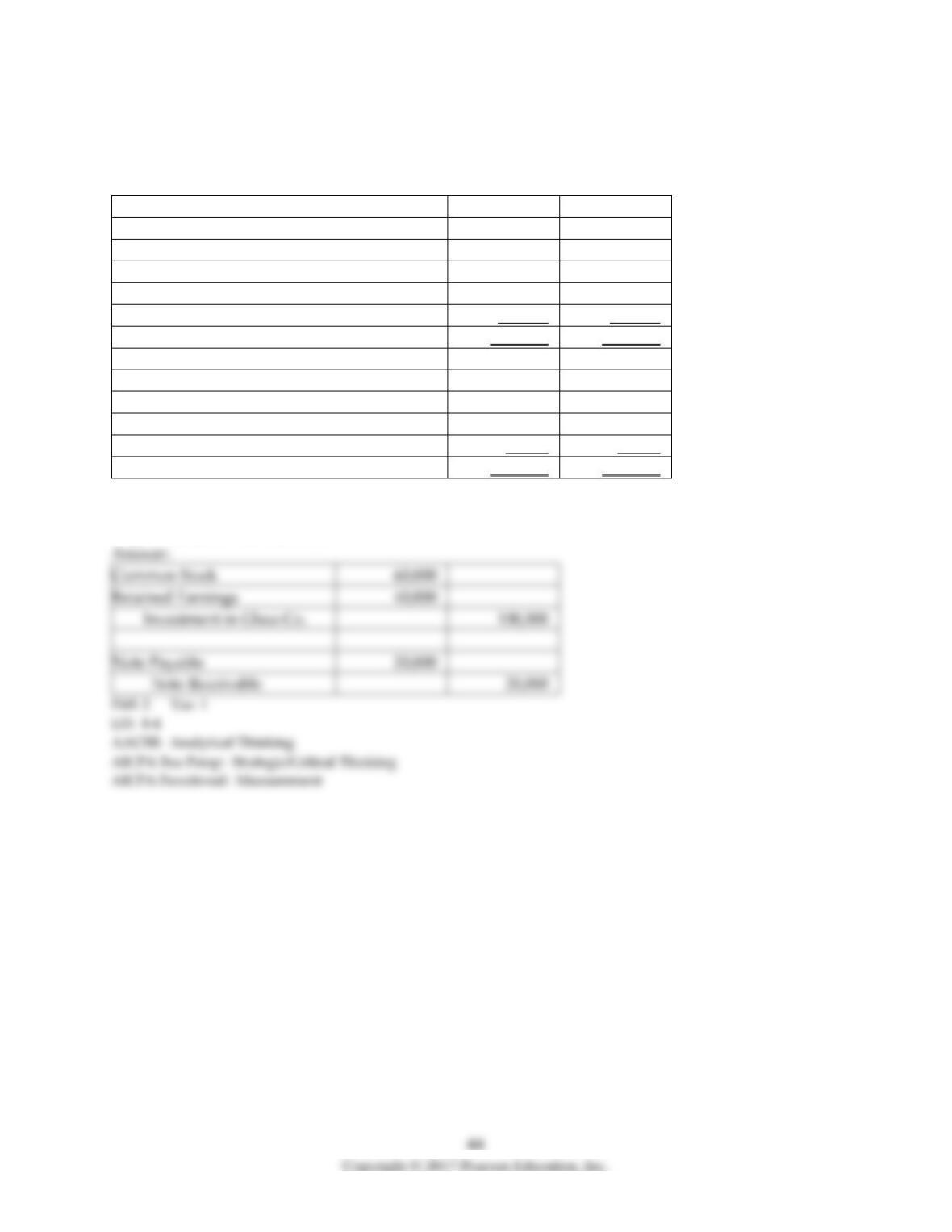
32) Colassal Company paid $100,000 for all the common stock of Glass Company. Glass Company
borrowed $20,000 from Colassal Company by signing a note payable. The following information is
available:
Colassal Co.
Glass Co.
Assets:
Cash
$ 7,000
$ 40,000
Note Receivable
20,000
Investment in Glass Co.
100,000
Other Assets
108,000
100,000
Total Assets
$235,000
$140,000
Liabilities and Stockholders’ Equity:
Accounts Payable
$ 15,000
$ 10,000
Notes Payable
20,000
30,000
Common Stock
120,000
60,000
Retained Earnings
80,000
40,000
Total Liabilities and Stockholders’ Equity
$235,000
$140,000
Required:
Prepare the elimination entries.
Common Stock
60,000
Retained Earnings
40,000
100,000
Note Payable
20,000
20,000
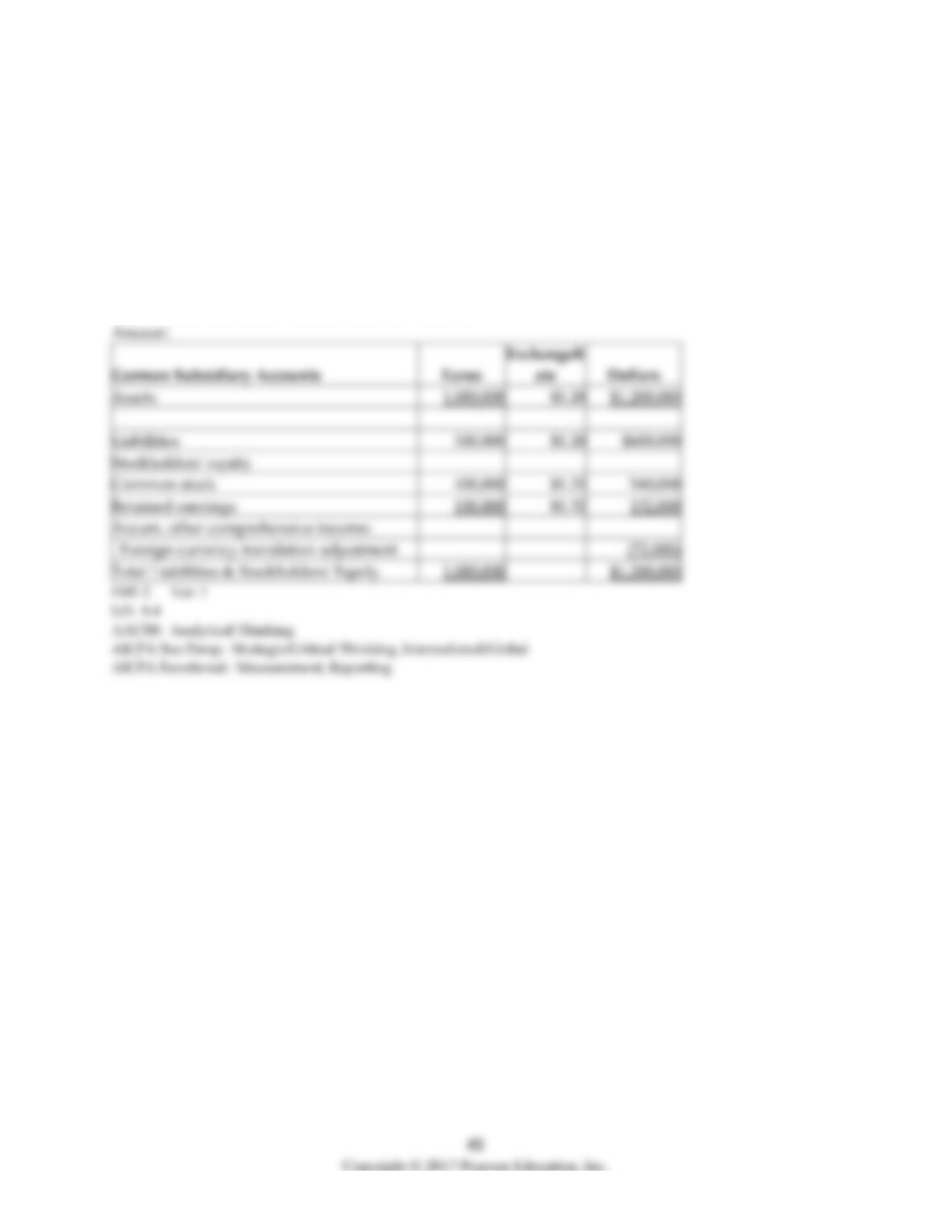
33) Parent Company acquired a subsidiary in Germany in 2012. The subsidiary’s balance sheet is stated
in euros. When Parent Company acquired the subsidiary in 2012, a euro was worth $1.35. When the
subsidiary earned its income during 2012-2017, the average exchange rate was $1.32. On December 31,
2017, a euro is worth $1.20.
At December 31, 2017, the subsidiary’s assets were 1,000,000 euros; the liabilities were 500,000 euros,
common stock was 400,000 euros and retained earnings was 100,000 euros.
Required:
Translate the subsidiary’s balance sheet into dollars.
5 Learning Objective 8-5
1) Cash proceeds from the sale of available-for-sale investments is reported as an investing activity on
the Consolidated Statement of Cash Flows.
2) The cash received when selling an investment in another company is reported on the statement of
cash flows as a(n):
A) investing cash outflow.
B) investing cash inflow.
C) financing cash outflow.
D) financing cash inflow.
3) The cash paid to purchase available-for-sale investments is reported on the statement of cash flows as
a(n):
A) increase in financing activities.
B) decrease in financing activities.
C) increase in investing activities.
D) decrease in investing activities.
4) The cash received from selling available-for-sale investments is reported on the statement of cash
flows as a(n):
A) increase in financing activities.
B) decrease in financing activities.
C) increase in investing activities.
D) decrease in investing activities.
5) The cash paid to purchase a held–to-maturity investment in bonds is reported on the statement of
cash flows as a(n):
A) increase in financing activities.
B) decrease in financing activities.
C) increase in investing activities.
D) decrease in investing activities.
6) The cash paid to purchase 40% of a corporation’s outstanding stock to be accounted for under the
equity method is reported on the statement of cash flows as a(n):
A) increase in financing activities.
B) decrease in financing activities.
C) increase in investing activities.
D) decrease in investing activities.
7) The cash received upon the maturity of bonds, that are classified as a held–to-maturity investment, is
reported on the statement of cash flows as:
A) financing activities.
B) operating activities.
C) investing activities.
D) none of the above.
6 Learning Objective 8-6
1) The present value of a single amount in the future can be determined using a present value of $1
table.
2) The process of determining the present value of a sum of money is called discounting because the
present value of a sum of money is more than the future value of a sum of money.
3) Ordinary annuity investments provide multiple receipts of an unequal amount at fixed year-end
intervals over the investment’s duration.
4) When the market interest rate is equal to the face interest rate on bonds, the present value of the
bonds will be less than the bond’s face value.
5) Most business decision makers solve present-value problems with Excel because the present-value
tables are limited to the interest rates in the columns or the periods of times in the rows.
6) The difference between the future value and the original investment is the amount of interest revenue
that will be earned.
7) Interest, the cost of using money, is recorded as interest revenue by the borrower.
8) The term time value of money refers to the fact that money earns interest over time.
9) Most business applications ignore compound interest.
10) All of the following are necessary to compute the future value of a single amount EXCEPT the:
A) interest rate.
B) length of time between investment and future payment or receipt.
C) amount of initial payment or receipt.
D) maturity value.
11) The future value of 1 will always be:
A) equal to 1.
B) greater than 1.
C) less than 1.
D) equal to the interest rate.
12) In present value calculations, the process of determining the present value of a single sum of money
is called:
A) allocating.
B) pricing.
C) negotiating.
D) discounting.
13) A single amount of $4700 is to be received in 3 years. If the single amount is discounted at 6% for 3
periods, the present value is ________. The present value of $1 for 3 periods at 6% is 0.840. The present
value of an ordinary annuity of $1 for 3 periods at 6% is 2.673. (Round your final answer to the nearest
dollar.)
A) $3948
B) $4418
C) $4700
D) $12,563
14) Which of the following discount rates will produce the smallest present value of a single sum of
money?
A) 4%
B) 6%
C) 7%
D) 9%
15) Cooper Company has purchased equipment that requires annual payments of $18,000 to be paid at
the end of each of the next 6 years. The discount rate is 8%. The present value of $1 for six periods at 8%
is 0.630. The present value of an ordinary annuity of $1 for six periods at 8% is 4.623. What amount will
be assigned to the equipment? (Round your final answer to the nearest dollar.)
A) $3894
B) $83,214
C) $94,554
D) $108,000
16) On January 1, 2016, bonds with a face value of $72,000 were sold. The bonds mature on January 1,
2026. The face interest rate is 6%. The bonds pay interest semiannually on July 1 and January 1. The
market rate of interest is 10%. What is the market price of the bonds? The present value of $1 for 20
periods at 5% is 0.377. The present value of an ordinary annuity of $1 for 20 periods at 5% is 12.462. The
present value of $1 for 20 periods at 3% is 0.554. The present value of an ordinary annuity of $1 for 20
periods at 3% is 14.878. (Round your final answer to the nearest dollar.)
A) $54,062
B) $74,160
C) $72,024
D) $72,000
17) On January 1, 2017, bonds with a face value of $94,000 were sold. The bonds mature on January 1,
2027. The face interest rate is 8% annually. The bonds pay interest semiannually on July 1 and January 1.
The market rate of interest is 10% annually. What is the market price of the bonds? The present value of
$1 for 20 periods at 5% is 0.377. The present value of an ordinary annuity of $1 for 20 periods at 5% is
12.462. The present value of $1 for 10 periods at 10% is 0.463. The present value of an ordinary annuity
of $1 for 10 periods at 10% is 6.145. (Round your final answer to the nearest dollar.)
A) $82,295
B) $66,627
C) $94,000
D) $97,760
18) Which of the following statements regarding the concept of present value is INCORRECT?
A) Compound interest is not only interest earned on the principal amount but also the interest received
on the interest already earned.
B) Ordinary annuity investments provide multiple receipts of an equal amount at fixed year-end
intervals over the investment’s duration.
C) When using the Present Value of Ordinary Annuity of $1 table, multiply the factor times the amount
that will be received at the end of each year times the number of years the amount will be received.
D) The present value of a bond is the present value of the principal amount at maturity plus the present
value of the stated interest payments.