Chapter 8 – Variable Costing and the Costs of Quality and Sustainability
8-41
74. The following data relate to Santa Mia, Inc., a new company:
Planned and actual production
200,000 units
Sales at $48 per unit
170,000 units
Manufacturing costs:
Variable
$18 per unit
Fixed
$840,000
Selling and administrative costs:
Variable
$7 per unit
Fixed
$925,000
There were no variances during the period.
Required:
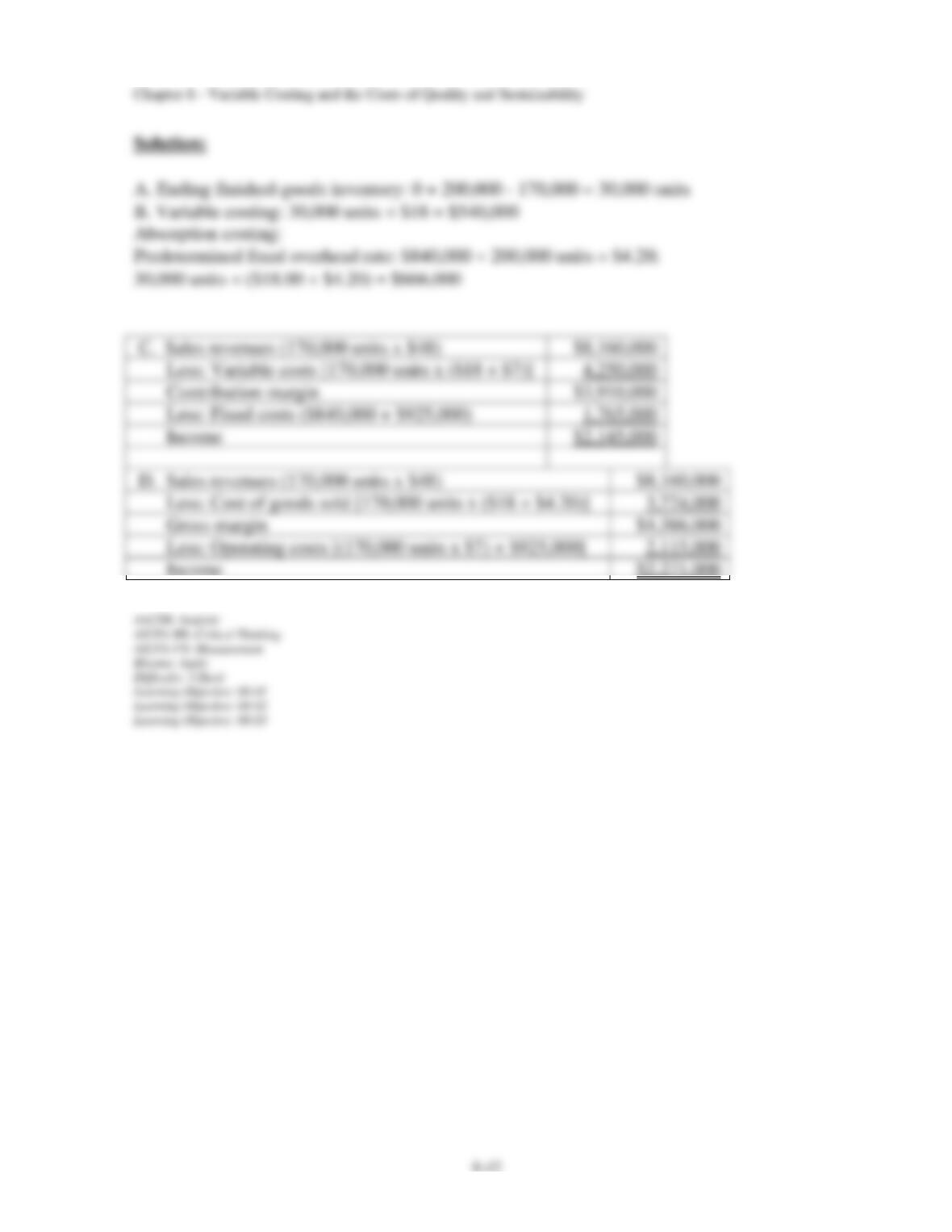
A. Determine the number of units in the ending finished-goods inventory.
B. Calculate the cost of the ending finished-goods inventory under (1) variable costing and (2)
absorption costing.
C. Determine the company’s variable-costing income.
D. Determine the company’s absorption-costing income.
8-43
75. Carrington, Inc. began business at the start of the current year and maintains its
accounting records on an absorption-cost basis. The following selected information appeared
on the company’s income statement and end-of-year balance sheet:
Income Statement data:
Sales revenues (35,000 units x $22)
$770,000
Gross margin
210,000
Total sales and administrative expenses
160,000
Balance sheet data:
Ending finished goods inventory (12,000 units)
192,000
Carrington achieved its planned production level for the year. The company’s fixed
manufacturing overhead totaled $141,000, and the firm paid a 10% commission based on
gross sales dollars to its sales force.
Required:
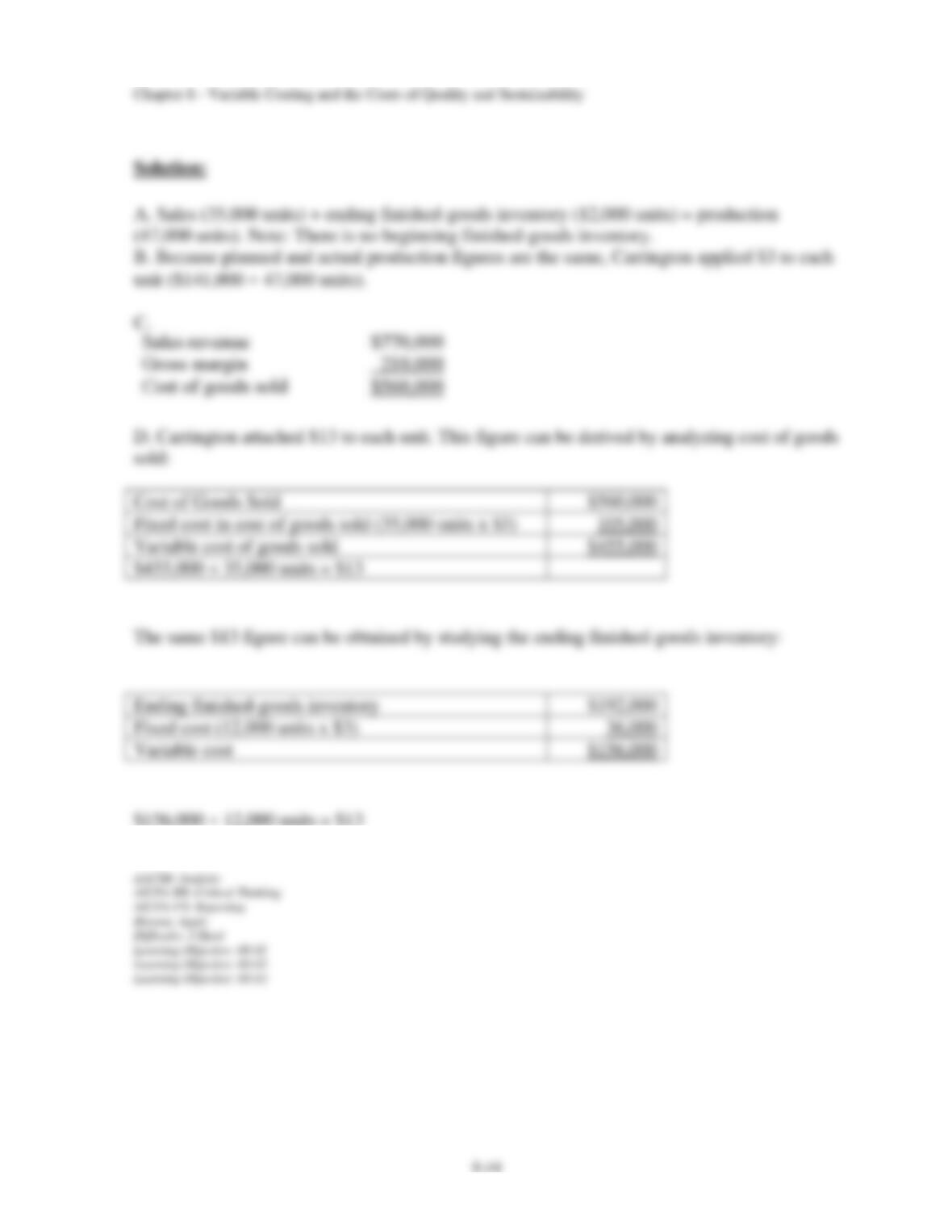
A. How many units did Carrington plan to produce during the year?
B. How much fixed manufacturing overhead did the company apply to each unit produced?
C. Compute Carrington’s cost of goods sold.
D. How much variable cost did the company attach to each unit manufactured?
76. Craig Company has per-unit fixed and variable manufacturing costs of $40 and $15,
respectively. Variable selling and administrative costs are $9 per unit. Consider the two
independent cases that follow for the firm.
Case A: Variable-costing income, $110,000; sales, 6,000 units; production, 6,000 units
Case B: Variable-costing income, $178,000; sales, 7,500 units; production, 7,100 units
Required:
A. From a product-costing perspective, what is the basic difference between absorption
costing and variable costing?
B. Compute Craig’s absorption-costing income in Case A.
C. Compute Craig’s absorption-costing income in Case B.
Solution:
77. Dalton Corporation has fixed manufacturing cost of $12 per unit. Consider the three
independent cases that follow.
Case A: Absorption- and variable costing income each totaled $240,000 in a period when the
firm produced 18,000 units.
Case B: Absorption-costing income totaled $320,000 in a period when finished-goods
inventory levels rose by 7,000 units.
Case C: Absorption-costing income and variable-costing income respectively totaled
$220,000 and $250,000 in a period when the beginning finished-goods inventory was 14,000
units.
Required:
A. In Case A, how many units were sold during the period?
B. In Case B, how much income would Dalton report under variable costing?
C. In Case C, how many units were in the ending finished-goods inventory?
Solution:
8-47
78. Carolina Corporation, which uses throughput costing, began operations at the start of the
current year. Planned and actual production equaled 20,000 units, and sales totaled 17,500
units at $95 per unit. Cost data for the year were as follows:
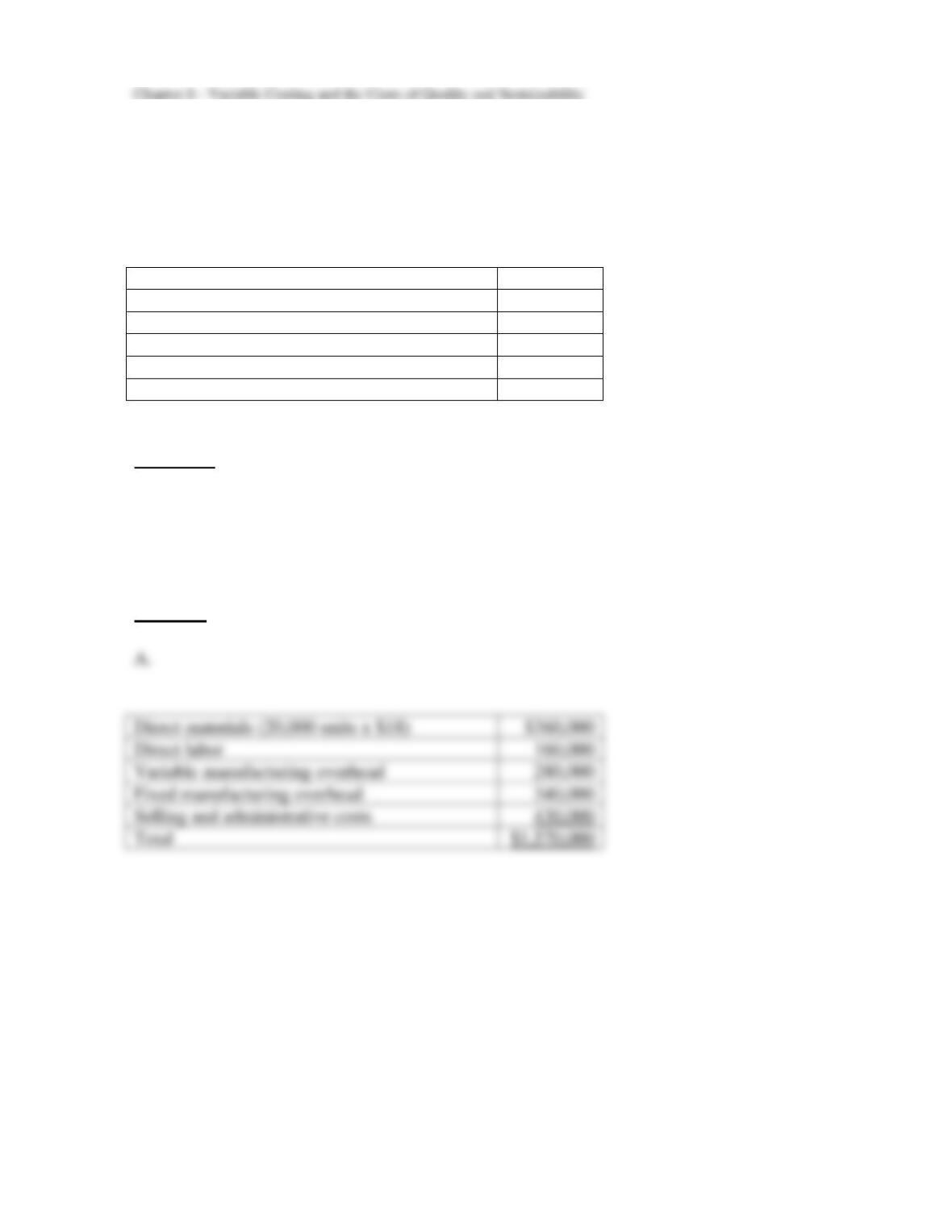
Direct materials (per unit)
$18
Conversion cost:
Direct labor
160,000
Variable manufacturing overhead
280,000
Fixed manufacturing overhead
340,000
Selling and administrative costs (total)
430,000
Required:
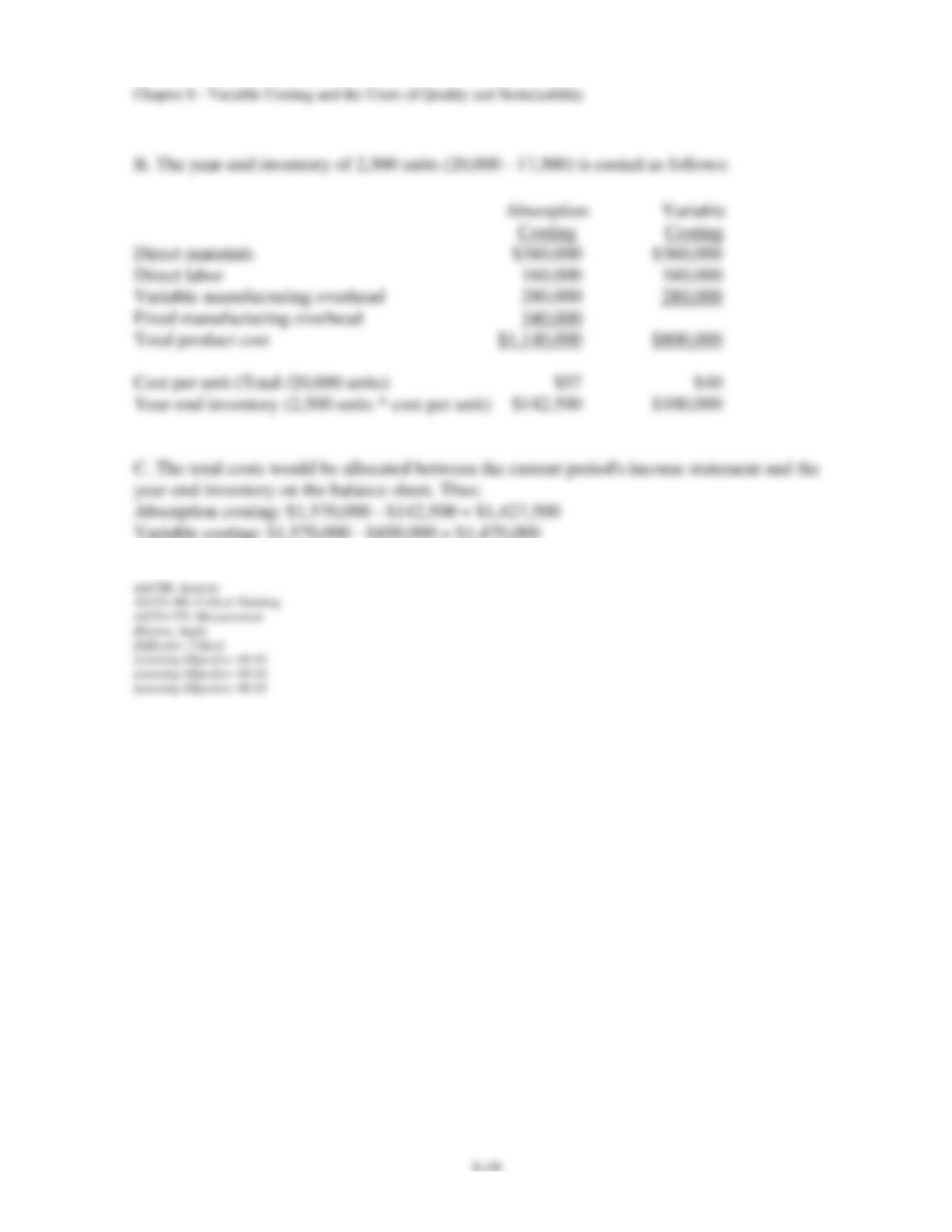
A. Compute the company’s total cost for the year.
B. How much of this cost would be held in year-end inventory under (1) absorption costing
and (2) variable costing?
C. How much of the company’s total cost for the year would appear on the period’s income
statement under (1) absorption costing and (2) variable costing?
Solution:
Direct materials (20,000 units x $18)
Direct labor
160,000
Variable manufacturing overhead
280,000
Fixed manufacturing overhead
340,000
Selling and administrative costs
430,000
Total
79. Absorption and variable costing are two different methods of measuring income and
costing inventory.
Required:
A. Product costs are defined as costs associated with the manufacturing process. How does
the operational definition of product cost differ between absorption costing and variable
costing?
B. An absorption-costing income statement will report gross profit or gross margin whereas a
variable-costing income statement will report contribution margin. What is the difference
between these terms?
Solution:
80. The difference in income between absorption and variable costing can be explained by the
change in finished-goods inventory (in units) multiplied by the standard fixed manufacturing
overhead rate.
Required:
Explain why this calculation accounts for the difference noted.
Solution:
81. Fly Boy Company manufactures fishing rods with a variable cost of $35. The rods sell for
$54. Budgeted fixed manufacturing overhead for the most recent year was $784,000. Actual
production was equal to planned production.
Required:
Under each of the following conditions, state (1) whether operating income is higher under
variable or absorption costing and (2) the amount of the difference in reported operating
income under the two methods. Treat each condition as an independent case.
A. Production .………………………………………. 196,000 units
Sales .……………………………………………..192,000 units
B. Production .………………………………………. 128,000 units
Sales .………………………………………………136,000 units
C. Production .………………………………………. 180,000 units
Sales .…………………………………………….. 180,000 units
Solution: