Chapter 8 – Variable Costing and the Costs of Quality and Sustainability
44. Which of the following statements pertain to both variable costing and absorption
costing?
45. Variable costing of inventory and absorption costing of inventory is relevant for which of
the following types of businesses?
46. Which of the following product-costing systems is/are required for tax purposes?
47. ProTech began business at the start of the current year. The company planned to produce
40,000 units, and actual production conformed to expectations. Sales totaled 37,000 units at
$42 each. Costs incurred were:
Variable manufacturing overhead per unit $19
Fixed manufacturing overhead 240,000
Variable selling and administrative cost per unit 7
Fixed selling and administrative cost per unit 140,000
If there were no variances, the company’s variable-costing income would be:
48. ProTech began business at the start of the current year. The company planned to produce
40,000 units, and actual production conformed to expectations. Sales totaled 37,000 units at
$42 each. Costs incurred were:
Variable manufacturing overhead per unit $19
Fixed manufacturing overhead 240,000
Variable selling and administrative cost per unit 7
Fixed selling and administrative cost per unit 140,000
If there were no variances, the company’s absorption-costing income would be:
49. The following data relate to Lebeaux Corporation for the year just ended:
Sales revenue $750,000
Cost of goods sold:
Variable portion 370,000
Fixed portion 110,000
Variable selling and administrative costs 50,000
Fixed selling and administrative cost 75,000
Which of the following statements is correct?
Chapter 8 – Variable Costing and the Costs of Quality and Sustainability
Use the following information to answer Questions 50 and 51.
Favaz began business at the start of this year and had the following costs: variable
manufacturing cost per unit, $9; fixed manufacturing costs, $60,000; variable selling and
administrative costs per unit, $2; and fixed selling and administrative costs, $220,000. The
company sells its units for $45 each. Additional data follow.
Planned production in units 10,000
Actual production in units 10,000
Number of units sold 8,500
There were no variances.
50. The income (loss) under absorption costing is:
51. The income (loss) under variable costing is:
52. Income reported under absorption costing and variable costing is:
53. Chu Enterprise’s inventory increased during the year. On the basis of this information,
income reported under absorption costing:
54. Which of the following conditions would cause absorption-costing income to be lower
55. Which of the following conditions would cause absorption-costing income to be higher
56. Which of the following situations would cause variable-costing income to be lower than
absorption-costing income?
57. Which of the following situations would cause variable-costing income to be higher than
absorption-costing income?
58. Consider the following statements about absorption- and variable-costing income:
I. Yearly income reported under absorption costing will differ from income reported under
variable costing if production and sales volumes differ.
II. In the long-run, total income reported under absorption costing will often be close to that
reported under variable costing.
III. Differences in income under absorption and variable costing can often be reconciled by
multiplying the change in inventory (in units) by the variable manufacturing overhead cost per
unit.
59. Which of the following formulas can often reconcile the difference between absorption–
and variable-costing income?
60. Foxtrot reported $65,000 of income for the year by using absorption costing. The
company had no beginning inventory, planned and actual production of 20,000 units, and
sales of 18,000 units. Standard variable manufacturing costs were $20 per unit, and total
budgeted fixed manufacturing overhead was $100,000. If there were no variances, income
under variable costing would be:
61. Razor Technologies reported $106,000 of income for the year by using variable costing.
The company had no beginning inventory, planned and actual production of 50,000 units, and
sales of 47,000 units. Standard variable manufacturing costs were $15 per unit, and total
budgeted fixed manufacturing overhead was $150,000. If there were no variances, income
under absorption costing would be:
62. Consider the following statements about absorption costing and variable costing:
I. Variable costing is consistent with contribution reporting and cost-volume-profit analysis.
II. Absorption costing must be used for external financial reporting.
III. A number of companies use both absorption costing and variable costing.
Which of the above statements is (are) true?
63. Consider the following statements about absorption costing and variable costing:
I. Variable costing is consistent with contribution reporting and cost-volume-profit analysis.
II. Variable costing must be used for external financial reporting.
III. A number of companies use both absorption costing and variable costing.
64. For external-reporting purposes, generally accepted accounting principles require that net
income be based on:
65. Which of the following is not a type of quality cost?
66. Costs of determining whether defects exist are called:
67. The optimum level of product quality is where:
68. Which of the following statements about environmental costs is false?
Chapter 8 – Variable Costing and the Costs of Quality and Sustainability
Essay Questions
69. Consider the statements that follow.
1. Variable selling costs are expensed when incurred.
2. The income statement discloses a company’s contribution margin.
3. Fixed manufacturing overhead is attached to each unit produced.
4. Direct labor becomes part of a unit’s cost.
5. Sales revenue minus cost of goods sold equals contribution margin.
6. This method must be used for external financial reporting.
7. Fixed selling and administrative expenses are treated in the same manner as fixed
manufacturing overhead.
8. This method is sometimes called full costing.
9. This method requires the calculation of a fixed manufacturing cost per unit.
Required:
Determine which of the nine statements:
A. Relate only to absorption costing.
B. Relate only to variable costing.
C. Relate to both absorption costing and variable costing.
D. Relate to neither absorption costing nor variable costing.
Solution:
8-36
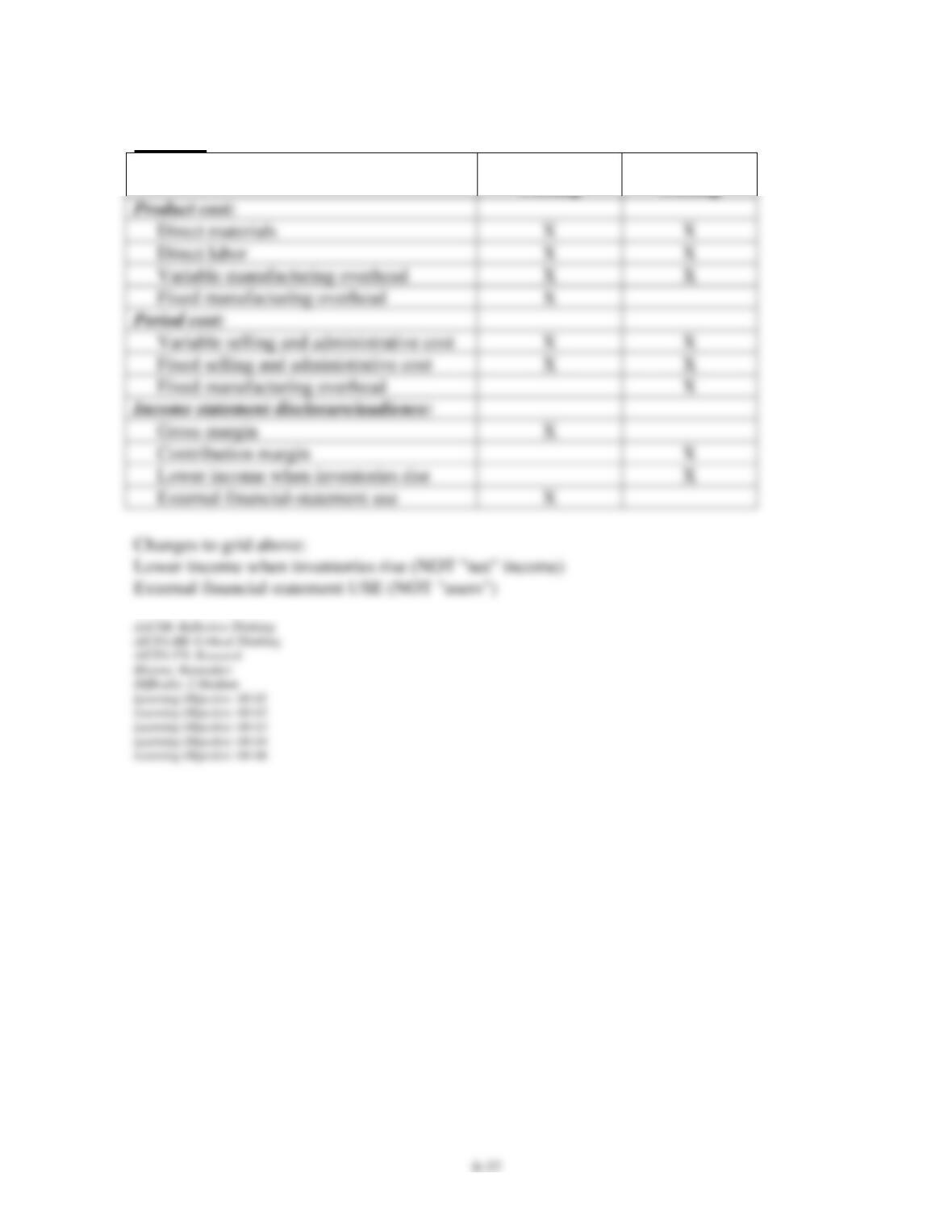
70. The table that follows denotes selected characteristics of absorption costing and/or
variable costing.
Characteristic
Absorption Costing
Variable Costing
Product cost:
Direct materials
Direct labor
Variable manufacturing overhead
Fixed manufacturing overhead
Period cost:
Variable selling and administrative cost
Fixed selling and administrative cost
Fixed manufacturing overhead
Income statement disclosure/audience:
Gross margin
Contribution margin
Lower net income when inventories rise
External financial-statement users
Required:
Evaluate each product-cost, period-cost, and income-statement/disclosure characteristic and
determine whether it relates to absorption costing, variable costing, or both methods. Place an
“X” in the proper column.
Chapter 8 – Variable Costing and the Costs of Quality and Sustainability
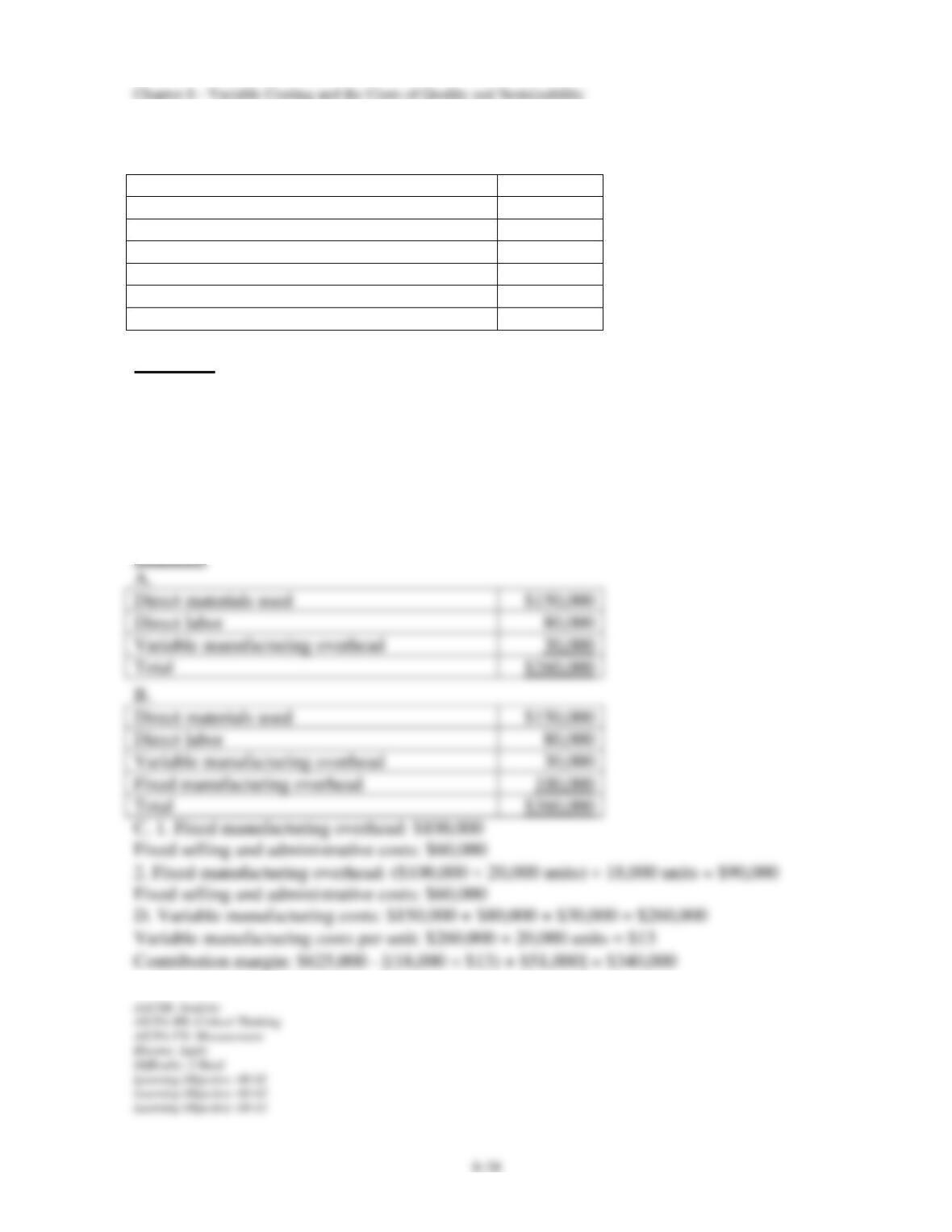
Solution:
Characteristic
Absorption
Costing
Variable
Costing
71. Information taken from Horner Corporation’s May accounting records follows.
Direct materials used
$150,000
Direct labor
80,000
Variable manufacturing overhead
30,000
Fixed manufacturing overhead
100,000
Variable selling and administrative costs
51,000
Fixed selling and administrative costs
60,000
Sales revenues
625,000
Required:
A. Assuming the use of variable costing, compute the inventoriable costs for the month.
B. Compute the month’s inventoriable costs by using absorption costing.
C. Assume that anticipated and actual production totaled 20,000 units, and that 18,000 units
were sold during May. Determine the amount of fixed manufacturing overhead and fixed
selling and administrative costs that would be expensed for the month under (1) variable
costing and (2) absorption costing.
D. Assume the same data as in requirement “C.” Compute the contribution margin that would
be reported on a variable-costing income statement.
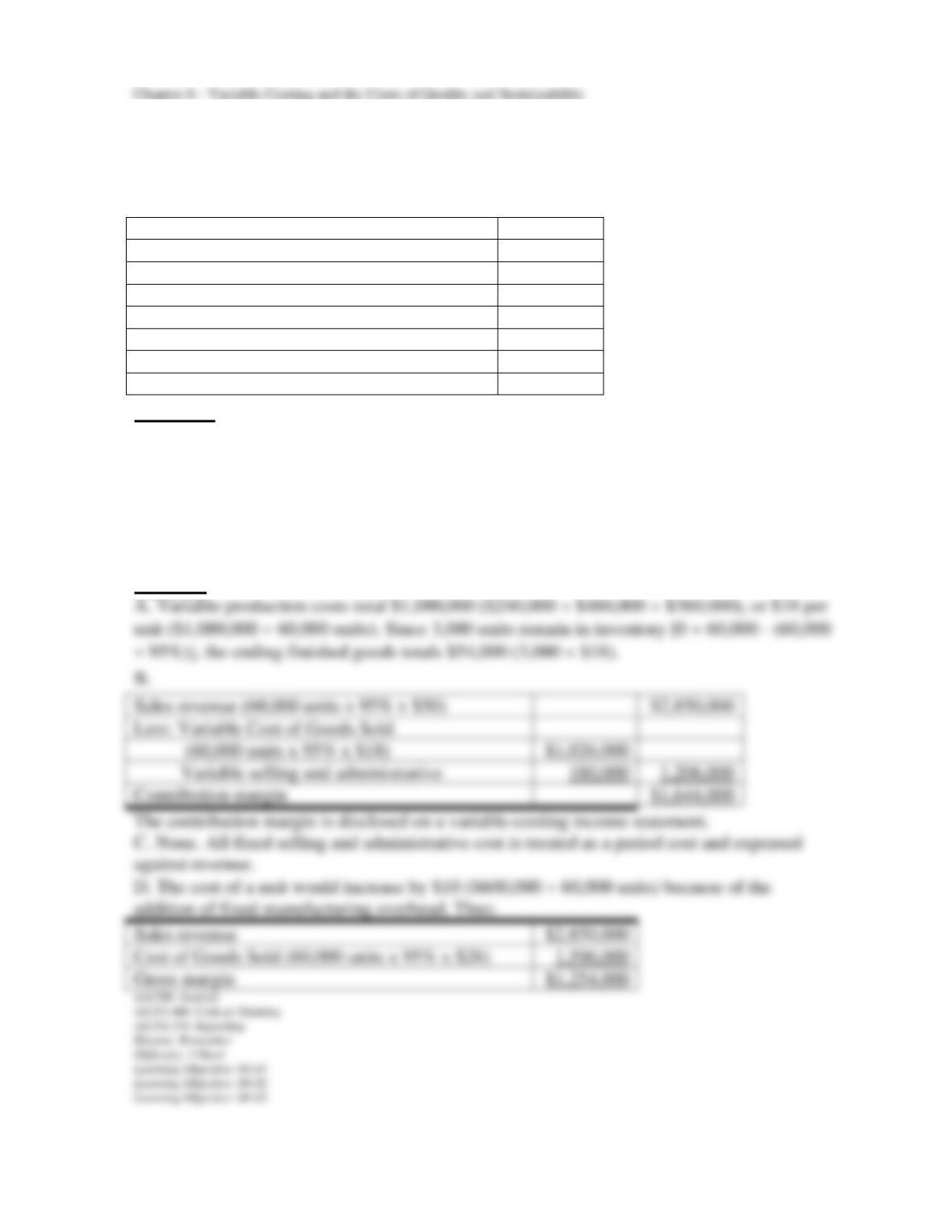
Solution:
Direct materials used
$150,000
Direct labor
80,000
Variable manufacturing overhead
30,000
Total
$260,000
Direct materials used
$150,000
Direct labor
80,000
Variable manufacturing overhead
30,000
Fixed manufacturing overhead
100,000
Total
$360,000
8-39
72. Vero, Inc. began operations at the start of the current year, having a production target of
60,000 units. Actual production totaled 60,000 units, and the company sold 95% of its
manufacturing output at $50 per unit. The following costs were incurred:
Manufacturing:
Direct materials used
$240,000
Direct labor
480,000
Variable manufacturing overhead
360,000
Fixed manufacturing overhead
600,000
Selling and administrative:
Variable
180,000
Fixed
630,000
Required:
A. Assuming the use of variable costing, compute the cost of Vero’s ending finished-goods
inventory.
B. Compute the company’s contribution margin. Would Vero disclose the contribution margin
on a variable-costing income statement or an absorption-costing income statement?
C. Assuming the use of absorption costing, how much fixed selling and administrative cost
would Vero include in the ending finished-goods inventory?
D. Compute the company’s gross margin.
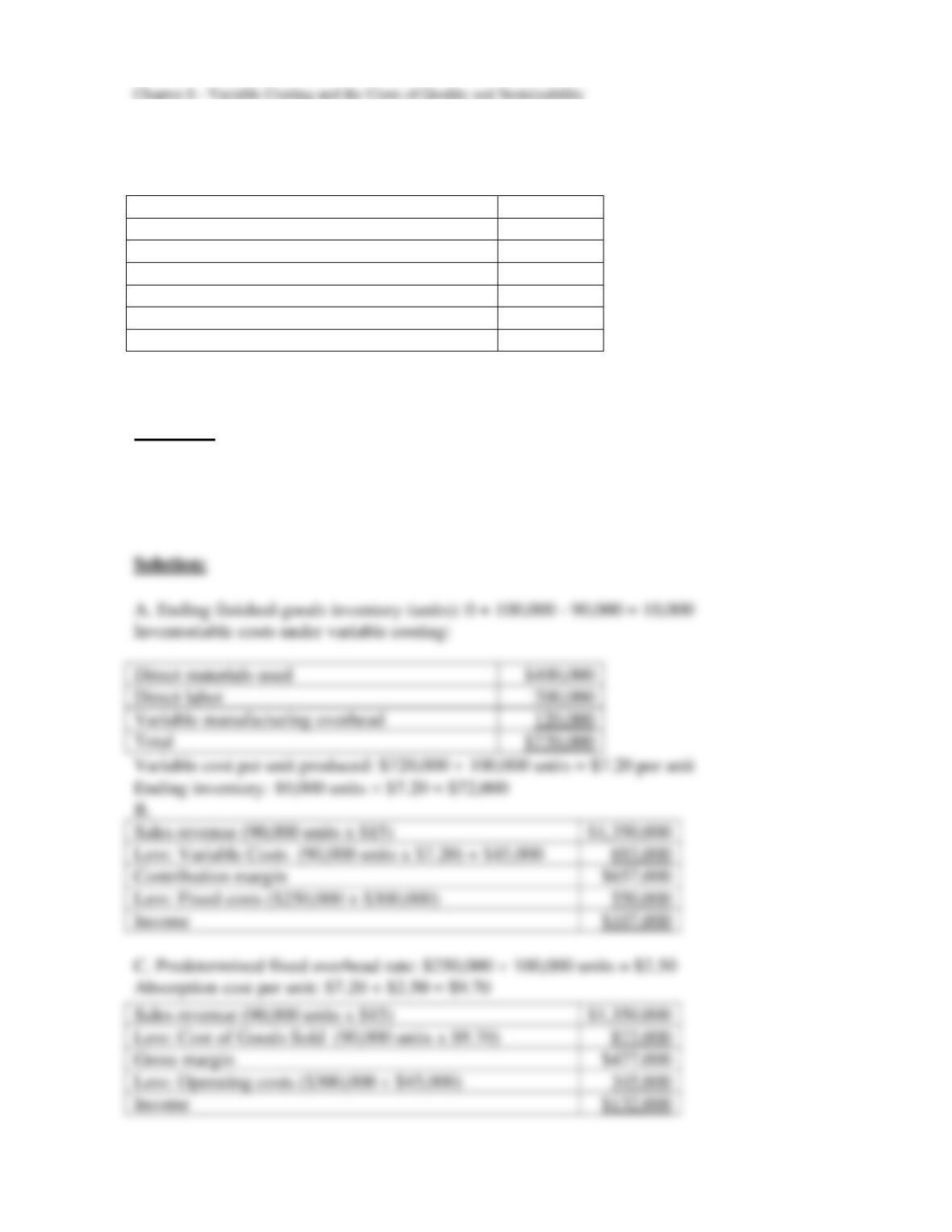
Solution:
Sales revenue (60,000 units x 95% x $50)
Less: Variable Cost of Goods Sold
(60,000 units x 95% x $18)
Variable selling and administrative
180,000
Contribution margin
Sales revenue
Cost of Goods Sold (60,000 units x 95% x $28)
Gross margin
8-40
73. The following data relate to Jupiter Company, a new corporation, during a period when
the firm produced and sold 100,000 units and 90,000 units, respectively:
Direct materials used
$400,000
Direct labor
200,000
Variable manufacturing overhead
120,000
Fixed manufacturing overhead
250,000
Selling and administrative expenses:
Variable
45,000
Fixed
300,000
The company met its original planned production target of 100,000 units. There were no
variances during the period, and the firm’s selling price is $15 per unit.
Required:
A. What is the cost of Jupiter’s end-of-period finished-goods inventory under the variable-
costing method?
B. Calculate the company’s variable-costing income.
C. Calculate the company’s absorption-costing income.
Direct materials used
$400,000
Direct labor
200,000
Variable manufacturing overhead
120,000
Total
$720,000
Sales revenue (90,000 units x $15)
$1,350,000
Less: Variable Costs (90,000 units x $7.20) + $45,000
Contribution margin
Less: Fixed costs ($250,000 + $300,000)
Income
Sales revenue (90,000 units x $15)
$1,350,000
Less: Cost of Goods Sold (90,000 units x $9.70)
Gross margin