37) Other comprehensive income:
A) is a separate section of stockholders’ equity on the balance sheet.
B) is reported in the liability section of the balance sheet.
C) is reported on the statement of comprehensive income.
D) is reported in the long–term investments section of the balance sheet.
38) The Allowance to Adjust Investment in Available-for-Sale Securities to Market account has a current
credit balance of $1200 after the adjustment at year-end. Available-for-sale investments have a fair value
of $21,000. The original cost of the investments was $22,200. The carrying value of the investments is:
A) $23,400.
B) $19,800.
C) $21,000.
D) $22,200.
39) The Allowance to Adjust Investment in Available-for-Sale Securities to Market account has a current
credit balance of $842. Long-term available-for-sale investments with a cost of $16,000 have a current
fair value of $18,400. The adjusting entry will require a:
A) credit to Allowance to Adjust Investment in Available-for-Sale Securities to Market for $1558.
B) credit to Allowance to Adjust Investment in Available–for-Sale Securities to Market for $3242.
C) debit to Allowance to Adjust Investment in Available-for-Sale Securities to Market for $1558.
D) debit to Allowance to Adjust Investment in Available-for-Sale Securities to Market for $3242.
40) Which is the most reliable method for determining the fair value of the available-for-sale portfolio?
A) estimates based on other observable inputs
B) quoted prices in active markets for identical assets
C) the company’s own estimates based on certain assumptions
D) None of the above statements are correct because the periodic adjustment to fair value cannot be
made for the portfolio as a whole.
41) On January 1, 2017, Imagine Corporation purchases bonds in Berkeley Company. The bonds mature
on January 1, 2027. Imagine Corporation intends to hold the bonds longer than one year but not until
the maturity date. How should Imagine Corporation classify these bonds?
A) trading security
B) held-to-maturity investment in bonds
C) equity method investment
D) investment in available-for-sale securities
42) On January 1, 2017, Jude Corporation purchases stock in Gelco Company. Jude Corporation owns
15% of the outstanding stock of Gelco Company. Jude Corporation intends to hold the stock for longer
than one year. How should Jude Corporation classify this stock?
A) investment in trading securities
B) held-to-maturity investment in bonds
C) short-term investment
D) investment in available-for-sale securities
43) Murphy Enterprises holds the following available-for-sale securities as long-term investments on
December 31, 2017:
Level 1
Stock
Cost
Fair Value
ABC Corporation
$95,000
$88,000
Turner Incorporated
115,000
145,000
Smith Company
48,000
51,000
Total
$258,000
$284,000
What amount will be reported as long-term investments on Murphy’s December 31, 2017 balance sheet?
A) $291,000
B) $284,000
C) $258,000
D) $251,000
44) The Allowance to Adjust Investment in Available-for-Sale Securities to Market is:
A) a required account used with Investment in Available-for-Sale Securities.
B) an optional companion account to Investment in Available-for-Sale Securities.
C) always added to the Investment in Available–for-Sale Securities.
D) always subtracted from the Investment in Available-for-Sale Securities.
45) U.S. Generally Accepted Accounting Principles require that a company adjust ________ of available-
for-sale securities to ________ at the end of each accounting period.
A) each security; amortized cost
B) each security; lower of cost or market
C) the portfolio; current replacement cost
D) the portfolio; fair value
46) Following U.S. Generally Accepted Accounting Principles, the fair value of a stock investment
should be determined using ________. Assume the stock is listed on a publicly-traded securities
exchange.
A) quoted prices in active markets for identical stocks
B) quoted prices for similar stocks
C) the investor’s own estimates based on certain assumptions
D) the investor’s educated guesses
47) A company has a long-term Investment in Available-for-Sale Securities. The investor’s percentage
ownership is 5%. On January 1, 2017, the purchase date, the cost of the stock investment was $107,000.
On December 31, 2017, the fair value of the investment is $105,000. An allowance account is used to
write-down the investment. On January 30, 2018, the investor sold the stock for $99,650. What journal
entries are required on January 30, 2018?
A) debit Allowance to Adjust Investment in Available-for-Sale Securities to Market for $2000 and credit
Unrealized Loss on Investment in Available-for-Sale Securities for $2000
B) debit Cash for $99,650, debit Loss on Sale of Investment in Available-for-Sale Securities for $7350 and
credit Investment in Available-for-Sale Securities for $107,000
C) debit Cash for $99,650, debit Loss on Sale of Investment of Available-for-Sale Securities for $5350 and
credit Investment in Available-for-Sale Securities for $105,000
D) A and B
48) A company has a long-term investment in available-for-sale securities. The Unrealized Gain on
Investment in Available-for-Sale Securities is reported as:
A) Other comprehensive income in the statement of comprehensive income.
B) Other gains on the income statement.
C) a change in owners’ equity that bypasses net income.
D) A and C.
49) On January 1, 2016, a company purchased long-term available-for-sale securities in one company.
The cost was $91,000 and the investor owns 5% of the outstanding common stock of the investee. The
investor does not use an allowance account to adjust the investment. At December 31, 2016, the fair
value of the investment is $87,000. What journal entry is needed on December 31, 2016?
A) debit Unrealized Loss on Investment in Available-for-Sale Securities for $4000 and credit Investment
in Available-for-Sale Securities for $4000
B) debit Investment in Available-for-Sale Securities for $4350 and credit Unrealized Gain on Investment
in Available-for-Sale Securities for $4350
C) debit Investment in Available-for-Sale Securities for $4550 and credit Unrealized Gain on Investment
in Available-for-Sale Securities for $4550
D) debit Investment in Available-for-Sale Securities for $4000 and credit Unrealized Gain on Investment
in Available-for-Sale Securities for $4000
50) On January 1, 2016, Innocente Company purchased 1,000 shares of Entel common stock at $40 per
share. Innocente intends to hold this investment for longer than one year. On June 1, 2016, Entel
declares and distributes a cash dividend of $0.50 per share. On December 31, 2016, the market price of
Entel’s stock is $44 per share. On December 31, 2017, the market price of Entel’s stock is $46 per share.
On February 1, 2018, the Entel’s stock is sold for $48 per share. Innocente Company uses a separate
allowance account to adjust the investment.
Prepare the journal entries on:
1. January 1, 2016
2. June 1, 2016
3. December 31, 2016
4. December 31, 2017
5. February 1, 2018
Explanations are not required.
3 Learning Objective 8-3
1) When an investor owns 35% of the stock of another business, cash dividends received from the
investee company are recorded by decreasing the Equity–method Investment account.
2) The equity method is used to account for stock investments in which the investor company owns less
than 20% of the outstanding stock of the investee.
3) Investments accounted for by the equity method are recorded initially at cost.
4) If an investor owns between 20% and 50% of an investee’s voting stock, it is assumed that the investor
has significant influence over the investee.
5) Under the equity method, when the investee reports net income, the Equity-method Investment
account increases.
6) When the equity method is used to account for stock investments, the carrying value of an
investment is the fair value as of the balance sheet date.
7) Under the equity method, the investor applies his percentage of ownership in recording his share of
the investee’s net income, but not dividends.
8) An investor owning between 20% and 50% of the investee’s voting stock can probably affect dividend
policies, product lines, and other important matters in the investee’s business.
9) When an investor owns between 20% and 50% of the outstanding stock of another company, the
________ method is used to account for the stock investment.
A) fair value
B) equity
C) consolidated
D) available-for-sale
10) An investor who may significantly influence the business activities of the investee should report the
investment using the:
A) fair value method.
B) consolidated method.
C) equity method.
D) available-for-sale method.
11) The equity method of accounting for a stock investment should generally be used when the investor
owns a level of stock ownership that:
A) gives the investor minor influence over the investee.
B) usually indicates a plan to acquire a controlling interest in the investee company.
C) requires the investor to prepare consolidated financial statements.
D) gives the investor significant influence over the investee company.
12) Under the equity method, the Equity-method Investment account is debited when the:
A) investee reports net income.
B) investee reports net loss.
C) investor receives a cash dividend.
D) investment is sold.
13) A company that owns 40% of the common stock of another business recognizes revenue from the
investment when:
A) the investor sells the shares in the investee company.
B) the investee issues a cash dividend.
C) the investee recognizes net income.
D) the investee issues a stock dividend.
14) Wolverine Corporation owns 27% of Buckeye Corporation. Net income for Buckeye for the year is
$300,000. The journal entry prepared by Wolverine Corporation is:
A) debit Equity-method Investment for $81,000 and credit Cash for $81,000.
B) debit Equity-method Investment for $81,000 and credit Equity-Method Investment Revenue for
$81,000.
C) debit Cash for $81,000 and credit Equity-method Investment for $81,000.
D) debit Equity-method Investment for $300,000 and credit Equity-method Investment Revenue for
$300,000.
15) If an investor company owns 35% of the common stock of another business, the investor:
A) receives 35% of the investee’s net income in cash.
B) reports the Equity-method Investment Revenue on the balance sheet.
C) records dividends received as investment revenue.
D) decreases its Equity-method Investment account for 35% of net losses reported by the investee
company.
16) Under the equity method of accounting for long-term investments in common stock, when a cash
dividend is received from the investee company:
A) the investor’s Equity-method Investment account is increased.
B) the Dividend Revenue account is increased.
C) the investor’s Equity-method Investment account is decreased.
D) no entry is necessary.
17) If the equity method is used to account for a long-term investment in common stock, cash dividends
received from the investee are recorded by the investor as:
A) a debit to Equity-method Investment and a credit to Equity-method Investment Revenue.
B) a debit to Cash and a credit to Dividend Revenue.
C) a debit to Dividend Receivable and a credit to Dividend Revenue.
D) a debit to Cash and a credit to Equity-method Investment
18) Acme Company owns 35% of Superior Company. Superior Company declared and paid $33,000
cash dividends for the year. Acme Company’s journal entry to record the dividends includes a:
A) credit to Equity-method Investments for $11,550.
B) credit to Equity-method Investments for $33,000.
C) credit to Dividend Revenue for $11,550.
D) credit to Dividend Revenue for $33,000.
19) A gain or loss on the sale of a long-term investment using the equity method is calculated by taking
the difference between the sale proceeds and the:
A) fair value of the investment.
B) lower-of-cost-or-market value of the investment.
C) cost of the investment.
D) carrying value of the investment.
20) Under the equity method, if an Equity-method Investment is sold at a gain, the gain is:
A) reported as operating revenue on the income statement.
B) reported on the balance sheet as an adjustment to accumulated other comprehensive income.
C) reported in the Other revenue and gain section of the income statement.
D) reported as Other comprehensive income on the statement of comprehensive income.
21) Under the equity method, if the investee company has a net loss, the investor company will
________ for its share of the net loss.
A) debit the Equity-method Investment account
B) credit the Unrealized Loss on Equity-method Investment account
C) credit the Equity-method Investment account
D) debit the Unrealized Loss on Equity-method Investment
22) On January 1, 2017, Barry Corporation paid $750,000 for 100,000 shares of Oak Company’s common
stock, which represents 40% of Oak’s outstanding common stock. For the year ending December 31,
2017, Oak reported net income of $190,000 and declared and paid cash dividends of $60,000. Barry
should report the investment in Oak Company on its balance sheet at December 31, 2017 at:
A) $750,000.
B) $698,000.
C) $774,000.
D) $802,000.
23) On January 1, 2016, Benson Corporation paid $780,000 to purchase 30% of the outstanding stock of
Westin Company. Westin Company reported net income of $180,000 for the year ending December 31,
2016 and declared and paid cash dividends of $40,000 during 2016. On January 1, 2017, Benson
Corporation sells its entire investment in Westin Company for $1,200,000. Benson Corporation will
report a(n):
A) realized gain on the sale of $420,000.
B) unrealized gain on the sale of $420,000.
C) realized gain on the sale of $378,000.
D) unrealized gain on the sale of $378,000.
24) Daniel Company purchased 34% of the outstanding shares of Clooney Corporation on January 1 at a
cost of $620,000. Clooney Corporation reported net income of $93,000 and declared and paid total
dividends of $20,000 for the year. At the end of the year, Clooney shares had a current fair value of
$614,000. After all necessary adjusting entries are made for the year, the balance in Daniel Company’s
Equity-method Investment account will be:
A) $614,000.
B) $644,820.
C) $693,000.
D) $687,000.
25) On January 1, 2016, Conner Corporation purchased 100,000 of the 400,000 shares of outstanding
stock of JJ Company for $560,000. Net income reported by JJ Company for 2016 was $600,000. Dividends
declared and paid by JJ Company during 2016 were $130,000. The Equity–method Investment will be
reported on Conner Corporation’s December 31, 2016 balance sheet in the amount of:
A) $560,000.
B) $592,500.
C) $677,500.
D) $742,500.
26) On January 1, 2016, Rod Corporation purchased 40% of the outstanding stock of Alamo Corporation
for $480,000. Net income reported by Alamo for 2016 was $210,000. Dividends declared and paid by
Alamo during 2016 were $40,000. The amount of investment revenue that Rod should recognize for
2016 is:
A) $16,000.
B) $68,000.
C) $84,000.
D) $100,000.
27) On January 1, 2017, Gardner Corporation purchased 29% of the common stock outstanding of Lance
Corporation for $300,000. During 2017, Lance Corporation reported net income of $80,000 and declared
and paid cash dividends of $37,000. The balance of the Equity-method Investment account at December
31, 2017 is:
A) $300,000.
B) $312,470.
C) $323,200.
D) $333,930.
28) Milton Company owns 26% interest in the stock of Darcy Corporation. During the year, Darcy
declares and pays $23,000 in dividends to Milton, and reports $110,000 in net income. Milton Company
will report Equity-method Investment Revenue of:
A) $5980.
B) $22,620.
C) $28,600.
D) $34,580.
29) An investor owns 28% of the outstanding common stock of Stokes Corporation. Stokes Corporation
declares and pays a $60,000 dividend. Which journal entry should the investor prepare?
A) debit Equity-method Investment for $16,800 and credit Cash for $16,800
B) debit Cash for $16,800 and credit Equity-method Investment for $16,800
C) debit Cash for $16,800 and credit Dividend Revenue for $16,800
D) debit Dividend Receivable for $16,800 and credit Dividend Revenue for $16,800
30) An investor owns 32% of the outstanding common stock of Leshan Company. Leshan Company
reports net income of $90,000 for the current year. Which journal entry should the investor prepare?
A) debit Cash for $28,800 and credit Equity-method Investment Revenue for $28,800
B) debit Cash for $28,800 and credit Equity-method Investment for $28,800
C) debit Equity-method Investment for $28,800 and credit Equity-method Investment Revenue for
$28,800
D) debit Equity-method Investment Revenue for $28,800 and credit Equity-method Investment for
$28,800
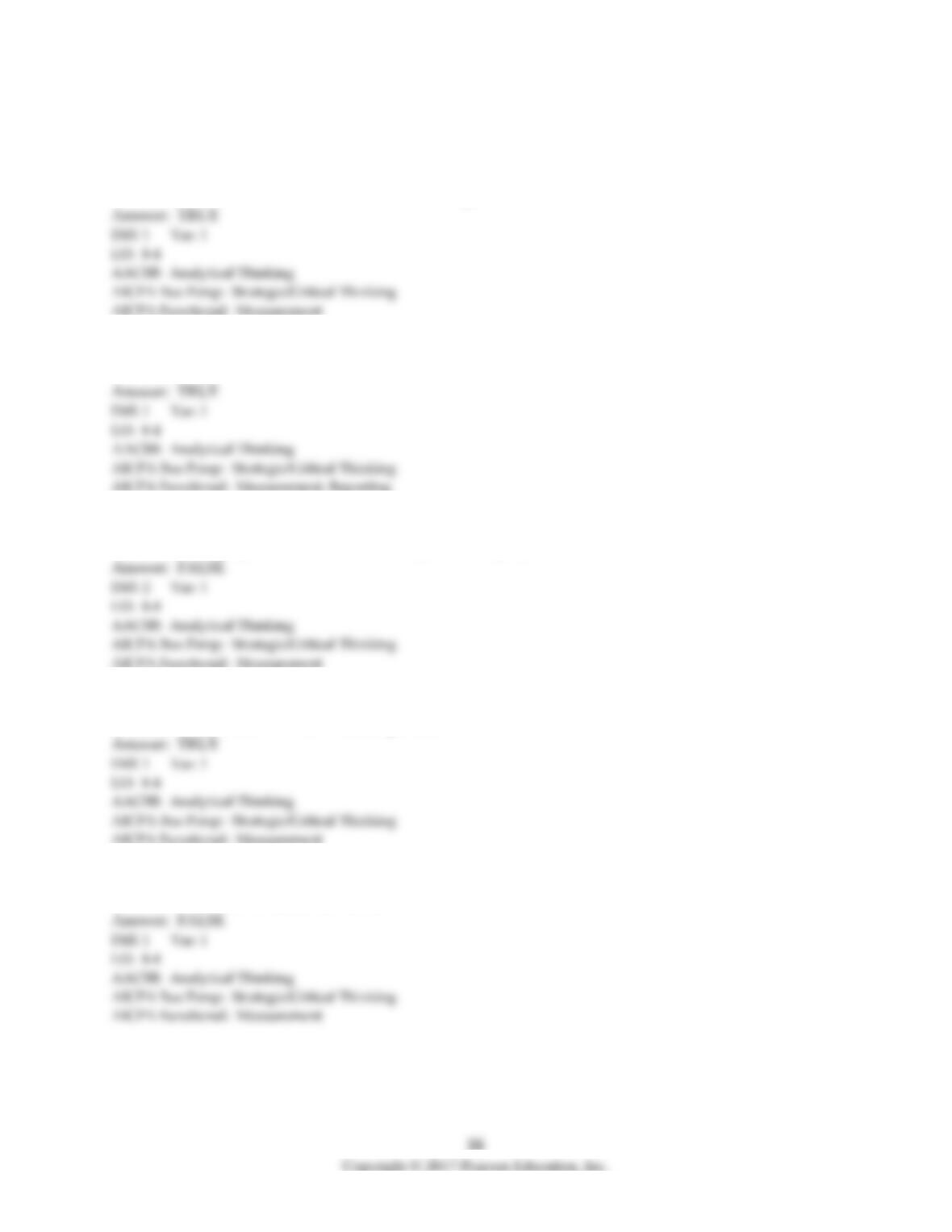
31) On January 1, 2017, Walker Company pays $10 million for 40% of the voting stock of a supplier,
Dorglass, Inc. On December 1, 2017, Dorglass declared and paid cash dividends of $100,000. For the
year ending December 31, 2017, Dorglass also reported net income of $1,000,000. At December 31, 2017,
the fair value of 40% of Dorglass’s stock was $9 million. On January 1, 2018, all the Dorglass stock was
sold for $9 million.
Required:
Prepare journal entries on the following dates:
1. January 1, 2017
2. December 1, 2017
3. December 31, 2017
4. January 1, 2018
Explanations are not required.
4 Learning Objective 8-4
1) The consolidation accounting method is appropriate when an investor controls an investee by
ownership of more than 50% of the investee’s voting stock.
2) Consolidated financial statements combine the financial statements of the parent company and its
subsidiaries.
3) In consolidation accounting, a year-end elimination entry is required to add the subsidiary company’s
stockholders’ equity accounts to those of the parent company.
4) A controlling interest enables the investor to elect a majority of the members of the investee’s board of
directors and thus control the investee‘s policies.
5) Goodwill arises when a parent company must pay more to acquire a subsidiary company than the
book value of the subsidiary’s net assets.