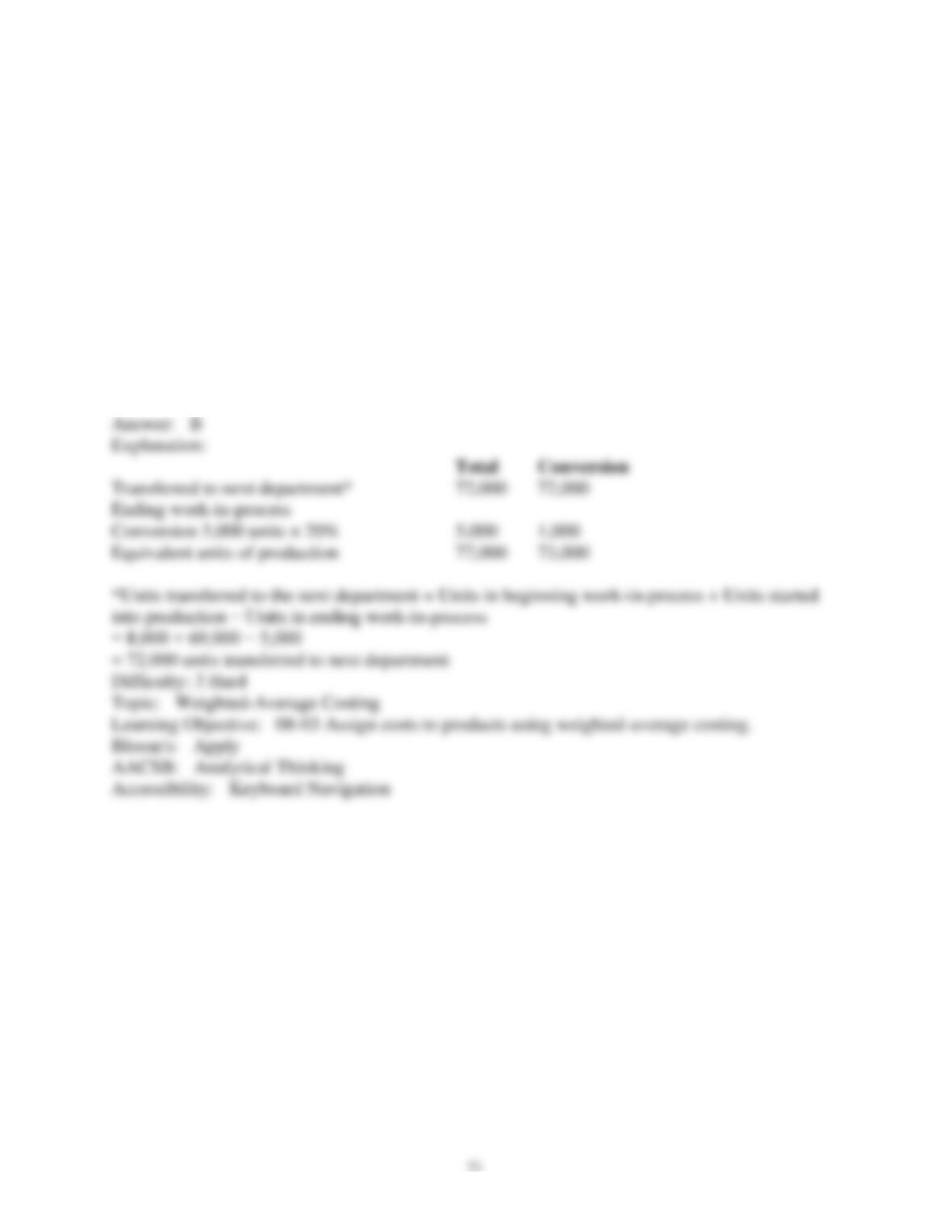
43) Seaside Company uses the weighted-average method in its process costing system. The
Sanding Department started the month with 8,000 units in its beginning work-in-process
inventory that were 70% complete with respect to conversion costs. An additional 69,000 units
were transferred in from the prior department during the month to begin processing in the
Sanding Department. There were 5,000 units in the ending work-in-process inventory of the
Sanding Department that were 20% complete with respect to conversion costs.
What were the equivalent units of production (EUPs) for conversion costs in the Sanding
Department for the month?
A) 67,400 EUPs
B) 73,000 EUPs
C) 72,000 EUPs
D) 66,000 EUPs
44) The Marshall Company has a process costing system. All materials are added when the
process is first begun. At the beginning of September, there were no units of product in process.
During September 50,000 units were started; 5,000 of these were still in process at the end of
September and were 3/5 finished. The equivalent units of material in September were:
A) 40,000.
B) 45,000.
C) 48,000.
D) 50,000.
45) The Chart Company has a process costing system. All materials are added when the process
is first begun. At the beginning of September, there were no units of product in process. During
September 50,000 units were started; 5,000 of these were still in process at the end of September
and were 3/5 finished. The equivalent units for the conversion costs in September were:
A) 40,000.
B) 45,000.
C) 48,000.
D) 50,000.
46) Department B had a beginning inventory of 400 units, 1/4 completed; an ending inventory of
300 units, 2/3 completed, and received 900 units during the period from Department A. What
were the equivalent units of production of Department B, assuming weighted-average process
costing?
A) 800 equivalent units.
B) 900 equivalent units.
C) 1,100 equivalent units.
D) 1,200 equivalent units.
47) Madison Corporation’s production cycle starts in the Processing Department. The following
information is available for April:
Units
Work-in-process, April 1 (25% complete) 40,000
Total units in process during April 280,000
Work-in-process, April 30 (60% complete) 25,000
Materials are added at the beginning of the process in the Processing Department. What are the
equivalent units of production for the month of April, assuming Madison uses the weighted-
average method?
Materials Conversion Costs
A. 240,000 260,000
B. 255,000 235,000
C. 280,000 270,000
D. 315,000 285,000
A) Option A.
B) Option B.
C) Option C.
D) Option D.
48) Department A had no Work-in-Process at the beginning of the period, 1,000 units were
completed during the period, 200 units were 50% completed at the end of the period, and the
following manufacturing costs were debited to the departmental Work-in-Process account during
the period:
Direct materials (1,200 at $10) $ 12,000
Direct labor 5,500
Factory overhead 4,400
Assuming that all direct materials are added at the beginning of production and Department A
uses weighted-average process costing, what is the total cost of the departmental Work-in–
Process Inventory at the end of the period?
A) $3,650.
B) $2,900.
C) $2,000.
D) $1,825.
49) DriveTrain, Inc. instituted a new process in October 2020. During October, 10,000 units
were started in Department A. Of the units started, 8,000 were transferred to Department B, and
2,000 remained in Work-in-Process at October 31, 2020. The Work-in-Process at October 31,
2020, was 100% complete as to material costs and 50% complete as to conversion costs.
Material costs of $27,000 and conversion costs of $36,000 were charged to Department A in
October. What were the total costs transferred to Department B assuming Department A uses
weighted-average process costing?
A) $46,900.
B) $53,600.
C) $56,000.
D) $57,120.
50) In a process costing system, manufacturing overhead applied is usually recorded as a debit
to:
A) Finished goods.
B) Work-in-process.
C) Manufacturing overhead.
D) Cost of goods sold.
51) The Lakeside Company uses a weighted-average process costing system. The following data
are available:
Beginning inventory -0-
Units started in production 20,000
Units finished during the period 16,000
Units in process at the end of the period
(complete as to materials,
¼ complete as to labor and overhead)
4,000
Cost of materials used $ 35,200
Labor and overhead costs $ 37,400
Equivalent units of production for materials are:
A) 16,000.
B) 17,000.
C) 19,000.
D) 20,000.
52) The Lakeside Company uses a weighted-average process costing system. The following data
are available:
Beginning inventory -0-
Units started in production 20,000
Units finished during the period 16,000
Units in process at the end of the period
(complete as to materials,
¼ complete as to labor and overhead)
4,000
Cost of materials used $ 35,200
Labor and overhead costs $ 37,400
Equivalent units of production for labor and overhead are:
A) 16,000.
B) 17,000.
C) 19,000.
D) 20,000.
53) The Lakeside Company uses a weighted-average process costing system. The following data
are available:
Beginning inventory -0-
Units started in production 20,000
Units finished during the period 16,000
Units in process at the end of the period
(complete as to materials,
¼ complete as to labor and overhead)
4,000
Cost of materials used $ 35,200
Labor and overhead costs $ 37,400
Cost per equivalent unit of materials is:
A) $2.20.
B) $2.07.
C) $1.85.
D) $1.76.
54) The Lakeside Company uses a weighted-average process costing system. The following data
are available:
Beginning inventory -0-
Units started in production 20,000
Units finished during the period 16,000
Units in process at the end of the period
(complete as to materials,
¼ complete as to labor and overhead)
4,000
Cost of materials used $ 35,200
Labor and overhead costs $ 37,400
Cost per equivalent unit of labor and overhead is:
A) $2.34.
B) $2.20.
C) $1.97.
D) $1.87.
55) The Lakeside Company uses a weighted-average process costing system. The following data
are available:
Beginning inventory -0-
Units started in production 20,000
Units finished during the period 16,000
Units in process at the end of the period
(complete as to materials,
¼ complete as to labor and overhead)
4,000
Cost of materials used $ 35,200
Labor and overhead costs $ 37,400
Total cost of the 16,000 units finished is:
A) $63,360.
B) $67,320.
C) $72,640.
D) $65,120.
56) The Lakeside Company uses a weighted-average process costing system. The following data
are available:
Beginning inventory -0-
Units started in production 20,000
Units finished during the period 16,000
Units in process at the end of the period
(complete as to materials,
¼ complete as to labor and overhead)
4,000
Cost of materials used $ 35,200
Labor and overhead costs $ 37,400
Total cost of the 4,000 units of the ending inventory:
A) $15,840.
B) $14,520.
C) $9,240.
D) $8,910.
57) The following information pertains to Oklahoma Co.’s Tulsa Division for the month of
April:
Units Materials
Beginning Work-in-Process 15,000 $ 5,500
Started in April 40,000 $ 18,000
Units completed 42,500
Ending Work-in-Process 12,500
All materials are added at the beginning of the process. Using the weighted-average method, the
cost per equivalent unit of materials is: (CPA adapted) (Round your answer to 2 decimal
places.)
A) $0.59.
B) $0.55.
C) $0.45.
D) $0.43.
58) Nebraska Company uses the weighted-average method in its process costing system. The
first processing department, the Welding Department, started the month with 18,000 units in its
beginning work-in-process inventory that were 30% complete with respect to conversion costs.
The conversion cost in this beginning work-in-process inventory was $44,820. An additional
90,000 units were started into production during the month. There were 21,000 units in the
ending work-in-process inventory of the Welding Department that were 10% complete with
respect to conversion costs. A total of $677,970 in conversion costs were incurred in the
department during the month.
What would be the cost per equivalent unit for conversion costs for the month? (Round your
answer to 3 decimal places.)
A) $8.112.
B) $8.300.
C) $7.533.
D) $6.108.
35
59) Kansas Company uses the weighted-average method in its process costing system. Operating
data for the first processing department for the month of June appear below:
Units Percent Complete with Respect to
Conversion
Beginning work-in-process inventory 11,000 50 %
Started into production during June 98,000
Ending work-in-process inventory 21,000 80 %
According to the company’s records, the conversion cost in beginning work-in-process inventory
was $46,915 at the beginning of June. Additional conversion costs of $825,183 were incurred in
the department during the month.
What was the cost per equivalent unit for conversion costs for the month? (Round your answer
to 3 decimal places.)
A) $8.420.
B) $6.934.
C) $8.530.
D) $8.322.
60) Fanciful Structures Company uses the weighted-average method in its process costing
system. The first processing department, the Welding Department, started the month with 22,000
units in its beginning work-in-process inventory that were 20% complete with respect to
conversion costs. The conversion cost in this beginning work-in-process inventory was $23,320.
An additional 97,000 units were started into production during the month and 101,000 units were
completed in the Welding Department and transferred to the next processing department. There
were 18,000 units in the ending work-in-process inventory of the Welding Department that were
40% complete with respect to conversion costs. A total of $529,380 in conversion costs were
incurred in the department during the month.
What would be the cost per equivalent unit for conversion costs for the month? (Round your
answer to 3 decimal places.)
A) $5.300.
B) $5.458.
C) $4.603.
D) $5.108.
37
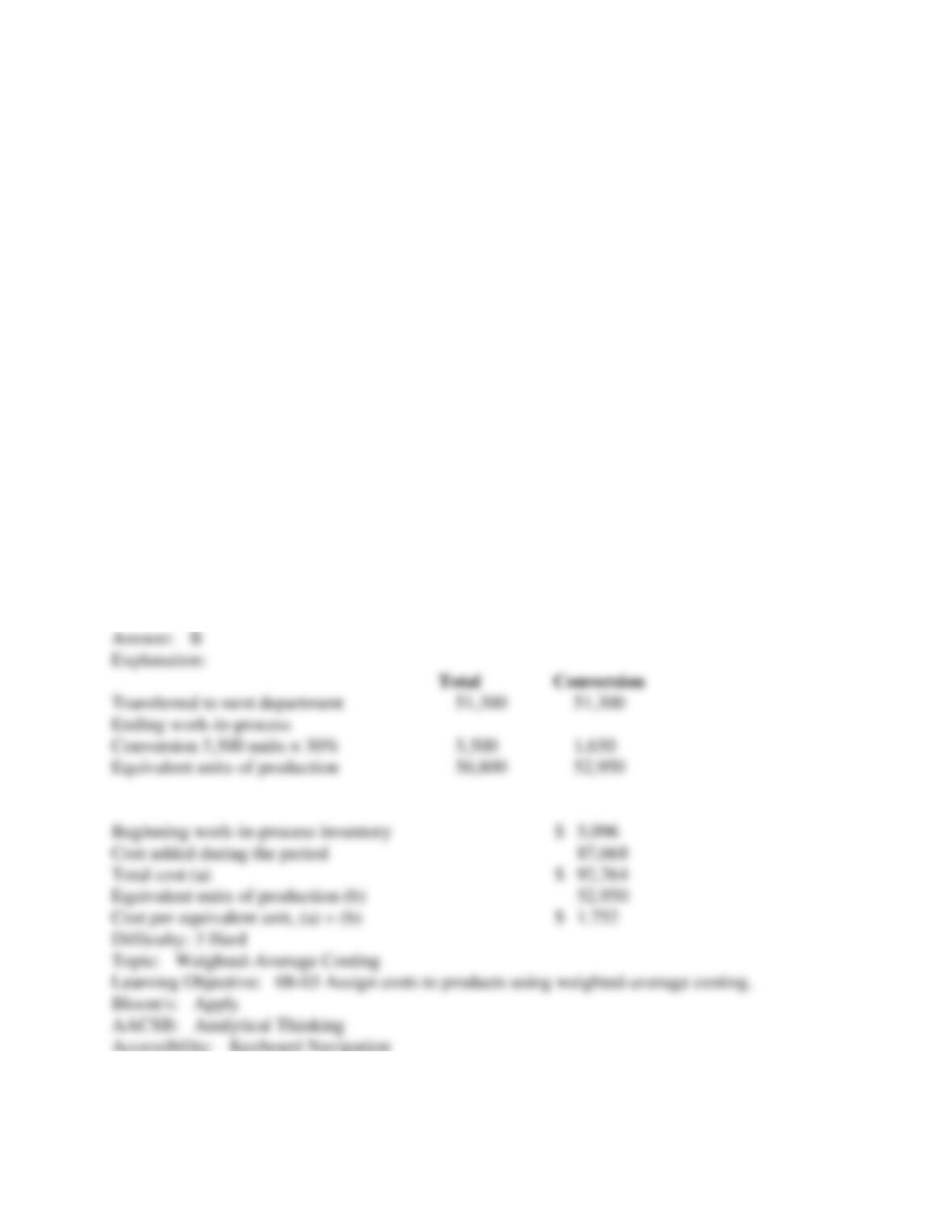
61) Holcomb Company uses the weighted-average method in its process costing system. The
Shaping Department is the second department in its production process. The data below
summarize the department’s operations in January.
Units Percent Complete with Respect to
Conversion
Beginning work-in-process inventory 3,800 90 %
Transferred in from the prior department
during January 53,000
Completed and transferred to the next department
during January 51,300
Ending work-in-process inventory 5,500 30 %
The accounting records indicate that the conversion cost that had been assigned to beginning
work-in-process inventory was $5,096 and a total of $87,668 in conversion costs were incurred
in the department during January.
What was the cost per equivalent unit for conversion costs for January in the Shaping
Department? (Round your answer to 3 decimal places.)
A) $1.654.
B) $1.752.
C) $1.490.
D) $1.499.
62) In the computation of the manufacturing cost per equivalent unit, the weighted-average
method of process costing considers:
A) current costs only.
B) current costs plus cost of beginning Work-in-Process Inventory.
C) current costs plus cost of ending Work-in-Process Inventory.
D) current costs less cost of beginning Work-in-Process Inventory.
63) Morgenstern Company had Work-in-Process Inventories that were 45% complete at the start
of the month. Work-in-Process at the end of the month was 10% complete. Materials were added
at the beginning of the process. If weighted-average process costing is used, the total equivalent
units for materials will equal the number of units:
A) transferred out during the period.
B) started and completed during the period.
C) started into the process during the period.
D) transferred out during the process plus the units in the ending inventory.
64) Materials are added at the beginning of a process in a process costing system. The beginning
Work-in-Process Inventory was 30% complete as to conversion costs. Using first-in, first-out
(FIFO) process costing, the total equivalent units for materials are:
A) beginning inventory this period for this process.
B) units started this period in this process.
C) units started this period in this process plus the beginning inventory.
D) units started this period in this process plus 70% of the beginning inventory this period.
65) Parkway Company incurred $126,000 in material costs during July. Additionally, the 12,000
units in the Work-in–Process Inventory on July 1 had materials assigned to them of $32,000,
even though they were only 5% complete as to materials. No additional units were started during
July, and there were no unfinished units on hand on July 31. What is the material cost per
equivalent unit for July, assuming Parkway uses weighted-average process costing?
A) $10.50.
B) $11.59.
C) $13.17.
D) $15.49.
66) Cranford Company completed and transferred out 2,300 units in May 2020. There were 200
units in the Work-in-Process Inventory on May 31, 2020, 30% complete as to conversion costs
and 100% complete as to materials. The month’s charges for conversion costs and material costs
were $9,440 and $6,250, respectively. There was no beginning inventory on May 1, 2020. What
is the cost of the work transferred-out during May, assuming that Cranford uses weighted-
average process costing?
A) $8,510.
B) $14,950.
C) $15,690.
D) $16,250.
67) A form prepared periodically for each processing department summarizing (1) the units for
which the department is accountable and the disposition of these units and (2) the costs charged
to the department and the allocation of these costs is called a:
A) schedule of Cost of Goods Manufactured.
B) production cost report.
C) job order cost sheet.
D) schedule of Cost of Goods Sold.