1. Process costing assumes all units are homogeneous and follow the same path through the
production process.
2. The
equivalent
unit
concept refers to the actual amount of work during the period stated
in terms of the work required to complete an equal number of whole units.
3. The number of units in the beginning Work–in-Process Inventory plus the units transferred
out during the period equals the number of units started during the period plus the number of
units in the ending Work–in-Process Inventory.
4. If materials are added continuously throughout the production process, then the
equivalent units for materials will always equal the equivalent units for the conversion costs.
5. If materials are only added at the beginning of the production process, then the degree of
completion for materials in the ending Work–in-Process Inventory is always 100%.
6. If materials are only added at the beginning of the production process, then the degree of
completion for materials in the ending Work–in-Process Inventory will be the same as the degree
of completion for the conversion costs.
7. If materials are only added at the end of the production process, then the degree of
completion for materials of units in the ending Work–in-Process Inventory is always 0%.
8. In the weighted-average approach, the number of physical units transferred out cannot be
greater than the equivalent number of units produced during the period.
9. The weighted-average approach to process costing combines the work and costs done in
prior periods with the work and costs done in the current period.
10. In a weighted-average process costing system, the costs in the beginning Work–in–
Process Inventory are not used to compute the costs transferred-out.
11. First-in, first-out (FIFO) process costing transfers out the costs in beginning inventory
before transferring out the costs associated with units started and completed.
12. If the beginning Work-in-Process inventory is zero, first-in, first-out (FIFO) and weighted-
average process costing will assign the same amount to the units transferred out.
13. In general, the ending Work-in-Process Inventory value computed using first-in, first-out
(FIFO) will be the same as the ending value computed using weighted-average process costing.
14. It is possible for units in the beginning Work–in-Process Inventory to also be part of the
ending Work-in-Process Inventory.
15. The more prices change, the greater the difference between the costs assigned to units
transferred out using weighted-average costing and the costs assigned to units transferred out
using first-in, first-out (FIFO).
16. In general, weighted-average costing is simpler to use while first-in, first-out (FIFO)
costing provides greater decision-making benefits to managers.
17. The degree of completion associated with
prior
department
costs
is always 100%.
18. Job costing requires more detailed recordkeeping than process costing.
19. Operation costing is used in manufacturing goods that have some common characteristics
and some individual characteristics.
20. Operational costing accounts for material costs like job costing and conversion costs like
process costing.
21. Which of the following statements is (are) true regarding product costing?
(A) Twenty cans of paint that are 25% full are equivalent to four cans of paint that are completely
full.
(B) The equivalent unit concept refers to the actual amount of work during the period stated in
terms of whole units.
22. Which of the following organizations would most likely use a process costing system?
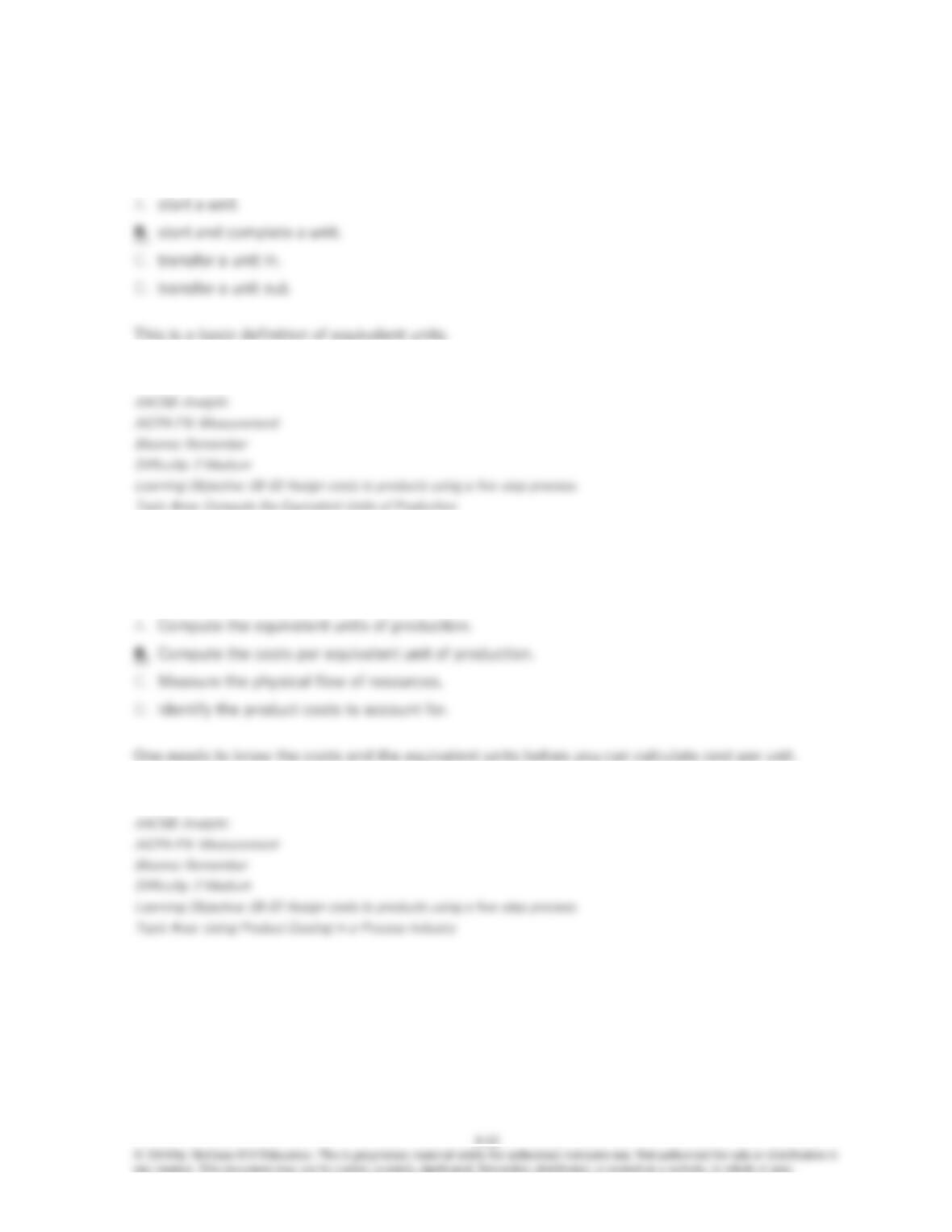
23. The following examples briefly describe the manufacture of two different products. Which
costing method (job-order or process) would be the best method to use for each project?
I. Fred Puetz manufactures Fred’s Wine Cooler. Fred once made the statement, “People can have
any flavor of Fred’s Wine Cooler they want as long it’s boysenberry.”
II. Ahmad Aerondonetics is manufacturing three space shuttles for the country of Kricherra. Each
shuttle is slightly different and production will last approximately two years.
24. An equivalent unit of conversion costs is equal to the amount of conversion costs required
to:
25. Of the following process costing steps, which must be done last?
26. If the units in the beginning Work-in-Process Inventory are greater than the units in the
ending Work-in-Process Inventory, then the units transferred out are:
27. Which of the following statements concerning a process cost accounting system is false?
28. In the computation of the manufacturing cost per equivalent unit, the weighted-average
method of process costing considers:
29. In order to compute equivalent units of production using the FIFO method of process
costing, work for the period must be broken down to units:
30. Blue Company has beginning and ending Work–in-Process Inventories that are 45% and
10% complete, respectively. Materials are added at the beginning of the process. If first-in, first-
out (FIFO) process costing is used, the total equivalent units for materials will equal the number
of units:
31. Red Company had Work-in-Process Inventories that were 45% complete at the start of the
month. Work-in-Process at the end of the month was 10% complete. Materials were added at the
beginning of the process. If weighted-average process costing is used, the total equivalent units
for materials will equal the number of units:
32. A form prepared periodically for each processing department summarizing (1) the units for
which the department is accountable and the disposition of these units and (2) the costs charged
to the department and the allocation of these costs is called a:
33. Materials are added at the beginning of a process in a process costing system. The
beginning Work-in-Process Inventory was 30% complete as to conversion costs. Using first-in,
first-out (FIFO) process costing, the total equivalent units for material are:
34. An error was made by ROC Company in computing the percentage–of-completion of the
current year’s ending Work-in-Process Inventory. The error resulted in the assignment of a lower
percentage of completion to each component of the inventory than actually was the case. There
was no beginning Work-in-Process Inventory. What is the effect of this error on (1) cost assigned
to cost of goods completed for the period and (2) the computation of costs per equivalent unit?
35. Which of the following statements regarding first-in, first-out (FIFO) process costing is
(are) true?
(A) First-in, first-out (FIFO) process costing transfers out the costs in beginning inventory before
transferring out the costs associated with units started and completed.
(B) First-in, first-out process costing requires one additional step in assigning costs to the units
transferred out and the ending Work–in-Process Inventory.
36. In a production cost report using process costing, transferred-in costs are most similar to:
37. Additional materials are added in the second department of a four-department production
process. However, this addition does not increase the number of units being produced in the
second department, but will: