
Accounting Information Systems, 2e (Kay/Ovlia)
Chapter 8 Accounting and Sustainability Intelligence
Objective 1
1) There is a class of corporation that reports on profit, people, and planet.
2) The triple bottom line measures the economic, social, and environmental results of corporate
decisions.
3) Short-term results that might appear favorable for all three bottom lines might also be
favorable in the long run.
4) The triple bottom line is sometimes call ________.
5) Although the triple bottom line and sustainability are related, ________ considers a longer run
perspective.
6) The triple bottom line focuses on the effect of which three results?
A) People, technology, and environment
B) Profit, people, and quality of life
C) People, profit, and the planet
D) Technology, profit, and corporate morals
7) The triple bottom line measures all the following business decision results EXCEPT
A) Social
B) Morale
C) Economic
D) Environmental
8) What is the triple bottom line and what does it measure?
1) Sustainability is transformational business, transforming business from a focus on bottom line
profit to a holistic view of the business as an integral part of a larger system.
2) For many corporations, decisions in the short run often produce extraordinary profits and the
results are sustainable in the long run.
3) Sustainability accounting does not impact people inside the organization.
4) XBRL uses electronic tags for data, both quantitative and qualitative.
5) The traditional cost-benefit decision model considers quantitative and qualitative factors.
6) ________ involves collecting, storing, organizing, and reporting economic, social, and
environmental information for making decisions and evaluating performance.
7) ________ is a recycling programs for electronic products.
8) Sustainability accounting is also called ________.
9) Sustainability requires the ability to view the enterprise from a(n)
A) Global perspective
B) Local perspective
C) Environmental perspective
D) Profitable perspective
10) Sustainability accounting collects information for which two general purposes?
A) Making decisions and evaluating performance
B) Reporting to investors and governmental agencies
C) Evaluating performance and reporting to governmental agencies
D) Evaluation performance and reporting to investors

11) How does sustainability accounting impact people?
A) Accountants collect the same type of data.
B) Customers expect more people-friendly products.
C) Vendors may be asked to provide less energy efficient products.
D) Employees will not need to modify business processes.
12) How does sustainability accounting impact technology?
A) Sustainability accounting has no impact on technology.
B) IT components may be redesigned to reduce or eliminate various heavy metals.
C) Data needs to be stored for longer periods of time.
D) Companies will place more dependance on paper and less dependance on computers.
13) E-cycling is
A) A transaction cycle of a purchase over the Internet
B) The recycling of electronics, such as computers and cellular phones
C) The improper disposal of electronic waste
D) Something that has little impact on IT hardware purchases
14) What does enterprise carbon accounting measure?
A) The reduction of carbon emissions resulting from a corporation’s process redesign
B) The impact of recycling on corporate profits
C) Consumer awareness of carbon emissions
D) The amount of carbon emissions resulting from a corporation’s operations and activities
15) What new perspective does sustainability require of corporations?
16) How does sustainability accounting impact people?
17) What are the three keys to sustainability?
18) You are a staff accountant in the purchasing cycle group at Acme Widgets. Acme
manufactures widgets from various metals and has manufacturing plants around the world.
Acme Widgets has come under pressure from various governments, environmental, and
humanitarian groups to improve their sustainability practices. You are asked to provide
suggestions on incorporating sustainability practices within the purchasing cycle. Prepare an
email with your suggestions.
19) What is the focus of enterprise carbon accounting?
1) True sustainability focuses on creating long-term value.
2) Biomimicry is an innovation method that seeks sustainable solutions by emulating nature’s
patterns and strategies.
3) Integrating sustainability into decision making often involves innovation, looking at issues as
opportunities and envisioning new sustainable solutions.
4) The ________ model provides an organizing framework for grappling with complex and
sometimes conflicting sustainability issues.
5) To be ________ sustainable, it is necessary to have a balance of cash inflows and cash
outflows that can be maintained in the long run.
6) ________ is an innovation method that seeks sustainable solutions by emulating nature’s
patterns and strategies.
7) Sustainability, a new approach to decision making, shifts the decision focus from minimizing
risk to ________.
8) A decision model
A) Streamlines the data collection process
B) Reveals the interdependencies of economic, social, and environmental factors in creating
value
C) Guarantees a corporation is making the right decision
D) Makes the decision process overly complex

9) True sustainability focuses on creating
A) Short-term profits
B) Short-term value
C) Long-term value
D) A and B
10) How are the quantitative and qualitative factors in the IDM model expanded in the IDa
model?
A) An estimated financial amount is associated with the qualitative factors.
B) They include the economic, social, and environmental (ESE) costs/disadvantages and
benefits/advantages.
C) They are not expanded in the IDa model.
D) The quantitative factors are converted to qualitative factors.
11) Which of the following steps is included in the sustainability IDa model but NOT in the IDM
model?
A) Performance evaluation
B) Qualitative analysis
C) Implement decision
D) A and C
12) Which type of sustainability is best defined as having a balance of cash inflows and cash
outflows that can be maintained in the long run?
A) Environmental sustainability
B) Economic sustainability
C) Social sustainability
D) Human sustainability

13) Biomimicry
A) Seeks sustainable solutions by avoiding nature’s patterns and strategies
B) Is a type of scientific research that studies nature and does not apply discoveries to
commercial use
C) Seeks sustainable solutions by emulating nature’s patterns and strategies
D) A and B
14) One approach to storing qualitative data is to
A) Quantify it using numerical ranking
B) Track it in spreadsheets
C) Ignore it; qualitative data is not relevant to business decisions
D) Convert it into a financial amount using business intelligence tools
15) Which of the following is NOT the best method of creating value?
A) Adopting a cradle-to-cradle/zero-waste model
B) Using life-cycle assessment
C) Redesigning the product and process
D) Implementing a lawsuit risk minimization plan
16) Which method of creating value is best defined as strive for zero waste as opposed to
reduced waste?
A) Cradle-to-cradle model
B) Life cycle assessment model
C) Redesign the product
D) Redesign the processes
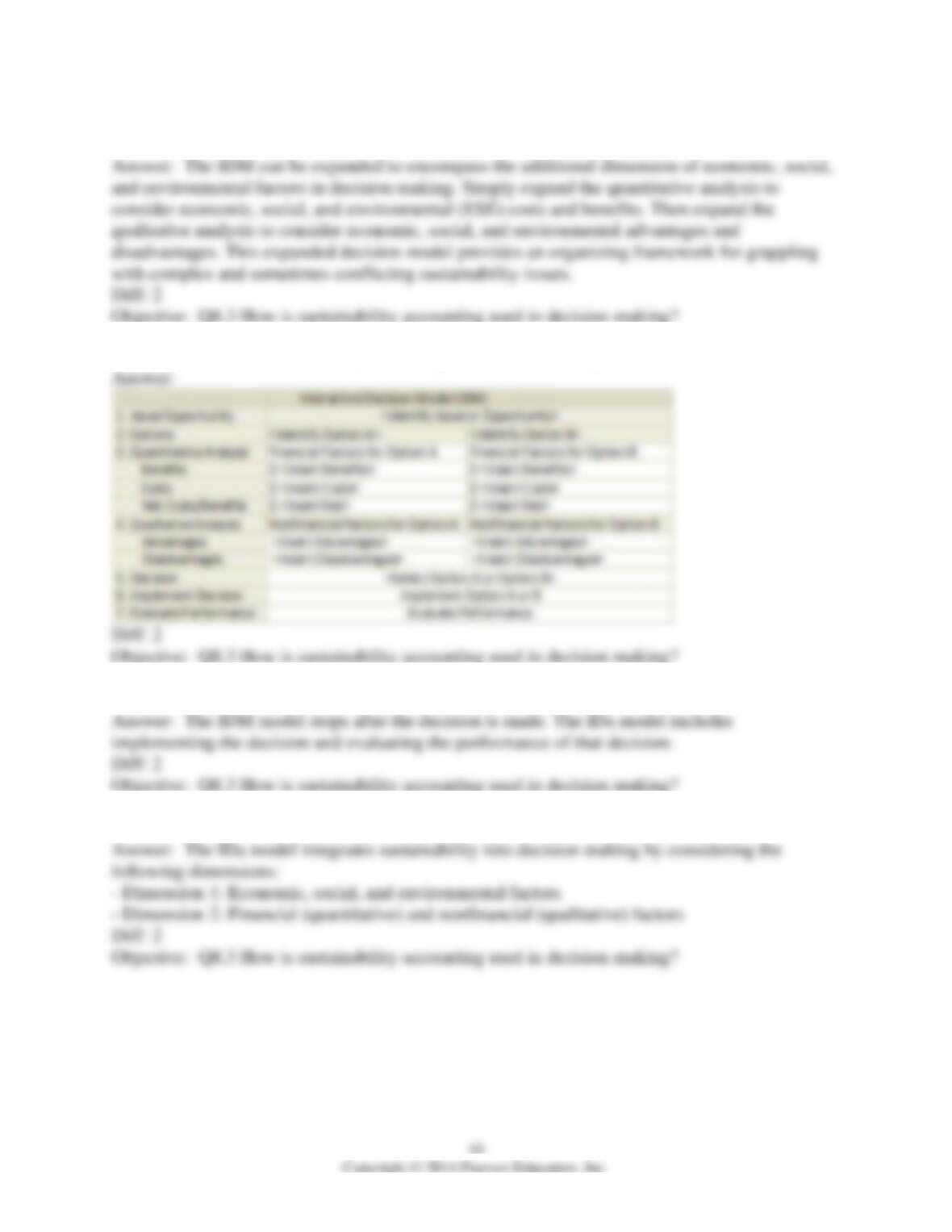
17) How can the integrative decision model be expanded to encompass the additional dimension
of economic, social, and environmental factors in decision making?
18) Create/draw the sustainability IDa (Integrated Decision analysis) model.
19) What is the difference between the IDM and IDa models?
20) How does the IDa model integrate sustainability into decision making?
21) Explain three approaches for storing qualitative data in a database. Provide an example of
each.
22) What is biomimicry? Provide an example.
23) List four value creation approaches.
1) Sustainability reports are used by investors, consumers, society, and others to evaluate a firm’s
performance in terms of profit, loss, and the ability to continue as a corporation.
2) The ISO 14000 Environmental Management framework provides specific levels of
environmental performance for an organization.
3) The ability to tag qualitative data with XBRL tags allows users to search for specific
economic, social, and environmental performance indicators, such as carbon footprint, and then
compare these among different organizations.
4) A complicated sustainability framework provides greater detail and is more effective than a
simplistic sustainability model.
5) The accounting system plays a crucial role in the success of sustainability reporting.