Chapter 08 Flexible Budgets, Standard Costs, and Variance Analysis
Answer Key
True / False Questions
1.
A planning budget is prepared before the period begins and is valid for whatever the actual
level of activity turns out to be.
2.
Comparing a static planning budget to actual costs is a good way to assess whether
variable costs are under control.
3.
Directly comparing a static planning budget to actual costs helps to distinguish between
differences in costs that are due to changes in activity and differences that are due to how
well costs were controlled.
4.
Fixed costs should be ignored when evaluating how well a manager has controlled costs.
5.
Fixed costs should be included in a flexible budget even though they do not change when
the level of activity changes.
6.
When a flexible budget is used in performance evaluation, actual costs are compared to
the static planning budget rather than to what the costs should have been for the actual
level of activity during the period.
7.
A flexible budget should not be used when making comparisons to actual results such as
actual expenses.
8.
A flexible budget cannot be used to estimate what costs should have been at a given level
of activity.
9.
A flexible budget can be used to estimate what revenues and costs should have been,
given the actual level of activity for the period.
10.
A spending variance is the difference between the cost in the static planning budget and
the actual amount of the cost for the period.
11.
A revenue variance is favorable if the actual revenue exceeds what the revenue should
have been for the actual level of activity of the period.
12.
A revenue variance is unfavorable if the actual revenue is less than the revenue in the
static planning budget.
13.
An unfavorable spending variance may reflect waste as well as paying too much for
inputs.
14.
The revenue and spending variances are the differences between the flexible budget and
the actual results for the period.
15.
A favorable spending variance occurs when the actual cost exceeds the amount of the
cost in the static planning budget.
16.
Controllability has little to do with whether a cost is fixed or variable.
17.
A direct materials quantity standard generally includes an allowance for waste.
18.
The materials price variance is computed by multiplying the difference between the actual
price and the standard price by the actual quantity of materials purchased.
19.
Waste on the production line will result in an unfavorable materials quantity variance.
20.
A materials price variance is unfavorable if the actual price exceeds the standard price.
21.
A favorable materials quantity variance occurs when the actual quantity used in
production is less than the standard quantity allowed for the actual output of the period.
22.
The standard price per unit for direct materials should not include the cost of delivering
the materials.
23.
Purchase of poor quality materials may cause a favorable materials price variance and an
unfavorable labor efficiency variance.
24.
An unfavorable labor rate variance can occur if workers with high hourly wage rates are
assigned to work on products with standards that assume workers have low hourly wage
rates.
25.
The standard labor rate per hour defines the company’s expected direct labor wage rate
per hour, including employment taxes and fringe benefits.
26.
The variable overhead efficiency variance measures how efficiently variable manufacturing
overhead resources were used.
27.
A quantity standard indicates how much output should have been produced.
28.
The standard cost per unit is computed by dividing the standard quantity or hours by the
standard price or rate.
Multiple Choice Questions
29.
A major weakness of flexible budgets is that:
30.
Comparing actual results to a budget based on the actual activity for the period is possible
with the use of a:
31.
A static planning budget is:
32.
Which of the following comparisons best isolates the impact that changes in operating
efficiency have on performance?
33.
Which of the following would produce a materials price variance?
34.
The variance that is usually most useful in assessing the performance of the purchasing
department manager is:
35.
Poor quality materials could have an unfavorable effect on which of the following
variances?
Labor Efficiency Variance
Materials Quantity Variance
A)
Yes
Yes
B)
Yes
No
C)
No
Yes
D)
No
No
36.
Which of the following would produce a labor rate variance?
37.
During a recent lengthy strike at Morell Manufacturing Company, management replaced
striking assembly line workers with office workers. The assembly line workers had been
paid $18 per hour while the office workers are only paid $10 per hour. What is the most
likely effect on the labor variances in the first month of this strike?
Labor Rate Variance
Labor Efficiency Variance
A)
Unfavorable
No effect
B)
No effect
Unfavorable
C)
Unfavorable
Favorable
D)
Favorable
Unfavorable
38.
In a company’s standard costing system direct labor-hours are used as the base for
applying variable manufacturing overhead costs. The standard direct labor rate is twice
the variable overhead rate. Last period the labor efficiency variance was unfavorable.
From this information one can conclude that last period the variable overhead efficiency
variance was:
39.
Variable manufacturing overhead is applied to products on the basis of standard direct
labor-hours. If the labor efficiency variance is unfavorable, the variable overhead efficiency
variance will be:
40.
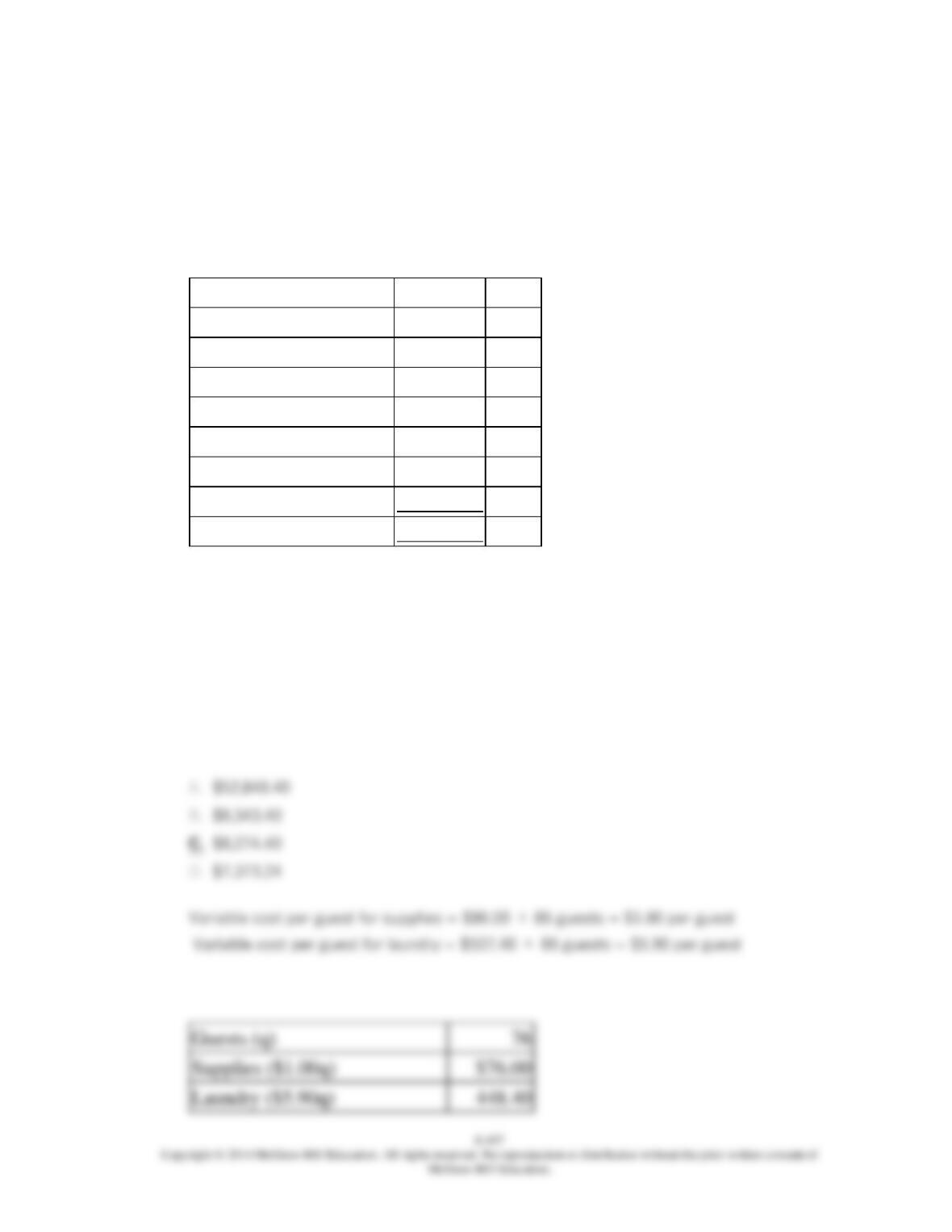
Papenfuss Family Inn is a bed and breakfast establishment in a converted 100-year-old
mansion. The Inn’s guests appreciate its gourmet breakfasts and individually decorated
rooms. The Inn’s overhead budget for the most recent month appears below:
Activity level
86
guests
Variable overhead costs:
Supplies
$86.00
Laundry
507.40
Fixed overhead costs:
Utilities
340.00
Salaries and wages
4,790.00
Depreciation
2,620.00
Total overhead cost
$8,343.40
The Inn’s variable overhead costs are driven by the number of guests.
What would be the total budgeted overhead cost for a month if the activity level is 76
guests?
41.
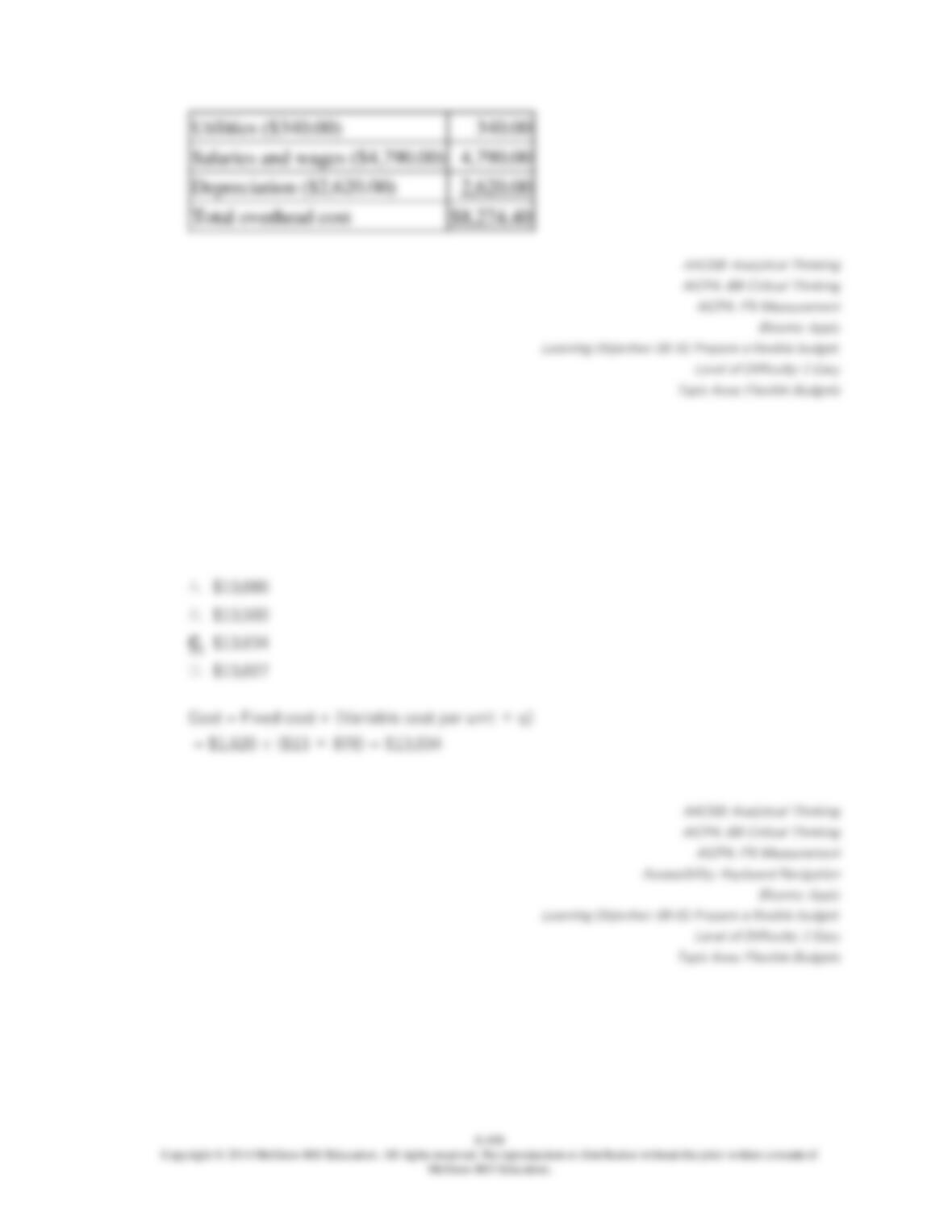
Ohme Framing’s cost formula for its supplies cost is $1,620 per month plus $13 per frame.
For the month of April, the company planned for activity of 882 frames, but the actual level
of activity was 878 frames. The actual supplies cost for the month was $13,500. The
supplies cost in the flexible budget for April would be closest to:
42.
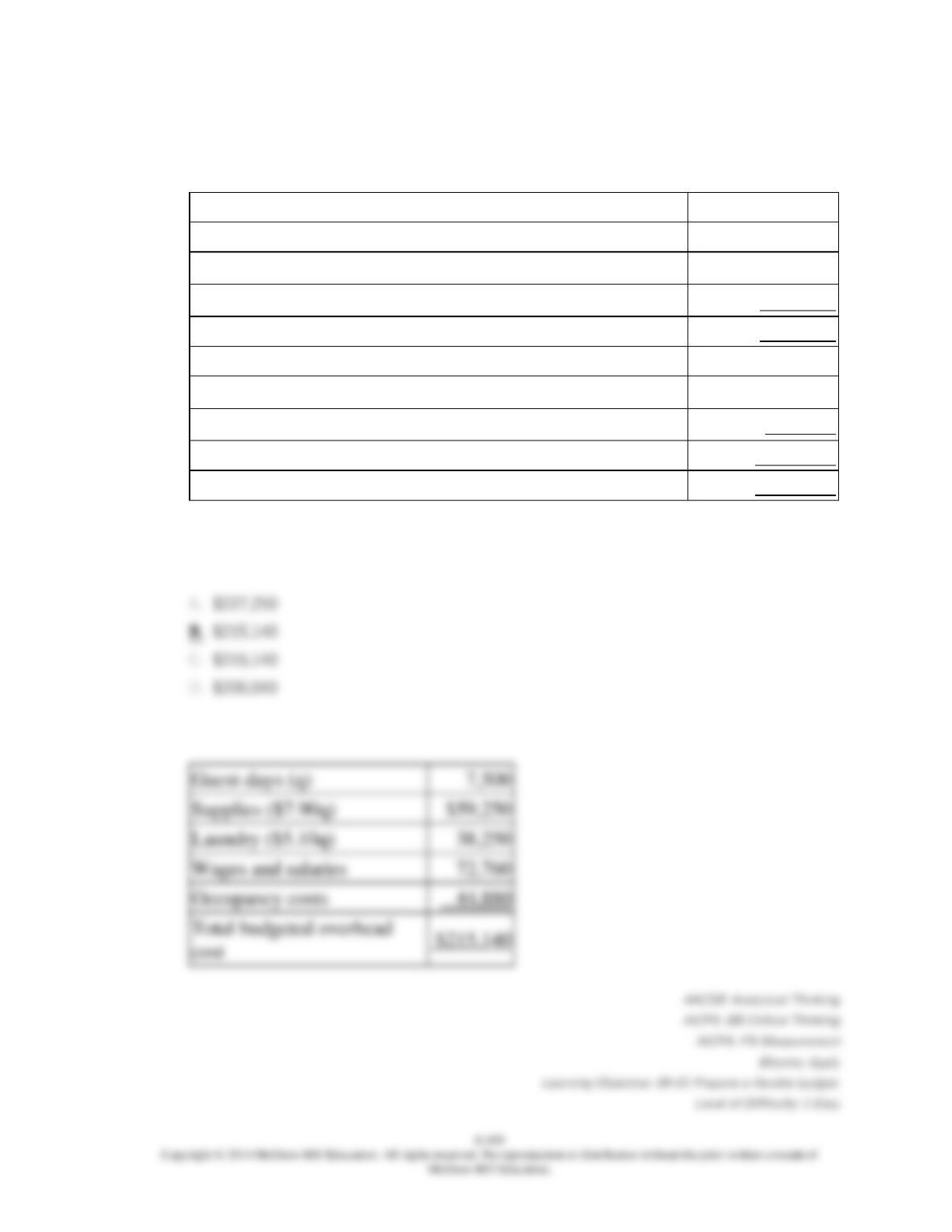
Fuhrer Hotel bases its budgets on guest-days. The hotel’s static budget for December
appears below:
Budgeted number of guest-days
6,800
Budgeted variable overhead costs:
Supplies (@ $7.90 per guest-day)
$53,720
Laundry (@ $5.10 per guest-day)
34,680
Total variable overhead cost
88,400
Budgeted fixed overhead costs:
Wages and salaries
72,760
Occupancy costs
44,880
Total fixed overhead cost
117,640
Total budgeted overhead cost
$206,040
The total overhead cost at an activity level of 7,500 guest-days per month should be:
Guest-days (q)
Supplies ($7.90q)
Laundry ($5.10q)
Wages and salaries
Occupancy costs