Chapter 8—Inventories: Cost Measurement and Flow Assumptions
Key
1. A manufacturing company typically has how many inventory accounts?
2. A manufacturing firm would not normally have an account titled
3. A retail firm would normally use an inventory account titled
4. Which of the following is not an advantage of a perpetual inventory system?
5. The cost of goods sold can be determined only after a physical count of inventory on hand under the
6. Using the following letters to represent items:
P = Purchases (net)
C = Cost of goods sold
B = Beginning inventory
E = Ending inventory
Which equation is correct?
7. Which one of the following statements is not true?
8. Exhibit 8-1
Walters Co. purchased raw materials with a catalog price of $70,000 on March 2, 2010. Credit terms of 4/20,
n/60 applied. If Walters pays for the purchase on March 18, 2010, calculate what amount is recorded for
inventory on March 2, 2010, using the method given.
Refer to Exhibit 8-1. Walters uses a perpetual inventory system and the net price method.
9. Exhibit 8-1
Walters Co. purchased raw materials with a catalog price of $70,000 on March 2, 2010. Credit terms of 4/20,
n/60 applied. If Walters pays for the purchase on March 18, 2010, calculate what amount is recorded for
inventory on March 2, 2010, using the method given.
Refer to Exhibit 8-1. Walters uses a perpetual inventory system and the gross price method.
10. Black Company determined its December 31, 2010 inventory to be $1,000,000 based on a physical count
priced at cost. It then determined the following additional information:
Merchandise costing $90,000, was shipped FOB shipping point from a vendor on December 30, 2010. This
merchandise was received and recorded on January 5, 2011.
Goods costing $120,000 were staged on the shipping dock and excluded from inventory although shipment was
not made until January 4, 2011. The goods were billed to the customer FOB shipping point on December 30,
2010.
What is Black’s ending inventory for its December 31, 2010 balance sheet?
11. Which one of the following types of costs is most likely to be included in determining the cost of
inventory?
12. Which one of the following statements is not true?
13. Exhibit 8-2
Walters Co. purchased raw materials with a catalog price of $70,000 on March 2, 2010. Credit terms of 4/20,
n/60 applied. Walters uses a perpetual inventory system and the net price method.
Refer to Exhibit 8-2. If Walters pays for the purchase on March 18, 2010, what amount is recorded in the
purchase discounts taken account?
14. Exhibit 8-2
Walters Co. purchased raw materials with a catalog price of $70,000 on March 2, 2010. Credit terms of 4/20,
n/60 applied. Walters uses a perpetual inventory system and the net price method.
Refer to Exhibit 8-2. If Walters pays for the purchase on March 31, 2010, what amount is recorded in the
purchase discounts lost account?
15. Which one of the following statements is true?
16. Phillips Corp. purchased raw materials with a catalog price of $60,000. Credit terms of 3/15, n/60 apply. If
Phillips uses the net price method, the purchase should be recorded at
17. A listing of the Montez Company’s inventory items at the end of 2010 totals $95,000. Included in this
amount are the following items:
Merchandise in transit as of 12/31/2010, purchased FOB
shipping point
$6,800
Goods held by Montez as consignee from Nirvana
5,000
Goods out on consignment, at cost plus 50% markup on cost
6,000
What is the dollar amount of Montez’s 2010 ending inventory that should be reported on the balance sheet?
18. Which one of the following statements is true?
19. Near the end of 2010, Bruce Co. made the following purchases. The months involved in all cases are
December 2010 and January 2011.
Date
Date
Date
Date
Goods
Invoice
Goods
Invoice
Amount
FOB
Shipped
Mailed
Rec’d
Rec’d
$1,575
Destination
12/29
1/2
1/5
1/4
2,430
Shipping Point
1/2
12/29
1/4
12/30
1,890
Shipping Point
12/28
1/2
1/3
1/4
2,700
Destination
12/29
12/27
1/2
12/28
What amount of the above purchases should be included in inventory at December 31, 2010?
20. Which one of the following types of costs should be included in the cost of a manufactured inventory?
21. The purchases discounts taken account may appear in the accounting records if which one of the following
methods is used to account for purchase discounts?
22. Concerning purchase discounts, which one of the following statements is true?
23. Which one of the following types of costs is excluded from the cost of inventory that is routinely
manufactured?
24. Which of the following inventory cost flow assumptions produces the same ending inventory values under
both the periodic and perpetual systems?
25. Exhibit 8-3
Davilo Co. had the following inventory activity during April:
Unit
Units
Cost
Beginning inventory
100
$ 8
Purchase (April 3)
60
12
Sale (April 10)
80
Purchase (April 18)
50
15
Purchase (April 23)
80
18
Sale (April 28)
100
Refer to Exhibit 8-3. Assuming Davilo uses a periodic FIFO cost flow assumption, ending inventory at April 30 would be

26. Exhibit 8-3
Davilo Co. had the following inventory activity during April:
Unit
Units
Cost
Beginning inventory
100
$ 8
Purchase (April 3)
60
12
Sale (April 10)
80
Purchase (April 18)
50
15
Purchase (April 23)
80
18
Sale (April 28)
100
Refer to Exhibit 8-3. Assuming Davilo uses a periodic LIFO cost flow assumption, ending inventory at April 30 would be
27. Exhibit 8-3
Davilo Co. had the following inventory activity during April:
Unit
Units
Cost
Beginning inventory
100
$ 8
Purchase (April 3)
60
12
Sale (April 10)
80
Purchase (April 18)
50
15
Purchase (April 23)
80
18
Sale (April 28)
100
Refer to Exhibit 8-3. Assuming Davilo uses a perpetual LIFO cost flow assumption, ending inventory at April 30 would be
28. Exhibit 8-4
RK, Inc. had the following activity for an inventory item during June:
Unit
Units
Cost
Beginning inventory
50
$10
Purchase (June 5)
10
16
Purchase (June 15)
30
14
Sale (June 20)
40
Sale (June 25)
20
Purchase (June 30)
10
20

Refer to Exhibit 8-4. Assuming RK uses a periodic weighted average cost flow assumption, cost of goods sold for June would be
29. Exhibit 8-4
RK, Inc. had the following activity for an inventory item during June:
Unit
Units
Cost
Beginning inventory
50
$10
Purchase (June 5)
10
16
Purchase (June 15)
30
14
Sale (June 20)
40
Sale (June 25)
20
Purchase (June 30)
10
20
Refer to Exhibit 8-4. Assuming RK uses a perpetual moving average cost flow assumption, ending inventory for June would be
30. Stabler, Inc. provided the following inventory transaction summary for January:
1/1
Purchased 200 units @ $3.00 per unit.
1/15
Sold 40 units.
1/21
Purchased 300 units @ $5.00 per unit.
1/31
Purchased 40 units @ $10.00 per unit.
In addition, it has been determined that Stabler’s inventory at the beginning of the month was $400.00 (200 units). What was Stabler’s cost per unit at
the end of January, using the moving average method?
31. The Elston Company uses a periodic inventory system. Relevant inventory information for the year follows:
1/1
Beginning inventory
20 units @ $170 per unit
5/23
Purchased
20 units @ $125 per unit
11/5
Purchased
400 units @ $160 per unit
11/18
Purchased
100 units @ $175 per unit

At year-end, 50 units remain in inventory. What is the cost of the ending inventory on a LIFO basis?
32. On July 1, Deuce Hardware, Inc. had an inventory of 300 gas grills costing $100 each. Purchases and sales
during July are as follows:
Date
Purchases
Sales
July 3
100 @ $125 each
July 10
50 @ $110 each
July 17
150 @ $130 each
July 28
50 @ $120 each
What is the cost of Deuce’s inventory on July 31 using the FIFO method?
33. On May 1, Mikrotek, Inc. had 120 units of a certain software package that cost $6 apiece. During May, the
following purchases were made:
May 7
60 units @ $9.00
15
80 units @ $12.00
21
140 units @ $10.50
During May, 300 units were sold. If Mikrotek uses the weighted average method, the cost of ending inventory would be
34. Mouton uses the moving average flow assumption. On July 1, there were 180 units on hand and the total
inventory cost was $900. On July 10, 40 more units were purchased at a cost of $6 apiece. Sales included 20
units on July 3 and 60 units on July 17. What was the total cost of goods sold recorded for the units sold on July
17?
35. Right Images Printing uses perpetual LIFO in valuing its inventory. The January 1 inventory amounted to
36 units at $6 each. Purchases and sales during January were as follows:
Purchases
Sales
Jan. 10
20 units @ $8
Jan. 5
10 units
17
24 units @ $10
15
22 units
The cost of the ending inventory was
36. On June 1, Corona Company had 40 units of inventory at a cost of $6 each. June purchases and sales were
as follows:
Purchases
Sales
June 5
10 units @ $8
June 4
20 units
12
20 units @ $10
20
12 units
25
10 units @ $16
The cost of goods sold during June was $272. Corona must use:
37. La Brea, Inc. reported sales of $1,200 in May and a gross profit of $370. The company had a May 1
inventory of 60 units that had a total cost of $300. May purchases and sales were as follows:
Purchases
Sales
May 7
40 units @ $6
May 2
20 units
10
20 units @ $7
8
40 units
18
40 units @ $8
12
10 units
24
20 units @ $9
20
20 units
28
20 units @ $10
26
30 units
La Brea, Inc., must use
38. Which one of the following is not a disadvantage of the specific identification method of inventory costing?
39. Which one of the following is not a disadvantage of the LIFO inventory cost flow assumption?
40. Which one of the following sets of inventory cost flow assumptions is not susceptible to profit manipulation
by management?
41. For the year in which the change takes place (assuming rising prices), adoption of a “just-in-time” inventory
system will most likely result in a(n):
42. Which one of the following is not an advantage of using the FIFO cost flow assumption?
43. Which one of the following cost-flow assumptions provides the lowest inventory value in periods of rising
prices?
44. Which one of the following statements is true?
45. Which one of the following is not an advantage of LIFO?
46. Which one of the following statements is true?
47. Which of the following is not a disadvantage of using the FIFO cost flow assumption?
48. Which one of the following statements is false?
49. Which one of the following is an advantage of LIFO?
50. Titan Company changed its inventory cost flow assumption from FIFO to LIFO in a period of rising prices.
What was the result of the change on ending inventory in the year of the change?
51. Titan Company changed its inventory cost flow assumption from FIFO to LIFO in a period of rising prices.
What was the result of the change on net income in the year of the change?
52. For companies that have little change in the characteristics of their inventory items, the most appropriate
method for computing a cost index for dollar value LIFO is the
53. Which of the following cannot be used as the “current cost” in dollar-value LIFO calculations?
54. Exhibit 8-5
Sully Provisions Co. switched from FIFO to LIFO on January 1, 2010, for external reporting and income tax
purposes, while retaining FIFO for internal reports. On that date, the FIFO inventory equaled $360,000. The
ensuing three-year period resulted in the following:
Inventory
Cost
Date
Year-End Costs
Index
December 31, 2010
$438,000
1.05
December 31, 2011
460,000
1.15
December 31, 2012
520,000
1.25
Refer to Exhibit 8-5. The ending inventory at December 31, 2011, using the dollar-value LIFO method would be
55. Exhibit 8-5
Sully Provisions Co. switched from FIFO to LIFO on January 1, 2010, for external reporting and income tax
purposes, while retaining FIFO for internal reports. On that date, the FIFO inventory equaled $360,000. The
ensuing three-year period resulted in the following:
Inventory
Cost
Date
Year-End Costs
Index
December 31, 2010
$438,000
1.05
December 31, 2011
460,000
1.15
December 31, 2012
520,000
1.25
Refer to Exhibit 8-5. The ending inventory at December 31, 2012, using the dollar-value LIFO method would be
56. Trigger Corp. began business in 2010. On December 31, 2010, Trigger’s single pool of inventory was
57. Maple Corp. uses dollar-value LIFO. Certain information follows:
Ending Inventory-
Year
Current Cost
Index
2010
$10,000
100
2011
11,845
103
2012
12,096
108
2013
13,090
110
Compute the ending 2013 inventory.
58. Typically, the impact of the “LIFO reserve” is to
59. A company uses a “LIFO reserve” because
60. In interim reporting, a LIFO liquidation requires the company to forecast the year-end
61. Management’s choice to use LIFO or FIFO can make a financial analyst’s efforts to compare companies
difficult. The financial analyst’s job is made easier because of
62. An American company purchasing goods from a foreign supplier has to account for differences in
currencies. This process is made easier
63. An exchange gain occurs when the exchange rate
64. Alabama Company (a U.S. company) purchases inventory from a Japanese company for 5,000,000 yen
when the exchange rate is $.012. Alabama makes payment when the exchange rate is .013. When making the
journal entry for payment, Alabama Company will record a
65. Which inventory cost flow assumption is not allowed for financial reporting in many foreign countries?
66. IFRS and GAAP are similar for all of the following inventory accounting standards except IFRS
67. IFRS do not allow the use of LIFO because it
68. Barber Company produces and sells only one product. The company began the year with inventory balances
as follows: Raw Materials $51,700, Goods in Process $12,000, and Finished Goods $123,500. During the year,
the following activity occurred:
Raw material purchases
$ 32,500
Direct labor
77,700
Indirect labor
38,000
Office rent
24,000
Factory rent
120,000
Depreciation-Office machinery
15,000
Depreciation-Equipment
25,000
Applied manufacturing overhead
300,000
Factory insurance
20,000
Raw materials used
40,000
Miscellaneous manufacturing overhead
94,600
Cost of goods manufactured
421,000
Cost of goods sold
405,800
Required:
Determine the ending balances for Raw Materials, Goods in Process, and Finished Goods.
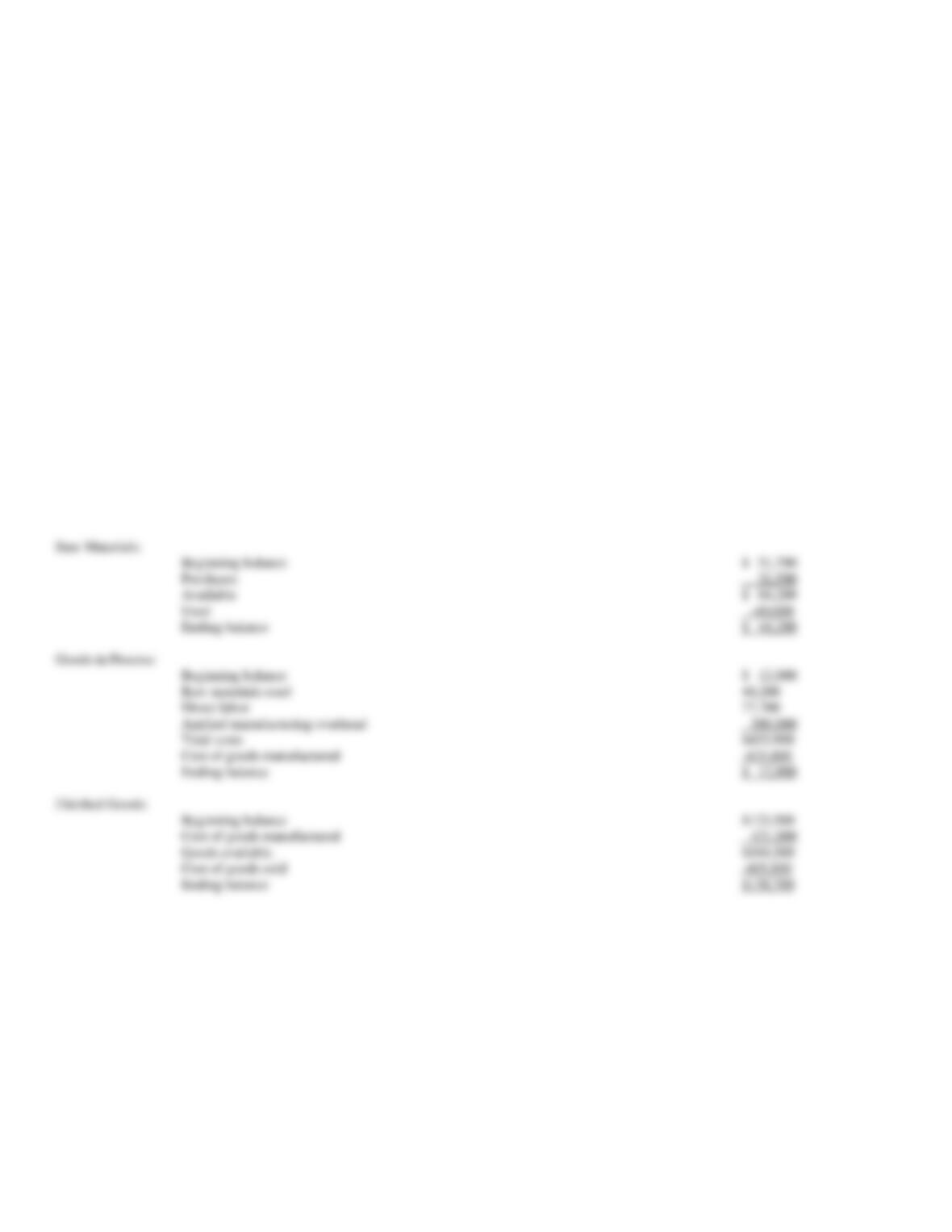
Raw Materials:
Beginning balance
$ 51,700
Purchases
32,500
Available
$ 84,200
Used
-40,000
Ending balance
$ 44,200
Goods in Process:
Beginning balance
$ 12,000
Raw materials used
44,200
Direct labor
77,700
Applied manufacturing overhead
300,000
Total costs
$433,900
Cost of goods manufactured
-421,000
Ending balance
$ 12,900
Finished Goods:
Beginning balance
$123,500
Cost of goods manufactured
421,000
Goods available
$544,500
Cost of goods sold
-405,800
Ending balance
$138,700