Financial Accounting, 11e (Harrison/Horngren/Thomas)
Chapter 8 Long-Term Investments & the Time Value of Money
1 Learning Objective 8-1
1) The amortized cost method determines the carrying value of held–to-maturity investments.
2) An investment in bonds is categorized as a held–to-maturity investment if management intends to sell
the investment before its maturity date.
3) If the stated rate of interest on a bond exceeds the market rate of interest, the bond will sell at a
premium.
4) The face interest rate of a bond determines the cash amount of interest the debtor company is
expected to pay annually or semiannually.
5) The market prices of bonds fluctuate inversely with market interest rates.
6) If the market interest rate is greater than the face rate of interest on a bond, the bond will sell at a
premium.
7) If bonds are issued at a premium, the carrying amount of the bonds will be less than the face value of
the bonds until the maturity date.
8) A quoted bond price of 103 means that the bonds were sold at a discount.
9) Bond investments are initially recorded at cost.
10) An investor should report securities that he or she intends to sell in the next 12 months, and that are
liquid, as a current asset.
11) At maturity, the carrying amount of a bond should be equal to its face value.
12) On the balance sheet, Interest Receivable is reported as a long-term asset.
13) Marathon Corporation owns 500 shares of Mini Company’s common stock. Mini Company has
100,000 shares of common stock outstanding. Marathon Corporation is the ________ and Mini Company
is the ________.
A) investee; investor
B) investor; investee
C) parent company; subsidiary company
D) controlling company; noncontrolling company
14) When an investment is readily convertible to cash and the investor plans to convert the investment
to cash within one year, the investment is reported on the balance sheet as:
A) a current asset.
B) a long-term asset.
C) stockholders’ equity.
D) a cash equivalent.
15) On January 1, 2017, Dodge Company purchases $90,000, 7% bonds at a price of 86.4 and a maturity
date of January 1, 2027. Dodge Company intends to hold the bonds until their maturity date. Interest is
paid semiannually, on January 1 and July 1. Dodge Company has a calendar year end. The entry to
record the purchase of the bond investment on January 1, 2017, is:
A) debit Held-to-Maturity Investment in Bonds for $90,000 and credit Cash for $90,000.
B) debit Held-to-Maturity Investment in Bonds for $77,760 and credit Cash for $77,760.
C) debit Cash for $90,000 and credit Bonds Payable for $90,000.
D) debit Cash for $77,760 and credit Investment in Bonds for $77,760.
16) On January 1, 2017, Dooley Company purchases $80,000, 5% bonds at a price of 86.4 and a maturity
date of January 1, 2027. Dooley Company intends to hold the bonds until their maturity date. Interest is
paid semiannually, on January 1 and July 1. Dooley Company has a calendar year end. The entry for the
receipt of interest on July 1, 2017 is:
A) debit Cash for $2000 and credit Interest Revenue for $2000.
B) debit Cash for $4000 and credit Interest Revenue for $4000.
C) debit Investment in Bonds for $2000 and credit Interest Revenue for $2000.
D) debit Investment in Bonds for $4000 and credit Interest Revenue for $4000.
17) On January 1, 2017, Corbin Company purchases $170,000, 6% bonds at a price of 99 and a maturity
date of January 1, 2027. Corbin Company intends to hold the bonds until their maturity date. Interest is
paid semiannually, on January 1 and July 1. Corbin Company has a calendar year end and uses the
straight-line amortization method for discounts and premiums. The entry to amortize the bond
investment on July 1, 2017 is:
A) debit Held-to-Maturity Investment in Bonds for $85 and credit Interest Receivable for $85.
B) debit Cash for $170 and credit Interest Revenue for $170.
C) debit Held-to-Maturity Investment in Bonds for $85 and credit Interest Revenue for $85.
D) debit Held-to-Maturity Investment in Bonds for $170 and credit Interest Revenue for $170.
18) On January 1, 2017, Benson Company purchases $120,000 , 6% bonds at a price of 93 and a maturity
date of January 1, 2022. Benson Company plans to hold the bonds until their maturity date. Interest is
paid semiannually, on January 1 and July 1. Benson Company has a calendar year and uses the straight–
line amortization method for discounts and premiums. The adjusting entry on December 31, 2017 is:
A) debit Cash $840 and credit Interest Revenue $840.
B) debit Cash $7200 and credit Interest Revenue $7200.
C) debit to Interest Receivable $3600, debit Held–to-Maturity Investment in Bonds for $840 and credit
Interest Revenue $4440.
D) debit to Interest Receivable $7200 and credit Interest Revenue $7200.
19) On January 1, 2017, Brooklyn Company purchases $80,000, 7% bonds at a price of 94 and a maturity
date of January 1, 2027. Brooklyn Company intends to hold the bonds until maturity. Interest is paid
semiannually, on January 1 and July 1. Brooklyn Company has a calendar year and uses the straight-
line amortization method for discounts and premiums. The adjusting entry to amortize the bond
investment on December 31, 2017 is:
A) debit Interest Receivable $2800 and credit Interest Revenue $2800.
B) debit Interest Receivable $5600 and credit Interest Revenue $5600.
C) debit Held-to-Maturity Investment in Bonds $240 and credit Interest Revenue $240.
D) debit Held-to-Maturity Investment in Bonds $480 and credit Interest Revenue $480.
20) On January 1, 2017, Centre Company purchases $170,000, 7% bonds at a price of 88 and a maturity
date of January 1, 2027. Centre Company intends to hold the bonds until the maturity date. Interest is
paid semiannually, on January 1 and July 1. Centre Company has a calendar year end. The journal entry
on January 1, 2018 is:
A) debit Cash $11,900 and credit Interest Revenue $11,900.
B) debit Cash $11,900 and credit Interest Receivable $11,900.
C) debit Cash $5950 and credit Interest Revenue $5950.
D) debit Cash $5950 and credit Interest Receivable $5950.
21) On January 1, 2018, Winston Company purchased 5% bonds with a face value of $50,000 for par.
Winston Company intends to hold the bonds until maturity. Interest is payable semiannually on July 1
and January 1. The company’s fiscal year ends on December 31. The journal entry on July 1, 2018 is:
A) debit Cash $2500 and credit Interest Revenue $2500.
B) debit Cash $1250 and credit Interest Revenue for $1250.
C) debit Cash $1250 and credit Interest Receivable for $1250.
D) debit Cash $2500 and credit Interest Receivable for $2500.
22) On January 1, 2018, Winston Company purchased 5% bonds with a face value of $60,000 for par.
Winston Company intends to hold the bonds until maturity. Interest is payable semiannually on July 1
and January 1. The company’s fiscal year ends on December 31. The company uses the straight-line
amortization method for discounts and premiums. The journal entry on December 31, 2018 is:
A) debit Interest Receivable for $1500 and credit Held–to-Maturity Investment in Bonds $1500.
B) debit Cash for $1500 and credit Interest Revenue for $1500.
C) debit Interest Receivable for $1500 and credit Interest Revenue for $1500.
D) debit Interest Receivable for $3000 and credit Held–to-Maturity Investment in Bonds $3000.
23) On January 1, 2017, Bucket Company purchased as an investment a $1200, 6% bond for $900. Bucket
plans to hold the bond until the maturity date of January 1, 2027. The bond pays interest on January 1
and July 1. The company’s fiscal year ends on December 31 and it uses the straight-line amortization
method for discounts and premiums. The journal entry on December 31, 2017 is:
A) debit Interest Receivable for $36, debit Held–to-Maturity Investment in Bond for $15 and credit
Interest Revenue for $51.
B) debit Cash for $36 and credit Interest Revenue for $36.
C) debit Interest Receivable for $51, credit Held–to-Maturity Investment in Bonds for $15 and credit
Interest Revenue for $36.
D) debit Held-to-Maturity Investment in Bonds for $36 and credit Interest Revenue for $36.
24) On January 1, 2017, Pale Company purchased as an investment a $900, 8% bond for $680. Pale plans
to hold the bond until the maturity date on January 1, 2027. The bond pays interest on January 1 and
July 1. The company’s fiscal year ends on December 31 and it uses the straight-line amortization method
for discounts and premiums. The entries on December 31, 2017 would include a:
A) debit Interest Receivable for $36.
B) debit Held-to-Maturity Investment in Bonds for $36.
C) debit Interest Receivable for $11.
D) credit Held-to-Maturity Investment in Bonds for $11.
25) Held-to-maturity investments in bonds are initially reported at ________ on the purchase date. On a
subsequent balance sheet date, the bonds are reported at ________.
A) cost; fair value.
B) amortized cost; fair value.
C) cost; amortized cost.
D) cost; lower of cost or market.
26) On January 1, 2017, Carmody Corporation purchased 5% bonds with a face value of $60,000 for
$62,000. Carmody Corporation intends to hold the bonds until the maturity date. Interest is paid
semiannually on January 1 and July 1. The company uses the straight-line amortization method for
discounts and premiums. The journal entry on January 1, 2017 is:
A) debit Held-to-Maturity Investment in Bonds for $60,000, debit Premium on Bonds for $2000 and
credit Cash for $62,000.
B) debit Held-to-Maturity Investment in Bonds for $62,000 and credit Cash for $62,000.
C) debit Investment in Bonds for $62,000 and credit Interest Revenue for $62,000.
D) debit Investment in Bonds for $60,000, debit Premium on Bonds for $2000 and credit Interest
Revenue $62,000.
27) On January 1, 2017, Carmello Corporation purchased 4% bonds with a face value of $100,000 for
$92,000. Carmello Corporation intends to hold the bonds until the maturity date of January 1, 2027.
Interest is paid semiannually on January 1 and July 1. The company uses the straight-line amortization
method for discounts and premiums. What journal entry(ies) is(are) prepared on July 1, 2017?
A) debit Cash $2000 and credit Interest Receivable $2000
B) debit Cash $4000 and credit Interest Revenue $4000
C) debit Interest Receivable $2000 and credit Interest Revenue $2000; debit Held–to-Maturity Investment
in Bonds $400 and credit Interest Revenue $400
D) debit Cash $2000 and credit Interest Revenue $2000; debit Held–to-Maturity Investment in Bonds
$400 and credit Interest Revenue $400
28) Long-term investments include:
A) stocks and bonds that are not liquid or readily convertible to cash.
B) securities that the investor expects to hold longer than one year or operating cycle, whichever is
longer.
C) securities reported in the non-current asset section of the balance sheet.
D) all of the above.
29) An investor purchased bonds and intends to hold them until the maturity date which is 10 years
into the future. The bonds were purchased at a discount. One year after purchase, this Held–to-Maturity
Investment in Bonds will be reported at ________ on the balance sheet.
A) fair value
B) historical cost
C) lower of cost or market
D) amortized cost
30) An investor purchased bonds and intends to hold them until the maturity date which is 10 years
into the future. The bonds were purchased at a discount and pay interest semiannually. Which journal
entry or entries is(are) needed at each interest date?
A) receipt of interest revenue only
B) amortization of bond discount only
C) amortization of bond premium only
D) A and B
31) Regarding bond investments that are reported by the amortized cost method, which of the following
statements is INCORRECT?
A) Whenever there is an issue premium or discount, it is amortized by adjusting the carrying value of
the bond upward or downward toward its par or face value.
B) On the maturity date of the bonds, the carrying value will equal the face value.
C) On each interest payment date, as interest revenue is recorded, the premium on bonds will be
amortized, reducing the amount of interest revenue and gradually reducing the carrying value of the
bonds.
D) Whenever there is an issue premium or discount, interest revenue equals the amount of cash
received.
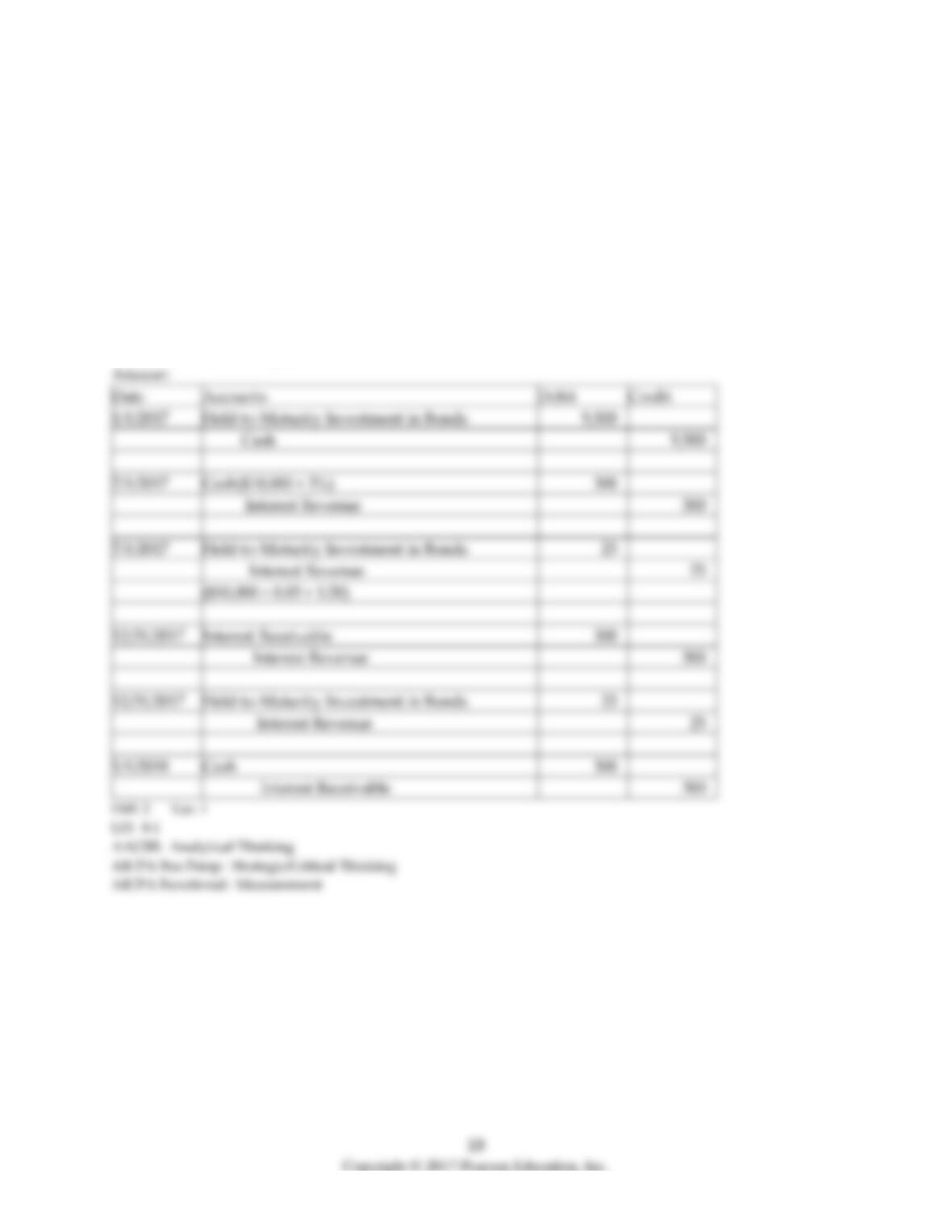
32) On January 1, 2017, Exclusive Company purchases $10,000 of 6% bonds in Smiley Company at a
price of 95. Exclusive Company intends to hold the bonds until the maturity date on January 1, 2027.
The interest dates are January 1 and July 1. Exclusive Company amortizes any discount or premium
using the straight-line method. The fiscal year end of Exclusive Company is December 31.
Required:
Prepare the journal entries on:
1. January 1, 2017
2. July 1, 2017
3. December 31, 2017
4. January 1, 2018
Explanations are not required.
2 Learning Objective 8-2
1) An investor has a long-term available-for-sale stock investment. The investor receives a stock
dividend on the stock investment. No journal entry is necessary for the stock dividend.
2) Unrealized Gain on Investment in Available-for-Sale Securities is reported as other comprehensive
income on a Statement of Comprehensive Income.
3) Long-term available-for-sale investments in stock are reported on the balance sheet at cost.
4) Long-term available-for-sale investments are adjusted to current fair value at the end of each
accounting period.
5) The Allowance to Adjust Investment in Available-for-Sale Securities to Market account is a liability
account.
6) Unrealized gains on investments in available-for-sale securities result from sales of the securities.
7) The Allowance to Adjust Investment in Available-for-Sale Securities to Market account will always
have a debit balance.
8) Realized gains on the sale of long-term available-for-sale securities are reported as other
comprehensive income on the Statement of Comprehensive Income.
9) Cash dividends received on stock investments with less than 20% ownership of the investee should
be credited to the Investment in Available-for-Sale Securities account.
10) A company purchased a long-term available-for-sale security at a cost of $50,000. At year end, the
fair value is $50,290. The adjusting entry requires a credit to Allowance to Adjust Investment in
Available-for-Sale Securities to Market for $290.
11) On the purchase date, long-term available-for-sale equity securities are reported on the balance
sheet at:
A) cost.
B) the lower-of–cost-or-market.
C) amortized cost.
D) fair value.
12) On each balance sheet after the purchase date, investments in long-term available-for-sale securities
are reported at:
A) cost.
B) the lower-of–cost-or-market.
C) amortized cost.
D) fair value.
13) Purdue Company had the following transactions pertaining to stock investments:
a. February 1: Purchased 3100 shares of Hudson Company (10% ownership) at the market price of $17
per share. Purdue Company intends to keep the stock for more than one year and classifies the stock as
available-for-sale.
b. June 1: Received cash dividends of $7000 on Hudson Company stock.
c. October 1: Sold 3100 shares of Hudson stock for $55,800.
The journal entry to record the purchase of the Hudson stock is:
A) debit Equity-Method Investment for $52,700 and credit Cash for $52,700.
B) debit Investment in Available-for-Sale Securities for $52,700 and credit Cash for $52,700.
C) debit Cash for $52,700 and credit Common Stock for $52,700.
D) debit Common Stock for $52,700 and credit Cash for $52,700.
14) Poultry Company had the following transactions pertaining to stock investments:
a. February 1: Purchased 3500 shares of Hudson Company (10% ownership) at the market price of $16
per share. Poultry Company intends to keep the stock for more than one year and classifies the stock as
available-for-sale.
b. June 1: Received cash dividends of $0.50 per share on Hudson Company stock.
c. October 1: Sold 3500 shares of Hudson stock for $59,500.
Which journal entry is prepared on June 1?
A) debit Cash $2800 and credit Interest Revenue $2800
B) debit Cash $3500 and credit Long-Term Investment for $3500
C) debit Interest Receivable for $2800 and credit Interest Revenue for $2800
D) debit Cash $2800 and credit Dividend Revenue for $2800
15) Pansee Company had the following transactions pertaining to stock investments:
a. February 1: Purchased 2900 shares of Hudson Company (10% ownership) at the market price of $22
per share. Pansee Company intends to keep the stock for more than one year and classifies the stock
as available-for-sale.
b. June 1: Received cash dividends of $4000 on Hudson Company stock.
c. June 30: End of accounting period. Fair value of Hudson Company stock is $62,800. The company
uses an allowance account to adjust the investment.
Which journal entry is prepared on June 30?
A) debit Unrealized Loss on Investment in Available-for-Sale Securities for $1000 and credit Allowance
to Adjust Investment in Available-for-Sale Securities to Market for $1000
B) debit Allowance to Adjust Investment in Available-for-Sale Securities to Market for $1000 and credit
Unrealized Loss on Investment in Available-for-Sale Securities for $1000
C) debit Unrealized Loss on Investment in Available-for-Sale Securities for $1000 and credit Investment
in Available-for-Sale Securities for $1000
D) debit Investment in Available-for-Sale Securities for $1000 and credit Unrealized Gain on Investment
in Available-for-Sale Securities for $1000
16) If an investor owns less than 20% of the common stock of another company as a long-term
investment:
A) the equity method of accounting should be used for the investment.
B) the investor has a controlling interest in the investee.
C) the investor usually has little or no influence on the investee.
D) the investor has significant influence on the investee.
17) For accounting purposes, the method used to account for long-term investments in common stock is
determined by:
A) the size of the investor.
B) the size of the investor when compared to the size of the investee.
C) vote by the Board of Directors of the investor.
D) the investor’s percentage ownership of the investee‘s stock.
18) If 15% of the common stock of an investee company is purchased as a long-term investment, the
appropriate method of accounting for the investment is:
A) the equity method.
B) the consolidation method.
C) the available-for-sale (fair value) method.
D) the lower of cost or market method.
19) The available-for-sale method of accounting for long-term investments in stock should be used
when the:
A) investor owns less than 20% of the outstanding stock of the investee.
B) investor has significant influence over the investee’s operating decisions and policies.
C) investor has little or no influence on the investee.
D) A and C.
20) The fair value of a long-term available-for-sale security has decreased from the last carrying value.
The journal entry to record this decrease will include a:
A) debit to the Allowance to Adjust Investment in Available–for-Sale Securities to Market.
B) credit to the Allowance to Adjust Investment in Available-for-Sale Securities to Market.
C) credit to the Unrealized Loss on Investment in Available–for-Sale Securities.
D) debit to the Unrealized Gain on Investment in Available-for-Sale Securities.
21) The Allowance to Adjust Investment in Available-for-Sale Securities to Market has a debit balance.
Therefore:
A) the Allowance account is subtracted from the carrying amount of the Investment in Available-for-
Sale Securities.
B) the Allowance account is added to the carrying amount of the Investment in Available-for-Sale
Securities.
C) the Allowance account is neither added nor subtracted from the carrying amount of the Investment
in Available-for-Sale Securities.
D) the Allowance account is added to Unrealized Gain or Loss on Investment in Available-for-Sale
Securities.
22) The fair value of a long-term available-for-sale security has increased from the last carrying value.
The company uses an allowance account to adjust the investment. The journal entry to record this
increase will include:
A) a debit to the Allowance to Adjust Investment in Available-for-Sale Securities to Market.
B) a credit to the Allowance to Adjust Investment in Available-for-Sale Securities to Market.
C) a debit to the Unrealized Gain on Investment in Available-for-Sale Securities.
D) a credit to the Unrealized Loss on Investment in Available-for-Sale Securities.
23) Unrealized gains and losses from long-term available-for-sale investments arise from:
A) the purchase of an investment.
B) the sale of the investment.
C) changes in the fair value of the investment.
D) investor’s share of investee’s net income or net loss.
24) Realized gains and losses from long-term available-for-sale investments arise from:
A) the purchase of an investment.
B) the sale of the investment.
C) changes in the fair value of the investment.
D) investor’s share of investee’s net income or net loss.
25) The balance in the Unrealized Gain on Investment in Available-for-Sale Securities account is
reported on the ________. The investments are classified as long-term.
A) balance sheet as a contra asset account
B) income statement under Other Expenses and Losses
C) balance sheet, as part of the stockholders’ equity section
D) balance sheet, as part of Long-Term Investments
26) The Unrealized Gain on Investment in Available-for-Sale Securities is reported in:
A) Other Revenues and Gains on the income statement.
B) Other Comprehensive Income on the Statement of Comprehensive Income.
C) Accumulated Other Comprehensive Income on the balance sheet.
D) B and C.
27) When accounting for long-term investments in available-for-sale securities, which of the following is
used to compute net income?
A) Unrealized Gains on Investments in Available-for-Sale Securities
B) Realized Gains on Investments in Available-for-Sale Securities
C) Dividend Revenue
D) B and C.
28) An investor receives a stock dividend from a long-term available-for-sale investment. Which journal
entry is required?
A) a debit to Cash and a credit to Dividend Revenue
B) a debit to Cash and a credit to Unrealized Gain on Investments
C) a debit to Investment in Available-for-Sale Securities and a credit to Dividend Revenue
D) a memorandum entry only
29) An investor receives a cash dividend from a long-term available-for-sale investment. Which journal
entry is required?
A) a debit to Cash and a credit to Dividend Revenue
B) a debit to Cash and a credit to Interest Revenue
C) a debit to Cash and credit to Investment in Available-for-Sale Securities
D) a debit to Cash and credit to Interest Receivable
30) How does the declaration and receipt of a cash dividend on a long-term Investment in Available-for-
Sale Securities affect the balance sheet?
A) increases assets and increases paid-in-capital
B) increases assets and decreases stockholders’ equity
C) increases assets and increases retained earnings
D) has no effect on assets or total stockholders’ equity
31) How does the receipt of a stock dividend on a long-term Investment in Available-for-Sale Securities
affect the balance sheet?
A) increases assets and increases paid–in-capital
B) increases assets and decreases stockholders’ equity
C) increases assets and increases retained earnings
D) has no effect on assets or total stockholders’ equity
32) Regarding the receipt of a stock dividend from an investment that is held as a long-term investment
in available-for-sale security, which of the following statements is CORRECT?
A) Dividend revenue, based on the current fair value of the stock, is recorded.
B) Because the number of shares of stock held has increased, the investor’s cost per share also increases.
C) A new cost per share is determined and that amount is used for all future transactions affecting the
investment.
D) The accounting treatment for a stock dividend is the same as the accounting treatment for a cash
dividend.
33) The gain or loss on the sale of an investment, classified as a long-term available-for-sale-security, is
measured by comparing the ________ of the investment with the ________ of the investment.
A) balance of the Allowance to Adjust Investment in AFSS to Market account; selling price
B) fair value at last balance sheet date; selling price
C) cost; selling price
D) fair value at date of sale; selling price
34) Seider Company receives a stock dividend of 110 shares from Dolhun Company. Seider previously
owned 830 shares of Dolhun stock that had a cost of $4400. After the stock dividend, the cost per share
of Dolhun stock is now: (Round your final answer to the nearest cent.)
A) $6.11.
B) $4.68.
C) $9.36.
D) $5.30.
35) A long-term investment in available-for-sale securities was acquired at a cost of $39,000. At year–
end, the fair value of the securities is $45,450. The year-end adjusting entry requires a:
A) credit to Investment in Available-for-Sale Securities for $6450.
B) debit to Allowance to Adjust Investment in Available-for-Sale Securities to Market for $6450.
C) credit to Allowance to Adjust Investment in Available–for-Sale Securities to Market for $6450.
D) debit to Unrealized Loss on Investment in Available–for-Sale Securities for $6450.
36) The journal entry to record the sale of a long-term available-for-sale investment includes a Gain on
Sale of Investment in Available-for-Sale Securities for $700. The income statement will report:
A) other comprehensive income of $700.
B) other income and gains of $700.
C) an extraordinary gain of $700.
D) accumulated other comprehensive income of $700.