Managerial Accounting, 16e (Garrison)
Chapter 7A: Time-Driven Activity-Based Costing: A Microsoft Excel-Based Approach
1) In a Cost Analysis report in time-based activity-based costing, the time-driven activity rate for
an activity is computed by dividing the minutes required of the resource per unit of activity by
the cost per minute of the resource supplied.
2) In time-based activity-based costing, the practical capacity percentage is an estimate of the
company’s capacity in relation to its closest competitor.
3) Time-based activity-based costing does not require extensive interviews with employees to
perform stage one allocations.
4) In a Cost Analysis report in time-based activity-based costing, the first step is to divide the
total cost of the resources supplied by the practical capacity of the resources supplied to obtain
the cost per minute of the resource supplied.
5) In a Capacity Analysis report in time-based activity-based costing, the unused capacity in
minutes is computed by subtracting the total minutes used to meet demand from the total minutes
available to meet demand.
6) In a Capacity Analysis report in time-based activity-based costing, the unused capacity in
number of employees is computed by multiplying the unused capacity in minutes by the practical
capacity per employee in minutes.
7) In a Capacity Analysis report in time-based activity-based costing, the impact on expenses of
matching capacity with demand is computed by multiplying the potential adjustment in the
number of employees by the average salary per employee.
8) Time-based activity-based costing does NOT use which of the following types of data inputs?
A) Resource data.
B) Direct cost data.
C) Activity data.
D) Costs object data.

4
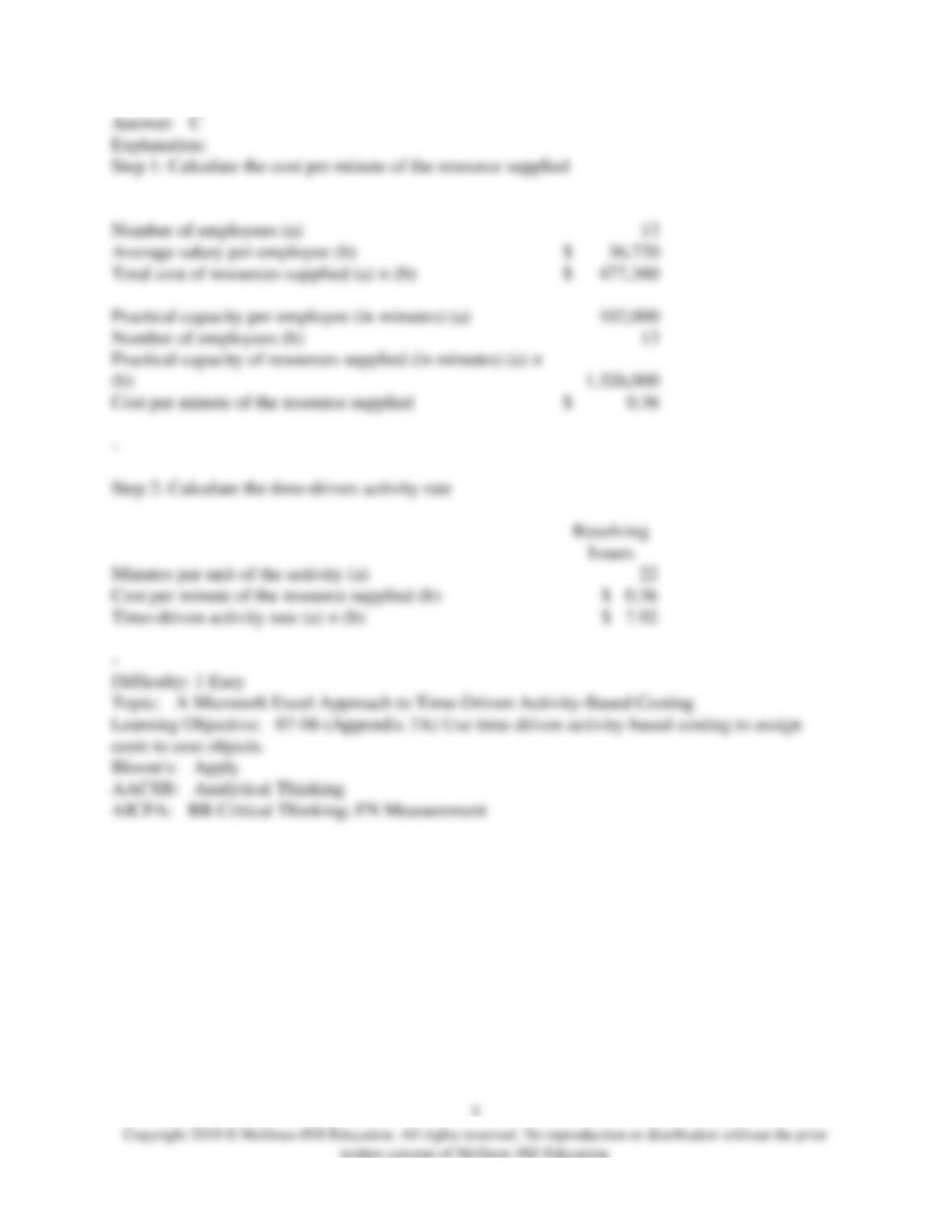
9) Clutts Corporation is conducting a time-driven activity-based costing study in its Customer
Support Department. The company has provided the following data to aid in that study:
Clutts Corporation
Customer Support Department
Data Inputs
Resource Data:
Number of employees
13
Average salary per employee
$
36,720
Practical capacity per employee (in minutes)
102,000
–
Activity Data:
Receiving
Calls
Resolving
Issues
Minutes per unit of the activity
16
22
–
On the Customer Cost Analysis report in time-driven activity-based costing, the time-driven
activity rate for Resolving Issues would be closest to:
A) $0.36 per issue resolved
B) $1.64 per issue resolved
C) $7.92 per issue resolved
D) $22.00 per issue resolved

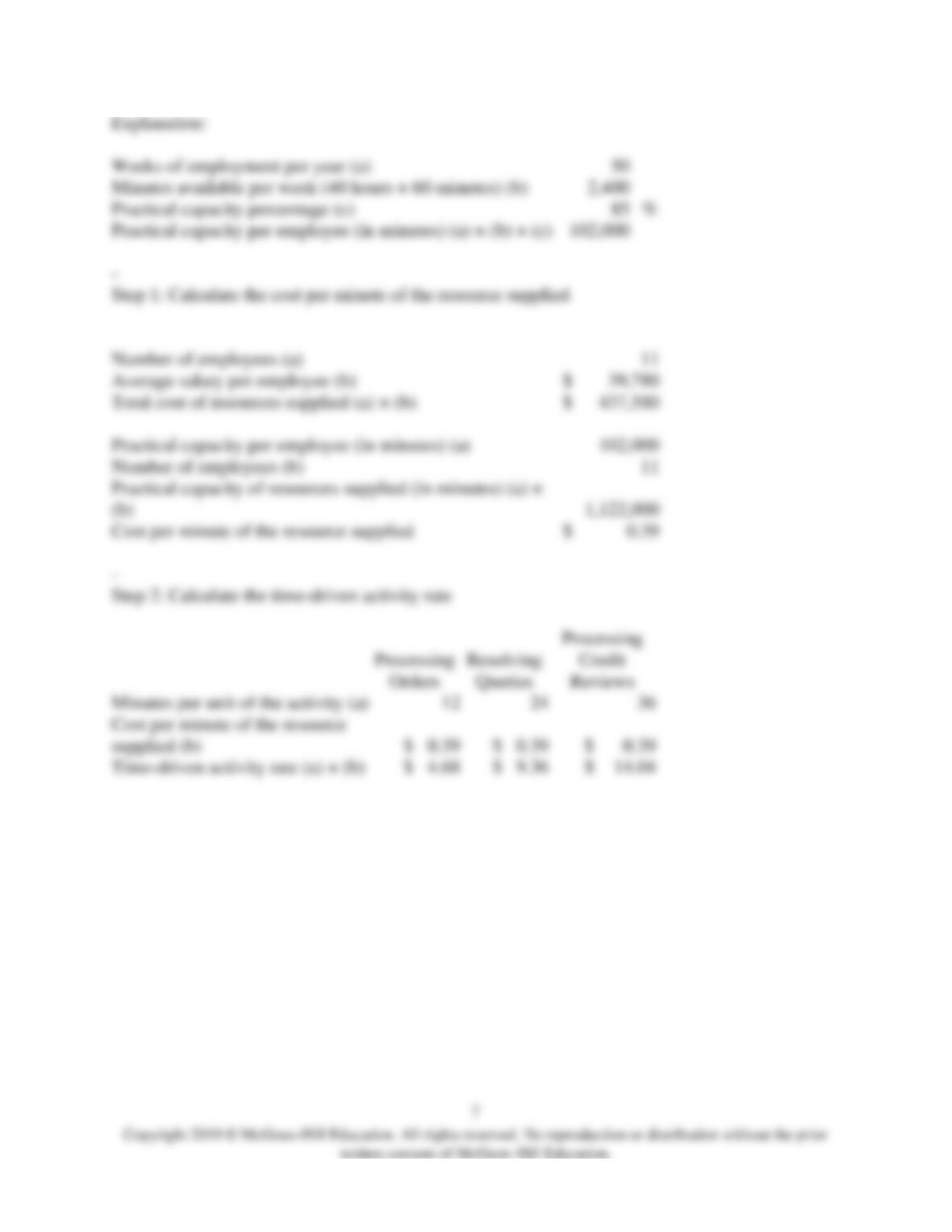
10) Pacius Corporation is conducting a time-driven activity-based costing study in its Customer
Service Department. The company has provided the following data to aid in that study:
Pacius Corporation
Customer Service Department
Data Inputs
Resource Data:
Number of employees
11
Average salary per employee
$
39,780
Weeks of employment per year
50
Minutes available per week (40 hours × 60 minutes)
2,400
Practical capacity percentage
85
%
–
Activity Data:
Receiving
Calls
Resolving
Issues
Processing
Credit
Reviews
Minutes per unit of the activity
12
24
36
–
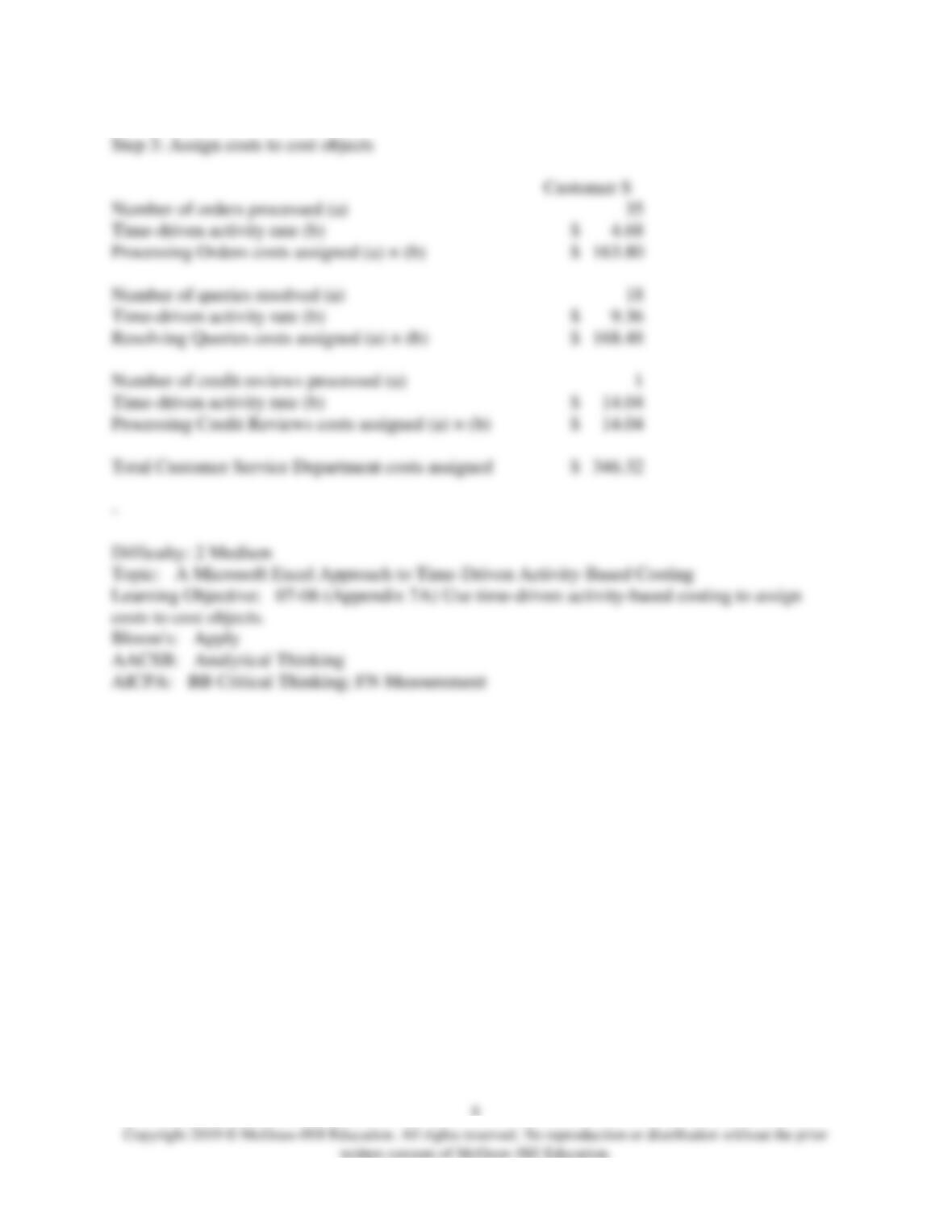
Cost Object Data:
Customer S
Number of orders processed
35
Number of queries resolved
18
Number of credit reviews processed
1
–
On the Customer Cost Analysis report in time-driven activity-based costing, the total cost
assigned to Customer S would be closest to:
A) $346.32
B) $14.04
C) $168.48
D) $163.80
–

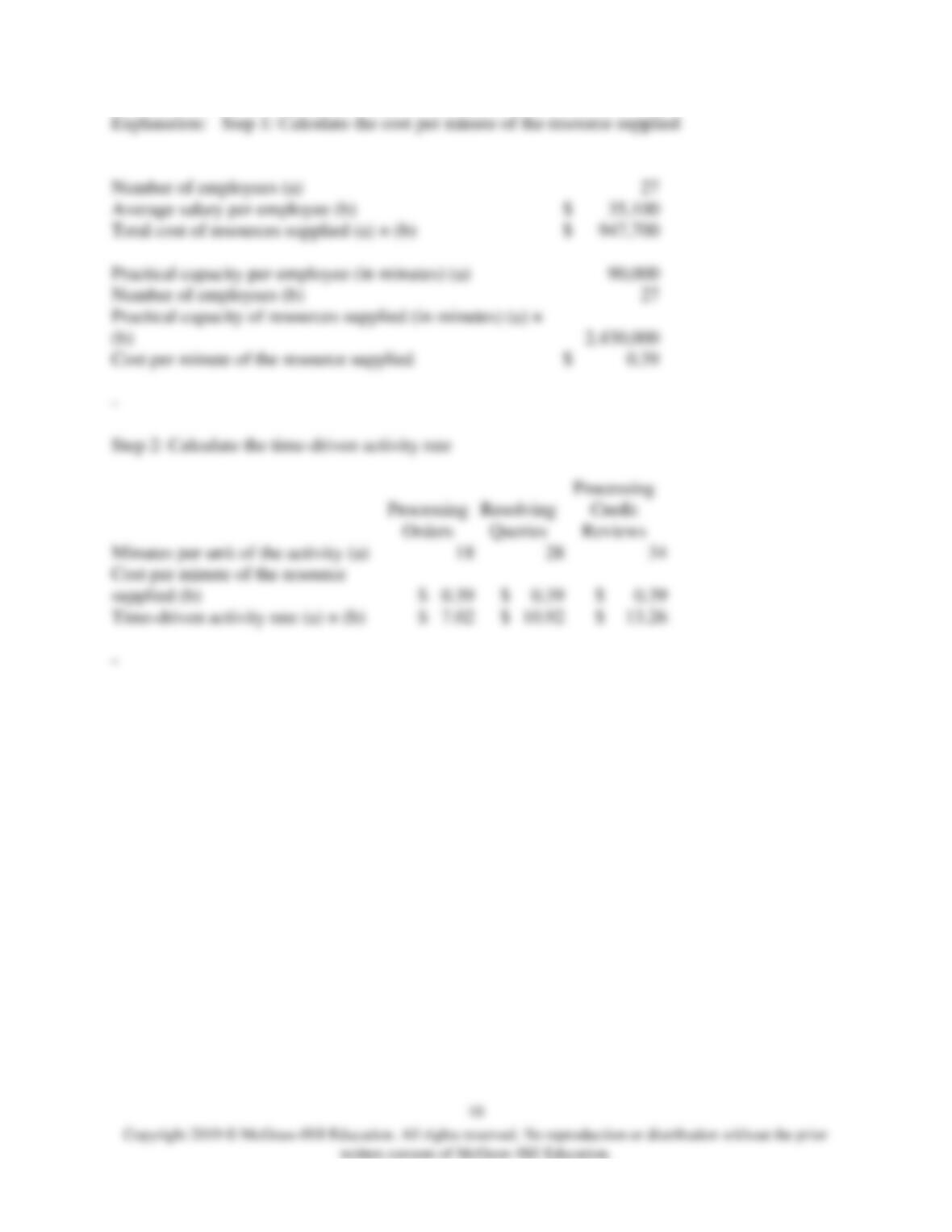
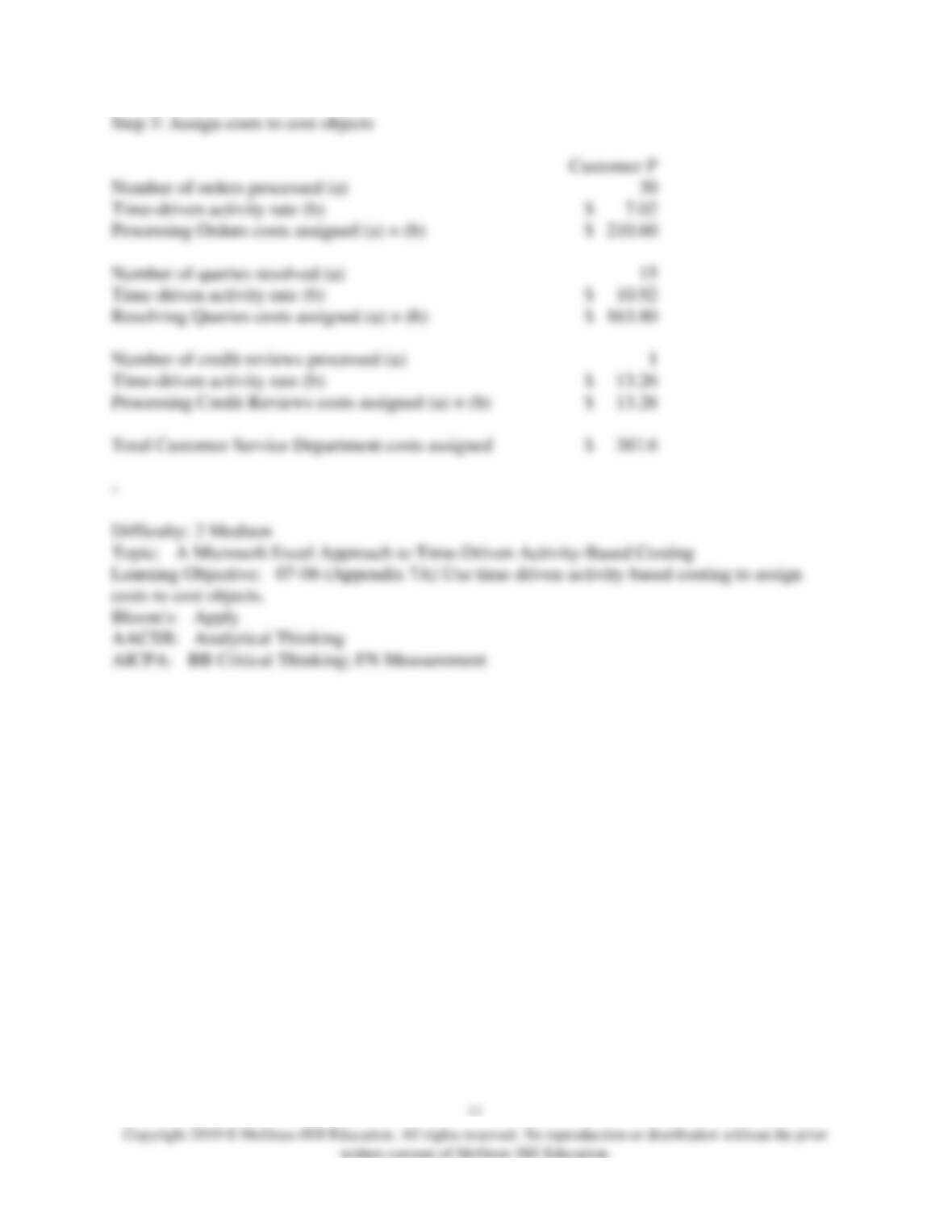
11) Schackow Corporation is conducting a time-driven activity-based costing study in its
Customer Service Department. The company has provided the following data to aid in that study:
Schackow Corporation
Customer Service Department
Data Inputs
Resource Data:
Number of employees
27
Average salary per employee
$
35,100
Practical capacity per employee (in minutes)
90,000
–
Activity Data:
Processing
Orders
Resolving
Queries
Processing
Credit
Reviews
Minutes per unit of the activity
18
28
34
–
Cost Object Data:
Customer P
Number of orders processed
30
Number of queries resolved
15
Number of credit reviews processed
1
–
On the Customer Cost Analysis report in time-driven activity-based costing, the total cost
assigned to Customer P would be closest to:
A) $163.80
B) $387.66
C) $13.26
D) $210.60

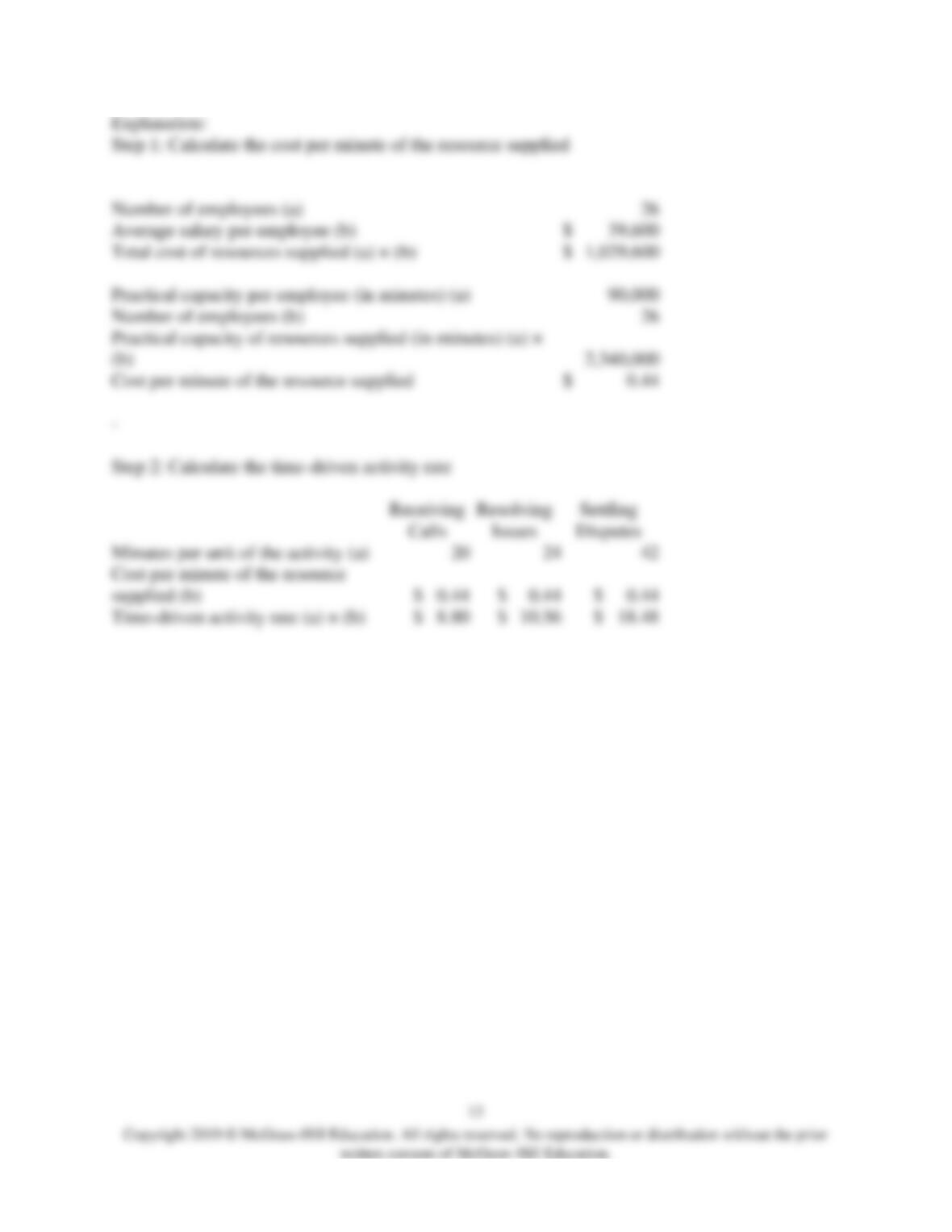
12) Oltz Corporation is conducting a time-driven activity-based costing study in its Customer
Support Department. The company has provided the following data to aid in that study:
Oltz Corporation
Customer Support Department
Data Inputs
Resource Data:
Number of employees
26
Average salary per employee
$
39,600
Practical capacity per employee (in minutes)
90,000
–
Activity Data:
Receiving
Calls
Resolving
Issues
Settling
Disputes
Minutes per unit of the activity
20
24
42
–
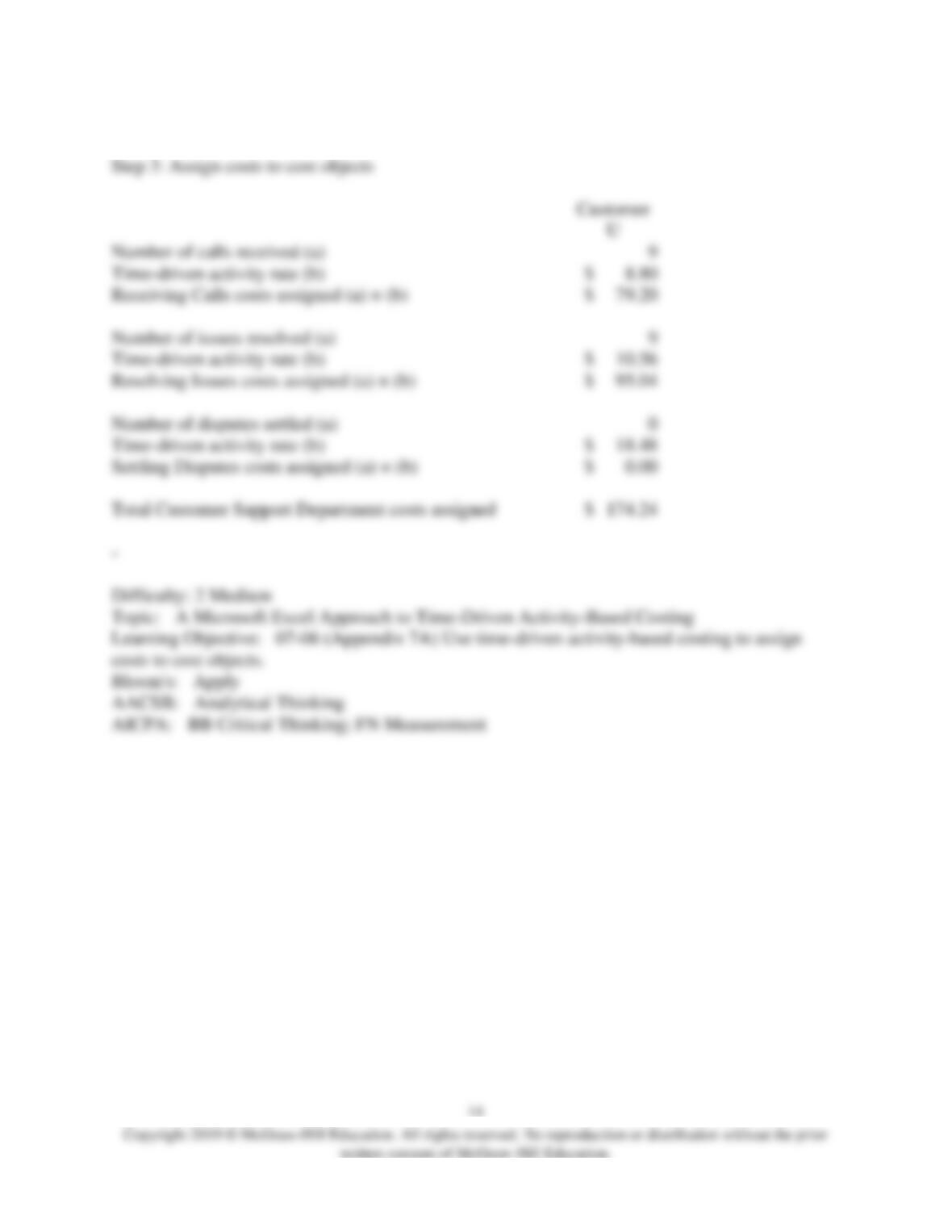
Cost Object Data:
Customer P
Customer T
Customer U
Number of calls received
26
17
9
Number of issues resolved
14
8
9
Number of disputes settled
1
0
0
–
On the Customer Cost Analysis report in time-driven activity-based costing, the total cost
assigned to Customer U would be closest to:
A) $0.00
B) $174.24
C) $79.20
D) $95.04
–
13) Schweiss Corporation is conducting a time-driven activity-based costing study in its
Customer Service Department. The company has provided the following data to aid in that study:
Schweiss Corporation
Customer Service Department
Data Inputs
Resource Data:
Number of employees
15
Average salary per employee
$
37,800
Weeks of employment per year
50
Minutes available per week (40 hours × 60 minutes)
2,400
Practical capacity percentage
90
%
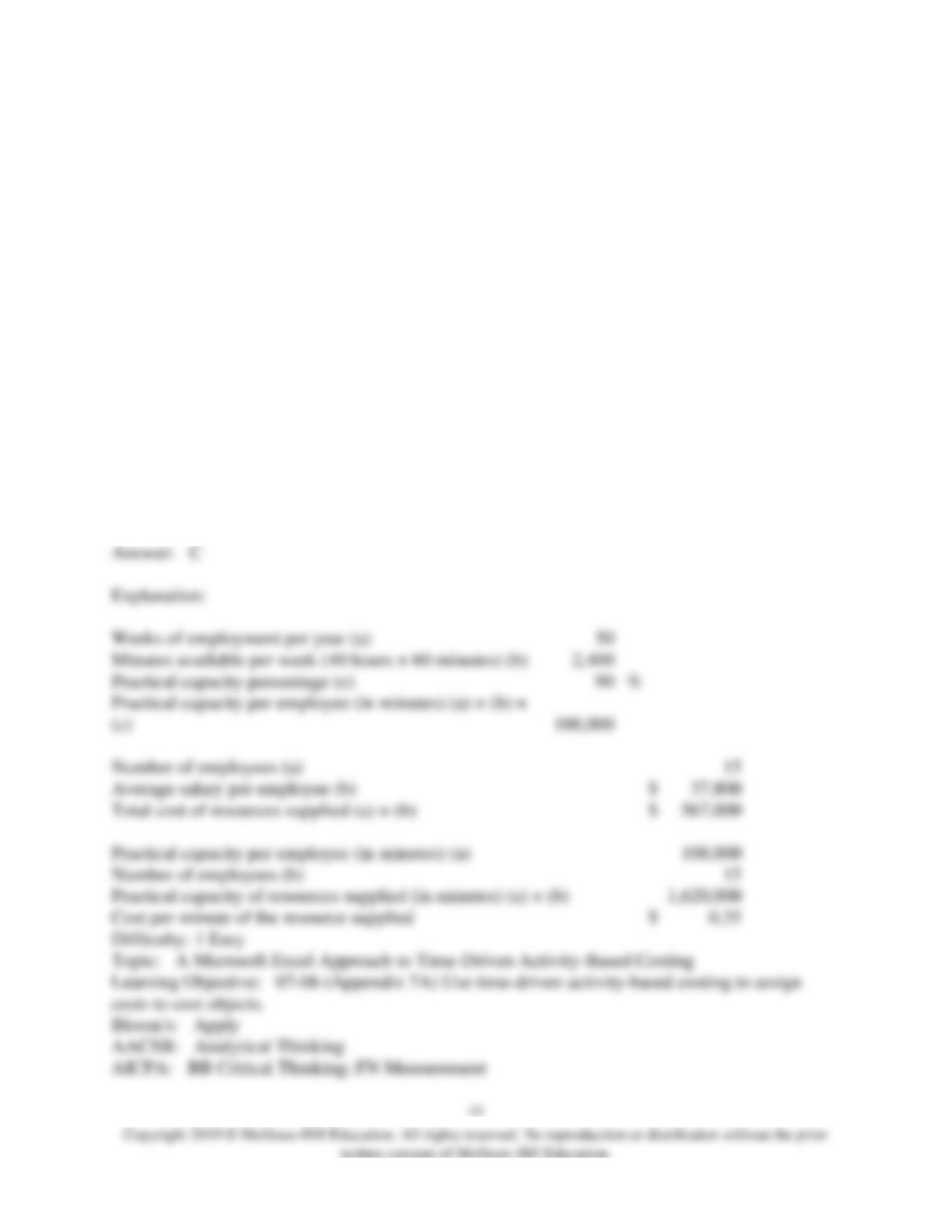
On the Customer Cost Analysis report in time-driven activity-based costing, the cost per minute
of the resource supplied would be closest to:
A) $17.50 per minute
B) $0.32 per minute
C) $0.35 per minute
D) $15.75 per minute
Weeks of employment per year (a)
Minutes available per week (40 hours × 60 minutes) (b)
Practical capacity percentage (c)
(c)
108,000
Number of employees (a)
Average salary per employee (b)
Total cost of resources supplied (a) × (b)
567,000
Practical capacity per employee (in minutes) (a)
108,000
Number of employees (b)
Practical capacity of resources supplied (in minutes) (a) × (b)
Cost per minute of the resource supplied

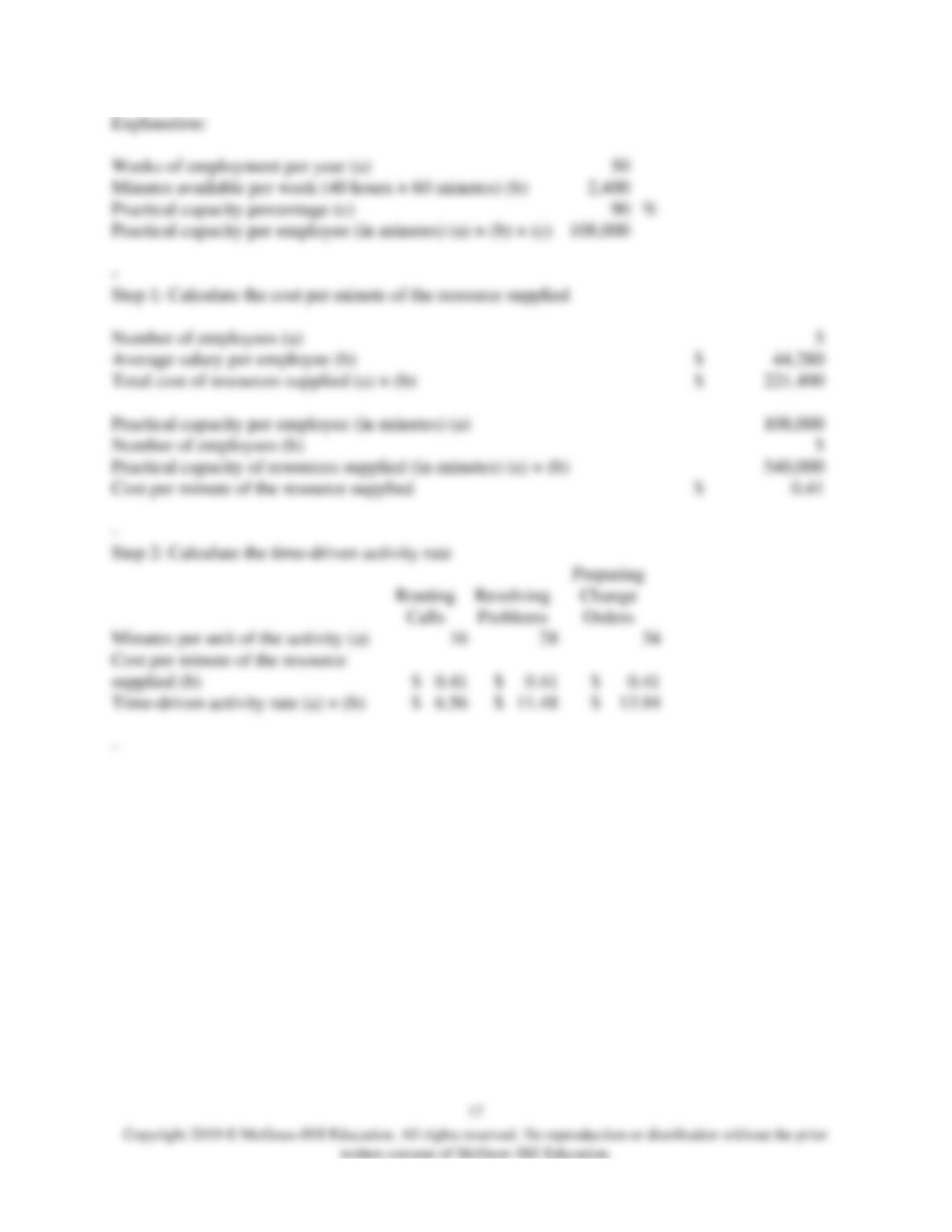
14) Offerman Corporation is conducting a time-driven activity-based costing study in its Tech
Support Department. The company has provided the following data to aid in that study:
Offerman Corporation
Tech Support Department
Data Inputs
Resource Data:
Number of employees
5
Average salary per employee
$
44,280
Weeks of employment per year
50
Minutes available per week (40 hours × 60 minutes)
2,400
Practical capacity percentage
90
%
–
Activity Data:
Routing Calls
Resolving
Problems
Preparing
Change
Orders
Minutes per unit of the activity
16
28
34
–
Cost Object Data:
Customer P
Customer Q
Number of calls routed
32
15
Number of problems resolved
18
10
Number of change orders prepared
0
0
–
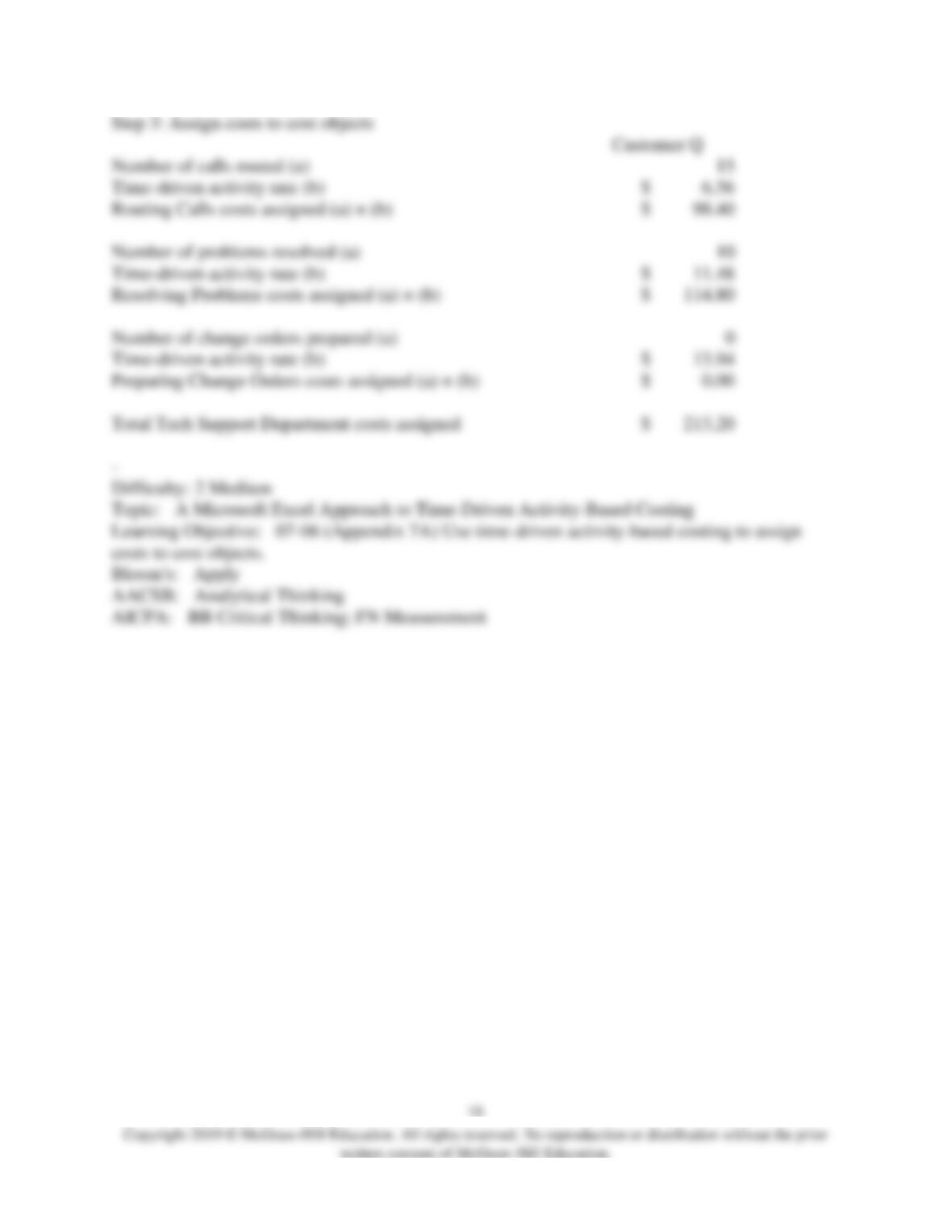
On the Customer Cost Analysis report in time-driven activity-based costing, the total cost
assigned to Customer Q would be closest to:
A) $0.00
B) $98.40
C) $213.20
D) $114.80

15) Chuong Corporation is conducting a time-driven activity-based costing study in its Order
Fulfillment Department. The company has provided the following data to aid in that study:
Chuong Corporation
Order Fulfillment Department
Data Inputs
Resource Data:
Number of employees
11
Average salary per employee
$
36,000
Practical capacity per employee (in minutes)
90,000
–
Activity Data:
Processing
Orders
Preparing
Deliveries
Handling
Returns
Minutes per unit of the activity
10
22
44
–
On the Customer Cost Analysis report in time-driven activity-based costing, the time-driven
activity rate for Handling Returns would be closest to:
A) $44.00 per return handled
B) $17.60 per return handled
C) $0.91 per return handled
D) $0.40 per return handled