Fixed Assets and Intangible Assets
63. Which of the following is not an intangible asset?
a. Goodwill
b. Trademark
c. Copyright
d. Long-term receivable
64. Which of the following intangible assets are amortized over their useful life?
a. Trademarks
b. Goodwill
c. Patents
d. All of the above
65. Which of the following statement is true about intangible assets?
a. They are usually presented in the balance sheet as fixed assets.
b. They are short-lived assets.
c. They are not held for resale.
d. They have physical existence.
66. The exclusive right to use a certain name or symbol is called a:
a. franchise.
b. patent.
c. trademark.
d. copyright.
67. Paleota Company purchased a patent from Finise for $234,000. At the time of purchase, the
patent had a remaining useful life of 10 years. Determine the patent amortization expense for
the first year.
a. $23,400
b. $23,000
c. $14,000
d. $9,800
Fixed Assets and Intangible Assets
68. Expenditures for research and development are generally recorded as:
a. current operating expenses.
b. assets, and amortized over their estimated useful life.
c. assets, and usually amortized over 40 years.
d. current assets.
69. The cost of a patent should be amortized :
a. over 10 years.
b. over its economic life.
c. over 20 years or its economic life, whichever is shorter.
d. only if an impairment occurs.
70. A patent was purchased for $585,000 with a legal life of 20 years. Management estimates that
the patent has an 12- year economic life. The entry to record amortization would include:
a. an increase in amortization expense for $29,250.
b. an increase in research and development expense for $585,000.
c. a decrease in patent for $48,750.
d. an increase in accumulated amortization for $585,000.
71. Fixed assets are ordinarily presented in the balance sheet:
a. at its current market value.
b. at its replacement cost.
c. at its cost less accumulated depreciation.
d. under intangible assets.
72. Which of the following is true of fixed asset turnover?
a. It measures the efficiency with which a company uses its fixed assets to generate sales.
b. It measures the proportion of fixed assets to total assets.
c. It uses net purchases as a denominator in its calculation.
d. It measures the profits generated by the fixed and current assets of the company.
Fixed Assets and Intangible Assets
73. The fixed asset turnover is calculated as .
a. net income divided by average fixed assets
b. net sales divided by cost of the assets
c. average fixed assets divided by net sales
d. net sales divided by average fixed assets
74. A fixed asset turnover ratio of 1.65 for a company indicates that:
a. a company is generating $1.65 of sales per average dollar of fixed asset.
b. a company is generating $1.65 of net income per average dollar of fixed asset.
c. a company has $1.65 of long term debt for every dollar of fixed asset.
d. a company has $1.65 of current assets for every dollar of fixed asset.
75. BlueInk Roadways Corporation operates throughout the United States. The following data (in
millions) were adapted from recent financial statements of BlueInk.
Year 2
Year 1
Net sales
$15,504
$9,685
Beginning of year property, plant, and equipment
7,531
5,727
End of year property, plant, and equipment
7,380
5,563
From the above data, what would be the fixed asset turnover for Year 2?
a. 2.08
b. 1.02
c. 2.01
d. 2.10
76. A company made some expensive repairs to equipment and buildings during the past year. (a)
What criteria is used in determining whether the repairs are capital expenditures or revenue
expenditures, and (b) what is the effect on the company’s financial statements if they are
incorrectly recorded as capital expenditures?
Fixed Assets and Intangible Assets
77. Identify each of the following expenditures as chargeable to (a) Land, (b) Land Improvements,
(c) Buildings, (d) Machinery and Equipment, or (e) Other accounts.
(1) Cost of paving parking area for employees and customers.
(2) Insurance during construction of building.
(3) Interest incurred on money borrowed for construction of building.
(4) Fee paid for installation of equipment.
(5) Special foundation for new equipment acquired.
(6) Transit insurance on new equipment.
(7) Freight charges on new equipment.
(8) Cost of repairing vandalism damage to equipment during installation.
(9) Sales tax on new equipment.
(10) Cost incurred in repairing damage resulting from installation of new equipment.
(11) Cost of landfill for building site.
(12) Cost of lubricating oil purchased for periodic oil changes for equipment.
(13) Parking lot lighting.
(14) Installing a fence around the parking lot.
(15) Repainting the trim on a building.
(16) Special assessment paid to city for extension of water main to the property.
(17) Cost of razing and removing the old building on property acquired for a building site.
(18) Delinquent real estate taxes assumed by purchaser on property acquired for a building
site.
(19) Attorney’s fee for title search.
(20) Architect’s fee for building plans and supervision of construction.
78. Cook Co. incurred the following costs related to the office building used in operating its sports
supply company:
(a) Replaced a broken window.
(b) Replaced the roof that had been on the building for 23 years.
(c) Serviced all the air conditioners before summer started.
(d) Replaced the air conditioners with refrigerated air conditioners in the customer service
areas.
(e) Added a warehouse to the back of the building.
(f) Repainted the interior walls.
(g) Installed window shutters on all windows.
Classify each of the costs as a capital expenditure or a revenue expenditure.
Fixed Assets and Intangible Assets
79. A pressurized spray painter was purchased on April 1 of the fiscal year for $3,900. It has a
useful life of 4 years and a residual value of $300. Determine depreciation expense for the first
two years, assuming a fiscal year end of December 31 and using (a) the straight-line method and
(b) the double-declining-balance method.
80. A company purchased a photocopy machine for $16,000. It has a useful life of 4 years and a
residual value of $1,000. Compute depreciation for the second year under each of the following
methods: (a) straight-line and (b) double-declining-balance.
81. A company acquired a truck for $79,000 at the beginning of the fiscal year. It has a useful life
of 5 years and a residual value of $9,000. The company uses the straight-line method of
depreciation. After owning the truck for two years, the company sold it for $34,000. (a)
Determine depreciation expense for each of the first two years, and (b) determine the gain or
loss resulting from the sale.
82. You have been hired by a high-growth startup company to assist in the determination of what
depreciation method to employ for financial reporting. The company’s fixed assets are equally
divided among buildings and high-tech equipment (heavily used in the initial years).
(a) Can the company select different methods of depreciation for financial reporting?
Explain.
(b) Explain to company management which method of depreciation would be suitable for
each type of fixed assets the company employs. Also, state why.
(c) Which method of depreciation would the company choose for taxes? Explain why.
Fixed Assets and Intangible Assets
83. A machine with a useful life of 6 years and a residual value of $3,000 was purchased at the
beginning of year 1 for $30,000. The machine was sold for $15,000 on April 1 in year 4.
(a)
What was the book value of the machine at the end of year 3 assuming the straight-line
method of depreciation is used?
(b)
Illustrate the effects on the accounts and financial statements of the depreciation from
January 1 to April 1 of year 4.
(c)
Illustrate the effects on the accounts and financial statements of the sale of the machine
on April 1.
(c)
84. Machine with a useful life of 5 years and a residual value of $6,000 was purchased on January
3, 2015, for $48,500. The machine was sold on January 5, 2020, for $13,000.
(a)
What is the book value of the machine on January 5, 2015, assuming straight-line
depreciation is used?
(b)
Illustrate the effects on the accounts and the financial statements of the sale of the
machine on January 5, 2015.
(c)
Illustrate the effects on the accounts and the financial statements of the sale of the
machine if it had been sold for $18,000 instead.
(c)
Fixed Assets and Intangible Assets
85. A company acquired mineral rights for $7,500,000. The mineral deposit is estimated at 600,000
tons and during the year 100,000 tons were extracted and sold.
(a) Calculate depletion expense for the year.
(b) Show the effects of (a) on the accounts and the financial statements of the company.
(c) What is the book value of the mineral rights at the end of the current year?
86. During 2015, Lexie, Inc. acquired Lena, Inc. for $10,000,000. The fair market value of the net
assets of Lena, Inc. was $8,500,000 on the date of purchase. During 2018, Lexie, Inc.
determined the goodwill resulting from the Lena acquisition was impaired and had a value of
$1,000,000.
(a) Determine the amount of goodwill implied during 2015.
(b) Illustrate the effects on the accounts and the financial statements of the December 31,
2018, adjustment for the goodwill impairment.
Fixed Assets and Intangible Assets
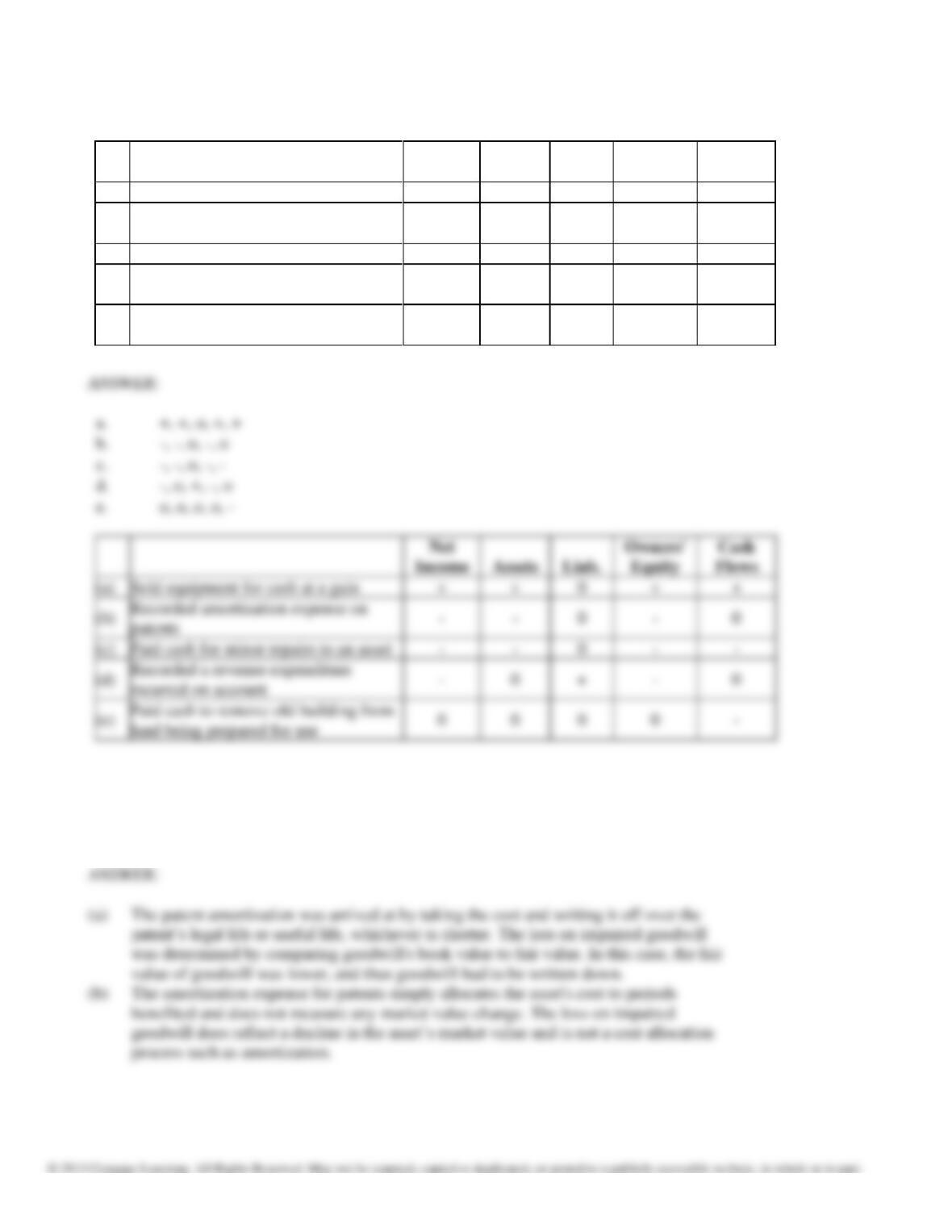
87. For each of the following items indicate whether the transactions listed below increased (+),
decreased (–) or had no effect (o) by inserting the appropriate symbol.
Net
Income
Assets
Liab.
Owners’
Equity
Cash
Flows
(a)
Record depreciation expense
(b)
Sold equipment for cash at a loss
(c)
Recorded loss on impaired goodwill
(d)
Recorded depletion expense
(e)
Recorded a capital expenditure and
issued a note payable
(a)
Record depreciation expense
(b)
Sold equipment for cash at a loss
(c)
Recorded loss on impaired goodwill
(d)
Recorded depletion expense
Fixed Assets and Intangible Assets
88. For each of the following items indicate whether the transactions listed below increased (+),
decreased (–) or had no effect (o) by inserting the appropriate symbol.
Net
Income
Assets
Liab.
Owners’
Equity
Cash
Flows
(a)
Sold equipment for cash at a gain
(b)
Recorded amortization expense on
patents
(c)
Paid cash for minor repairs to an asset
(d)
Recorded a revenue expenditure
incurred on account
(e)
Paid cash to remove old building from
land being prepared for use
Net
Owners’
Cash
(a)
Sold equipment for cash at a gain
Recorded amortization expense on
patents
(c)
Paid cash for minor repairs to an asset
Recorded a revenue expenditure
incurred on account
Paid cash to remove old building from
land being prepared for use
89. You are examining the financial statements of a company. You observe patent amortization
expense of $1.5 million and a loss on impairment of goodwill for $25 million.
(a) Describe how the accountants arrived at these amounts.
(b) Interpret any information provided by these disclosures.
Fixed Assets and Intangible Assets
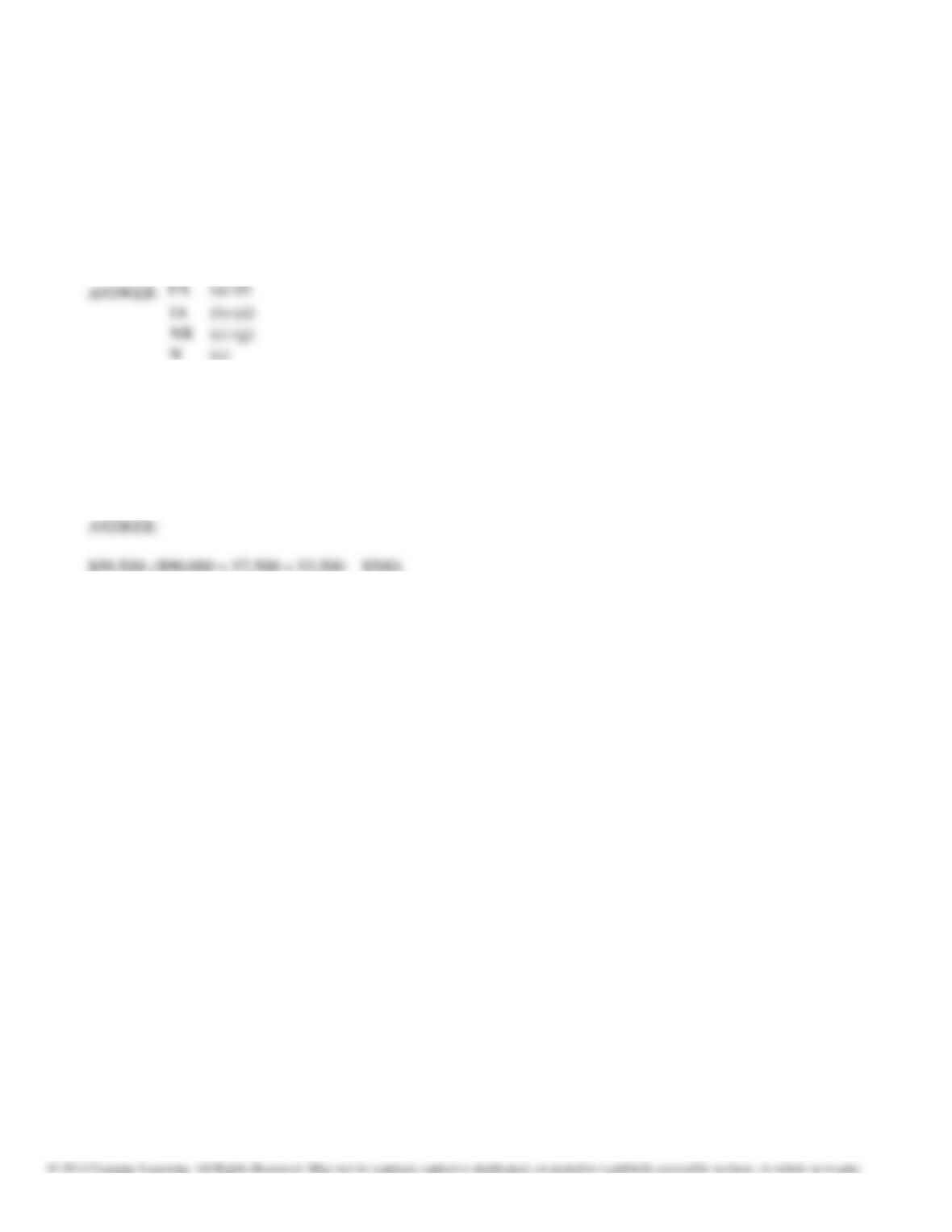
90. Identify the following as a Fixed Asset (FA), Intangible Asset (IA), Natural Resource (NR), or
None of these (N).
(a) Computer
(b) Patent
(c) Oil reserve
(d) Goodwill
(e) U.S. Treasury note
(f) Land used for employee parking
(g) Gold mine
91. Determine the cost of the land, based on the following data.
Land purchase price
$90,000
Broker’s commission
7,500
Payment for the demolition and removal of existing building
2,500
Cash received from the sale of materials salvaged from the demolished building
500