140) The following selected amounts are reported on the year-end unadjusted trial balance report
for a company that uses the percent of sales method to determine its bad debts expense.
Accounts receivable
$
435,000
Debit
Allowance for Doubtful Accounts
1,250
Debit
Net Sales
2,100,000
Credit
All sales are made on credit. Based on past experience, the company estimates 1% of credit sales
to be uncollectible. What adjusting entry should the company make at the end of the current year
to record its estimated bad debts expense?
A) Debit Bad Debts Expense $19,750; credit Allowance for Doubtful Accounts $19,750.
B) Debit Bad Debts Expense $15,225; credit Allowance for Doubtful Accounts $15,225.
C) Debit Bad Debts Expense $22,250; credit Allowance for Doubtful Accounts $22,250.
D) Debit Bad Debts Expense $7,350; credit Allowance for Doubtful Accounts $7,350.
E) Debit Bad Debts Expense $21,000; credit Allowance for Doubtful Accounts $21,000.
141) On February 1, a customer’s account balance of $2,300 was deemed to be uncollectible.
What entry should be recorded on February 1 to record the write-off assuming the company uses
the allowance method?
A) Debit Bad Debts Expense $2,300; credit Accounts Receivable $2,300.
B) Debit Allowance for Doubtful Accounts $2,300; credit Bad Debts Expense $2,300.
C) Debit Allowance for Doubtful Accounts $2,300; credit Accounts Receivable $2,300.
D) Debit Bad Debts Expense $2,300; credit Allowance for Doubtful Accounts $2,300.
E) Debit Accounts Receivable $250; credit Allowance for Doubtful Accounts $2,300.
142) All of the following statements regarding the allowance method are true except:
A) The allowance method estimates bad debts expense at the end of each accounting period and
records it with an adjusting entry.
B) The Allowance for Doubtful Accounts is a contra asset account.
C) The Allowance for Doubtful Accounts is subtracted from Accounts Receivable to report
receivables at realizable value.
D) The allowance method does not record bad debt expense until a customer’s account receivable
is determined to be uncollectible.
E) The write-off an uncollectible account does not impact the income statement.
143) Using the allowance method for bad debts, the end of the period adjusting entry for
estimated bad debts is:
A) Debit Bad Debts Expense and credit Accounts Receivable.
B) Debit Allowance for Doubtful Accounts and credit Accounts Receivable.
C) Debit Accounts Receivable and credit Allowance for Doubtful Accounts.
D) Debit Allowance for Doubtful Accounts and credit Bad Debts Expense.
E) Debit Bad Debts Expense and credit Allowance for Doubtful Accounts.
144) Using the allowance method for bad debts expense, the Allowance for Doubtful Accounts is
decreased:
A) When the estimate of bad debts is expensed.
B) When a specific customer account is written off.
C) When a specific customer account is collected.
D) When a sale to a credit customer is made.
E) When all customer accounts are considered collectible.
145) Winkler Company borrows $85,000 and pledges its receivables as security. The journal
entry to record this transaction would be:
A) Debit Cash of $85,000 and credit Accounts Receivable $85,000.
B) Debit Cash of $85,000 and credit Accounts Payable $85,000.
C) Debit Note Receivable $85,000 and credit Accounts Receivable $85,000.
D) Debit Cash $85,000 and credit Notes Payable $85,000.
E) Debit Accounts Receivable $85,000 and credit Notes Payable $85,000.
146) Mullis Company sold merchandise on account to a customer for $625, terms n/30. The
journal entry to record this sale transaction would be:
A) Debit Cash of $625 and credit Sales $625.
B) Debit Cash of $625 and credit Accounts Receivable $625.
C) Debit Accounts Receivable $625 and credit Sales $625.
D) Debit Accounts Receivable $625 and credit Cash $625.
E) Debit Sales $625 and credit Accounts Receivable $625.
147) Mullis Company sold merchandise on account to a customer for $625, terms n/30. The
journal entry to record the collection on account would be:
A) Debit Cash of $625 and credit Sales $625.
B) Debit Cash of $625 and credit Accounts Receivable $625.
C) Debit Accounts Receivable $625 and credit Sales $625.
D) Debit Accounts Receivable $625 and credit Cash $625.
E) Debit Sales $625 and credit Accounts Receivable $625.
148) MacKenzie Company sold $300 of merchandise to a customer who used a Regional Bank
credit card. Regional Bank deducts a 1.5% service charge for sales on its credit cards and credits
MacKenzie’s account immediately when sales are made. The journal entry to record this sale
transaction would be:
A) Debit Cash of $300 and credit Sales $300.
B) Debit Cash of $300 and credit Accounts Receivable $300.
C) Debit Accounts Receivable $300 and credit Sales $300.
D) Debit Cash $295.50; debit Credit Card Expense $4.50 and credit Sales $300.
E) Debit Cash $295.50 and credit Sales $295.50.
149) MacKenzie Company sold $180 of merchandise to a customer who used a Regional Bank
credit card. Regional Bank deducts a 4% service charge for sales on its credit cards. MacKenzie
electronically remits the credit card sales receipts to the credit card company and receives
payment immediately. The journal entry to record this sale transaction would be:
A) Debit Cash of $180 and credit Sales $180.
B) Debit Cash of $180 and credit Accounts Receivable—Regional $180.
C) Debit Accounts Receivable—Regional $172.80; debit Credit Card Expense $7.20 and credit
Sales $180.
D) Debit Cash $172.80; debit Credit Card Expense $7.20 and credit Sales $180.
E) Debit Cash $172.80 and credit Sales $172.80.
150) Kenai Company sold $600 of merchandise to a customer who used a National Bank credit
card. National Bank deducts a 3% service charge for sales on its credit cards. Kenai
electronically remits the credit card sales receipts to the credit card company and receives
payment immediately. The journal entry to record the collection from the credit card company
would be:
A) Debit Cash of $618 and credit Accounts Receivable—National $618.
B) Debit Cash of $618; credit Credit Card Expense $18 and credit Sales $600.
C) Debit Accounts Receivable—National $582; debit Credit Card Expense $18 and credit Sales
$600.
D) Debit Cash $582; debit Credit Card Expense $18 and credit Sales $600.
E) Debit Cash $582 and credit Sales $582.
151) Frederick Company borrows $63,000 from First City Bank and pledges its receivables as
security. Which of the following is true regarding this transaction:
A) First City Bank is the factor in this transaction.
B) Frederick Company’s financial statements must disclose the pledging of receivables.
C) Frederick Company no longer has the risk of bad debts.
D) First City Bank takes ownership of the receivables at the time of the pledge.
E) No journal entry is required for this event.
152) Majesty Productions accepted a $7,200, 120-day, 6% note from Swartz Studio on March 1.
On the date the note matures, Swartz is unable to pay, but Majesty intends to continue collection
efforts. What entry should Majesty record on the maturity date for this dishonored note?
A) Debit Accounts Receivable $7,200; credit Notes Receivable $7,200.
B) Debit Accounts Receivable $7,200; credit Allowance for Doubtful Accounts $7,200.
C) Debit Bad Debt Expense $7,344; credit Notes Receivable $7,344.
D) Debit Accounts Receivable $7,344; credit Interest Revenue $144; credit Notes Receivable
$7,200.
E) Debit Accounts Receivable $7,056; debit Interest Revenue $144; credit Notes Receivable
$7,200.
153) Match each of the following terms with the appropriate definitions.
A. Maker of a note
B. Bad debts
C. Aging of accounts receivable
D. Interest
E. Promissory note
F. Payee of a note
G. Accounts receivable
H. Allowance for doubtful accounts
I. Realizable value
J. Expense recognition principle
____ 1.
Amounts due from customers for credit sales.
____ 2.
A process of classifying accounts receivable by how long it is past its due date
for the purpose of estimating the amount of uncollectible accounts.
____ 3.
A written promise to pay a specified amount of money, usually with interest,
either on demand or at a definite future date.
____ 4.
The amount expected to be received.
____ 5.
The uncollectible accounts of credit customers who do not pay what they have
promised.
____ 6.
The accounting principle that requires expenses to be reported in the same
period as the sales they helped to produce.
____ 7.
The charge a borrower pays for using money borrowed.
____ 8.
A contra asset account with a balance approximating the amount of accounts
receivable expected to be uncollectible.
____ 9.
The party who signs a note and promises to pay it at maturity.
____10.
The party to whom the promissory note is payable.
154) Match each of the following terms with the appropriate definitions.
A. Allowance method
B. Installment accounts receivable
C. Principal of a note
D. Maturity date
E. Materiality constraint
F. Direct write-off method
G. Dishonoring a note
H. Accounts receivable turnover
I. Factoring accounts receivable
J. Pledging accounts receivable
____ 1.
A measure of both the quality and liquidity of accounts receivable that
indicates how often, on average, receivables are collected during the period.
____ 2.
Amounts owed by customers from credit sales for which payment is required
in periodic payments over an extended period of time.
____ 3.
The accounting constraint that states that an amount can be ignored if its effect
on the financial statements is unimportant to its users.
____ 4.
Refers to a note maker’s inability or refusal to pay a note at maturity.
____ 5.
A method of accounting for bad debts that matches the estimated loss from
uncollectible accounts receivable against the sales they helped to produce.
____ 6.
Selling all or a portion of accounts receivable to a finance company or bank.
____ 7.
The day note principal and interest must be repaid.
____ 8.
Committing accounts receivable as security for a loan.
____ 9.
A method of accounting for bad debts that records the loss from an
uncollectible account receivable immediately upon determining it is
uncollectible.
____10.
The amount that the signer of a note agrees to pay back when the note matures,
not including interest.
155) Describe how accounts receivable arise and how they accounted for, including the use of a
subsidiary ledger and an allowance account.
156) Define a note receivable and explain how to calculate the interest due on a short-term note
receivable.
157) Explain the options a company may use to convert its receivables to cash before they are
due.
158) What is the accounts receivable turnover ratio? How is it calculated and how is it used to
assess financial condition?
159) Describe the differences in how the direct write-off method and the allowance method are
applied in accounting for uncollectible accounts receivables.
160) The allowance method of accounting for bad debts requires an estimate of bad debt expense
at the end of each accounting period. The two common methods to determine the estimate
amount are the percent of sales method and the percent of receivables method. Explain the basic
differences between the two methods.
161) Explain how to record the receipt (acceptance) of a note receivable.
162) Explain the difference between honoring and dishonoring a note receivable.
163) What are some of the considerations management should make when assessing the accounts
receivable turnover ratio?
164) A company allows its customers to use bank credit cards to charge purchases. When
customers use the credit cards, the net amount is deposited in the company’s checking account,
less a 2.5% service charge. Assume that on April 13, the company sold $20,000 worth of
merchandise to customers who used credit cards. Prepare the company’s journal entry to record
the credit card sales for April 13 assuming the company deposited the receipts that same day.
165) Gemstone Products allows customers to use bank credit cards to charge purchases. The
bank used by Gemstone Products processes all bank credit cards in exchange for a 3%
processing fee and all credit card receipts deposited are credited to the company account on the
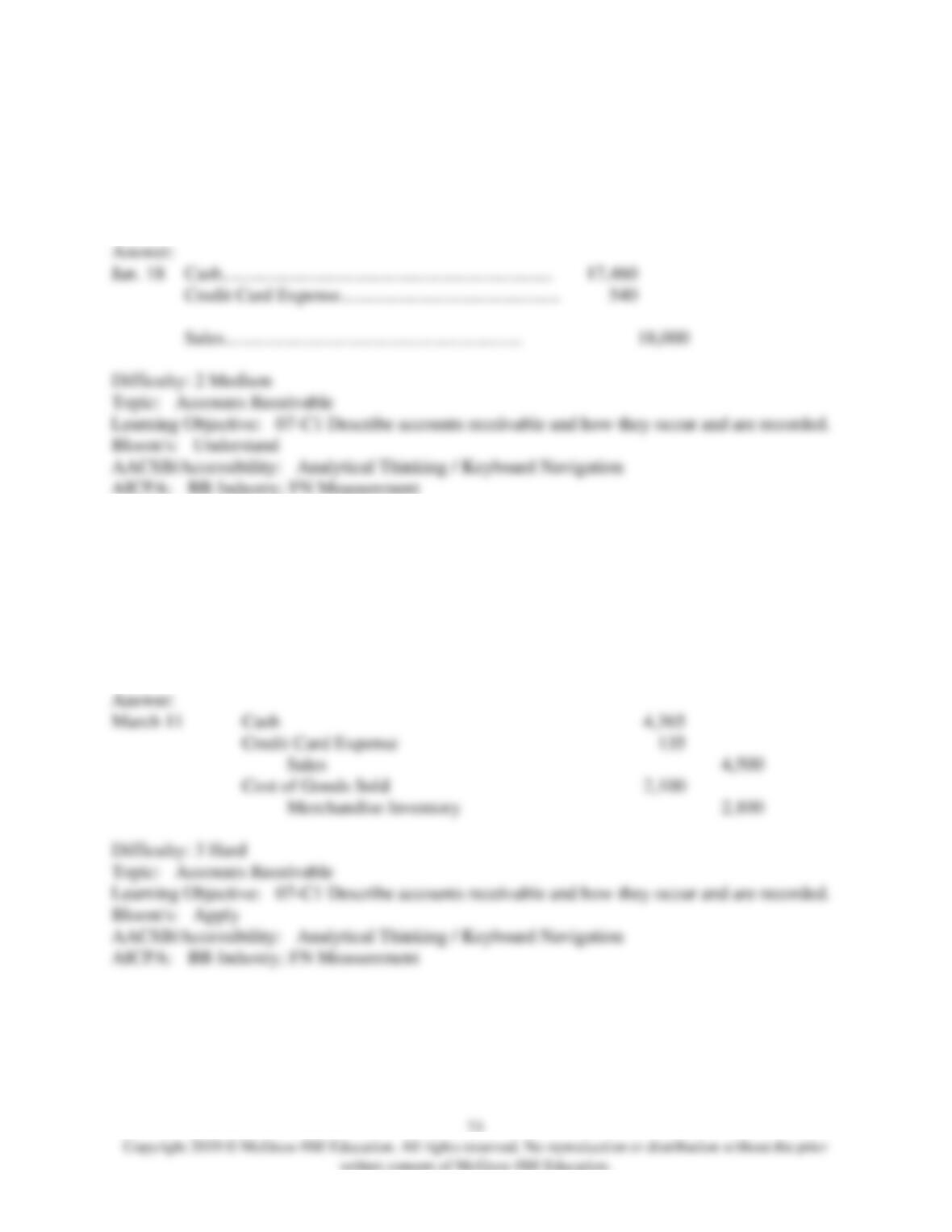
day of deposit. Assume that on January 18, Gemstone Products sold and deposited $18,000
worth of bank credit card receipts. Prepare the general journal entry to record this transaction.
Jan. 18
Cash……………………………………………………………..
Credit Card Expense………………………………………..
Sales……………………………………………………….
18,000
166) Mercks uses the perpetual inventory system, and accepts the Discovery bank credit card for
credit card sales. Discovery charges Mercks a 3% fee, and all credit card receipts deposited are
credited to the company account on the day of deposit. Prepare journal entries to record the
following transaction.
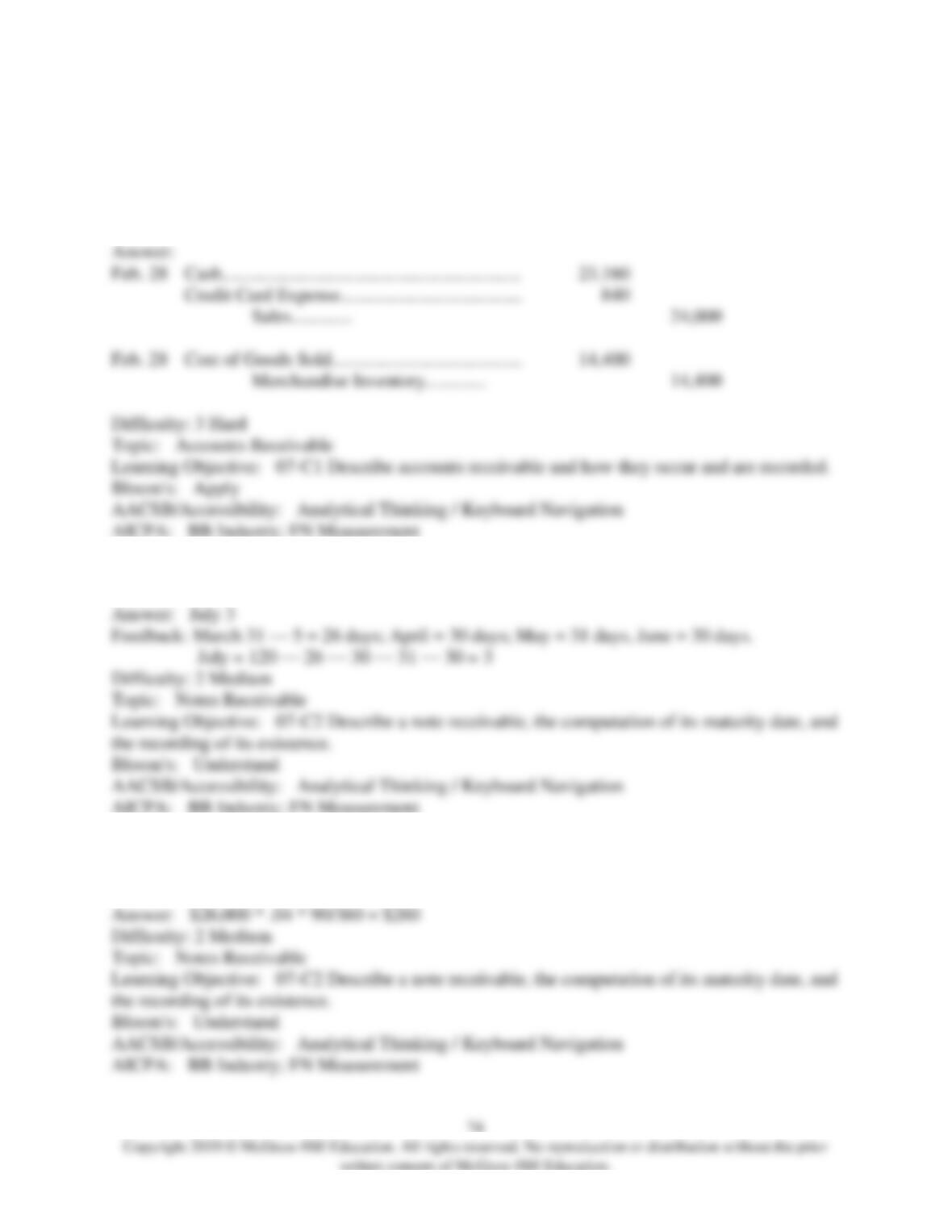
March 11
Sold merchandise for $4,500 (that had cost $2,100) and accepted the
customer’s Discovery bank card.
March 11
Cash
Credit Card Expense
Cost of Goods Sold
167) Woods Co. uses a perpetual inventory system, and accepts the World Express bank credit
card from its customers. World Express charges a 3.5% service fee and all credit card receipts
deposited are credited to the company account on the day of deposit. On February 28, Woods
sold $24,000 worth of merchandise to customers (that had cost $14,400) using the World
Express charge card. Prepare the journal entries to record February 28 sales.
168) What is the maturity date of a 120-day note receivable dated March 5?
169) Prudence Co. receives a $26,000, 90-day, 4% note receivable. What is the amount of
interest that is due at maturity?
170) Prudence Co. receives a $26,000, 90-day, 4% note receivable. What is the total principal
and interest due at maturity?
171) Calculate the amount of interest that would be owed on a $18,000, 60-day, 8% note
receivable at maturity.
172) If a 90-day note receivable is dated July 12, what is the maturity date of the note?
173) If a 60-day note receivable is dated September 22, what is the maturity date of the note?
174) On May 31, a company had a balance in its accounts receivable of $103,200. Prepare
journal entries to record the following transactions for June. Assume the company uses a
perpetual inventory system.
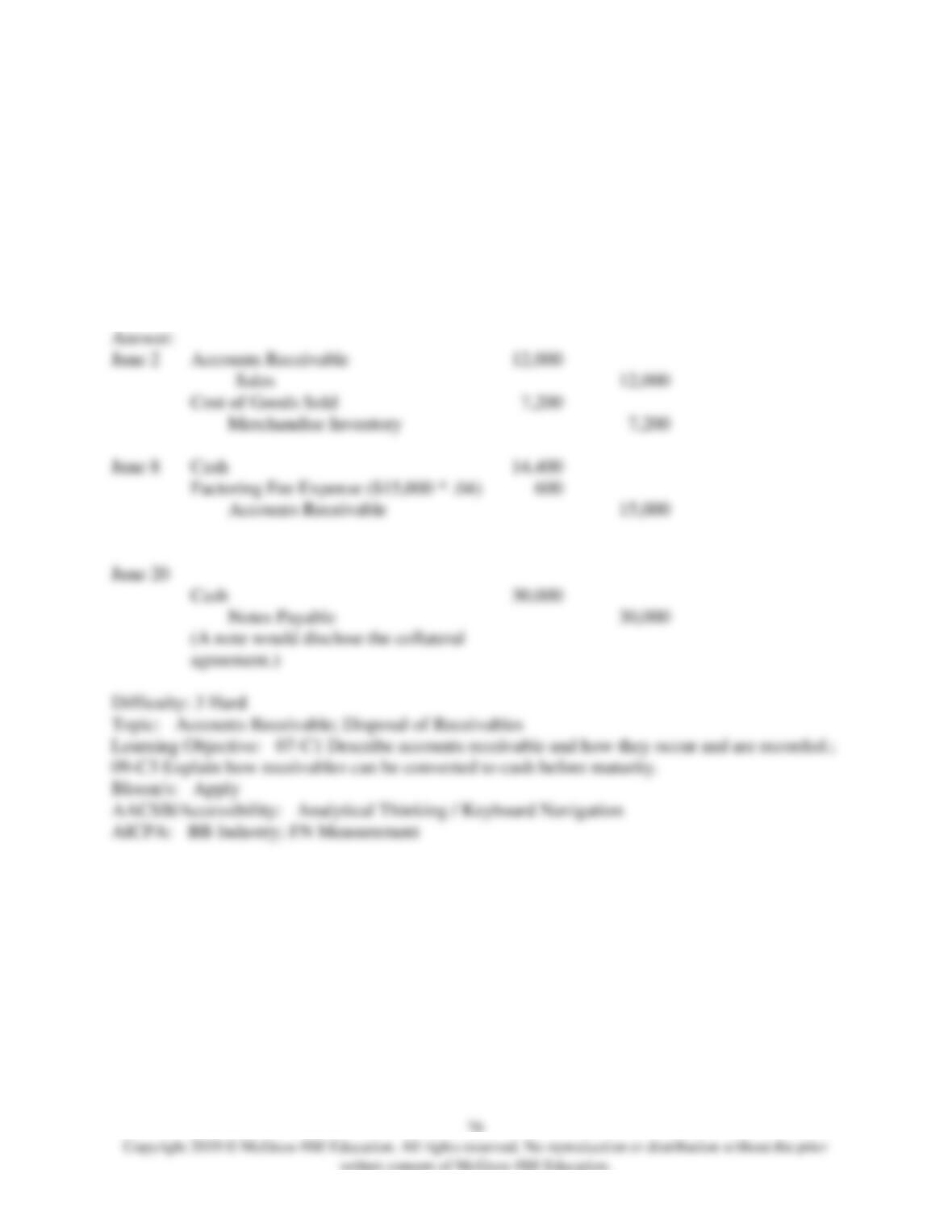
June 2
Sold merchandise on account, $12,000. The cost of the merchandise was $7,200.
June 8
Sold $15,000 worth of accounts receivable to First Bank. First Bank charged a
4% factoring fee.
June 20
Borrowed $30,000 cash from Second National Bank, pledging $31,500 worth of
accounts receivable as collateral for the loan.
June 2
Accounts Receivable
Cost of Goods Sold
June 8
Cash
Factoring Fee Expense ($15,000 * .04)
June 20
Cash
agreement.)
175) Orman Co. sold $80,000 of accounts receivable to First Savings and incurred a 3%
factoring fee. Prepare the journal entry for Orman Co. to record the sale.
176) Flax had net sales of $7,875 and its average accounts receivables is $1,250. Calculate Flax’s
accounts receivable turnover:
177) Morgan had net sales of $310,000 and average accounts receivable of $75,600. Its
competitor, Stanley, had net sales of $290,000 and average accounts receivables of $61,350.
Calculate the accounts receivable turnover for both companies. Which company is doing a better
job of managing its accounts receivables?
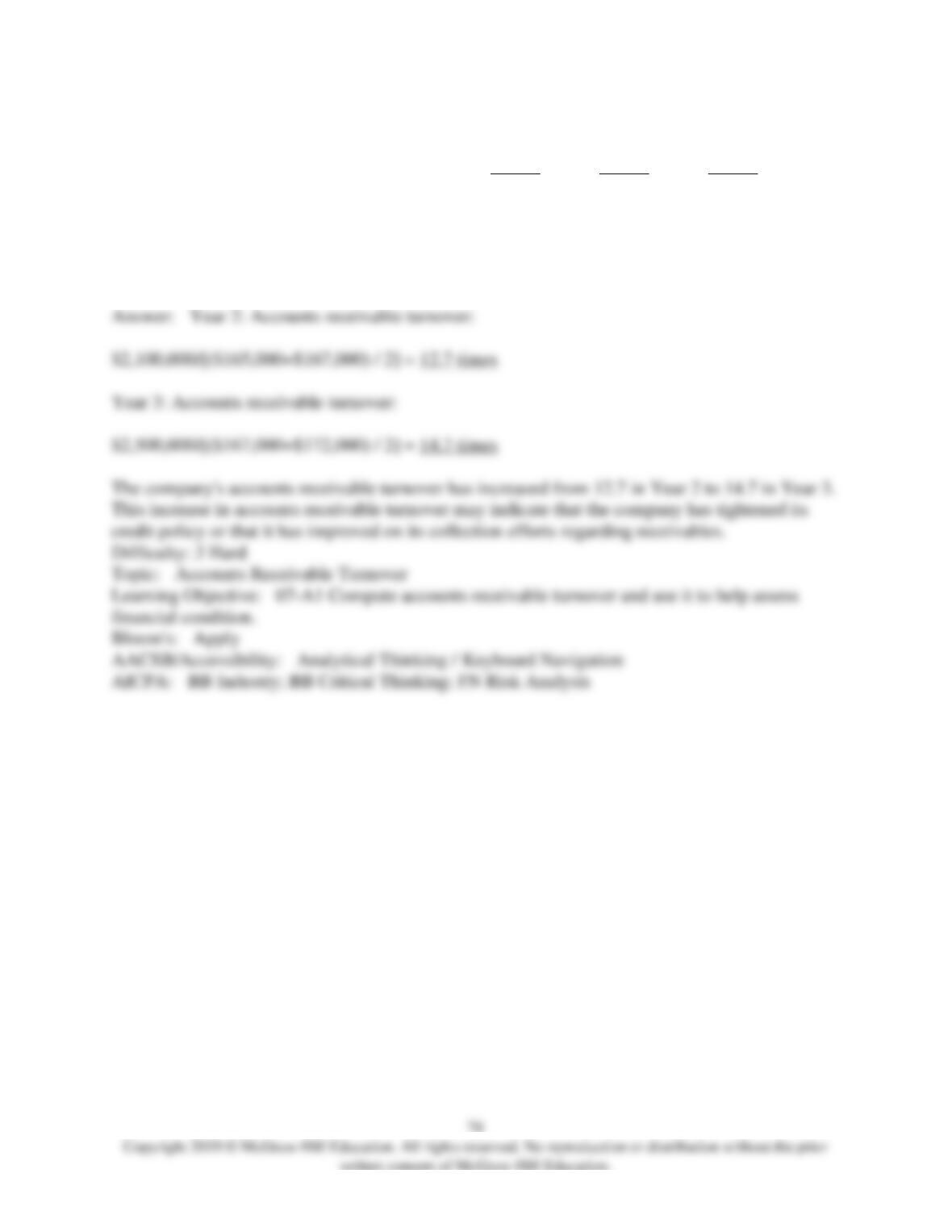
178) A company reports the following results in its financial statements:
Year 3
Year 2
Year 1
Net Sales…………….………………….
$2,500,000
$2,100,000
$1,900,000
Accounts receivable, Ending Balance…
172,000
167,000
165,000
Calculate the company accounts receivable turnover for Year 2 and Year 3. Compare these two
results and give a possible explanation for any significant change.
179) The Links Company uses the percent of sales method of accounting for uncollectible
accounts receivable. During the current year, the following transactions occurred:
Sept 7
Links Company determined that the $8,000 account receivable of the
Rainier Company was uncollectible, and wrote it off.
Oct 15
Links Company determined that the $3,500 account receivable of the
Olympic Company was uncollectible and wrote it off.
Nov 9
Rainier Company paid $6,000 of the amount owed to the Links
Company. Links Company does not expect further collections from the
Rainier Company.
Dec 31
Links Company estimates that 1% of its $1,900,000 of credit
sales would be uncollectible.
1. Prepare the general journal entries to record these transactions.
2. If the balance of the allowance for uncollectible accounts was a $4,000 credit on January 1 of
the current year, determine the balance of the allowance for uncollectible accounts at December
31 of the current year. Assume that the transactions above are the only transactions affecting the
allowance for uncollectible accounts during the year.
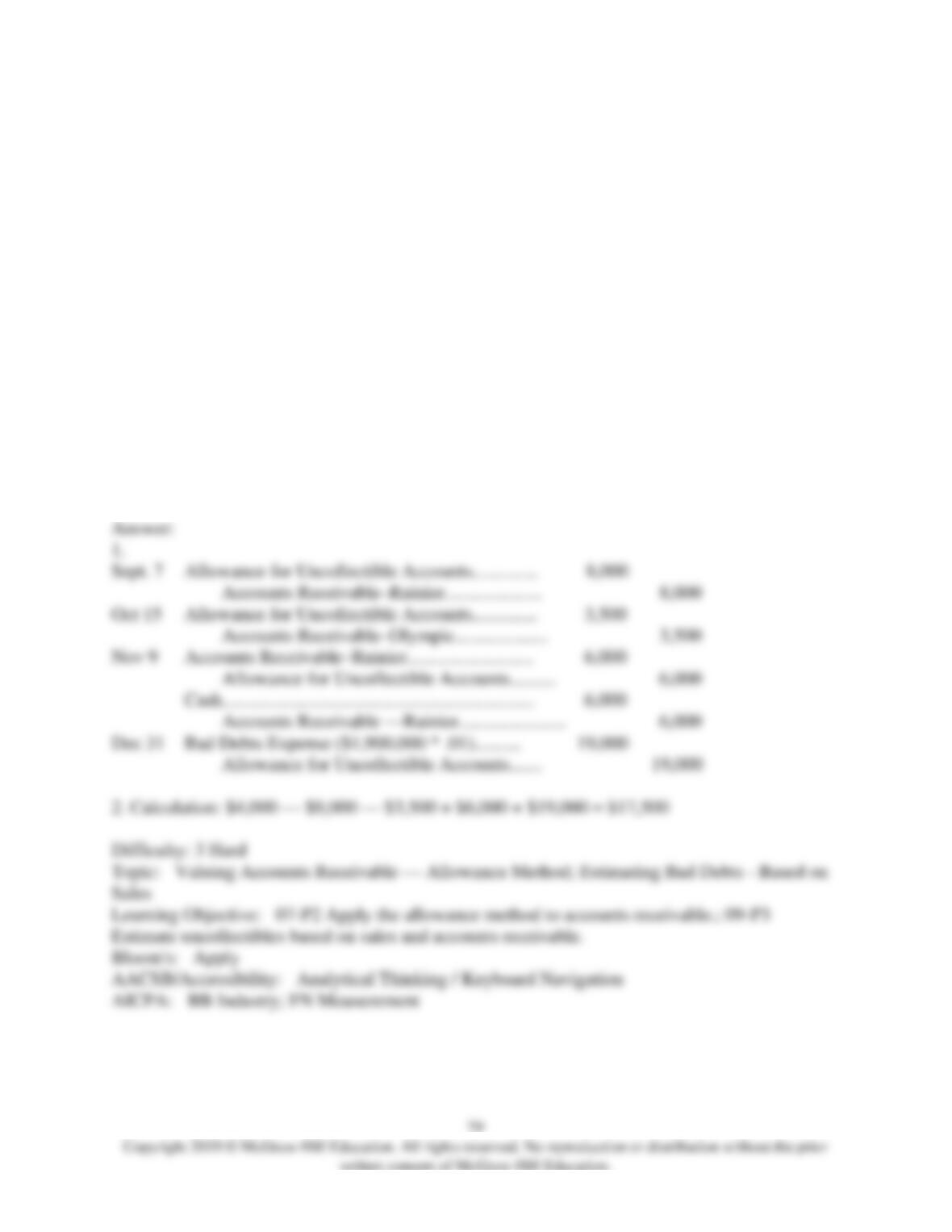
Sept. 7
Allowance for Uncollectible Accounts…………..
Oct 15
Allowance for Uncollectible Accounts…………..
Nov 9
Accounts Receivable–Rainier………………………
Cash………………………………………………………….
Dec 31
Bad Debts Expense ($1,900,000 * .01)……….

80
180) The Lily Company uses the percent of receivables method of accounting for uncollectible
accounts receivable, and a perpetual inventory system. As of January 1, its net accounts
receivable totaled $192,000 (Accounts Receivable $200,000 less an $8,000 Allowance for
Doubtful Accounts). During the current year, the following transactions occurred.
1)
Merchandise costing $1,050,000 was sold on account for $1,400,000.
2)
The company collected $1,294,000 from customers on account.
3)
$6,000 of accounts receivable were deemed uncollectible and written off.
4)
$1,000 of accounts receivable previously written off as uncollectible were
recovered.
5)
At year-end, Lily Company estimates that 4% of its accounts receivable are
uncollectible.
Prepare journal entries to record these transactions.