
Chapter 7 The Use of Cost Information in Management Decision Making
7-21
99. Tool Time manufactures carpenter-grade screwdrivers. The company is trying to decide
whether to continue to make the case in which the screwdrivers are sold, or to outsource
the case to another company. The direct material and direct labor cost to produce the
cases total $2.00 per case. The overhead cost is $1.00 per case which consists of $0.40
in variable overhead that would be eliminated if the cases are bought from the outside
supplier. The $0.60 of fixed overhead is based on expected production of 200,000 cases
per year and consists of the salary of the case production manager of $40,000 per year,
along with the remainder consisting of rent, insurance, and depreciation on equipment
that will have no resale value. The manager will be laid off if the cases were bought
externally. The outside supplier has offered to supply the cases for $2.80 each. How
much will Tool Time save or lose if the cases are bought externally?
A. Save $0.40 per case
B. Lose $0.20 per case
C. Lose $0.80 per case
D. Save $0.20 per case
100. Diamond Brands manufactures rice, wheat, and oat cereals. Sanders Company has
approached Diamond Brands with a proposal to sell the company the rice cereals at a
price of $22,000 for 20,000 pounds. The following costs are associated with production
of 20,000 pounds of rice cereal:
Direct material $13,000
Direct labor 5,000
Manufacturing overhead 7,000
Total $25,000
The manufacturing overhead consists of $2,000 of variable costs with the balance being
allocated to fixed costs. What is the amount of avoidable costs if Diamond Brands buys
rather than makes the rice cereal?
A. $25,000
B. $22,000
C. $23,000
D. $20,000
101. Diamond Brands manufactures rice, wheat, and oat cereals. Sanders Company has
approached Diamond Brands with a proposal to sell the company the rice cereals at a
price of $22,000 for 20,000 pounds. The following costs are associated with production
of 20,000 pounds of rice cereal:
Direct material $13,000
Direct labor 5,000
Manufacturing overhead 7,000
Total $25,000
The manufacturing overhead consists of $2,000 of variable costs with the balance being
allocated to fixed costs, which are 30% unavoidable. What is the incremental cost per
pound that Diamond will (incur) or save if it buys the rice cereal from Sanders?
A. $1.175 savings
B. $0.10 cost
C. $0.075 savings
D. $23.50 cost

Test Bank to accompany Jiambalvo Managerial Accounting, 6th Edition
7-22
102. Diamond Brands manufactures rice, wheat, and oat cereals. Sanders Company has
approached Diamond Brands with a proposal to sell the company the rice cereals at a
price of $22,000 for 20,000 pounds. The following costs are associated with production
of 20,000 pounds of rice cereal:
Direct material $13,000
Direct labor 5,000
Manufacturing overhead 7,000
Total $25,000
The manufacturing overhead consists of $2,000 of variable costs with the balance being
allocated fixed costs. Should Diamond Brands make or buy the rice cereal?
A. Buy the cereal to save $4,000.
B. Continue to make the cereal because the incremental cost of buying is $2,000.
C. Buy them to save $2,000.
D. Continue to make the cereal because the incremental cost of buying is $22,000.
103. Macho Sports Company sells soccer and baseball merchandise. The company is trying
to decide whether or not to continue the baseball merchandise given the decline in the
demand and current loss of this product line. The following information is available for
the segments:
Baseball Soccer
Sales $120,000 $420,000
Variable costs 72,000 220,000
Contribution margin 48,000 200,000
Direct fixed costs 32,000 70,000
Allocated common fixed costs 20,000 70,000
Net income ($ 4,000) $ 60,000
If the baseball segment is dropped, soccer sales will be unaffected. What will be the
effect on overall profits if the baseball segment is eliminated?
A. Overall profits will increase $4,000.
B. Overall profits will decrease by $48,000.
C. Overall profits will decrease by $16,000.
D. Overall profits will decrease by $120,000.

Chapter 7 The Use of Cost Information in Management Decision Making
7-23
104. Macho Sports Company sells soccer and baseball merchandise. The company is trying
to decide whether or not to continue the baseball merchandise given the decline in the
demand and current loss of this product line. The following information is available for
the segments:
Baseball Soccer
Sales $120,000 $420,000
Variable costs 72,000 220,000
Contribution margin 48,000 200,000
Direct fixed costs 32,000 70,000
Allocated common fixed costs 20,000 70,000
Net income ($ 4,000) $ 60,000
The company will allocate more space to the soccer product line if the baseball line is
dropped. This will allow soccer sales to increase by 25%. What is the incremental effect
of the decision to drop the baseball line?
A. Net income will increase by $2,000.
B. Net income will increase by $30,000.
C. Net income will increase by $34,000.
D. Net income will increase by $54,000.
105. Wedding Supply is trying to decide whether or not to continue distributing reception
supplies. The following information is available for Wedding Supply’s business
segments.
Reception Supplies Bridal Dresses Floral Decorations
Sales $160,000 $110,000 $210,000
Variable costs 84,000 50,000 120,000
Contribution margin 76,000 60,000 90,000
Direct fixed costs 50,000 20,000 25,000
Allocated common fixed costs 30,000 25,000 30,000
Net income ($ 4,000) $ 15,000 $ 35,000
If reception supplies are dropped, what change will occur to profit?
A. Decrease by $26,000
B. Decrease by $76,000
C. Increase by $4,000
D. None of these answer choices are correct.

Test Bank to accompany Jiambalvo Managerial Accounting, 6th Edition
7-24
106. Wedding Supply is trying to decide whether or not to continue distributing reception
supplies. The following information is available for Wedding Supply’s business
segments.
Reception Supplies Bridal Dresses Floral Decorations
Sales $160,000 $110,000 $210,000
Variable costs 84,000 50,000 120,000
Contribution margin 76,000 60,000 90,000
Direct fixed costs 50,000 20,000 25,000
Allocated common fixed costs 30,000 25,000 30,000
Net Income ($ 4,000) $ 15,000 $ 35,000
If reception supplies are dropped, floral decoration sales are expected to increase by
20%. What impact will the increase in floral decorations have on overall profitability?
A. Income will increase by $7,000.
B. Income will increase by $16,000.
C. Income will decrease by $18,000.
D. Income will decrease by $8,000.
107. Diva Footwear is contemplating if it should continue producing platform shoes. The
following information is available for the company’s segments
Platform Shoes Athletic Shoes Boots
Sales $120,000 $420,000 $360,000
Variable costs 64,000 220,000 140,000
Contribution margin 56,000 200,000 220,000
Direct fixed costs 45,000 70,000 90,000
Allocated fixed costs 20,000 70,000 60,000
Net income ($ 9,000) $ 60,000 $ 70,000
Based on the information provided, which of the following is most likely to be the basis of
allocating the fixed costs to the segments?
A. Sales
B. Direct fixed costs
C. Net income
D. Variable costs
108. Diva Footwear is contemplating if it should continue producing platform shoes. The
following information is available for the company’s segments.
Platform Shoes Athletic Shoes Boots
Sales $120,000 $420,000 $360,000
Variable costs 64,000 220,000 140,000
Contribution margin 56,000 200,000 220,000
Direct fixed costs 45,000 70,000 90,000
Allocated fixed costs 20,000 70,000 60,000
Net income ($ 9,000) $ 60,000 $ 70,000
If platform shoes are dropped, what effect will occur to Diva Footwear’s net income?
A. Increase by $9,000
B. Decrease by $56,000
C. Decrease by $11,000
D. Increase by $56,000

Chapter 7 The Use of Cost Information in Management Decision Making
7-25
109. Diva Footwear is contemplating if it should continue producing platform shoes. The
following information is available for the company’s segments.
Platform Shoes Athletic Shoes Boots
Sales $120,000 $420,000 $360,000
Variable costs 64,000 220,000 140,000
Contribution margin 56,000 200,000 220,000
Direct fixed costs 45,000 70,000 90,000
Allocated fixed costs 20,000 70,000 60,000
Net income ($ 9,000) $ 60,000 $ 70,000
If platform shoes are dropped, sales of athletic shoes are expected to drop by 10%.
What impact will occur to Diva Footwear’s net income?
A. Income will decrease by $11,000.
B. Income will decrease by $31,000.
C. Income will decrease by $53,000.
D. Income will increase by $9,000.
110. The following information is available for Diva Footwear’s segments:
Platform Shoes Athletic Shoes Boots
Sales $120,000 $420,000 $360,000
Variable costs 64,000 220,000 140,000
Contribution margin 56,000 200,000 220,000
Direct fixed costs 45,000 70,000 90,000
Allocated fixed costs 20,000 70,000 60,000
Net income ($ 9,000) $ 60,000 $ 70,000
Diva Footwear normally sells boots for $90 per pair. An exporter has approached Diva
about buying 1,000 pairs of boots for a one-time export deal for $81 per pair. Diva can
avoid $3.00 per pair of the normal variable cost on this sale, but Diva must pay a fixed
cost of $4,000 to have the boots shipped. Diva has the capacity to produce this order,
and no regular sales will be affected. What affect will occur on Diva’s profits if the order
is accepted?
A. Profits will increase by $42,000.
B. Profits will increase by $49,000.
C. Profits will increase by $45,000.
D. More information is needed to answer.
111. Hurley Processors processes clay into two joint products—molding foam and craft
blocks. When processed, each pound of clay yields 20 units of foam and 80 units of
blocks. Foam sells for $2 per unit and blocks sells for $1.50 per unit. The total cost to
process a 100-pound batch of clay is $35. If the physical quantities method is used to
allocate the joint costs, how much will be allocated to each batch of modeling foam?
A. $7.00
B. $8.75
C. $28.00
D. $40.00
Test Bank to accompany Jiambalvo Managerial Accounting, 6th Edition
7-26
112. Hurley Processors processes clay into two joint products, molding foam and craft blocks.
When processed, each pound of clay yields 20 units of foam and 80 units of blocks.
Foam sells for $2 per unit and blocks sells for $1.50 per unit. The total cost to process a
100–pound batch of clay is $35. If the physical quantities method is used to allocate the
joint costs, how much will be allocated to each batch of craft blocks?
A. $1.20
B. $28.00
C. $8.75
D. $120.00
113. Hurley Processors processes clay into two joint products, molding foam and craft blocks.
When processed, each pound of clay yields 20 units of foam and 80 units of blocks.
Foam sells for $2 per unit and blocks sells for $1.50 per unit. The total cost to process a
100–pound batch of clay is $35. If the relative sales value method is used to allocate the
joint costs, what is the total amount that will be allocated to each batch?
A. $55
B. $35
C. $160
D. None of these answer choices are correct.
114. Hurley Processors processes clay into two joint products, molding foam and craft blocks.
When processed, each pound of clay yields 20 units of foam and 80 units of blocks.
Foam sells for $2 per unit and blocks sells for $1.50 per unit. The total cost to process a
100–pound batch of clay is $35. If the relative sales value method is used to allocate the
joint costs, how much will be allocated to each batch of modeling foam?
A. $7.00
B. $8.75
C. $28.00
D. $15.00
115. Hurley Processors processes clay into two joint products, molding foam and craft blocks.
When processed, each pound of clay yields 20 units of foam and 80 units of blocks.
Foam sells for $2 per unit and blocks sells for $1.50 per unit. The total cost to process a
100–pound batch of clay is $35. If the relative sales value method is used to allocate the
joint costs, how much will be allocated to craft blocks?
A. $8.75
B. $26.25
C. $28.00
D. $15.00

Chapter 7 The Use of Cost Information in Management Decision Making
7-27
116. Soren Company makes two products from a joint input that have the following
information:
Sales Value Total Additional Sales Value
Units Per Unit Processing Per Unit After
Produced At Split-Off Costs Additional Processing
Product A 40,000 $10 $400,000 $15
Product B 150,000 4 300,000 7
The joint cost incurred to produce the two products to the split-off point is $600,000. How
much joint cost should be allocated to Product A using the relative sales value at split-off
as the allocation method?
A. $600,000
B. $126,316
C. $400,000
D. $240,000
117. Soren Company makes two products from a joint input that have the following
information:
Sales Value Total Additional Sales Value
Units Per Unit Processing Per Unit After
Produced At Split-Off Costs Additional Processing
Product A 40,000 $10 $400,000 $15
Product B 150,000 4 300,000 7
The joint cost incurred to produce the two products to the split-off point is $600,000.
Which product(s) should be processed further?
A. A
B. B
C. Neither A nor B
D. Both A and B
118. Each pound of the raw material, ore, yields 5 units of Beta and 15 units of Gamma. Ore
costs $20 per pound. A pound of ore has processing costs (not including the cost of the
raw material) of $30 at the split-off point. The selling price for a unit of Beta is $80. The
selling price for a unit of Gamma is $40. If the physical quantities method is used to
allocate the joint costs, what is the total cost that will be allocated to each unit of Beta?
A. $12.50
B. $16.67
C. $7.50
D. $5.00
119. Each pound of the raw material, ore, yields 5 units of Beta and 15 units of Gamma.
Ore costs $20 per pound. A pound of ore has processing costs (not including the
cost of the raw material) of $30 at the split-off point. The selling price for a unit of
Beta is $80. The selling price for a unit of Gamma is $40. If the physical quantities
method is used to allocate the joint costs, what is the total cost that will be allocated
to each unit of Gamma?
A. $30.00
B. $37.50
C. $15.00
D. $22.50

Test Bank to accompany Jiambalvo Managerial Accounting, 6th Edition
7-28
120. Each pound of the raw material, ore, yields 5 units of Beta and 15 units of Gamma.
Ore costs $20 per pound. A pound of ore has processing costs (not including the
cost of the raw material) of $30 at the split-off point. The selling price for a unit of
Beta is $80. The selling price for a unit of Gamma is $40. If the relative sales value
method is used to allocate the joint costs, what is the total cost allocated to each unit
of Beta?
A. $12.00
B. $20.00
C. $33.33
D. $12.50
121. Each pound of the raw material, ore, yields 5 units of Beta and 15 units of Gamma.
Ore costs $20 per pound. A pound of ore has processing costs (not including the
cost of the raw material) of $30 at the split-off point. The selling price for a unit of
Beta is $80. The selling price for a unit of Gamma is $40. If the relative sales value
method is used to allocate the joint costs, what is the total cost allocated to each unit
of Gamma?
A. $30.00
B. $37.50
C. $16.00
D. $16.67
122. Brevall Industries makes corn oil and corn meal from harvested corn in a joint process.
The corn oil can be further processed into margarine, and the corn meal can be further
processed into corn muffin mix. The joint cost incurred to process the corn to the split-off
point is $140,000. Information on the quantities, value, and further processing costs for
the joint products appear below:
Sales Value Estimated Further Sales Value
Quantity At Split-off Processing Cost After Processing
Corn Oil 800,000 lbs. $0.30/lb. $0.15/lb. $0.60/lb.
Corn Meal 1,600,000 lbs. 0.10/lb. 0.46/lb. 0.55/lb.
Brevall allocates the joint cost to the products based on the relative sales value at split-
off point. How much joint cost should be assigned to the corn oil?
A. $46,667
B. $84,000
C. $105,000
D. $70,000

Chapter 7 The Use of Cost Information in Management Decision Making
7-29
123. Brevall Industries makes corn oil and corn meal from harvested corn in a joint process.
Corn oil can be further processed into margarine, and the corn meal can be further
processed into corn muffin mix. The joint cost incurred to process the corn to the split-off
point is $140,000. Information on the quantities, value, and further processing costs for
the joint product appears below:
Sales Value Estimated Further Sales Value
Quantity At Split-off Processing Cost After Processing
Corn Oil 800,000 lbs. $0.30/lb. $0.15/lb. $0.60/lb.
Corn Meal 1,600,000 lbs. 0.10/lb. 0.46/lb. 0.55/lb.
Brevall allocates the joint cost to the products based on physical units. Corn oil is
assigned $46,667 of joint cost and corn meal is assigned $93,333 of joint cost. Which
products should be processed further?
A. Corn oil
B. Corn meal
C. Both corn oil and corn meal
D. Neither corn oil nor corn meal
124. Teruba Melons purchased a truckload of watermelons weighing 3,000 pounds for $900.
The company separated the melons into two grades: superior and economy. The
superior grade melons have a total weight of 2,400 pounds and the economy grade
melons total 600 pounds. The company sells the superior grade at $0.60 per pound and
the economy grade at $0.30 per pound. How much of the $900 cost of the truckload will
be allocated to the superior grade melons using the physical quantity method? Use five
significant digits in calculations.
A. $540
B. $720
C. $771
D. $1,440
125. Teruba Melons purchased a truckload of watermelons weighing 3,000 pounds for $900.
The company separated the melons into two grades: superior and economy. The
superior grade melons have a total weight of 2,400 pounds and the economy grade
melons total 600 pounds. The company sells the superior grade at $0.60 per pound and
the economy grade at $0.30 per pound. How much of the $900 cost of the truckload will
be allocated to the superior grade melons using the relative sales value method? Use
five significant digits in calculations.
A. $800
B. $720
C. $600
D. $1,440
Test Bank to accompany Jiambalvo Managerial Accounting, 6th Edition
7-30
126. Havenstock produces lime juice and lime margarita mix. A 500–pound batch of limes
costing $70 is processed and results in two components—concentrate and nectar. The
labor to achieve this process is $120 per batch. The concentrate is used to produce lime
juice and the nectar is used to produce margarita mix. The concentrate is processed into
80 pints of lime juice at a batch cost of $30, and the nectar is processed into 40 pints of
margarita mix at a cost of $20 per batch. The sales price of each pint of juice is $5, and
each bottle of margarita mix has a sales value of $2.50. How much is the joint cost
allocated to lime juice using the relative sales value method?
A. $46.67
B. $56.00
C. $96.00
D. $152.00
*127. Express Toys makes 2 products, both of which currently have very strong demand.
Product P sells for $7.00 per unit, has a variable cost of $3.00 per unit, and requires 2
minutes of processing time on Machine A. Product Q sells for $9.00 per unit, has
variable cost of $2.00 per unit, and requires 10 minutes processing time on Machine A. If
there are only 3,000 hours available on Machine A during the month, which product
should be produced?
A. Product P
B. Product Q
C. Neither product P nor Q
D. Equal quantities of each product
*128. Raintree makes 2 products, rain jackets and rain pants. Each passes through the cutting
machine, which is the binding constraint. Rain jackets take 16 minutes on the cutting
machine and have a contribution margin per jacket of $20. Rain pants take 24 minutes
on the cutting machine and have a contribution margin per pair of pants of $32. Which
product should be made if there is unlimited demand for each?
A. Rain jackets
B. Rain pants
C. An equal number of pants and jackets
D. There is not enough information provided to answer.
*129. Raintree makes 2 products, rain jackets and rain pants. Each passes through the cutting
machine, which is the binding constraint. Rain jackets take 15 minutes on the cutting
machine and have a contribution margin per jacket of $16. Rain pants take 24 minutes
on the cutting machine and have a contribution margin per pair of pants of $32. Assume
that there are 4,800 hours available on the cutting machine and that the minimum
demand for each product is 3,000 units. How many of each product should be made?
A. 3,000 jackets and 10,125 pants
B. 600 jackets and 4,200 pants
C. 3,600 jackets and 1,200 pants
D. 3,000 jackets and 3,000 pants
Chapter 7 The Use of Cost Information in Management Decision Making
7-31
*130. Raintree makes 2 products, rain jackets and rain pants. Each passes through the cutting
machine, which is the binding constraint. Rain jackets take 15 minutes on the cutting
machine and have a contribution margin per jacket of $16. Rain pants take 24 minutes
on the cutting machine and have a contribution margin per pair of pants of $32.Assume
that there are 4,800 hours available on the cutting machine and that the minimum
demand for each product is 3,000 units. If 100 more hours of machine time can be
obtained, how much will profits increase?
A. $1,600
B. $3,200
C. $8,000
D. None of these answer choices are correct.
Material from the appendix to the chapter is marked with an asterisk (*).
Answers to Multiple Choice

Test Bank to accompany Jiambalvo Managerial Accounting, 6th Edition
7-32
MATCHING
131. Match each of the following terms with the phrase that most closely describes it. Each
answer may be used only once.
_____ 1. Opportunity costs
_____ 2. Relative sales value method
_____ 3. Relevant costs
_____ 4. Split-off point
_____ 5. Sunk costs
_____ 6. Avoidable costs
_____ 7. Common costs
_____ 8. Differential costs
_____ 9. Incremental costs
_____ 10. Joint costs
A. The additional cost incurred as a result of selecting one decision alternative over
another; the same as a relevant or differential cost
B. A cost that can be avoided if a company takes a particular course of action
C. The costs of the common inputs that result in two or more products
D. Another term for an incremental or relevant cost
E. Costs incurred in the past that are not relevant to present decisions
F. The only kind of cost that managers need to consider when deciding whether to
make or buy a product; the same as a differential or incremental cost
G. The point where joint products can be separately identified
H. Value of the benefits foregone when one decision alternative is selected over
another
I. The cost incurred for the benefit of multiple departments or products
J. The preferred method of allocating common costs to joint products
Chapter 7 The Use of Cost Information in Management Decision Making
7-33
EXERCISES
132. Print Jiff manufactures books. The company is trying to decide whether to print the
individual pages in-house (the current practice) or have a printing company perform this
task. For each of the following items, indicate if the item is relevant or not relevant to this
decision.
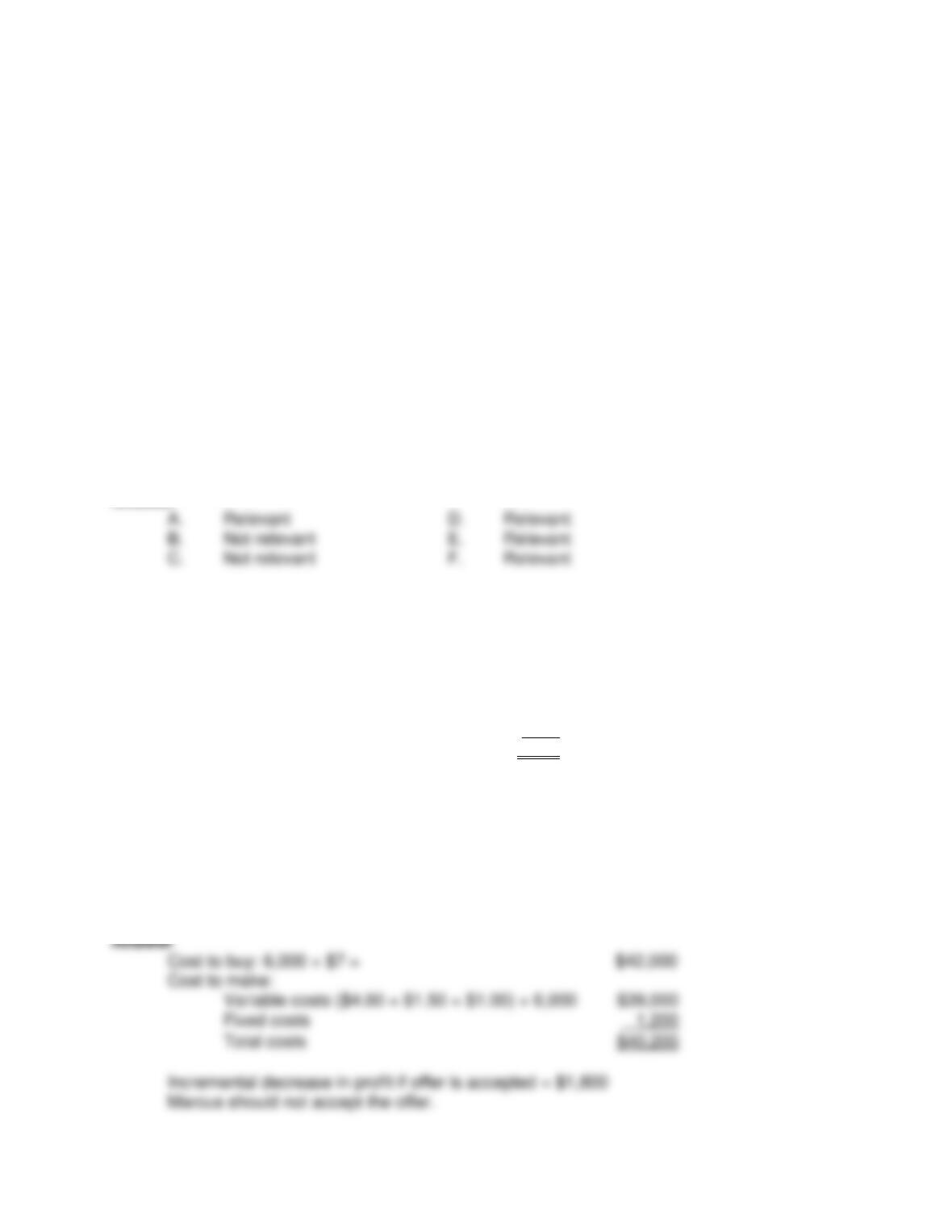
________ A. Cost of buying ink
________ B. Rent on the Print Jiff factory
________ C. Original price of the book binder owned by Print Jiff
________ D. Salvage value of the binding equipment owned by Print Jiff
________ E. Cost of paper for printing books
________ F. Morale of employees in the printing company
Answer
133. Marcus Company requires three units of P11 for every unit of A5 that it produces.
Currently, P11 is made by Marcus, with the following per unit costs in a month when
4,000 units were produced:
Direct materials $4.00
Direct labor 1.50
Manufacturing overhead 2.60
Total $8.10
Variable manufacturing overhead is applied at $1.00 per unit. The other $1.60 of
overhead consists of allocated fixed costs. Marcus will need 6,000 units of P11 for next
year’s production.
Landers Corporation has offered to supply 6,000 units of P11 at a price of $7.00 per unit.
If Marcus accepts the offer, all of the variable costs and $1,200 of the fixed costs will be
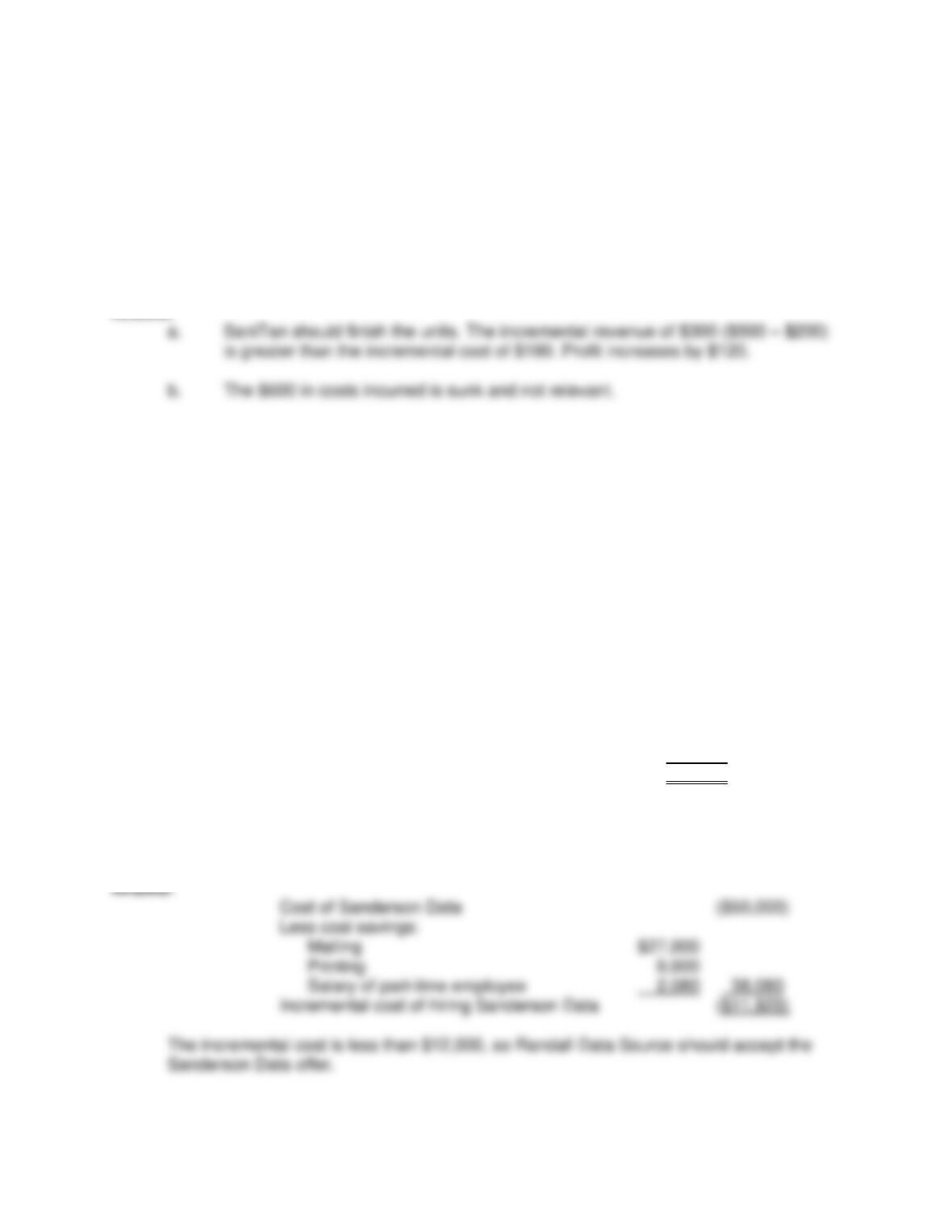
avoided. Should Marcus Company accept the offer from Landers Corporation?
Test Bank to accompany Jiambalvo Managerial Accounting, 6th Edition
7-34
134. An employee of SaniTan has found some partially completed units of Model 45 in a
dusty corner of the warehouse. A job ticket attached to the units indicates that a total of
$600 in manufacturing costs have been used to bring the materials to this point in the
manufacturing process. The units can be sold in their current condition for $200 to a
scrap metal dealer. If SaniTan spends $180 to complete the units, they can be sold for
$500.
a. What should SaniTan? Justify your answer.
b. Identify a sunk cost in this problem.
Answer
135. Each year, Randall Data Source surveys 5,000 former and prospective customers
regarding satisfaction and brand awareness. For the current year, the company is
considering outsourcing the survey to Sanderson Data, a company that has offered to
conduct the survey and summarize results for $50,000. Randall Wince, the president of
Randall Data Source, believes that Sanderson will do a higher-quality job than his
company has been doing, but is unwilling to spend more than $12,000 above current
costs. The head of bookkeeping for Randall has prepared the following summary of
costs related to the survey in the prior year.
Mailing $27,000
Printing (done by Sanderson Data) 9,000
Salary of part-time employee who stuffs envelopes and
summarizes survey data (130 hours × $16) 2,080
Share of depreciation of computer and software used to
track survey responses and summarize results 1,200
Share of electricity/phone/etc. based on square feet of
space occupied by the part-time employee 600
Total $39,880
Prepare an incremental analysis in good form to determine the impact on net income of
hiring an outside company versus conducting the survey in house. Will Randall Data
Source accept the Sanderson offer? Why or why not?