17. Determine the interest on the following notes payable: Round answers to two decimal places.
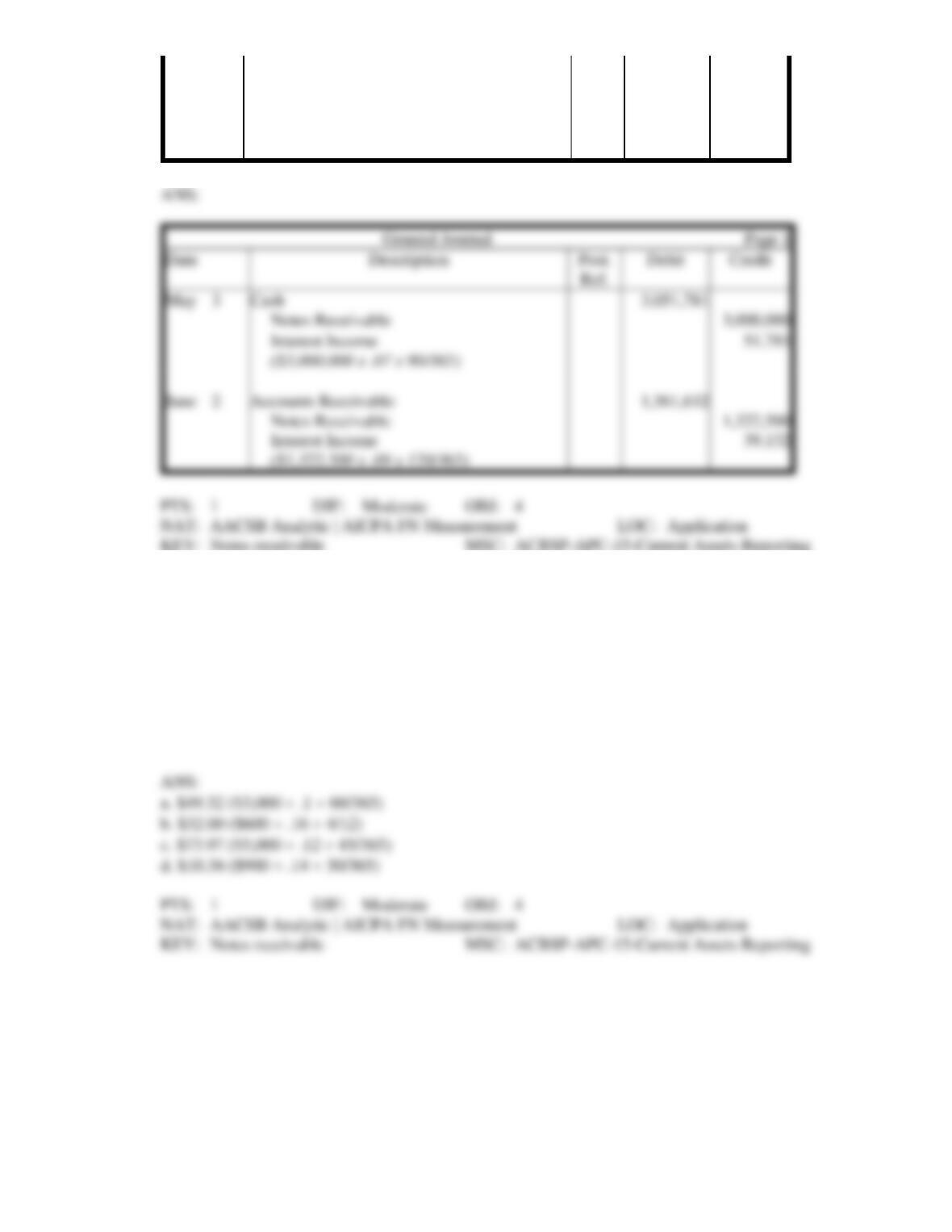
a. $3,000 at 10 percent for 60 days
b. $600 at 16 percent for 4 months
c. $5,000 at 12 percent for 45 days
d. $900 at 14 percent for 30 days
MATCHING
Match each definition with the correct term below.
a.
One way to control a cash fund and cash advances.
b.
A minimum amount that a bank requires a company to keep in its bank account as part of
a credit-granting arrangement.
c.
The method of estimating uncollectible accounts that calculates the Uncollectible
Accounts Expense.
d.
The process of accounting for the difference between the balance on a company’s bank
statement and the balance in its Cash account.
e.
The total proceeds of a promissory note.
f.
An unconditional promise to pay a definite sum of money on demand or at a future date.
g.
The method of accounting for uncollectible accounts that matches bad debts against the
sales they help produce.
h.
Short-term financial assets that arise from credit sales made in the ordinary course of
doing business.
i.
A method of conducting business transactions that does not involve the actual transfer of
cash.
j.
The cost of borrowing money or the return on lending money.
k.
A potential liability that can develop into a real liability if a particular event occurs.
l.
The method of estimating uncollectible accounts that calculates the targeted balance of
Allowance for Uncollectible Accounts.
1. Compensating balance
2. Accounts receivable
3. Contingent liability
4. Imprest system
5. Electronic funds transfer (EFT)
6. Bank reconciliation
7. Allowance method
8. Percentage of net sales method
9. Accounts receivable aging method
10. Interest
11. Promissory note
12. Maturity value
PROBLEM
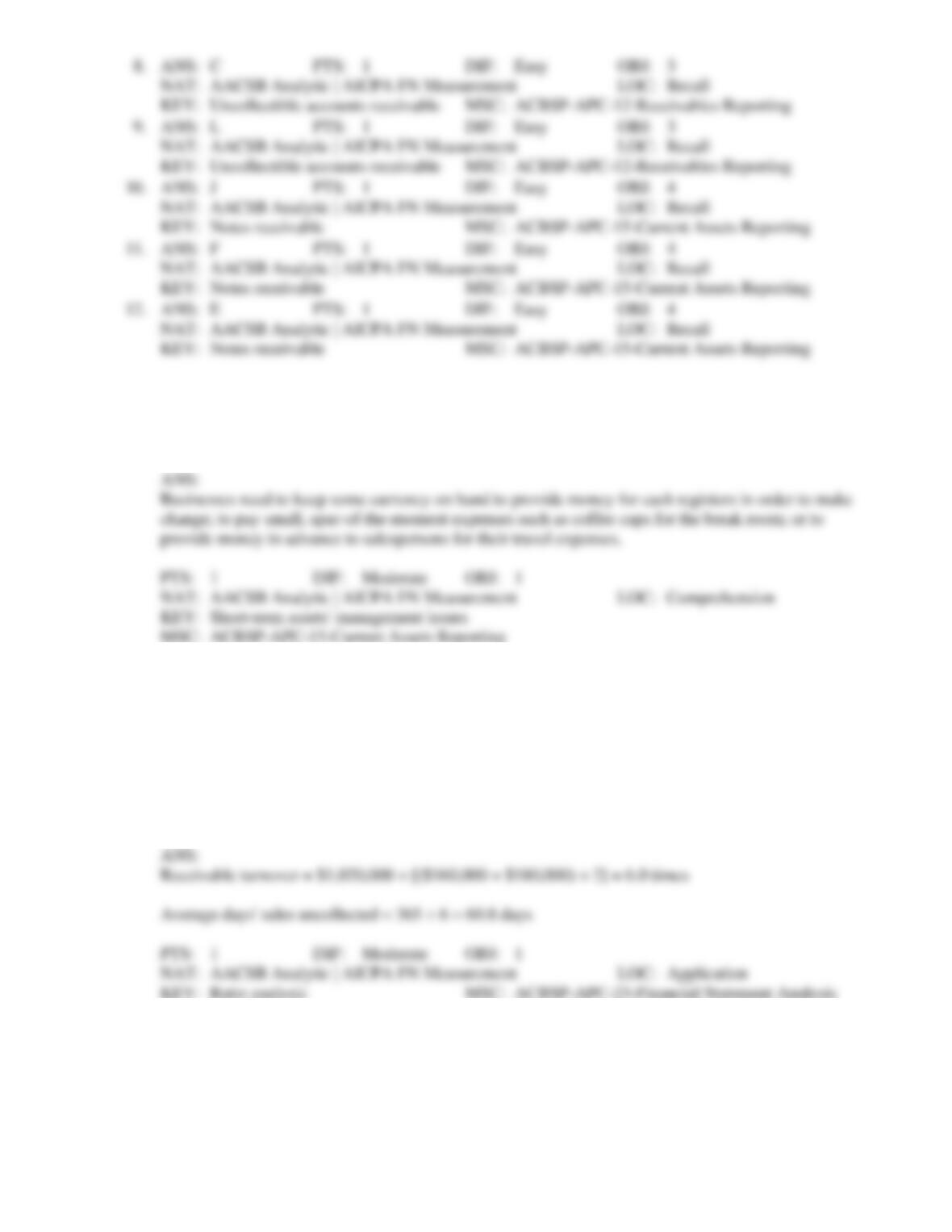
1. Why do businesses need to keep some currency on hand?
2. The following data exist for Alcona Company:
2013
2012
Accounts Receivable
$ 160,000
$ 180,000
Sales
1,020,000
821,000
Calculate the receivable turnover and the average days’ sales uncollected for 2013. Round answers to
one decimal place.
3. Jayne Luke started a computer business in her basement less than a year ago. Her personal attention to
clients and persistence in obtaining new customers has caused the business to grow at a tremendous
pace. Jayne has become so busy she has neglected to keep after clients who have failed to pay her. As
a result, Jayne has a large amount of accounts receivable and notes receivable on her balance sheet but
not much cash. She continues to service clients, but she now realizes that her cash will soon be
exhausted. Suggest some options Jayne has to achieve a strong cash balance.
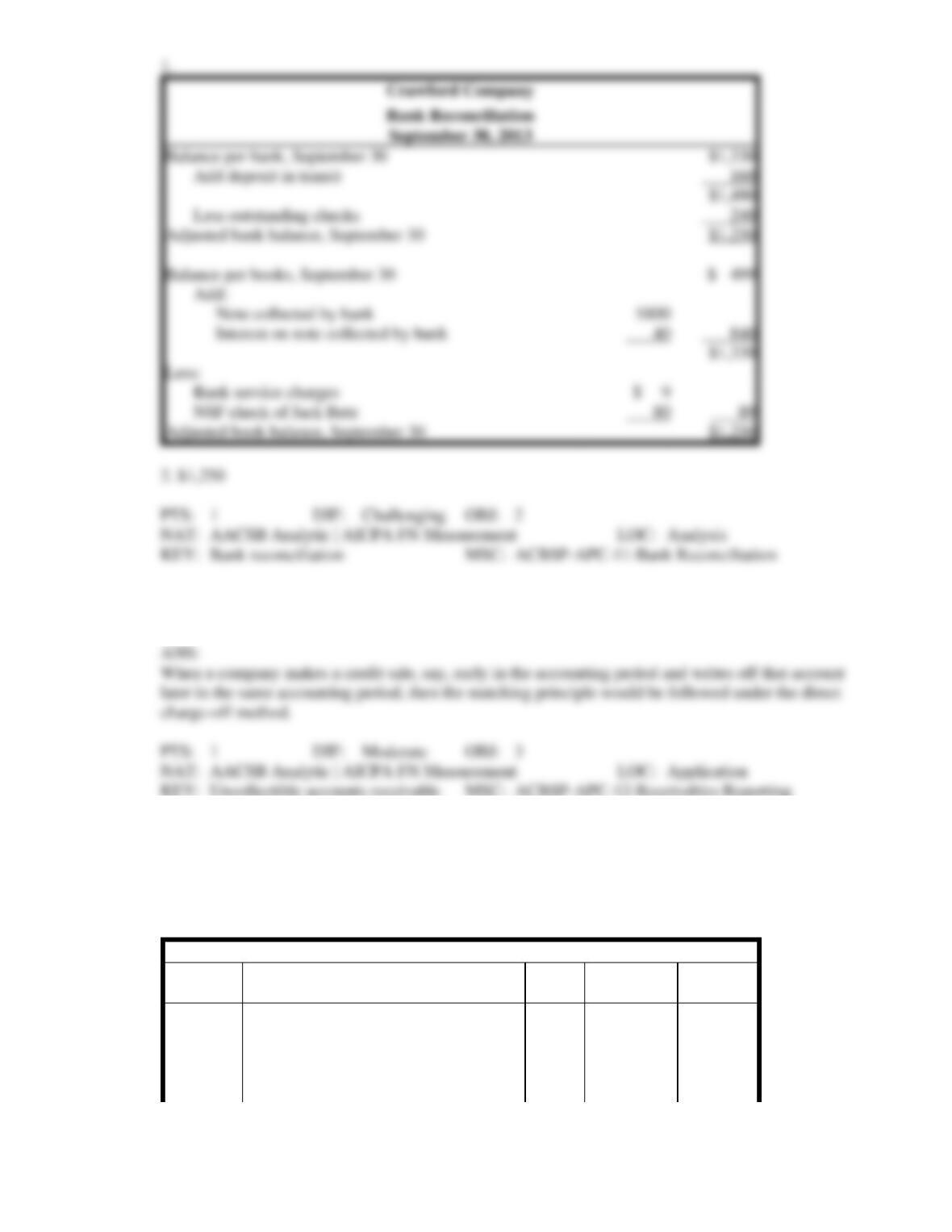
4. The following information pertains to the bank transactions of Crawford Company:
a.
Cash on the books as of September 30 was $499. Cash as shown on the bank statement
for the same date was $1,330.
b.
A deposit of $160, representing cash receipts of September 30, did not appear on the
bank statement.
c.
Outstanding checks totaled $240.
d.
Bank service charges for September amounted to $9.
e.
The bank collected for Crawford Company $840 (which includes $40 interest) on a
note left for collection.
f.
An NSF check for $80 from a customer, Jack Betz, was returned with the statement.
1. Prepare a bank reconciliation for Crawford Company as of September 30.
2. State the amount of cash that would appear on the balance sheet as of September 30.
Crawford Company
Bank Reconciliation
September 30, 2013
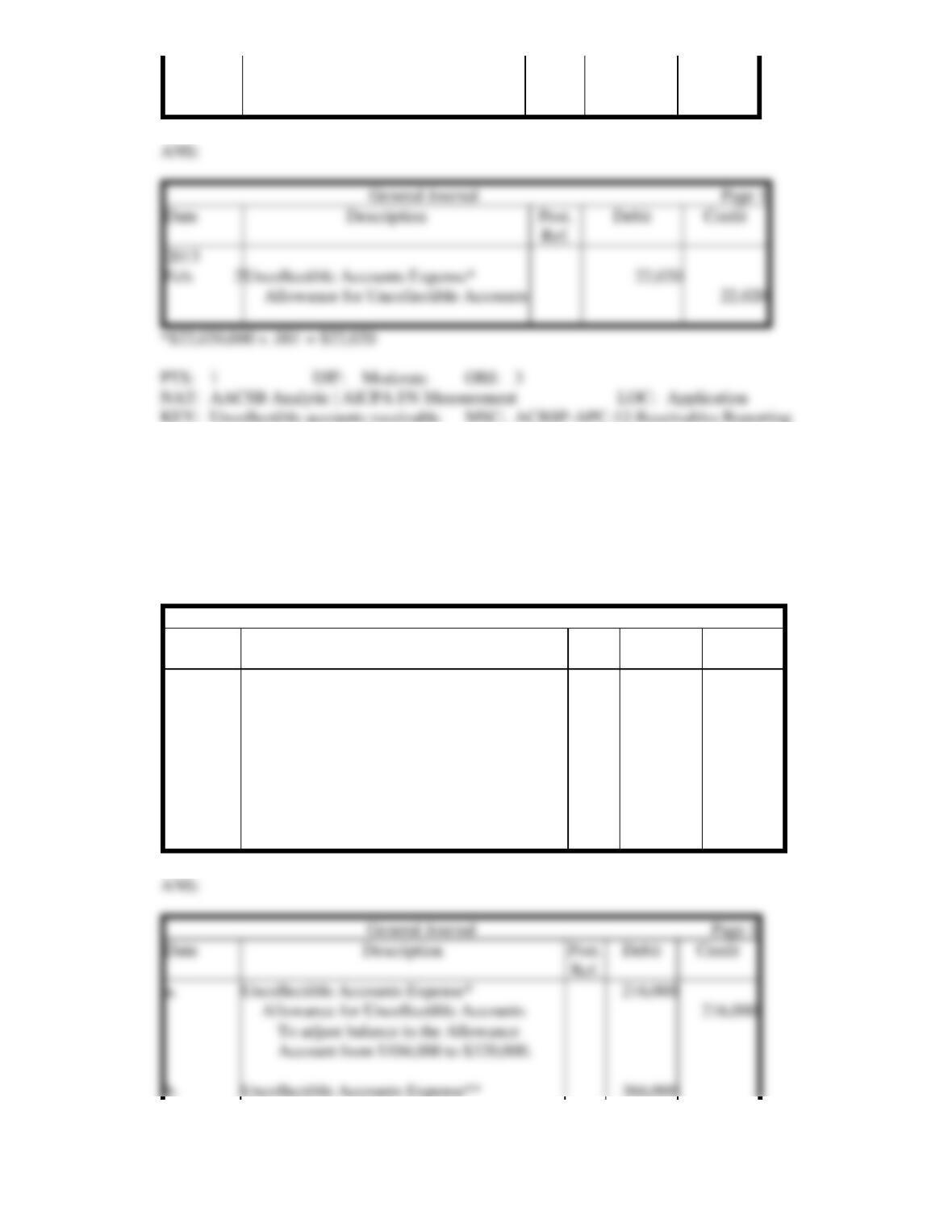
5. Under what specific circumstance will application of the direct charge-off method be in accordance
with the matching principle?
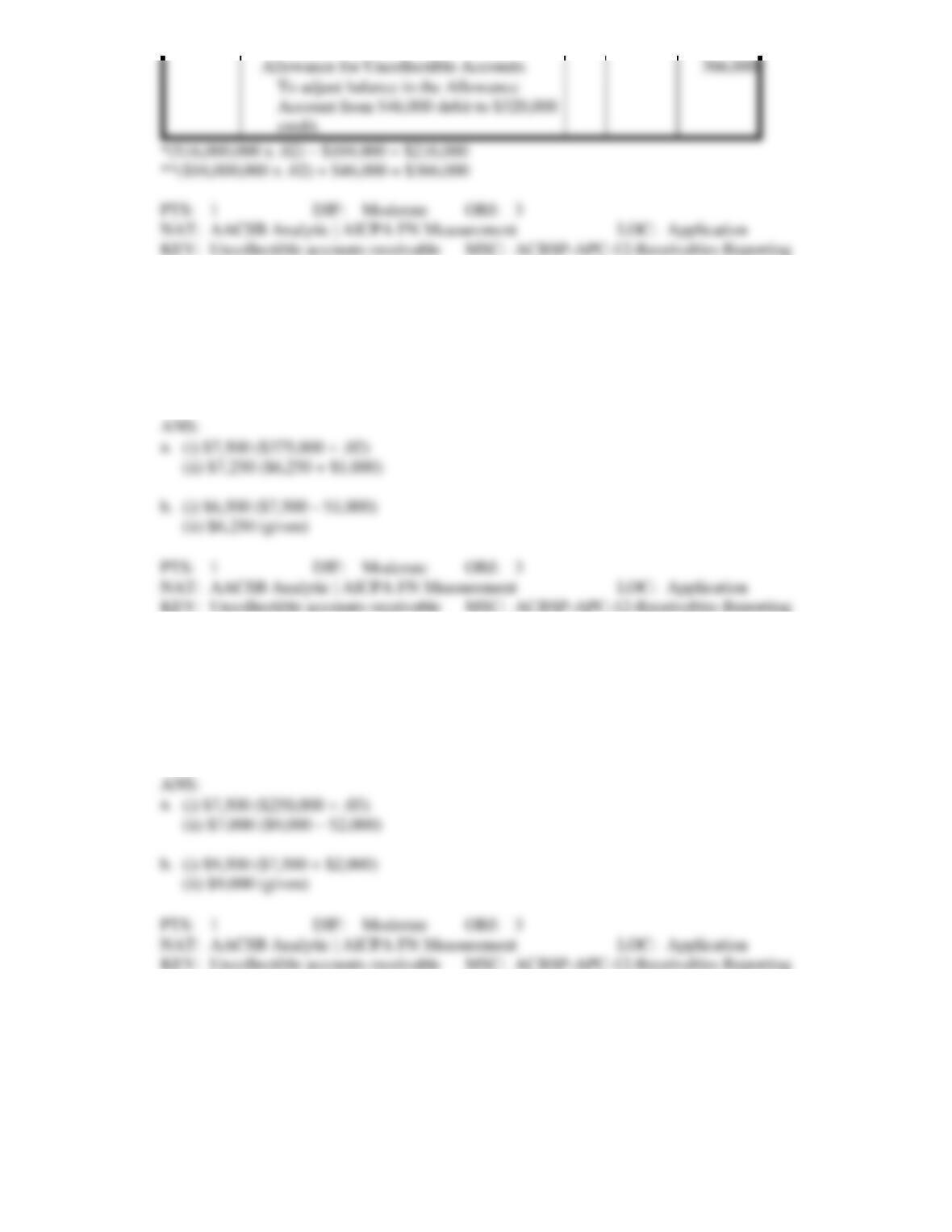
6. Assume that part of accounts and other receivables on Todd Toys’ balance sheet is $3,200,000 as of
February 2, 2013. Also assume that Allowance for Uncollectible Accounts has a credit balance of
$110,000 and that Todd estimates its uncollectible accounts as 0.1 percent of net sales and net sales for
the year is $22,020,000. Record the adjusting entry to recognize uncollectible accounts using the
percentage of net sales method. Omit explanations.
General Journal
Page 1
Date
Description
Post.
Ref.
Debit
Credit
Balance per bank, September 30
$1,330
Add deposit in transit
$1,490
Less outstanding checks
Adjusted bank balance, September 30
$1,250
Balance per books, September 30
$ 499
Add:
Note collected by bank
Interest on note collected by bank
$1,339
Less:
Bank service charges
NSF check of Jack Betz
89
Adjusted book balance, September 30
$1,250
7. Assume that part of accounts and other receivables on Thompson Toys’ balance sheet is $16 million
and that Thompson estimates its uncollectible accounts as 2 percent of all accounts receivable. Record
the adjusting entry assuming that the company uses the accounts receivable aging method to recognize
uncollectible accounts if the Allowance for Uncollectible Accounts has a balance of:
a. $104,000 credit
b. $46,000 debit
General Journal
Page 1
Date
Description
Post.
Ref.
Debit
Credit
Page 1
Uncollectible Accounts Expense*
Uncollectible Accounts Expense**
Feb.
Uncollectible Accounts Expense*
8. The general ledger account for Accounts Receivable shows a debit balance of $37,500. The Allowance
for Uncollectible Accounts has a debit balance of $1,000. Net sales for the year were $375,000. In the
past, 2 percent of net sales have proved uncollectible. An aging of accounts receivable accounts results
in an estimate of $6,250 of uncollectible accounts receivable. Calculate (a) Uncollectible Accounts
Expense and (b) the ending balance of the Allowance for Uncollectible Accounts using (i) the
percentage of net sales method and (ii) the accounts receivable aging method.
9. The general ledger account for Accounts Receivable shows a debit balance of $40,000. The Allowance
for Uncollectible Accounts has a credit balance of $2,000. Net sales for the year were $250,000. In the
past, 3 percent of net sales have proved uncollectible. An aging of accounts receivable accounts results
in an estimate of $9,000 of uncollectible accounts receivable. Calculate (a) Uncollectible Accounts
Expense and (b) the ending balance of the Allowance for Uncollectible Accounts using (i) the
percentage of net sales method and (ii) the accounts receivable aging method.
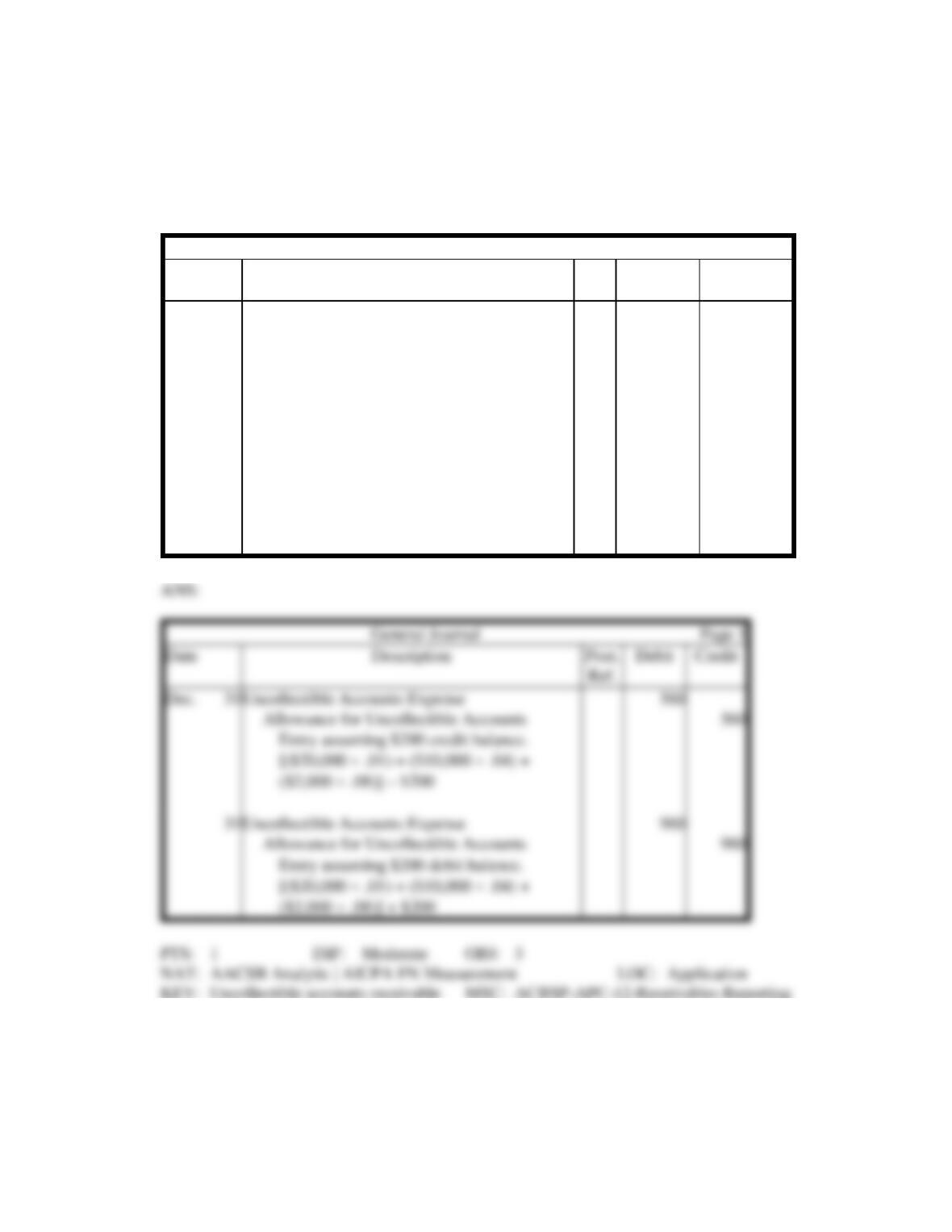
10. Caplan Corporation uses the accounts receivable aging method to account for Uncollectible Accounts
Expense. As of December 31, Caplan’s accountant prepared the following data about ending
receivables: $20,000 was not yet due (1 percent expected not to be collected), $10,000 was 1-60 days
past due (4 percent expected not to be collected), and $2,000 was over 60 days past due (8 percent
expected not to be collected). At December 31, Allowance for Uncollectible Accounts had a credit
balance prior to adjustment of $200. In the journal provided, prepare Caplan’s end–of-period
adjustment for estimated uncollectible accounts. Also prepare the entry that would have been made
had the credit balance instead been a debit balance. Omit explanations.
General Journal
Page 1
Date
Description
Post.
Ref.
Debit
Credit
11. Assuming that the allowance method is being used, prepare journal entries to record the following
transactions. Omit explanations.
Apr.
15
Sold merchandise to Rice Company for $12,000 on account.
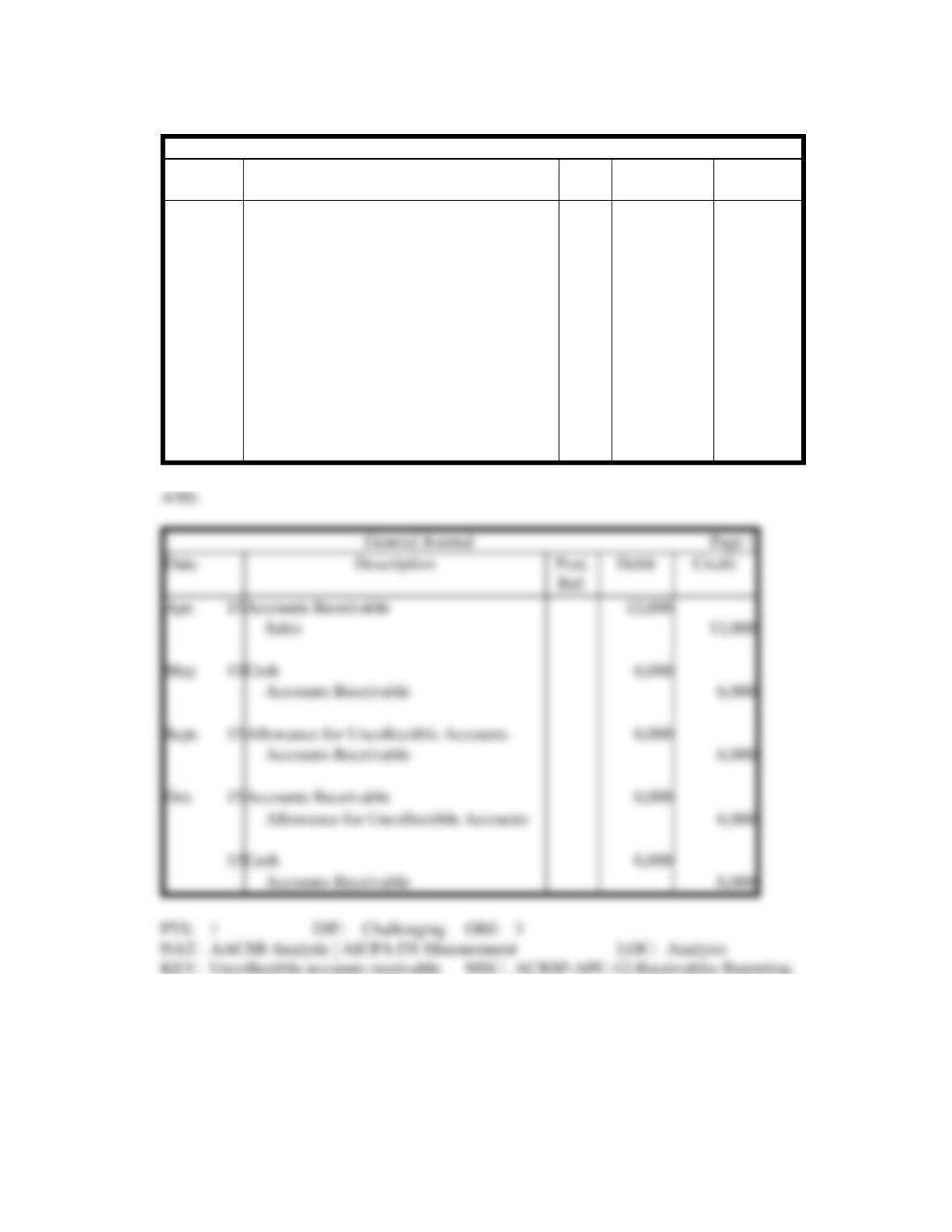
May
15
Received $6,000 from Rice Company.
Sept.
15
Wrote off Rice Company’s account as uncollectible.
Oct.
15
Unexpectedly received payment in full from Rice Company.
General Journal
Page 1
Date
Description
Post.
Ref.
Debit
Credit
12. In the journal provided, prepare the entries for the following transactions. (Omit explanations.)
Dec.
1
Sold merchandise on account to Katurah Wells for $600.
12
Received payment of $400 from Katurah Wells.
Sales
Allowance for Uncollectible Accounts
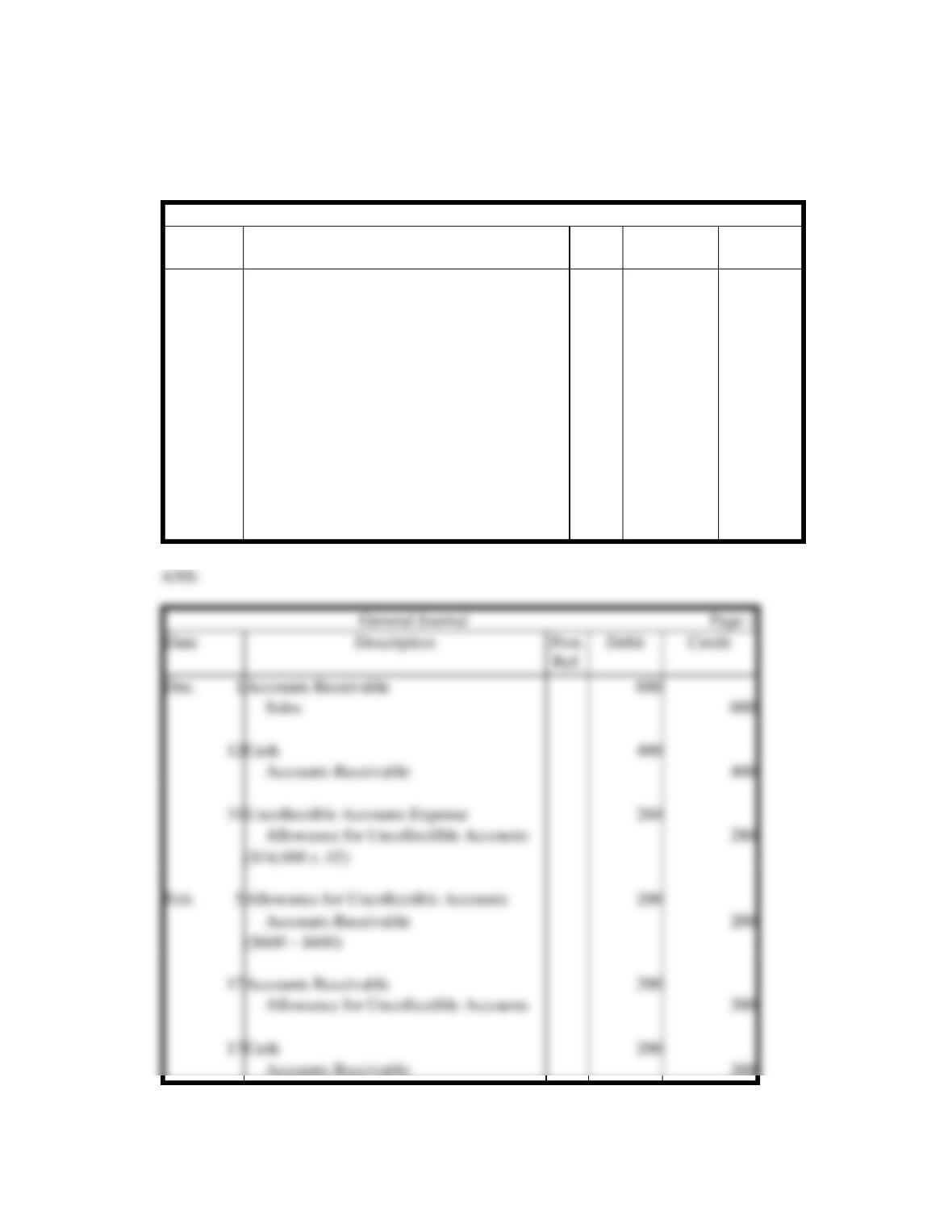
31
Made adjusting entry for Uncollectible Accounts Expense, using the
percentage of net sales method. Net sales for the year totaled $14,000,
uncollectible accounts are estimated at 2 percent, and Allowance for
Uncollectible Accounts has a $50 credit balance prior to adjustment.
Feb.
5
Wrote off Katurah Wells’s balance because she filed for bankruptcy.
17
Unexpectedly received the $200 from Katurah Wells.
General Journal
Page 1
Date
Description
Post.
Ref.
Debit
Credit
13. Explain the difference between the two methods used to estimate uncollectible accounts and identify
which financial statement is emphasized by each method.
14. Carlson Corporation engaged in the following transactions involving promissory notes in 2012 and
2013. Journalize these transactions in the journal provided. (Omit explanations.) Round to nearest
whole dollar.
2012
Sept.
1
Sold land to Duane Eppy for $30,000. A six-month, 10 percent note was
received in exchange (no gain or loss realized).
Nov.
1
Received a 30-day, 12 percent note receivable from Tricha Kalson in
settlement of her accounts receivable of $500.
Dec.
1
Tricha Kalson dishonored her note issued 30 days earlier. Round to nearest
whole dollar.
31
Recorded accrued interest on the note received on September 1.
2013
Mar.
1
Received payment in full from Duane Eppy.
General Journal
Page 1
Date
Description
Post.
Ref.
Debit
Credit