57. The general ledger account for Accounts Receivable shows a debit balance of $50,000. Allowance for
Uncollectible Accounts has a credit balance of $3,000. Net sales for the year were $500,000. In the
past, 3 percent of sales have proved uncollectible, and an aging of accounts receivable resulted in an
estimate of $20,000 of uncollectible accounts receivable.
Using the percentage of net sales method, the entry to record the Uncollectible Accounts Expense is:
a.
Uncollectible Accounts Expense 12,000
Allowance for Uncollectible Accounts 12,000
b.
Uncollectible Accounts Expense 15,000
Allowance for Uncollectible Accounts 15,000
c.
Uncollectible Accounts Expense 18,000
Allowance for Uncollectible Accounts 18,000
d.
Uncollectible Accounts Expense 20,000
Allowance for Uncollectible Accounts 20,000
58. The general ledger account for Accounts Receivable shows a debit balance of $50,000. Allowance for
Uncollectible Accounts has a credit balance of $3,000. Net sales for the year were $500,000. In the
past, 3 percent of sales have proved uncollectible, and an aging of accounts receivable resulted in an
estimate of $20,000 of uncollectible accounts receivable.
Using the percentage of net sales method, the Allowance for Uncollectible Accounts balance (after
adjustment) would be
a.
$15,000.
b.
$20,000.
c.
$18,000.
d.
$12,000.
59. The general ledger account for Accounts Receivable shows a debit balance of $50,000. Allowance for
Uncollectible Accounts has a credit balance of $3,000. Net sales for the year were $500,000. In the
past, 3 percent of sales have proved uncollectible, and an aging of accounts receivable resulted in an
estimate of $20,000 of uncollectible accounts receivable.
Using the accounts receivable aging method, the entry to record the Uncollectible Accounts Expense
is:
a.
Uncollectible Accounts Expense 21,500
Allowance for Uncollectible Accounts 21,500
b.
Uncollectible Accounts Expense 17,000
Allowance for Uncollectible Accounts 17,000
c.
Uncollectible Accounts Expense 20,000
Allowance for Uncollectible Accounts 20,000
d.
Uncollectible Accounts Expense 23,000
Allowance for Uncollectible Accounts 23,000
60. The general ledger account for Accounts Receivable shows a debit balance of $50,000. Allowance for
Uncollectible Accounts has a credit balance of $3,000. Net sales for the year were $500,000. In the
past, 3 percent of sales have proved uncollectible, and an aging of accounts receivable resulted in an
estimate of $20,000 of uncollectible accounts receivable.
Using the accounts receivable aging method, the Allowance for Uncollectible Accounts balance (after
adjustment) would be
a.
$23,000.
b.
$20,000.
c.
$17,000.
d.
$21,500.
61. You have just received notice that Agnes Fisher, a customer of yours with an Accounts Receivable
balance of $200, has gone bankrupt and will not be making any future payments. Assuming you use
the allowance method, the journal entry you make is to
a.
debit Uncollectible Accounts Expense and credit Accounts Receivable.
b.
debit Allowance for Uncollectible Accounts and credit Uncollectible Accounts Expense.
c.
debit Uncollectible Accounts Expense and credit Allowance for Uncollectible Accounts.
d.
debit Allowance for Uncollectible Accounts and credit Accounts Receivable.
62. Cottage Sales Company made most of its sales on credit during its first year of operation, 2013. At the
end of the year, accounts receivable amounted to $100,000. On December 31, 2013, management
reviewed the collectible status of the accounts receivable. Approximately $6,000 of the $100,000 of
accounts receivable were estimated to be uncollectible. As per the accounts receivable aging method
the adjusting entry that would be made on December 31 of that year is:
a.
Uncollectible Accounts Expense 6,000
Accounts receivable 6,000
b.
Allowance for Uncollectible Accounts 10,000
Uncollectible Accounts Expense 10,000
c.
Uncollectible Accounts Expense 6,000
Allowance for Uncollectible Accounts 6,000
d.
Allowance for Uncollectible Accounts 10,000
Accounts receivable 10,000
63. Assume that on March 15, a customer who owes Chisago sales company $3,000 is declared bankrupt
by a federal court. The entry that would be made to write off this account is:
a.
Allowance for uncollectible 3,000
Accounts receivable, customer account 3,000
b.
Accounts receivable, customer account 3,000
Cash 3,000
c.
Accounts receivable, customer account 3,000
Notes receivable 3,000
d.
Cash 3,000
Accounts Receivable, customer account 3,000
64. Each of the following is a characteristic of a promissory note except a(n)
a.
maturity date that can be determined on the date the note is signed.
b.
payee who has an unconditional right to receive a definite amount on a definite date.
c.
maker who agrees to pay a definite sum subject to certain conditions.
d.
amount to be paid that can be determined on the date the note is signed.
65. Which of the following statements is false regarding promissory notes?
a.
They are sometimes used to extend past-due accounts.
b.
They can be resold to banks.
c.
They must be held by the maker until maturity.
d.
They are often received upon the sale of machinery and automobiles.
66. A dishonored note means the payee’s entry includes a
a.
credit to Accounts Receivable.
b.
debit to Interest Expense.
c.
debit to Notes Receivable.
d.
credit to Interest Income.
67. Interest on a note receivable may be calculated without knowledge of the
a.
principal amount.
b.
rate of interest.
c.
note’s maturity date.
d.
note’s duration.
68. A note receivable dated May 23 and due in 90 days would be due on
a.
August 20.
b.
August 21.
c.
August 23.
d.
August 22.
69. The interest on a three-month, 12 percent, $16,600 note receivable is
a.
$498.
b.
$166.
c.
$332.
d.
$1,992.
70. The maturity value of a 60-day, 9 percent, $2,000 note receivable is
a.
$1,970.33.
b.
$1,820.89.
c.
$2,029.59.
d.
$2,180.12.
71. Interest on a 90-day, 10 percent, $30,000 note receivable is
a.
$7,502.31.
b.
$865.14.
c.
$739.73.
d.
$3,001.89.
72. A promissory note is executed in June. When the note is paid the following January, the payee’s entry
includes (assuming a calendar-year accounting period and no reversing entries) a
a.
debit to Interest Income.
b.
credit to Cash.
c.
credit to Interest Receivable.
d.
debit to Notes Receivable.
73. Assume that the $2,000, 90-day, 8 percent note was received on August 31 and that the fiscal year
ended on September 30. The adjusting entry that would be made to record the interest receivable is
(amounts rounded to nearest dollar):
a.
Interest receivable 13
Interest Income 13
b.
Notes receivable 13
Interest Income 13
c.
Accounts receivable 40
Cash 40
d.
Interest income 40
Accounts receivable 40
74. Assume that on August 1, a $6,000, 90-day, 12 percent note receivable was received from a customer
as an extension of his of past – due account. The entry that would be made to record the note is:
a.
Notes receivable 6,000
Cash 6,000
b.
Notes receivable 6,000
Interest Income account 6,000
c.
Notes receivable 6,000
Accounts receivable 6,000
d.
Cash 6,000
Accounts receivable 6,000
75. Assume that on December 1, a note which has a face value of $18,000, bears interest at 10 percent for
90 days, received from a customer as an extension of his past-due account is dishonored. The entry
that would be made to record the dishonor (ignoring interest) is:
a.
Notes receivable 18,000
Cash 18,000
b.
Accounts receivable 18,000
Cash 18,000
c.
Accounts receivable 18,000
Notes receivable 18,000
d.
Cash 18,000
Accounts Receivable 18,000
76. Assume that on December 1, a note which has a face value of $1,000, bears interest at 6 percent for 90
days, received from a customer as an extension of his of past-due account is honored on due date. The
entry that would be made to record the receipt on due date (ignoring interest) is:
a.
Notes receivable 1,000
Cash 1,000
b.
Accounts receivable 1,000
Cash 1,000
c.
Accounts receivable 1,000
Notes receivable 1,000
d.
Cash 1,000
Notes receivable 1,000
SHORT ANSWER
1. What is a contingent liability, and how does it relate to the discounting of a note receivable at the
bank?
2. What purpose is served by a factoring arrangement? What does it mean to factor accounts receivable
with recourse?
3. On a balance sheet, what items normally are included in Cash?
4. What is a compensating balance? By whom is it required?
5. Compute the correct amount for each letter in the following table:
Case 1
Case 2
Case 3
Case 4
Balance per bank statement
$ a
$35,600
$1,260
$7,960
Deposits in transit
2,400
b
200
500
Outstanding checks
6,000
4,000
c
300
Balance per books
13,800
37,600
900
d
6. For each of the items below, use the following letters to identify the correct treatment in a bank
reconciliation.
A = Add to balance per bank
C = Add to balance per books
B = Deduct from balance per bank
D = Deduct from balance per books
____ 1. Interest income
____ 2. Outstanding checks
____ 3. Check written for $89, but $98 recorded in books
____ 4. Customer’s NSF check
____ 5. Note receivable collected by bank
____ 6. Deposit made for $70, but $700 recorded in books
____ 7. Bank check-printing charge
____ 8. Check written for $52, but $25 recorded in books
____ 9. Deposits in transit
____ 10. Bank fee for collection on note receivable
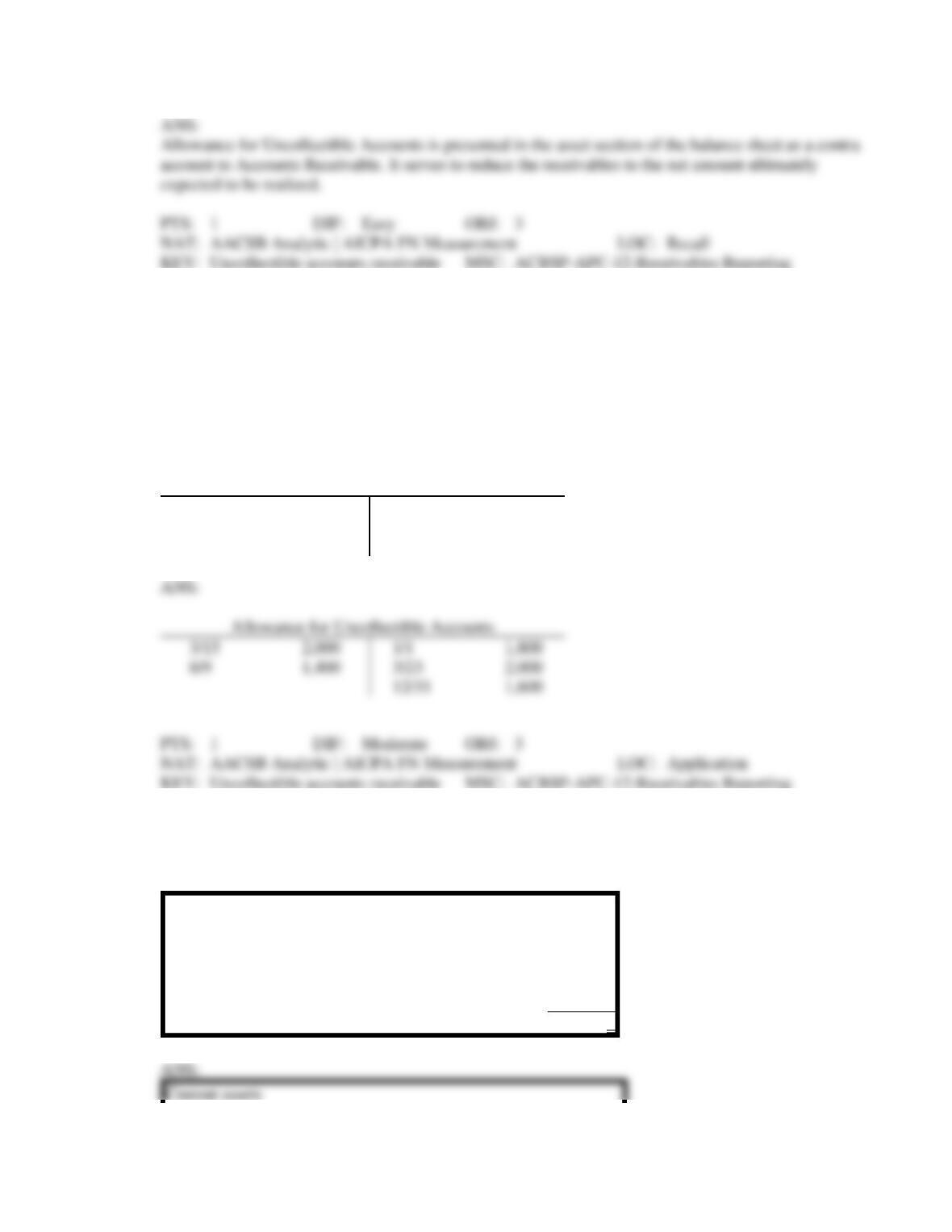
7. How is the account Allowance for Uncollectible Accounts presented in the financial statements, and
what purpose does this presentation serve?
8. Using the following transactions for the year, show how the T-account below would appear after all
appropriate postings have been made. Assume an opening balance of $1,800.
Mar.
15
Wrote off an individual account for $2,000.
23
Reinstated the account written off on February 13.
June
9
Wrote off an individual account for $1,400.
Dec.
31
Made year-end adjustment of $1,600 for estimated uncollectible accounts.
Allowance for Uncollectible Accounts
1/1 1,800
Allowance for Uncollectible Accounts
1/1 1,800
3/23 2,000
12/31 1,600
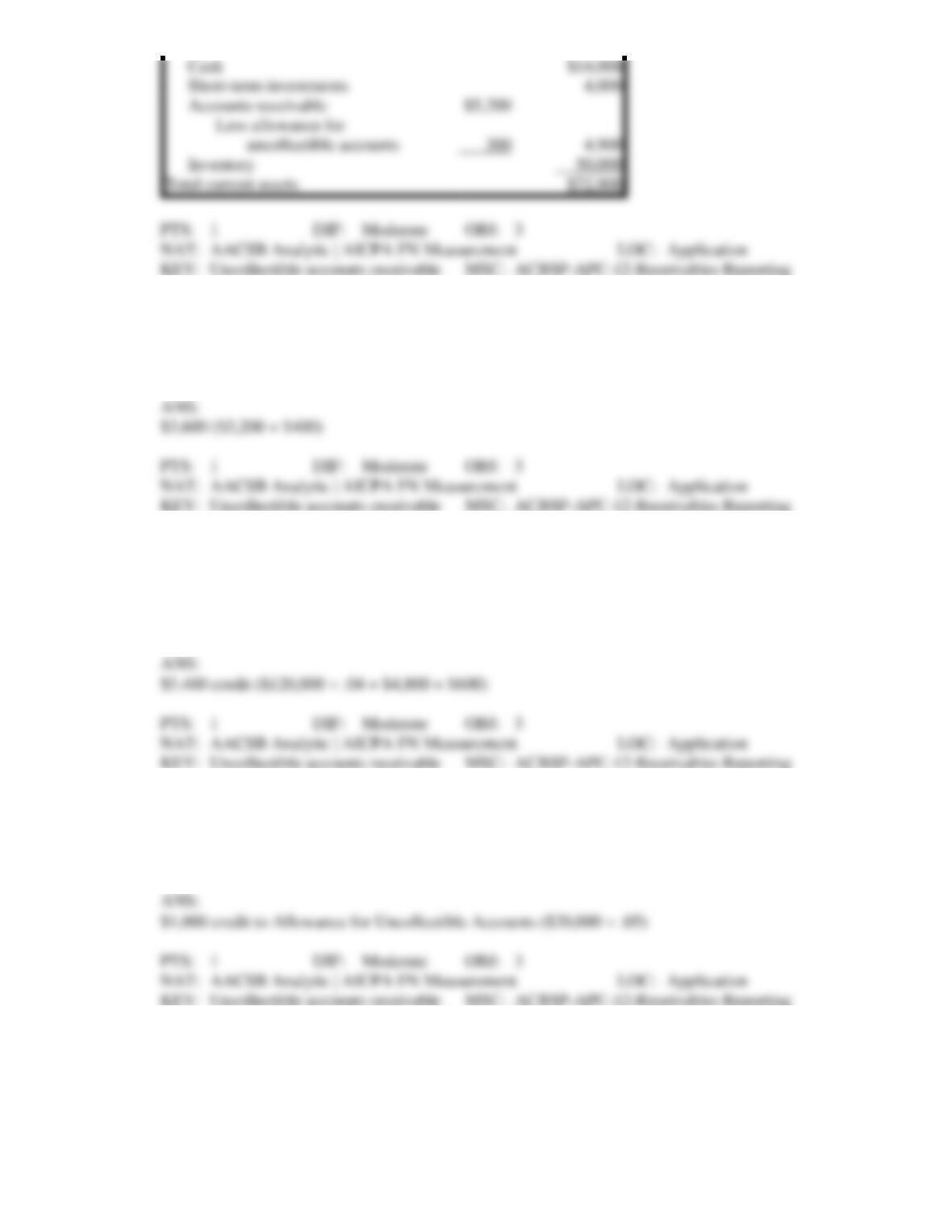
9. Sally’s Dress Shop has $5,200 in Accounts Receivable at December 31. The company’s accountant
estimates that $300 of the $5,200 will never be collected. Complete the current asset section of the
balance sheet below.
Current assets
Cash
$14,000
Short-term investments
4,000
Accounts receivable
Inventory
50,000
Total current assets
$
Current assets
10. On December 31, Skinner Enterprises has a $400 debit balance in Allowance for Uncollectible
Accounts. If an accounts receivable aging method analysis indicated that an estimated $3,200 of
December 31 receivables are uncollectible, for what amount would the adjusting entry for
uncollectible accounts be recorded? (Show your work.)
11. On December 31, Becker Products has a $600 credit balance in Allowance for Uncollectible Accounts.
It estimates that 4 percent of the $120,000 in sales are uncollectible. After the appropriate adjusting
entry for uncollectible accounts has been made using percentage of net sales method, what will be the
balance in Allowance for Uncollectible Accounts? Indicate if the balance is a debit or credit. (Show
your work.)
12. At year end, Erwin Graphics has a $350 debit balance in Allowance for Uncollectible Accounts. It
estimates that 5 percent of the $20,000 in sales are uncollectible. Give the amount that should be used
in the adjusting entry using percentage of net sales method to record uncollectible accounts. (Show
your calculations.)
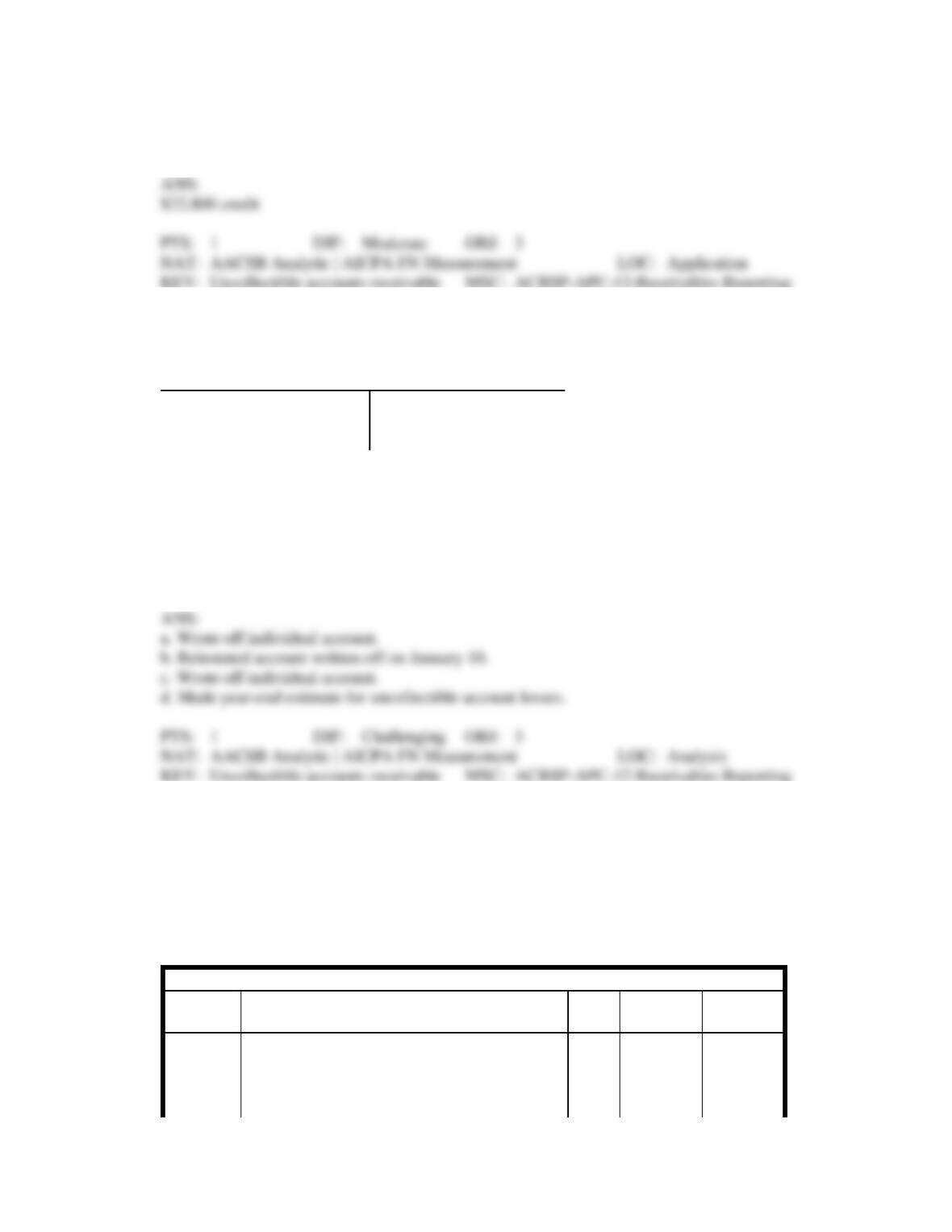
13. At year end, Blue Earth Company has a $3,600 credit balance in Allowance for Uncollectible
Accounts. If an accounts receiving aging method analysis indicates that an estimated $22,800 of
year-end receivables are uncollectible, what will be the balance in Allowance for Uncollectible
Accounts after the appropriate adjusting entry for uncollectible accounts has been made? Indicate if the
balance is a debit or credit.
14. Use the following T account to answer the questions below (assume a calendar-year accounting
period).
Allowance for Uncollectible Accounts
1/10 300
1/15 300
5/12 440
12/31 3,600
What apparently occurred on the following dates?
a. January 10
b. January 15
c. May 12
d. December 31
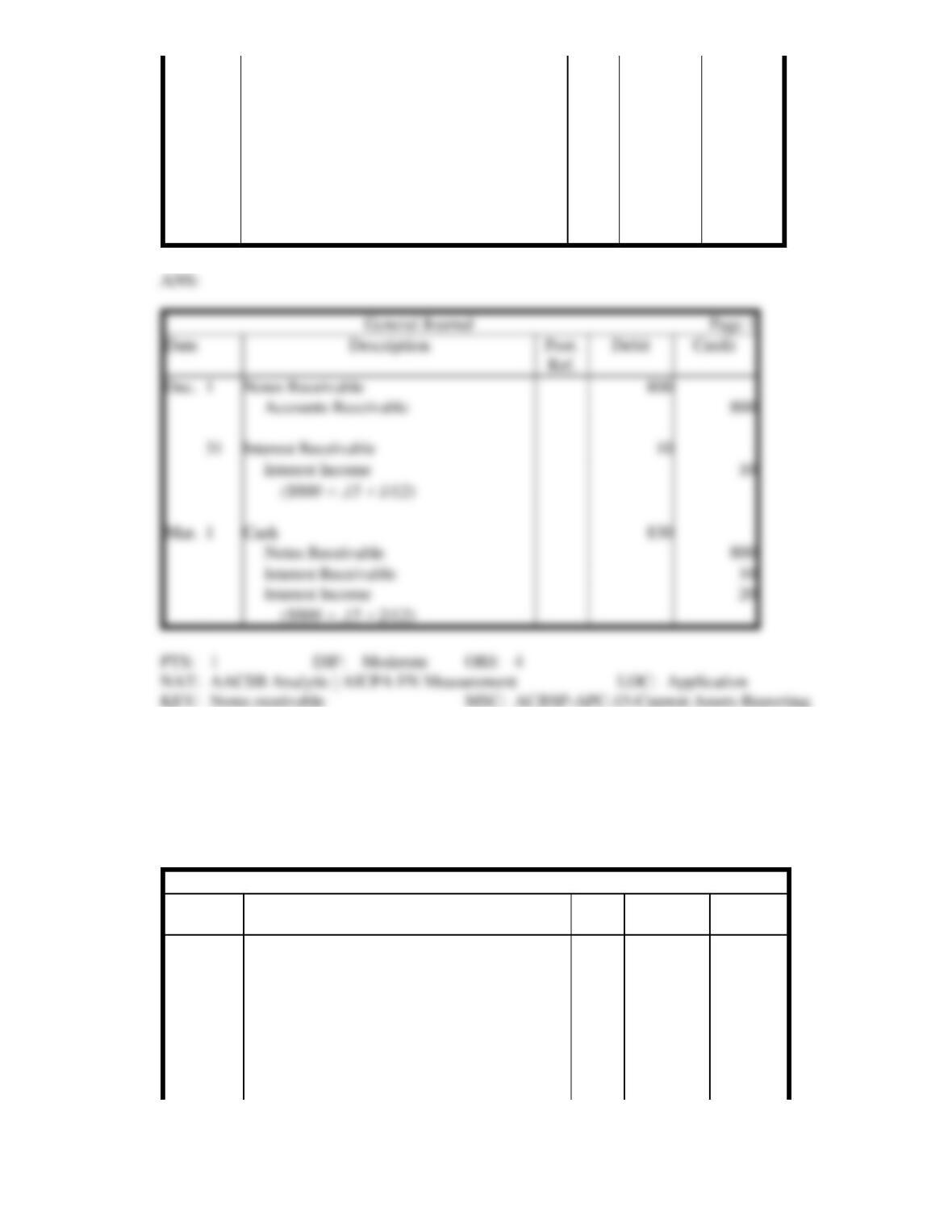
15. In the journal provided, prepare entries for the following (assume a calendar-year accounting period):
Omit explanations.
Dec.
1
Received a three-month, 15 percent note receivable for $800 from a customer as
an extension of his past-due account.
31
Made the year-end adjustment for accrued interest.
Mar.
1
Received full payment on the note.
General Journal
Page 1
Date
Description
Post.
Ref.
Debit
Credit
16. Assume that part of accounts and other receivables on Kittson Company’s February 2, 2010, balance
sheet is comprised of $4,322,500 of notes receivable. Two notes make up the amount. The first note
has a face value of $3,000,000 and bears interest at 7 percent for 90 days. The second note has a face
value of $1,322,500 and bears interest at 9 percent for 120 days. Record the journal entry for the
collection of the 7 percent note on May 3 and the dishonor of the 9 percent note on June 2. (Omit
explanations; assume no interest had been accrued.) Round amounts to nearest dollar.
General Journal
Page 1
Date
Description
Post.
Ref.
Debit
Credit