199) On December 1, 2018, General Mole borrowed $400,000 at 12% interest and pledged
$500,000 in accounts receivable as collateral. Additionally, General Mole was charged a finance
fee equal to 1% of the accounts receivable assigned. At the end of December, $300,000 of the
assigned receivables were collected and remitted to the lender along with accrued interest.
Required:
Prepare journal entries to record the borrowing, the assignment of receivables, the collection on
the receivables, and the recognition of interest expense.
200) On October 1, 2018, Watergate Hotels borrowed $400,000 at 12% interest and pledged
$500,000 in accounts receivables as collateral. Additionally, Watergate was charged a finance
fee equal to 1% of the accounts receivable assigned. At the end of December, $300,000 of the
assigned receivables were collected and remitted to the lender along with accrued interest.
Required:
Prepare journal entries to record the borrowing, the assignment of receivables, the collection on
the receivables, and the recognition of interest expense.
201) On February 1, 2018, Stealth Trucks sold a diesel rig to Kansas Transports for $250,000,
receiving a $50,000 down payment and a 12-month, 10% note for the balance. Principal and
interest are due at maturity, and the 10% interest rate reflected the market rate of interest at the
time of sale. On August 1, 2018, Kansas Transports discounted the note without recourse at the
First South Bank at 12% interest.
Required:
Prepare all required journal entries at August 1 to recognize interest revenue and the discounting
of the note.
202) On June 30, 2018, Blondie Fixtures was considering alternatives to bolster its cash position.
Option One called for transferring $400,000 in accounts receivable to Dogwood Finance
Company without recourse for a 5% fee. Option Two calls for Blondie to transfer the $400,000
in receivables to Dogwood with recourse. Dogwood’s charges a 4% fee for receivables factored
with recourse. Option Two meets the conditions to be considered a sale, but Blondie estimates a
$3,000 recourse liability. Under either option, Dogwood will immediately remit 90% of the
factored receivables to Blondie, and retain 10%. When Dogwood collects the remaining
receivables, it remits the amount, less the fee, to Blondie. Blondie estimates that the fair value of
the final 10% of the receivables is $25,000 (ignoring the factoring fee).
Required:
1. Prepare any necessary journal entry or entries if receivables are factored under Option
One.
2. Prepare any necessary journal entry or entries if receivables are factored under Option
Two.

102
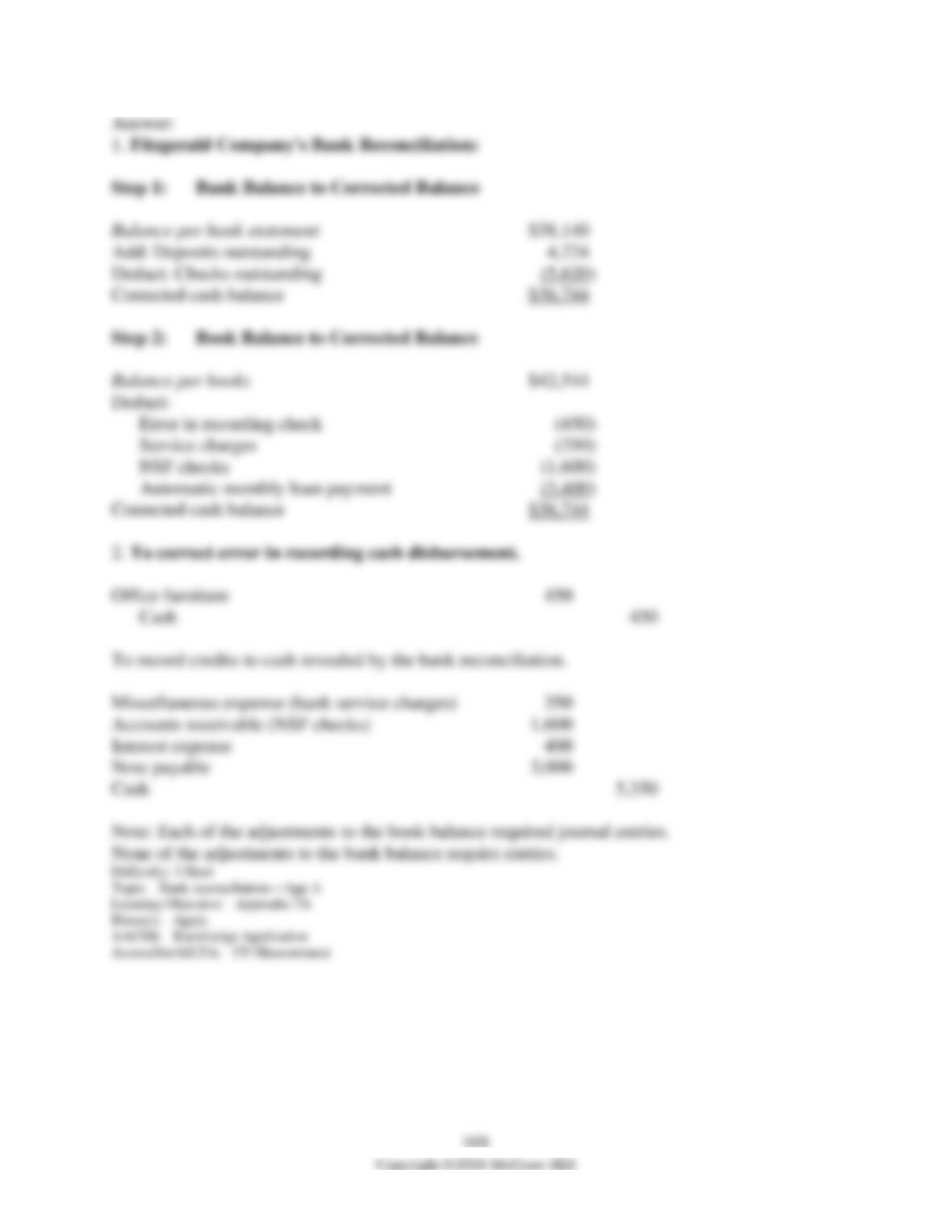
203) The Fitzgerald Company maintains a checking account at the Bank of the North. The bank
provides a bank statement along with canceled checks on the last day of each month. The
October 31, 2018, bank statement included the following information:
Balance, October 1, 2018 $ 32,690
Deposits 86,000
Checks processed (75,200)
Service charges (350)
NSF checks (1,600)
Monthly loan payment deducted
directly by bank from account
(includes $400 in interest) (3,400)
Balance, October 31, 2018 $ 38,140
The company’s general ledger cash (checking) account had a balance of $42,544 at the end of
October. Deposits outstanding totaled $4,224, and all checks written by the company were
processed by the bank except for those totaling $5,620. In addition, a check for $500 for the
purchase of office furniture was incorrectly recorded by the company as a $50 disbursement. The
bank correctly processed the check during October.
Required:
1. Prepare a bank reconciliation for the month of October.
2. Prepare the necessary journal entries at the end of October to adjust the general ledger
cash account.
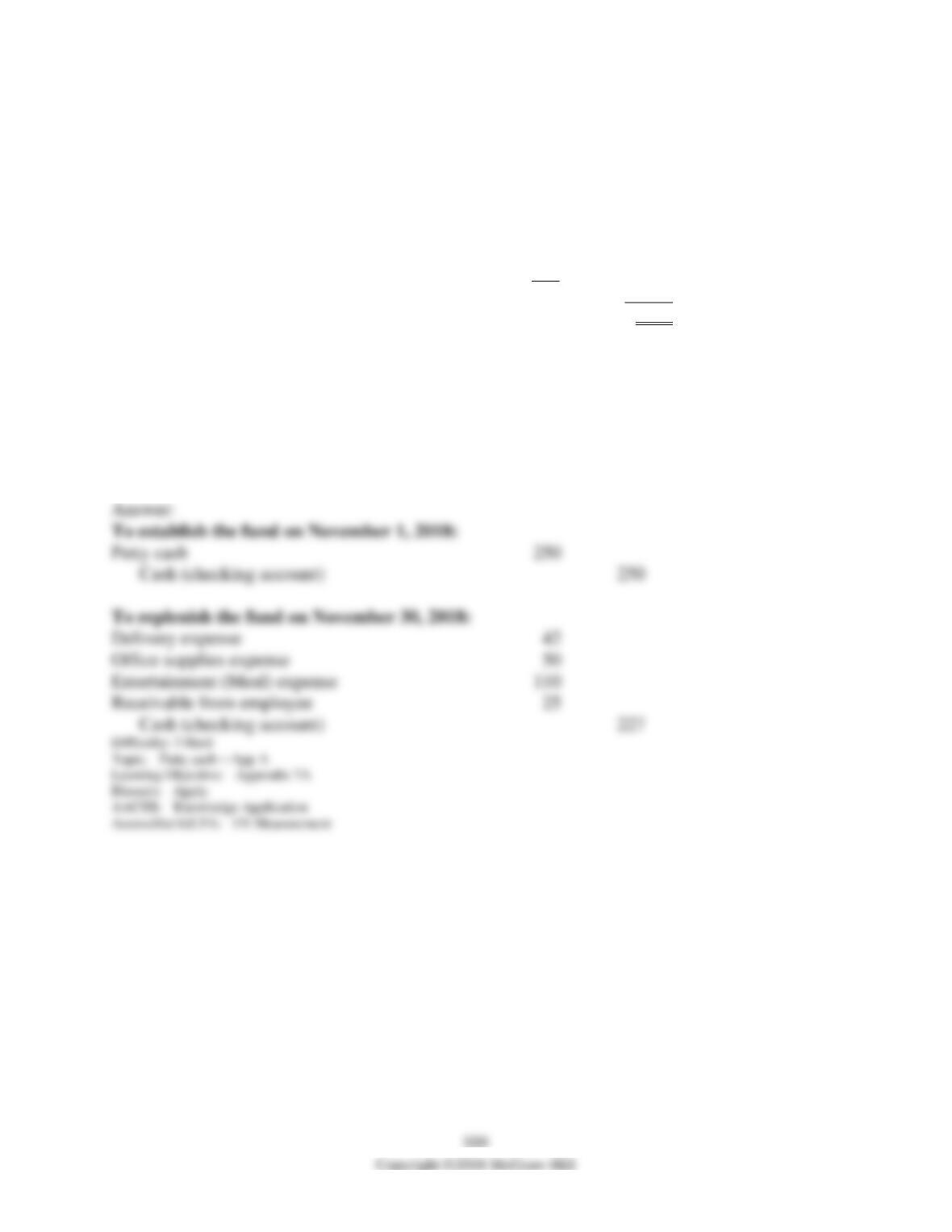
204) The petty cash fund of Western Glass Company contained the following items on
November 30, 2018:
Currency and coins $ 23
Receipts for the following expenditures:
Delivery charges $42
Office supplies 50
Restaurant receipt for entertaining a customer 110 202
An I.O.U. from an employee 25
Total $250
The petty cash fund was established on November 1, 2018, with a transfer of $250 from cash to
the petty cash account.
Required:
Prepare the journal entries to establish the petty cash account and to replenish the fund at the end
of November.
205) Sarduchi Imports owes Radnor S&L $50 million under an 8% note with three years
remaining to maturity. Due to financial difficulties of Sarduchi, the previous year’s interest ($4
million) was not received. Radnor believes it is probable that Sarduchi will default on the note,
and that the present value of all amounts it eventually will collect is $25 million.
Required: Compute the impairment loss that the bank would record.
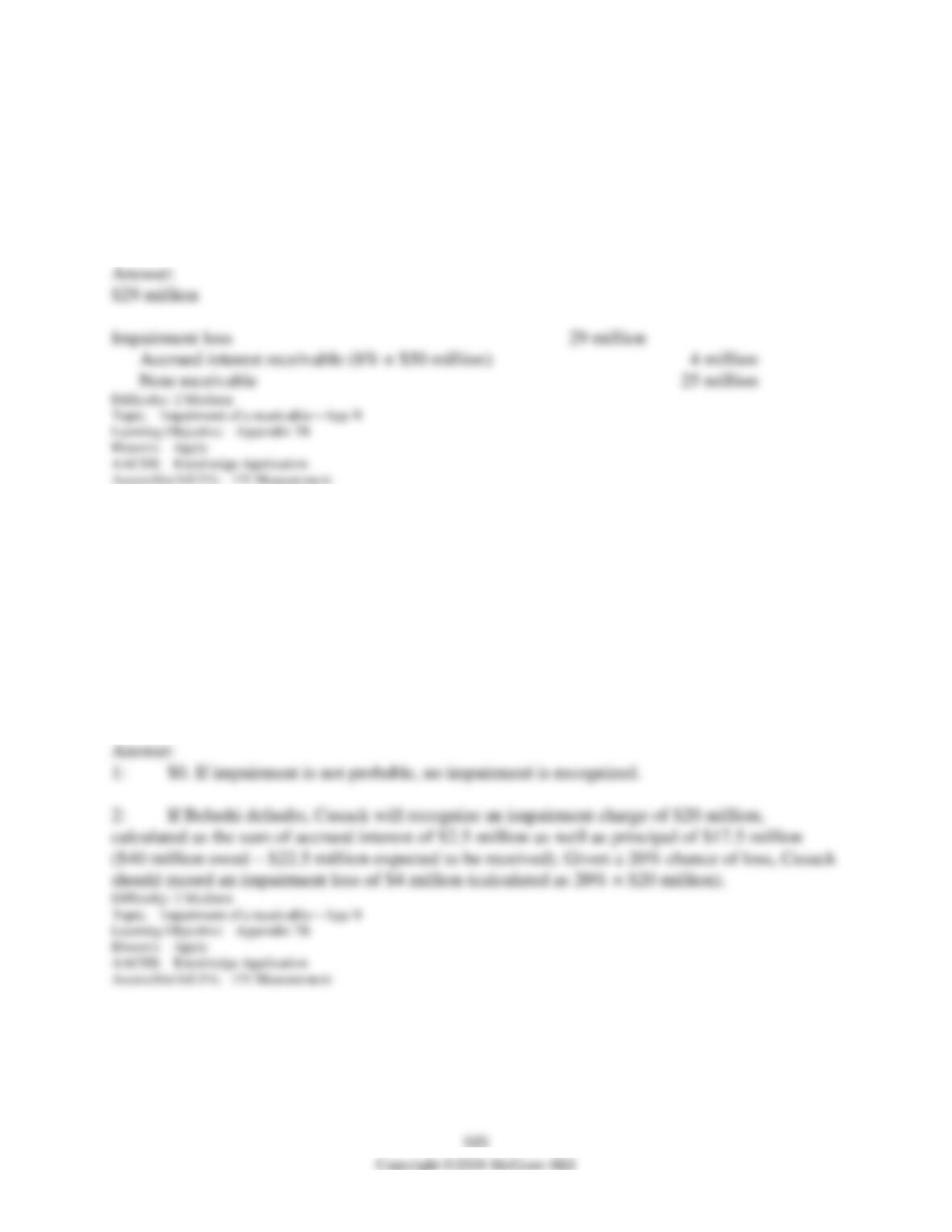
206) Belushi, Inc. owes Cusack County Trust $40 million under an 5% note with six years
remaining to maturity. Due to financial difficulties of Belushi, the previous year’s interest ($2.5
million) was not received. Cusack believes there is a 20% chance that Belushi will default on the
note, and that, if Belushi defaults, the present value of all amounts Cusack eventually will collect
is $22.5 million.
Required:
1. Compute the impairment loss that Cusack would record.
2. Assume Cusack is reporting under ASU 2016-13 and therefore using the CECL model.
Compute the impairment loss that Cusack would record.
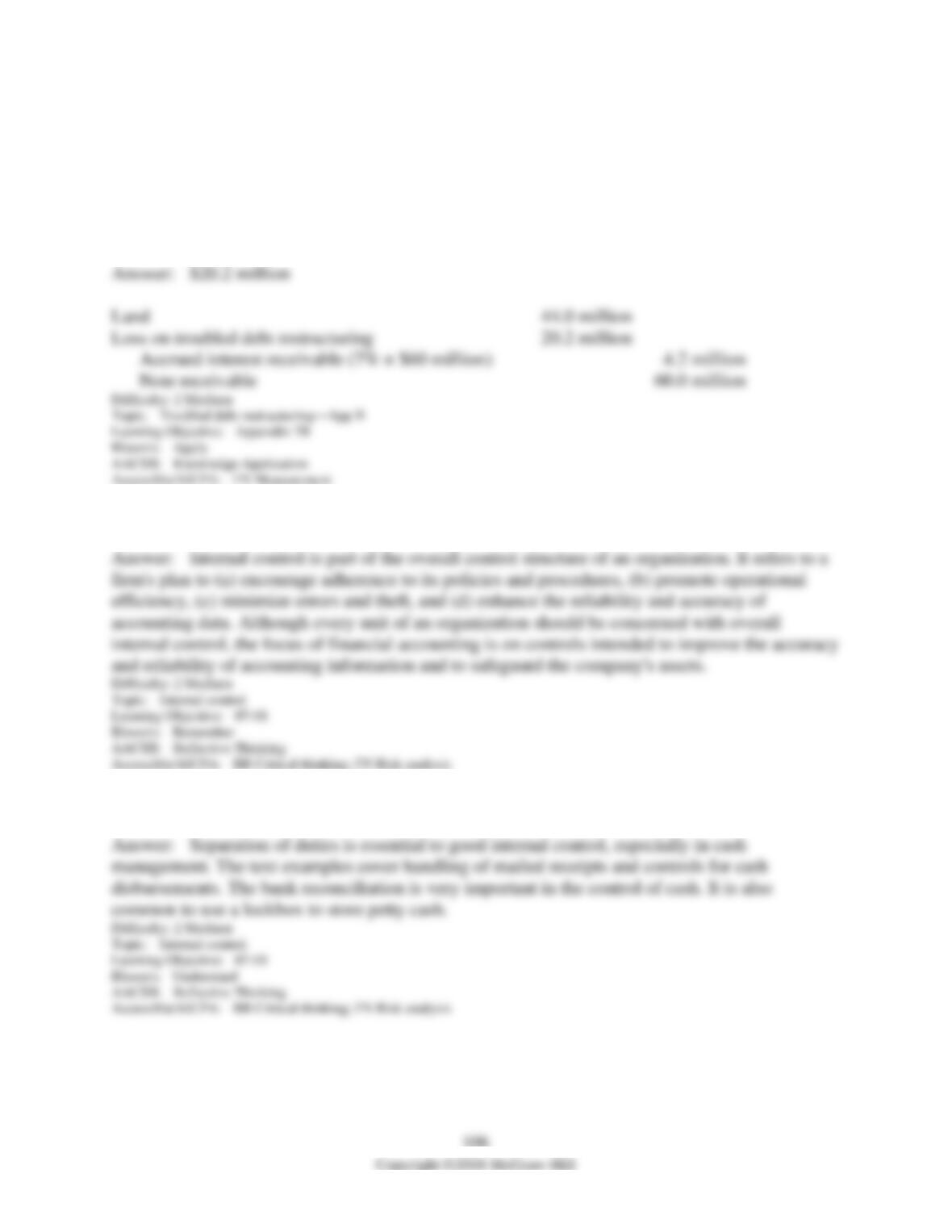
207) Guido Properties owes First State Bank $60 million under a 7% note with two years
remaining to maturity. Due to financial difficulties of Guido, the previous year’s interest ($4.2
million) was not received. The bank agrees to settle the note receivable and accrued interest
receivable in exchange for land having a fair value of $44 million.
Required: Compute the loss on troubled debt restructuring that the bank would record.
208) Define what it is meant by internal control.
209) Describe some key elements of an internal control system for cash.
210) Cash is the most liquid of all assets but is not always reported under current assets. Explain
this statement.
211) Although the net method is theoretically more sound, many companies use the gross
method of accounting for cash discounts related to sales on account. Explain this statement.
212) Briefly explain the accounting treatment for estimated sales returns at the end of an
accounting period for which accounts receivable remain outstanding.
213) Briefly explain the accounting treatment for estimated sales returns at the end of an
accounting period for which cash has already been collected from customers.
214) Briefly explain why the direct write-off of uncollectible accounts is not permitted by GAAP
if bad debts are material.
215) Last year, Simpson Company had a receivables turnover ratio of 12. Homer, Simpson’s
president, was delighted when the ratio went to 18 for this year. This year, Simpson’s long-
standing credit terms of net 30 were changed to net 10. Should Homer be happy? Explain.

109
216) You have recently been hired as the assistant controller for Clayton, Inc., a large, publicly
held manufacturing company. Your immediate superior is the controller who, in turn, is
responsible to the chief financial officer. The controller has assigned the task of preparing the
year-end adjusting entry for bad debts to you. The allowance for uncollectibles accounts has a
credit balance of $86,000 before the year-end adjustment. Your analysis indicates that an
appropriate balance for the allowance account is $210,000. After showing your analysis to the
controller, she tells you to adjust the allowance account to $310,000. Tactfully, you ask the
controller for an explanation for the amount and she tells you, “We are having a really good year.
Let’s bump up the allowance.”
Required:
Discuss the ethical dilemma you face. Consider your options and responsibilities along with the
possible consequences of any action you might take.
217) Briefly compare and contrast the two approaches to estimating bad debt expense. In your
answer, indicate which approach, if either, is superior.
218) Companies can have accounts receivable from ordinary trade customers and from related
parties (e.g., directors, employees or large shareholders). How does U.S. GAAP differ from IFRS
in its requirements regarding separate disclosure of trade receivables and related-party
receivables? Why might separate disclosure of related party receivables be useful?
Use this information to answer the following questions:
The following note disclosure appeared in a recent annual report of Halliburton:
Our receivables are generally not collateralized. Included in notes and accounts receivable are
notes with varying interest rates totaling $12 million at December 31. At December 31, 39% of
our consolidated receivables related to our United States government contracts, primarily for
projects in the Middle East.
219) Explain the reason that Halliburton indicates that its receivables include notes with varying
interest rates totaling $12 million at December 31. What significance does this have to the
reader?
220) Explain the reason that Halliburton indicates that its receivables are generally not
collateralized. What significance does this have to the reader?
221) Explain the transactions that typically would affect the discount on notes receivable
account.
222) A company’s investment in receivables is affected by several related variables. Give an
example of this interrelationship.
223) Explain how a company could manipulate cash flow from operations by changing the extent
to which it factors accounts receivable and treats those factoring arrangements as sales of
receivables.
224) Explain briefly how IFRS and U.S. GAAP differ in determining whether a transfer of an
accounts receivable qualifies as a sale.