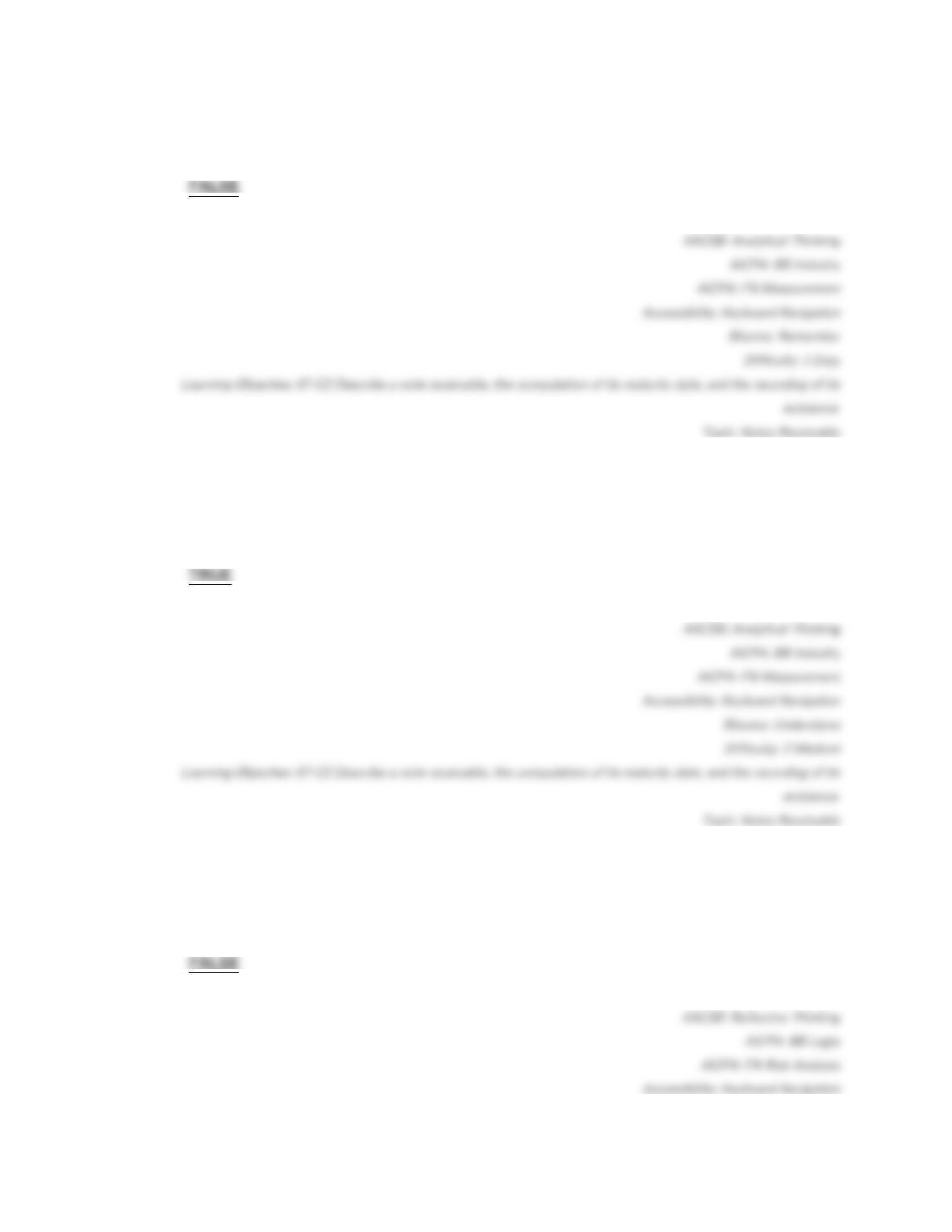
48.
Notes receivable are classified as current liabilities regardless of the time to maturity.
49.
A company received a $15,000, 90-day, 10% note receivable. The journal entry to record
receipt of the note in the payee records includes a debit to Notes Receivable.
50.
For legal reasons, it is not advisable to accept a note receivable in exchange for an
overdue account receivable.
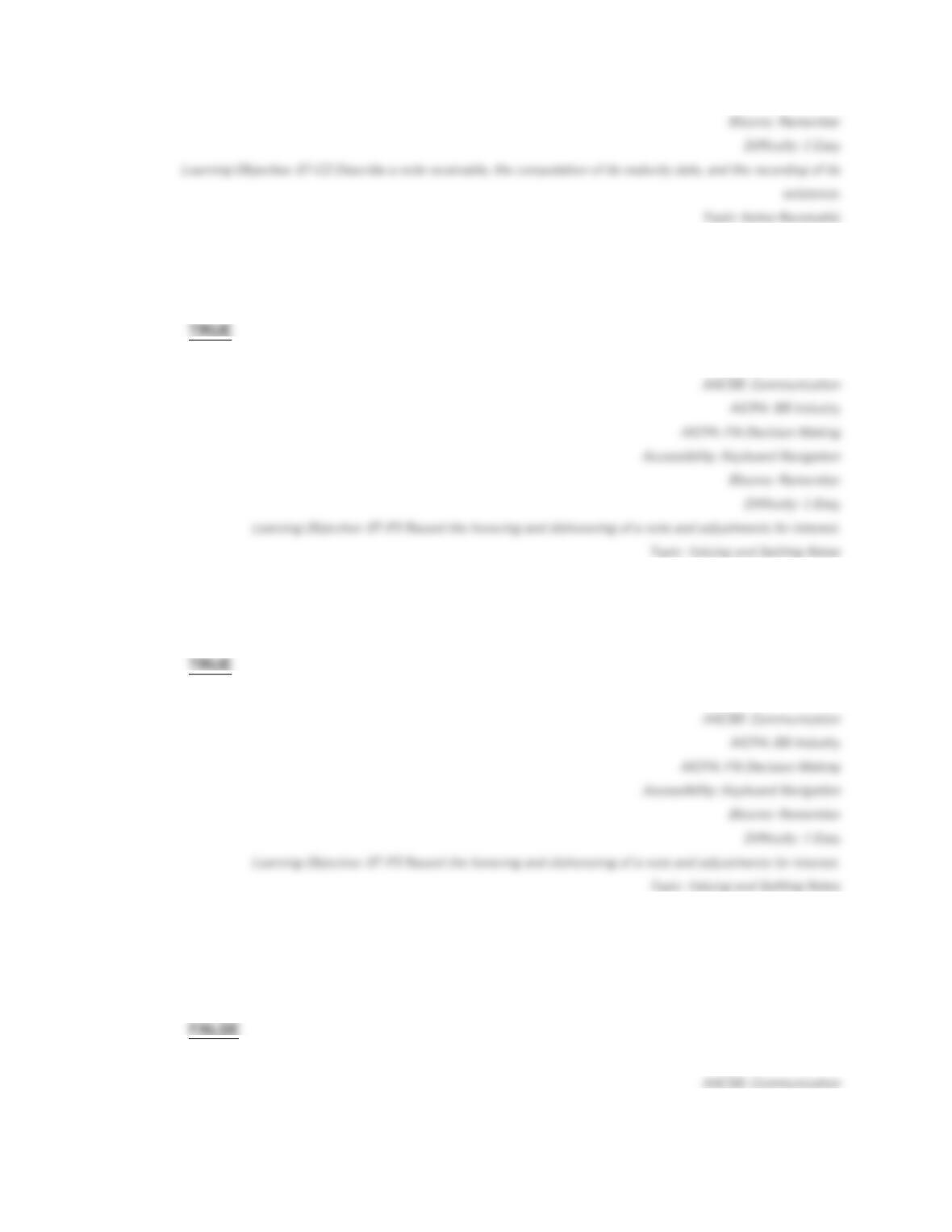
51.
A note that the maker is unable or refuses to pay at maturity is called a dishonored note.
52.
A maker who dishonors a note is one who does not pay it at maturity.
53.
The notes receivable account of a business should include both the notes that haven’t
matured and the dishonored notes.
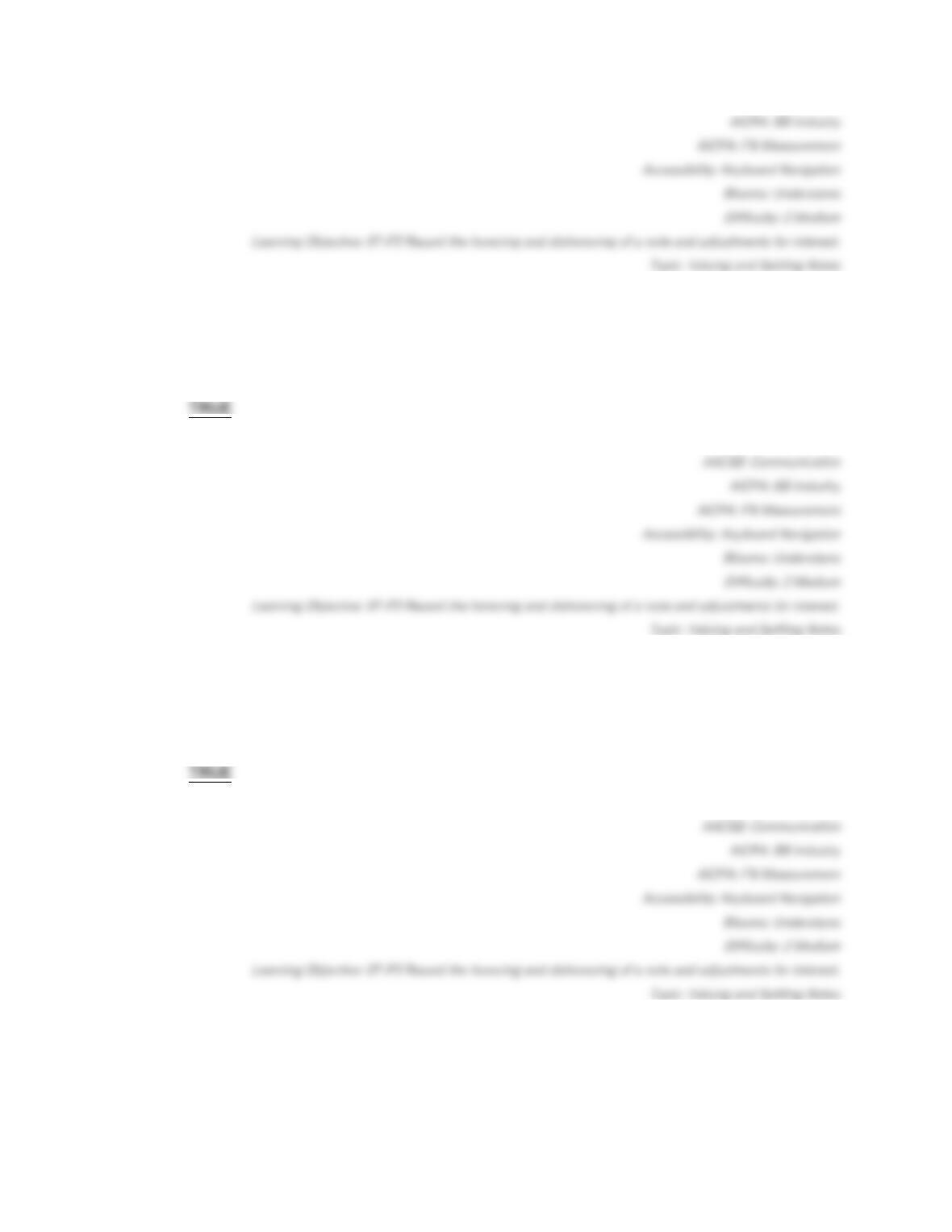
54.
The practice of placing dishonored notes receivable into accounts receivable keeps only
notes that have not matured in the Notes Receivable account.
55.
The matching principle requires that accrued interest on outstanding notes receivable be
recorded at the end of each accounting period.
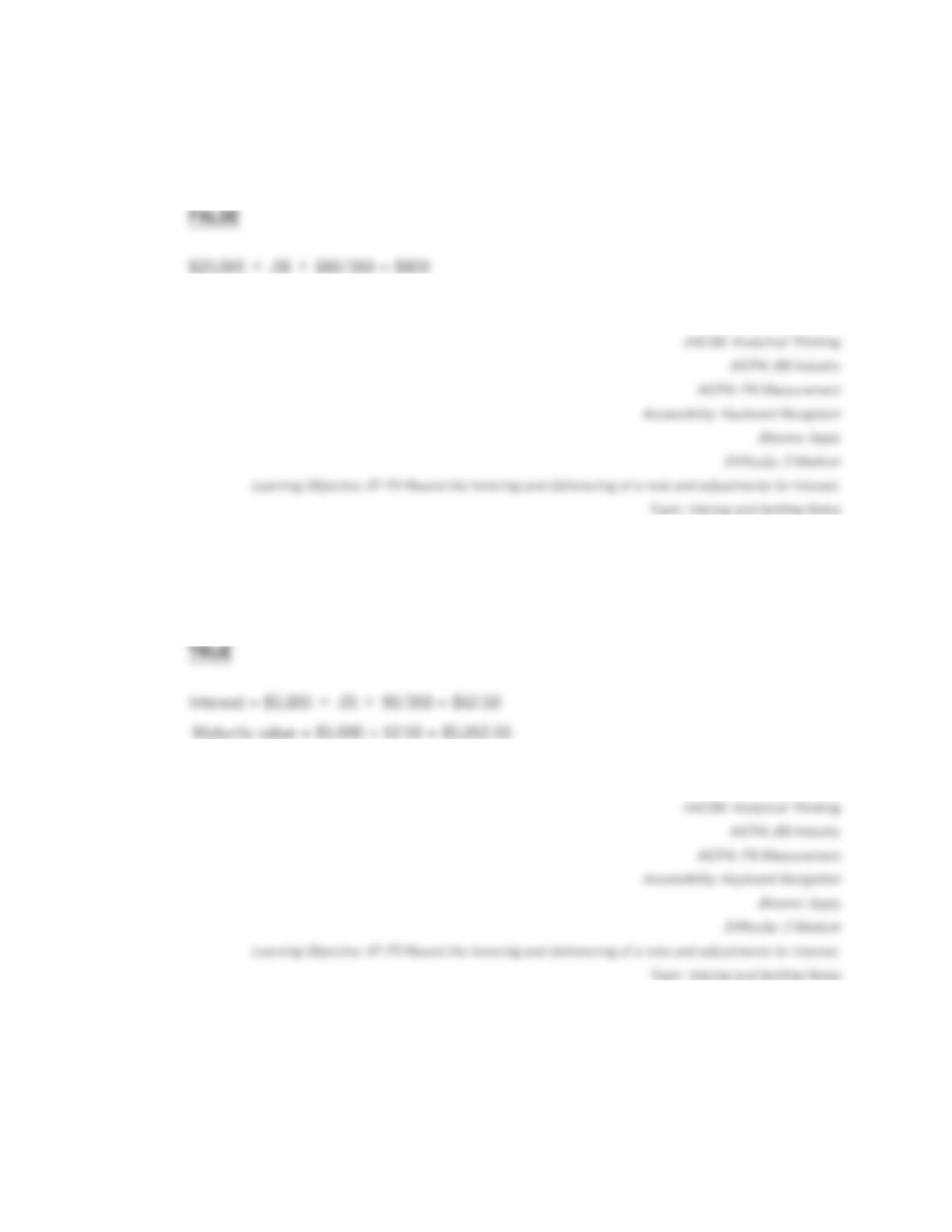
56.
Flack Company receives a $20,000, 8%, 180 day note receivable from a customer. The total
interest on this note is $1,600.
57.
Jaspreet Industries accepts a $5,000, 90-day, 5% note receivable from a customer on an
overdue Accounts Receivable. The amount due upon maturity is $5,062.50.
58.
If Taylor Corp. receives a $10,000, 120-day, 6% note on October 1, 2016, the amount of
interest that should be accrued on December 31, 2016, the end of Taylor’s accounting
period, is $200.
Multiple Choice Questions
59.
Separate accounts receivable information for each customer is important because it
reveals all of the following
except
:
60.
A credit sale of $5,275 to a customer would result in which of the following?
61.
Sellers allow customers to use credit cards to pay for products and services for all of the
following reasons
except
:
62.
Which of the following is
not
true regarding a credit card expense?
63.
A promissory note received from a customer in exchange for an account receivable is
recorded by the payee as:
64.
The person who signs a note receivable and promises to pay the principal and interest is
the:
65.
Reporting the details of notes is consistent with which accounting principle that requires
financial statements (including footnotes) to report all relevant information?
66.
A promissory note:
67.
The maturity date of a note receivable:
68.
The interest accrued on $7,500 at 6% for 90 days is:
69.
A 90-day note issued on April 10 matures on:
70.
A company receives a 10%, 120-day note for $1,500. The total interest due on the maturity
date is:
71.
A company borrowed $10,000 by signing a 180-day promissory note at 9%. The total
interest due on the maturity date is.
72.
A company borrowed $10,000 by signing a 180-day promissory note at 9%. The maturity
value of the note is:
73.
A finance company or bank that purchases and takes ownership of another company’s
accounts receivable is called a:
74.
Factoring receivables is beneficial to a seller for all of the following reasons
except
:
75.
A company factored $45,000 of its accounts receivable and was charged a 4% factoring
fee. The journal entry to record this transaction would include a:
76.
The
quality
of
receivables
refers to:
77.
The account receivable turnover measures:
78.
The accounts receivable turnover is calculated by:
79.
A company has net sales of $1,200,000 and average accounts receivable of $400,000.
What is its accounts receivable turnover for the period?
80.
Pepperdine reported net sales of $8,600 million, net income of $126 million and average
accounts receivable of $890 million. Its accounts receivable turnover is:
81.
Axle Co’s accounts receivable turnover was 9.9 for this year and 11.0 for last year.
Betterman’s turnover was 9.3 for this year and 9.3 for last year. These results imply that:
82.
A company had net sales of $600,000, total sales of $750,000, and an average accounts
receivable of $75,000. Its accounts receivable turnover equals: