70) A company pledges their receivables so they may
A) Collect a pledge fee.
B) Borrow money.
C) Charge a factoring fee.
D) Increase sales.
E) Recognize a sale.
71) A promissory note:
A) Is a short-term investment for the maker.
B) Is a written promise to pay a specified amount of money at a certain date.
C) Is a liability to the payee.
D) Is another name for an installment receivable.
E) Cannot be used in payment of an account receivable.
72) The maturity date of a note receivable:
A) Is the day of the credit sale.
B) Is the day the note was signed.
C) Is the day the note is due to be repaid.
D) Is the date of the first payment.
E) Is the last day of the month.
73) The interest accrued on $7,500 at 6% for 90 days is: (Use 360 days a year.)
A) $450.00.
B) $37.50.
C) $112.50.
D) $11.25.
E) $1,800.00.
74) A 90-day note issued on April 10 matures on:
A) July 9.
B) July 10.
C) July 11.
D) July 12.
E) July 13.
75) A company receives a 10%, 120-day note for $1,500. The total interest due on the maturity
date is: (Use 360 days a year.)
A) $50.00.
B) $150.00.
C) $75.00.
D) $37.50.
E) $87.50.
76) A company borrowed $10,000 by signing a 180-day promissory note at 9%. The total
interest due on the maturity date is: (Use 360 days a year.)
A) $900
B) $75
C) $450
D) $300
E) $1,800
77) A company borrowed $10,000 by signing a 180-day promissory note at 9%. The total to be
paid at maturity of the note is: (Use 360 days a year.)
A) $10,450
B) $10,900
C) $10,075
D) $11,800
E) $10,300
78) A finance company or bank that purchases and takes ownership of another company’s
accounts receivable is called a:
A) Payer.
B) Pledger.
C) Factor.
D) Payee.
E) Pledgee.
79) Factoring receivables is beneficial to a seller for all of the following reasons except:
A) Allows firms to receive cash earlier.
B) Passes ownership of the receivables to the factor.
C) There are no fees for factoring.
D) Seller avoids the cost of billing and accounting for receivables.
E) May pass the risk of bad debts to the factor.
80) A company factored $45,000 of its accounts receivable and was charged a 4% factoring fee.
The journal entry to record this transaction would include a:
A) Debit to Cash of $45,000, a debit to Factoring Fee Expense of $1,800, and a credit to
Accounts Receivable of $46,800.
B) Debit to Cash of $45,000 and a credit to Accounts Receivable of $45,000.
C) Debit to Cash of $43,200, a debit to Factoring Fee Expense of $1,800, and a credit to
Accounts Receivable of $45,000.
D) Debit to Cash of $46,800 and a credit to Accounts Receivable of $46,800.
E) Debit to Cash of $45,000 and a credit to Notes Payable of $45,000.
81) The quality of receivables refers to:
A) The creditworthiness of sellers.
B) The method of collection.
C) The likelihood of collection without loss.
D) Sales turnover.
E) The interest rate.
82) The account receivable turnover measures:
A) How long it takes to sell accounts receivable to a factor.
B) How often, on average, receivables are received and collected during the period.
C) The relation of cash sales to credit sales.
D) How long it takes to sell merchandise inventory.
E) All of the options are correct.
83) The accounts receivable turnover is calculated by:
A) Dividing net sales by average accounts receivable.
B) Dividing net sales by average accounts receivable and multiplying by 365.
C) Dividing average accounts receivable by net sales.
D) Dividing average accounts receivable by net sales and multiplying by 365.
E) Dividing net income by average accounts receivable.
84) A company has net sales of $1,200,000 and average accounts receivable of $400,000. What
is its accounts receivable turnover for the period?
A) 0.33
B) 5.00
C) 20.0
D) 73.0
E) 3.0
85) Pepperdine reported net sales of $8,600 million, net income of $126 million and average
accounts receivable of $890 million. Its accounts receivable turnover is:
A) 37.8.
B) 9.7.
C) 68.3.
D) 7.1.
E) 51.7.
86) Axle Co.’s accounts receivable turnover was 9.9 for this year and 11.0 for last year.
Betterman’s turnover was 9.3 for this year and 9.3 for last year. These results imply that:
A) Betterman has the better turnover for both years.
B) Axle has the better turnover for both years.
C) Betterman’s turnover is improving.
D) Axle’s credit policies are too loose.
E) Betterman is collecting its receivables more quickly than Axle in both years.
87) A company had net sales of $600,000, total sales of $750,000, and an average accounts
receivable of $75,000. Its accounts receivable turnover equals:
A) 0.13
B) 0.80
C) 7.75
D) 8.00
E) 10.00
88) A company had total sales of $600,000, net sales of $550,000, and an average accounts
receivable of $90,000. Its accounts receivable turnover equals:
A) 6.1
B) 63.0
C) 54.8
D) 1.1
E) 6.3
89) The expense recognition principle, as applied to bad debts, requires:
A) That expenses be ignored if their effect on the financial statements is unimportant to users’
business decisions.
B) The use of the direct write-off method for bad debts.
C) The use of the allowance method of accounting for bad debts.
D) That bad debts be disclosed in the financial statements.
E) That bad debts not be written off.
90) The materiality constraint, as applied to bad debts:
A) Permits the use of the direct write-off method when bad debts expenses are relatively small.
B) Requires use of the allowance method for bad debts.
C) Requires use of the direct write-off method.
D) Requires that bad debts not be written off.
E) Requires that expenses be reported in the same period as the sales they helped produce.
91) If the credit balance of the Allowance for Doubtful Accounts account exceeds the amount of
a bad debt being written off, the entry to record the write-off against the allowance account
results in:
A) An increase in the expenses of the current period.
B) An increase in current assets.
C) A reduction in equity.
D) No effect on the expenses of the current period.
E) A reduction in current liabilities.
92) On October 12 of the current year, a company determined that a customer’s account
receivable was uncollectible and that the account should be written off. Assuming the allowance
method is used to account for bad debts, what effect will this write-off have on the company’s net
income and total assets?
A) Decrease in net income; no effect on total assets.
B) No effect on net income; no effect on total assets.
C) Decrease in net income; decrease in total assets.
D) Increase in net income; no effect on total assets.
E) No effect on net income; decrease in total assets.
93) On October 12 of the current year, a company determined that a customer’s account
receivable was uncollectible and that the account should be written off. Assuming the direct
write-off method is used to account for bad debts, what effect will this write-off have on the
company’s net income and total assets?
A) Decrease in net income; no effect on total assets.
B) No effect on net income; no effect on total assets.
C) Decrease in net income; decrease in total assets.
D) Increase in net income; no effect on total assets.
E) No effect on net income; decrease in total assets.
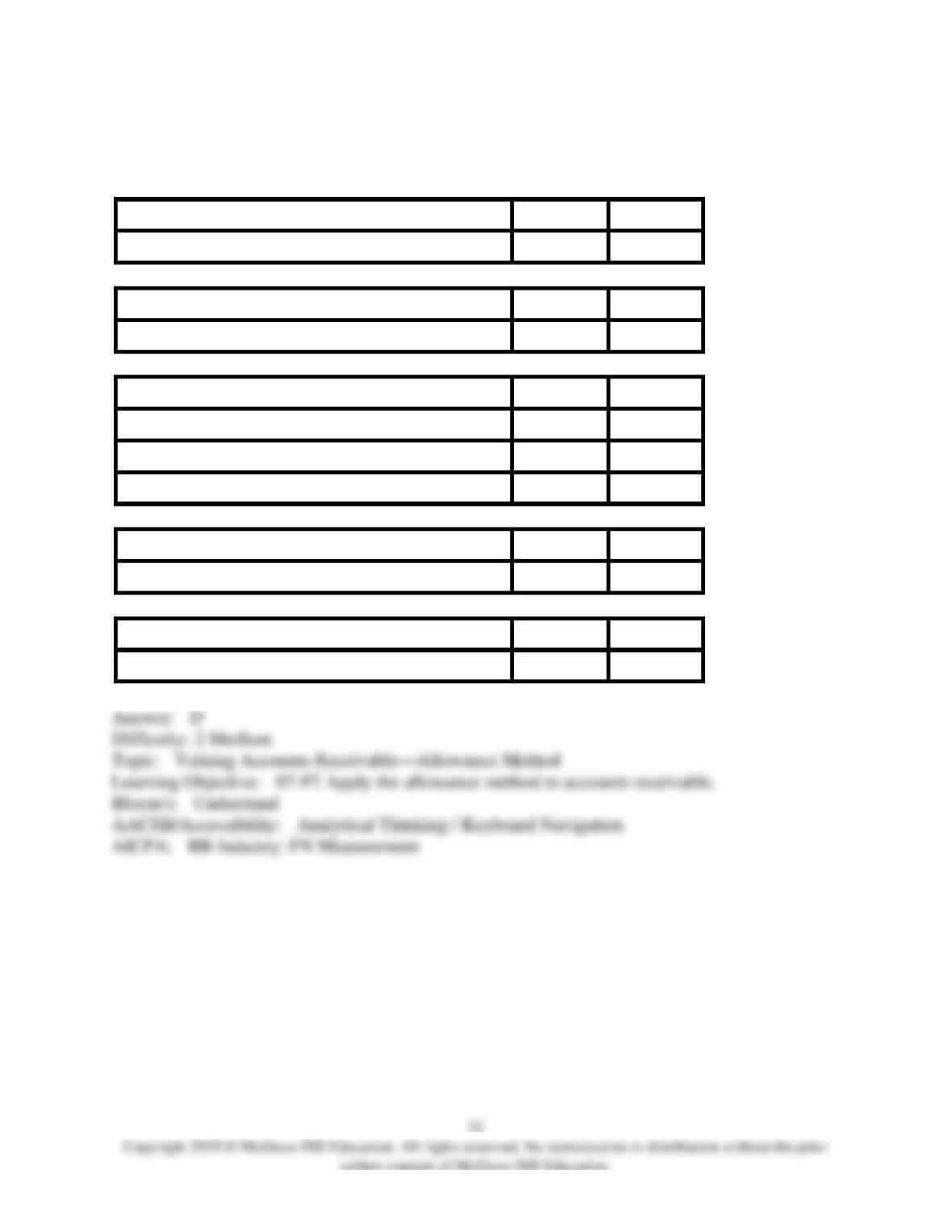
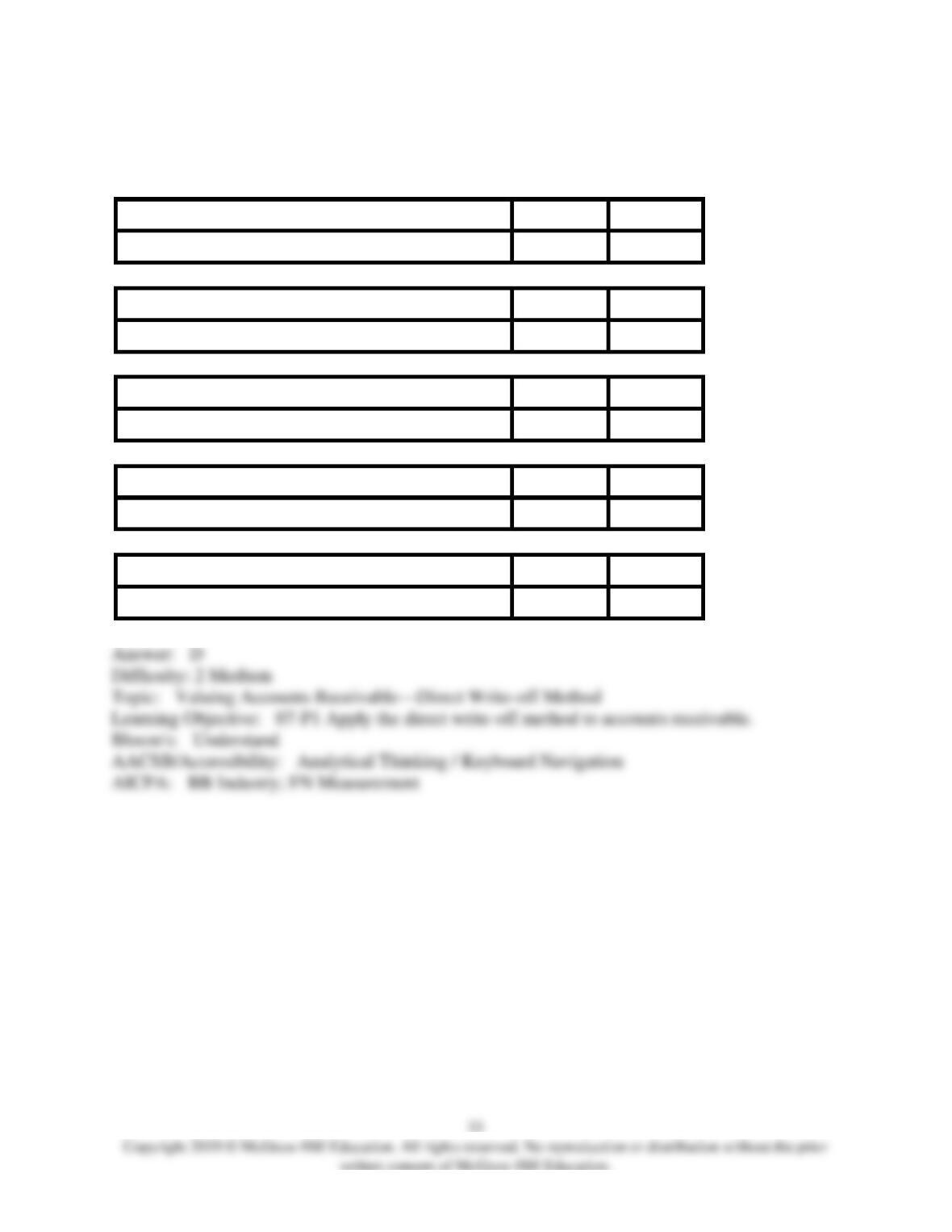
94) Gideon Company uses the allowance method of accounting for uncollectible accounts. On
May 3, the Gideon Company wrote off the $2,000 uncollectible account of its customer, A.
Hopkins. The entry or entries Gideon makes to record the write off of the account on May 3 is:
A)
Accounts Receivable—A. Hopkins
2,000
Allowance for Doubtful Accounts
2,000
B)
Allowance for Doubtful Accounts
2,000
Bad debts expense
2,000
C)
Accounts Receivable—A. Hopkins
2,000
Bad debts expense
2,000
Cash
2,000
Accounts Receivable—A. Hopkins
2,000
D)
Allowance for Doubtful Accounts
2,000
Accounts Receivable—A. Hopkins
2,000
E)
Cash
2,000
Accounts Receivable—A. Hopkins
2,000
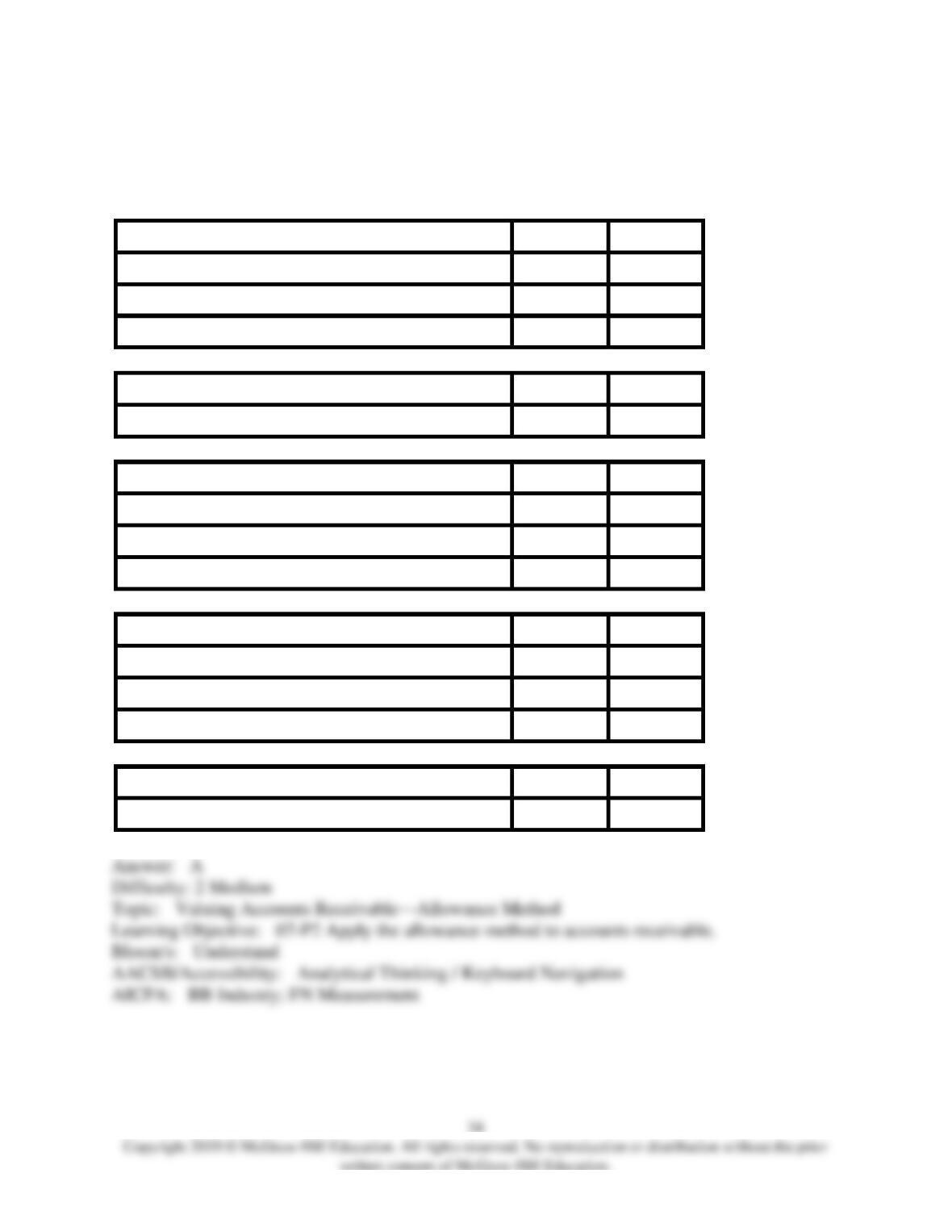
95) Gideon Company uses the direct write-off method of accounting for uncollectible accounts.
On May 3, the Gideon Company wrote off the $2,000 uncollectible account of its customer, A.
Hopkins. The entry or entries Gideon makes to record the write off of the account on May 3 is:
A)
Accounts Receivable—A. Hopkins
2,000
Bad Debts Expense
2,000
B)
Allowance for Doubtful Accounts
2,000
Accounts Receivable—A. Hopkins
2,000
C)
Accounts Receivable—A. Hopkins
2,000
Cash
2,000
D)
Bad Debts Expense
2,000
Accounts Receivable—A. Hopkins
2,000
E)
Cash
2,000
Accounts Receivable—A. Hopkins
2,000
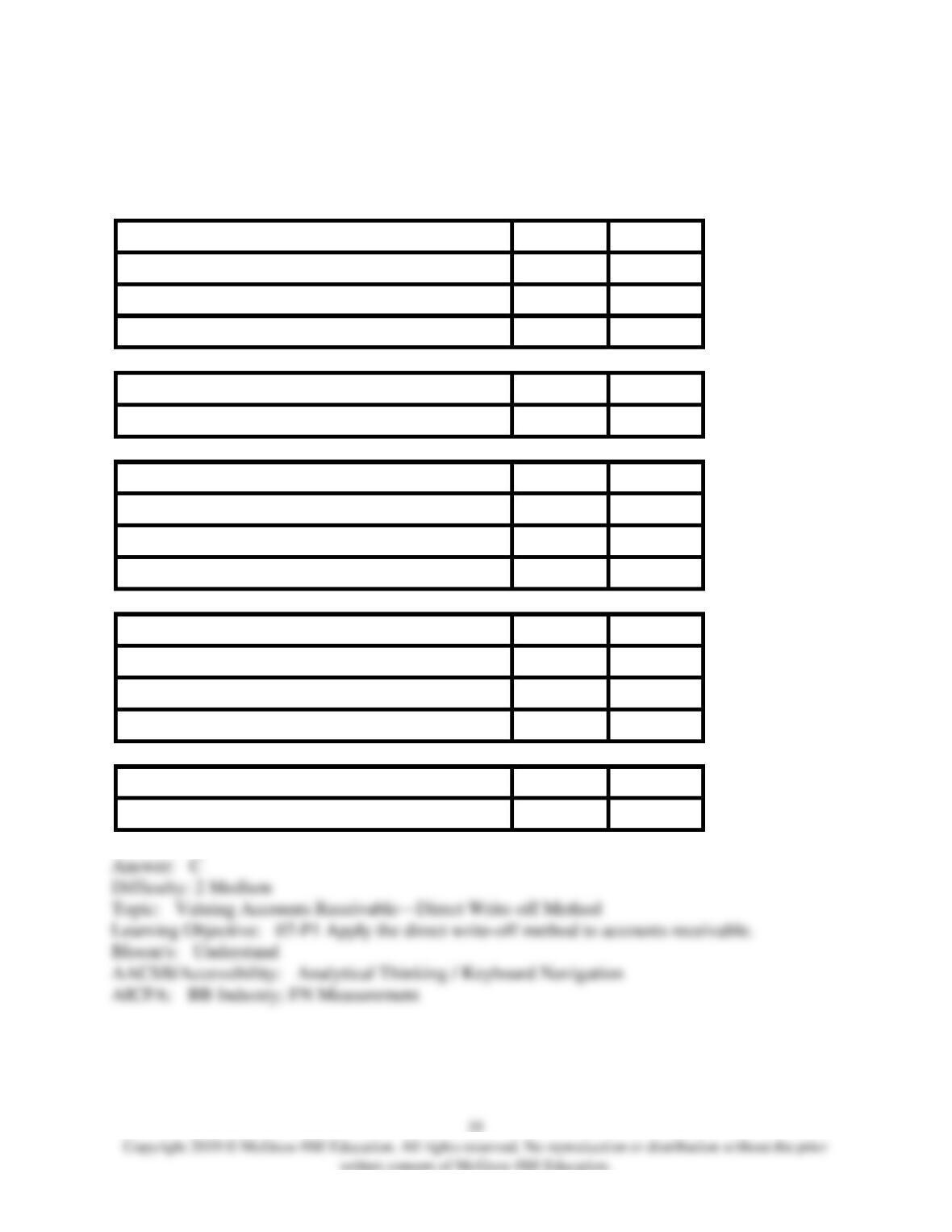
96) Gideon Company uses the allowance method of accounting for uncollectible accounts. On
May 3, the Gideon Company wrote off the $2,000 uncollectible account of its customer, A.
Hopkins. On July 10, Gideon received a check for the full amount of $2,000 from Hopkins. On
July 10, the entry or entries Gideon makes to record the recovery of the bad debt is:
A)
Accounts Receivable—A. Hopkins
2,000
Allowance for Doubtful Accounts
2,000
Cash
2,000
Accounts Receivable—A. Hopkins
2,000
B)
Cash
2,000
Bad debts expense
2,000
C)
Accounts Receivable—A. Hopkins
2,000
Bad debts expense
2,000
Cash
2,000
Accounts Receivable—A. Hopkins
2,000
D)
Allowance for Doubtful Accounts
2,000
Accounts Receivable—A. Hopkinse
2,000
Accounts Receivable—A. Hopkins
2,000
Cash
2,000
E)
Cash
2,000
Accounts Receivable—A. Hopkins
2,000
97) Gideon Company uses the direct write-off method of accounting for uncollectible accounts.
On May 3, the Gideon Company wrote off the $2,000 uncollectible account of its customer, A.
Hopkins. On July 10, Gideon received a check for the full amount of $2,000 from Hopkins. On
July 10, the entry or entries Gideon makes to record the recovery of the bad debt is:
A)
Accounts Receivable—A. Hopkins
2,000
Allowance for Doubtful Accounts
2,000
Cash
2,000
Accounts Receivable—A. Hopkins
2,000
B)
Cash
2,000
Bad debts expense
2,000
C)
Accounts Receivable—A. Hopkins
2,000
Bad debts expense
2,000
Cash
2,000
Accounts Receivable—A. Hopkins
2,000
D)
Allowance for Doubtful Accounts
2,000
Accounts Receivable—A. Hopkinse
2,000
Accounts Receivable—A. Hopkins
2,000
Cash
2,000
E)
Cash
2,000
Accounts Receivable—A. Hopkins
2,000
98) The allowance method that assumes a given percent of a company’s credit sales for the
period is uncollectible is:
A) The percent of sales method.
B) The percent of accounts receivable method.
C) The aging of accounts receivable method.
D) Direct write-off method.
E) Factoring method.
99) A method of estimating bad debts expense that involves a detailed examination of
outstanding accounts and the length of time past due is the:
A) Direct write-off method.
B) Aging of accounts receivable method.
C) Percentage of sales method.
D) Aging of investments method.
E) Percent of accounts receivable method.
100) Which of the following is an accounting method that (1) estimates and reports bad debts
expense from credit sales during the period the sales are recorded, and (2) reports accounts
receivable at the estimated amount of cash to be collected?
A) Allowance method of accounting for bad debts.
B) Aging of notes receivable method.
C) Adjustment method for uncollectible debts.
D) Direct write-off method of accounting for bad debts.
E) Cash basis method of accounting for bad debts.
101) On December 31 of the current year, the unadjusted trial balance of a company using the
percent of receivables method to estimate bad debt included the following: Accounts Receivable,
debit balance of $95,250; Allowance for Doubtful Accounts, credit balance of $921. What
amount should be debited to Bad Debts Expense, assuming 6% of outstanding accounts
receivable at the end of the current year are estimated to be uncollectible?
A) $5,715.
B) $6,636.
C) $4,794.
D) $5,770.
E) $5,660.
102) At the end of the current year, using the aging of receivable method, management estimated
that $15,750 of the accounts receivable balance would be uncollectible. Prior to any year-end
adjustments, the Allowance for Doubtful Accounts had a debit balance of $375. What adjusting
entry should the company make at the end of the current year to record its estimated bad debts
expense?
A)
Bad Debts Expense
15,750
Allowance for Doubtful Accounts
15,750
B)
Bad Debts Expense
15,375
Allowance for Doubtful Accounts
15,375
C)
Bad Debts Expense
16,125
Allowance for Doubtful Accounts
16,125
D)
Accounts Receivable
15,750
Bad Debts Expense
375
Sales
16,125
E)
Accounts Receivable
16,125
Allowance for Doubtful Accounts
16,125
103) At the end of the current year, using the aging of receivable method, management estimated
that $15,750 of the accounts receivable balance would be uncollectible. Prior to any year-end
adjustments, the Allowance for Doubtful Accounts had a credit balance of $375. What adjusting
entry should the company make at the end of the current year to record its estimated bad debts
expense?
A)
Bad Debts Expense
15,750
Allowance for Doubtful Accounts
15,750
B)
Bad Debts Expense
16,125
Allowance for Doubtful Accounts
16,125
C)
Bad Debts Expense
15,375
Allowance for Doubtful Accounts
15,375
D)
Accounts Receivable
15,750
Bad Debts Expense
375
Sales
16,125
E)
Accounts Receivable
16,125
Allowance for Doubtful Accounts
16,125
104) A company uses the percent of sales method to determine its bad debts expense. At the end
of the current year, the company’s unadjusted trial balance reported the following selected
amounts:
Accounts receivable
$
375,000
debit
Allowance for uncollectible accounts
500
debit
Net Sales
800,000
credit
All sales are made on credit. Based on past experience, the company estimates that 0.6% of net
credit sales are uncollectible. What amount should be debited to Bad Debts Expense when the
year-end adjusting entry is prepared?
A) $1,275
B) $1,775
C) $4,500
D) $4,800
E) $5,500