Required:
Prepare the necessary journal entries to record the transactions on Stewart Ski Company’s books.
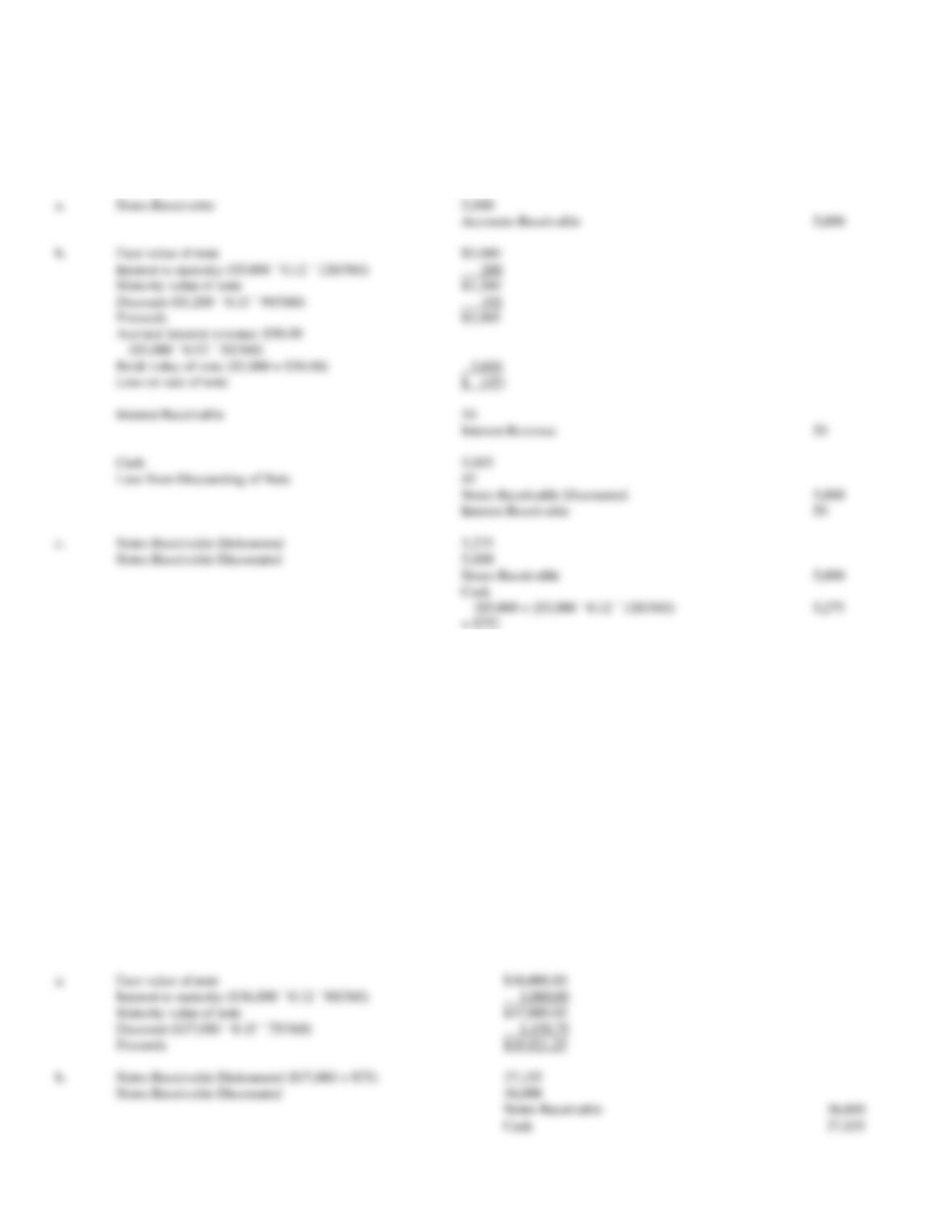
104. Markham Corp. sold goods for $36,000 on July 17, 2010, and accepted a 12%, 90-day note. On August 1,
the note was discounted at 15%.
Required:
a.
Compute the proceeds.
b.
If the maker dishonored the note at maturity, prepare an entry (or entries) for Markham Corp. assuming $75 of bank protest fees.
Face value of note
$36,000.00
Interest to maturity ($36,000 ´ 0.12 ´ 90/360)
1,080.00
Maturity value of note
$37,080.00
Discount ($37,080 ´ 0.15 ´ 75/360)
1,158.75
Proceeds
$35,921.25
Notes Receivable Discounted
36,000
a.
Notes Receivable
5,000
Accounts Receivable
5,000
b.
Face value of note
$5,000
Interest to maturity ($5,000 ´ 0.12 ´ 120/360)
200
Maturity value of note
$5,200
Discount ($5,200 ´ 0.15 ´ 90/360)
195
Proceeds
$5,005
Accrued interest revenue: $50.00
($5,000 ´ 0.12 ´ 30/360)
Book value of note ($5,000 + $50.00)
5,050
Loss on sale of note
$ (45)
Interest Receivable
Interest Revenue
Cash
5,005
Loss from Discounting of Note
Notes Receivable Discounted
5,000
Interest Receivable
c.
Notes Receivable Dishonored
5,275
Notes Receivable Discounted
5,000
Notes Receivable
5,000
Cash
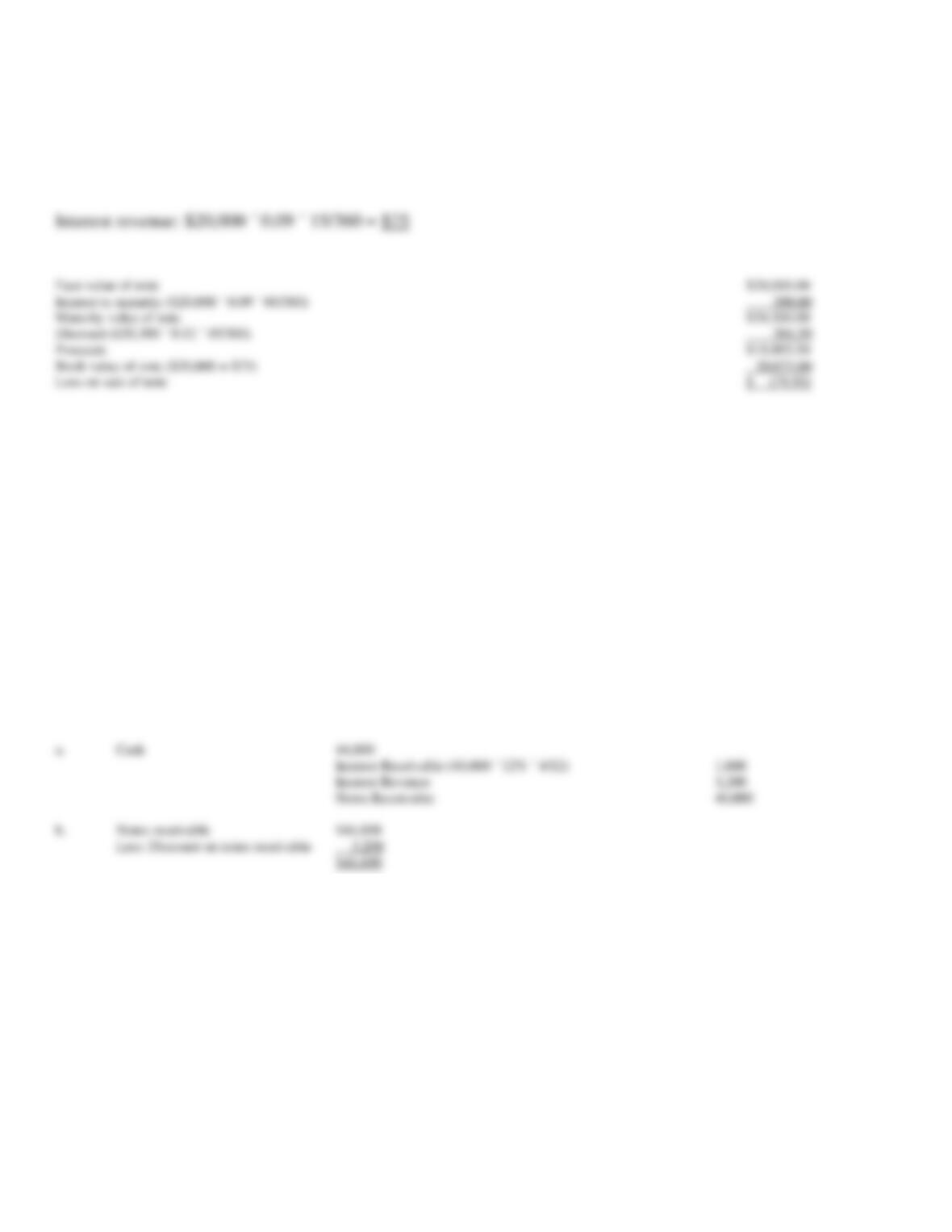
105. On April 7, Willow, Inc. sold goods for $20,000 and accepted a 9%, 60-day note. On April 22, the
company discounted the note at 12%.
Required:
Compute the amount of interest revenue and the loss on sale of the note.
106. On September 1, 2010, Greco Co. sold $40,000 of goods and accepted a one-year, 12% note.
Required:
a.
If no reversing entries were made after December 31, 2010, and adjusting entries were made, record the collection of the note on
September 1, 2011.
b.
Assume instead that a noninterest-bearing note for $44,800 for the same goods was issued. What balance sheet accounts and amounts
should be disclosed on December 31, 2011?
107. On November 1, 2010, Lemon Grove Co. sold $30,000 of goods and accepted a note bearing 6% interest.
The note was due in one year.
Required:
a.
Prepare a reversing entry for January 1, 2011.
b.
Record the collection of the note on October 31, 2011.
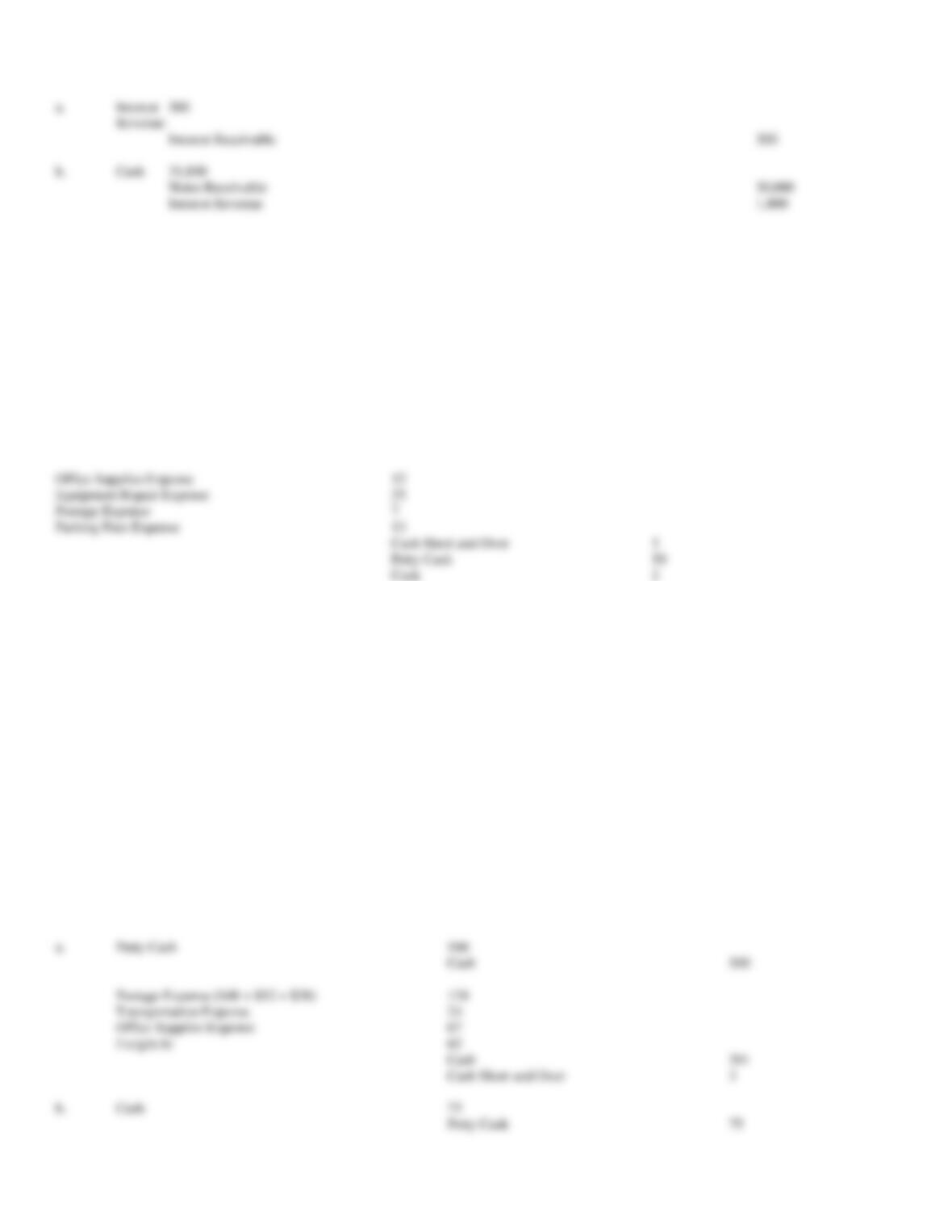
108. Elk, Inc. established a $250 petty cash fund three months ago. Today, April 21, the petty cash custodian
has $198 in cash and receipts for the following: office supplies $12, equipment repairs $25, postage $7, and
parking fees $13.
Required:
Prepare a compound journal entry to replenish the fund and reduce its size to $200.
Office Supplies Expense
12
Equipment Repair Expense
25
Postage Expense
7
Parking Fees Expense
Cash Short and Over
5
Petty Cash
50
Cash
2
109. On January 1, 2010, Jones Company established a petty cash fund of $500. By March 31, 2010, when the
fund was replenished, the following petty cash vouchers had been issued: January 26, postage, $48; February
16, postage, $52; February 6, airport limousine fares, $24; January 18, office supplies, $67; March 8, postage,
$38; March 4, local express delivery charges on purchases, $65. There was $309 in coins and currency left in
petty cash before replenishment.
Required:
a.
Prepare the journal entries to record the transactions relating to Jones Company’s petty cash fund for the first quarter of 2010.
b.
On April 1, the size of the petty cash fund was decreased to $425. What journal entry (if any) is necessary to record this action?
Petty Cash
500
Cash
500
Postage Expense ($48 + $52 + $38)
138
Transportation Expense
24
Office Supplies Expense
67
Cash
291
Interest Receivable
b.
Cash
31,800
Notes Receivable
30,000
Interest Revenue
1,800
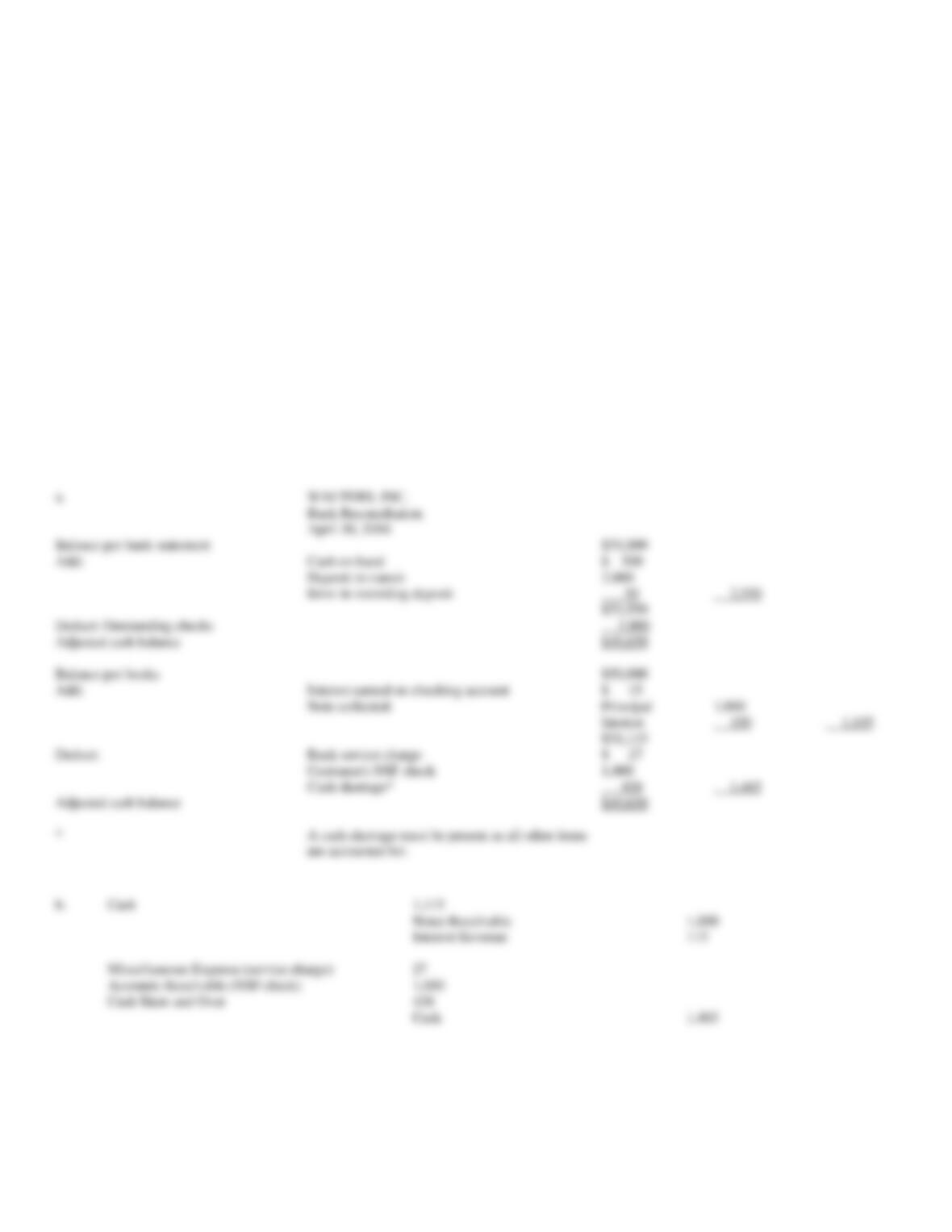
110. The accounting records and bank statement for Walters, Inc. revealed the following information for April
30, 2010:
Bank statement balance, April 30, 2010
$51,000
Credit memo with bank statement for interest earned during April
on bank account
15
Debit memo with bank statement for April’s service charge
27
Deposits in transit on April 30
2,000
Cash on hand
500
NSF customer check on April 30
1,000
A $175 deposit made on April 3 was recorded incorrectly by the bank as
125
The bank collected a customer’s note receivable (including 10% interest)
1,100
Outstanding checks on April 30
3,900
Cash account balance, April 30, 2010
50,000
Required:
a.
Prepare a bank reconciliation using good format.
b.
Prepare any necessary adjusting journal entries for April 30, 2010.
Balance per bank statement
$51,000
Add:
Cash on hand
$ 500
Deposit in transit
2,000
Error in recording deposit
2,550
$53,550
Deduct: Outstanding checks
3,900
Adjusted cash balance
$49,650
Balance per books
$50,000
Add:
Interest earned on checking account
$ 15
Note collected:
Principal
1,000
Interest
100
$51,115
Deduct:
Bank service charge
$ 27
Customer’s NSF check
1,000
Cash shortage*
438
1,465
Adjusted cash balance
$49,650
Notes Receivable
1,000
Interest Revenue
115
Miscellaneous Expense (service charge)
27
Accounts Receivable (NSF check)
1,000
Cash Short and Over
438
Cash
1,465

111. You are in the process of preparing a bank reconciliation for Carpenter Company as of May 31. Listed
below is information necessary to prepare the reconciliation.
Required:
In the spaces provided, place the appropriate letter to indicate whether each item of information should be
a.
deducted from the balance per bank statement
b.
added to the balance per bank statement
c.
deducted from the balance per company records
d.
added to the balance per company records
e.
omitted from the reconciliation
____
1.
Deposit in transit of $1,500 as of May 31.
____
2.
April service charge of $30 recorded by the company in May.
____
3.
Checks totaling $1,100 written in April that have not cleared the bank by May 31.
____
4.
Check of Tomi, Inc. for $780 deposited in May by Carpenter Company and returned by the bank with the NSF notation in
May bank statement.
____
5.
Canceled check No. 205 written by Carpenter Company for $200 to Mays, Inc., had been recorded on the company’s books
as $2,000.
____
6.
Note receivable face value plus interest collected by the bank and deposited into Carpenter’s account and not previously
recorded by Carpenter Company.
____
7.
Bank service charge of $35 for May.
____
8.
Check of Carpets, Inc. charged in error against Carpenter’s account by the bank during May and not corrected as of May 31.
1.
b
5.
d
2.
e
6.
d
3.
a
7.
c
4.
c
8.
b
112. The following information for the month of March is available from Batters, Inc.’s accounting records:
·
Balance per bank statement, March 31, 2010
$12,100
·
Cash balance per books, March 31, 2010
15,295
·
Deposit made on February 28; recorded by bank on March 3
3,600
·
March 31, 2010, outstanding checks:
#2346
438
#2348
231
#2355
107
·
Bank service charge for March (not recorded yet by Batters)
54
·
NSF check of customer returned by bank with March statement
832
·
A check drawn on Moore Company was erroneously charged to Batters
275
·
A $347 check to a supplier in payment of account was erroneously
recorded on Batters’ books as $437
?
·
Deposit made on March 31, recorded by bank on April 3
2,900
Required:
a.
Prepare a March 31, 2010, bank reconciliation in good form.
b.
Prepare any related adjusting entries that are necessary on March 31, 2010.
Balance per bank statement
$12,100
Add:
Moore Co. check
$ 275
Deposit in transit
2,900
3,175
$15,275
Deduct outstanding checks:
#2346
$ 438
#2348
231
#2355
107
776
Adjusted cash balance
$14,499
Balance per company records
$15,295
Add:
Error in recording check
$15,385
Deduct:
NSF check returned
$ 832
Bank service charge
886
Adjusted cash balance
$14,499
Miscellaneous Expense (service charge)
54
Accounts Receivable (NSF check)
832
Cash
886
Cash
90
Accounts Payable
90
Based on transposition error ($437 – $347)
113. Gordon Co. prepares bank reconciliations that adjust to the correct balance of cash. You are given the
following information:
Outstanding checks
$ 177
Note collected for Gordon by bank
(a)
?
Balance per bank statement
3,716
Bank service charges
27
Adjusted cash balance
3,731
Check written for $98 incorrectly recorded in books at $89; check
cleared the bank
(b)
?
NSF check
82
Unadjusted book balance
3,299
Deposits in transit
(c)
?
Required:
Prepare the bank reconciliation. Omit the heading.
114. Parker, Inc. has lost some of its accounting records regarding its July cash receipts and payments. It
reconciled its June 30, 2010 bank statement on July 2 and made the related adjusting entries at that time. The
company has not reconciled its July 31, 2010 bank statement. It provides you with the following information on
August 3:
7/31/2010
Cash account balance
$3,278
Bank statement balance
7,010
Deposits in transit
564
Outstanding checks (cleared next month)
920
Bank service charge
44
Bank charges-NSF checks returned
380
Collection by bank of company’s notes receivable
4,000
Add:
Deposits in transit
(c)
192
$3,908
Deduct:
Outstanding checks
177
Add:
Note collected by bank
(a)
550
Deduct:
Error in recording check
(b)
$ 9
$3,849
NSF check
82
Bank service charge
27
118
In addition, it was found that a July check for $320 (included in the July 31 bank statement) to purchase office supplies was erroneously recorded in
the checkbook for $120.
Required:
a.
Prepare a bank reconciliation for the month ended July 31, 2010.
b.
Prepare the correcting entry for the month ended July 31, 2010.
115. A member of the board of directors has just returned from a meeting with the external auditors concerning
the company’s internal controls. The director noticed that the auditors stressed the importance of cash control
and wants you, the company controller, to explain internal controls for cash.
Required:
a.
Define internal control and explain its purpose.
b.
Identify at least four typical internal controls over cash.
a.
July 31, 2010
Balance per bank statement
$7,010
Deposits in transit
Outstanding checks
(920)
Adjusted cash balance
$6,654
Balance per company records
$3,278
Notes receivable
4,000
(200)
Service charge
(44)
NSF checks (July)
(380)
Adjusted cash balance
$6,654
Cash
3,376
Miscellaneous Expense (bank fees)
Accounts Receivable (NSF check)
380
Office Supplies Expense
Notes Receivable
4,000
116. A student in the accounting principles course comes to you, an upper-division accounting major, for an
explanation of the difference between the gross price and net price methods of recording credit sales. The
principles student wants to know why, if there is no difference in net income, a company would prefer one
method over the other.
Required:
Explain the basics of each method, how each method is reported on the income statement, and the advantages
and disadvantages of each method.
117. When a company extends credit to its customers, the company realizes it will not likely collect all of the
related accounts receivable. As some accounts may prove to be uncollectible, a company must estimate its bad
debt expense.
Required:
a.
What is the purpose of estimating bad debt expense?
b.
There are two relationships that can be used to estimate the bad debt expense for a company. Describe the two major relationships that
can be used to estimate bad debts expense and the financial statement orientation of each.
118. In certain circumstances a company may find it necessary to accelerate the cash inflows potentially
generated from its accounts receivable. This can be accomplished through pledging, assigning, or factoring the
accounts receivable.
Required:
Explain each of these arrangements. Include in your discussion an explanation of each agreement, who retains
the risks and benefits of ownership, whether or not the agreement is formally recorded in the company’s
accounting records, and how the agreement is disclosed in the company’s financial statements.
119. Under U.S. GAAP, a company can designate a receivable, upon initial recognition, to be recognized at fair
value without meeting any criteria. IFRS has established qualifying criteria for fair value designation.
Required:
Describe the IFRS qualifying criteria that must be met to designate a receivable as fair value.