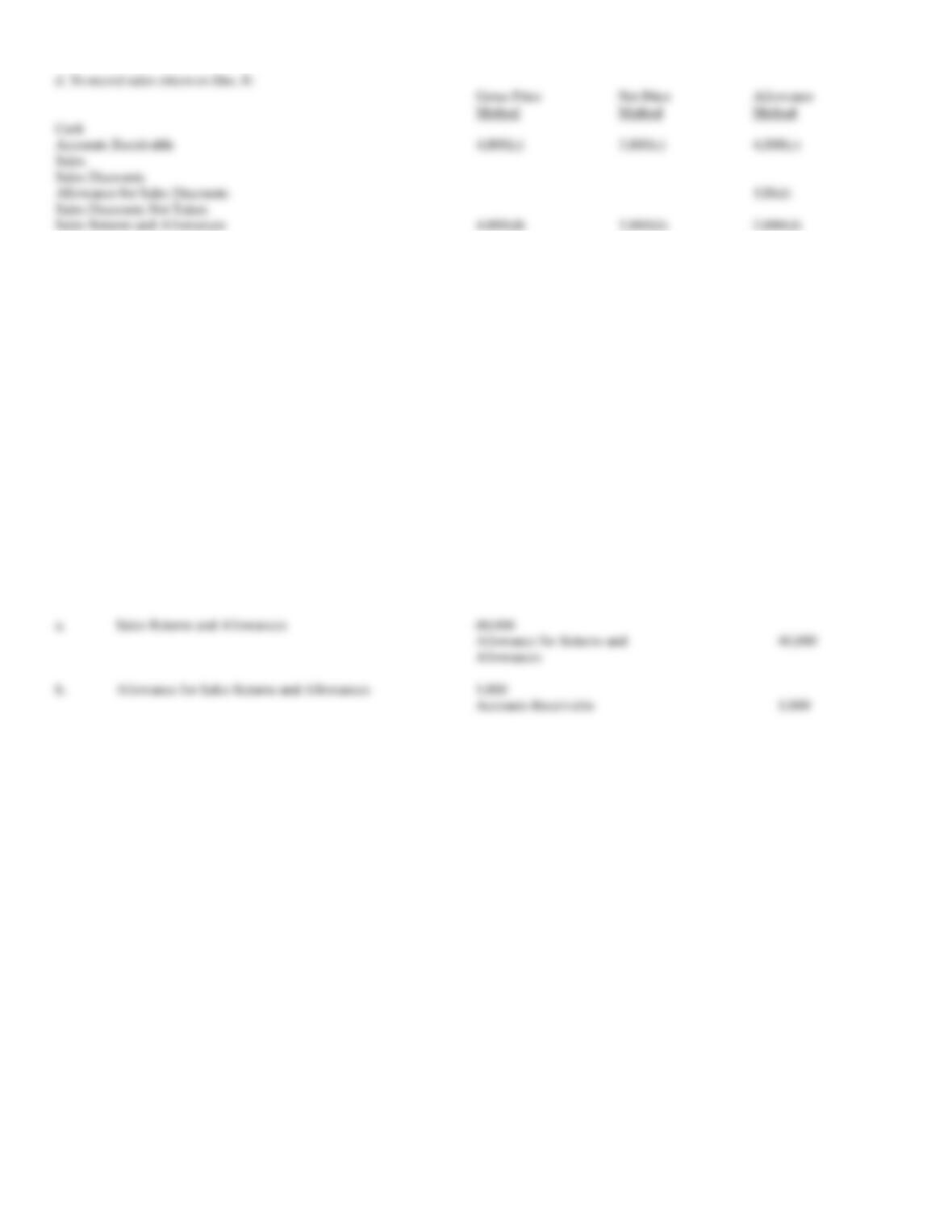
d. To record sales return on Dec. 8:
Gross Price
Net Price
Allowance
Method
Method
Method
Cash
________
________
________
Accounts Receivable
________
________
________
Sales
________
________
________
Sales Discounts
________
________
________
Allowance for Sales Discounts
________
________
________
Sales Discounts Not Taken
________
________
________
Sales Returns and Allowances
________
________
________
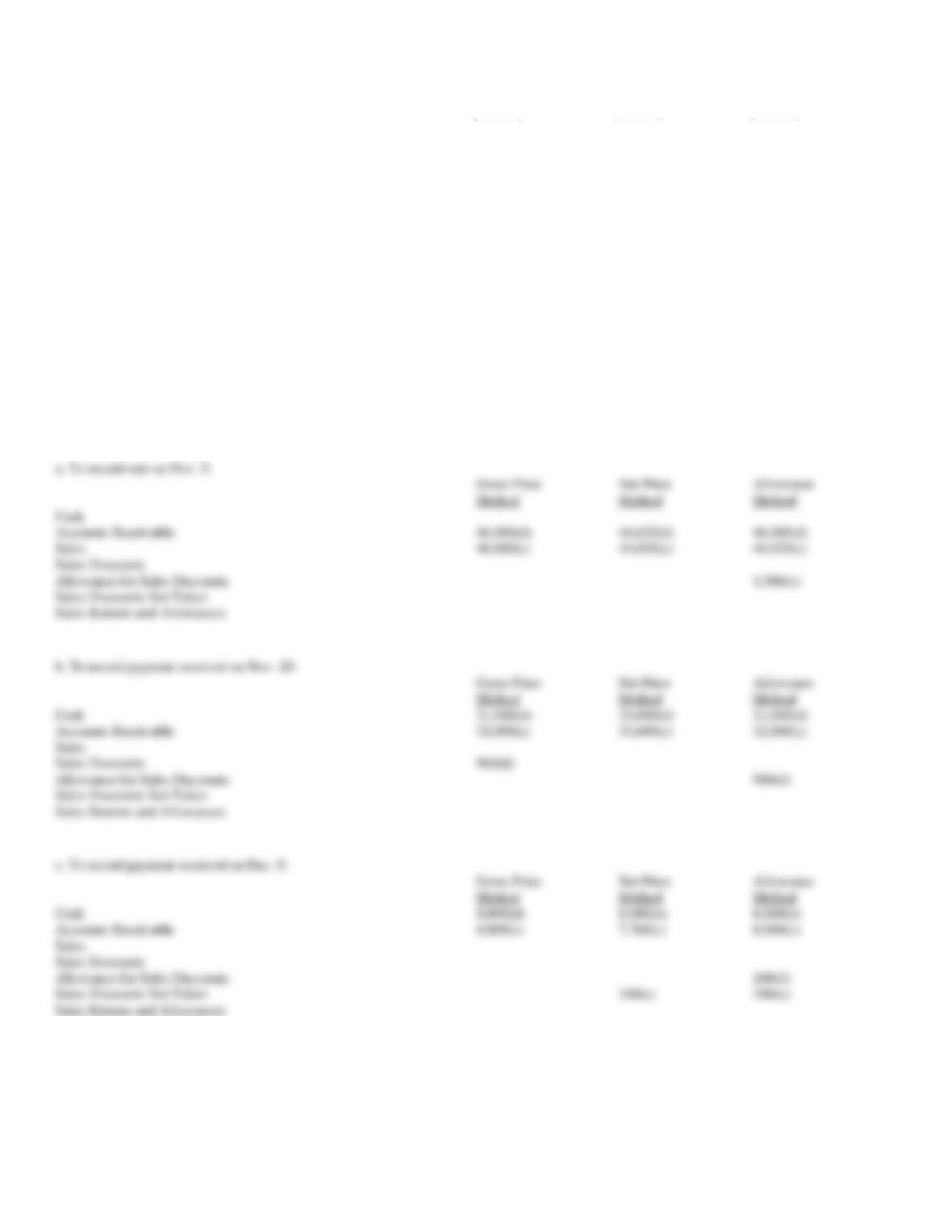
a. To record sale on Nov. 5:
Gross Price
Net Price
Allowance
Method
Method
Method
Cash
Accounts Receivable
46,000(d)
44,620(d)
46,000(d)
Sales
46,000(c)
44,620(c)
44,620(c)
Sales Discounts
Allowance for Sales Discounts
1,380(c)
Sales Discounts Not Taken
Sales Returns and Allowances
b. To record payment received on Nov. 20:
Gross Price
Net Price
Allowance
Method
Method
Method
Cash
31,040(d)
31,040(d)
31,040(d)
Accounts Receivable
32,000(c)
31,040(c)
32,000(c)
Sales
Sales Discounts
960(d)
Allowance for Sales Discounts
960(d)
Sales Discounts Not Taken
Sales Returns and Allowances
c. To record payment received on Dec. 5:
Gross Price
Net Price
Allowance
Method
Method
Method
Cash
8,000(d)
8,000(d)
8,000(d)
Accounts Receivable
8,000(c)
7,760(c)
8,000(c)
Sales
Sales Discounts
Allowance for Sales Discounts
240(d)
Sales Discounts Not Taken
240(c)
240(c)
Sales Returns and Allowances
88. Lockwell Co. records estimated future sales returns and allowances. Total sales amount to $1,600,000, and,
in the past, sales returns and allowances have been 2 1/2% of sales.
Required:
Prepare journal entries to:
a.
Record the estimated sales returns and allowances.
b.
Record the return of $1,000 of defective furniture.
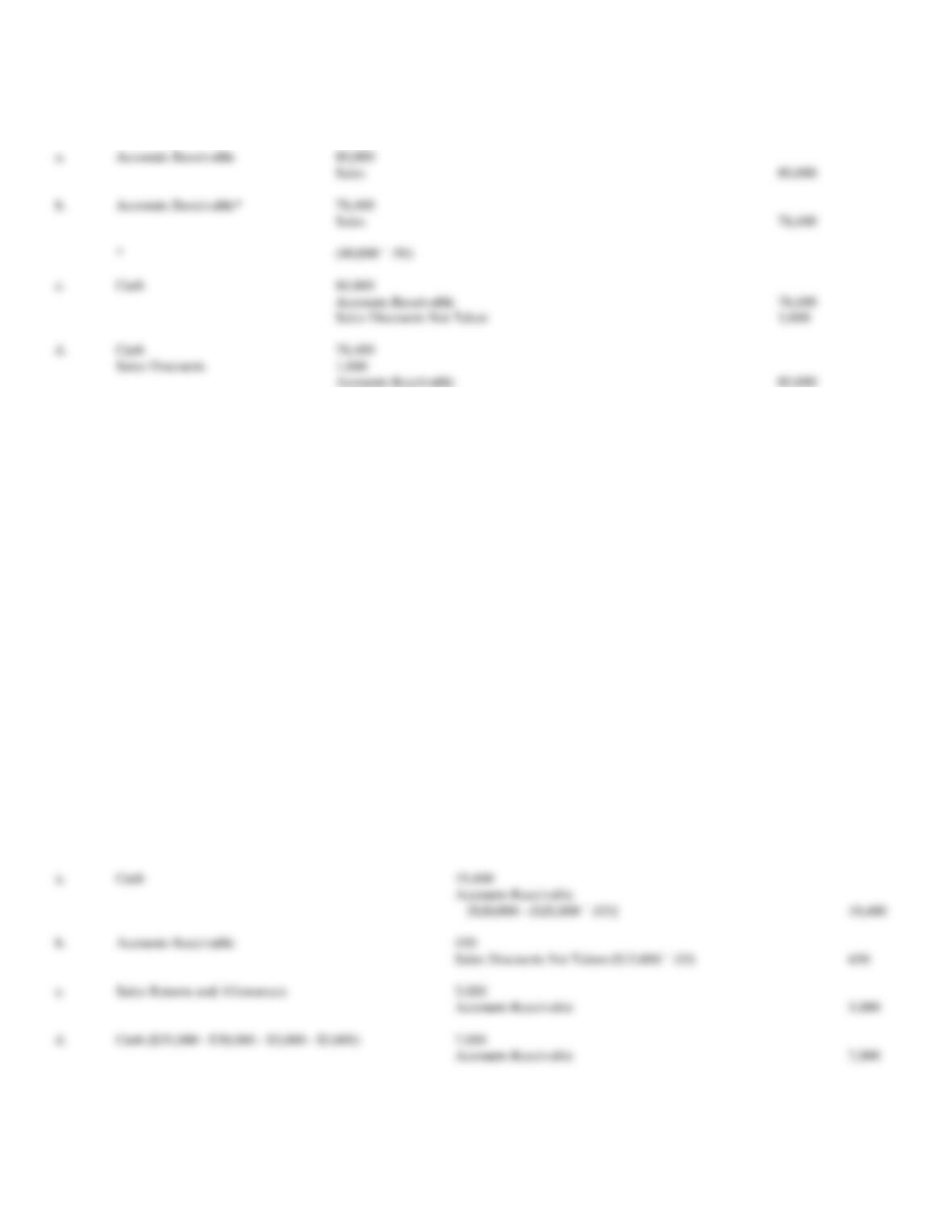
a.
Sales Returns and Allowances
40,000
b.
Allowance for Sales Returns and Allowances
1,000
Accounts Receivable
1,000
89. Shirley, Inc. sold goods for $80,000 with terms of 2/10, n/30 on May 1.
Required:
Prepare journal entries for the following:
a.
The sale, assuming the gross price method is used.
b.
The sale, assuming the net price method is used.
c.
Receipt of payment, assuming collection is made on May 31 and the net price method is used.
d.
Receipt of payment, assuming collection is made on May 9 and the gross price is used.
d. To record sales return on Dec. 8:
Gross Price
Net Price
Allowance
Method
Method
Method
Cash
Accounts Receivable
4,000(c)
3,880(c)
4,000(c)
Sales
Sales Discounts
Allowance for Sales Discounts
120(d)
Sales Discounts Not Taken
Sales Returns and Allowances
4,000(d)
3,880(d)
3,880(d)
90. Guerra Co. sold goods with a list price of $35,000 (gross billings) on terms of 3/10, n/30 on December 14,
2010. Accounts receivable and sales were recorded using the net method. By December 23, Guerra had
collected on $20,000 (gross billings) of these receivables. On January 2, additional collections were made on
sales of $5,000 (gross billings) and sales returns and allowances of $3,000 (gross billings) were granted by
Guerra. On January 15, 2011, all remaining balances were collected.
Required:
Prepare journal entries for the following:
a.
Collections received by December 23, net method of accounting for sales discounts.
b.
Any required adjustment, December 31, net method.
c.
Sales returns and allowances granted on January 2, net method.
d.
Collections received on January 15, net method.
a.
Cash
19,400
Accounts Receivable
[$20,000 – ($20,000 ´ .03)]
b.
Accounts Receivable
450
Sales Discounts Not Taken ($15,000 ´ .03)
c.
Sales Returns and Allowances
3,000
Accounts Receivable
d.
Cash ($35,000 – $20,000 – $5,000 – $3,000)
7,000
Accounts Receivable
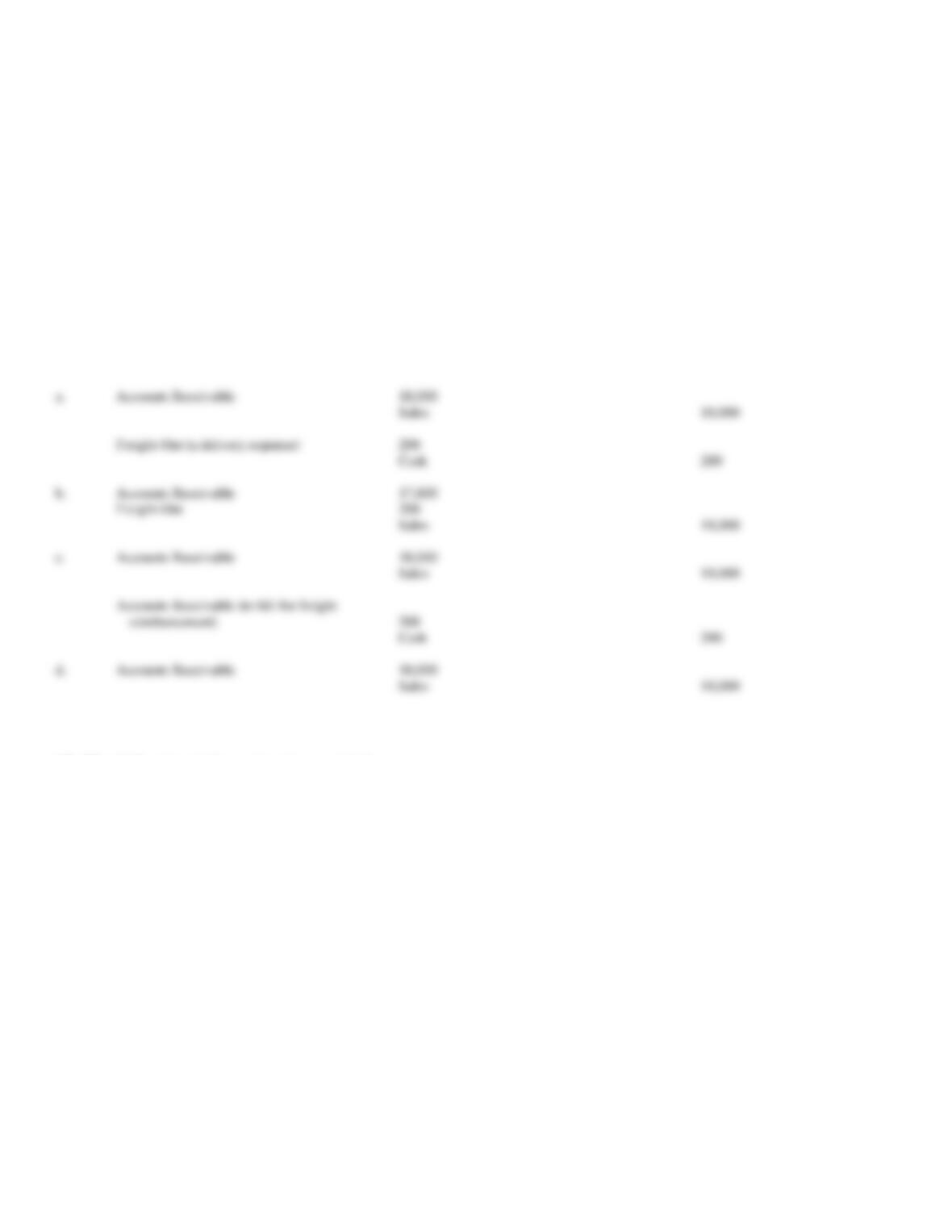
a.
Accounts Receivable
80,000
Sales
80,000
b.
Accounts Receivable*
78,400
Sales
78,400
*
(80,000 ´ .98)
c.
Cash
80,000
Accounts Receivable
78,400
Sales Discounts Not Taken
1,600
d.
Cash
78,400
Sales Discounts
1,600
Accounts Receivable
80,000
91. Closet Collectibles Co. sold goods of $18,000 on credit. Shipping costs were $200.
Required:
Prepare journal entries to record the sale assuming that the shipping terms are:
a.
FOB destination with the seller prepaying the shipping cost.
b.
FOB destination with the buyer paying the freight upon delivery.
c.
FOB shipping point with the seller prepaying the shipping cost.
d.
FOB shipping point with the buyer paying the freight upon delivery.
92. The following information is provided:
Unadjusted balance in Allowance for Doubtful Accounts
$ 100
(debit)
Accounts Receivable, December 31
60,000
Sales Returns and Allowances
3,000
Sales
600,000
Sales Discounts
10,000
Required:
a.
Prepare the adjusting entry if bad debts are estimated to be 0.5% of net sales.
b.
Compute the amount of the adjusting entry if bad debts are estimated to be 3% of ending accounts receivable.
a.
Accounts Receivable
18,000
Sales
18,000
Freight-Out (a delivery expense)
200
Cash
200
b.
Accounts Receivable
17,800
Freight-Out
200
Sales
18,000
c.
Accounts Receivable
18,000
Sales
18,000
Accounts Receivable (to bill for freight
reimbursement)
200
Cash
200
d.
Accounts Receivable
18,000
Sales
18,000
93. Prior to recording the recovery and collection of a $1,200 account receivable previously written off and the
adjusting entry for bad debt expense for the year, the general ledger reflected the following information:
Sales
$1,600,000
Sales Discounts
120,000
Accounts Receivable, December 31
320,000
Sales Returns & Allowances
24,000
Allowance for Doubtful Accounts
660
(debit)
Required:
a.
Compute the amount of the bad debt expense, assuming it is based on 0.8% of net sales.
b.
Prepare the adjusting entry for bad debts assuming it is based on 3.4% of the ending accounts receivable.
b.
Bad Debt Expense*
10,340
Allowance for Doubtful Accounts
*
Accts. Rec. = $320,000 + $1,200 (recovery) – $1,200 (collection) = $320,000
Est. Allow. Bal. ($320,000 ´ .034)
$10,880
Allow. Acct. ($1,200 – $660)
(540)
Bad Debt Expense
$10,340
Allowance for Doubtful Accounts
[0.005 ($600,000 – $3,000 – $10,000)]
2,935
94. Zhang, Inc. recorded credit sales of $750,000 during 2010. At December 31, 2010, the company had a
$150,000 debit balance in Accounts Receivable and a $3,000 credit balance in Allowance for Doubtful
Accounts.
Required:
a.
Prepare the necessary adjusting journal entry at December 31 to record the estimated bad debt expense, assuming that bad debts are
estimated at 2% of credit sales.
b.
Prepare the necessary adjusting journal entry at December 31 to record the estimated bad debt expense, assuming that bad debts are
estimated at 9% of outstanding accounts receivable.
c.
Assume that a customer whose $1,300 account had been written off earlier in the year now pays the balance owed in full. Prepare the
journal entry, or entries, to record the collection of this customer’s account.
95. On December 31, the Tom, Inc. general ledger contained the following balances prior to write-offs and
adjustments:
Trade Accounts Receivable
$ 615,300
Allowance for Doubtful Accounts
5,800
(credit)
Net Credit Sales
1,529,000
Before completing an aging analysis to determine the estimated amount uncollectible, Tom decided to write off $5,500 of an account past due over
360 days.
Aging of the accounts receivable balance after the write-off on December 31 indicated the following:
Estimated
Percentage
Age
Amount
Uncollectible
Under 30 days
$338,800
1.5%
30-90 days
156,000
3.0%
91-180 days
86,000
7.0%
181-360 days
24,000
20.0%
Over 360 days
5,000
60.0%
$609,800
Bad Debt Expense ($750,000 ´ 0.02)
15,000
Allowance for Doubtful Accounts
15,000
b.
Bad Debt Expense [($150,000 ´ 0.09) – $3,000]
10,500
Allowance for Doubtful Accounts
10,500
Accounts Receivable
1,300
Allowance for Doubtful Accounts
1,300
Cash
1,300
Accounts Receivable
1,300
Required:
a.
Prepare the necessary journal entry to record the write-off.
b.
Prepare the adjusting journal entry at December 31 to record Tom, Inc.’s estimated bad debts assuming that the company uses the aging
of accounts receivable method.
c.
What is the net realizable value of accounts receivable on the December 31 balance sheet?
96. Fisher Co. factored $40,000 of its accounts receivable to Wilkins Finance Co. Wilkins Finance advanced
85% of the factored receivables and charged a 9% commission on the gross amount of the receivables. All
conditions for a sale have been met.
Required:
Prepare the journal entries necessary to record the following:
a.
The sale of the receivables.
b.
Sales Returns and Allowances of $1,200 on a factored account.
c.
The conclusion of the sale agreement.
a.
Allowance for Doubtful Accounts
5,500
Accounts Receivable
5,500
b.
0.015 ´ $338,800 =
$ 5,082
0.03 ´ $156,000 =
4,680
0.07 ´ $86,000 =
6,020
0.20 ´ $24,000 =
4,800
0.60 ´ $5,000 =
3,000
$23,582
Balance in allowance account
(300)
$23,282
Bad Debt Expense
23,282
Allowance for Doubtful Accounts
23,282
c.
Accounts receivable
$609,800
Less allowance for doubtful accounts
(23,582)
Net accounts receivable
$586,218
97. Pollock Supply Co. makes American Express credit card sales of $66,000. There is a 3% collection fee.
Required:
Accounts Receivable
64,020
Sales
66,000
98. In order to resolve its cash flow problems, Townsend Company assigned $120,000 of its accounts
receivable to Household Finance Company on August 1. Townsend received 85% of the assigned accounts
receivable less a service charge of 2% of the cash received. Townsend was also charged 13% interest annually
on the outstanding loan balance. By August 31, Townsend had collected $76,000, and remitted this amount plus
the interest to date on August 31 to Household Finance.
Required:
a.
Prepare journal entries to record the above assignment transactions on Townsend’s books.
b.
If Townsend collected an additional $20,000 on outstanding accounts and remitted this to Household Finance on September 30, how
much additional interest must be paid on September 30?
a.
Cash [($40,000 ´ .85) – $3,600]
30,400
Receivable from Factor ($40,000 ´ .15)
6,000
Accounts Receivable
40,000
Sales Returns and Allowances
1,200
c.
Cash
4,800
Receivable from Factor
4,800
99. On December 1, the Lennon Company sold $155,000 of its accounts receivable to Friendly Finance
Company for 75% of their value. A 10% commission on the gross value of the factored accounts was charged,
and the factoring was without recourse.
Required:
a.
Prepare the journal entry to record the factoring.
Briefly discuss how the factored accounts are disclosed in the financial statements.
a.
Cash [($155,000 ´ 0.75) – $15,500]
100,750
Receivable from Factor ($155,000 ´ 0.25)
38,750
Accounts Receivable
155,000
100. Cappleman Supplies frequently assigns its accounts receivable in order to obtain immediate cash.
Required:
Prepare journal entries for the following:
a.
The company assigned $100,000 of accounts receivable, receiving a 92% advance less service charges of $1,800.
b.
The company collected $30,000 of these receivables and remitted the collection to the finance company along with one month’s interest
at 15%.
a.
Cash [($120,000 ´ 0.85) –
(0.02 ´ $120,000 ´ 0.85)]
99,960
Note Payable ($120,000 ´ 0.85)
102,000
Accounts Receivable Assigned
120,000
Cash
76,000
Accounts Receivable Assigned
76,000
Interest Expense ($102,000 ´ 0.13 ´ 1/12)
1,105
Cash
77,105
101. Prepare the journal entries for the following transactions:
a.
Sold $150,000 of goods to Farley Co. on account.
b.
Collected $50,000 from Farley Co.
c.
Accepted a $100,000, one-year, 10% note from Farley Co. for the amount remaining on the account.
d.
After 60 days, discounted the note from Farley Co. at First National Bank at a 12% interest rate.
Required:
Prepare the journal entries for each transaction.
a.
Accounts Receivable, Farley
150,000
Sales
150,000
b.
Cash
50,000
Accounts Receivable, Farley
50,000
c.
Notes Receivable, Farley
100,000
Accounts Receivable, Farley
100,000
d.
Cash
99,000
Loss from Discounting Note
2,667
Notes Receivable
100,000
Interest Receivable
1,667
Computations for answer d:
Face value of note
$100,000
Interest to maturity ($100,000 ´ 10% ´ 360/360)
10,000
Maturity value of note
$110,000
Discount ($110,000 ´ 12% ´ 300/360)
(11,000)
Proceeds received
$ 99,000
Accrued interest receivable
Book value of note
(101,667)
a.
Accounts Receivable Assigned
100,000
Accounts Receivable
100,000
Cash (0.92 ´ $100,000) – $1,800
90,200
Assignment Service Charge Expense
1,800
Note Payable
92,000
b.
Cash
30,000
Note Payable
30,000
Interest Expense ($92,000 ´ 0.15 ´ 1/12)
1,150
Cash
31,150
102. During 2010, Dawson’s first year of operations, the following transactions occurred:
·
Credit sales of $2,000,000.
·
Collections on account of $1,700,000.
·
Accounts receivable written off during the year, $5,000.
·
Estimated uncollectible accounts, $8,000.
·
Accepted a $10,000, one-year, 12% note receivable on June 30.
Required:
Prepare as appropriate:
a.
The receivables portion of Dawson’s first year operation’s balance sheet.
b.
Notes to the financial statements for receivables.
103. Stewart Ski Company engaged in the following transactions:
a.
A 120-day note receivable for $5,000 with interest at 12% was accepted in settlement of a customer’s unpaid accounts receivable
balance.
b.
Thirty days later, Stewart Ski Company discounted the note at a local bank. The bank’s discount percentage was 15%. The company
records its contingent liability on discounted notes directly in an account.
c.
At the maturity date of the note, the maker failed to pay the note. The bank required Stewart Ski Company to pay the amount due plus a
protest fee of $75.
Balance sheet disclosures:
Accounts receivable, net
$247,000*
Notes receivable
10,000
Interest on notes receivable
b.
Notes to the financial statements:
Trade receivables
$250,000
Allowance, beginning of the year
Charged to expense
8,000
Deductions
(5,000)
Allowance, end of the year
$ 3,000
Net receivables
*$247,000