81
174) On February 14, 2018, Prime Company sold 50 air-conditioning units to L&P Heating and
Cooling. The units list for $700 each, but L&P was granted a 30% trade discount. All of Prime’s
sales are subject to terms 2/10, n/30. Prime uses the net method of accounting for sales discounts.
Required:
1. Prepare the journal entry to record the sale.
2. Prepare the journal entry to record receipt of the payment, assuming the correct amount
was received on February 22, 2018.
3. Prepare the journal entry to record receipt of the payment, assuming the correct amount
was received on March 10, 2018.
175) Beethoven Music Company started business in March 2018. Sales for its first year were
$400,000. Beethoven priced its merchandise to yield a 45% gross profit based on sales dollars.
Industry statistics suggest that 10% of the merchandise sold to customers will be returned.
Beethoven estimated its sales returns based on the industry average. During the year, customers
returned $30,000 in sales. Beethoven uses a perpetual inventory system.
Required:
Prepare summary journal entries to record (1) sales, (2) sales returns, and (3) the year-end
adjusting entry for estimated sales returns. Assume that cash has not yet been collected for
merchandise that could yet be returned.
83
Use this information to answer the following questions:
The following note disclosure is taken from the 2018 annual report to shareholders of Winchester
International Corporation.
NOTE 5: ALLOWANCE FOR LOAN LOSSES
The allowance for loan loss is maintained at a level to absorb probable losses inherent in the loan
portfolio. This allowance is increased by provisions charged to operating expense and by
recoveries on loans previously charged off, and reduced by charge-offs on loans.
The following is a summary of the changes in the allowances for loan losses for three years:
At December 31,
(In thousands) 2018 2017 2016
Balance at beginning of year $ 91,809 73,658 66,201
Allowances from purchase transactions 1,851 10,980 3,647
Provisions charged to operations 14,400 11,800 9,000
Subtotal 108,060 96,438 78,848
Charge-offs (11,575) (6,816) (7,406)
Recoveries 1,822 2,187 2,216
Net charge-offs (9,753) (4,629) (5,190)
Balance at end of year $ 98,307 91,809 73,658
Winchester also reported (in thousands) in its comparative balance sheet that it held Loans
receivable, net, of $6,869,11 and $6,819,209 at December 31, 2018, and December 31, 2017,
respectively.
176) What kind of account is the Allowance for Loan Losses in Winchester’s financial
statements?
84
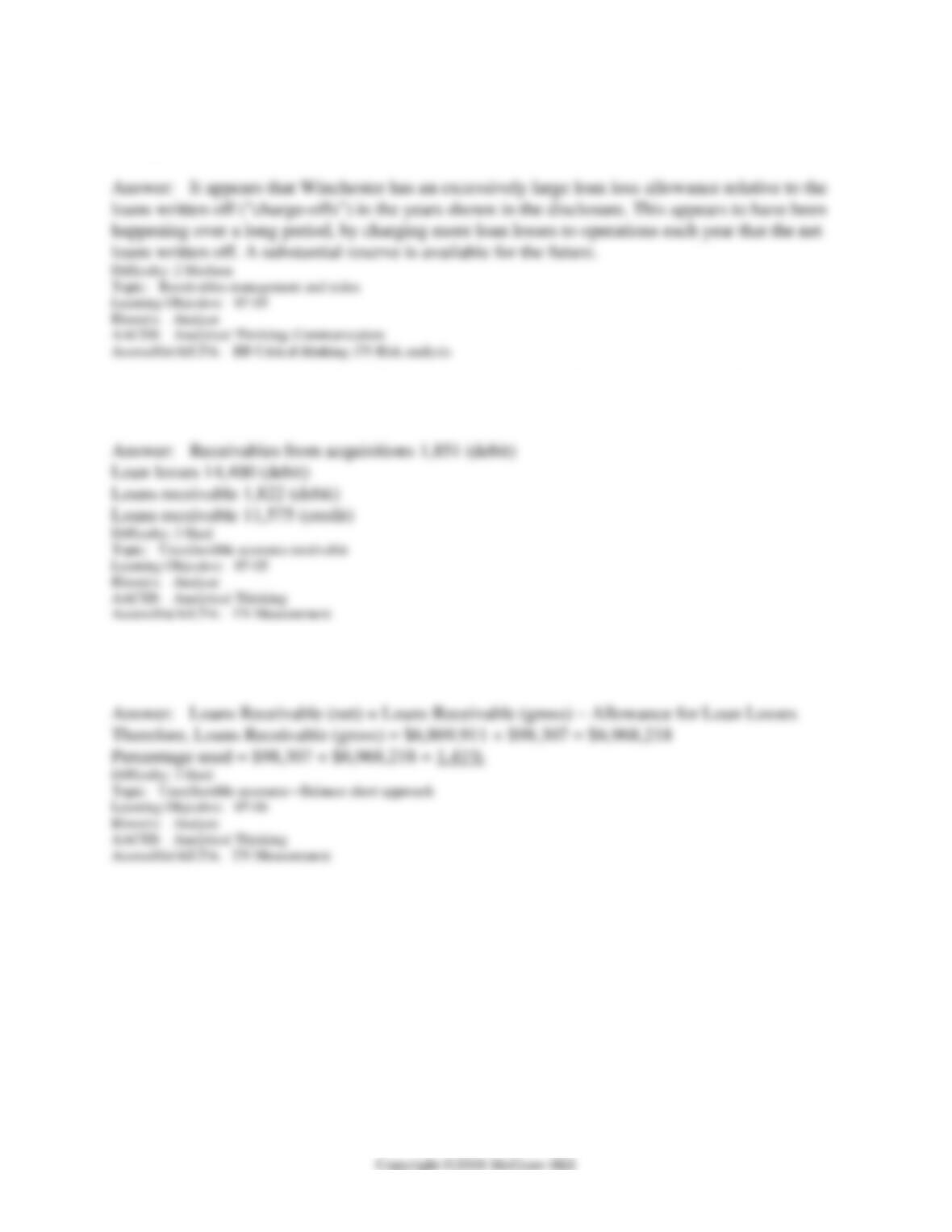
177) Using a T-account for the Allowance for Loan Losses, identify the changes in the account
during 2018.
178) How might a company with loan receivables like Winchester be able to manage earnings in
applying generally accepted accounting principles?
85
179) Is there any evidence in Winchester’s disclosures above that are consistent with earnings
management?
180) For each posted entry in the Allowance account during 2018, indicate the remaining
entry(ies) in other accounts.
181) If Winchester is using the balance sheet approach to determining loan losses and the
Allowance account balance, what percentage did it use in 2018?
86
Use this information to answer the following questions:
The following information is taken from the 2015 annual report to shareholders of Hewlett-
Packard (HP) Co.
For Fiscal 2015 For Fiscal 2014
Provision for doubtful accounts $ 46 million $25 million
At Fiscal Year-end 2015 At Fiscal Year-end 2014
Accounts receivable, net 13,363 million 13,832 million
Accounts receivable, gross 13,552 million 14,064 million
182) What is the balance in HP’s allowance for doubtful accounts at the end of the fiscal years
2015 and 2014, respectively?
Answer:
Allowance for doubtful accounts = Accounts receivable (gross) – accounts receivable (net) =
$13,552 million – 13,363 million = $189 million in 2015; and
$14,064 million – 13,832 million = $232 million in 2014.
Difficulty: 2 Medium
Topic: Uncollectible accounts receivable
Learning Objective: 07-05
Bloom’s: Apply
AACSB: Knowledge Application
Accessible/AICPA: FN Measurement
183) What kind of account is the provision for doubtful accounts in HP’s financial statements?
87
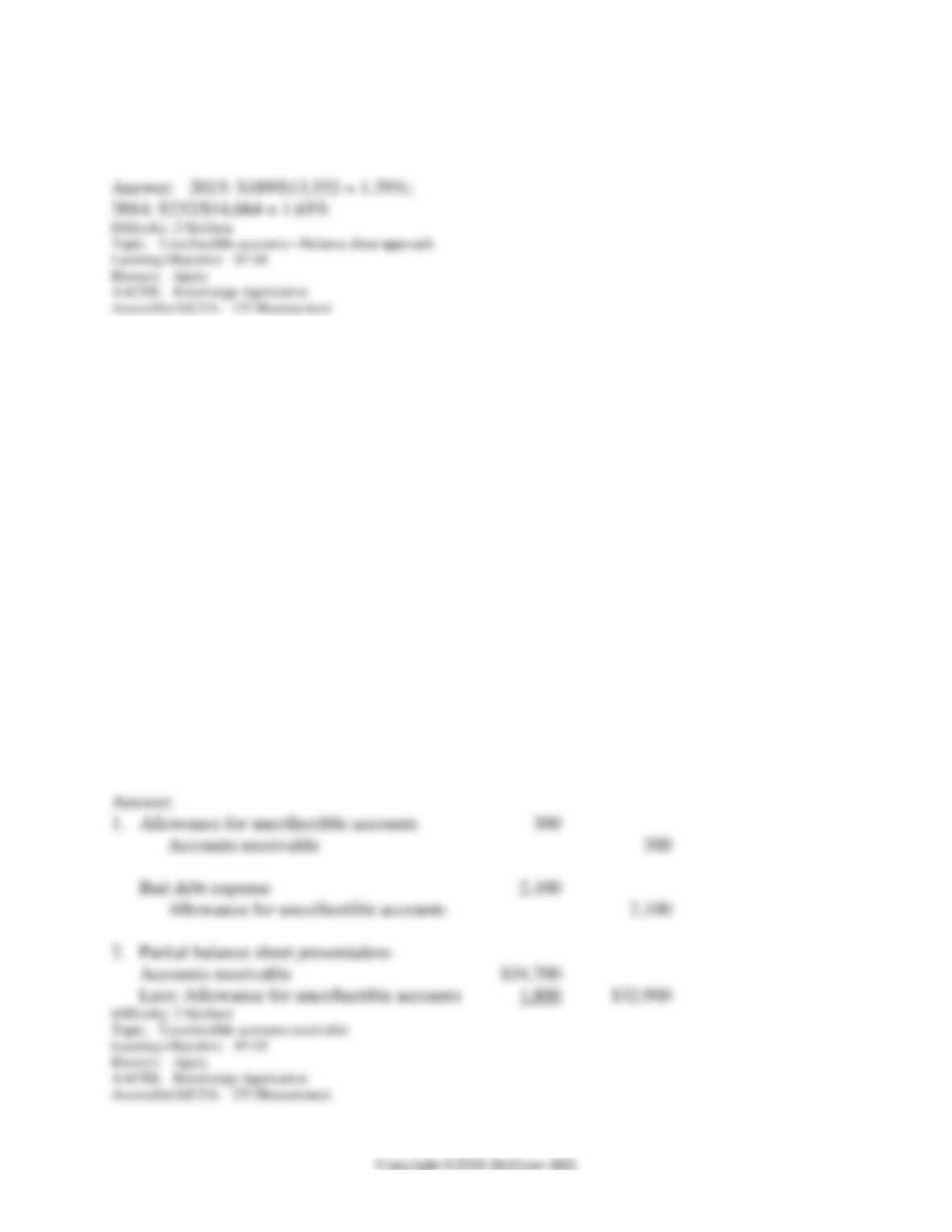
184) Using a T-account for the allowance for doubtful accounts, identify the changes in the
account during fiscal year 2015.
185) How could a company with receivables like HP be able to manage earnings in applying
generally accepted accounting principles?
186) Is there any evidence in HP’s disclosures above that are consistent with earnings
management?
88
187) If HP is using the balance sheet approach to determining bad debt expense, what percentage
of year-end gross receivables did it use in 2015 and 2014, respectively?
188) For each posted entry in the allowance account during 2015, prepare the journal entry.
Answer:
Provision for doubtful accounts (bad debt expense) 46
Allowance of doubtful accounts 46
Allowance for doubtful accounts 89
Accounts receivable 89
Difficulty: 2 Medium
Topic: Uncollectible accounts receivable
Learning Objective: 07-05
Bloom’s: Apply
AACSB: Knowledge Application
Accessible/AICPA: FN Measurement
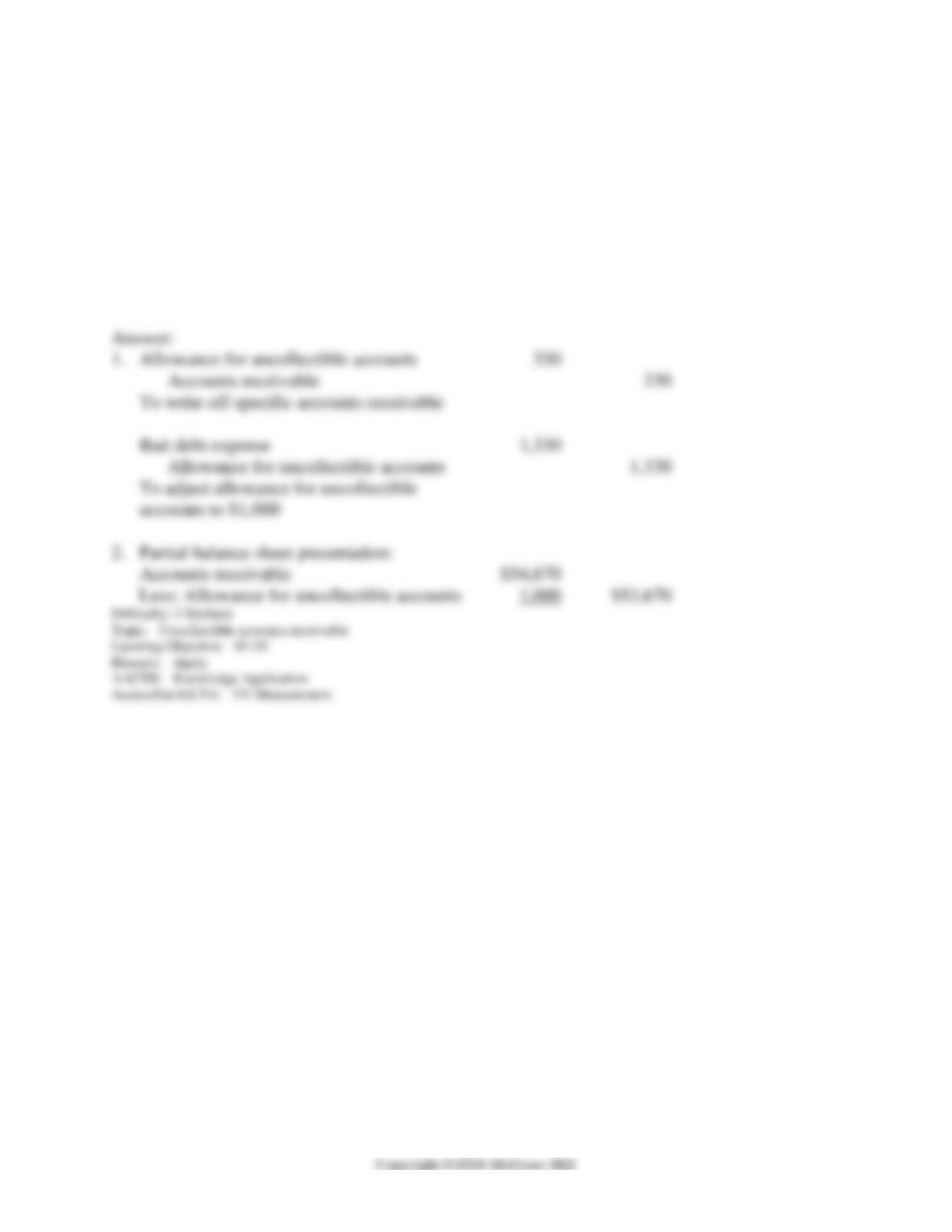
189) During Burns Company’s first year of operations, credit sales totaled $140,000 and
collections on credit sales totaled $105,000. Burns estimates that bad debt losses will be 1.5% of
credit sales. By year-end, Burns had written off $300 of specific accounts as uncollectible.
Required:
1. Prepare all appropriate journal entries relative to uncollectible accounts and bad debt
expense.
2. Show the year-end balance sheet presentation for accounts receivable.
89
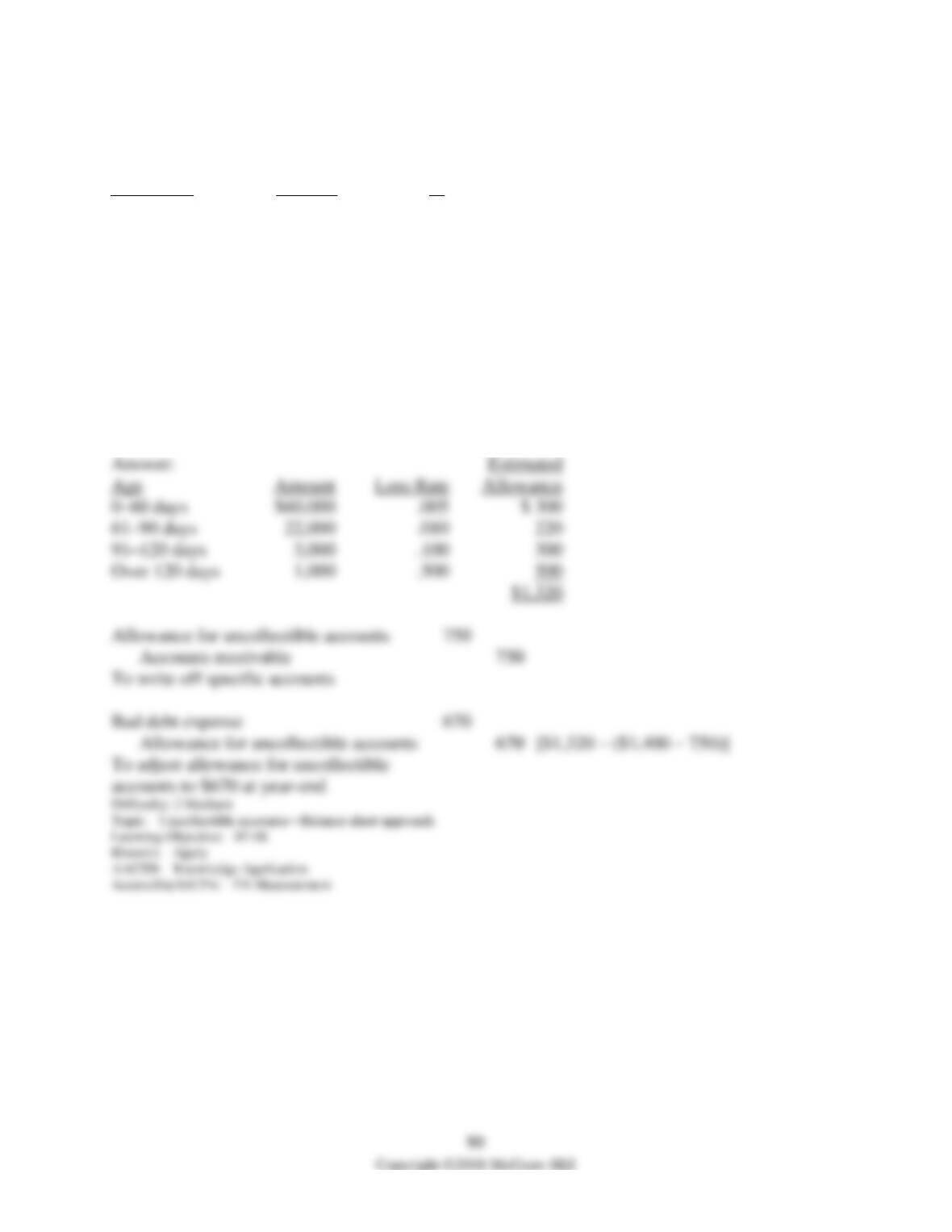
190) During Bricker Company’s first year of operations, credit sales totaled $200,000 and
collections on credit sales totaled $145,000. Bricker estimates that $1,000 of its ending accounts
receivable balance will not be collected. By year-end, Bricker had written off $330 of specific
accounts as uncollectible.
Required:
1. Prepare all appropriate journal entries relative to uncollectible accounts and bad debt
expense.
2. Show the year-end balance sheet presentation for accounts receivable.
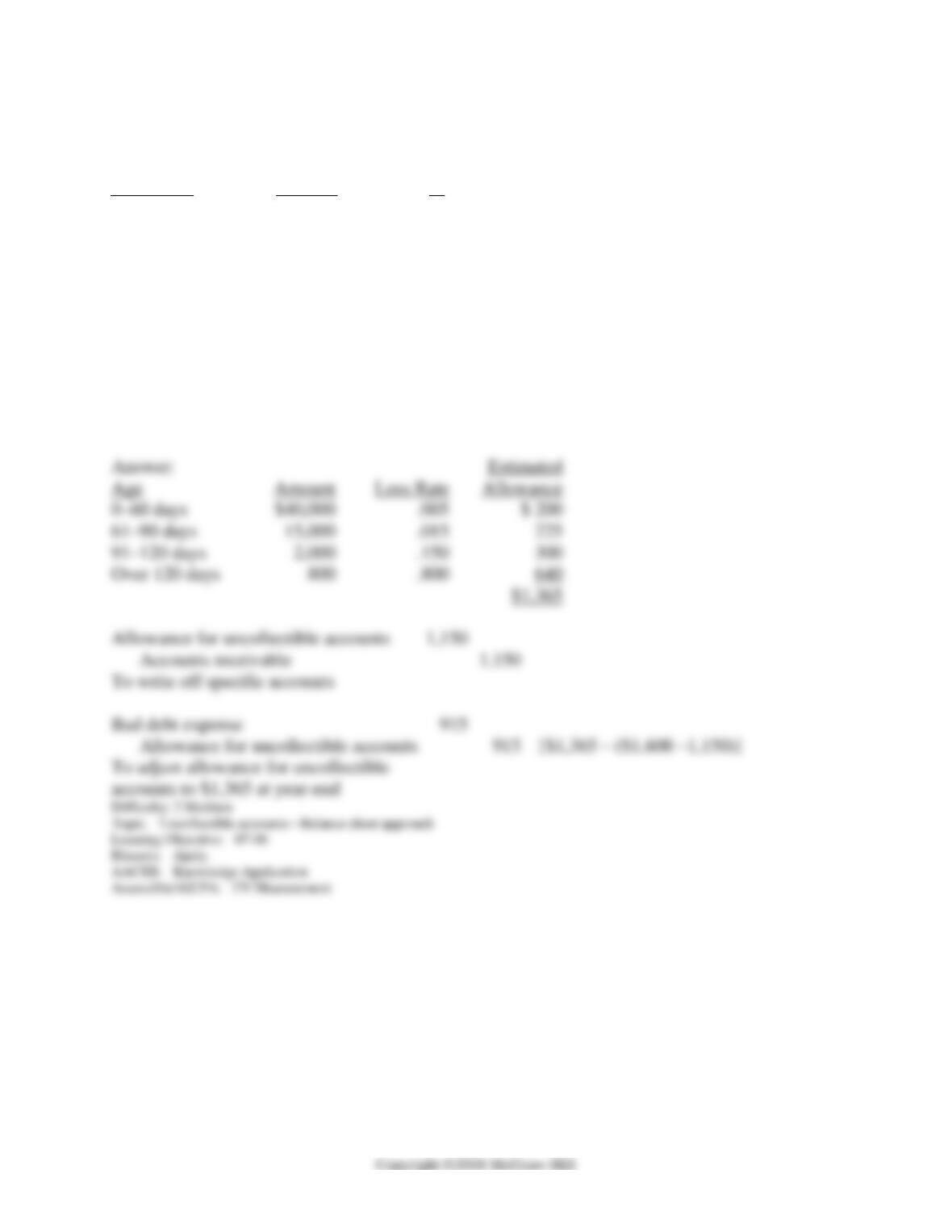
191) A summary of Klugman Company’s December 31, 2018, accounts receivable aging
schedule is presented below along with the estimated percent uncollectible for each age group:
Age Group Amount %
0–60 days $60,000 .5
61–90 days 22,000 1.0
91–120 days 3,000 10.0
Over 120 days 1,000 50.0
The allowance for uncollectible accounts had a balance of $1,400 on January 1, 2018. During the
year, bad debts of $750 were written off.
Required:
Prepare all journal entries for 2018 with respect to bad debts and the allowance for uncollectible
accounts.
91
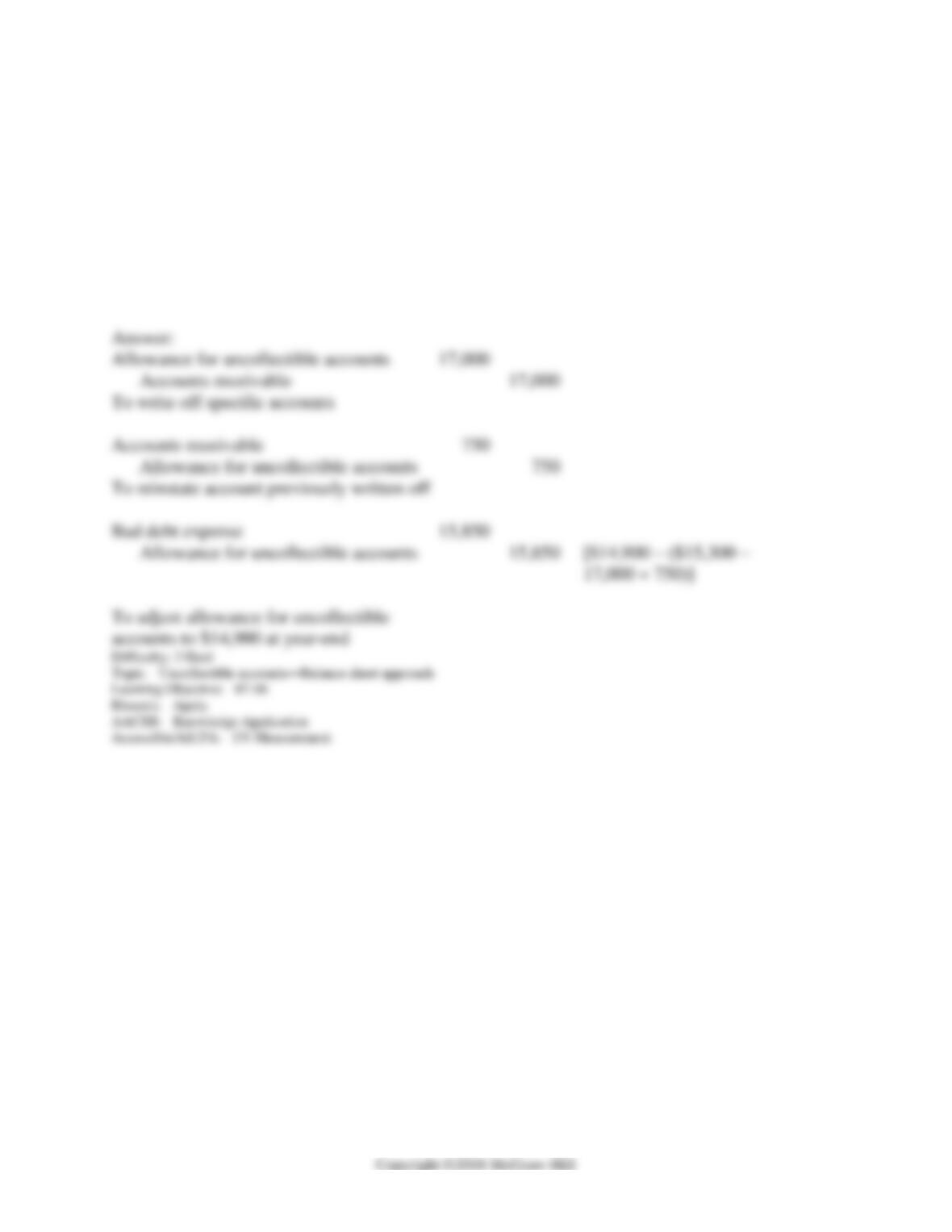
192) A summary of London Fashion’s December 31, 2018, accounts receivable aging schedule is
presented below along with the estimated percent uncollectible for each age group:
Age Group Amount %
0–60 days $40,000 .5
61–90 days 15,000 1.5
91–120 days 2,000 15.0
Over 120 days 800 80.0
The allowance for uncollectible accounts had a balance of $1,600 at January 1, 2018. During the
year bad debts of $1,150 were written off.
Required:
Prepare all 2018 journal entries with respect to bad debts and the allowance for uncollectible
accounts.
92
193) On December 31, 2017, Central Freight reported an allowance for uncollectible accounts of
$15,300. During 2018, Central wrote off $17,000 in accounts receivable. Included in the write-
off was Roskoff Corp.’s account in the amount of $750. Roskoff subsequently paid this balance.
At December 31, 2018, an analysis of the accounts receivable aging schedule indicated the need
for an allowance for uncollectible accounts of $14,900.
Required:
Prepare all implied journal entries relative to bad debt expense and the allowance for
uncollectible accounts.

93
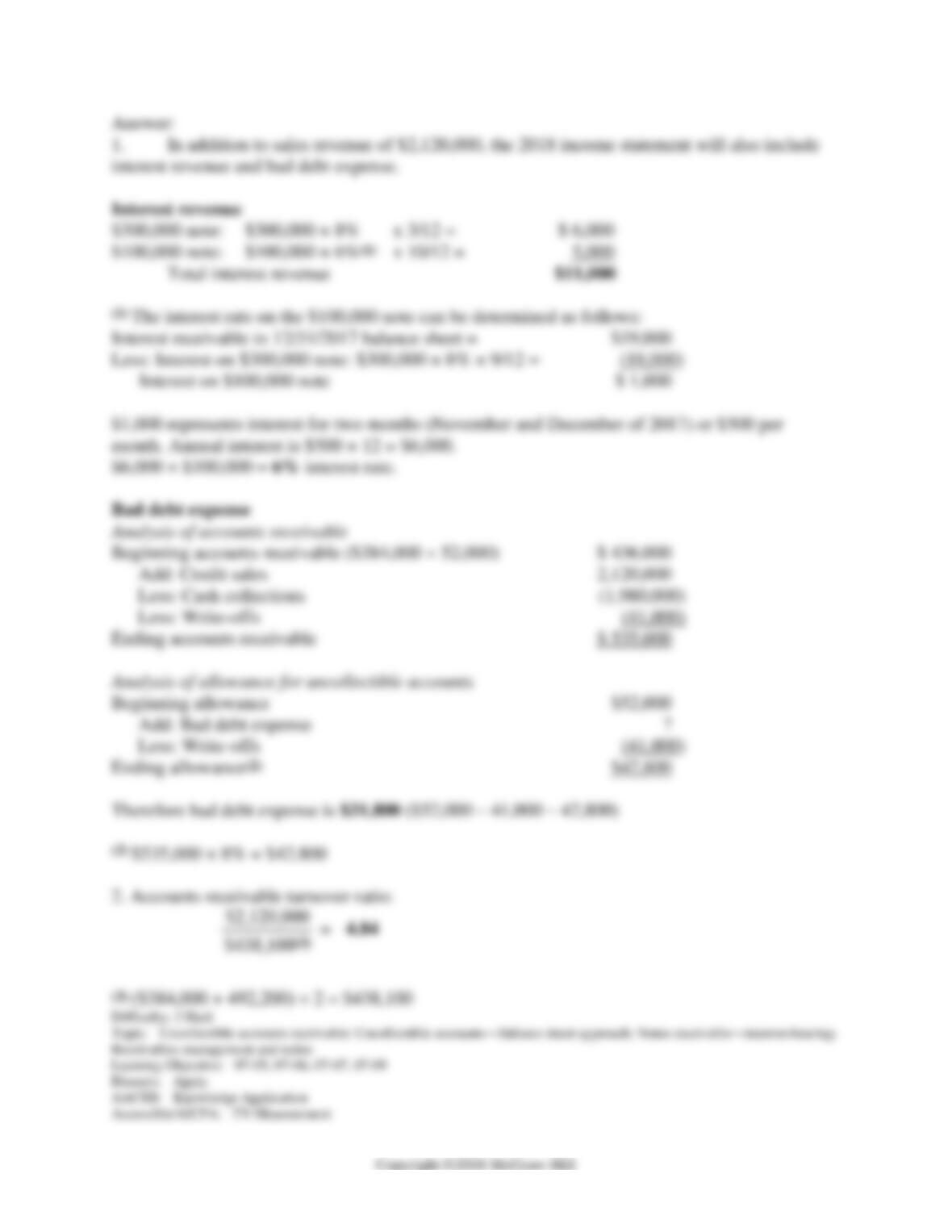
194) Cordova, Inc., reported the following receivables in its December 31, 2017, year-end
balance sheet:
Current assets:
Accounts receivable, net of $52,000 in allowance for
uncollectible accounts $384,000
Interest receivable 19,000
Notes receivable 400,000
Additional information:
1. The notes receivable account consists of two notes, a $100,000 note and a $300,000 note.
The $100,000 note is dated October 31, 2017, with principal and interest payable on October 31,
2018. The $300,000 note is dated March 31, 2017, with principal and 8% interest payable on
March 31, 2018.
2. During 2018, sales revenue totaled $2,120,000, $1,980,000 cash was collected from
customers, and $41,000 in accounts receivable were written off. All sales are made on a credit
basis. Bad debt expense is recorded at year-end by adjusting the allowance account to an amount
equal to 8% of year-end gross accounts receivable.
Required:
1. In addition to sales revenue, what revenue and expense amounts related to receivables
will appear in Cordova’s 2018 income statement?
2. Calculate the receivables turnover ratio for 2018.
94
95
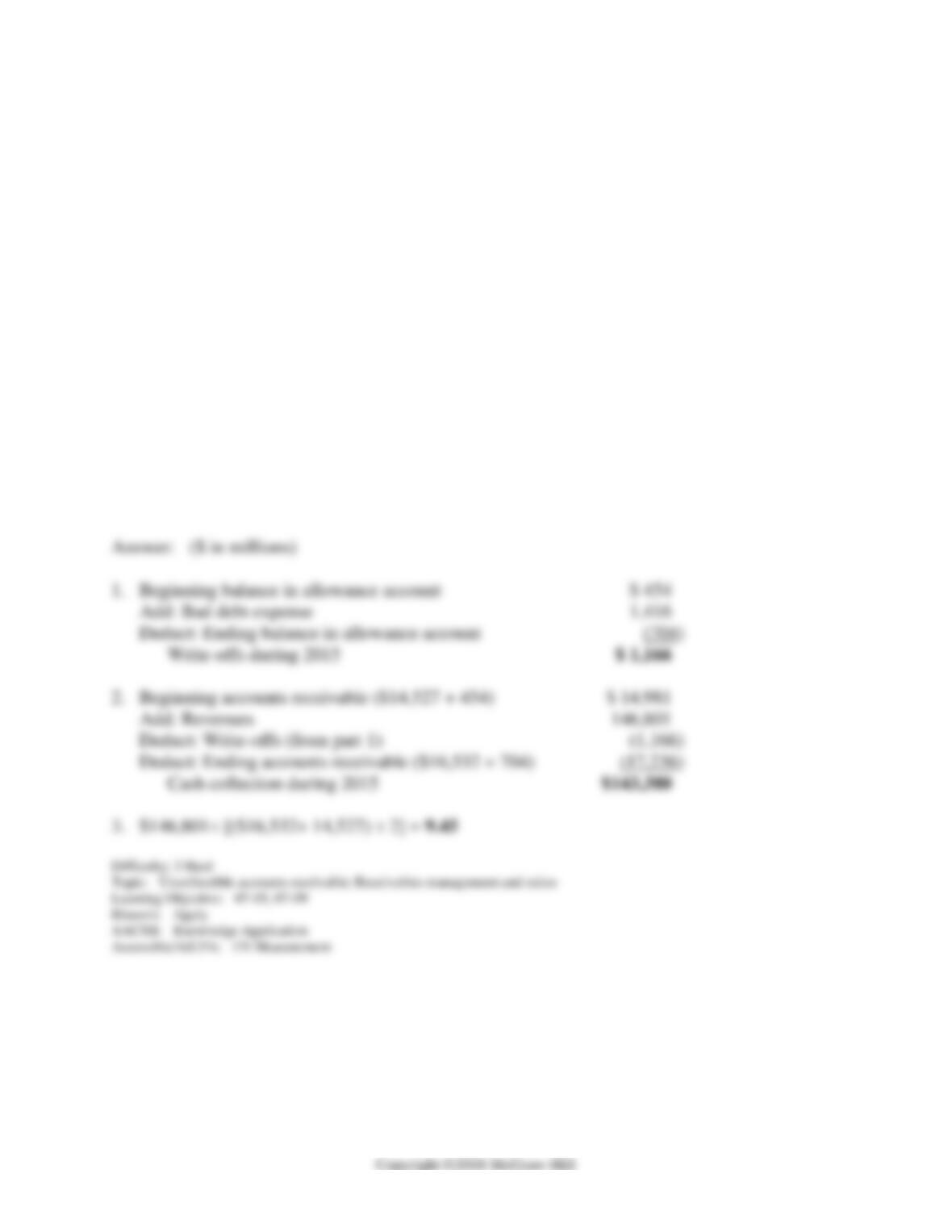
195) AT&T’s financial statements for the 2015 and 2014 fiscal years contained the following
information:
Balance Sheets ($ in millions) 2015 2014
Current assets:
Accounts receivable, net of allowances for
doubtful accounts of $704 and $454 $16,532 $14,527
Income Statements ($ in millions) 2015 2014
Revenues $146,801 $132,447
In addition, the statement of cash flows disclosed bad debt expense of $1,416 million in 2015
and $1,032 million in 2014.
Required:
1. Determine the amount of actual bad debt write-offs made during 2015.
2. Determine the amount of cash collected from customers during 2015.
3. Compute the receivables turnover ratio for 2015.
96
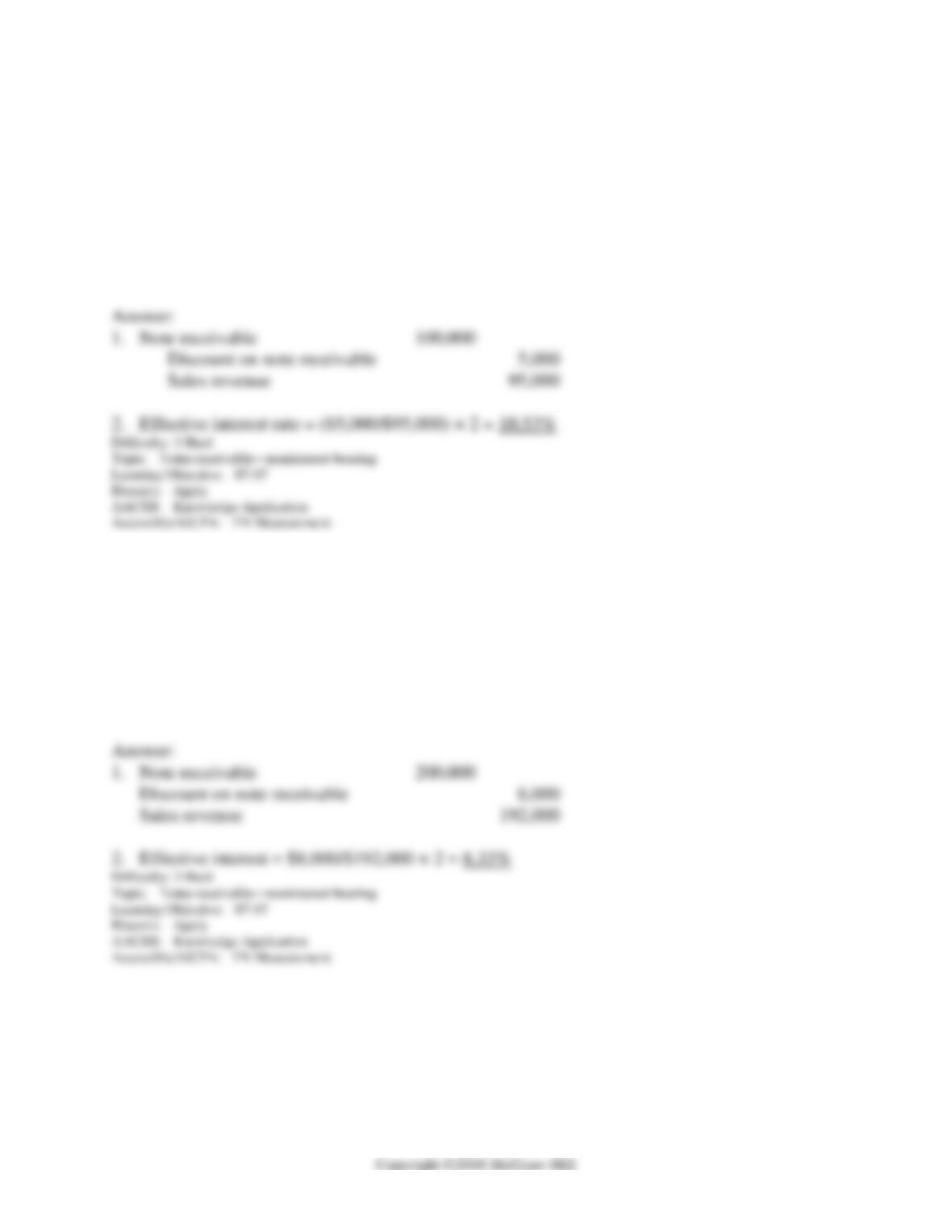
196) Tokyo Imports sold merchandise to Tall-Mart, receiving a six-month, noninterest-bearing
note for $100,000. The implied discount rate on the note is 10% per annum. Tokyo uses a
periodic inventory system, and views the financing component of this transaction to be
significant.
Required:
1. Prepare the journal entry to record the sale.
2. Compute the effective rate of interest.
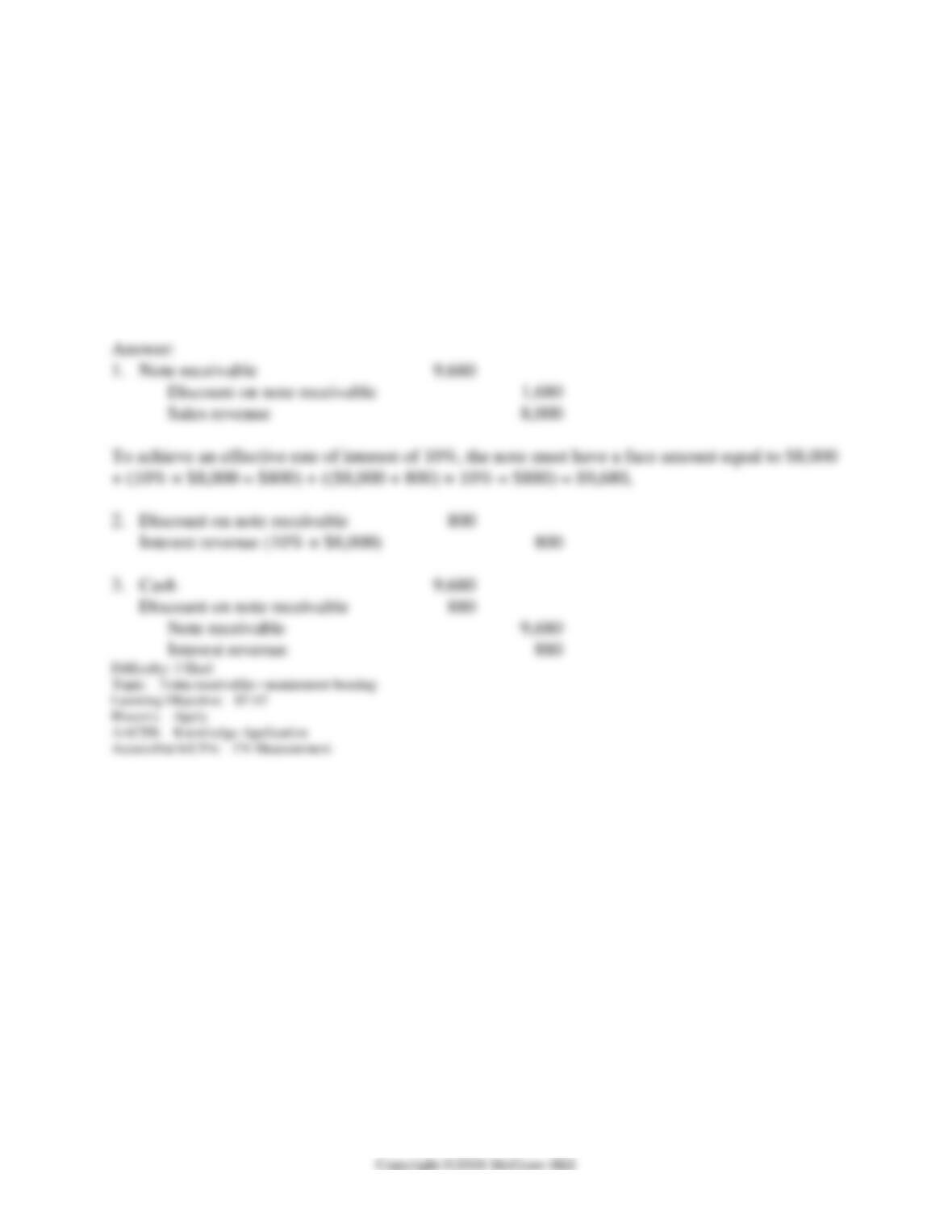
197) Montana Minerals sold coal to Beta Electric, receiving a six-month, noninterest-bearing
note for $200,000. The implied discount rate on the note is 8% per annum. Montana uses a
periodic inventory system, and views the financing component of this transaction to be
significant.
Required:
1. Prepare the journal entry to record the sale.
2. Compute the effective rate of interest.
97
198) On January 1, 2018, Happy Tubs sold a hot tub to Monica, receiving a two-month,
noninterest-bearing note in exchange for a hot tub that normally sells for $8,000. The note is for
an amount that achieves an effective interest rate of 10% per year, and Happy Tubs views the
financing component of this transaction to be significant.
Required:
1. Prepare the journal entry to record the sale.
2. Prepare any adjusting entry necessary on December 31, 2018.
3. Prepare any adjusting entry necessary on December 31, 2019.