Cash and Receivables
7 – 39
DERIVATIONS — Computational (cont.)
Test Bank for Intermediate Accounting, Seventeenth Edition
7 – 40
DERIVATIONS — Computational (cont.)
No. Answer Derivation
Cash and Receivables
7 – 41
DERIVATIONS — CPA Adapted
No. Answer Derivation
BRIEF EXERCISES
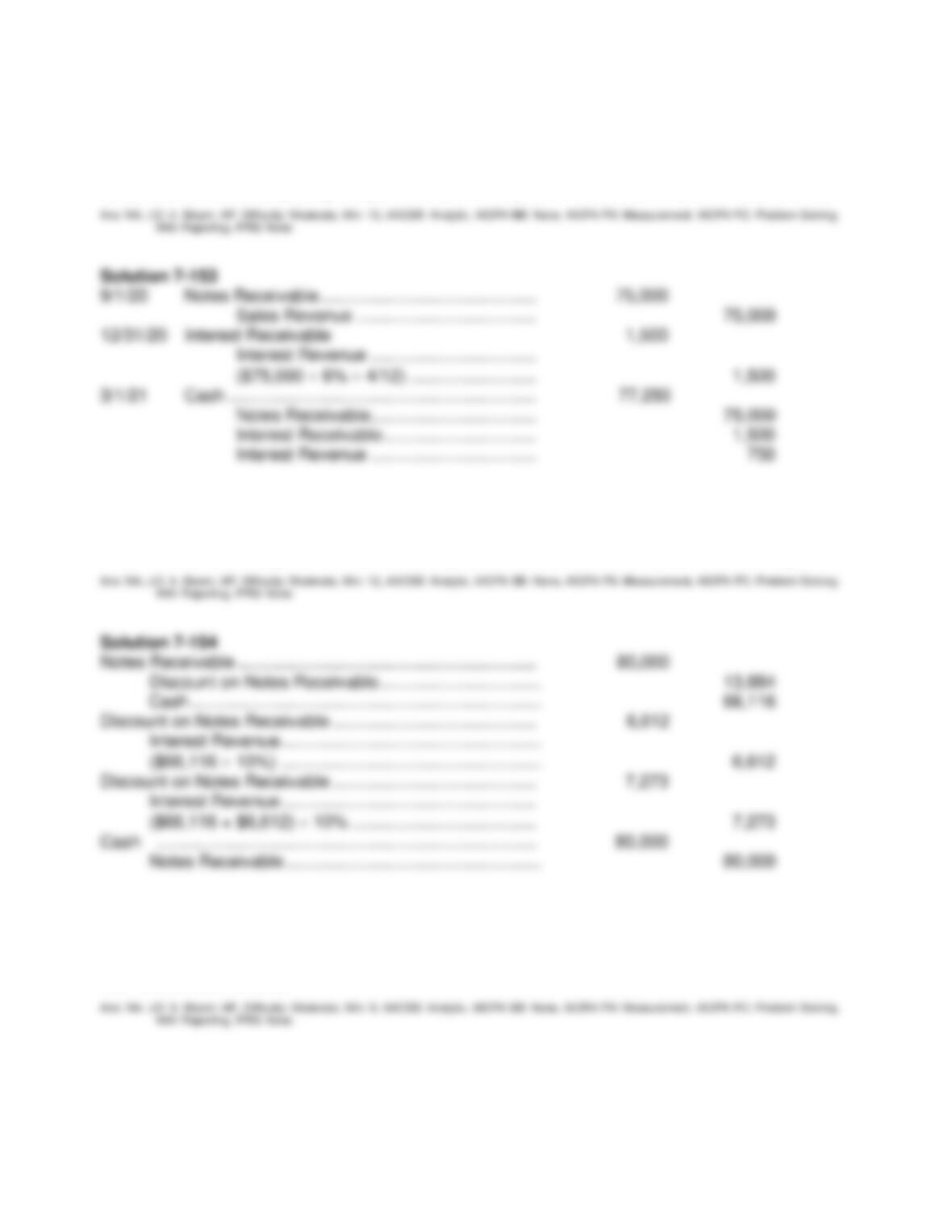
BE7–152
Telfer Co. uses the gross method to record sales made on credit. On July 1, 2020, it made sales
of $90,000 with terms 2/10 n/30. On July 9, 2020, Telfer received full payment for the July 1 sale.
Prepare the required journal entries for Telfer Co.
Test Bank for Intermediate Accounting, Seventeenth Edition
7 – 42
BE7–153
Sutherland Corporation sold goods to Rice Decorators for $75,000 on September 1, 2020,
accepting Rice’s $75,000, 6-month, 6% note. Prepare Sutherland’s September 1 entry,
December 31 annual adjusting entry, and March 1 entry for the collection of the note and interest.
BE7–154
Kohl Company loaned $66,116 to Hemingway, Inc, accepting Hemingway‘s 2-year, $80,000,
zero-interest-bearing note. The implied interest rate is 10%. Prepare Kohl’s journal entries for the
initial transaction, recognition of interest each year, and the collection of $80,000 at maturity.
BE7–155
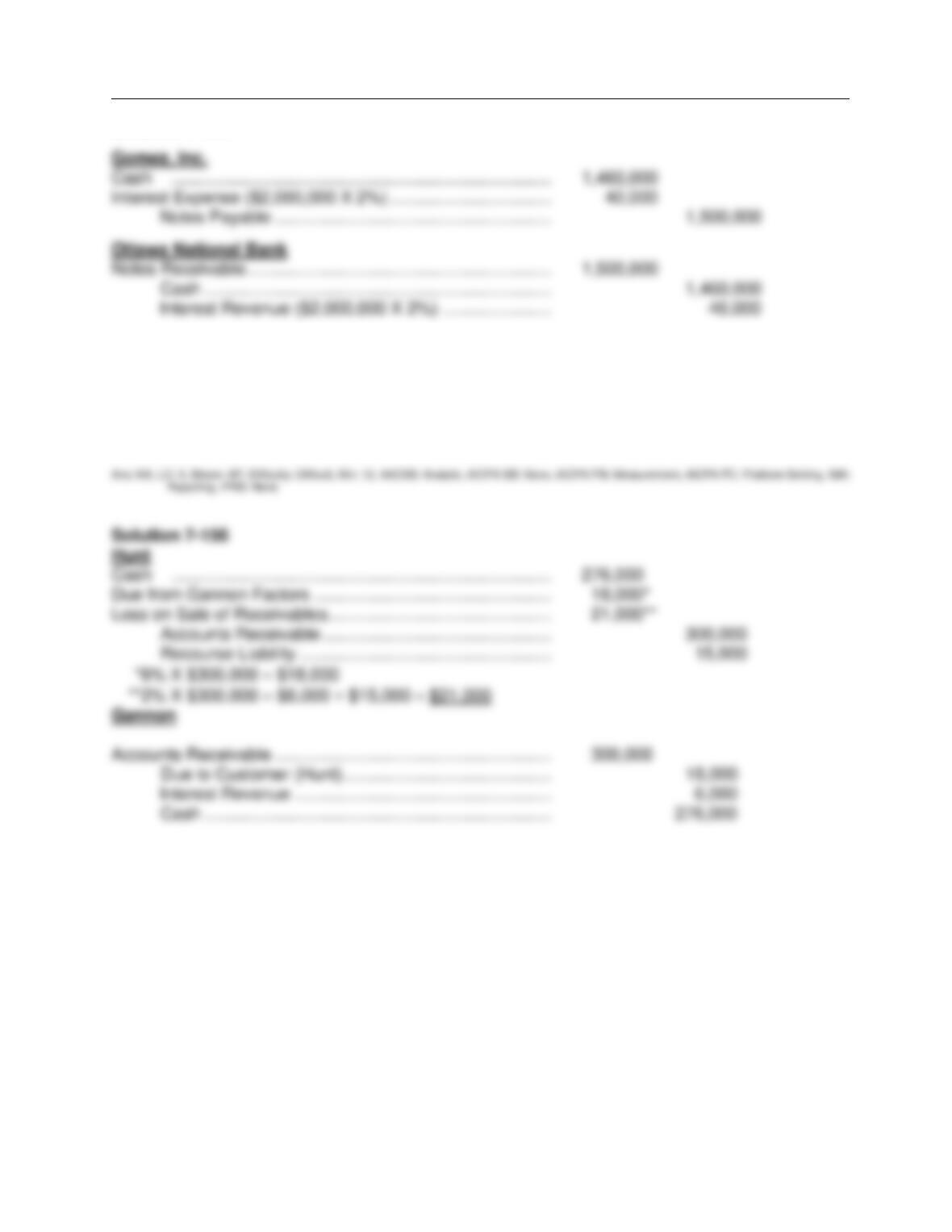
On October 1, 2020, Gomez Inc. assigns $2,000,000 of its accounts receivable to Ottawa
National Bank as collateral for a $1,500,000 note. The bank assesses a finance charge of 2% of
the receivables assigned and interest on the note of 7%. Prepare the October 1 journal entries for
both Gomez and Ottawa.
Cash and Receivables
7 – 43
Solution 7-155
BE7–156
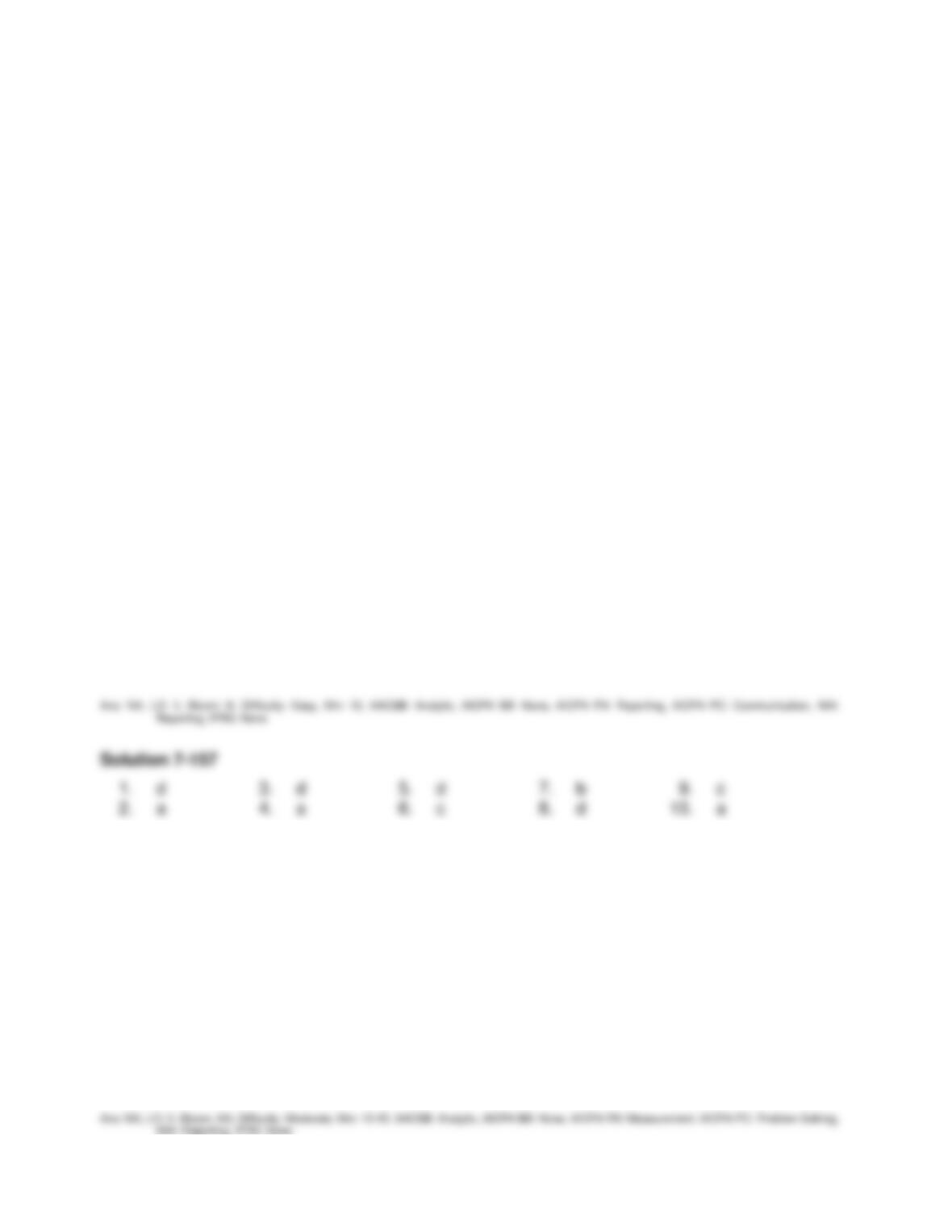
Hunt Incorporated sold $300,000 of accounts receivable to Gannon Factors Inc. on a with
recourse basis. Gannon assesses a 2% finance charge of the amount of accounts receivable and
retains an amount equal to 6% of accounts receivable for possible adjustments. Prepare the
journal entries for Hunt Incorporated and Gannon Factors to record the sale of the accounts
receivable to Gannon assuming that the recourse liability has a fair value of $15,000.
Test Bank for Intermediate Accounting, Seventeenth Edition
7 – 44
EXERCISES
Ex. 7-157—Asset classification.
Below is a list of items. Classify each into one of the following balance sheet categories:
a. Cash c. Short-term Investments
b. Receivables d. Other
___ 1. Compensating balances held in long-term borrowing arrangements
___ 2. Savings account
___ 3. Trust fund
___ 4. Checking account
___ 5. Postage stamps
___ 6. Treasury bills maturing in six months
___ 7. Post-dated checks from customers
___ 8. Certificate of deposit maturing in five years
___ 9. Common stock of another company (to be sold by December 31, this year)
___ 10. Change fund
Ex. 7-158—Allowance for doubtful accounts.
When a company has a policy of making sales for which credit is extended, it is reasonable to
expect a portion of those sales to be uncollectible. As a result of this, a company must recognize
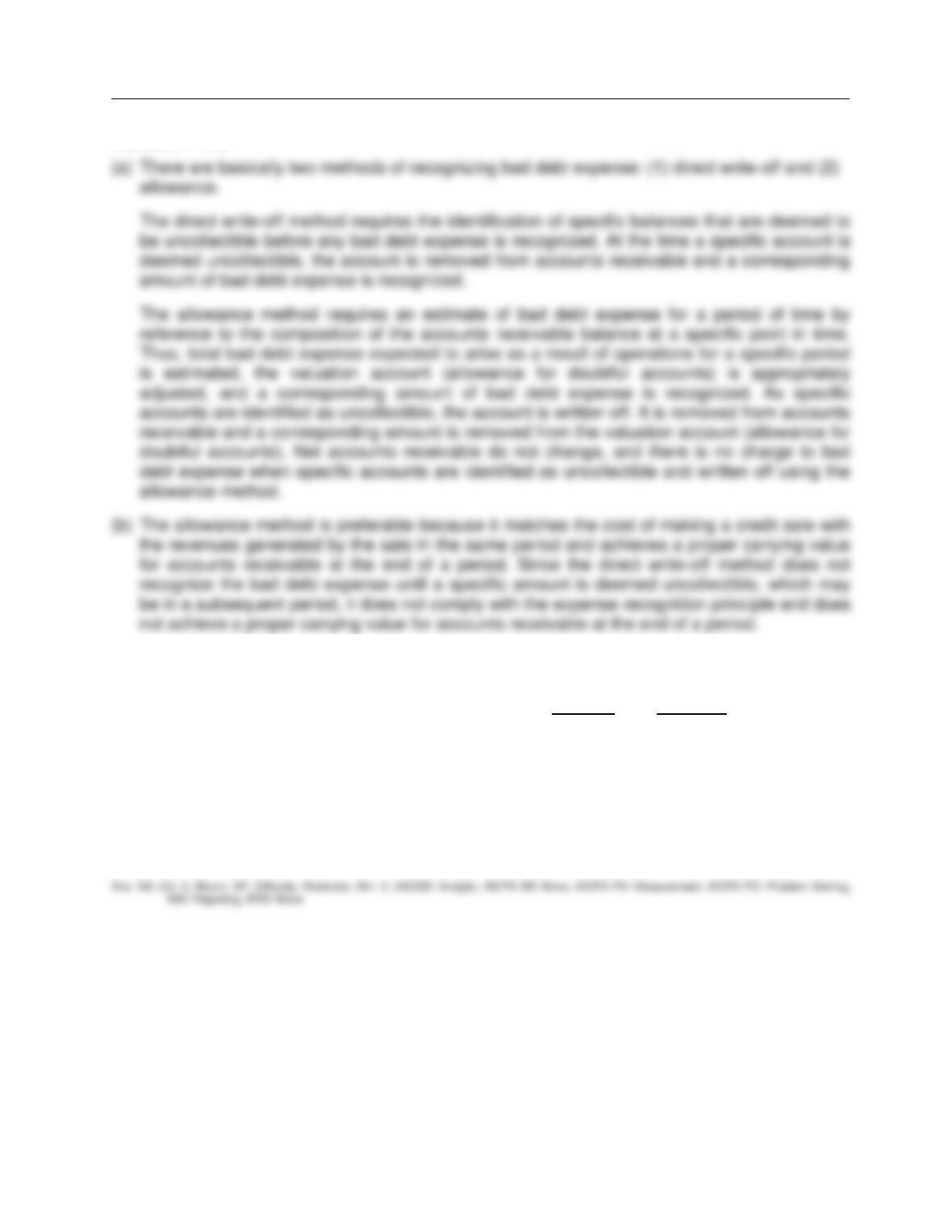
bad debt expense. There are basically two methods of recognizing bad debt expense: (1) direct
write-off method, and (2) allowance method.
Instructions
(a) Describe fully both the direct write-off method and the allowance method of recognizing bad
debt expense.
(b) Discuss the reasons why one of the above methods is preferable to the other and the reasons
why the other method is not usually in accordance with generally accepted accounting
principles.
Cash and Receivables
7 – 45
Solution 7-158
Ex. 7-159–—Entries for bad debt expense.
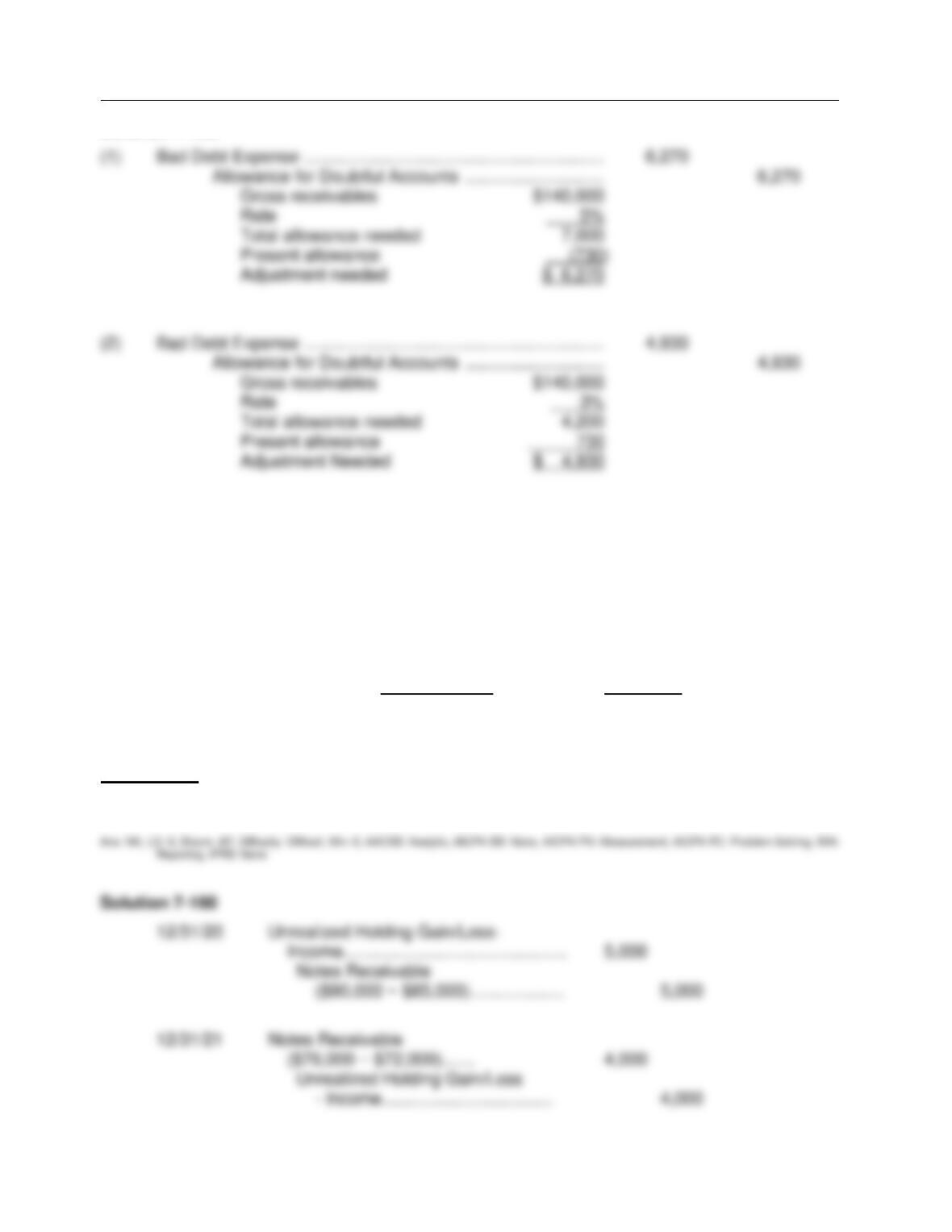
A trial balance before adjustment included the following:
Debit Credit
Accounts receivable $140,000
Allowance for doubtful accounts 730
Sales $610,000
Sales returns and allowances 8,000
Prepare journal entries assuming that the estimate of uncollectible accounts is determined by
taking (1) 5% of gross accounts receivable and (2) 3% of gross accounts receivable (assuming a
$730 debit allowance account balance).
Test Bank for Intermediate Accounting, Seventeenth Edition
7 – 46
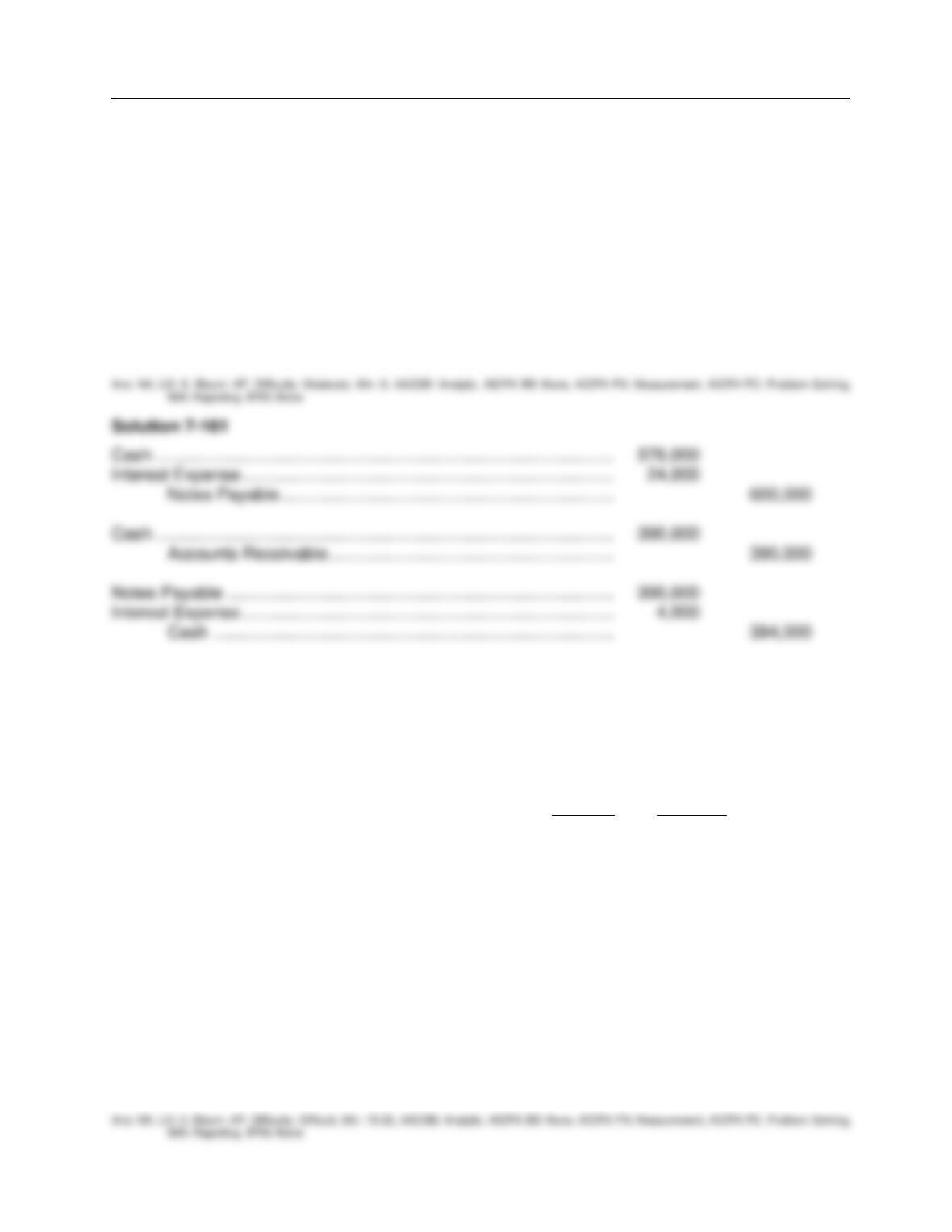
Solution 7-159
Ex. 7-160—Fair Value Option.
Ellison Company sells large store-rack systems and frequently accepts notes receivable from
customers as payment. Ellison conducts a through credit check on its customers, and it charges a
fairly low interest rate (1/2 of 1% payable monthly) on these notes. Ellison has elected to use the
fair value option for one of these notes and has the following data related to the carrying and fair
value for its note.
Carrying Value Fair Value
December 31, 2020 $90,000 $85,000
December 31, 2021 72,000 76,000
Instructions
Prepare the journal entry at December 31 (Ellison’s year-end) for 2020 and 2021, to record the
fair value option for these notes.
Cash and Receivables
7 – 47
Ex. 7-161—Accounts receivable assigned.
Accounts receivable in the amount of $700,000 were assigned to the Fast Finance Company by
Marsh, Inc., as security for a loan of $600,000. The finance company assessed a 4% finance
charge on the face amount of the loan, and the note bears interest at 8% per year.
During the first month, Marsh collected $390,000 on assigned accounts. This amount was
remitted to the finance company along with one month’s interest on the note.
Instructions
Make all the entries for Marsh Inc. associated with the transfer of the accounts receivable, the
loan, and the remittance to the finance company.
PROBLEMS
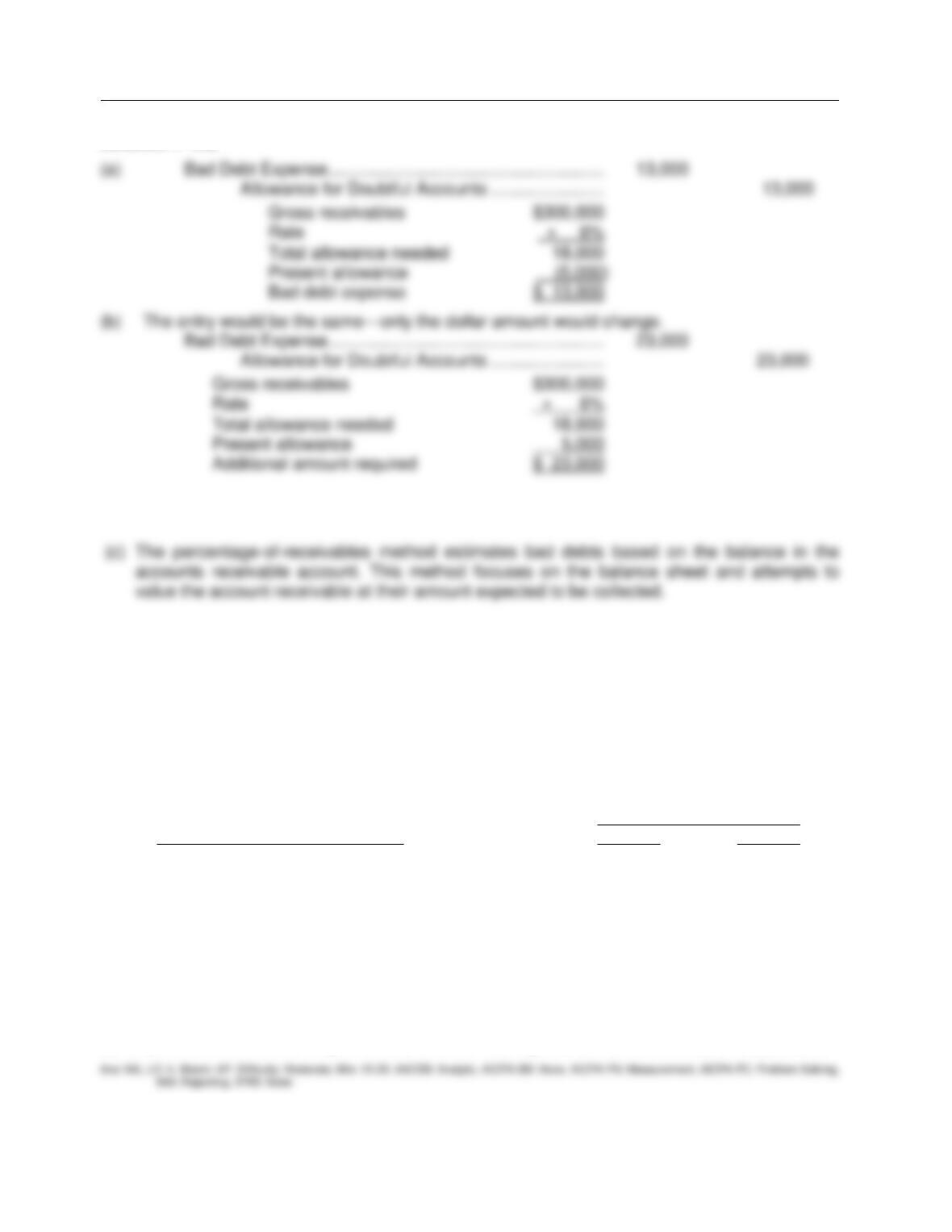
Pr. 7-162—Entries for bad debt expense.
The trial balance before adjustment of Risen Company reports the following balances:
Dr. Cr.
Accounts receivable $300,000
Allowance for doubtful accounts $ 5,000
Sales (all on credit) 1,700,000
Sales returns and allowances 80,000
Instructions
(a) Prepare the entry for estimated bad debts assuming that doubtful accounts are estimated to
be 6% of gross accounts receivable.
(b) Assume that all the information above is the same, except that the Allowance for Doubtful
Accounts has a debit balance of $5,000 instead of a credit balance. How will this difference
affect the journal entry in part (a)?
(c) What is the theoretical justification for the percentage-of-receivables method used to
estimate bad debts?
Test Bank for Intermediate Accounting, Seventeenth Edition
7 – 48
Solution 7-162
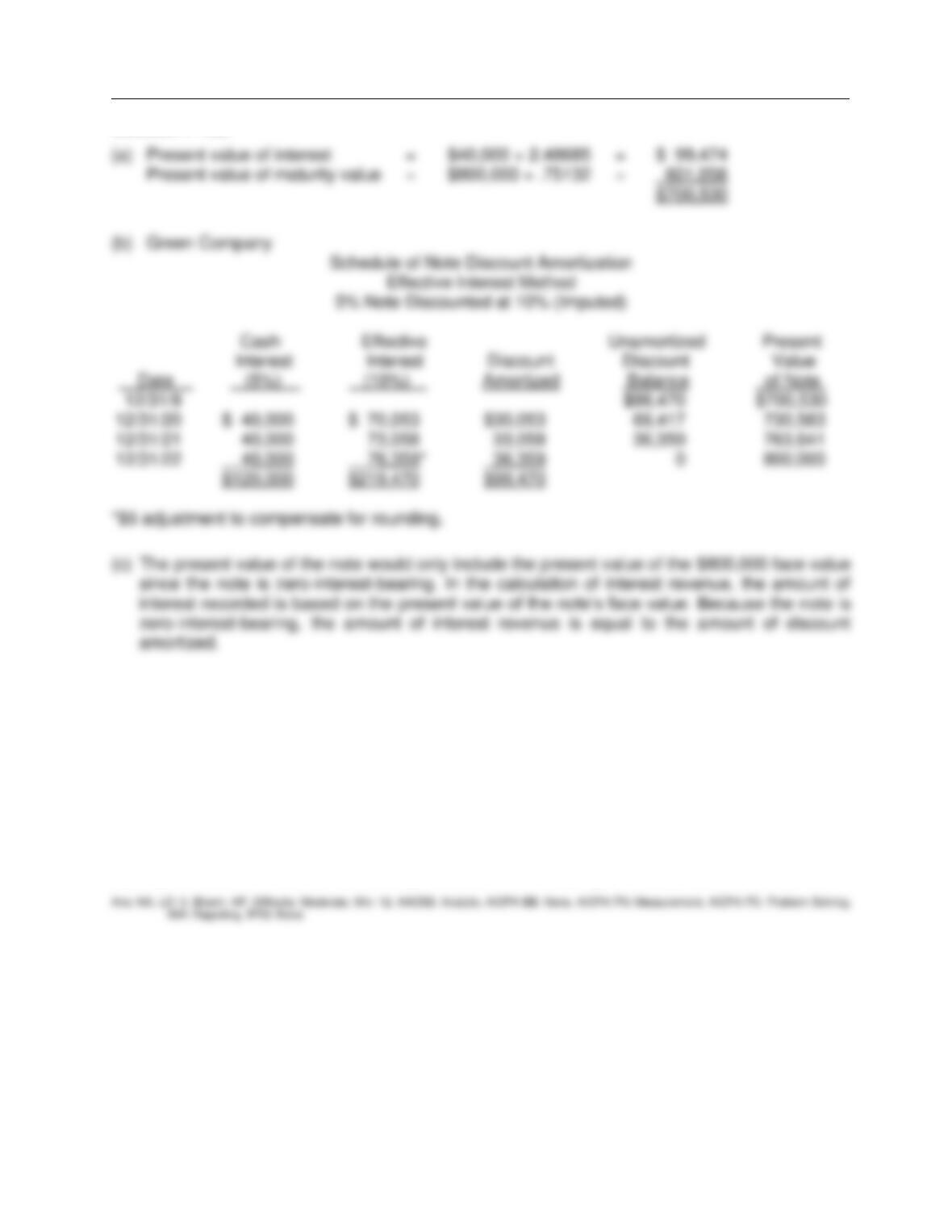
Pr. 7-163—Amortization of discount on note.
On December 31, 2019, Green Company finished consulting services and accepted in exchange
a promissory note with a face value of $800,000, a due date of December 31, 2022, and a stated
rate of 5%, with interest receivable at the end of each year. The fair value of the services is not
readily determinable and the note is not readily marketable. Under the circumstances, the note is
considered to have an appropriate imputed rate of interest of 10%.
The following interest factors are provided:
Interest Rate
Table Factors For Three Periods 5% 10%
Future Value of 1 1.15763 1.33100
Present Value of 1 .86384 .75132
Future Value of Ordinary Annuity of 1 3.15250 3.31000
Present Value of Ordinary Annuity of 1 2.72325 2.48685
Instructions
(a) Determine the present value of the note.
(b) Prepare a Schedule of Note Discount Amortization for Green Company under the effective
interest method. (Round to whole dollars.)
(c) Explain how the accounting for a zero-interest-bearing note would differ in (a) and (b) above.
Cash and Receivables
7 – 49
Solution 7-163
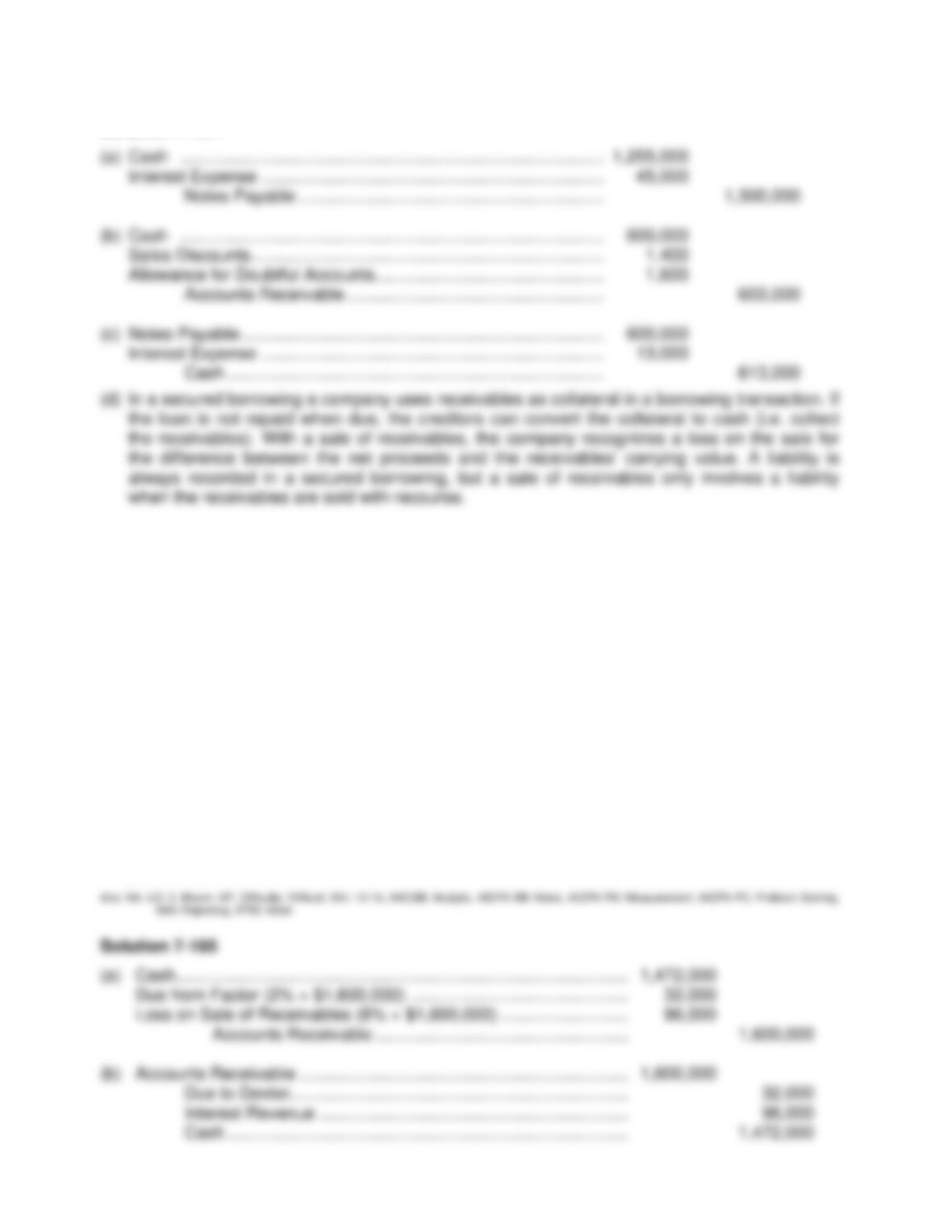
Pr. 7-164—Accounts receivable assigned.
Prepare journal entries for Mars Co. for:
(a) Accounts receivable in the amount of $1,500,000 were assigned to Utley Finance Co. by
Mars as security for a loan of $1,300,000. Utley charged a 3% commission on the accounts;
the interest rate on the note is 12%.
(b) During the first month, Mars collected $600,000 on assigned accounts after deducting $1,400
of discounts. Mars wrote off a $1,600 assigned account.
(c) Mars paid to Utley the amount collected plus one month’s interest on the note.
(d) Explain the differences in accounting for a secured borrowing and a sale of receivables.
Test Bank for Intermediate Accounting, Seventeenth Edition
7 – 50
Solution 7-164
Pr. 7-165—Factoring Accounts Receivable.
On May 1, Dexter, Inc. factored $1,600,000 of accounts receivable with Quick Finance on a
without recourse basis. Under the arrangement, Dexter was to handle disputes concerning
service, and Quick Finance was to make the collections, handle the sales discounts, and absorb
the credit losses. Quick Finance assessed a finance charge of 6% of the total accounts
receivable factored and retained an amount equal to 2% of the total receivables to cover sales
discounts.
Instructions
(a) Prepare the journal entry required on Dexter’s books on May 1.
(b) Prepare the journal entry required on Quick Finance’s books on May 1.
(c) Assume Dexter factors the $1,600,000 of accounts receivable with Quick Finance on a with
recourse basis instead. The recourse provision has a fair value of $28,000. Prepare the
journal entry required on Dexter’s books on May 1.
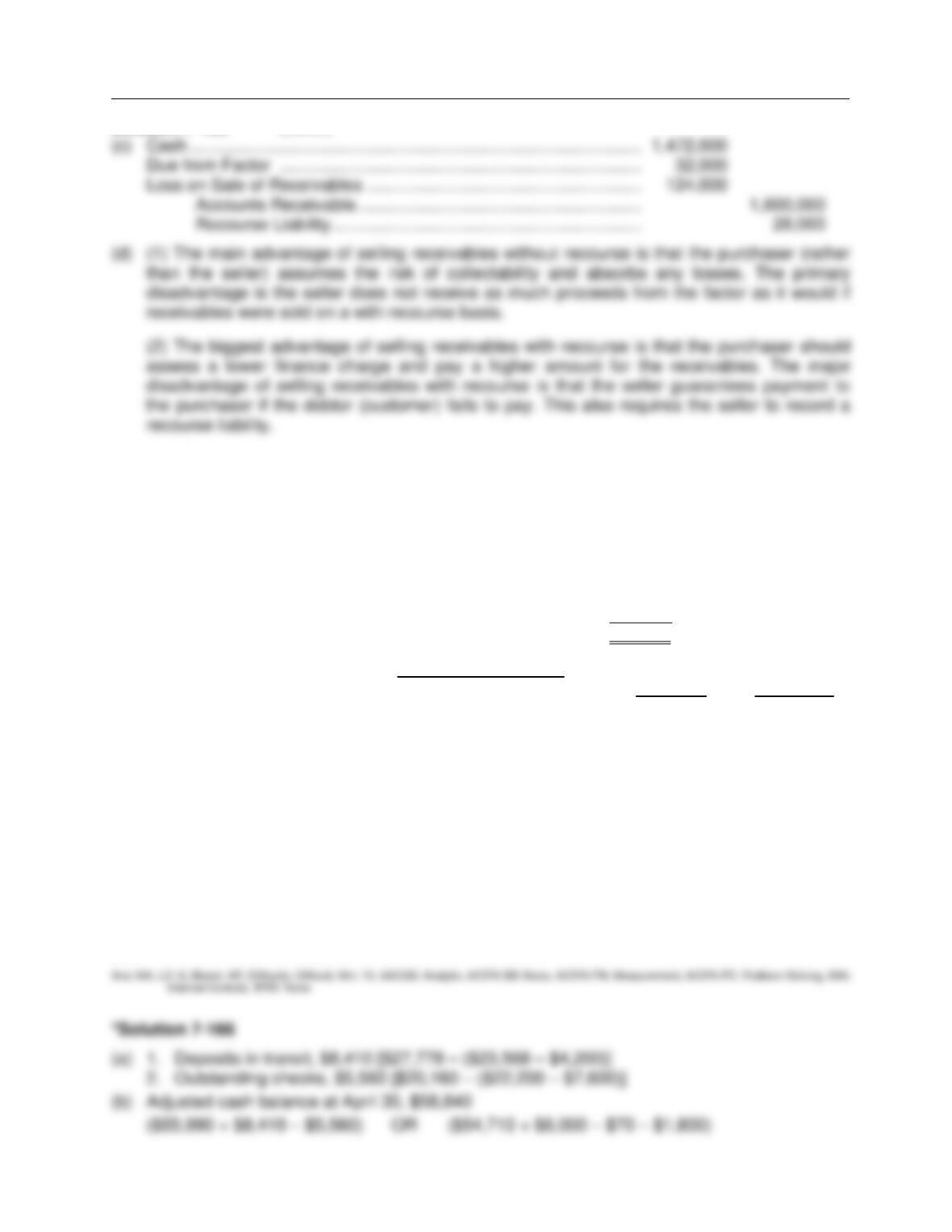
(d) Explain the main advantage and disadvantage of selling receivables (1) without recourse and
(2) with recourse.
Cash and Receivables
7 – 51
Solution 7-165 (Cont.)
*Pr. 7-166—Bank reconciliation.
Benson Plastics Company deposits all receipts and makes all payments by check. The following
information is available from the cash records:
MARCH 31 BANK RECONCILIATION
Balance per bank $53,492
Add: Deposits in transit 4,200
Deduct: Outstanding checks (7,600)
Balance per books $50,092
Month of April Results
Per Bank Per Books
Balance April 30 $55,990 $54,710
April deposits 23,568 27,778
April checks 22,200 20,160
April note collected (not included in April deposits) 6,000 -0-
April bank service charge 70 -0-
April NSF check of a customer returned by the bank
(recorded by bank as a charge) 1,800 -0-
Instructions
(a) Calculate the amount of the April 30:
1. Deposits in transit
2. Outstanding checks
(b) What is the April 30 adjusted cash balance? Show all work.
Test Bank for Intermediate Accounting, Seventeenth Edition
7 – 52
IFRS QUESTIONS
True/False:
1. IFRS and GAAP are very similar in accounting for cash and receivables.
2. IFRS does not permit the reversal of impairment losses, as does GAAP.
3. Under IFRS, there is a specific standard that mandates segregation of receivables with
different characteristics.
4. Under IFRS, there is no specific standard related to pledging receivables.
5. Both the FASB and IASB have indicated that they believe all financial instruments should be
recorded and reported at fair value.
Answers to True/False:
Multiple Choice
Use the following information to answer Question 1 and 2.
Harrison Company has a loan receivable with a carrying value of $15,000 at December 31, 2019.
On January 3, 2020, the borrower, Thomas Clark Imports, declares bankruptcy, and Harrison
estimates that it will collect only 60% of the loan balance.
1. Which of the following entries would Harrison make to record the impairment under IFRS?
a. Loan Receivable 9,000
Impairment Loss 9,000
b. Loan Recovery Expense 6,000
Loan Receivable 6,000
c. Impairment Loss 9,000
Loan Receivable 9,000
d. Bad Debt Expense 6,000
Provision for Doubtful Accounts 6,000

Cash and Receivables
7 – 53
2. Assume that on January 5, 2021, Harrison learns that Thomas Clark Imports has emerged
from bankruptcy. As a result, Harrison now estimates that all but $1,500 will be repaid on the
loan. Under IFRS, which of the following entries would be made on January 5, 2021?
a. Provision for Doubtful Accounts 4,500
Bad Debt Expense 4,500
b. Loan Receivable 1,500
Recovery of Impairment Loss 1,500
c. Bad Debt Expense 1,500
Impairment Loss 1,500
d. No journal entry is allowed under IFRS.
3. The IFRS criteria for recognizing a transfer of a receivable focuses on which of the following?
a. Risks
b. Rewards
c. Loss of control
d. All of these answers choices are correct.
4. Which of the following standards specifically addresses issues related to cash?
a. IAS No.1 (Presentation of Financial Statements)
b. IFRS No. 7 (Financial Instruments: Disclosures)
c. IAS No. 39 (Financial Instruments: Recognition and Measurement)
d. None of these answer choices are correct.
5. Key similarities between GAAP and IFRS include all of the following except
a. the definition used for cash equivalents.
b. accounting and reporting issues related to recognition and measurement of
receivables, such as the use of allowance accounts.
c. working toward implementing fair value measurement for all financial instruments.
d. the same criteria is used to recognize a transfer of a receivable.

Test Bank for Intermediate Accounting, Seventeenth Edition
7 – 54
Use the following information to answer Questions 6 and 7.
Johnstone Company has a loan receivable with a carrying value of $125,000 at December 31, 2019.
On January 1, 2020, the borrower, Ralph Young Industries, declares bankruptcy, and Johnstone
estimates that it will collect only 45% of the loan balance.
6. Which of the following entries would Johnstone make to record the impairment under IFRS?
a. Loan Receivable 56,250
Impairment Loss 56,250
b. Loan Recovery Expense 68,750
Loan Receivable 68,750
c. Impairment Loss 56,250
Loan Receivable 56,250
d. Bad Debt Expense 68,750
Provision for Doubtful Accounts 68,750
7. Assume that on January 4, 2021, Johnstone learns that Ralph Young Industries has emerged
from bankruptcy. As a result, Johnstone now estimates that all but $11,500 will be paid on the
loan. Under IFRS, which of the following entries would be made on January 4, 2021?
a. Provision for Doubtful Accounts 57,250
Bad Debt Expense 57,250
b. Loan Receivable 11,500
Recovery of Impairment Loss 11,500
c. Bad Debt Expense 11,500
Impairment Loss 11,500
d. No journal entry is allowed under IFRS.
8. Under IFRS,
a. receivables are generally reported in the current assets section of the statement of
financial position.
b. cash and receivables are reported as the last items in the current assets section of the
statement of financial position.
c. bank overdrafts are generally reported as cash.
d. All of these answer choices are correct.
Answers to Multiple Choice
Cash and Receivables
7 – 55
Short Answer:
10. Briefly describe some of the similarities and differences between GAAP and IFRS with
respect to the accounting for cash and receivables.
11. Walton Company, which uses IFRS, has a note receivable with a carrying value of $30,000 at
December 31, 2019. On January 2, 2020, the borrower declares bankruptcy, and Walton
estimates that only $25,000 of the note will be collected. Briefly describe the accounting for
the loan subsequent to the bankruptcy, assuming Walton later estimates that more than
$25,000 can be repaid.