192.
On July 31, Orwell Co. has $448,800 of accounts receivable.
Required:
1. Prepare journal entries to record the following selected August transactions. The
company uses the perpetual inventory system.
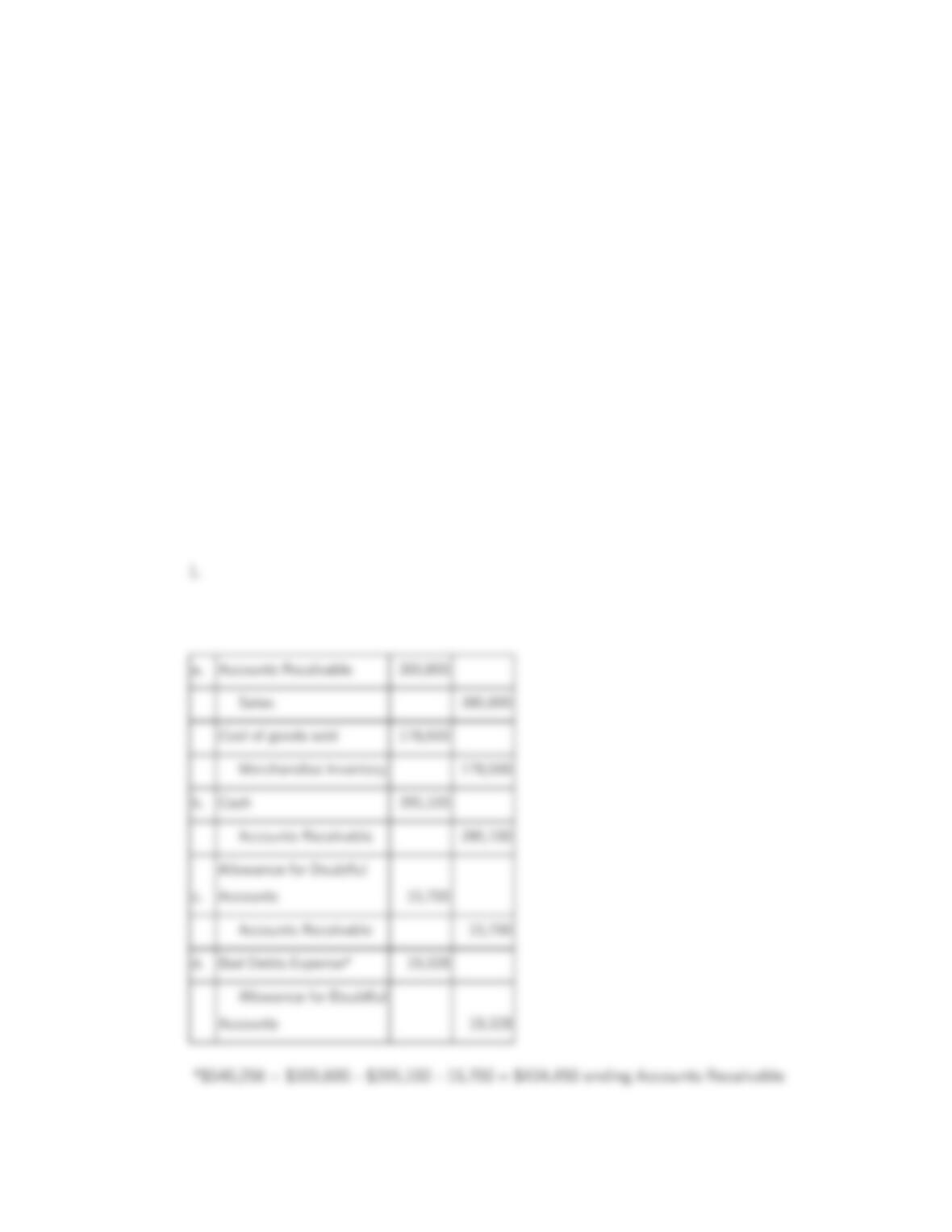
2. Also prepare any footnotes to the August 31 financial statements that result from these
transactions.
3. Calculate the balance in the Accounts Receivable account as of August 10.
Aug 3
Sold $250,000 of merchandise (that cost
$122,000) to customers on credit.
Aug 5
Sold $300,000 of accounts receivable to
Cash Solutions. Cash Solutions charges a
7% factoring fee.
Aug 8
Received $165,200 from customers in
payment on their accounts.
Aug 9
Borrowed $50,000 cash from State Bank,
pledging $65,000 of accounts receivable
as security for the loan. The note is a 90-
day, 9% note.
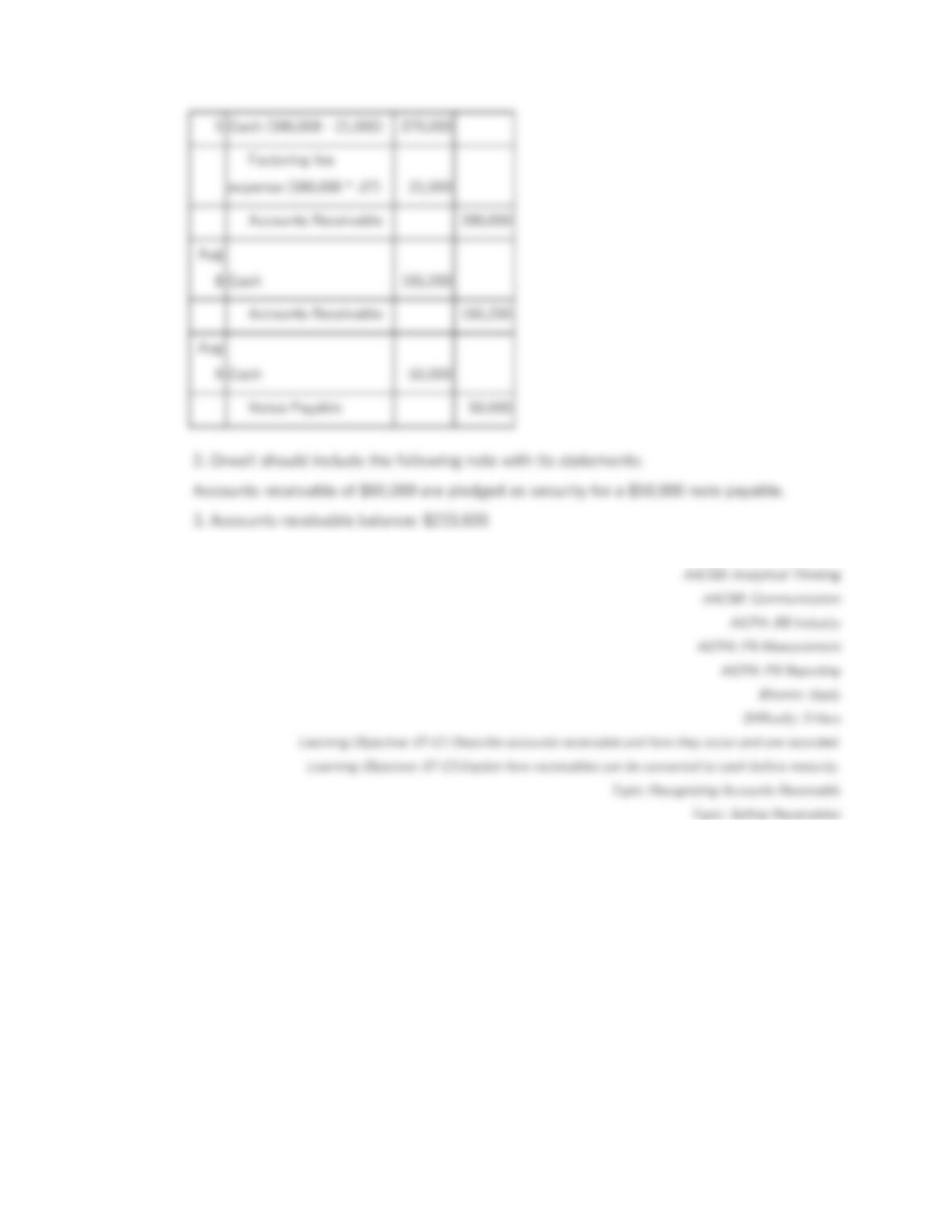
Accounts Receivable
Sales
Cost of goods sold
193.
On September 30, Waldon Co. has $540,250 of accounts receivable. Waldon uses the
allowance method of accounting for bad debts and has an existing credit balance in the
allowance for doubtful accounts of $13,750.
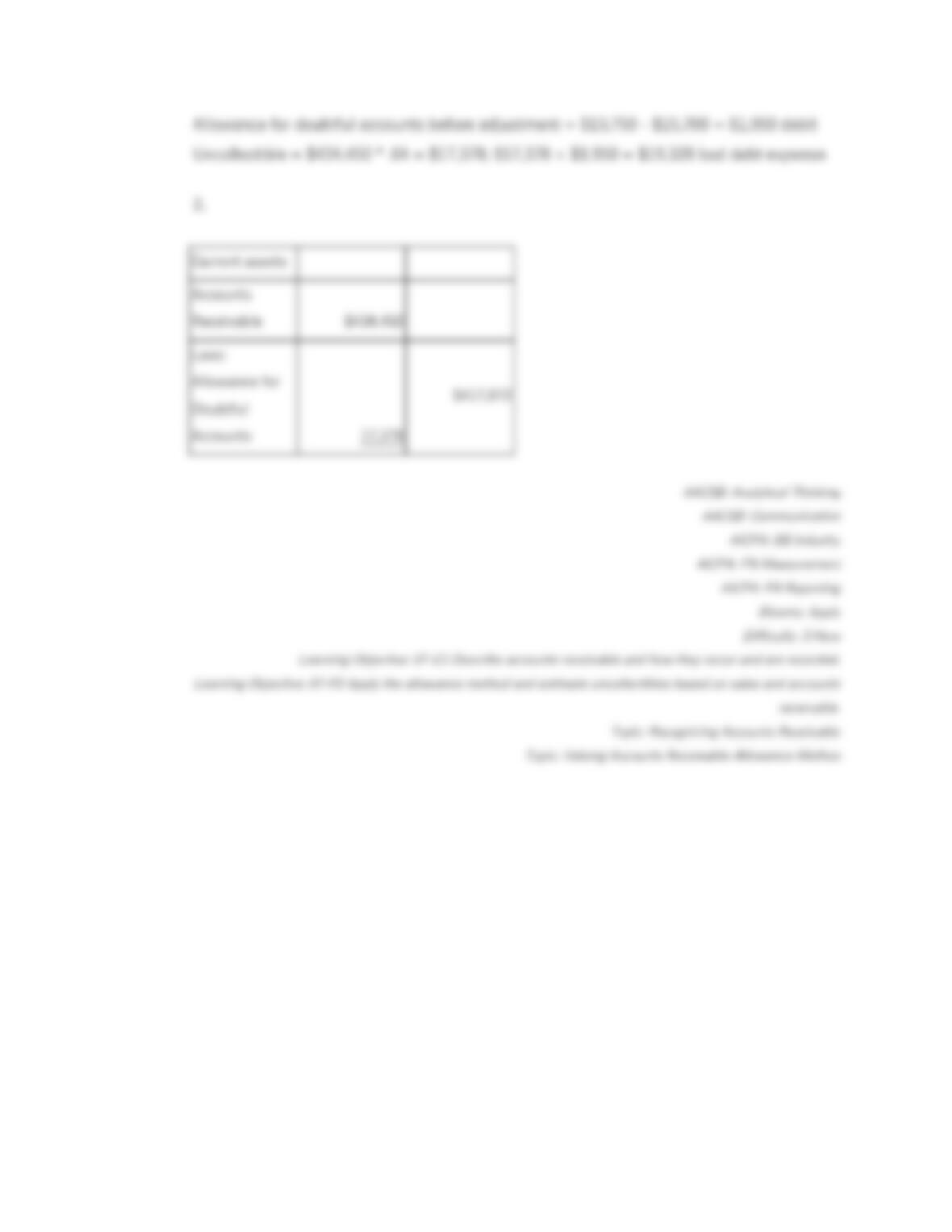
1. Prepare journal entries to record the following selected October transactions. The
company uses the perpetual inventory system. 2. Show how Accounts Receivable and the
Allowance for Doubtful Accounts appear on its October 31 balance sheet.
a. Sold $305,000 of merchandise (that cost $178,500) to customers on credit.
b. Received $395,100 cash in payment of accounts receivable.
c. Wrote off $15,700 of uncollectible accounts receivable.
d. In adjusting the accounts on October 31, its fiscal year–end, the company estimated
that 4.0% of accounts receivable will be uncollectible.
194.
Bonita Company estimates uncollectible accounts using the allowance method at
December 31. It prepared the following aging of receivables analysis.
Total
Current
Days 1
to 30
Past 31
to 60
Due
61 to
90
Over
90
Accounts
receivable
$110,000
$68,000
$17,000
$10,000
$8,000
$7,000
Percent
uncollectible
1%
2%
5%
8%
13%
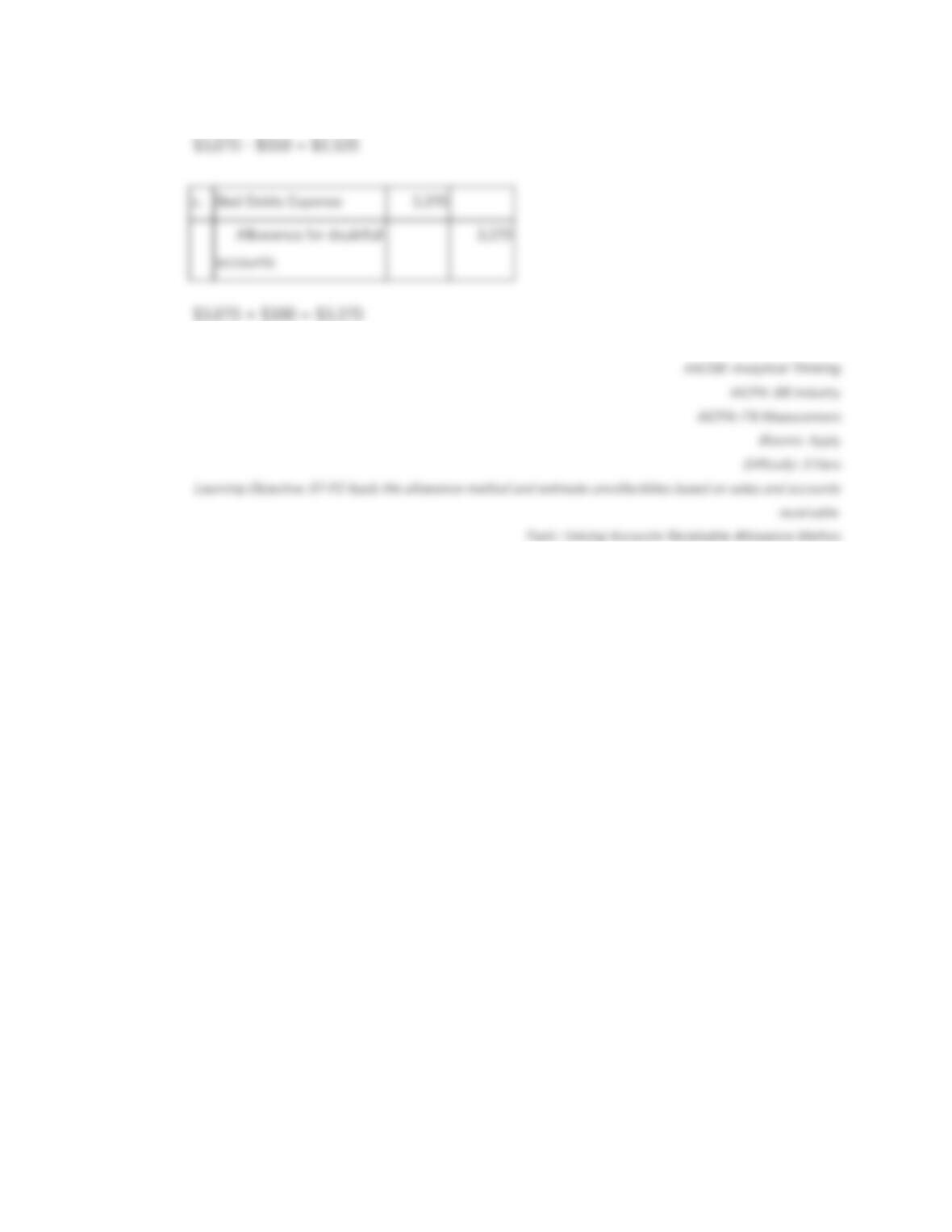
a. Estimate the balance of the Allowance for Doubtful Accounts using the aging of
accounts receivable method.
b. Prepare the adjusting entry to record Bad Debts Expense using the estimate from part
a. Assume the unadjusted balance in the Allowance for Doubtful Accounts is a $550 credit.
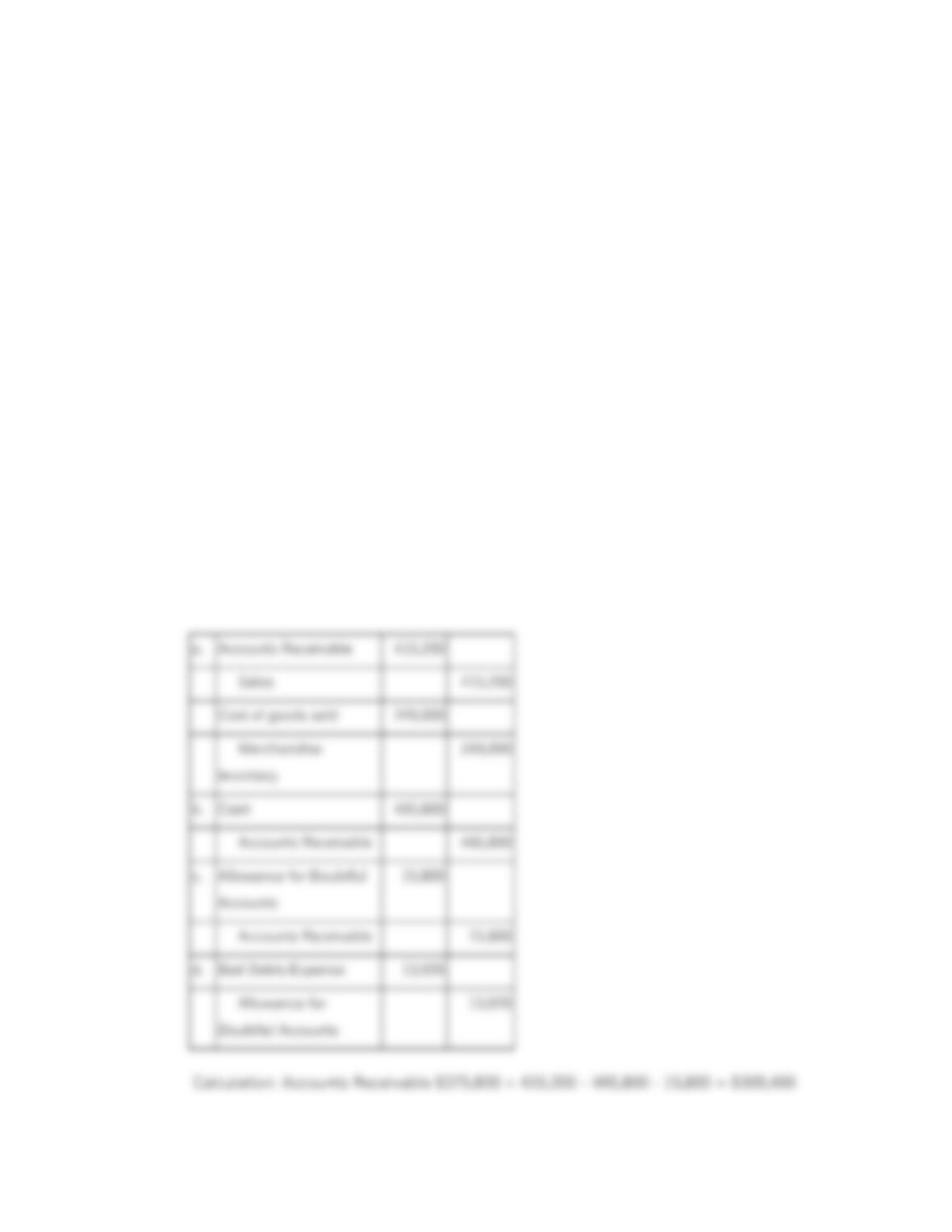
c. Prepare the adjusting entry to record Bad Debts Expense using the estimate from part
a. Assume the unadjusted balance in the Allowance for Doubtful Accounts is a $300
debit.
Percent
uncollectible
1%
2%
5%
8%
13%
Estimated
Allowance for doubtful
195.
On May 31, Cray has $375,800 of accounts receivable. Cray uses the allowance method of
accounting for bad debts and has an existing credit balance in the allowance for doubtful
accounts of $14,250.
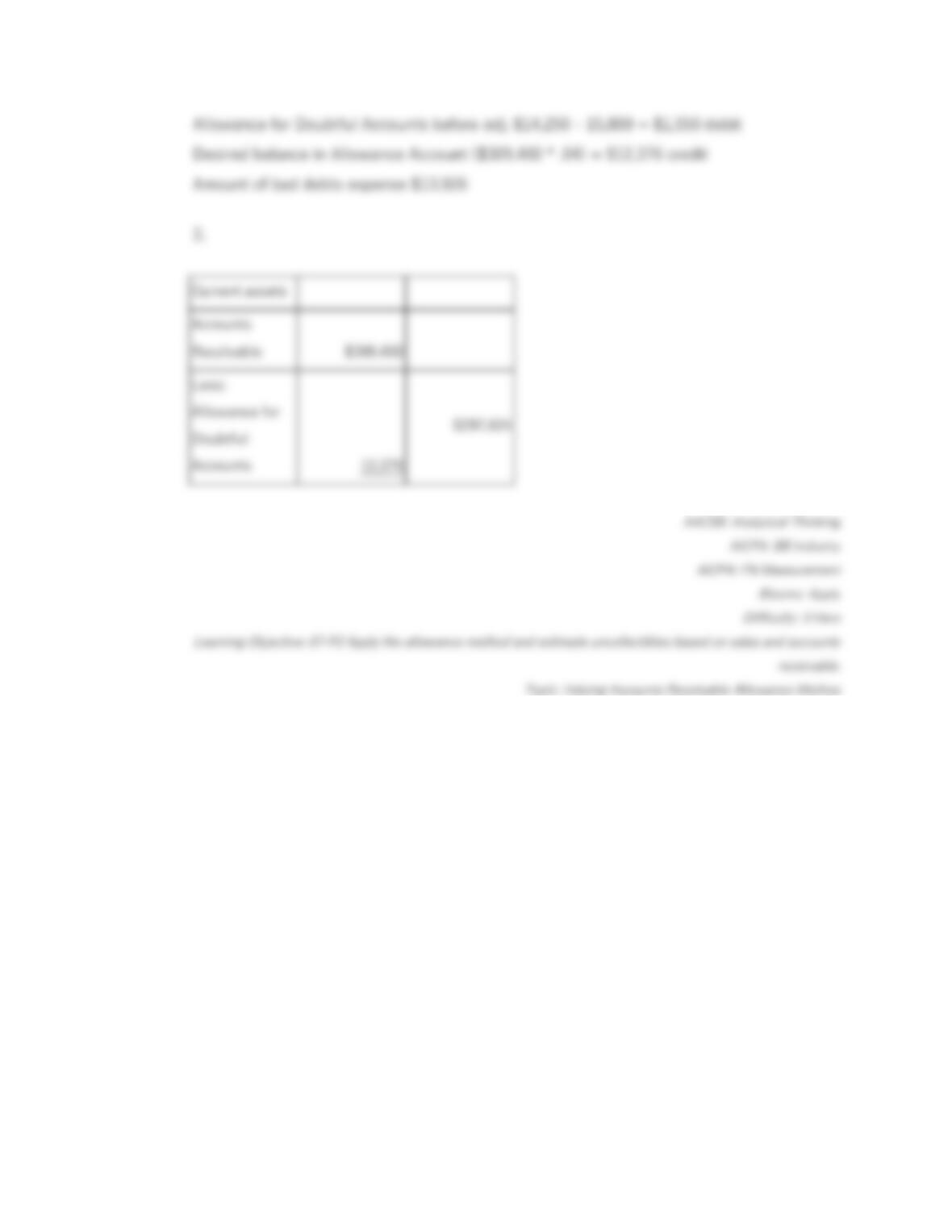
1. Prepare journal entries to record the following selected May transactions. The company
uses the perpetual inventory system.
2. Show how Accounts Receivable and the Allowance for Doubtful Accounts appear on its
May 31 balance sheet.
a. Sold $415,200 of merchandise (that cost $249,000) to customers on credit.
b. Received $465,800 cash in payment of accounts receivable.
c. Wrote off $15,800 of uncollectible accounts receivable.
d. In adjusting the accounts on May 31, its fiscal year-end, the company estimated that
4.0% of accounts receivable will be uncollectible.
196.
At December 31, Yarrow Company reports the following results for its calendar year from
the adjusted trial balance.
Credit sales
$2,300,000
Cash sales
1,050,000
Accounts Receivable
295,000
Allowance for doubtful
accounts (credit balance)
750
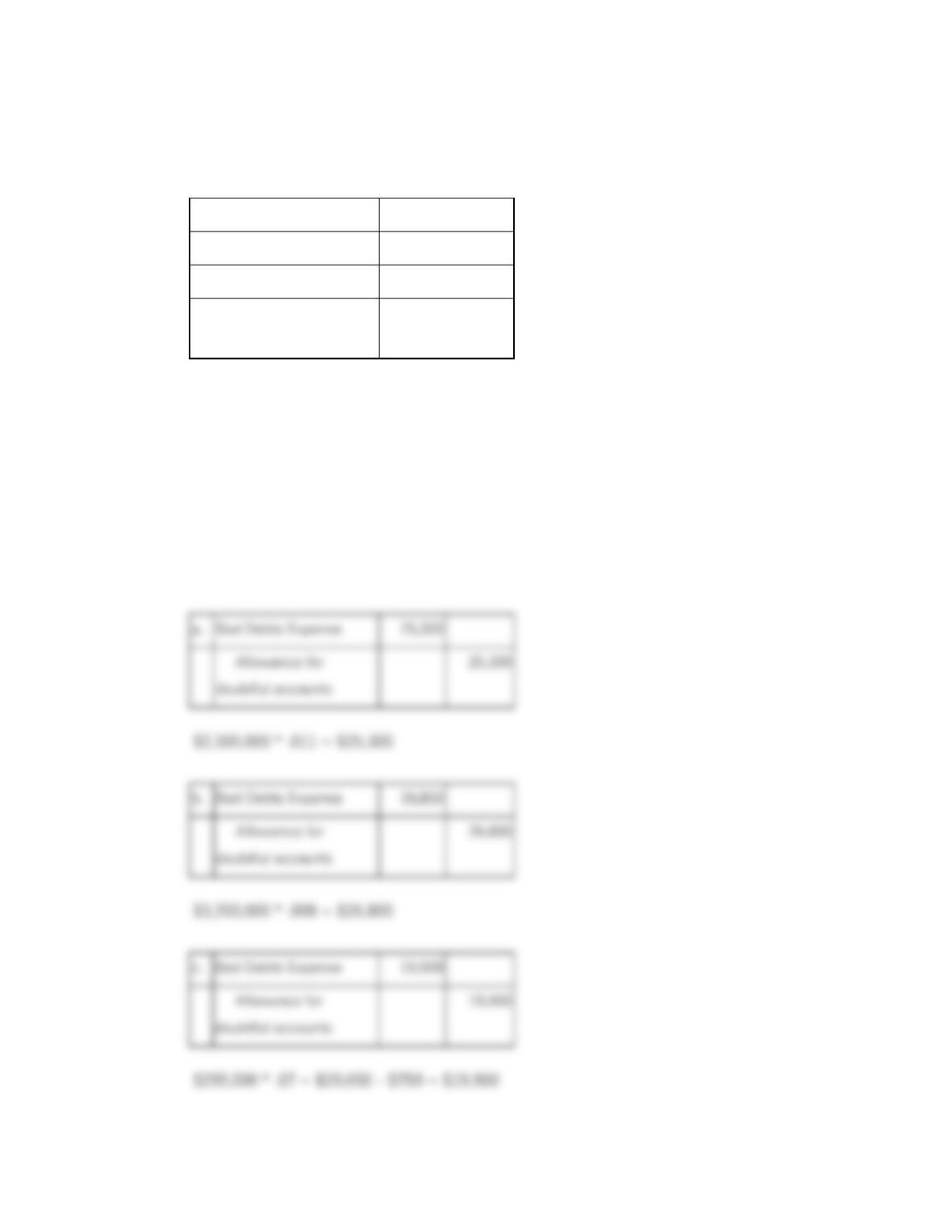
a. Prepare the adjusting entry to record Bad Debts Expense assuming uncollectibles are
estimated to be 1.1% of credit sales.
b. Prepare the adjusting entry to record Bad Debts Expense assuming uncollectibles are
estimated to be .8% of total sales.
c. Prepare the adjusting entry to record Bad Debts Expense assuming uncollectibles are
estimated to be 7.0% of year-end accounts receivable.
Bad Debts Expense
Allowance for
doubtful accounts
Bad Debts Expense
Bad Debts Expense
Allowance for
doubtful accounts

197.
White Company allows customers to make purchases on credit. The terms of all credit
sales are 2/10, n/30, and all sales are recorded at the gross price. Other customers can
use a bank credit card where the bank deducts a 4% service charge for credit card sales
and credits the bank account of White immediately when credit card receipts are
deposited. White uses the perpetual inventory method and accounts for sales discounts
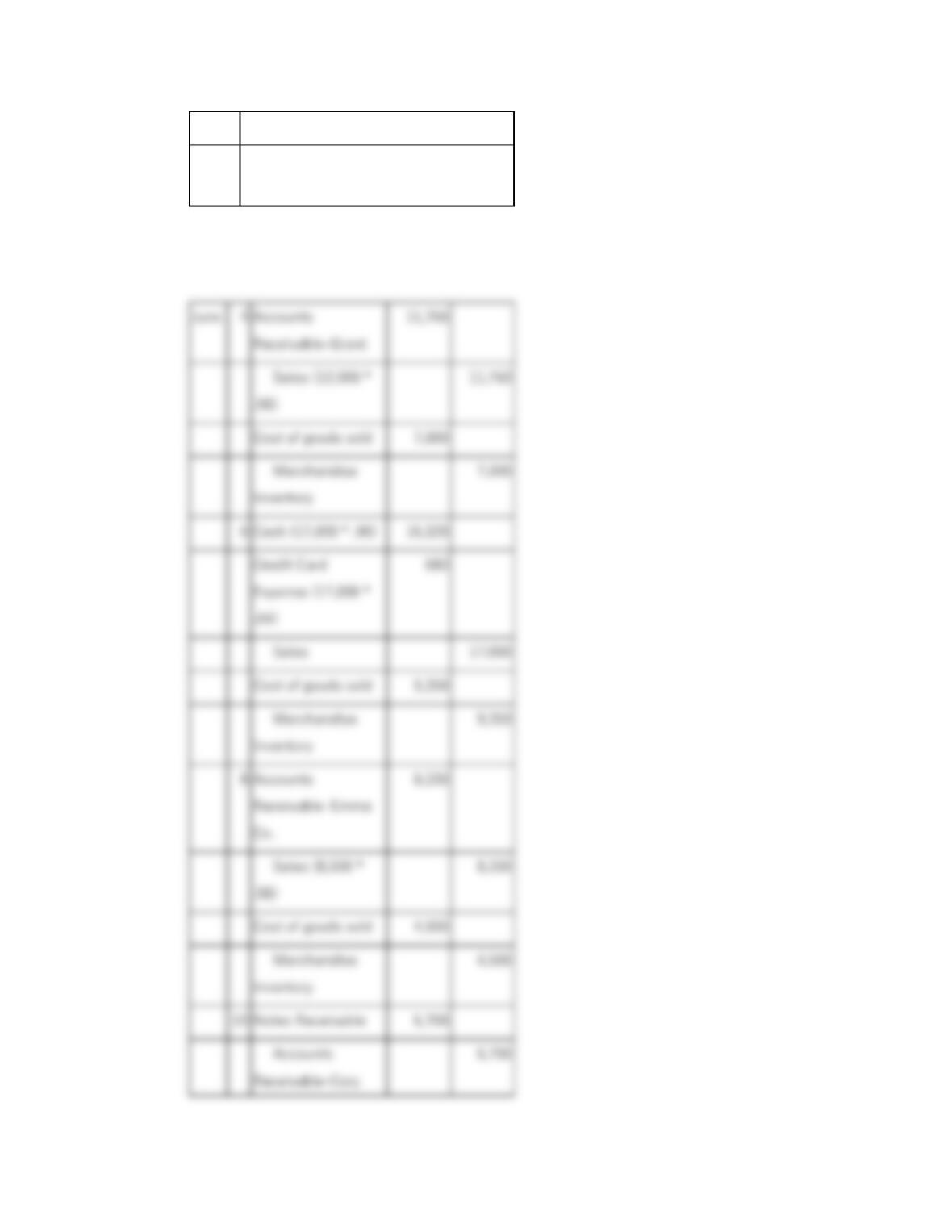
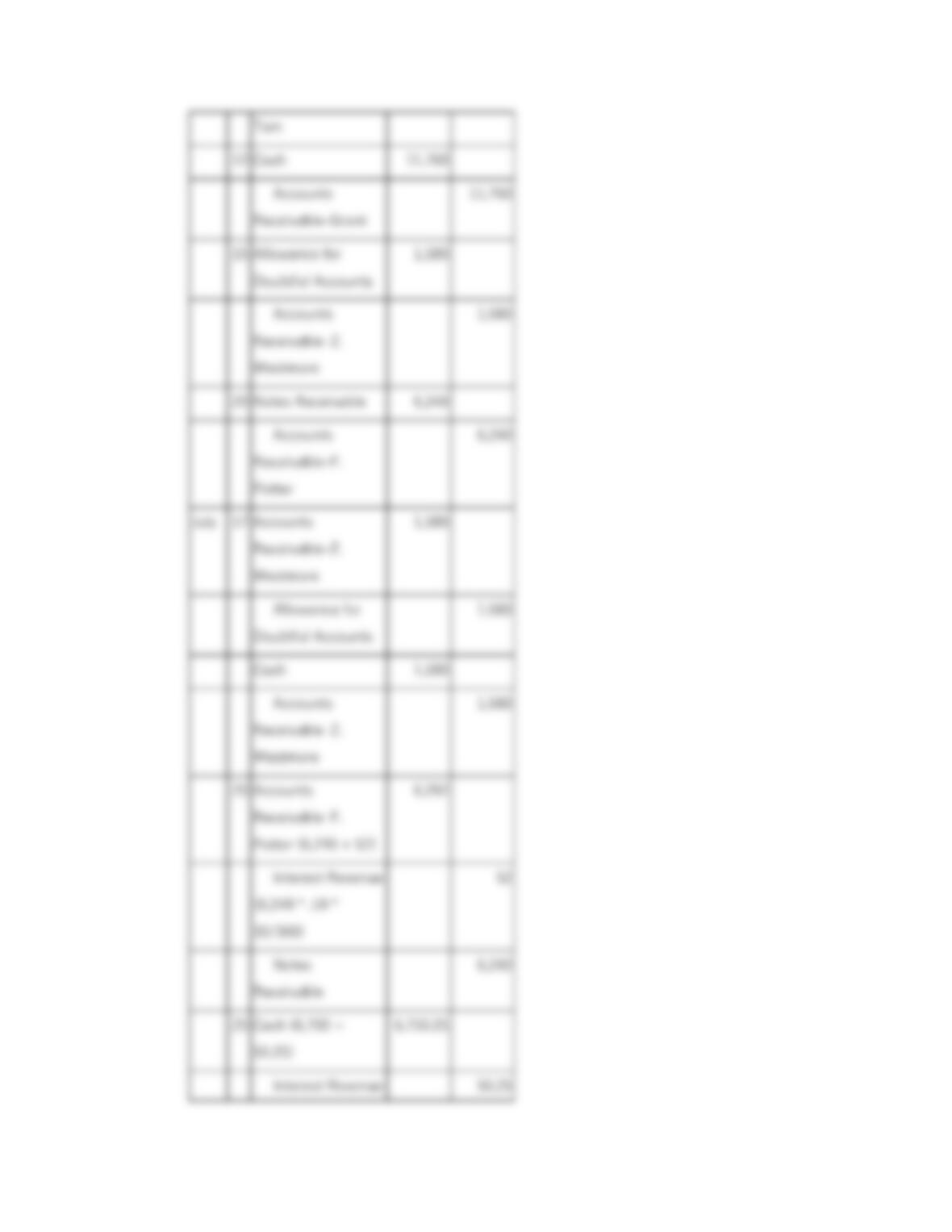
using the net method. Prepare journal entries to record the following selected transactions
and events.
June 4
Sold $12,000 of merchandise (cost
$7,000) on credit to Grant.
6
Sold $17,000 of merchandise (cost
$9,350) to customers who used a bank
credit card, receipts were processed and
deposited the same day.
8
Sold $8,500 of merchandise (cost $4,500)
on credit to Emma Company.
10
Accepted a $6,700, 45-day, 6% note
dated this day in granting Cory Tam a
time extension on his past-due account
receivable.
12
Received Grant’s check in full payment of
the purchase on June 4.
15
Wrote off the account of Z. Westmore
against the Allowance for Doubtful
Accounts. The $1,580 balance stemmed
from a credit sale in January.
20
Accepted a $6,240, 30-day, 10% note
dated this day in granting F. Potter a time
extension on his past-due account
receivable.
July 17
Received the amount previously written-
off from Z. Westmore.
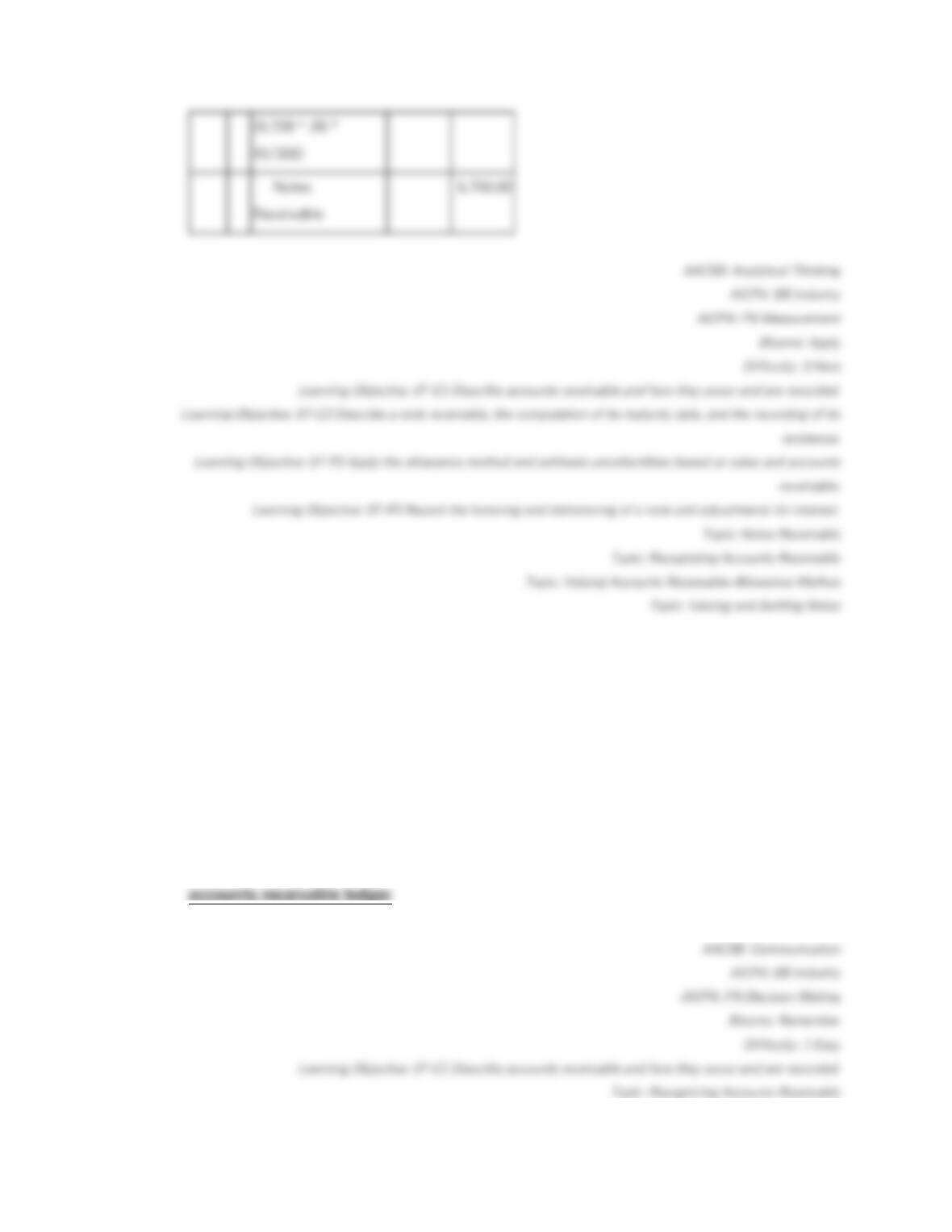
20
F. Potter dishonored his note when
presented for payment.
25
Received payment of principal plus
interest from Cory Tam.
Accounts
Sales (8,500 *
Cost of goods sold
Merchandise
Notes Receivable
Fill in the Blank Questions
198.
A supplementary record created to maintain a separate account for each customer is
called the ________________________.
199.
A ____________________ is a signed agreement to pay a specified amount of money either
on demand or at a definite future date.
200.
The person to whom a note is payable is known as the ______________.
201.
____________________ is the charge for using borrowed money until its due date.
202.
The ____________________ of a note is the day the principle plus interest of a note must be
repaid.
203.
Converting receivables to cash before they are due is usually done by either (1)
_______________________ or (2) ________________________________.
204.
The accounts receivable turnover is calculated by dividing _________________ by
________________.
205.
The _________________ method of accounting for bad debts records the loss from an
uncollectible account receivable at the time it is determined to be uncollectible (and not
before).
206.
____________________________ are amounts owed by customers from credit sales where
payment is required in periodic amounts over an extended time period.
207.
To write off an uncollectible account receivable when the allowance method of accounting
for uncollectible accounts is used, a company should debit _______________________ and
credit accounts receivable.
208.
The _________________________ method of computing uncollectible accounts uses income
statement relationships to estimate bad debts and is based on the idea that a given
percent of a company’s credit sales for a period are uncollectible.
209.
The ________________________ method of computing uncollectible accounts use balance
sheet relations to estimate bad debts—mainly the relation between accounts receivable
and the allowance amount.
210.
The _______________________ method uses both past and current receivables to estimate
the allowance amount, and assumes that the longer an amount is past due, the more likely
it is to be uncollectible.
211.
Felton Corporation purchased $4,000 in merchandise from Marita Co. Felton signed a 60–
day, 10%, $4,000 promissory note. Marita should record the sale with a journal entry
debiting ____________________ for $________ and crediting __________________ for
$________.
212.
When the maker of a note is unable or refuses to pay at maturity, the note is said to be
___________________.
213.
_______________ refers to the expected proceeds from converting an asset into cash.