158.
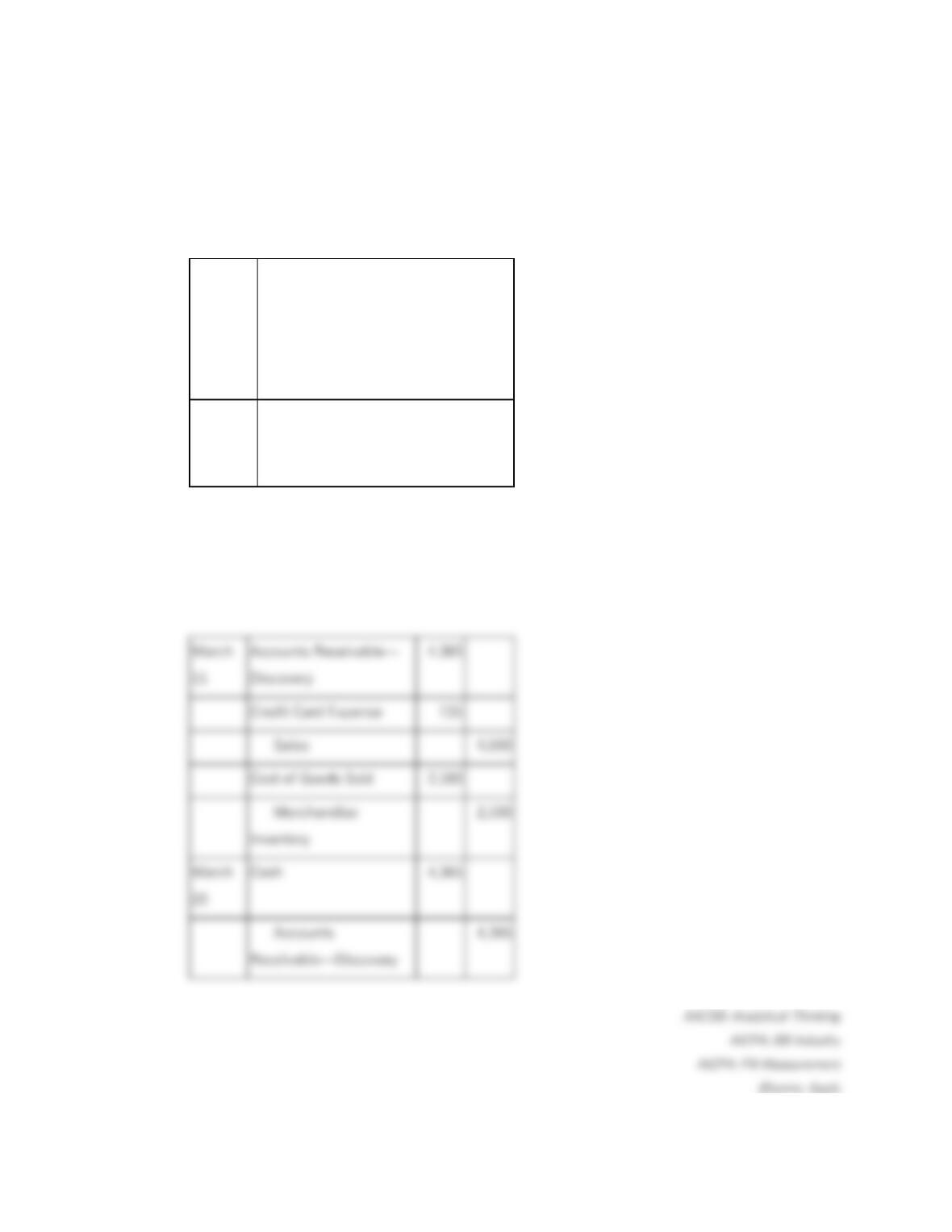
Mercks accepts the Discovery credit card for credit card sales. Mercks sends credit card
receipts to Discovery on a weekly basis. Discovery charges Mercks a 3% fee. Mercks
usually receives payment from Discovery within a week. Prepare journal entries to record
the following transactions.
March 11
Sold merchandise for $4,500 (that had
cost $2,100) and accepted the
customer’s Discovery card.
Transferred the credit card receipts to
Discovery, requesting payment.
March 20
Received Discovery’s check for the
March 11 billing, less the service
charge.
159.
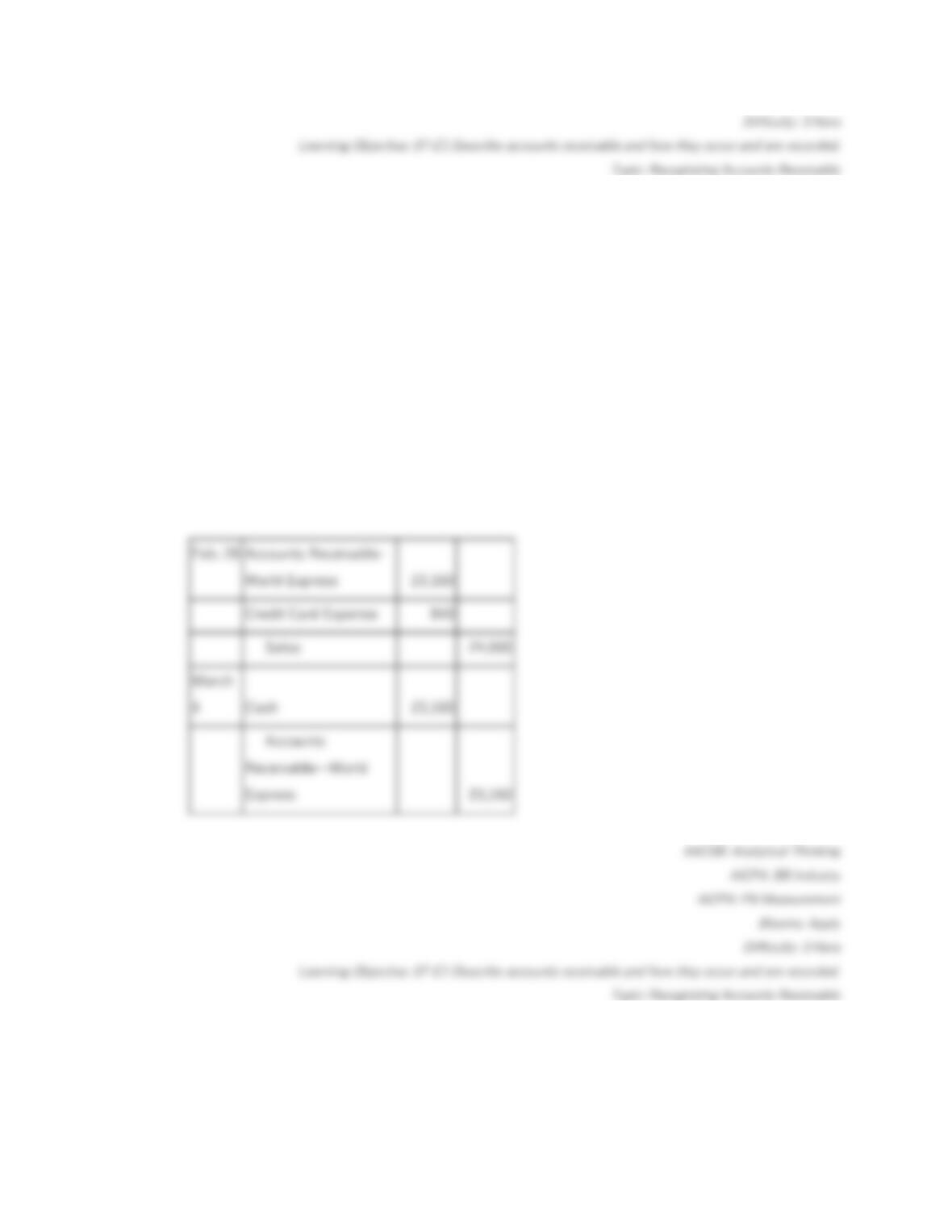
Woods Co. accepts the World Express credit card from its customers. World Express
charges a 3.5% service fee and pays Woods the amount net of World Express charges
once a month. During February, Woods sold $24,000 worth of merchandise to customers
using the World Express charge card. On February 28, Woods sent the $24,000 worth of
credit card receipts to World Express. On March 4, Woods received cash proceeds from
World Express for the February credit sales less the service charge. Prepare the journal
entries to record February sales and the March 4 cash receipt.
160.
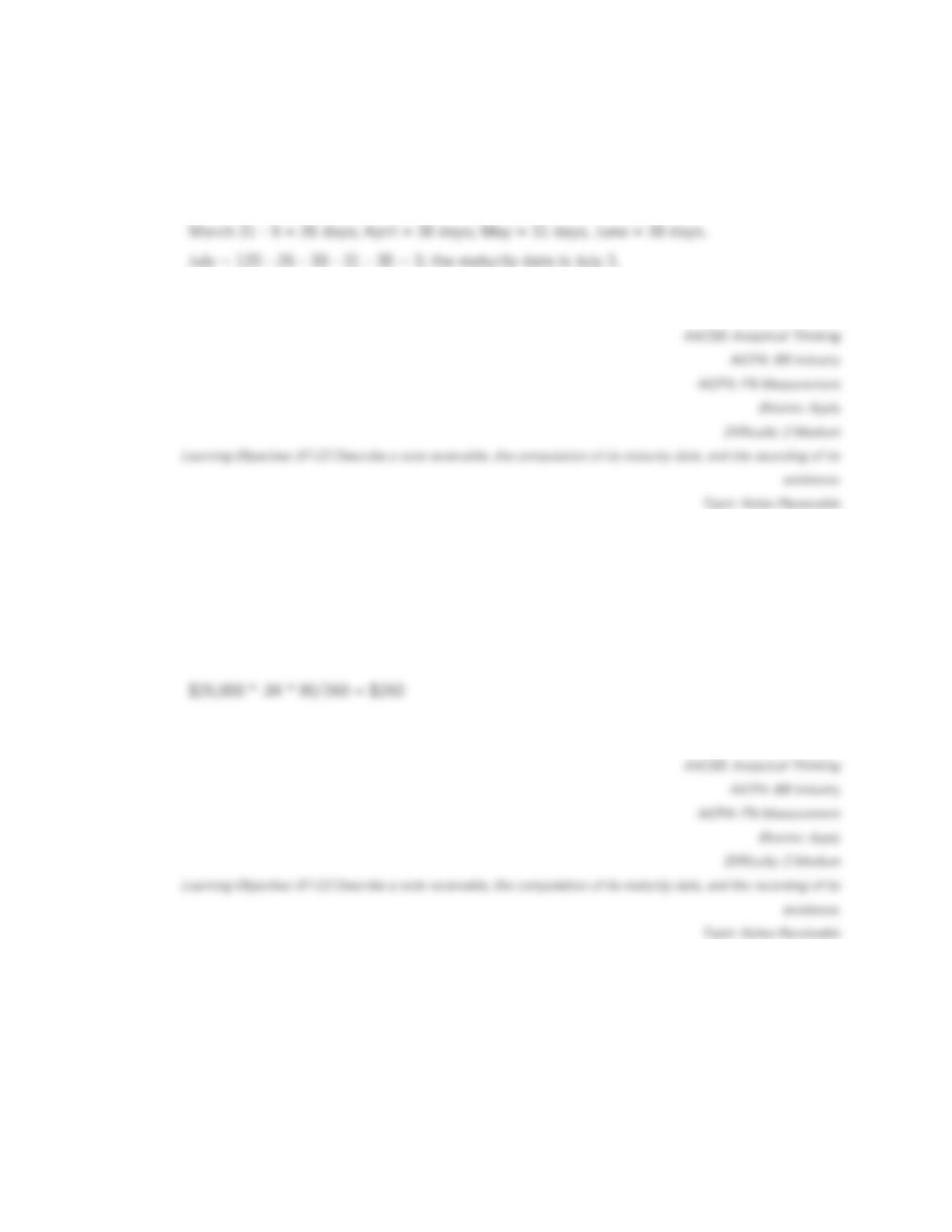
What is the maturity date of a 120-day note receivable dated March 5?
161.
Prudence Co. receives a $26,000, 90-day, 4% note receivable. What is the amount of
interest that is due at maturity?
162.
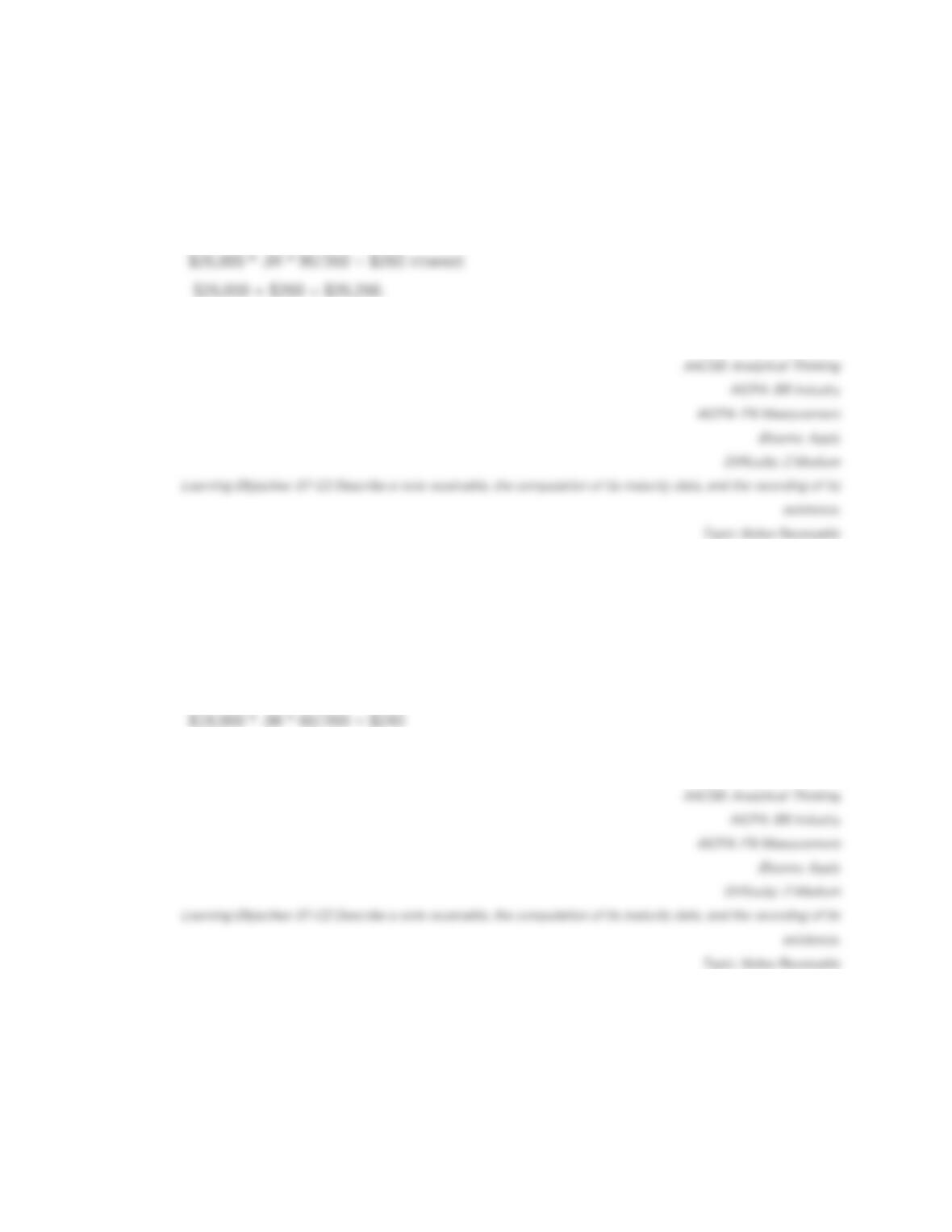
Prudence Co. receives a $26,000, 90-day, 4% note receivable. What is maturity value of the
note?
163.
Calculate the amount of interest that would be owed on a $18,000, 60-day, 8% note
receivable at maturity.
164.
If a 90-day note receivable is dated July 12, what is the maturity date of the note?
165.
If a 60-day note receivable is dated September 22, what is the maturity date of the note?
166.
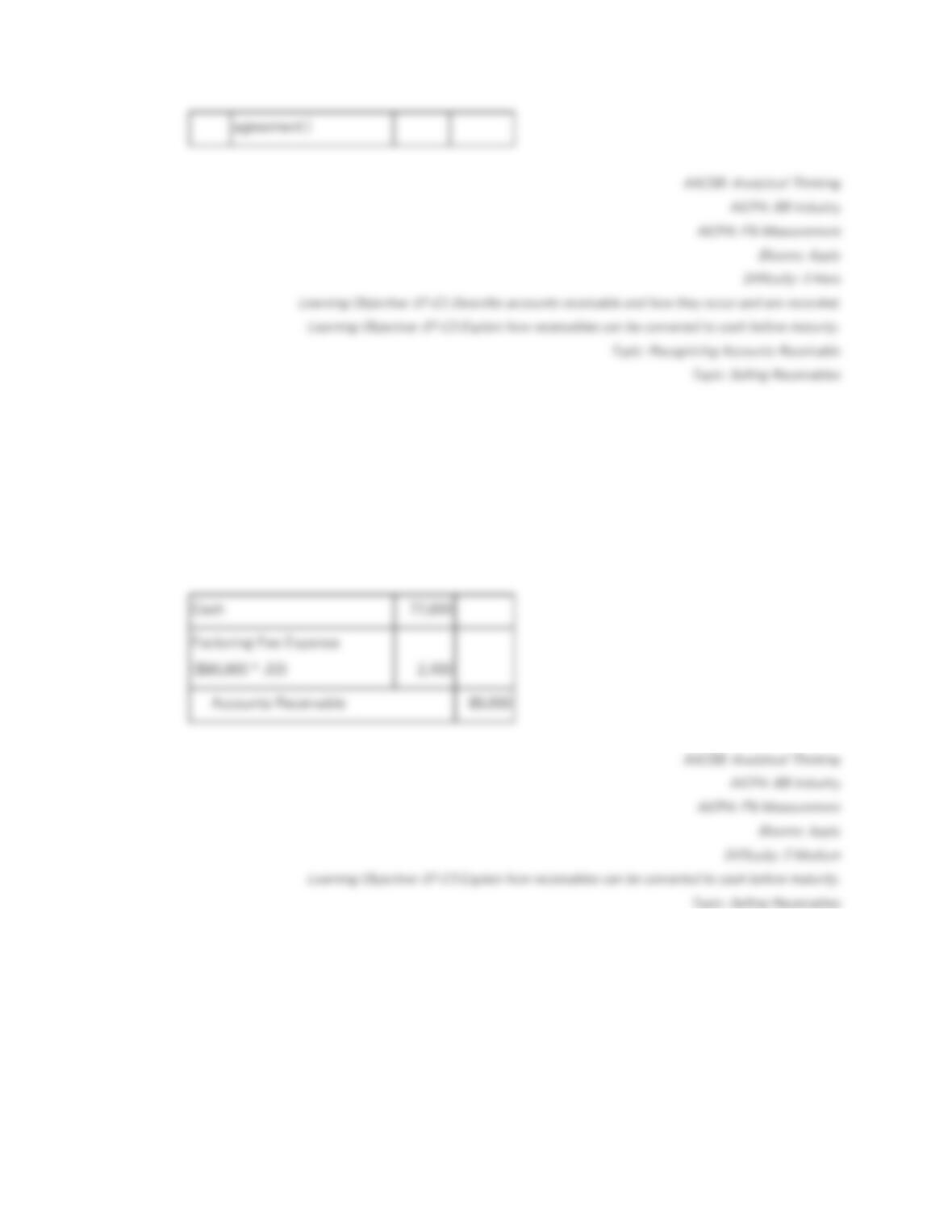
On May 31, a company had a balance in its accounts receivable of $103,200. Prepare
journal entries to record the following transactions for June.
June 2
Sold merchandise on account, $12,000.
The cost of the merchandise was $7,200.
June 8
Sold $15,000 worth of accounts
receivable to First Bank. First Bank
charged a 4% factoring fee.
June
20
Borrowed $30,000 cash from Second
National Bank, pledging $31,500 worth of
accounts receivable as collateral for the
loan.
Accounts Receivable
Sales
Cost of Goods Sold
Accounts Receivable
Notes Payable
167.
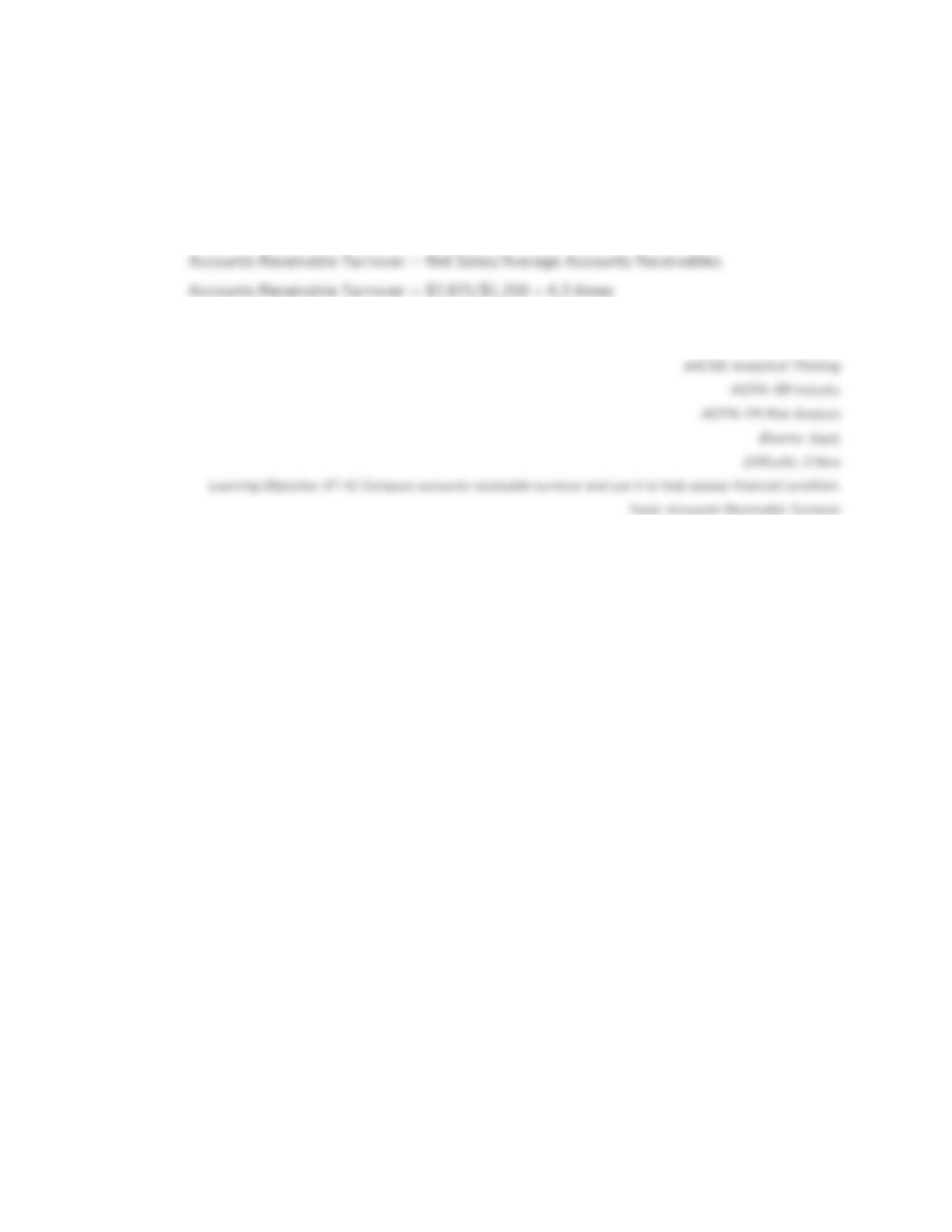
Orman Co. sold $80,000 of accounts receivable to First Savings and incurred a 3%
factoring fee. Prepare the journal entry for Orman Co. to record the sale.
168.
Flax had net sales of $7,875 and its average accounts receivables is $1,250. Calculate
Flax’s accounts receivable turnover:
169.
Morgan had net sales of $310,000 and average accounts receivable of $75,600. Its
competitor, Stanley, had net sales of $290,000 and average accounts receivables of
$61,350. Calculate the accounts receivable turnover for both companies. Which company
is doing a better job of managing its accounts receivables?
170.
A company reports the following results in its financial statements:
Year 3
Year 2
Year 1
Net Sales
$2,500,000
$2,100,000
$1,900,000
Accounts
receivable,
Ending
Balance
172,000
167,000
165,000
Calculate the company accounts receivable turnover for Year 2 and Year 3. Compare
these two results and give a possible explanation for any significant change.

171.
The Links Company uses the percent of sales method of accounting for uncollectible
accounts receivable. During the current year, the following transactions occurred:
Sept 7
Links Company determined that the
$8,000 account receivable of the Rainier
Company was uncollectible, and wrote it
off.
Oct 15
Links Company determined that the
$3,500 account receivable of the Olympic
Company was uncollectible and wrote it
off.
Nov 9
Rainier Company paid $6,000 of the
amount owed to the Links Company.
Links Company does not expect further
collections from the Rainier Company.
Dec 31
Links Company estimates that 1% of its
$1,900,000 of credit sales would be
uncollectible.
1. Prepare the general journal entries to record these transactions.
2. If the balance of the allowance for doubtful accounts was a $4,000 credit on January 1
of the current year, determine the balance of the allowance for doubtful accounts at
December 31 of the current year. Assume that the transactions above are the only
transactions affecting the allowance for doubtful accounts during the year.
1.
172.
The Barron Company uses the percent of sales method of accounting for uncollectible
accounts. Barron Company estimates that 1% of its $2,900,000 of credit sales will be
uncollectible. If the balance of the allowance for doubtful accounts was a $4,000 credit
before adjustment at the end of the year, prepare the adjusting entry Barron must record.
173.
The Branson Company uses the percent of sales method of accounting for uncollectible
accounts receivable. During the current year, the following transactions occurred:
Mar 7
Branson Company determined that the
$2,000 account receivable of the Bing
Company was uncollectible, and wrote it
off.
Jun 9
Bing Company paid $1,500 of the amount
owed to the Branson Company. Branson
Company does not expect further
collections from the Bing Company.
Dec
31
Branson Company estimates that 1.5% of
its $900,000 of credit sales will be
uncollectible.
Prepare the general journal entries to record these transactions.
174.
The Waring Company uses the allowance method of accounting for uncollectible accounts
receivable. During the current year, the following transactions occurred:
Mar 7
Waring Company determined that the
$1,700 account receivable of the Abraham
Company was uncollectible, and wrote it
off.
Jun 9
Abraham Company paid half of the
amount owed to the Waring Company.
Waring Company does not expect further
collections from the Abraham Company.
Prepare the general journal entries to record these transactions.
175.
Thatcher Company had a January 1, credit balance in its Allowance for Doubtful Accounts
of $4,000 for the current year. The following transactions and events affected the
Allowance for Doubtful Accounts during the current year:
Apr 15
Bean’s account receivable of $2,700 was
deemed uncollectible.
July 1
Cho paid the full amount of a previously
written-off account receivable. This
receivable of $1,300 had been written off
in the prior year.
Dec
31
Bad debts expense of $4,500 was
recorded.
What amount should appear in the allowance for doubtful accounts in the December 31,
balance sheet for the current year?
176.
Owens Company uses the direct write-off method of accounting for uncollectible accounts
receivable. On December 6, Year 1, Owens sold $6,300 of merchandise to the Valley
Company. On August 8, Year 2, after numerous attempts to collect the account, Owens
determined that the account of the Valley Company was uncollectible.
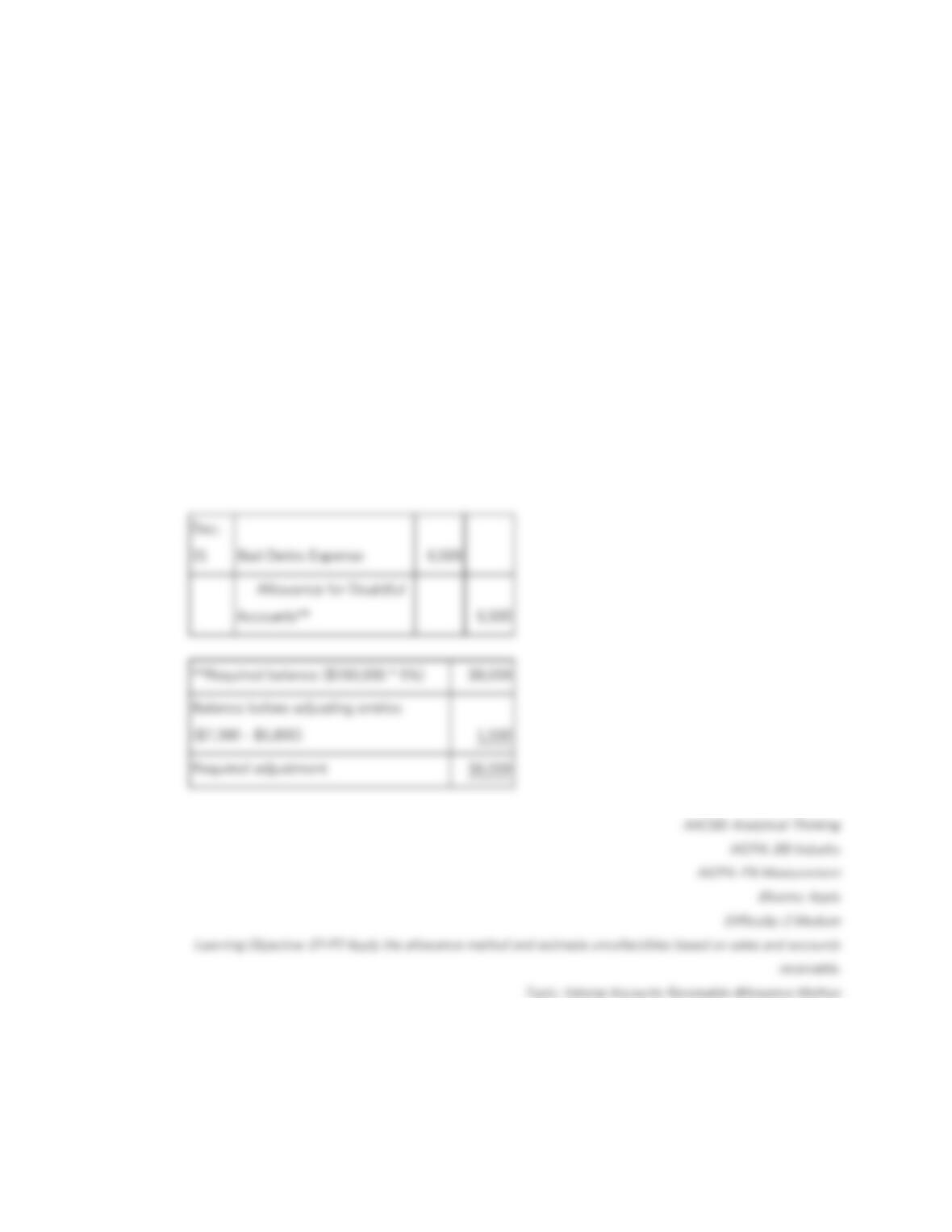
a. Prepare the journal entry required to record the transactions on August 8.
b. Assuming that the $6,300 is material, explain how the direct write-off method violates
the matching principle in this case.
177.
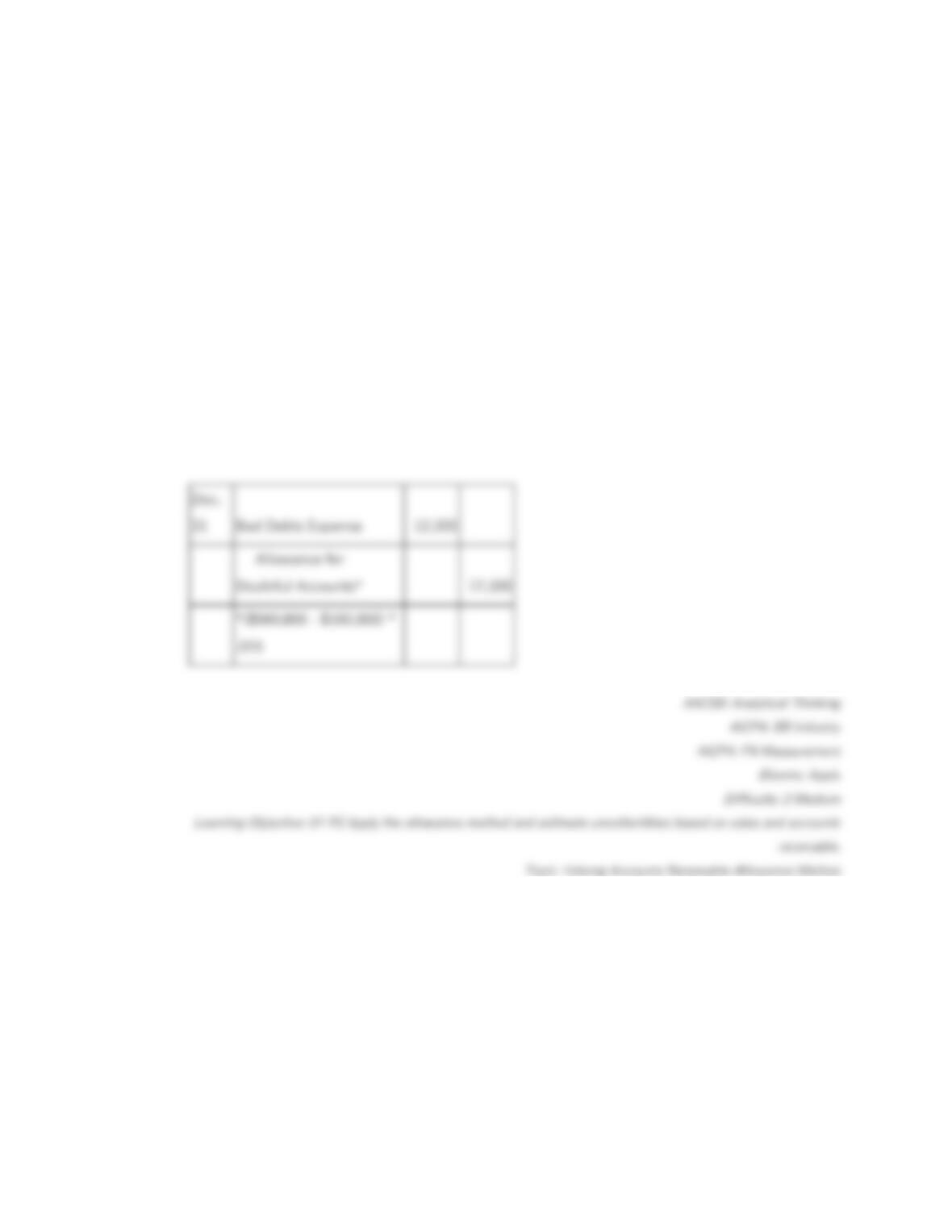
At December 31 of the current year, a company reported the following:
Total sales for the current year: $980,000 includes $160,000 in cash sales
Accounts receivable balance at Dec. 31, end of current year: $160,000
Allowance for Doubtful Accounts balance at January 1, beginning of current year: $7,300
credit
Bad debts written off during the current year: $5,800.
Prepare the necessary adjusting entries to record bad debts expense assuming this
company’s bad debts are estimated to equal 5% of accounts receivable.
178.
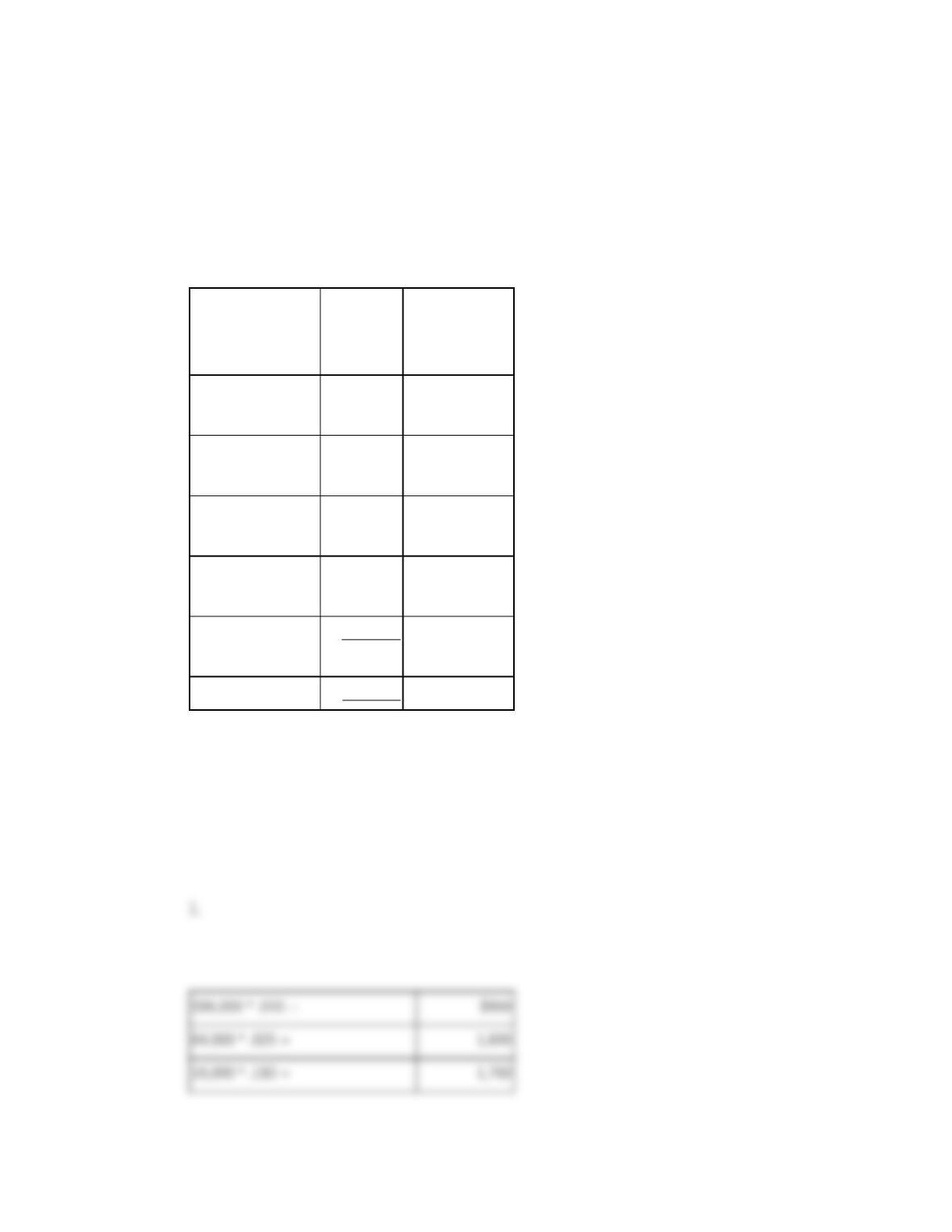
At December 31 of the current year, a company reported the following:
Total sales for the current year: $980,000 includes $160,000 in cash sales
Accounts receivable balance at Dec. 31, end of current year: $160,000
Allowance for Doubtful Accounts balance at January 1, beginning of current year: $7,300
Bad debts written off during the current year: $5,800.
Prepare the necessary adjusting entries to record bad debts expense assuming this
company’s bad debts are estimated to equal 1.5% of credit sales:
179.
A company has the following unadjusted account balances at December 31, of the current
year; Accounts Receivable of $185,700 and Allowance for Doubtful Accounts of $1,600
(credit balance). The company uses the aging of accounts receivable to estimate its bad
debts. The following aging schedule reflects its accounts receivable at the current year–
end:
Account Age
Balance
Estimated
Uncollectible
Percentage
Current (not yet
due)
$96,000
1.0%
1—30 days past
due
64,000
2.5%
30—60 days past
due
16,000
11.0%
61—90 days past
due
6,500
37.0%
Over 90 days past
due
3,200
70.0%
Total
$185,700
1. Calculate the amount of the Allowance for Doubtful Accounts that should appear on the
December 31, of the current year, balance sheet.
2. Prepare the adjusting journal entry to record bad debts expense for the current year.