
Name:
Class:
Date:
chapter 7
Indicate whether the statement is true or false.
1. On the variable costing income statement, variable selling and administrative expenses are deducted from
manufacturing margin to yield contribution margin.
a.
True
b.
False
2. Electricity purchased to operate factory machinery would be included as part of the cost of products manufactured
under the absorption costing concept.
a.
True
b.
False
3. For a period during which the quantity of product manufactured exceeds the quantity sold, operating income reported
under absorption costing will be smaller than operating income reported under variable costing.
a.
True
b.
False
4. In a service firm, it may be necessary to have several activity bases to properly match the change in costs with the
changes in various activities.
a.
True
b.
False
5. Sales mix is generally defined as the relative distribution of sales among the various products sold.
a.
True
b.
False
6. For an accounting period during which the quantity of inventory at the end is smaller than the quantity at the beginning,
operating income reported under variable costing will be larger than operating income reported under absorption costing.
a.
True
b.
False
7. On the absorption costing income statement, deduction of the cost of goods sold from sales yields contribution margin.
a.
True
b.
False
8. For short-run production planning, information in the variable costing format is more useful to management than is
information in the absorption costing concept format.
a.
True
b.
False
9. Direct labor cost is an example of a controllable cost for the supervisor of a manufacturing department.
a.
True
b.
False
10. Variable costing is appropriate only for manufacturing firms, not for service firms.
a.
True

Name:
Class:
Date:
chapter 7
a.
True
b.
False
11. In the long run, for a business to remain in operation, the revenues from products sold should normally cover all costs
and expenses and provide a reasonable income.
a.
True
b.
False
12. The contribution margin and the manufacturing margin are usually equal.
a.
True
b.
False
13. Under absorption costing, the cost of finished goods includes direct materials, direct labor, and all factory overhead.
a.
True
b.
False
14. Property taxes on a factory building would be included as part of the cost of products manufactured under the
absorption costing concept.
a.
True
b.
False
15. Under absorption costing, the amount of income reported from operations can be increased by producing more units
than are sold.
a.
True
b.
False
16. On the variable costing income statement, variable costs are deducted from contribution margin to yield
manufacturing margin.
a.
True
b.
False
17. In variable costing, the cost of products manufactured is composed of only those manufacturing costs that increase or
decrease as the volume of production rises or falls.
a.
True
b.
False
18. The absorption costing income statement does not distinguish between variable and fixed costs.
a.
True
b.
False
19. For a period during which the quantity of inventory at the end equals the inventory at the beginning, operating income
reported under variable costing will be smaller than operating income reported under absorption costing.
a.
True
b.
False
20. The factory superintendent’s salary would be included as part of the cost of products manufactured under the
absorption costing concept.

Name:
Class:
Date:
chapter 7
b.
False
21. The contribution margin ratio is computed as contribution margin divided by sales.
a.
True
b.
False
22. On the absorption costing income statement, deduction of the cost of goods sold from sales yields gross profit.
a.
True
b.
False
23. Management may use both absorption and variable costing methods for analyzing a particular product.
a.
True
b.
False
24. EBITDA represents operating income after income tax, depreciation, and amortization have been deducted.
a.
True
b.
False
25. In evaluating the performance of salespersons, the salesperson with the highest level of sales dollars should be
evaluated as the best performer.
a.
True
b.
False
26. On the variable costing income statement, deduction of the variable cost of goods sold from sales yields
manufacturing margin.
a.
True
b.
False
27. In variable costing, fixed costs do not become part of the cost of goods manufactured, but they are considered an
expense of the period.
a.
True
b.
False
28. The taxes on the factory superintendent’s salary would be included as part of the cost of products manufactured under
the variable costing concept.
a.
True
b.
False
29. On the variable costing income statement, deduction of the variable cost of goods sold from sales yields gross profit.
a.
True
b.
False
30. In the short run, the selling price of a product should normally not be less than the variable costs and expenses of
making and selling it.
a.
True
b.
False

Name:
Class:
Date:
chapter 7
31. For a period during which the quantity of product manufactured equals the quantity sold, operating income reported
under absorption costing will equal the operating income reported under variable costing.
a.
True
b.
False
32. Managers in service firms do not find contribution margin reports useful because their firms do not sell inventory.
a.
True
b.
False
33. Property tax expense is an example of a controllable cost for the supervisor of a manufacturing department.
a.
True
b.
False
34. For a period during which the quantity of product manufactured exceeds the quantity sold, operating income reported
under absorption costing will be larger than operating income reported under variable costing.
a.
True
b.
False
35. Service firms can only have one activity base for analyzing changes in costs.
a.
True
b.
False
36. On the absorption costing income statement, deduction of the cost of goods sold from sales yields net profit.
a.
True
b.
False
37. For a period during which the quantity of inventory at the end equals the inventory at the beginning, operating income
reported under variable costing will equal operating income reported under absorption costing.
a.
True
b.
False
38. For short-run production planning, information in the absorption costing format is more useful to management than is
information in the variable costing format.
a.
True
b.
False
39. In determining cost of goods sold, two alternate costing concepts can be used: direct costing and variable costing.
a.
True
b.
False
40. On the variable costing income statement, the amounts representing the difference between the contribution margin
and operating income are the fixed manufacturing costs and fixed selling and administrative expenses.
a.
True
b.
False
41. On the variable costing income statement, all of the fixed costs are deducted from the contribution margin.

Name:
Class:
Date:
chapter 7
a.
True
b.
False
42. Fixed factory overhead costs are included as part of the cost of products manufactured under the absorption costing
concept.
a.
True
b.
False
43. For a period during which the quantity of inventory at the end is larger than that at the beginning, operating income
reported under variable costing will be smaller than operating income reported under absorption costing.
a.
True
b.
False
44. If the ability to sell and the amount of production facilities devoted to each of two products are equal, it is profitable to
increase the sales of that product with the highest contribution margin.
a.
True
b.
False
45. Variable costing is also known as direct costing.
a.
True
b.
False
46. If the ability to sell and the amount of production facilities devoted to each of two products are equal, it is profitable to
increase the sales of that product with the lowest contribution margin.
a.
True
b.
False
47. For a period during which the quantity of inventory at the end is larger than that at the beginning, operating income
reported under variable costing will be larger than operating income reported under absorption costing.
a.
True
b.
False
48. Under absorption costing, the cost of finished goods includes only direct materials, direct labor, and variable factory
overhead.
a.
True
b.
False
49. For a period during which the quantity of product manufactured is less than the quantity sold, operating income
reported under absorption costing will be larger than operating income reported under variable costing.
a.
True
b.
False
50. Changes in the quantity of finished goods inventory, caused by differences in the levels of sales and production,
directly affect the amount of operating income reported under absorption costing.
a.
True
b.
False

Name:
Class:
Date:
chapter 7
51. For a period during which the quantity of product manufactured is less than the quantity sold, operating income
reported under absorption costing will be smaller than operating income reported under variable costing.
a.
True
b.
False
52. For a period during which the quantity of inventory at the end is smaller than that at the beginning, operating income
reported under variable costing will be smaller than operating income reported under absorption costing.
a.
True
b.
False
53. In determining cost of goods sold, two alternate costing concepts can be used: absorption costing and variable costing.
a.
True
b.
False
54. Under absorption costing, increases or decreases in operating income due to changes in inventory levels could be
misinterpreted to be the result of operating efficiencies or inefficiencies.
a.
True
b.
False
55. EBITDA removes a significant fixed and noncash cost from the operating income number and may approximate the
contribution margin.
a.
True
b.
False
56. For a period during which the quantity of product manufactured equals the quantity sold, operating income reported
under absorption costing will be smaller than the operating income reported under variable costing.
a.
True
b.
False
57. For internal decision-making purposes, managers may use EBITDA as a substitute for the contribution margin.
a.
True
b.
False
Indicate the answer choice that best completes the statement or answers the question.
58. The level of inventory of a manufactured product has increased by 7,000 units during a period. The following data are
also available:
Variable
Fixed
Unit manufacturing costs of the period
$12.00
$6.00
Unit operating expenses of the period
4.00
1.50
The effect on operating income if absorption costing is used rather than variable costing would be a
a.
$42,000 decrease
b.
$42,000 increase
c.
$52,500 increase
d.
$52,500 decrease

Name:
Class:
Date:
chapter 7
59. A business operated at 100% of capacity during its first month, with the following results:
Sales (160 units)
$160,000
Production costs (200 units):
Direct materials
$100,000
Direct labor
20,000
Variable factory overhead
10,000
Fixed factory overhead
4,000
134,000
Operating expenses:
Variable operating expenses
$ 12,000
Fixed operating expenses
2,000
14,000
The amount of manufacturing margin that would be reported on the variable costing income statement is
a.
$30,000
b.
$38,000
c.
$56,000
d.
$44,000
60. A business operated at 100% of capacity during its first month and incurred the following costs:
Production costs (10,000 units):
Direct materials
$140,000
Direct labor
40,000
Variable factory overhead
20,000
Fixed factory overhead
4,000
$204,000
Operating expenses:
Variable operating expenses
$ 34,000
Fixed operating expenses
2,000
36,000
If 2,000 units remain unsold at the end of the month and sales total $300,000 for the month, the amount of operating
income reported on the variable costing income statement would be
a.
$100,800
b.
$100,000
c.
$114,800
d.
$140,000
A business operated at 100% of capacity during its first month, with the following results:
Sales (90 units)
$90,000
Production costs (100 units):
Direct materials
$40,000
Direct labor
20,000
Variable factory overhead
2,000
Fixed factory overhead
7,000
69,000
Operating expenses:
Variable operating expenses
$ 8,000
Fixed operating expenses
1,000
9,000

Name:
Class:
Date:
chapter 7
61. The amount of gross profit that would be reported on the absorption costing income statement is
a.
$21,000
b.
$18,900
c.
$27,900
d.
$18,000
62. A business operated at 100% of capacity during its first month and incurred the following costs:
Production costs (20,000 units):
Direct materials
$180,000
Direct labor
240,000
Variable factory overhead
280,000
Fixed factory overhead
100,000
$800,000
Operating expenses:
Variable operating expenses
$130,000
Fixed operating expenses
50,000
180,000
If 1,600 units remain unsold at the end of the month, the amount of inventory that would be reported on the variable
costing balance sheet is
a.
$64,000
b.
$56,000
c.
$66,400
d.
$78,400
63. Under which inventory costing method could increases or decreases in operating income be misinterpreted to be the
result of operating efficiencies or inefficiencies?
a.
only variable costing
b.
only absorption costing
c.
both variable and absorption costing
d.
neither variable nor absorption costing
64. A business operated at 100% of capacity during its first month and incurred the following costs:
Production costs (20,000 units):
Direct materials
$180,000
Direct labor
240,000
Variable factory overhead
280,000
Fixed factory overhead
100,000
$800,000
Operating expenses:
Variable operating expenses
$130,000
Fixed operating expenses
50,000
180,000
If 1,500 units remain unsold at the end of the month, the amount of inventory that would be reported on the variable
costing balance sheet is
a.
$62,500
b.
$73,500
c.
$60,000

Name:
Class:
Date:
chapter 7
d.
$52,500
65. Under absorption costing, which of the following costs would not be included in finished goods inventory?
a.
direct labor cost
b.
direct materials cost
c.
variable and fixed factory overhead cost
d.
variable and fixed selling and administrative expenses
66. S&P Enterprises sold 10,000 units of inventory during a given period. The level of inventory of the manufactured
product remained unchanged. The manufacturing costs were as follows:
Variable
Fixed
Unit manufacturing costs of the period
$11.00
$7.00
Unit operating expenses of the period
3.00
2.50
Which of the following statements is true?
a.
Net income will be the same under both variable and absorption costing.
b.
Net income under variable costing will be $45,000 less than net income under absorption costing.
c.
Net income under absorption costing will be $40,000 more than under variable costing.
d.
The difference in net income cannot be determined.
67. Which of the following would be included in the cost of a product manufactured according to absorption costing?
a.
advertising expense
b.
sales salaries
c.
depreciation expense on factory building
d.
office supplies costs
68. Management should focus its sales and production efforts on the product or products that will provide the
a.
highest sales revenue
b.
lowest product costs
c.
maximum contribution margin
d.
lowest direct labor hours
69. Under absorption costing, which of the following costs would not be included in finished goods inventory?
a.
hourly wages of assembly worker
b.
straight-line depreciation on factory equipment
c.
overtime wages paid to factory workers
d.
the salaries for salespeople
70. Which of the following would be included in the cost of a product manufactured according to variable costing?
a.
sales commissions
b.
office supply costs
c.
interest expense
d.
direct materials
71. A business operated at 100% of capacity during its first month and incurred the following costs:

Name:
Class:
Date:
chapter 7
Production costs (5,000 units):
Direct materials
$70,000
Direct labor
20,000
Variable factory overhead
10,000
Fixed factory overhead
2,000
$102,000
Operating expenses:
Variable operating expenses
$17,000
Fixed operating expenses
1,000
18,000
If 1,000 units remain unsold at the end of the month and sales total $150,000 for the month, the amount of manufacturing
margin that would be reported on the absorption costing income statement is
a.
$50,000
b.
$54,000
c.
not reported
d.
$70,000
72. A business operated at 100% of capacity during its first month and incurred the following costs:
Production costs (10,000 units):
Direct materials
$ 80,000
Direct labor
120,000
Variable factory overhead
140,000
Fixed factory overhead
40,000
$380,000
Operating expenses:
Variable operating expenses
$ 65,000
Fixed operating expenses
25,000
90,000
If 1,000 units remain unsold at the end of the month, the amount of inventory that would be reported on the absorption
costing balance sheet is
a.
$38,000
b.
$40,500
c.
$34,000
d.
$47,000
73. The relative distribution of sales among the various products sold is referred to as the
a.
by-product mix
b.
joint product mix
c.
profit mix
d.
sales mix
A business operated at 100% of capacity during its first month, with the following results:
Sales (90 units)
$90,000
Production costs (100 units):
Direct materials
$40,000
Direct labor
20,000
Variable factory overhead
2,000
Fixed factory overhead
7,000
69,000

Name:
Class:
Date:
chapter 7
Operating expenses:
Variable operating expenses
$ 8,000
Fixed operating expenses
1,000
9,000
74. The amount of operating income that would be reported on the absorption costing income statement is
a.
$21,000
b.
$18,900
c.
$18,200
d.
$27,900
75. Which of the following is not true when determining the selling price for a product?
a.
Absorption costing should be used to determine routine pricing which includes both fixed and variable costs.
b.
As long as the selling price is set above the variable costs, the company will make a profit in the short run.
c.
Variable costing is effective when determining short-run decisions, but absorption costing is only used for
long-term pricing policies.
d.
Both variable and absorption pricing plans should be considered, to include several pricing alternatives.
76. The amount of income under absorption costing will equal the amount of income under variable costing when units
manufactured
a.
exceed units sold
b.
equal units sold
c.
are less than units sold
d.
are equal to or greater than units sold
77. The level of inventory of a manufactured product has increased by 4,000 units during a period. The following data are
also available:
Variable
Fixed
Unit manufacturing costs of the period
$22.00
$11.00
Unit operating expenses of the period
7.00
5.00
The effect on operating income if absorption costing is used rather than variable costing would be a
a.
$44,000 decrease
b.
$44,000 increase
c.
$64,000 increase
d.
$64,000 decrease
78. A business operated at 100% of capacity during its first month and incurred the following costs:
Production costs (5,000 units):
Direct materials
$70,000
Direct labor
20,000
Variable factory overhead
10,000
Fixed factory overhead
2,000
$102,000
Operating expenses:
Variable operating expenses
$17,000

Name:
Class:
Date:
chapter 7
Fixed operating expenses
1,000
18,000
If 1,000 units remain unsold at the end of the month and sales total $150,000 for the month, the amount of contribution
margin that would be reported on the variable costing income statement is
a.
$51,400
b.
$52,000
c.
$54,000
d.
$53,000
79. Management will use both variable and absorption costing in all of the following activities except
a.
controlling costs
b.
product pricing
c.
production planning
d.
controlling inventory levels
A business operated at 100% of capacity during its first month, with the following results:
Sales (90 units)
$90,000
Production costs (100 units):
Direct materials
$40,000
Direct labor
20,000
Variable factory overhead
2,000
Fixed factory overhead
7,000
69,000
Operating expenses:
Variable operating expenses
$ 8,000
Fixed operating expenses
1,000
9,000
80. The amount of operating income that would be reported on the variable costing income statement is
a.
$18,900
b.
$18,200
c.
$18,000
d.
$21,000
81. Costs that can be influenced by management at a specific level of management are called
a.
direct costs
b.
variable costs
c.
noncontrollable costs
d.
controllable costs
82. In the variable costing income statement, deduction of variable selling and administrative expenses from
manufacturing margin yields
a.
differential margin
b.
contribution margin
c.
gross profit
d.
marginal expenses

Name:
Class:
Date:
chapter 7
83. A business operated at 100% of capacity during its first month and incurred the following costs:
Production costs (2,500 units):
Direct materials
$42,500
Direct labor
85,000
Variable factory overhead
47,500
Fixed factory overhead
12,500
$187,500
Operating expenses:
Variable operating expenses
$15,000
Fixed operating expenses
4,500
19,500
If 75 units remain unsold at the end of the month, the amount of inventory that would be reported on the absorption
costing balance sheet is
a.
$5,625
b.
$5,250
c.
$5,760
d.
$6,210
84. A business operated at 100% of capacity during its first month and incurred the following costs:
Production costs (10,000 units):
Direct materials
$170,000
Direct labor
360,000
Variable factory overhead
190,000
Fixed factory overhead
50,000
$770,000
Operating expenses:
Variable operating expenses
$ 60,000
Fixed operating expenses
18,000
78,000
If 500 units remain unsold at the end of the month, the amount of inventory that would be reported on the variable costing
balance sheet is
a.
$41,500
b.
$36,000
c.
$42,800
d.
$38,500
85. Another name for variable costing is
a.
indirect costing
b.
process costing
c.
direct costing
d.
differential costing
86. Which of the following statements is correct using the direct costing concept?
a.
All manufacturing costs are included in the calculation of cost of goods manufactured.
b.
Only fixed costs are included in the calculation of cost of goods manufactured, while variable costs are
considered period costs.
c.
Only variable manufacturing costs are included in the calculation of cost of goods manufactured, while fixed

Name:
Class:
Date:
chapter 7
costs are considered period costs.
d.
All manufacturing costs are considered period costs.
87. Which of the following would not be an appropriate activity base for cost analysis in a service firm?
a.
lawns mowed
b.
inventory produced
c.
customers served
d.
haircuts given
88. A business operated at 100% of capacity during its first month and incurred the following costs:
Production costs (10,000 units):
Direct materials
$140,000
Direct labor
40,000
Variable factory overhead
20,000
Fixed factory overhead
4,000
$204,000
Operating expenses:
Variable operating expenses
$ 34,000
Fixed operating expenses
2,000
36,000
If 2,000 units remain unsold at the end of the month and sales total $300,000 for the month, the amount of manufacturing
margin that would be reported on the variable costing income statement is
a.
$104,000
b.
$106,000
c.
$140,000
d.
not reported
A business operated at 100% of capacity during its first month, with the following results:
Sales (90 units)
$90,000
Production costs (100 units):
Direct materials
$40,000
Direct labor
20,000
Variable factory overhead
2,000
Fixed factory overhead
7,000
69,000
Operating expenses:
Variable operating expenses
$ 8,000
Fixed operating expenses
1,000
9,000
89. The amount of contribution margin that would be reported on the variable costing income statement is
a.
$34,200
b.
$20,200
c.
$29,700
d.
$26,200
90. Jake Entertainment Corporation has three segments with revenue, operating income, and depreciation and
Name:
Class:
Date:
chapter 7
amortization information (in millions) as follows:
Segment
Revenue
Operating
Income
Depreciation
and Amortization
Film
$5,000
$1,500
$525
Theme Park
1,000
320
112
Video Game
500
175
53
Totals
$6,500
$1,995
$690
The EBITDA for the Theme Park segment is
a.
$432 million
b.
$568 million
c.
$680 million
d.
$792 million
91. The amount of income under absorption costing will be less than the amount of income under variable costing when
units manufactured
a.
exceed units sold
b.
equal units sold
c.
are less than units sold
d.
are equal to or greater than units sold
92. Jake Entertainment Corporation has three segments with revenue, operating income, and depreciation and
amortization information (in millions) as follows:
Segment
Revenue
Operating
Income
Depreciation
and Amortization
Film
$5,000
$1,500
$525
Theme Park
1,000
320
112
Video Game
500
175
53
Totals
$6,500
$1,995
$690
The EBITDA for the Film segment is
a.
$975 million
b.
$2,025 million
c.
$2,975 million
d.
$4,475 million
93. The contribution margin ratio is computed as
a.
sales divided by contribution margin
b.
contribution margin divided by sales
c.
contribution margin divided by cost of sales
d.
contribution margin divided by variable cost of sales
94. A business operated at 100% of capacity during its first month and incurred the following costs:

Name:
Class:
Date:
chapter 7
Production costs (5,000 units):
Direct materials
$70,000
Direct labor
20,000
Variable factory overhead
10,000
Fixed factory overhead
2,000
$102,000
Operating expenses:
Variable operating expenses
$17,000
Fixed operating expenses
1,000
18,000
If 1,000 units remain unsold at the end of the month and sales total $150,000 for the month, the amount of operating
income reported on the absorption costing income statement would be
a.
$50,400
b.
$70,000
c.
$52,000
d.
$68,400
95. Under variable costing, which of the following costs would not be included in finished goods inventory?
a.
direct labor cost
b.
direct materials cost
c.
variable factory overhead cost
d.
fixed factory overhead cost
96. Jake Entertainment Corporation has three segments with revenue, operating income, and depreciation and
amortization information (in millions) as follows:
Segment
Revenue
Operating
Income
Depreciation
and Amortization
Film
$5,000
$1,500
$525
Theme Park
1,000
320
112
Video Game
500
175
53
Totals
$6,500
$1,995
$690
The EBITDA as a percent of revenue for the Video Game segment is
a.
4%
b.
24%
c.
46%
d.
54%
97. It would be acceptable to have the selling price of a product just above the variable costs and expenses of making and
selling it in
a.
the long run
b.
the short run
c.
both the short and long run
d.
neither the short nor the long run

Name:
Class:
Date:
chapter 7
98. Under variable costing, which of the following costs would be included in finished goods inventory?
a.
neither variable nor fixed factory overhead cost
b.
both variable and fixed factory overhead cost
c.
only variable factory overhead cost
d.
only fixed factory overhead cost
99. Accountants prefer the variable costing method over the absorption costing method for evaluating the performance of
a company because
a.
by using the absorption costing method, income could appear to be higher by producing more inventory.
b.
by using the absorption costing method, income could appear to be lower by producing more inventory.
c.
by using the variable costing method, the cost of goods sold will be higher as more units are manufactured and
sales remain the same.
d.
by using the variable costing method, all fixed and variable costs are included in the unit cost of the product
manufactured.
100. The amount of income under absorption costing will be more than the amount of income under variable costing when
units manufactured
a.
exceed units sold
b.
equal units sold
c.
are less than units sold
d.
are equal to or greater than units sold
101. Which of the following terms is commonly used to describe the concept whereby the cost of manufactured products
is composed of direct materials cost, direct labor cost, and variable factory overhead cost?
a.
absorption costing
b.
differential costing
c.
standard costing
d.
variable costing
102. Which of the following is a reason for easy identification and control of variable manufacturing costs under the
variable costing method?
a.
Variable and fixed costs are reported separately.
b.
Variable costs can be controlled by the operating management.
c.
Fixed costs, such as property insurance, are normally the responsibility of higher management not the
operating management.
d.
all of these choices
103. The level of inventory of a manufactured product has increased by 5,000 units during a period. The following data
are also available:
Variable
Fixed
Unit manufacturing costs of the period
$24.00
$10.00
Unit operating expenses of the period
8.00
3.00
The effect on operating income if variable costing is used rather than absorption costing would be a
a.
$50,000 decrease
b.
$50,000 increase

Name:
Class:
Date:
chapter 7
c.
$65,000 increase
d.
$65,000 decrease
104. The level of inventory of a manufactured product has increased by 8,000 units during a period. The following data
are also available:
Variable
Fixed
Unit manufacturing costs of the period
$24.00
$10.00
Unit operating expenses of the period
8.00
3.00
The effect on operating income if absorption costing is used rather than variable costing would be a(n)
a.
$80,000 decrease
b.
$80,000 increase
c.
$104,000 increase
d.
$104,000 decrease
105. A business operated at 100% of capacity during its first month and incurred the following costs:
Production costs (10,000 units):
Direct materials
$ 80,000
Direct labor
120,000
Variable factory overhead
140,000
Fixed factory overhead
40,000
$380,000
Operating expenses:
Variable operating expenses
$ 65,000
Fixed operating expenses
25,000
90,000
If 600 units remain unsold at the end of the month, the amount of inventory that would be reported on the absorption
costing balance sheet is
a.
$24,300
b.
$28,200
c.
$22,800
d.
$34,000
106. On the variable costing income statement, the figure representing the difference between manufacturing margin and
contribution margin is
a.
fixed manufacturing costs
b.
variable cost of goods sold
c.
fixed selling and administrative expenses
d.
variable selling and administrative expenses
107. Under variable costing, which of the following costs would not be included in finished goods inventory?
a.
wages of machine operator
b.
steel costs for a machine tool manufacturer
c.
salary of factory supervisor
d.
electricity used by factory machinery
108. The level of inventory of a manufactured product has increased by 8,000 units during a period. The following data

Name:
Class:
Date:
chapter 7
are also available:
Variable
Fixed
Unit manufacturing costs of the period
$24.00
$10.00
Unit operating expenses of the period
8.00
3.00
The effect on operating income if variable costing is used rather than absorption costing would be a(n)
a.
$80,000 decrease
b.
$80,000 increase
c.
$104,000 decrease
d.
$104,000 increase
109. Jake Entertainment Corporation has three segments with revenue, operating income, and depreciation and
amortization information (in millions) as follows:
Segment
Revenue
Operating
Income
Depreciation
and Amortization
Film
$5,000
$1,500
$525
Theme Park
1,000
320
112
Video Game
500
175
53
Totals
$6,500
$1,995
$690
The segment with the highest EBITDA as a percent of revenue is
a.
Film
b.
Theme Park
c.
Video Game
d.
The Theme Park and Video Game segments have equal EBITDA as a percent of revenue.
110. Which of the following terms is commonly used to describe the concept whereby the cost of manufactured products
is composed of direct materials cost, direct labor cost, and all factory overhead cost?
a.
standard costing
b.
variable costing
c.
absorption costing
d.
marginal costing
111. For a supervisor of a manufacturing department, which of the following costs is controllable?
a.
direct materials
b.
insurance on factory building
c.
depreciation of factory building
d.
sales salaries
112. Under variable costing, which of the following costs would be included in finished goods inventory?
a.
salary of salesperson
b.
salary of vice president of finance
c.
wages of carpenters in a furniture factory
d.
straight-line depreciation on factory equipment

Name:
Class:
Date:
chapter 7
113. Contribution margin reporting can be beneficial for analyzing which of the following?
a.
sales personnel
b.
products
c.
sales territory
d.
all of these choices
Match each of the following descriptions with the appropriate costing concept (a–c).
a.
Absorption costing only
b.
Variable costing only
c.
Both absorption and variable costing
114. Treats fixed selling cost as a period cost
115. Required by generally accepted accounting principles
116. Treats fixed manufacturing cost as a period cost
117. Operating income impacted by changes in inventory level
118. Generally provides the most useful report for controlling costs
119. Generally provides the most useful report for setting long-term prices
120. May be used in a manufacturing company
121. Includes gross profit on the income statement
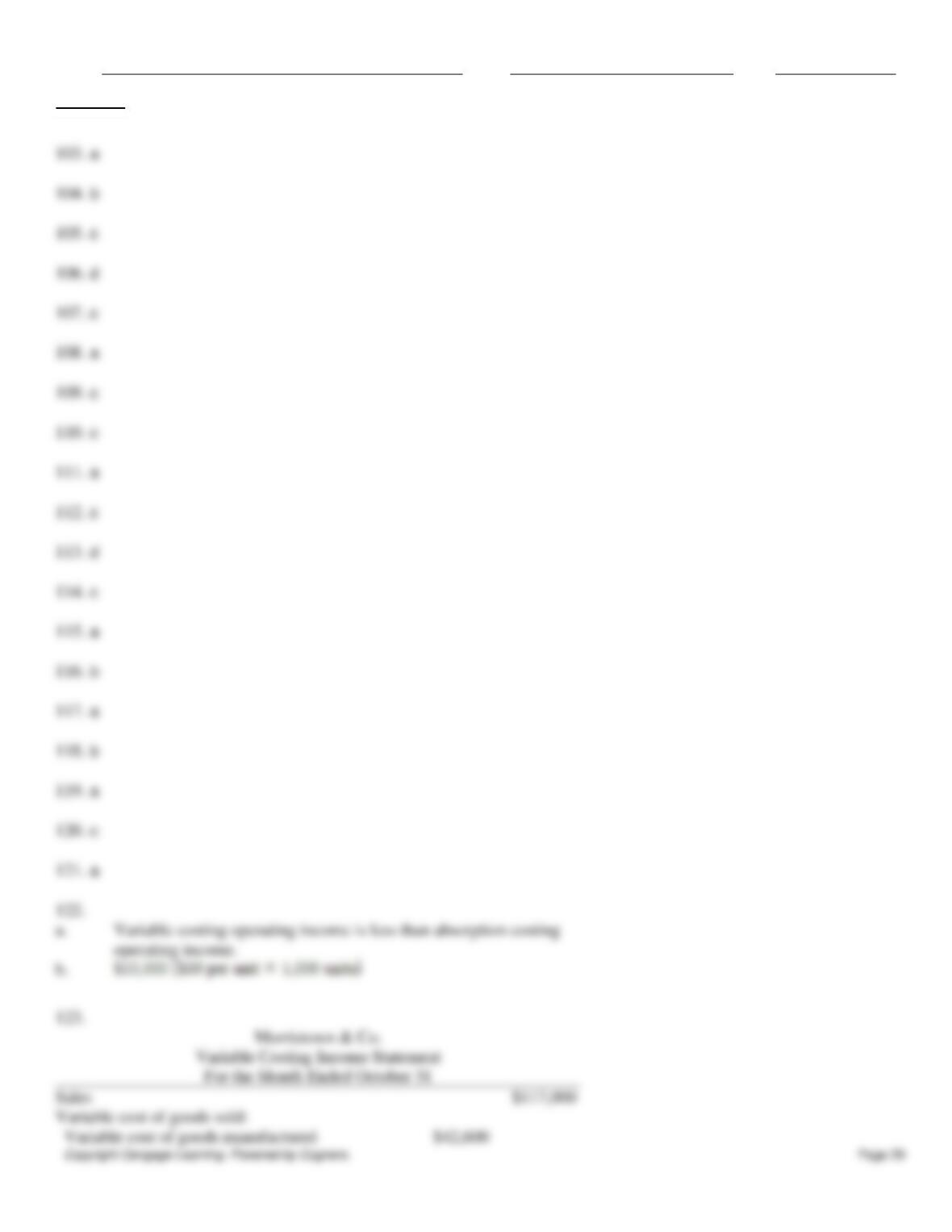
122. Fixed costs are $10 per unit, and variable costs are $25 per unit. Production was 13,000 units, while sales were
12,000 units. Determine (a) whether variable costing operating income is less than or greater than absorption costing
operating income and (b) the difference in variable costing and absorption costing operating income.
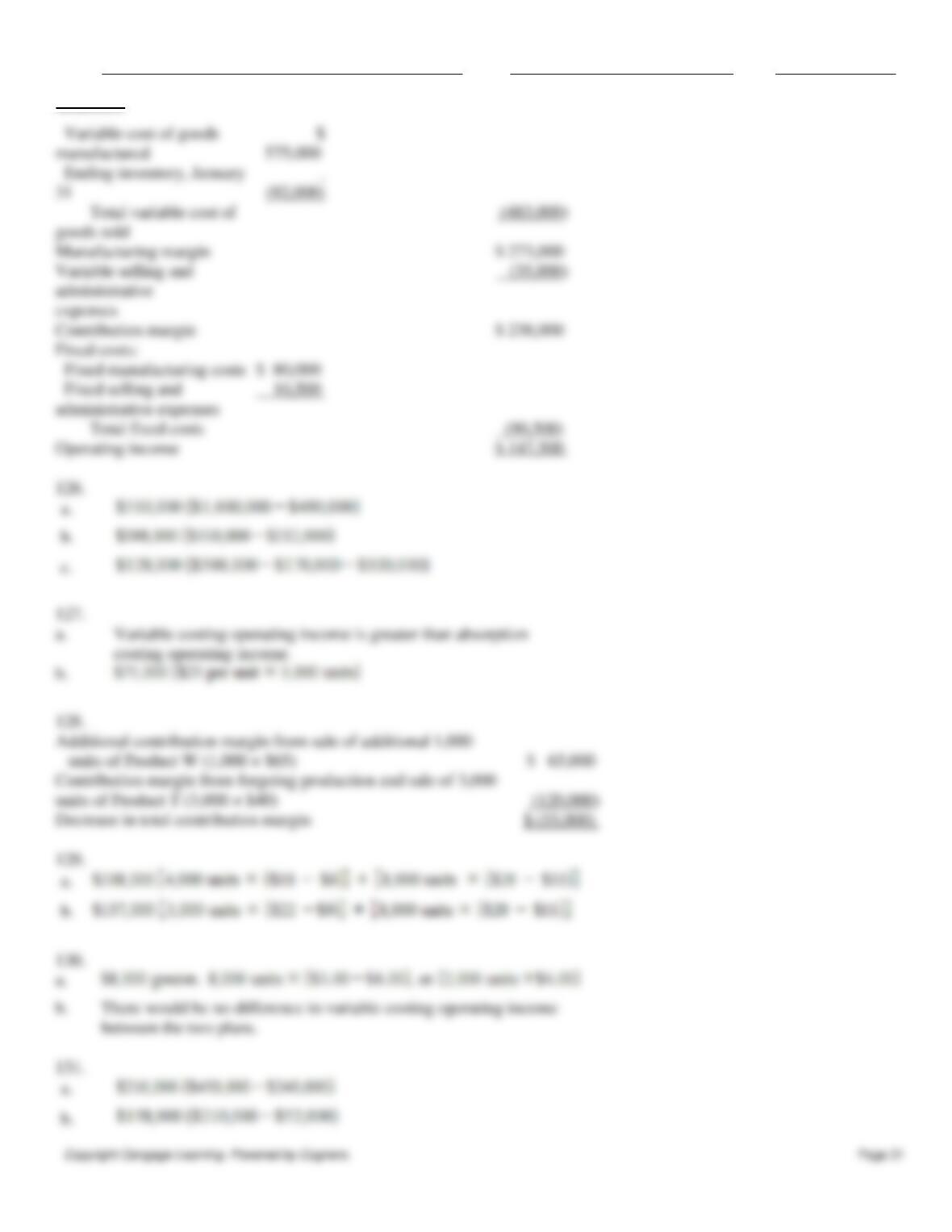
123. On October 31, the end of the first month of operations, Morristown & Co. prepared the following income statement
based on absorption costing:
Morristown & Co.
Absorption Costing Income Statement
For the Month Ended October 31
Sales (2,600 units)
$117,000
Cost of goods sold:
Cost of goods manufactured
$ 85,500
Ending inventory (400 units)
(11,400)
Total cost of goods sold
(74,100)
Gross profit
$ 42,900
Selling and administrative expenses
(21,500)
Operating income
$ 21,400
Name:
Class:
Date:
chapter 7
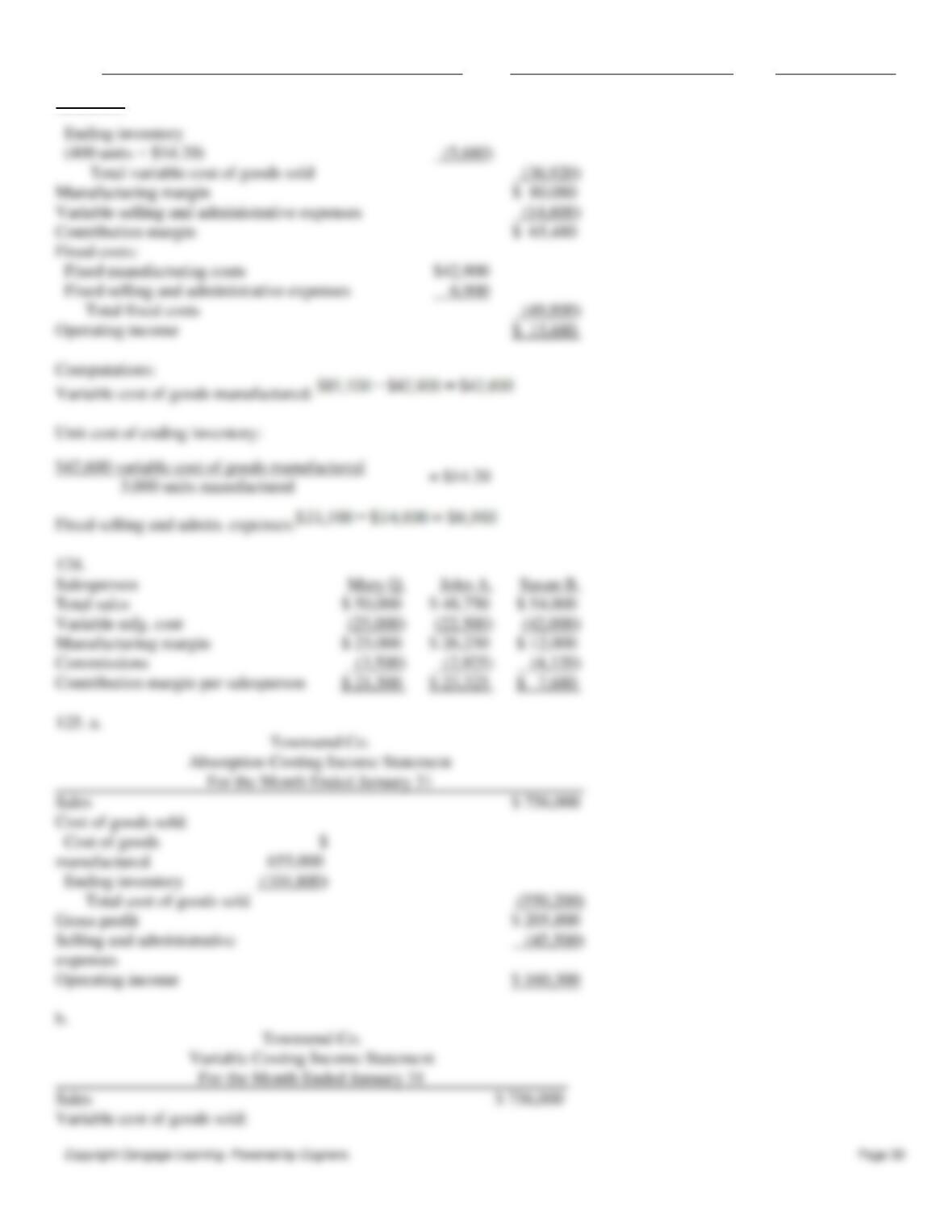
If the fixed manufacturing costs were $42,900 and the variable selling and administrative expenses were $14,600, prepare
an income statement using variable costing.
124. Excelsior Company has three salespersons. Average sales price per unit sold, average variable manufacturing costs
per unit, and number of units sold for each salesperson are shown below.
Commissions are earned according to the following schedule:
Total Sales
Percentage
$0 to $49,999
6%
$50,000 to $52,999
7%
Over $53,000
8%
Salesperson
Mary Q.
John A.
Susan B.
Avg. selling price per unit
$50.00
$65.00
$45.00
Avg. var. mfg. costs per unit
25.00
30.00
35.00
Number of units sold
1,000
750
1,200
Prepare a contribution by salesperson report.
125. On January 1 of the current year, Townsend Co. commenced operations. It operated its plant at 100% of capacity
during January. The following data summarized the results for January:
Units
Production
50,000
Sales ($18 per unit)
(42,000)
Inventory, January 31
8,000
Manufacturing costs:
Variable
$575,000
Fixed
80,000
Total
$655,000
Selling and administrative expenses:
Variable
$ 35,000
Fixed
10,500
Total
$ 45,500
a.
Prepare an income statement using absorption costing.
b.
Prepare an income statement using variable costing.
126. Tony’s Company has the following information for March:
Sales
$1,000,000
Variable cost of goods sold
490,000
Fixed manufacturing costs
170,000
Variable selling and administrative expenses
112,000
Fixed selling and administrative expenses
100,000
Determine the March (a) manufacturing margin, (b) contribution margin, and (c) operating income for Tony’s Company.
Name:
Class:
Date:
chapter 7
127. The beginning inventory is 5,000 units. All of the units manufactured during the period and 3,000 units of the
beginning inventory were sold. The beginning inventory fixed costs are $25 per unit, and variable costs are $55 per unit.
Determine (a) whether variable costing operating income is less than or greater than absorption costing operating income
and (b) the difference in variable costing and absorption operating income.
128. Gyro Company manufactures Products T and W and is operating at full capacity. Manufacturing Product W requires
three times the number of machine hours required for Product T. Market research indicates that 1,000 additional units of
Product W could be sold. The contribution margin by unit of product is as follows:
Product T
Product W
Sales price
$ 300
$ 325
Variable cost of goods sold
(235)
(250)
Manufacturing margin
$ 65
$ 75
Variable selling and administrative expenses
(25)
(10)
Contribution margin
$ 40
$ 65
Determine the increase or decrease in total contribution margin if 1,000 additional units of Product W are produced and
sold.
129. The following data are for Trendy Fashion Apparel:
North
South
Sales volume (units):
Blouses
5,000
5,000
Skirts
4,000
8,000
Sales price per unit:
Blouses
$20
$22
Skirts
$18
$20
Variable cost per unit
Blouses
$ 7
$ 9
Skirts
$ 9
$11
Determine the contribution margin for (a) Skirts and (b) the South Region.
130. At XLT Inc., variable costs are $80 per unit, and fixed costs are $40,000. Sales are estimated to be 4,000 units.
a. How much would absorption costing operating income differ between a plan to produce 8,000 units and a plan to
produce 10,000 units?
b. How much would variable costing operating income differ between the two production plans?
131. Philadelphia Company has the following information for March:
Sales
$450,000
Variable cost of goods sold
240,000
Fixed manufacturing costs
70,000
Variable selling and administrative expenses
52,000
Fixed selling and administrative expenses
35,000
Determine the March (a) manufacturing margin, (b) contribution margin, and (c) operating income for Philadelphia
Company.

Name:
Class:
Date:
chapter 7
132. During the first year of operations, 18,000 units were manufactured and 13,500 units were sold. On August
31, Olympic Inc. prepared the following income statement based on the variable costing concept:
Olympic Inc.
Variable Costing Income Statement
For the Year Ended August 31
Sales
$ 297,000
Variable cost of goods sold:
Variable cost of goods manufactured
$288,000
Ending inventory
(72,000)
Total variable cost of goods sold
(216,000)
Manufacturing margin
$ 81,000
Variable selling and administrative expenses
(40,500)
Contribution margin
$ 40,500
Fixed costs:
Fixed manufacturing costs
$ 12,000
Fixed selling and administrative expenses
10,800
Total fixed costs
(22,800)
Operating income
$ 17,700
Determine the unit cost of goods manufactured, based on (a) the variable costing concept and (b) the absorption costing
concept.
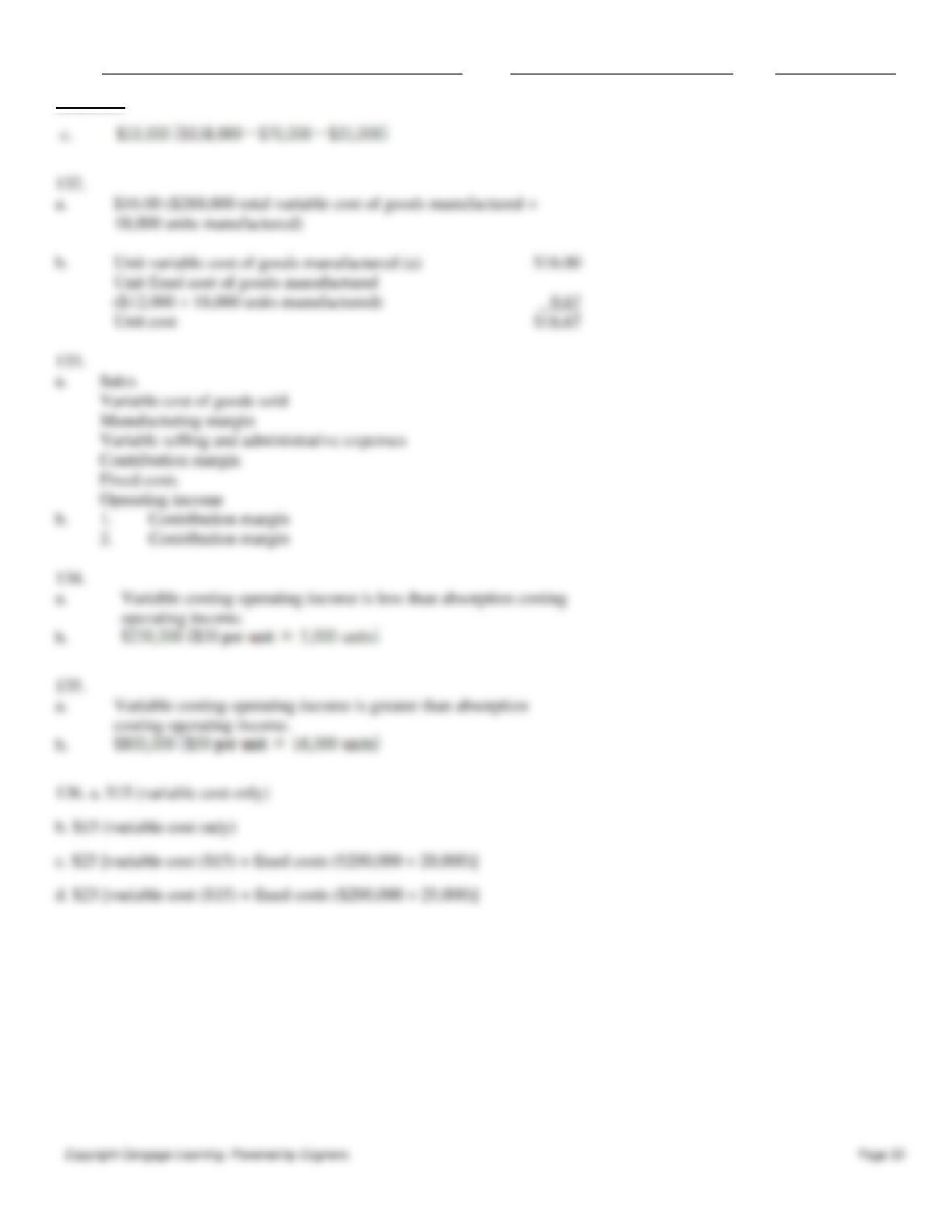
133. The major categories or captions that would appear on an income statement prepared in the variable costing format
are as follows:
Contribution margin
Fixed costs
Manufacturing margin
Operating income
Sales
Variable cost of goods sold
Variable selling and administrative expenses
a.
Arrange these captions in the proper order in accordance with the variable costing
concept.
b.
Which of the captions represents (1) the difference between sales and the total of all
the variable costs and expenses and (2) the remaining amount of revenue available
for fixed manufacturing costs, fixed expenses, and net income?
134. Fixed costs are $50 per unit, and variable costs are $125 per unit. Production was 130,000 units, while sales were
125,000 units. Determine (a) whether variable costing operating income is less than or greater than absorption costing
operating income and (b) the difference in variable costing and absorption costing operating income.
135. At EOM Inc., the beginning inventory is 20,000 units. All of the units manufactured during the period and 16,000
units of the beginning inventory were sold. The beginning inventory fixed costs are $50 per unit, and variable costs are
$300 per unit. Determine (a) whether variable costing operating income is less than or greater than absorption costing
operating income and (b) the difference in variable costing and absorption operating income.
136. If variable manufacturing costs are $15 per unit and total fixed manufacturing costs are $200,000, what is the
manufacturing cost per unit if:

Name:
Class:
Date:
chapter 7
b. 25,000 units are manufactured and the company uses the variable costing concept?
c. 20,000 units are manufactured and the company uses the absorption costing concept?
d. 25,000 units are manufactured and the company uses the absorption costing concept?
Name:
Class:
Date:
chapter 7
Answer Key

Name:
Class:
Date:
chapter 7
Name:
Class:
Date:
chapter 7
Name:
Class:
Date:
chapter 7
Name:
Class:
Date:
chapter 7
Name:
Class:
Date:
chapter 7
Name:
Class:
Date:
chapter 7
Name:
Class:
Date:
chapter 7