180.
A company has the following unadjusted account balances at December 31, of the current
year; Accounts Receivable of $183,400 and Allowance for Doubtful Accounts of $1,600
(credit balance). The company uses the aging of accounts receivable to estimate its bad
debts. The following aging schedule reflects its accounts receivable at the current year–
end:
Account Age
Balance
Estimated
Uncollectible
Percentage
Current (not yet
due)
$106,000
2.0%
1—30 days past
due
54,000
4.0%
30—60 days past
due
12,000
10.0%
61—90 days past
due
8,500
25.0%
Over 90 days past
due
2,900
75.0%
Total
$183,400
Calculate the amount of the Allowance for Doubtful Accounts that should appear on the
December 31, of the current year, balance sheet.
181.
A company had the following items and amounts in its unadjusted trial balance as of
December 31 of the current year:
Debit
Credit
Cash sales
$188,000
Credit sales
275,000
Accounts receivable
$76,000
Allowance for doubtful
accounts
1,000
Prepare the adjusting entry to estimate bad debts assuming an aging analysis estimates
that 8% of the outstanding accounts receivable will be uncollectible.
allowance account:
.08 =
allowance account:
182.
A company had the following items and amounts in its unadjusted trial balance as of
December 31 of the current year:
Debit
Credit
Cash sales
$188,000
Credit sales
275,000
Accounts receivable
$76,000
Allowance for doubtful
accounts
1,000
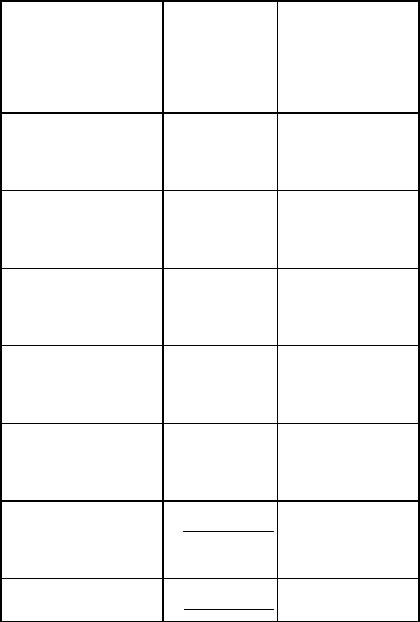
Bad Debts Expense
Allowance for Doubtful Accounts
$275,000 * .025 = $6,875
Prepare the adjusting entry to estimate bad debts assuming bad debts are estimated to
be 2.5% of credit sales.
183.
A company uses the aging of accounts receivable method to estimate its bad debts
expense. On December 31 of the current year an aging analysis of accounts receivable
revealed the following:
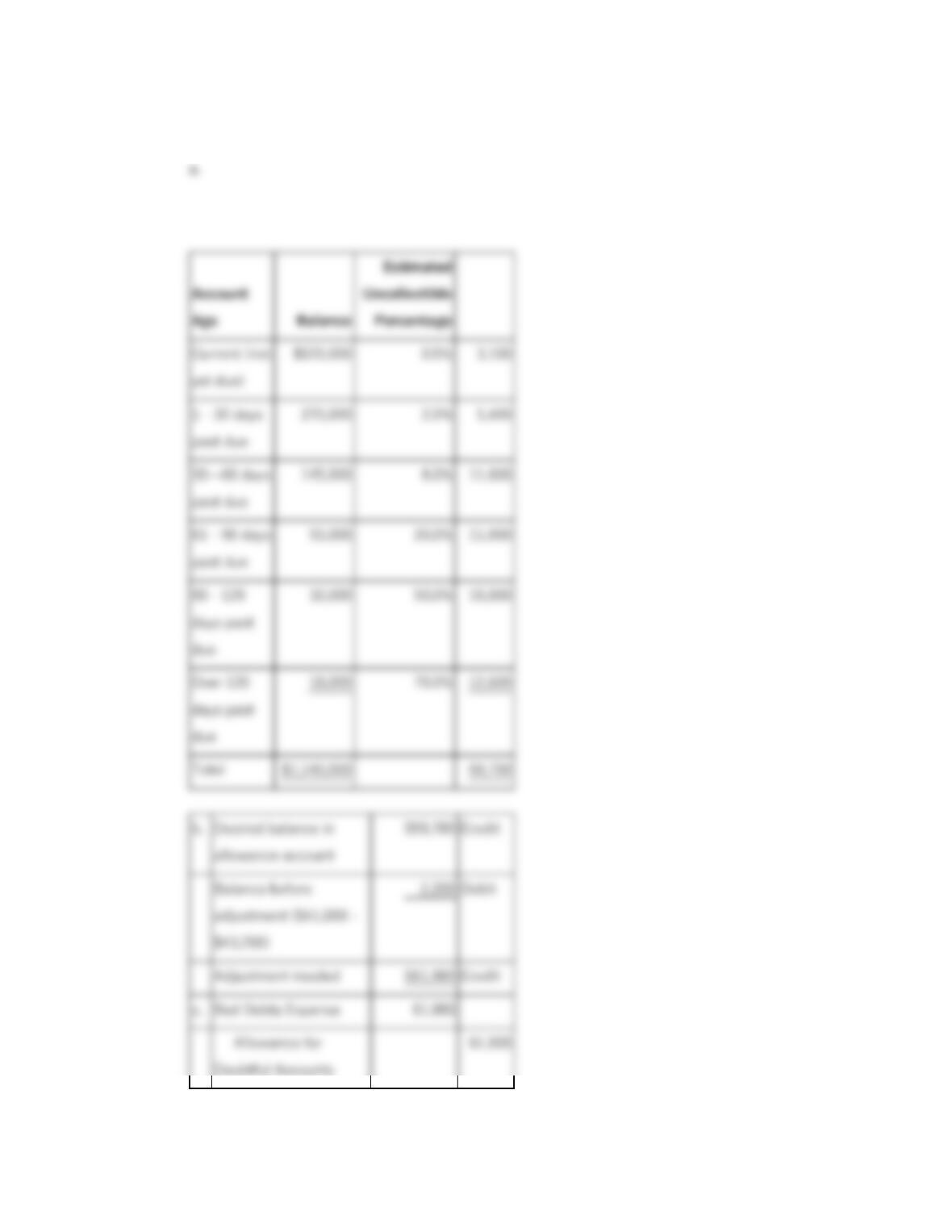
Account Age
Balance
Estimated
Uncollectible
Percentage
Current (not yet
due)
$620,000
0.5%
1—30 days past
due
270,000
2.0%
30—60 days past
due
145,000
8.0%
61—90 days past
due
55,000
20.0%
90—120 days past
due
32,000
50.0%
Over 120 days
past due
18,000
70.0%
Total
$1,140,000
Required:
a. Calculate the amount of the Allowance for Doubtful Accounts that should be reported
on the current year-end balance sheet.
b. Calculate the amount of the Bad Debts Expense that should be reported on the current
year’s income statement, assuming that the balance of the Allowance for Doubtful
Accounts on January 1 of the current year was $41,000 and that accounts receivable
written off during the current year totaled $43,200.
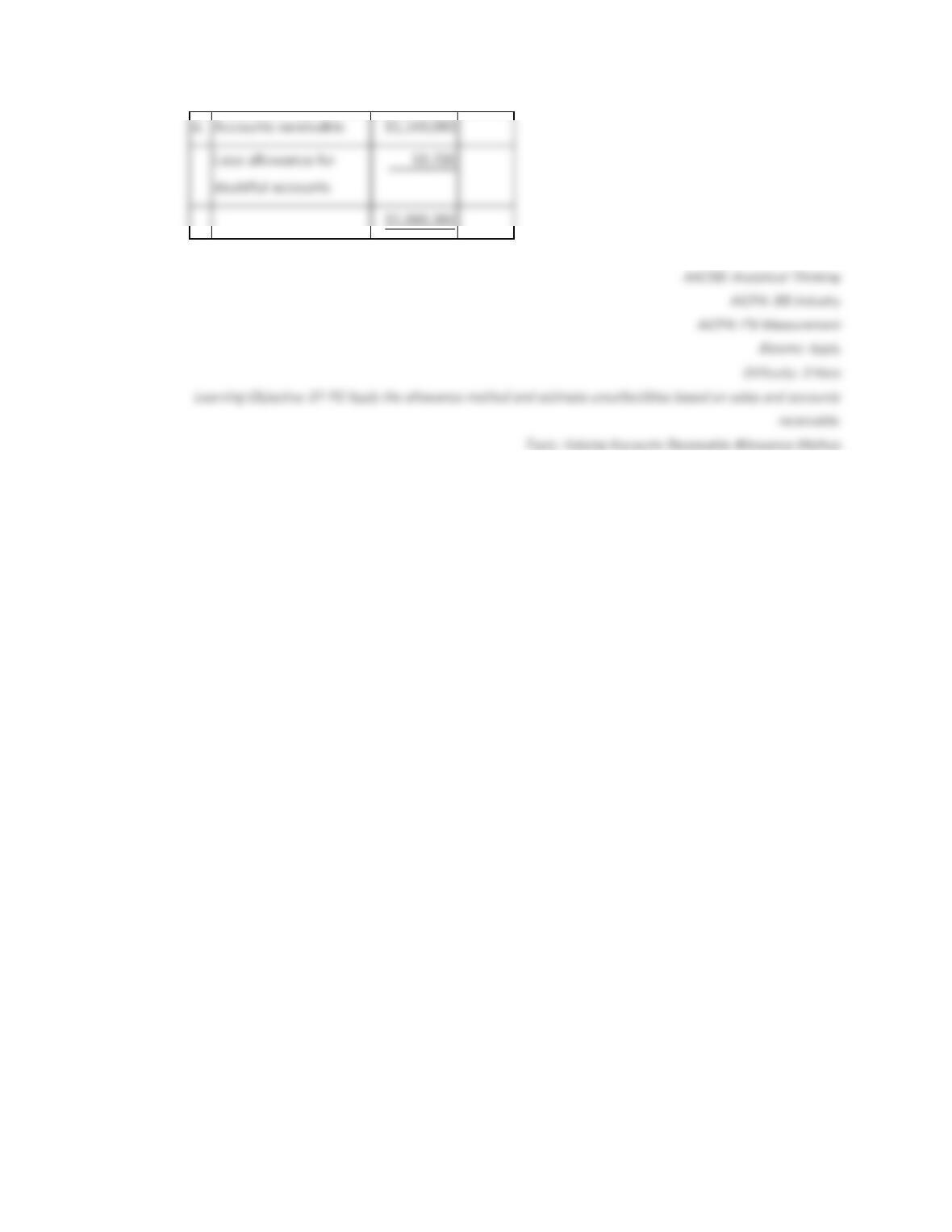
c. Prepare the adjusting entry to record bad debts expense on December 31 of the current
year.
d. Show how Accounts Receivable will appear on the current year-end balance sheet as of
December 31.
184.
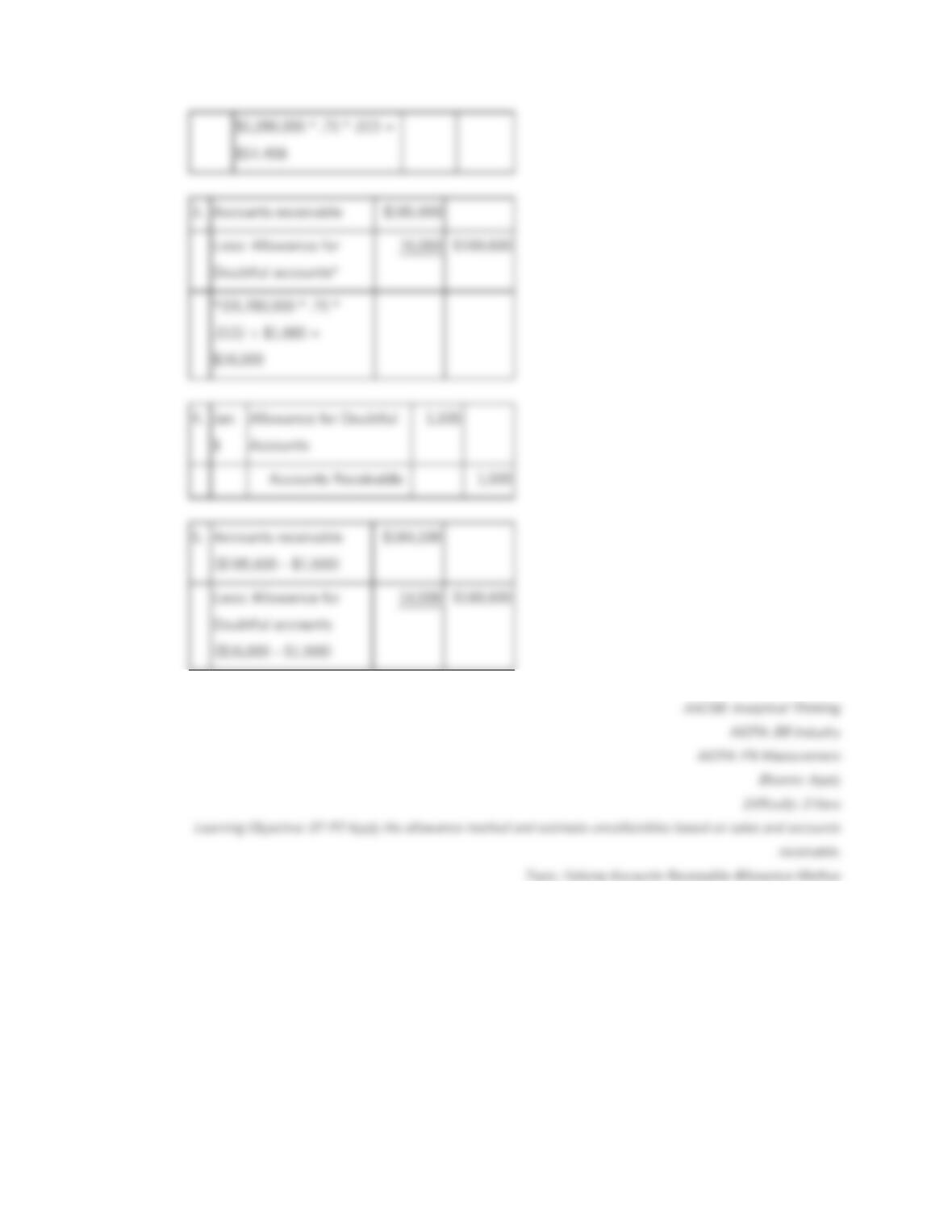
On December 31, of the current year, Spectrum Company’s unadjusted trial balance
revealed the following: Accounts receivable of $185,600; Sales Revenue of $1,280,000;
(75% were on credit), and Allowance for Doubtful Accounts of $1,600 (credit balance).
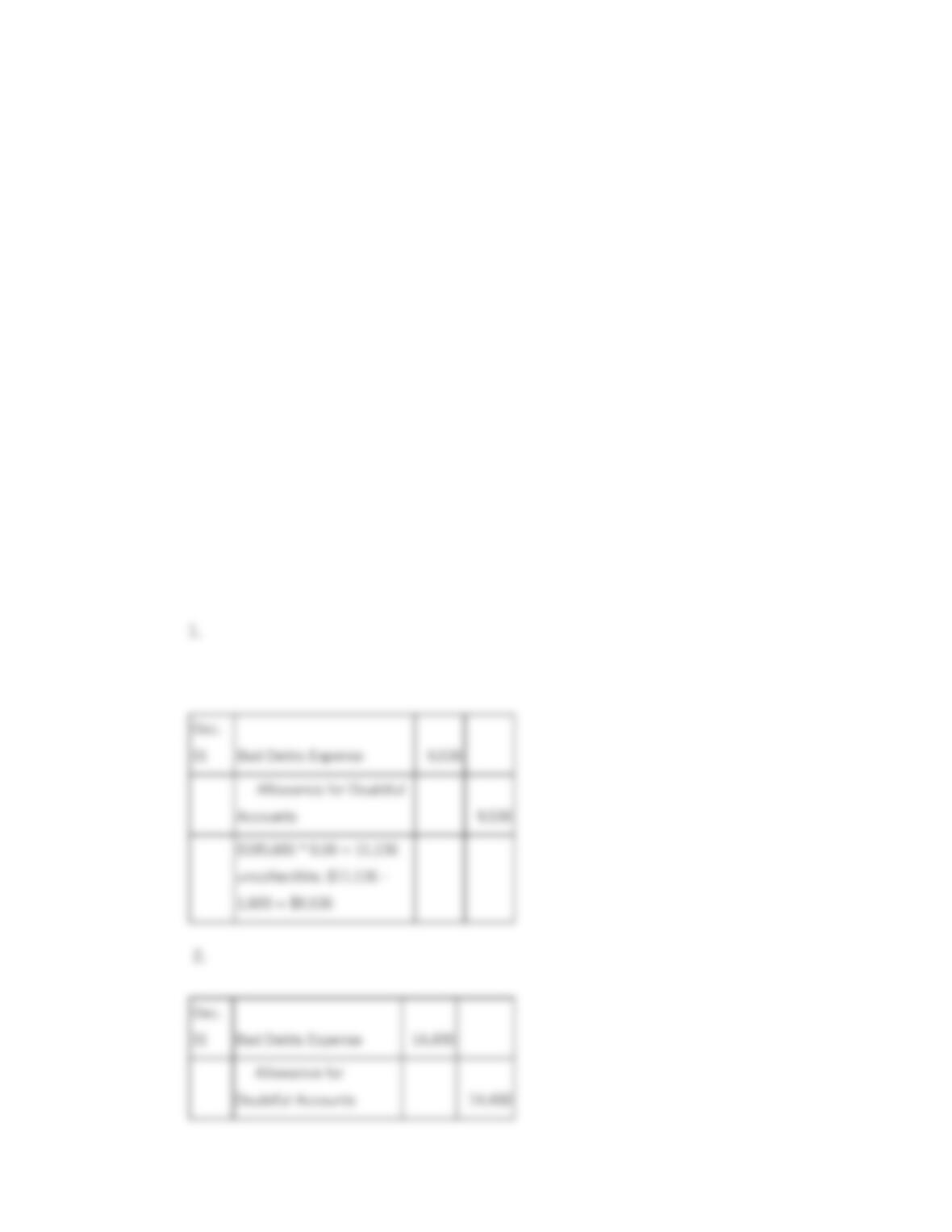
Prepare the adjusting journal entry to record Spectrum’s estimate for bad debts
assuming:
1. 6.0% of the accounts receivable balance is assumed to be uncollectible.
2. Bad debts expense is estimated to be 1.5% of credit sales.
3. Show how Accounts Receivable and the Allowance for Doubtful Accounts would appear
on the balance sheet after adjustment assuming the percentage of sales method is used.
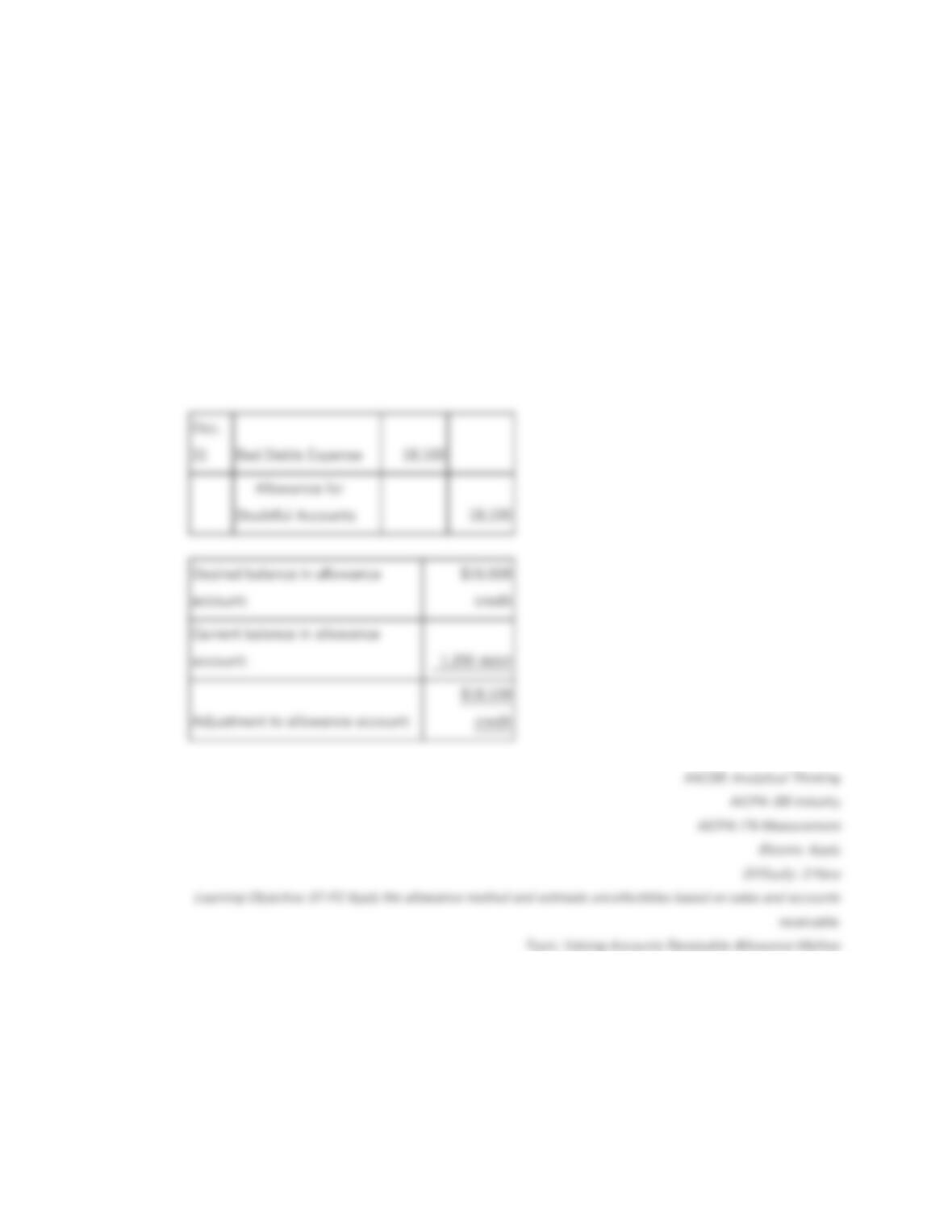
4. Prepare the entry to write off a $1,500 account receivable on January 1 of the next year.
5. Show how Accounts Receivable and the Allowance for Doubtful Accounts would appear
on the balance sheet immediately after writing off the account in part 4 assuming the
percentage of sales method is used.
185.
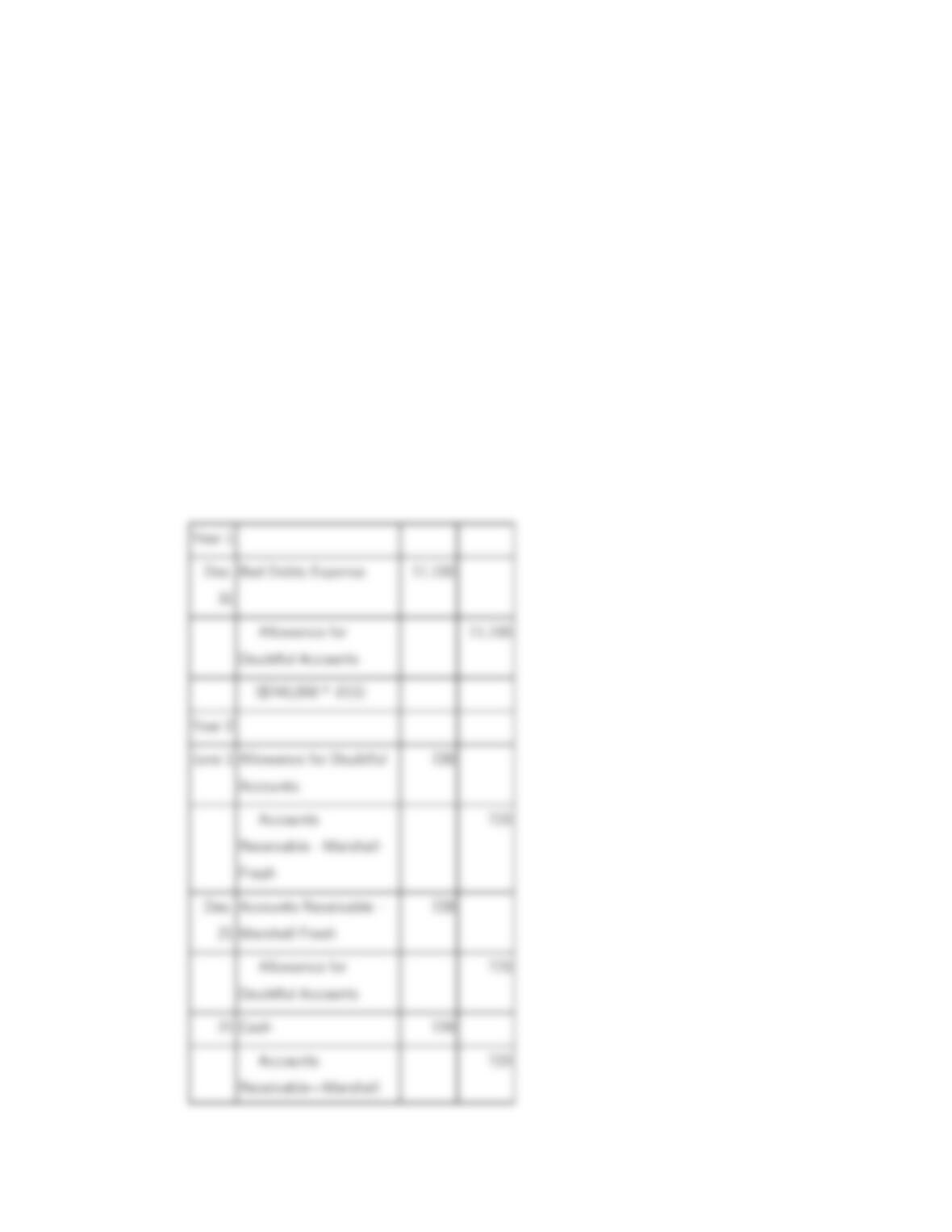
Each December 31, Kimura Company ages its accounts receivable to determine the
amount of its adjustment for bad debts. At the end of the current year, management
estimated that $16,900 of the accounts receivable balances would be uncollectible. The
Allowance for Doubtful Accounts account had a debit balance of $1,200 before any year–
end adjustment for bad debts. Prepare the adjusting journal entry that Kimura Company
should make on December 31, of the current year, to estimate bad debts expense.
186.
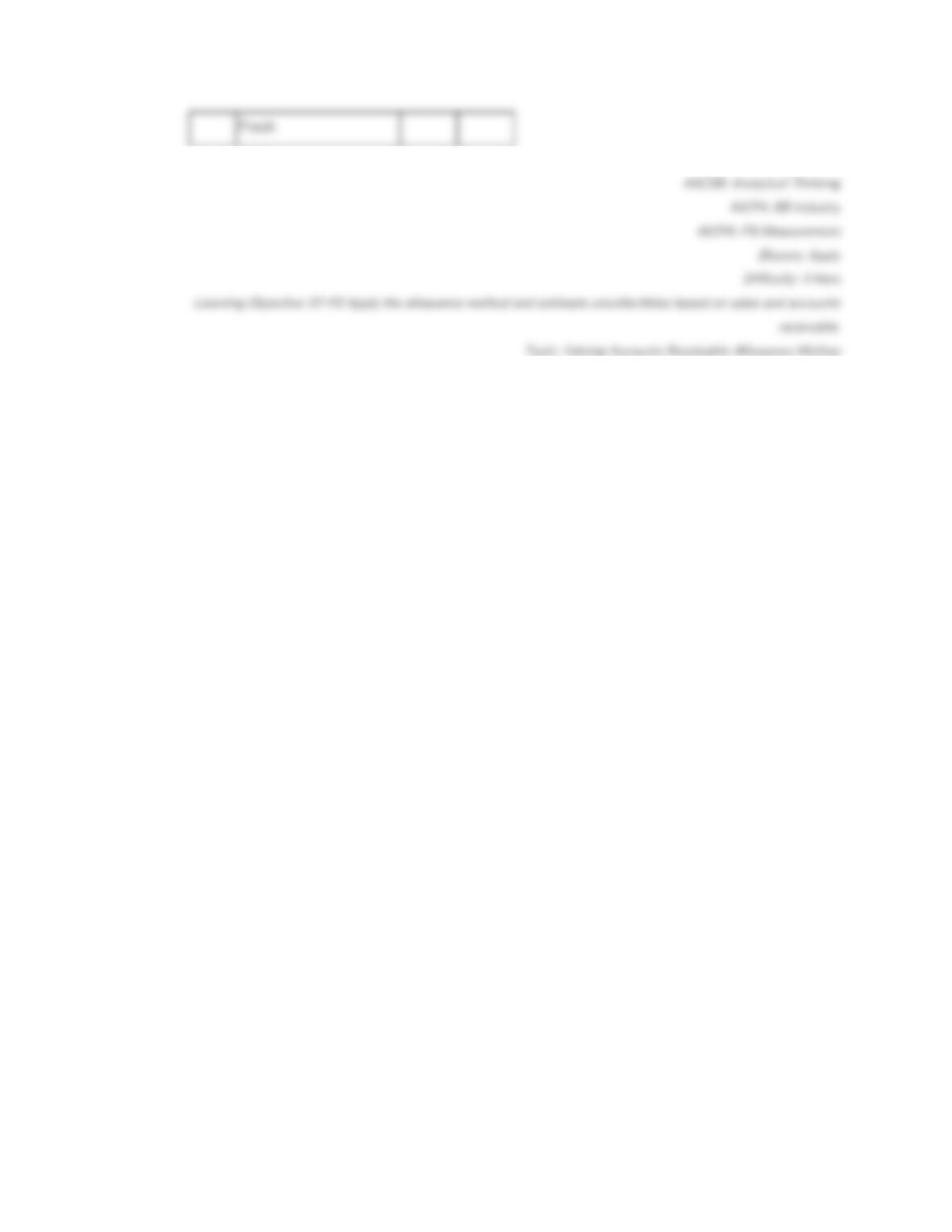
A company that uses the percent of sales to account for its bad debts had credit sales of
$740,000 in Year 1, including a $720 sale to Marshall Fresh. On December 31, Year 1, the
company estimated its bad debts at 1.5% of its credit sales. On June 1, Year 2, the
company wrote off, as uncollectible, the $720 account of Marshall Fresh. On December 21,
Year 2, Marshall Fresh unexpectedly paid his account in full. Prepare the necessary
journal entries:
(a) On December 31, Year 1, to reflect the estimate of bad debts expense.
(b) On June 1, Year 2, to write off the bad debt.
(c) On December 21, Year 2, to record the unexpected collection.
187
.
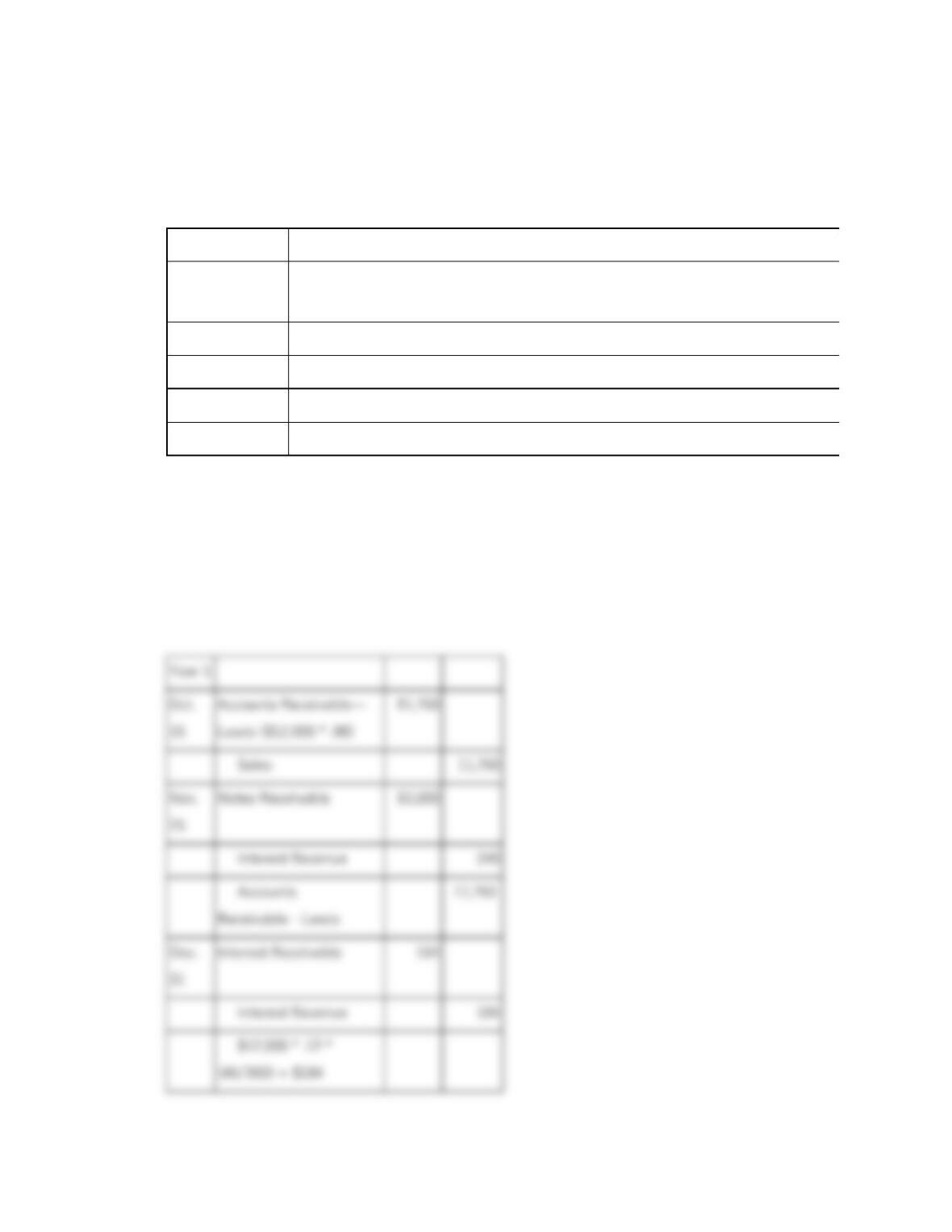
The following series of transactions occurred during Year 1 and Year 2, when Foxworth Co.
sold merchandise to Kevin Lewis. Foxworth’s annual accounting period ends on December 31.
The company uses the net method of accounting for sales discounts.
10/15/Yr 1
Sold $12,000 of merchandise to K. Lewis, terms 2/10, n/30.
11/15/Yr 1
Lewis reports that he cannot pay the account until early next year. He agrees to exchan
account for a 120-day, 12% note receivable.
12/31/Yr 1
Prepared the adjusting journal entry to record accrued interest on the note.
03/15/Yr 2
Foxworth receives a check from Lewis for the maturity value (with interest) of the not
03/22/Yr 2
Foxworth receives notification that Lewis’ check is being returned for nonsufficient fu
12/31/Yr 2
Foxworth writes off Lewis’ account as uncollectible.
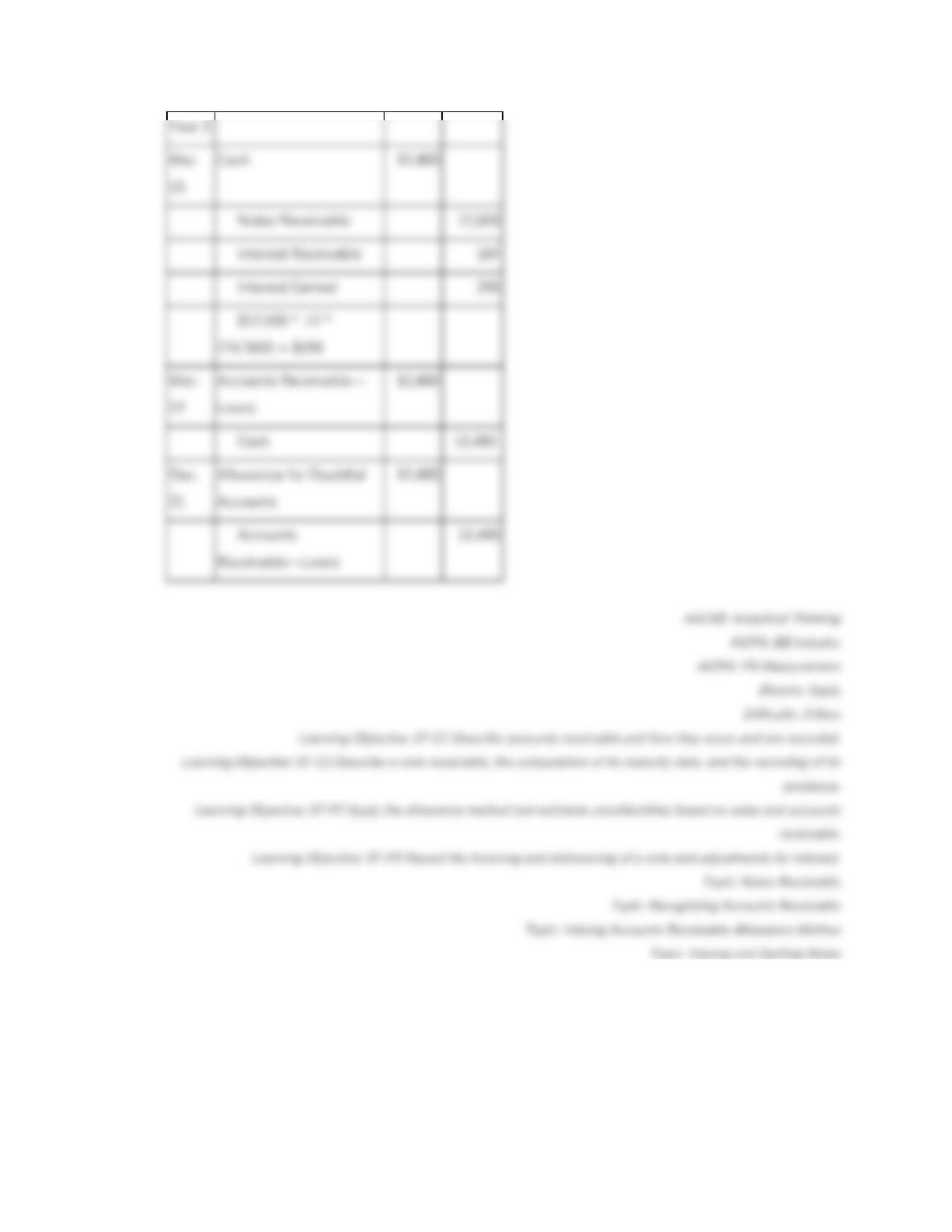
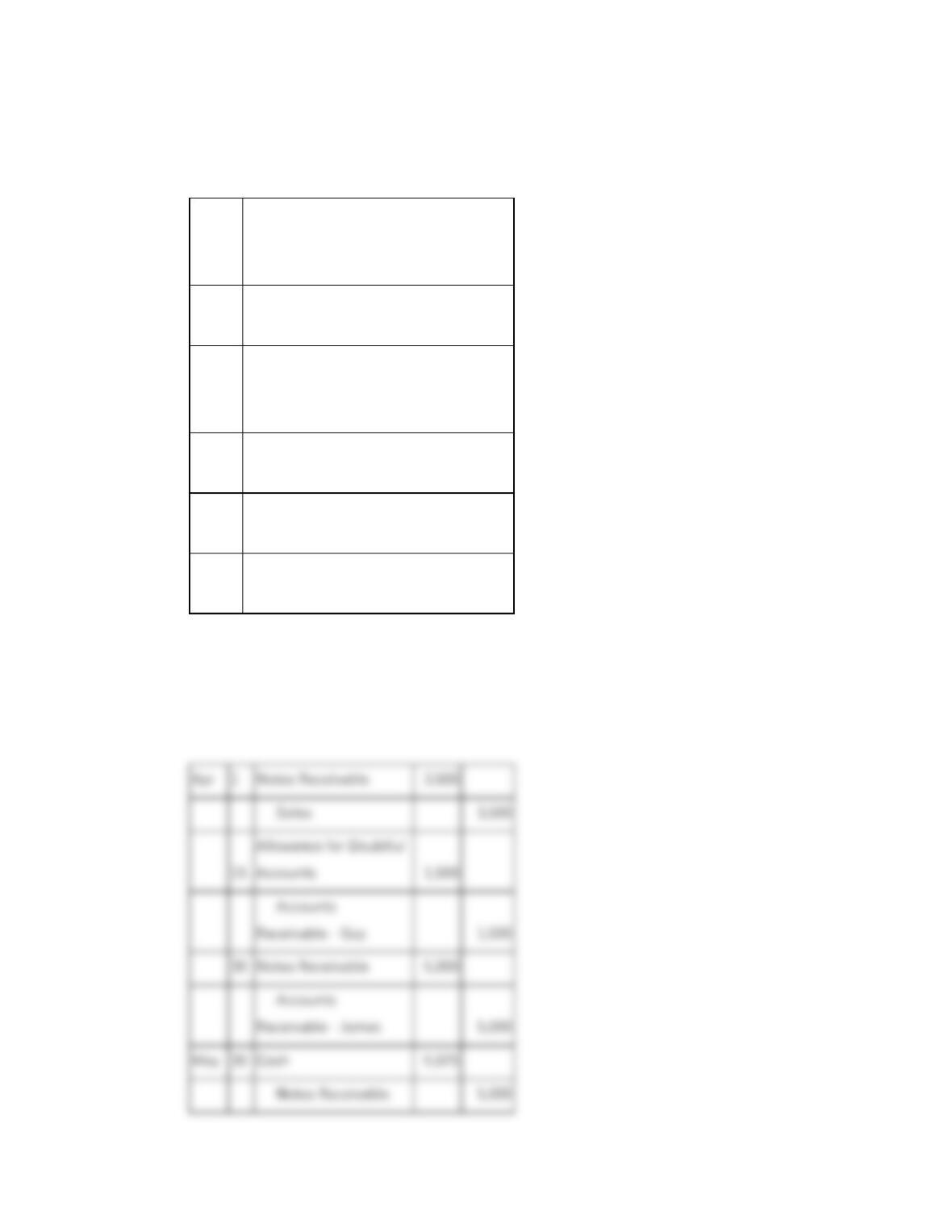
Prepare Foxworth Co.’s journal entries to record the above transactions. The company uses
the allowance method to account for its bad debt expense.
Year 1
Oct.
Accounts Receivable—
Lewis ($12,000 * .98)
Sales
Nov.
Notes Receivable
Interest Revenue
Dec.
Interest Receivable
Interest Revenue
188.
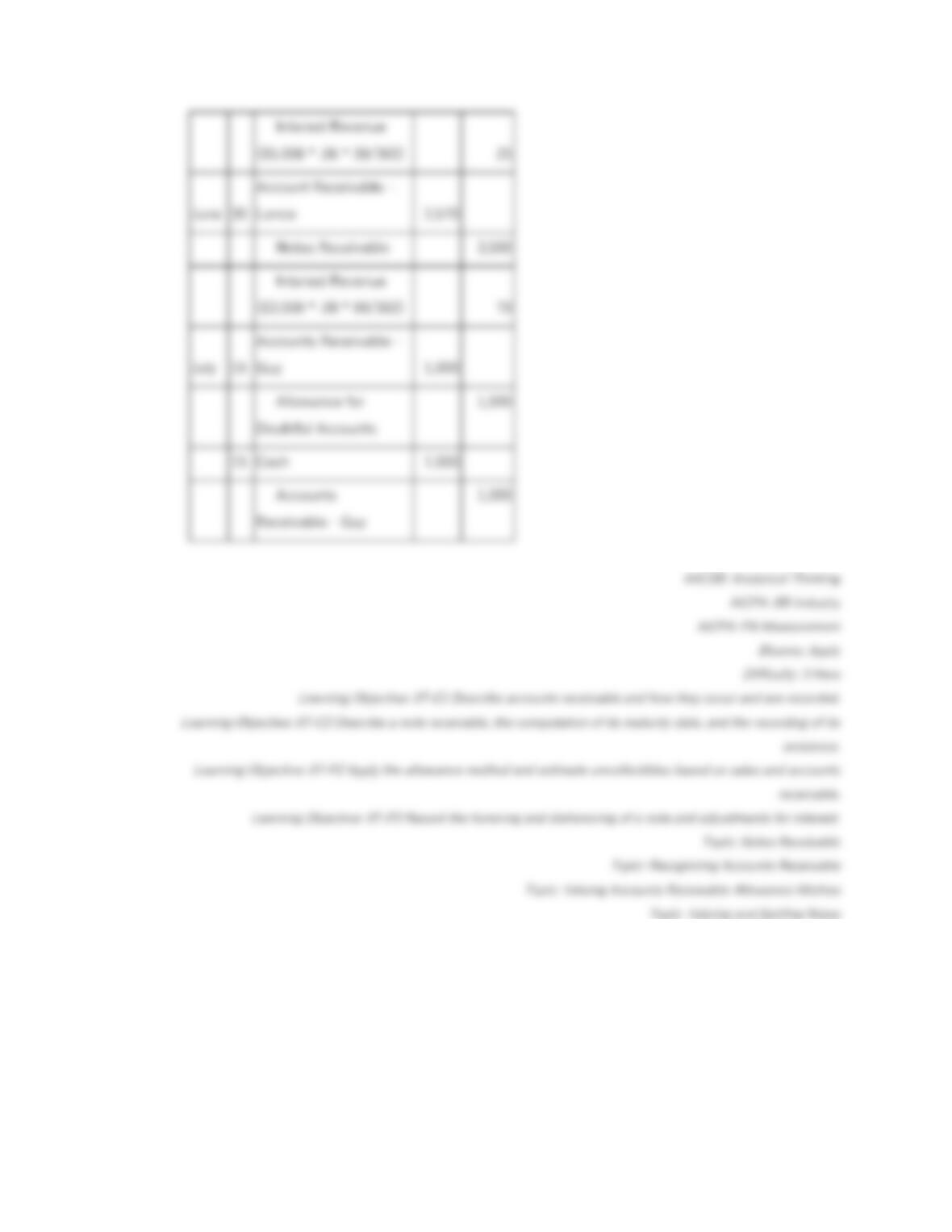
Prepare general journal entries for the following transactions of Norman Company,
assuming they use the allowance method to account for uncollectible accounts.
Apr 01
Sold $3,500 of merchandise to Lance
Co., receiving an 8%, 90-day, $3,500
note.
15
Wrote off $1,500 owed by Guy Co. from a
previous period sale.
30
Received a $5,000, 6%, 30-day note
receivable from James Co. as settlement
for its $5,000 account receivable.
May 30
The note received from James on April
30 was collected in full.
Jun 30
Lance Co. was unable to pay the note on
the due date.
Jul 15
Guy Co. paid $1,000 of the amount
written off on April 15.
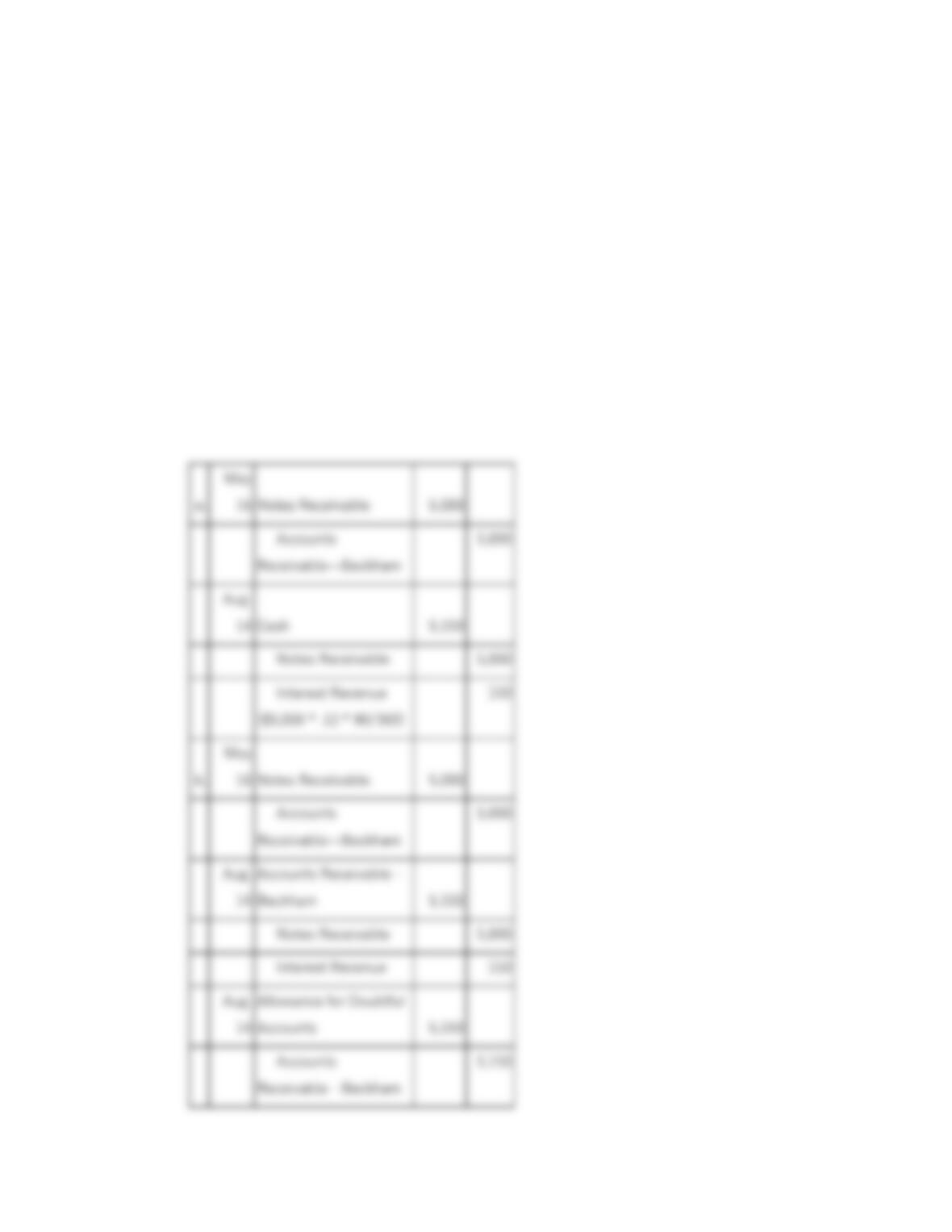
Notes Receivable
Sales
Allowance for Doubtful
Accounts
Accounts
Receivable—Guy
Notes Receivable
Accounts
Receivable—James
Notes Receivable
189.
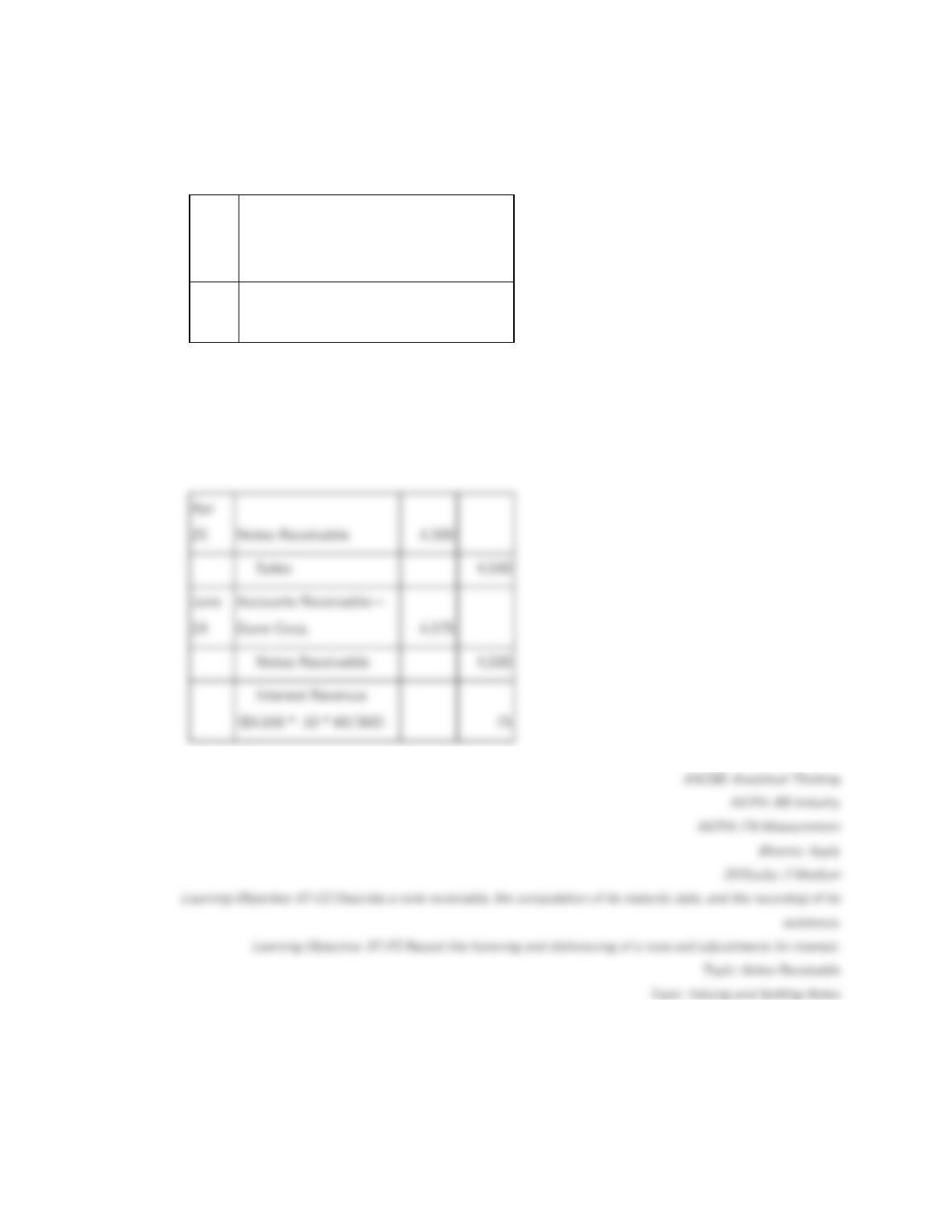
Jordan Co. uses the allowance method of accounting for uncollectible accounts. Jordan Co.
accepted a $5,000, 12%, 90-day note dated May 16, from Beckam Co. in exchange for its
past-due account receivable. Make the necessary general journal entries for Jordan Co. on
May 16 and the August 14 maturity date, assuming that the:
a. Note is held until maturity and collected in full at that time.
b. Note is dishonored; the amount of the note and its interest are written off as
uncollectible.
190.
Prepare general journal entries for the following transactions for the current year:
Apr.
25
Sold $4,500 of merchandise to Dunn
Corp., receiving a 10%, 60-day. $4,500
note receivable.
June
24
The note of Dunn Corp., received on April
25 was dishonored.
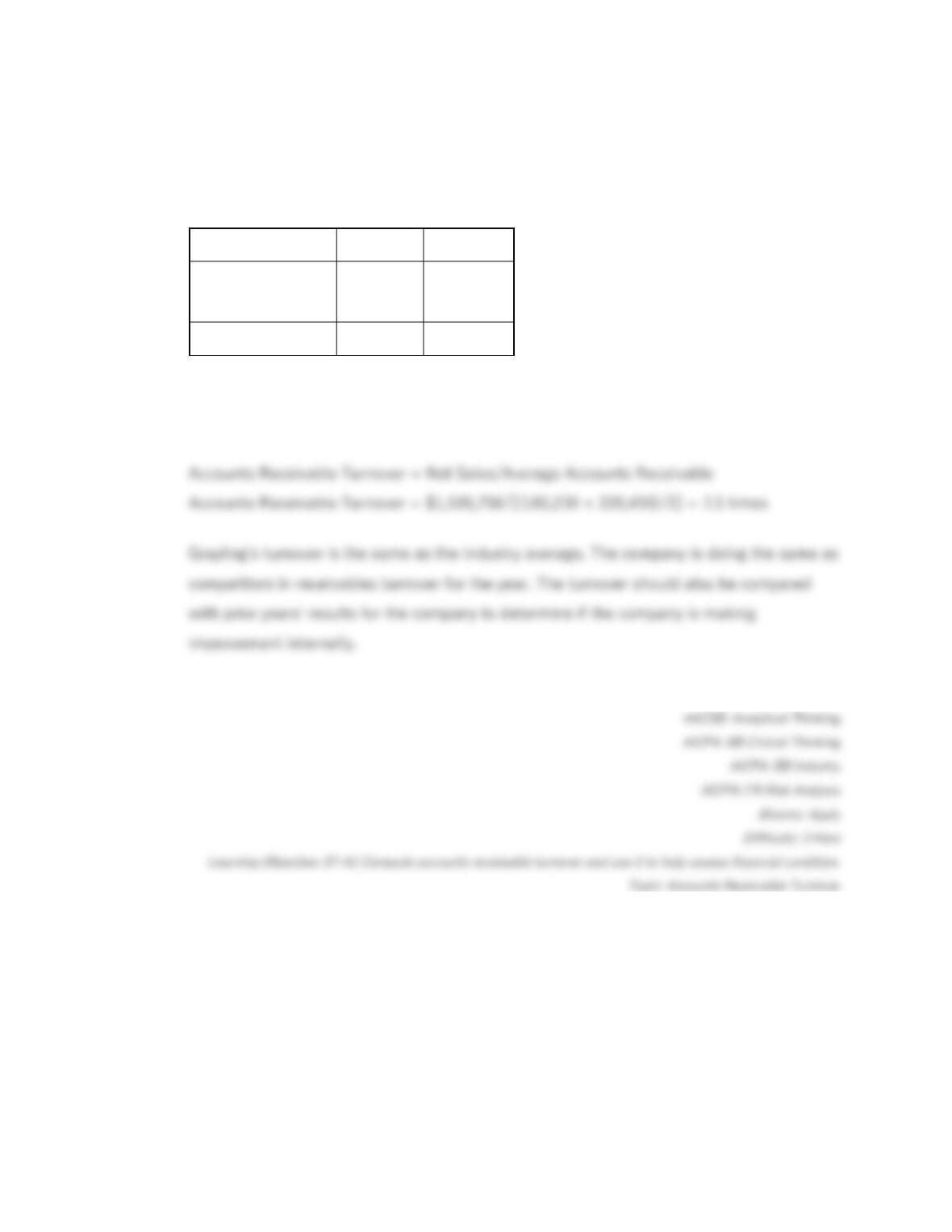
Apr
25
June
24
Accounts Receivable—
Dunn Corp.
Interest Revenue
($4,500 * .10 * 60/360)
191.
The following data are taken from the comparative balance sheets of Grayling Company.
Compute and interpret its accounts receivable turnover for Year 2. Competitors average a
turnover of 7.5. How is the company doing in relation to its competitors?
Year 2
Year 1
Accounts receivable,
net
$180,230
$220,450
Net sales
$1,500,750
$1,495,600