82) RJ Corporation has provided the following information about one of its inventory items:
Date
Transaction
Number of
Units
Cost per Unit
1/1
Beginning Inventory
400
$
3,200
6/6
Purchase
800
$
3,600
9/10
Purchase
1,200
$
4,000
11/15
Purchase
800
$
4,200
During the year, RJ sold 3,000 units.
What was ending inventory using the FIFO cost flow assumption?
A) $640,000.
B) $840,000.
C) $960,000.
D) $880,000.
83) RJ Corporation has provided the following information about one of its inventory items:
Date
Transaction
Number of
Units
Cost per Unit
1/1
Beginning Inventory
400
$
3,200
6/6
Purchase
800
$
3,600
9/10
Purchase
1,200
$
4,000
11/15
Purchase
800
$
4,200
During the year, RJ sold 3,000 units.
What was ending inventory using the average cost flow assumption?
A) $640,000.
B) $840,000.
C) $770,000.
D) $880,000.
84) RJ Corporation has provided the following information about one of its inventory items:
Date
Transaction
Number of
Units
Cost per Unit
1/1
Beginning Inventory
400
$
3,200
6/6
Purchase
800
$
3,600
9/10
Purchase
1,200
$
4,000
11/15
Purchase
800
$
4,200
During the year, RJ sold 3,000 units.
What was cost of goods sold using the average cost flow assumption?
A) $11,680,000.
B) $11,590,000.
C) $11,480,000.
D) $11,550,000.
85) RJ Corporation has provided the following information about one of its inventory items:
Date
Transaction
Number of
Units
Cost per Unit
1/1
Beginning Inventory
400
$
3,200
6/6
Purchase
800
$
3,600
9/10
Purchase
1,200
$
4,000
11/15
Purchase
800
$
4,200
During the year, RJ sold 3,000 units.
What was cost of goods sold using the LIFO cost flow assumption?
A) $11,680,000.
B) $11,590,000.
C) $11,480,000.
D) $11,550,000.
86) RJ Corporation has provided the following information about one of its inventory items:
Date
Transaction
Number of
Units
Cost per Unit
1/1
Beginning Inventory
400
$
3,200
6/6
Purchase
800
$
3,600
9/10
Purchase
1,200
$
4,000
11/15
Purchase
800
$
4,200
During the year, RJ sold 3,000 units.
What was cost of goods sold using the FIFO cost flow assumption?
A) $11,680,000.
B) $11,590,000.
C) $11,480,000.
D) $11,550,000.
87) On March 15, 2019, Ryan Company purchased $10,000 of merchandise on credit subject to
terms of 2/10, n/30. Ryan Company records its purchases using the gross amount.
Which of the following journal entries is correct when Ryan Company pays for these goods on
March 30, 2019?
A)
Accounts payable
9,800
Cash
9,800
B)
Accounts payable
10,000
Cash
10,000
C)
Accounts payable
10,000
Inventory
200
Cash
9,800
D)
Accounts payable
9,800
Inventory
200
Cash
10,000
88) On March 15, 2019, Ryan Company purchased $10,000 of merchandise on credit subject to
terms of 2/10, n/30. Ryan Company records its purchases using the gross amount.
Which of the following journal entries is correct when Ryan Company pays for these goods on
March 20, 2019?
A)
Accounts payable
9,800
Cash
9,800
B)
Accounts payable
10,000
Cash
10,000
C)
Accounts payable
10,000
Cash
9,800
Inventory
200
D)
Accounts payable
9,800
Inventory
200
Cash
10,000
89) JJ Enterprises began the year with 480 units of one of its most popular products. During the
year JJ purchased 1,000 units and sold 1,100 units for $500 each. What is the pre-tax effect of
JJ’s LIFO liquidation?
Date
Transaction
Number of
Units
Cost per Unit
1/1
Beginning
Inventory
480
$
384
5/6
Purchase
1000
$
432
A) $38,400
B) $9,600
C) $4,800
D) $11,600
90) Seattle, Co. began the year with 480 units of one of its most popular products. During the
year Seattle purchased 1,000 units and sold 1,100 units for $750 each. What is the pre-tax effect
of Seattle’s LIFO liquidation?
Date
Transaction
Number of
Units
Cost per Unit
1/1
Beginning
Inventory
480
$
576
8/6
Purchase
1000
$
648
A) $57,600
B) $7,200
C) $14,400
D) $17,400
91) Which of the following statements is correct regarding either the perpetual or periodic
inventory systems?
A) In a perpetual inventory system, the amount of inventory is not known until the end of the
period when the inventory count is taken.
B) In a perpetual inventory system, cost of goods sold is recorded at the time of each sale during
the accounting period.
C) In a periodic inventory system, cost of goods sold is developed only from a comparison of
beginning inventory and ending inventory.
D) In a periodic inventory system, the inventory account is increased for each purchase during
the accounting period.
92) When a company uses the periodic inventory system, which of the following is true?
A) Purchases are recorded in the cost of goods sold account.
B) The inventory account is updated after each sale.
C) Cost of goods sold is computed at the end of the accounting period rather than at each sale
date.
D) The inventory account is updated throughout the year as purchases are made.
93) Carrie Company sold merchandise with an invoice price of $1,000 to Underwood, Inc., with
terms of 2/10, n/30. Which of the following is the correct entry to record the payment by
Underwood Inc., within 10 days if the company uses the perpetual inventory system and the
gross method to record purchases?
A)
Cash
980
Inventory
20
Accounts payable
1,000
B)
Accounts Payable
1,000
Cash
980
Inventory
20
C)
Accounts Payable
1,000
Cash
1,000
D)
Purchases
980
Cash
980
94) Iris Company has provided the following information regarding two of its items of inventory
at year-end:
• There are 100 units of Item A, having a cost of $20 per unit, a selling price of $24 and a cost to
sell of $6 per unit.
• There are 50 units of Item B, having a cost of $50 per unit, a selling price of $56 and a cost to
sell of $4 per unit.
How much is the ending inventory using lower of cost or net realizable value?
A) $4,100.
B) $4,300.
C) $4,400.
D) $4,500.
95) Carr Corporation has provided the following information for its most recent month of
operation: sales $8,000; beginning inventory $1,000; ending inventory $2,000 and gross profit
$5,000. How much were Carr’s inventory purchases during the period?
A) $9,000.
B) $5,000.
C) $6,000.
D) $4,000.
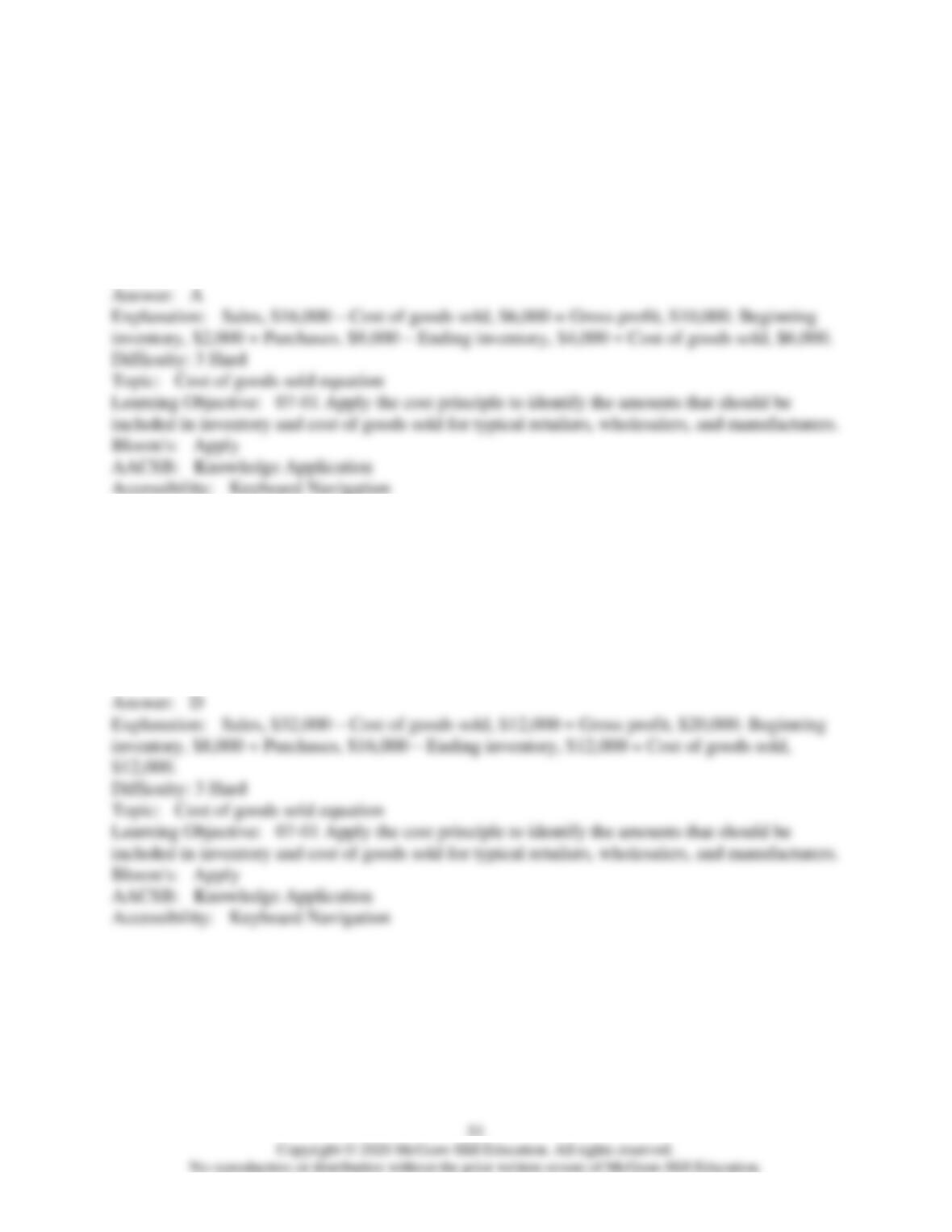
96) Carp Corporation has provided the following information for its most recent month of
operation: sales $16,000; ending inventory $4,000, purchases $8,000 and gross profit $10,000.
How much was Carp’s beginning inventory?
A) $2,000.
B) $18,000.
C) $6,000.
D) $12,000.
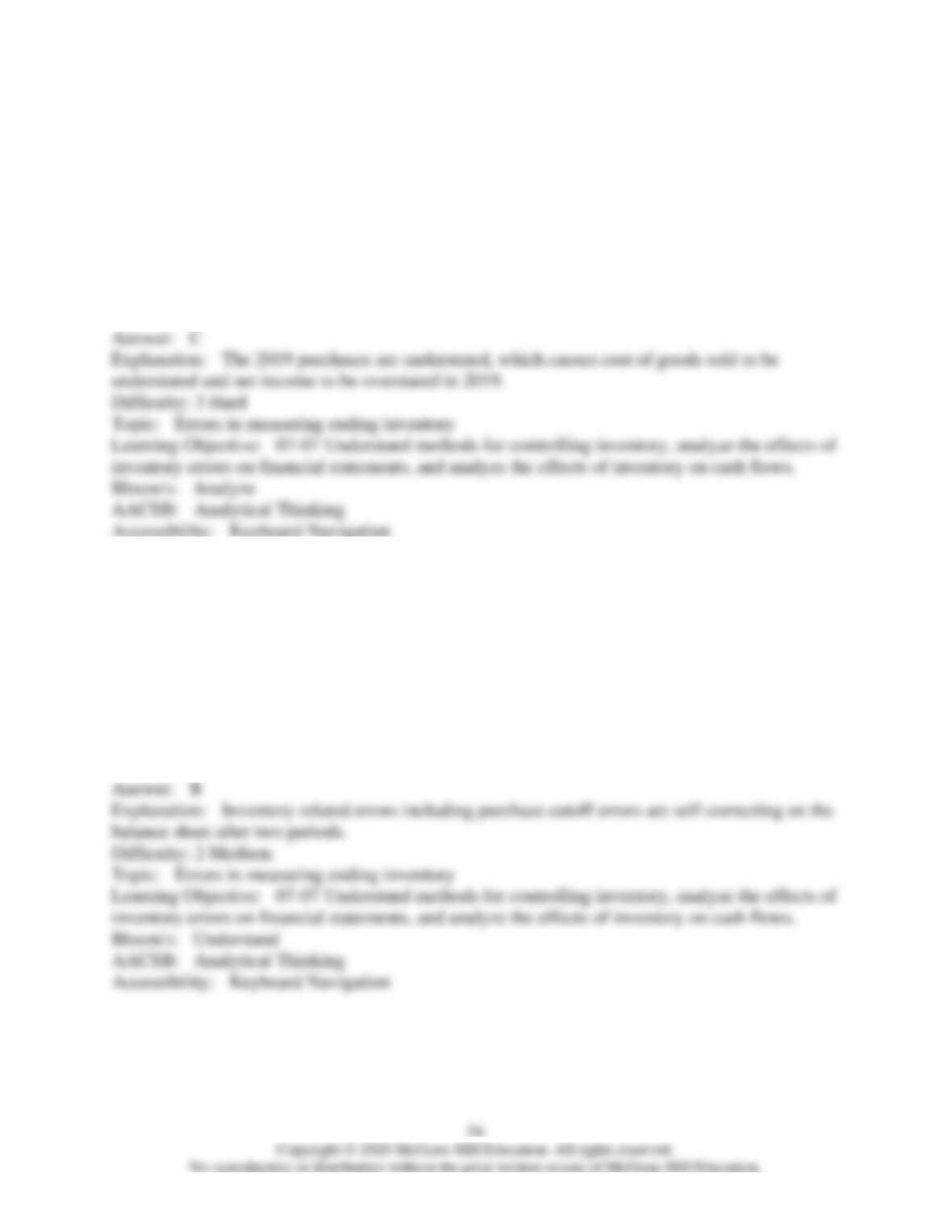
97) Cassie Corporation has provided the following information for its most recent month of
operation: sales $32,000, beginning inventory $8,000, purchases $16,000 and gross profit
$20,000. How much was Cassie’s ending inventory?
A) $4,000.
B) $8,000.
C) $6,000.
D) $12,000.
98) Atomic Company did not record a December 2019 purchase of inventory on credit until
January 2020. Assume that the December 31, 2019 ending inventory was correctly determined.
What is the effect of this error on the financial statements for the year ended December 31,
2019?
A) Net income is correct.
B) Stockholders’ equity is understated.
C) Net income is overstated.
D) Current assets are understated.
99) Atomic Company did not record a December 2019 purchase of inventory on credit until
January 2020. Assume that the December 31, 2019 ending inventory was correctly determined.
What is the effect of this error on the financial statements for the year ended December 31,
2020?
A) Net income is correct.
B) Stockholders’ equity is correct.
C) Net income is overstated.
D) Stockholders’ equity is overstated.
100) Which of the following costs does not become a part of inventory of a manufacturer?
A) The cost of raw materials used.
B) The cost of factory overhead.
C) The cost of rent on the factory building.
D) Rent on corporate headquarters.
101) Which of the following statements is correct?
A) Cost of goods available for sale is allocated between costs of goods sold and inventory at
year-end.
B) A purchase of inventory on credit increases both cost of goods available for sale and cost of
goods sold.
C) Purchases of inventory during a period less that period’s cost of goods sold equals ending
inventory regardless of the beginning inventory amount.
D) Cost of goods available for sale equals ending inventory plus purchases.
102) Which of the following businesses would not be as likely to use the specific identification
method of inventory valuation?
A) An automobile dealer.
B) A custom jewelry store.
C) A grocery store.
D) An art dealer.
103) Which of the following statements is incorrect?
A) A year-end purchase of inventory increases the LIFO cost of goods sold when unit costs are
increasing.
B) A year-end purchase of inventory increases the FIFO ending inventory when unit costs are
increasing.
C) The choice of an inventory costing method is dependent on the actual flow of goods when
inventory is sold.
D) A year-end purchase of inventory has an impact on the weighted-average ending inventory
when unit costs are increasing.
104) Which of the following statements is incorrect when inventory unit costs are increasing?
A) LIFO’s cost of goods sold will be the largest among the inventory costing methods.
B) LIFO’s income tax will be the lowest among the inventory costing methods.
C) Ending inventory using the average cost method will be larger than the ending inventory
when the LIFO method is used.
D) Cost of goods sold using the average cost method will be less than cost of goods sold when
the FIFO method is used.
105) Which of the following statements is correct when inventory unit costs are decreasing?
A) FIFO’s cost of goods sold will be the largest among the inventory costing methods.
B) LIFO’s income tax will be the lowest among the inventory costing methods.
C) Ending inventory using the FIFO cost method will be higher than the ending inventory when
the LIFO method is used.
D) Cost of goods sold using the average cost method will be less than cost of goods sold when
the LIFO method is used.
106) Which of the following statements is correct when inventory unit costs are increasing?
A) LIFO’s ending inventory will be the largest among the inventory costing methods.
B) FIFO’s gross profit will be the lowest among the inventory costing methods.
C) Inventory turnover will be the largest when the LIFO inventory method is used.
D) Use of the LIFO method will result in lower cash flows due to an increased cost of goods
sold.
107) Which of the following statements is correct when inventory unit costs are decreasing?
A) Inventory turnover will be the greatest when the average cost inventory method is used.
B) FIFO’s gross profit will be the highest among the inventory costing methods.
C) Inventory turnover will be the largest when the LIFO inventory method is used.
D) Use of the LIFO method will result in lower cash flows due to a decreased cost of goods sold.
108) Which of the following statements is correct with respect to the determination of cash flows
from operating activities?
A) A decrease in inventory is subtracted from net income.
B) An increase in accounts payable is subtracted from net income.
C) An increase in inventory is subtracted from net income.
D) A decrease in accounts payable is added to net income.
109) What is the net adjustment to net income with respect to the determination of cash flows
from operating activities when inventory increases $100,000 and accounts payable increases
$20,000?
A) An increase of $120,000.
B) A decrease of $120,000.
C) An increase of $80,000.
D) A decrease of $80,000.
110) Of the following, which is not a reason for having controls to safeguard inventories?
A) Protect inventory items from theft.
B) Avoid stock-outs from not having enough inventory on hand.
C) Reduce costs of maintaining the LIFO Reserve.
D) Keep track of overstocked items.
111) Of the following, which is not a control for safeguarding inventories?
A) Storing inventory in a locked warehouse.
B) Having the person responsible for receiving inventory purchases also be responsible for
shipping inventory sales.
C) Limiting inventory access to authorized employees.
D) Separating inventory accounting from inventory handling duties.