108.
Failure by a promissory notes’ maker to pay the amount due at maturity is known as:
109.
Uniform Supply accepted a $4,800, 90-day, 10% note from Tracy Janitorial on October 17.
What entry should Uniform Supply make on January 15 of the next year when the note is
paid, assuming interest was properly accrued at the previous December 31 year end?
110.
Uniform Supply accepted a $4,800, 90-day, 10% note from Tracy Janitorial on October 17.
What entry should Uniform Supply make on December 31, to record the accrued interest
on the note?
111.
Uniform Supply accepted a $4,800, 90-day, 10% note from Tracy Janitorial on October 17.
If the note is dishonored, what entry should Uniform Supply make on January 15 of the
next year, assuming interest was properly accrued at the previous December 31 year
end?
112.
Valley Spa purchased $7,800 in plumbing components from Tubman Co. Valley Spa signed
a 60-day, 10% promissory note for $7,800. If the note is dishonored at maturity, what is the
amount due on the note?
113.
Valley Spa purchased $7,800 in plumbing components from Tubman Co. Valley Spa signed
a 60-day, 10% promissory note for $7,800. If the note is dishonored at maturity, what is the
journal entry to record the dishonored note?
114.
Which of the following is not true about the Allowance for Doubtful Accounts?
115.
Jervis sells $75,000 of its accounts receivable to Northern Bank in order to obtain
necessary cash. Northern Bank charges a 5% factoring fee. What entry should Jervis make
to record the transaction?
116.
Jervis accepts all major bank credit cards, including those issued by Northern Bank (NB),
which assesses a 3% charge on sales for using its card. On June 28, Jervis had $3,500 in
NB Card credit sales. What entry should Jervis make on June 28 to record the deposit?
117.
Brinker accepts all major bank credit cards, including First Savings Bank’s, which assesses
a 2.5% charge on sales for using its card. On May 26, Brinker had $4,800 in First Savings
Bank Card credit sales. What entry should Brinker make on May 26 to record the deposit?
118.
Craigmont uses the allowance method to account for uncollectible accounts. Its year-end
unadjusted trial balance shows Accounts Receivable of $104,500, allowance for doubtful
accounts of $665 (credit) and sales of $925,000. If uncollectible accounts are estimated to
be 4% of accounts receivable, what is the amount of the bad debts expense adjusting
entry?
119.
Craigmont uses the allowance method to account for uncollectible accounts. Its year-end
unadjusted trial balance shows Accounts Receivable of $104,500, allowance for doubtful
accounts of $665 (credit) and sales of $925,000. If uncollectible accounts are estimated to
be 0.5% of sales, what is the amount of the bad debts expense adjusting entry?
120.
On July 9, Mifflin Company receives a $8,500, 90-day, 8% note from customer Payton
Summers as payment on account. Compute the maturity date for the note.
121.
On July 9, Mifflin Company receives a $8,500, 90-day, 8% note from customer Payton
Summers as payment on account. Compute the amount due at maturity for the note.
122.
On July 9, Mifflin Company receives a $8,500, 90-day, 8% note from overdue customer
Payton Summers as payment on account. What entry should be made on July 9 to record
receipt of the note?
123.
On July 9, Mifflin Company receives a $8,500, 90-day, 8% note from overdue customer
Payton Summers as payment on account. What entry should be made on the maturity date
assuming the maker pays in full?
124.
On November 19, Nicholson Company receives a $15,000, 60-day, 8% note from a
customer as payment on a past-due account. What adjusting entry should be made on the
December 31 year-end?
125.
On November 1, Orpheum Company accepted a $10,000, 90-day, 8% note from a customer
to settle a past-due account. What entry should be made on November 1 to record the
note acceptance?
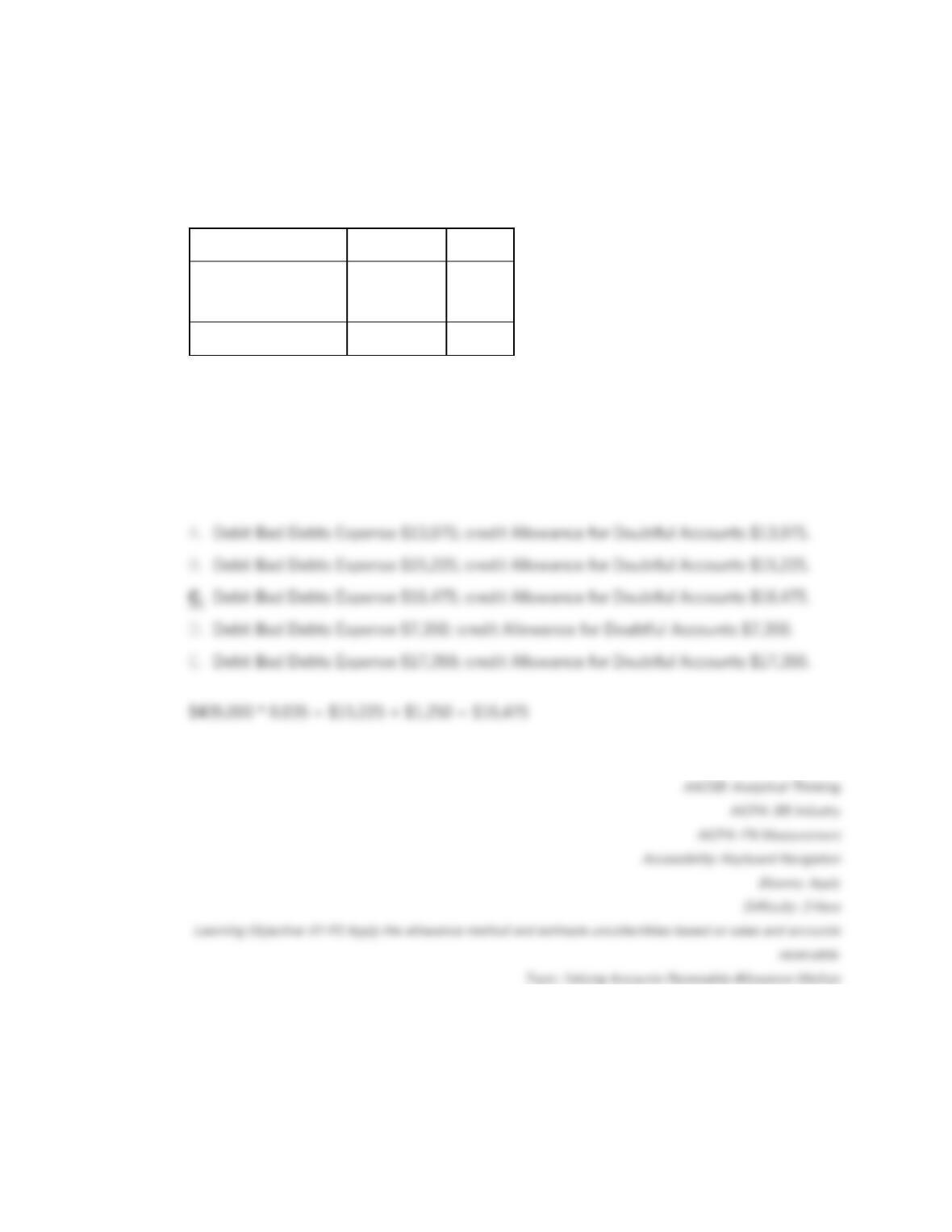
126.
The unadjusted trial balance at year-end for a company that uses the percent of
receivables method to determine its bad debts expense reports the following selected
amounts:
Accounts receivable
$435,000
Debit
Allowance for Doubtful
Accounts
1,250
Debit
Net Sales
2,100,000
Credit
All sales are made on credit. Based on past experience, the company estimates 3.5% of
ending account receivable to be uncollectible. What adjusting entry should the company
make at the end of the current year to record its estimated bad debts expense?
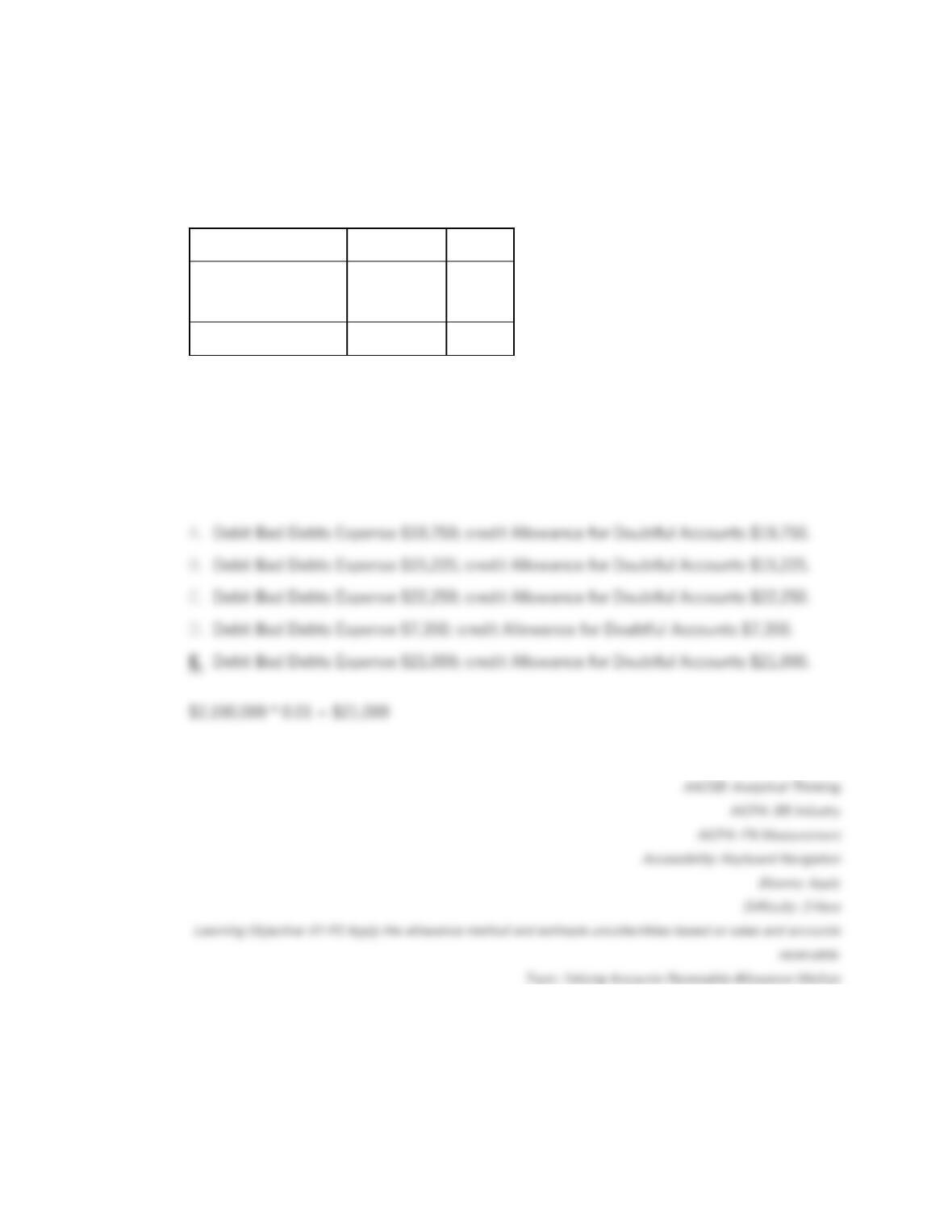
127.
The following selected amounts are reported on the year-end unadjusted trial balance
report for a company that uses the percent of sales method to determine its bad debts
expense.
Accounts receivable
$435,000
Debit
Allowance for Doubtful
Accounts
1,250
Debit
Net Sales
2,100,000
Credit
All sales are made on credit. Based on past experience, the company estimates 1% of
credit sales to be uncollectible. What adjusting entry should the company make at the end
of the current year to record its estimated bad debts expense?
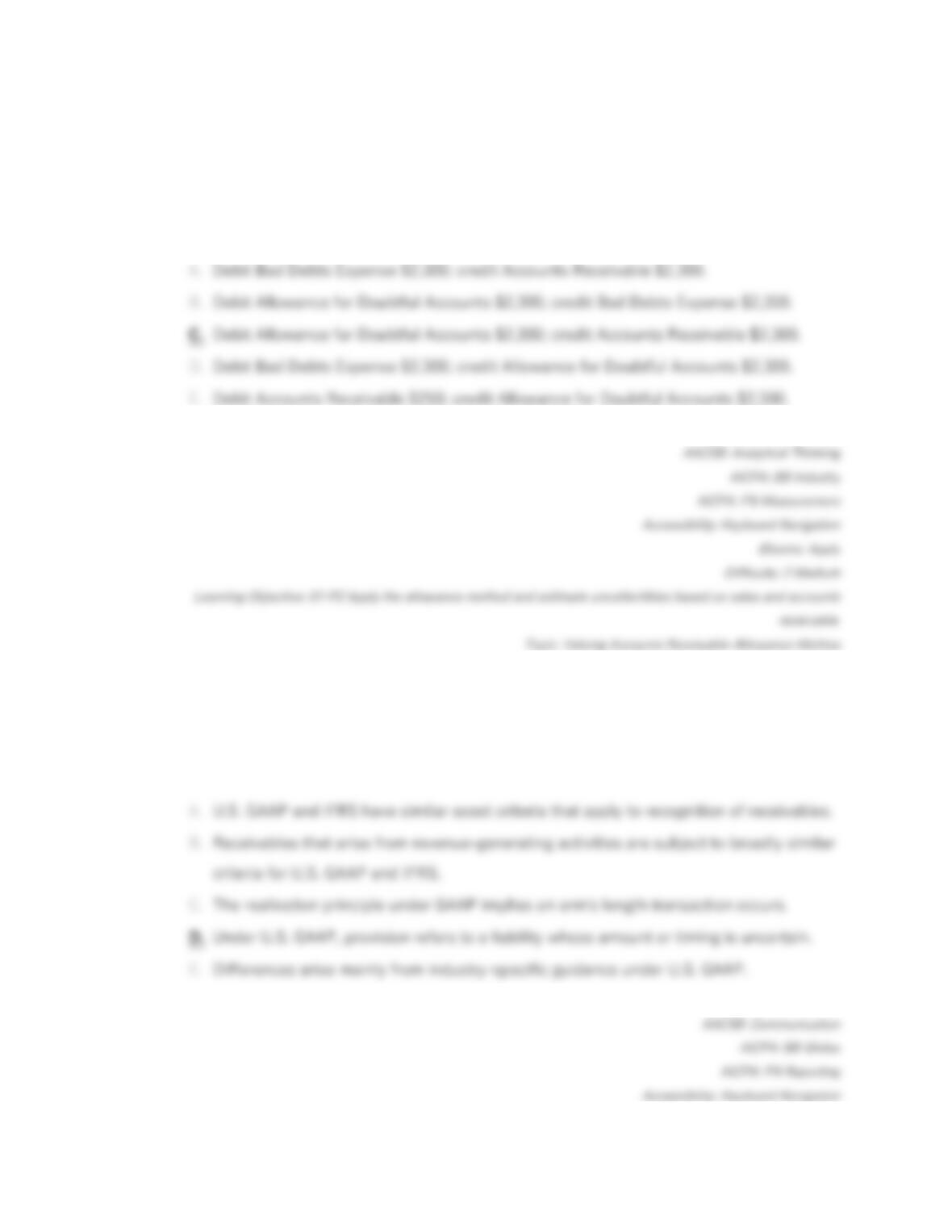
128.
On February 1, a customer’s account balance of $2,300 was deemed to be uncollectible.
What entry should be recorded on February 1 to record the write-off assuming the
company uses the allowance method?
129.
All of the following statements regarding recognition of receivables under U.S. GAAP and
IFRS are true
except
:
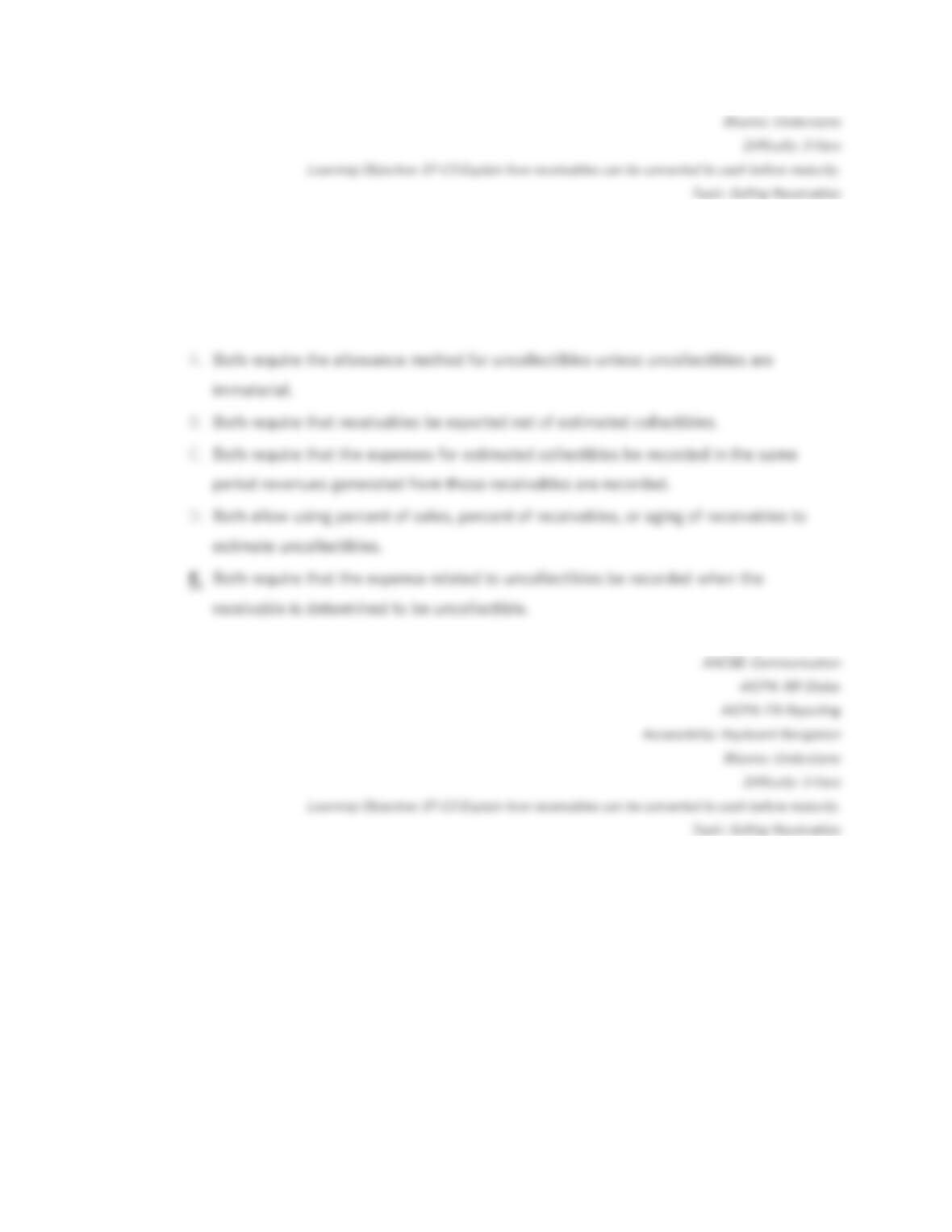
130.
All of the following statements regarding valuation of receivables under U.S. GAAP and
IFRS are true
except
: