DelauderEnterprises makes a variety of products that it sells to other businesses. The company’s
activity-based costing system has four activity cost pools for assigning costs to products and
customers. Details concerning that ABC system are listed below:
Activity Cost Pool
Activity Measure
Activity Rate
Supporting assembly
Direct labor-hours (DLHs)
$
3.45
per DLH
Processing batches
Number of batches
$
193.30
per batch
Processing orders
Number of orders
$
83.05
per order
Serving customers
Number of customers
$
1,608.00
per customer
The cost of serving customers, $1,608.00 per customer, is the cost of serving a customer for one
year. Grennon Corporation buys only one of the company’s products. The details of last year’s
purchases of this product are listed below:
Number of units purchased
1,500
units
Number of batches
5
batches
Number of orders
2
orders
Direct labor-hour requirement
0.25
DLHs per unit
Selling price
$
18.55
per unit
Direct materials cost
$
8.35
per unit
Direct labor cost
$
3.95
per unit
166) According to the ABC system, the total cost of the activity “Supporting assembly” for this
customer this past year was closest to:
A) $5,175.00
B) $0.86
C) $1,293.75
D) $375.00
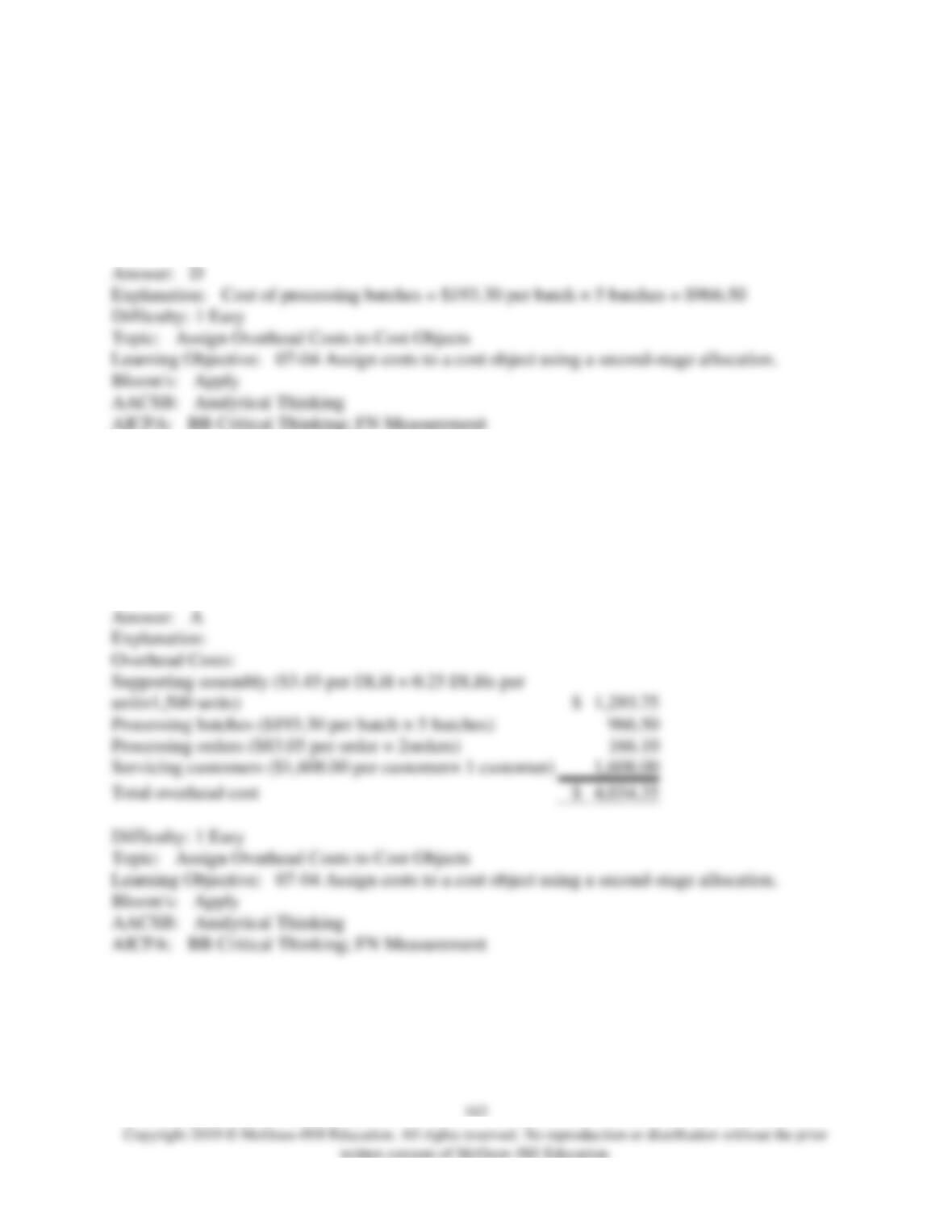
167) According to the ABC system, the total cost of the activity “Processing batches” for this
customer this past year was closest to:
A) $1,049.55
B) $83.05
C) $193.30
D) $966.50
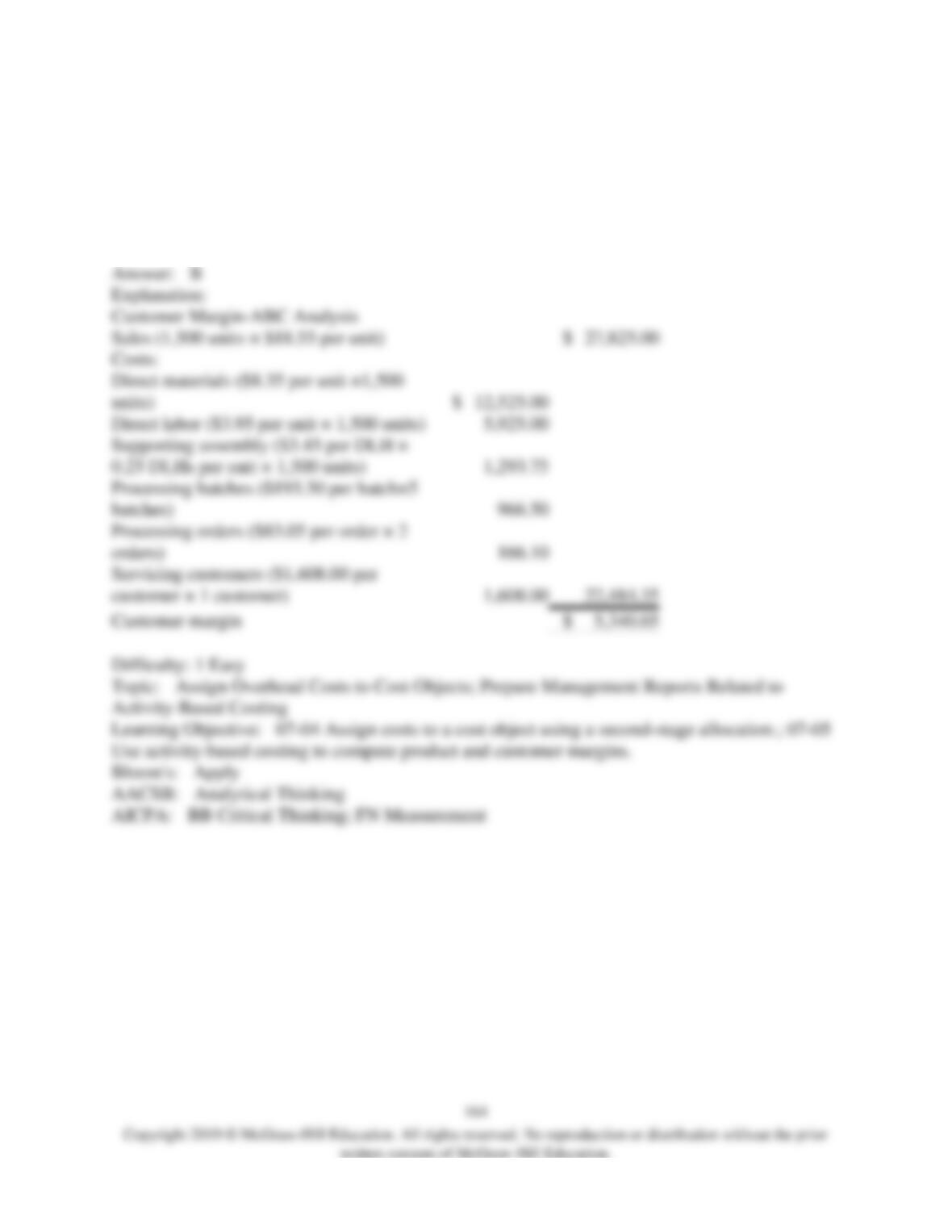
168) According to the ABC system, the total overhead cost for this customer this past year was
closest to:
A) $4,034.35
B) $22,484.35
C) $2,426.35
D) $18,450.00
169) According to the ABC system, the customer margin for this customer this past year was
closest to:
A) $9,375.00
B) $5,340.65
C) $23,790.65
D) $15,300.00
Scholfield Enterprises makes a variety of products that it sells to other businesses. The company’s
activity-based costing system has four activity cost pools for assigning costs to products and
customers. Details concerning that ABC system are listed below:
Activity Cost Pool
Activity Measure
Activity Rate
Supporting assembly
Direct labor-hours (DLHs)
$
6.55
per DLH
Processing batches
Number of batches
$
138.20
per batch
Processing orders
Number of orders
$
52.60
per order
Serving customers
Number of customers
$
1,191.00
per customer
The cost of serving customers, $1,191.00 per customer, is the cost of serving a customer for one
year.
Latif Corporation buys only one of the company’s products which Scholfield Enterprises sells for
$15.60 per unit. Last year Latif Corporation ordered a total of 1,100 units of this product in 2
orders. To fill the orders, 7 batches were required. The direct materials cost is $7.85 per unit and
the direct labor cost is $1.90 per unit. Each unit requires 0.10 DLHs.
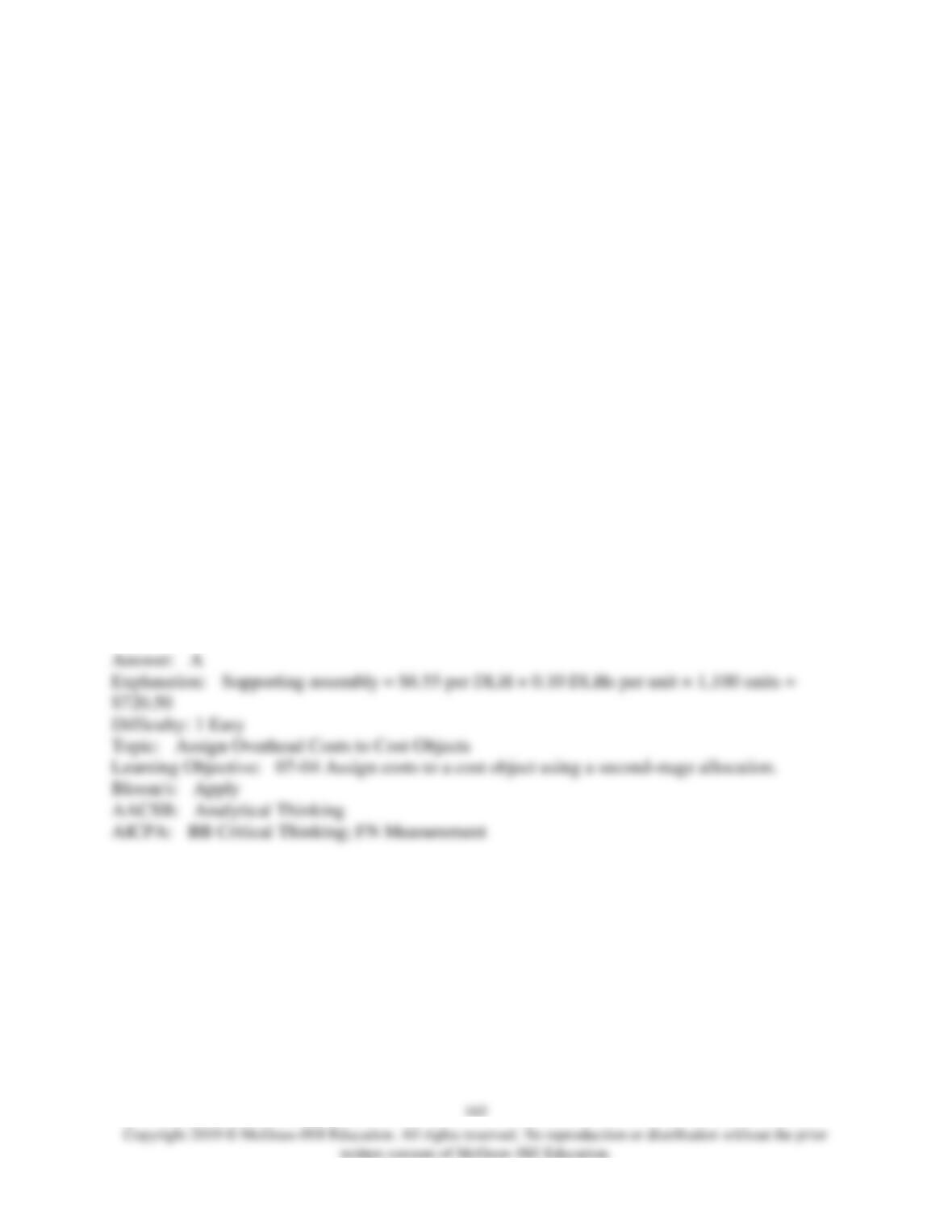
170) According to the ABC system, the total cost of the activity “Supporting assembly” for this
customer this past year was closest to:
A) $720.50
B) $110.00
C) $0.66
D) $7,205.00
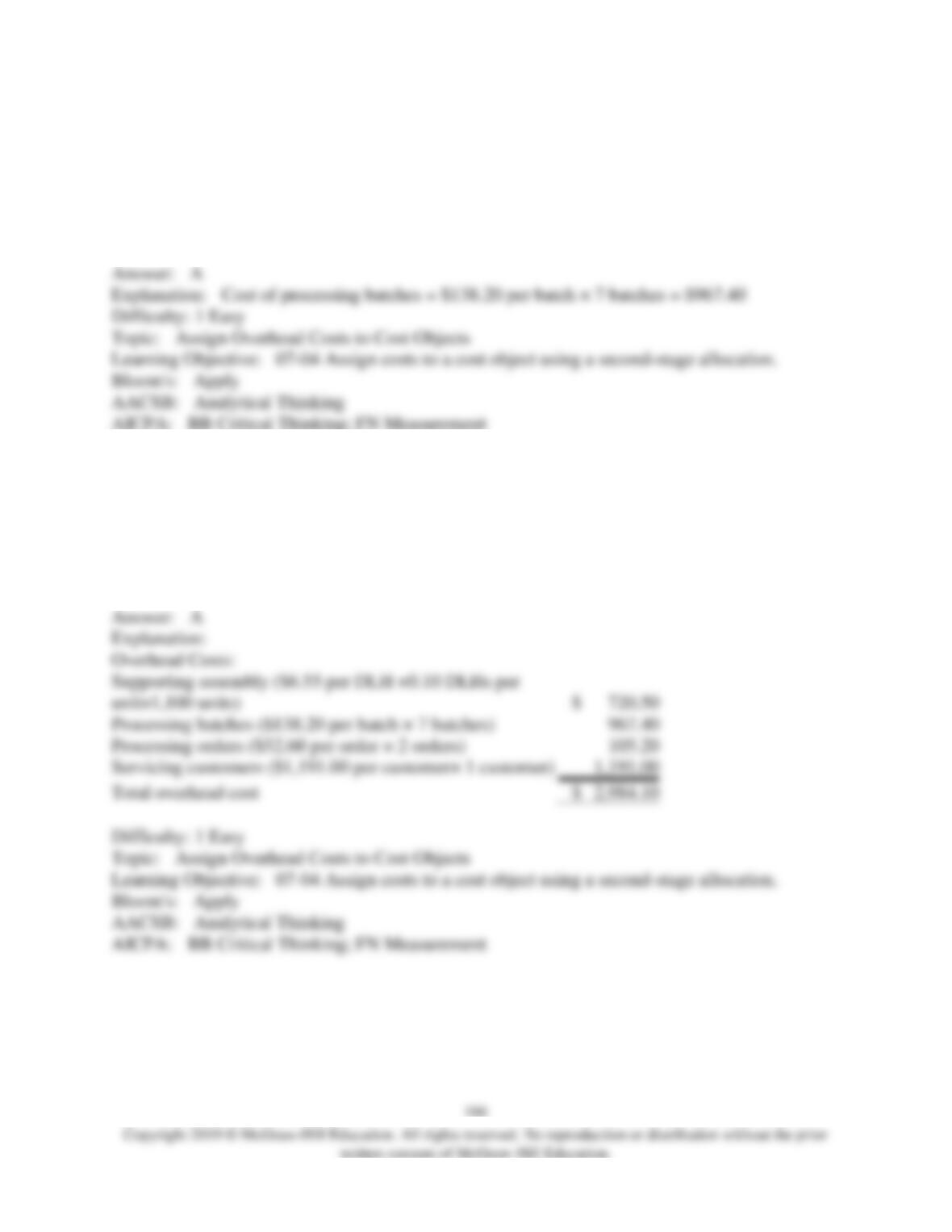
171) According to the ABC system, the total cost of the activity “Processing batches” for this
customer this past year was closest to:
A) $967.40
B) $1,020.00
C) $52.60
D) $138.20
172) According to the ABC system, the total overhead cost for this customer this past year was
closest to:
A) $2,984.10
B) $10,725.00
C) $1,793.10
D) $13,709.10
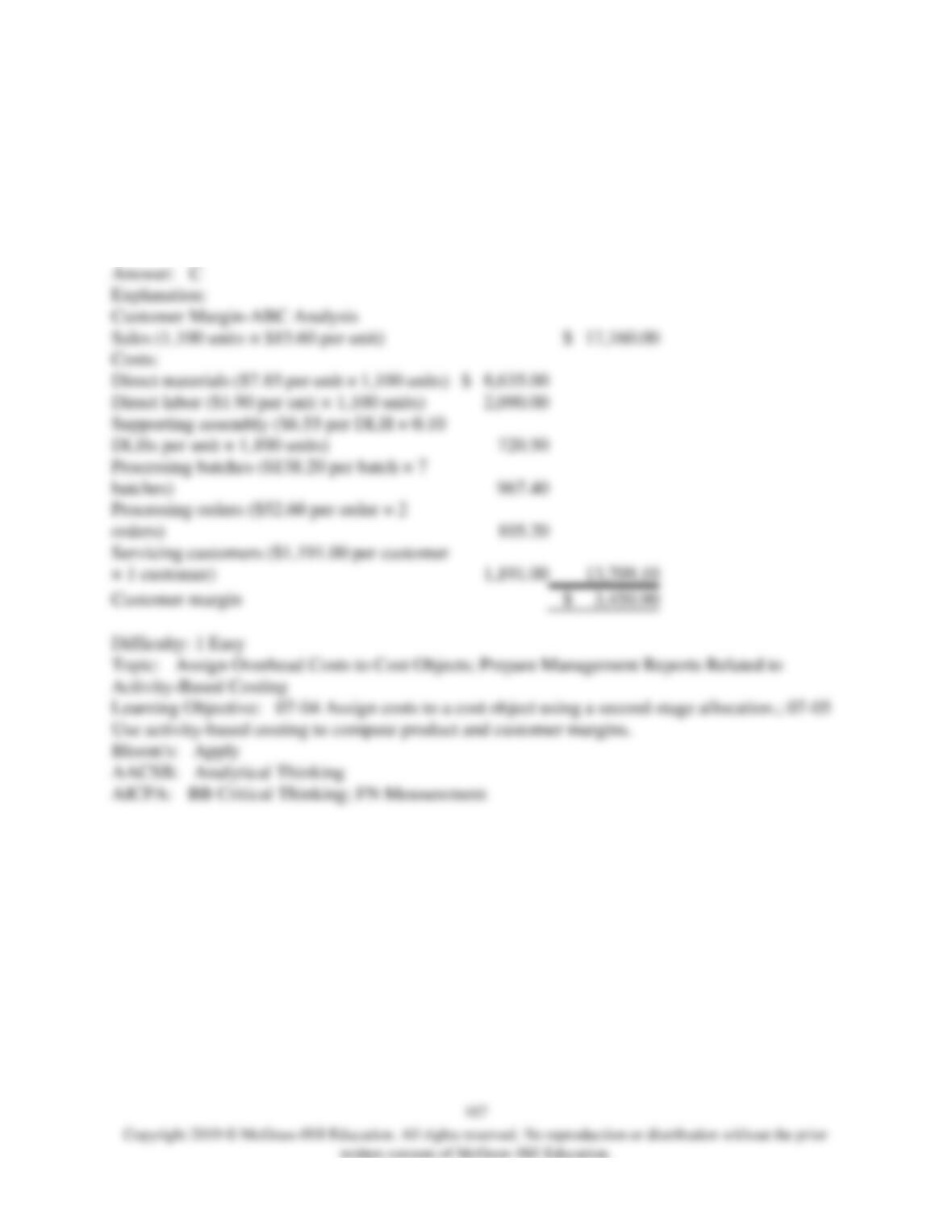
173) According to the ABC system, the customer margin for this customer this past year was
closest to:
A) $14,175.90
B) $6,435.00
C) $3,450.90
D) $8,525.00

168
Nissley Wedding Fantasy Corporation makes very elaborate wedding cakes to order. The owner of
the company has provided the following data concerning the activity rates in its activity-based
costing system:
Activity Cost Pools
Activity Rate
Size-related
$
1.13
per guest
Complexity-related
28.22
per tier
Order-related
$
74.72
per order
The measure of activity for the size-related activity cost pool is the number of planned guests at the
wedding reception. The greater the number of guests, the larger the cake. The measure of
complexity is the number of tiers in the cake. The activity measure for the order-related cost pool is
the number of orders. (Each wedding involves one order.) The activity rates include the costs of
raw ingredients such as flour, sugar, eggs, and shortening. The activity rates do not include the
costs of purchased decorations such as miniature statues and wedding bells, which are accounted
for separately.
Data concerning two recent orders appear below:
Tijerina
Wedding
Twersky
Wedding
Number of reception guests
49
126
Number of tiers on the cake
2
4
Cost of purchased decorations for cake
$
28.60
$
54.64
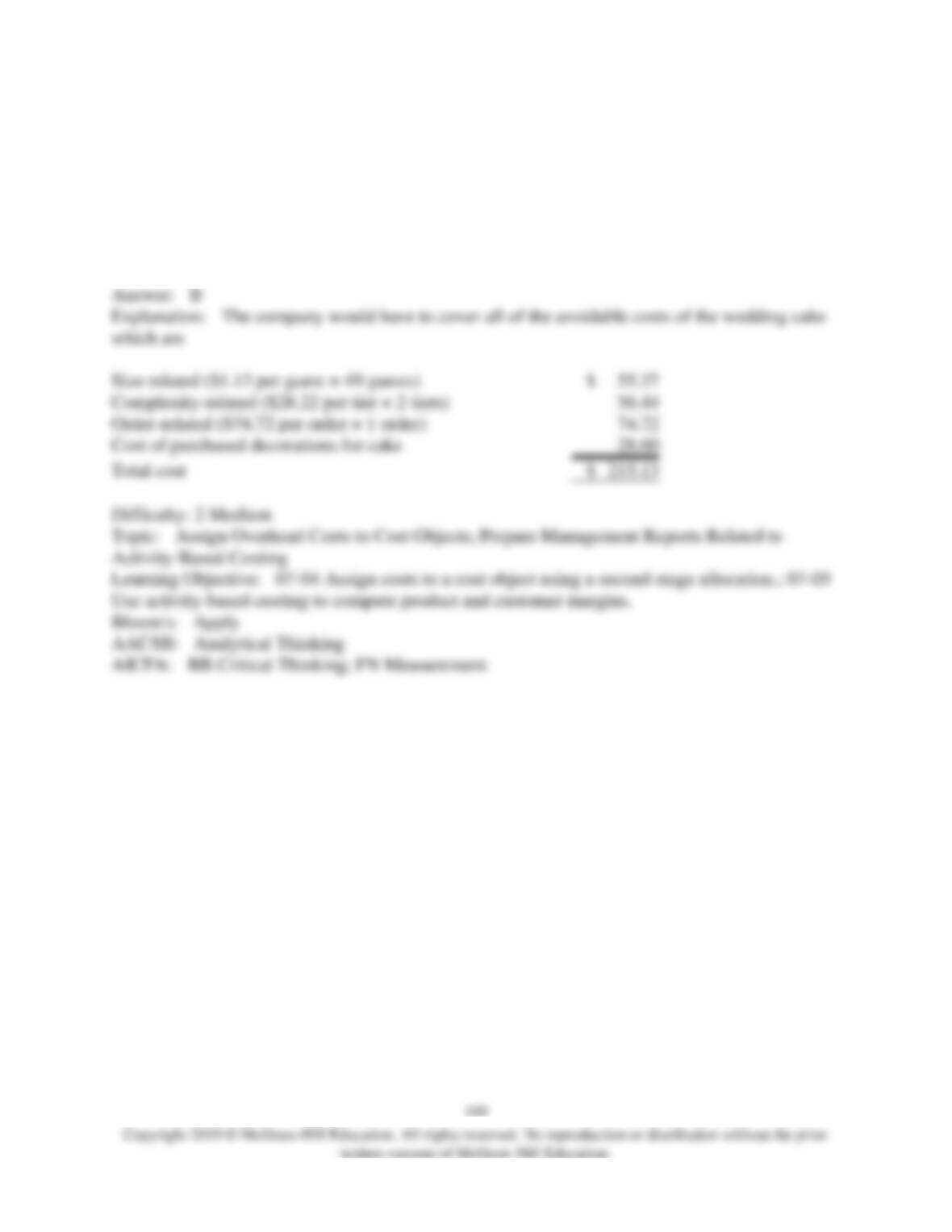
174) Assuming that all of the costs listed above are avoidable costs in the event that an order is
turned down, what amount would the company have to charge for the Tijerina wedding cake to just
break even?
A) $74.72
B) $215.13
C) $28.60
D) $260.31
175) Assuming that the company charges $465.39 for the Twersky wedding cake, what would be
the overall margin on the order?
A) $135.41
B) $80.77
C) $384.62
D) $155.49
176) Suppose that the company decides that the present activity-based costing system is too
complex and that all costs (except for the costs of purchased decorations) should be allocated on
the basis of the number of guests. In that event, what would you expect to happen to the costs of
cakes?
A) The costs of all cakes would go up.
B) The cost of cakes for receptions with fewer than the average number of guests would go down.
C) The cost of cakes for receptions with more than the average number of guests would go down.
D) The costs of all cakes would go down.
Meade Nuptial Bakery makes very elaborate wedding cakes to order. The company has an
activity-based costing system with three activity cost pools. The activity rate for the Size-Related
activity cost pool is $1.13 per guest. (The greater the number of guests, the larger the cake.) The
activity rate for the Complexity-Related cost pool is $43.52 per tier. (Cakes with more tiers are
more complex.) Finally, the activity rate for the Order-Related activity cost pool is $61.44 per
order. (Each wedding involves one order for a cake.) The activity rates include the costs of raw
ingredients such as flour, sugar, eggs, and shortening. The activity rates do not include the costs of
purchased decorations such as miniature statues and wedding bells, which are accounted for
separately.
Data concerning two recent orders appear below:
Ericson
Wedding
Haupt
Wedding
Number of reception guests
60
162
Number of tiers on the cake
4
3
Cost of purchased decorations for cake
$
16.89
$
38.61
177) Assuming that all of the costs listed above are avoidable costs in the event that an order is
turned down, what amount would the company have to charge for the Ericson wedding cake to just
break even?
A) $61.44
B) $387.45
C) $16.89
D) $320.21
Size related ($1.13 per guest × 60 guests)
$
67.80
Complexity-related ($43.52 per tier × 4 tiers)
174.08
Order-related ($61.44 per order × 1 order)
61.44
Cost of purchased decorations for cake
16.89
Total cost
$
320.21
178) Assuming that the company charges $500.54 for the Haupt wedding cake, what would be the
overall margin on the order?
A) $86.87
B) $413.67
C) $148.31
D) $125.48

174
179) Daher Corporation manufactures two products: Product A34R and Product E05V. The
company uses a plantwide overhead rate based on direct labor-hours. It is considering
implementing an activity-based costing (ABC) system that allocates all of its manufacturing
overhead to four cost pools. The following additional information is available for the company as a
whole and for Products A34R and E05V.
Activity Cost Pool
Activity Measure
Total Cost
Total Activity
Machining
Machine-hours
$95,000
5,000
MHs
Machine setups
Number of setups
$80,000
200
setups
Product design
Number of products
$96,000
2
products
General factory
Direct labor-hours
$310,000
10,000
DLHs
Activity Measure
Product A34R
Product E05V
Machine-hours
2,000
3,000
Number of setups
150
50
Number of products
1
1
Direct labor-hours
3,000
7,000
Required:
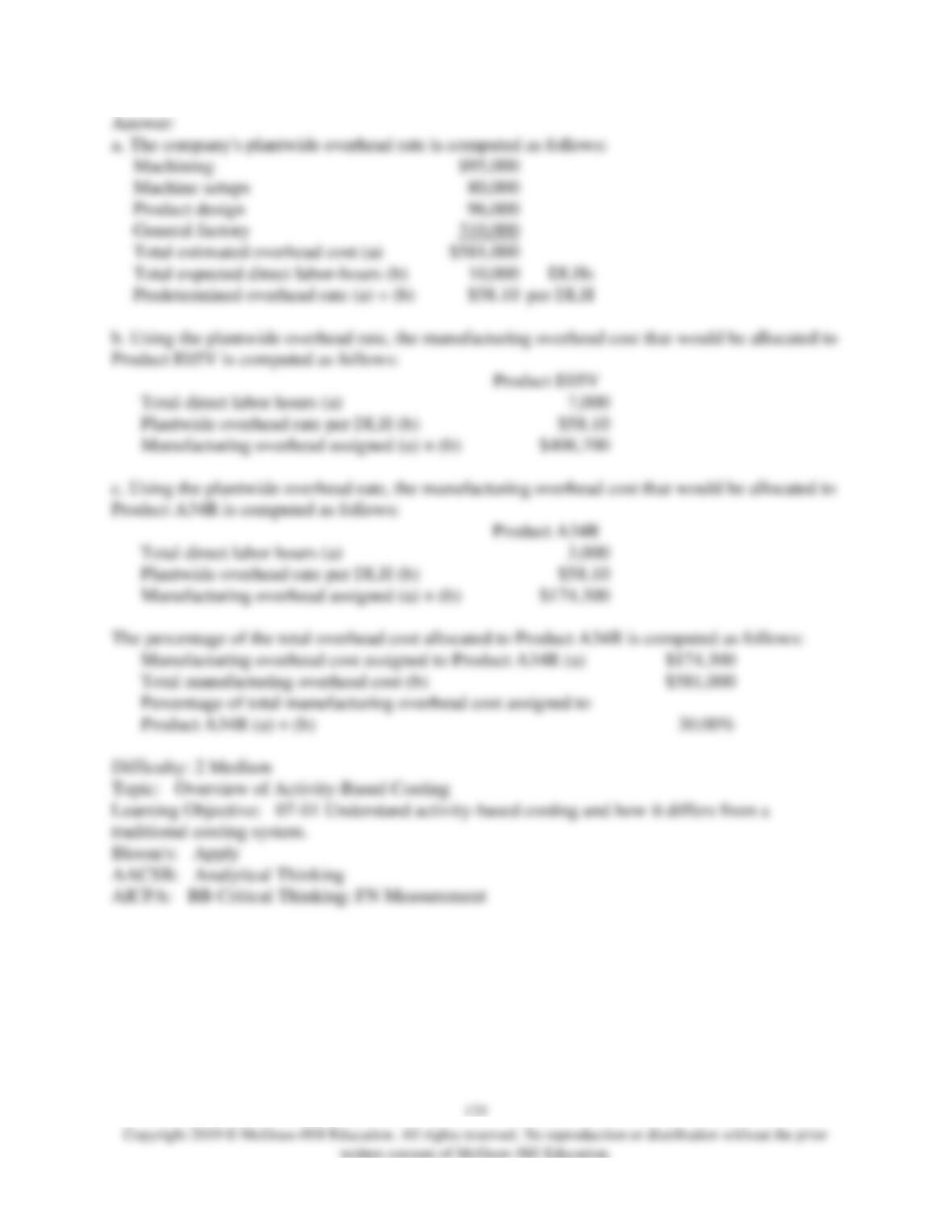
a. What is the company’s plantwide overhead rate?
b. Using the plantwide overhead rate, how much manufacturing overhead cost would be allocated
to Product E05V?
c. Using the plantwide overhead rate, what percentage of the total overhead cost is allocated to
Product A34R?

176
180) Vito Corporation manufactures two products: Product F77I and Product I48D. The company
uses a plantwide overhead rate based on direct labor-hours. It is considering implementing an
activity-based costing (ABC) system that allocates its manufacturing overhead to four cost pools.
The following additional information is available for the company as a whole and for Products
F77I and I48D.
Activity Cost Pool
Activity Measure
Total Cost
Total Activity
Machining
Machine-hours
$207,000
9,000
MHs
Machine setups
Number of setups
$120,000
300
setups
Product design
Number of products
$76,000
2
products
General factory
Direct labor-hours
$330,000
10,000
DLHs
Activity Measure
Product F77I
Product I48D
Machine-hours
6,000
3,000
Number of setups
120
180
Number of products
1
1
Direct labor-hours
7,000
3,000
Required:
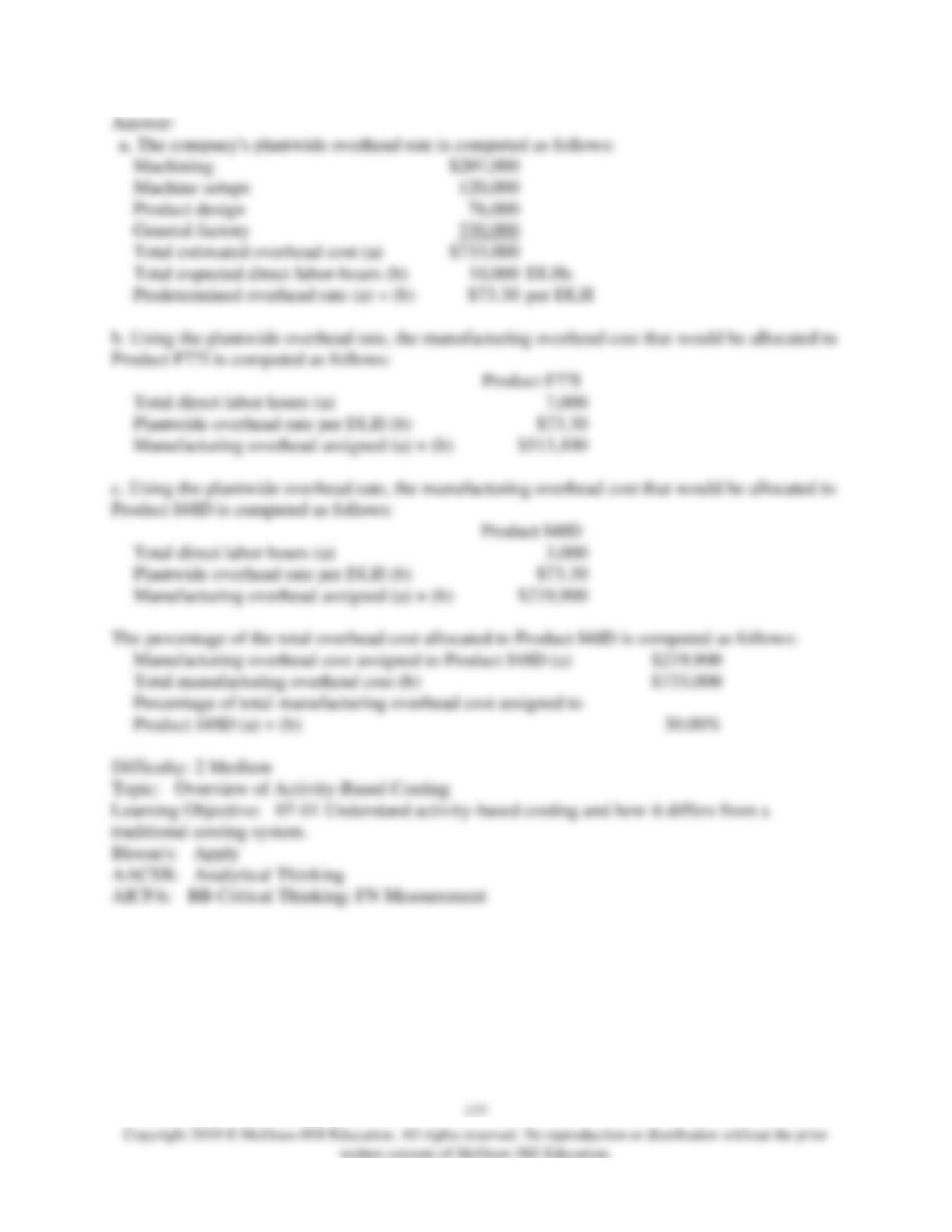
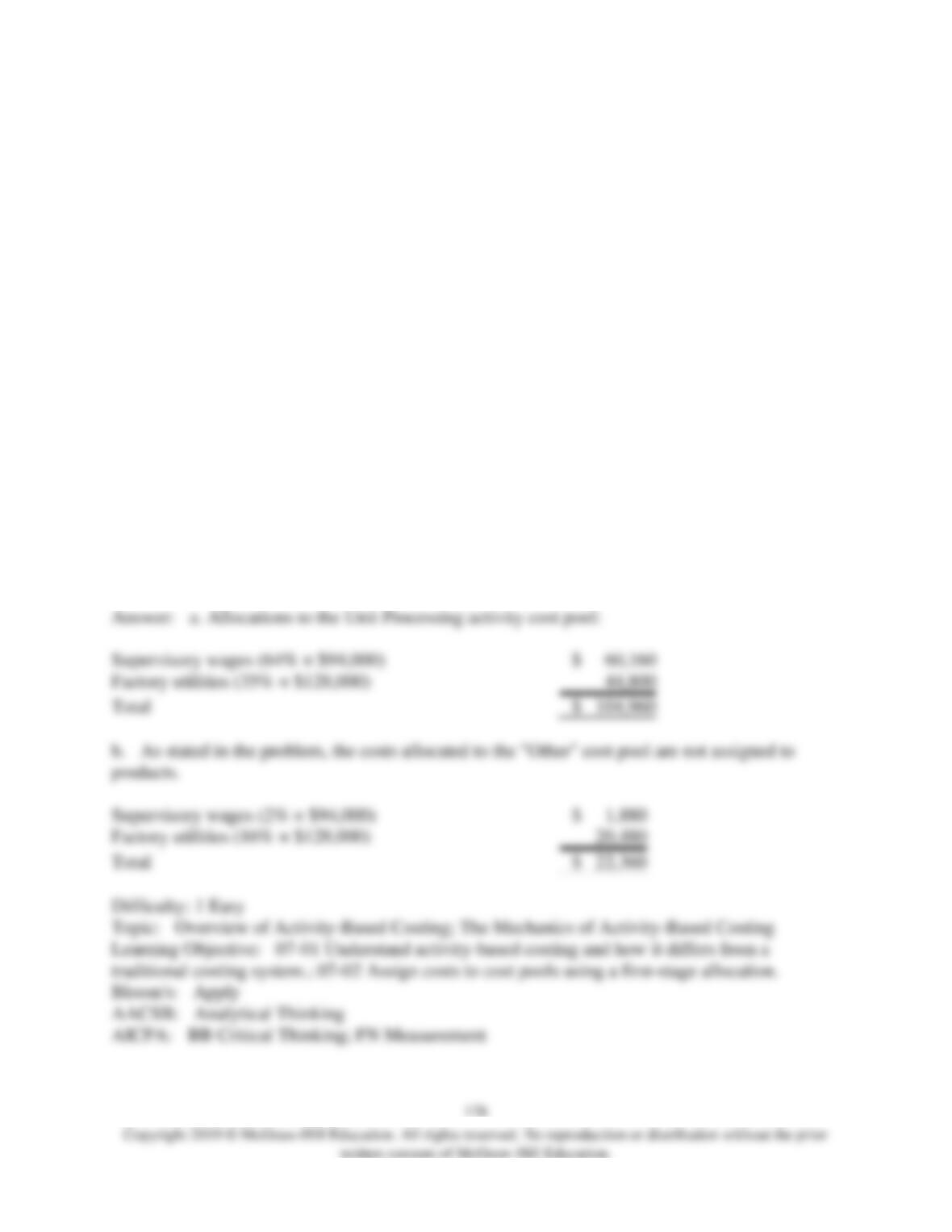
a. What is the company’s plantwide overhead rate?
b. Using the plantwide overhead rate, how much manufacturing overhead cost would be allocated
to Product F77I?
c. Using the plantwide overhead rate, what percentage of the total overhead cost is allocated to
Product I48D?
181) Desilets Corporation has provided the following data from its activity-based costing
accounting system:
Supervisory wages
$
94,000
Factory utilities
$
128,000
Distribution of Resource Consumption across Activity Cost Pools:
Activity Cost Pools
Batch Set-Ups
Unit Processing
Other
Total
Supervisory wages
34%
64%
2%
100%
Factory utilities
49%
35%
16%
100%
The “Other” activity cost pool consists of the costs of idle capacity and organization-sustaining
costs that are not assigned to products.
Required:
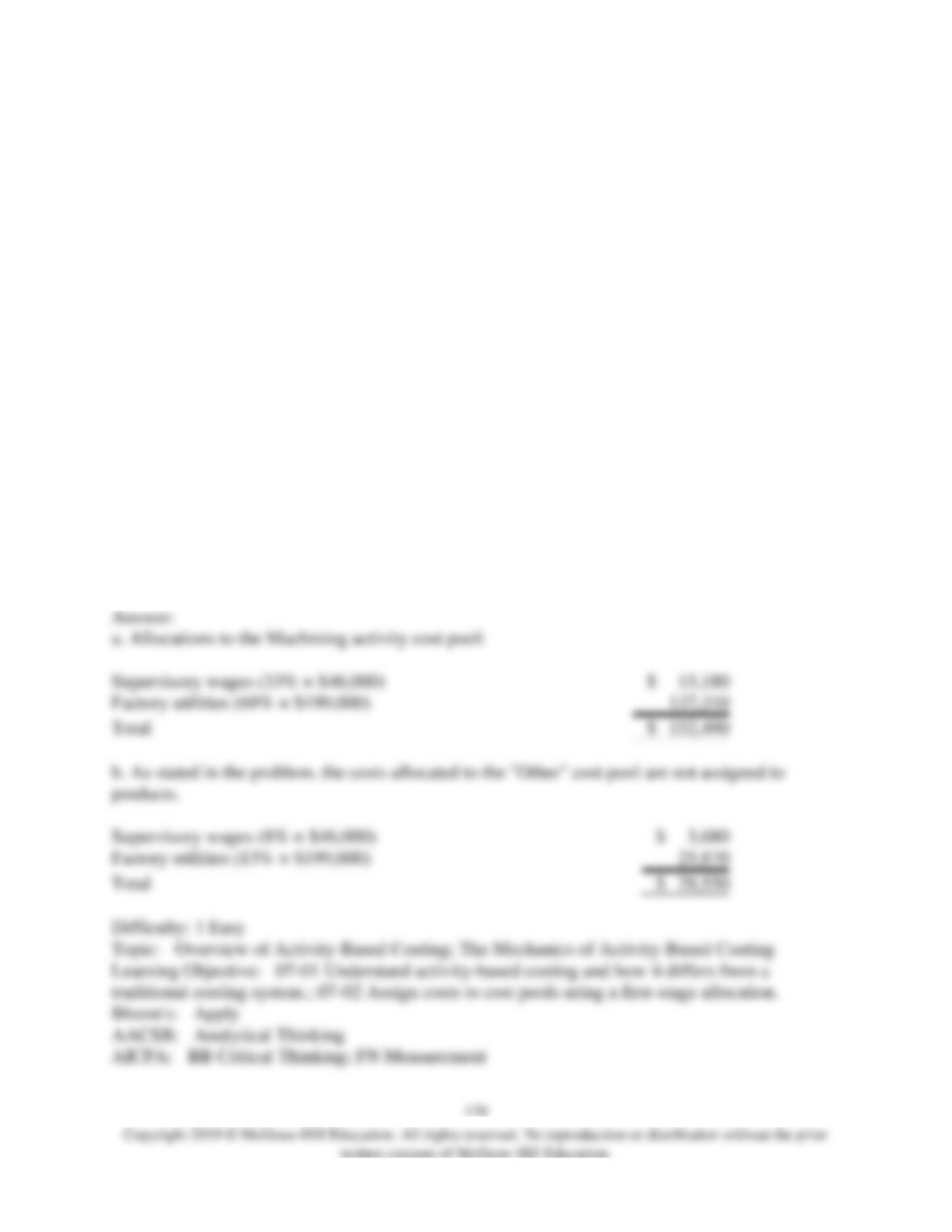
a. Determine the total amount of supervisory wages and factory utilities costs that would be
allocated to the Unit Processing activity cost pool.
b. Determine the total amount of supervisory wages and factory utilities costs that would NOT be
assigned to products.
Supervisory wages (64% × $94,000)
$
60,160
Factory utilities (35% × $128,000)
44,800
Total
$
Supervisory wages (2% × $94,000)
$
1,880
Factory utilities (16% × $128,000)
Total
$
182) The following data have been provided by Hooey Corporation from its activity-based costing
accounting system:
Supervisory wages
$
46,000
Factory utilities
$
199,000
Distribution of Resource Consumption across Activity Cost Pools:
Activity Cost Pools
Product Changeovers
Machining
Other
Total
Supervisory wages
59%
33%
8%
100%
Factory utilities
18%
69%
13%
100%
The “Other” activity cost pool consists of the costs of idle capacity and organization-sustaining
costs that are not assigned to products.
Required:
a. Determine the total amount of supervisory wages and factory utilities costs that would be
allocated to the Machining activity cost pool.
b. Determine the total amount of supervisory wages and factory utilities costs that would NOT be
assigned to products.
Supervisory wages (33% × $46,000)
$
15,180
Factory utilities (69% × $199,000)
137,310
Total
$
152,490
Supervisory wages (8% × $46,000)
$
3,680
Factory utilities (13% × $199,000)
25,870
Total
$
29,550
183) Beckley Corporation has provided the following data from its activity-based costing
accounting system:
Indirect factory wages
$
16,000
Factory equipment depreciation
$
193,000
Distribution of Resource Consumption across Activity Cost Pools:
Activity Cost Pools
Customer Orders
Product Processing
Other
Total
Indirect factory wages
48%
47%
5%
100%
Factory equipment depreciation
61%
25%
14%
100%
The “Other” activity cost pool consists of the costs of idle capacity and organization-sustaining
costs that are not assigned to products.
Required:
a. Determine the total amount of indirect factory wages and factory equipment depreciation costs
that would be allocated to the Product Processing activity cost pool.
b. Determine the total amount of indirect factory wages and factory equipment depreciation costs
that would NOT be assigned to products.
Indirect factory wages (47% × $16,000)
$
7,520
Factory equipment depreciation (25% × $193,000)
48,250
Total
$
55,770
Indirect factory wages (5% × $16,000)
Factory equipment depreciation (14% × $193,000)
27,020
Total
27,820