Chapter 7: The Governmental Accounting Cycle
Proprietary-Type Funds
Multiple Choice
1. In what way do Internal Service Funds differ from Enterprise Funds?
a. in the basis of accounting that they use
b. in the nature of the entities to which they supply goods or services
c. in the measurement focus that they use
d. in the kinds of financial statements that they prepare
2. A school district wants to establish a separate fund to acquire, store, and sell school
supplies to individual schools within the district. What type of fund should it use?
a. enterprise fund
b. agency fund
c. internal service fund
d. public-purpose trust fund
3. To achieve the pricing objective of an Internal Service Fund, which measurement
focus and basis of accounting must be used?
a. cash measurement focus and cash basis of accounting
b. current financial resources measurement focus and full accrual basis of
accounting
c. economic resources measurement focus and modified accrual basis of
accounting
d. economic resources measurement focus and full accrual basis of accounting
4. A proprietary fund statement of net position report assets and liabilities in what
format?
a. relative order of liquidity
b. classified (current/noncurrent)
c. by asset/liability type
d. separating capital assets and related debt for other assets and liabilities
5. Which of the following activities is most likely to be accounted for in an Internal

Service Fund?
a. operation of the municipal parks and cultural centers
b. sale of printing services to all departments in the municipality
c. sale of electricity services to the municipality’s residents
d. accumulation of resources to pay pension benefits to municipal employees
6. In establishing prices for its services, which of the following practices is the least
appropriate for an Internal Service Fund?
a. price at less than cost
b. price at cost only
c. price at cost plus an amount for anticipated inflation of equipment costs
d. price at cost plus an amount for depreciation of equipment purchased with a
transfer of cash from the General Fund
7. The General Fund transfers $500,000 to a Printing Internal Service Fund, which the
Internal Service Fund uses to acquire machinery. How should the Internal Service
Fund account for the cost of acquiring and using the equipment?
a. record the acquisition cost as an expenditure and ignore any depreciation
b. record the acquisition cost as an asset and depreciate it over its estimated
useful life
c. record the acquisition cost as an asset, credit investment in capital assets, do
not depreciate the asset, and write off the entire asset when it is disposed of
d. record the acquisition cost as an expenditure of the General Fund
8. When an Internal Service Fund sends a bill to the General Fund, which account
should the Internal Service Fund debit?
a. expenditures – vehicle usage
b. transfer out to the general fund
c. revenues – vehicle charges
d. due from general fund
9. A city’s Water and Sewer Enterprise Fund should include which of the following
components in its statement of net position?

a. only assets, liabilities, and net position
b. assets, deferred outflows, liabilities, deferred inflows, and net position
c. assets, deferred outflows, liabilities, deferred inflows, and retained earnings
d. assets, liabilities, and retained earnings
10. A city’s General Fund makes a contribution of $800,000 to an Internal Service Fund
(ISF) so that the ISF can operate. How should the ISF report the contribution?
a. as operating revenue
b. as nonoperating revenue
c. as a transfer after operating income but before change in net position
d. as a direct addition to fund net position
11. In Proprietary Fund accounting, which of the following statements are true?
a. materials and supplies are recognized as expenditures when purchased
b. materials and supplies are recognized as expenses when consumed
c. capital assets are considered as expenditures when they are acquired
d. capital assets are not recorded in proprietary funds
12. You are computing an hourly billing rate for the Print Shop Internal Service Fund.
Which of the following items should become part of the rate?
a. salaries paid to maintenance staff
b. materials consumed during the year
c. depreciation
d. all of the above
13. An Internal Service Fund (ISF) sends bills for motor vehicle services to various
departments that receive appropriations from the General Fund. When it sends the
bills out, which account should the ISF credit?
a. due from general fund
b. other financing sources – motor vehicle services
c. revenues – motor vehicle services
d. expenditures – motor vehicle costs
14. Which of the following statements is true about the source of Enterprise Fund
revenues?
a. enterprise fund revenues may include revenues from sales to governmental

agencies
b. enterprise fund revenues always come from sales to individuals and
organizations other than governmental organizations
c. enterprise funds never receive governmental subsidies
d. enterprise funds record proceeds from revenue bonds as revenues
15. Which basis of accounting is used by Enterprise Funds?
a. full accrual
b. modified accrual
c. cash
d. modified cash
16. Under which of the following circumstances must an Enterprise Fund be used?
a. when its activities are partially financed with advances from the general
fund
b. when its activities are financed with debt that is secured solely by the full
faith and credit of the related primary government
c. when its activities are financed with debt that is secured solely by a pledge
of the net revenues from the charges made by the activity
d. when its activities are financed in such a way that all costs except capital
costs are covered.
17. Which of the following accounts properly would not appear in a proprietary-type
statement of net position (balance sheet)?
a. accumulated depreciation
b. retained earnings
c. net position, unrestricted
d. inventory
18. Which of the following accounts properly would not appear in the operating
statement of a proprietary-type fund?
a. transfer in from the general fund
b. depreciation expense

c. expenditures—capital outlay
d. revenues—charges for services
19. Which of the following would least likely be accounted for in an Enterprise Fund?
a. a local government’s mass transit operation
b. a public swimming pool for which the government charges admission fees
c. a municipal golf course
d. a fire department
20. Which of the following accounts would be least likely to appear in an Enterprise
Fund statement of net position (balance sheet)?
a. cash and cash equivalents
b. general obligation bonds payable
c. net investment in capital assets
d. equipment acquired under capital leases
21. Proprietary funds sometimes report special assessment revenues. What are special
assessments?
a. a means of financing services that benefit one group of citizens more than
the general public
b. an additional assessment made so that an internal service or enterprise fund
can cover all of its costs each year
c. a fee charged to cover the cost of creating new service capacity
d. revenues reported as direct additions to net investment in capital assets
22. For fund-level financial reporting, a statement of cash flows is required for
Enterprise Internal Service
Funds Funds
a. yes no
b. no no

c. no yes
d. yes yes
23. Enterprise funds report capital contributions separate from operating and
nonoperating revenues and expenses. When does an inflow of resources constitute
a capital contribution?
a. when the inflows must be used to purchase capital assets or consist of
capital assets
b. when the inflows are grants restricted to use on capital projects
c. when the contributions are from property owners
d. when the inflow consists of donated capital assets
24. City Parks Department activities are accounted for in the General Fund. The Parks
Department receives two invoices, one from the Lighting Enterprise Fund (EF) and
one from the Printing Internal Service Fund (ISF). On receiving the invoices, which
accounts should the department debit?
a. due to lighting EF and due to printing ISF
b. expenditures (for lighting services) and expenditures (for printing services)
c. expenditures (for lighting services) and transfers (for printing services)
d. transfers (for lighting services) and expenditures (for printing services)
25. A Water Enterprise Fund (EF) issues $4 million of 5% revenue bonds on October 1,
2013. The EF will make its first payment of interest on March 31, 2014, together
with a principal payment of $200,000. What amount, if any, should the EF report in
its fund statement of revenues, expenses, and changes in net position for the year
ended December 31, 2013?
a. zero
b. interest expense of $100,000
c. interest expense of $50,000 and principal expense of $100,000
d. interest expense of $50,000
26. A city accounts for its hospital in an Enterprise Fund. An individual brings a
malpractice suit against the hospital in 2013. City lawyers are concerned about
losing the case if it goes to court, but estimate that it is probable they can settle it
out of court for $50,000. In any event, the city does not expect any cash outflows
on the claim for several years. How should the Enterprise Fund report this item in
its statements for the year ended December 31, 2013?

a. no reporting is necessary
b. the situation should be reported only by means of note disclosure
c. the enterprise fund should report a claims expense and a current liability of
$50,000
d. the enterprise fund should report a claims expense and a noncurrent liability
of $50,000
27. At December 31, 2013, a Water Enterprise Fund has outstanding revenue bonds
payable of $1 million, of which $40,000 is due to be paid on February 15, 2014,
and $50,000 is due to be paid on August 15, 2014. How should it report this
liability in its fund statement of net position as of December 31, 2013?
a. It should report $40,000 as a current liability and disclose $960,000 in a
note
b. It should report $40,000 as a current liability and $960,000 as a noncurrent
liability
c. It should report $90,000 as a current liability and $910,000 as a noncurrent
liability
d. It should report no liability for this obligation on the fund statement of net
position
28. The Village of Catlett provides electricity to its residents through an Enterprise
Fund (EF). The EF’s fiscal year ends June 30. Its last payroll period starts June 26
and ends July 7. For financial reporting purposes, how should the EF handle the
salaries earned by its employees June 26-30?
a. Nothing should be done, because nothing needs to be reported for the
period June 26-30
b. The EF should report salary expense and a liability for salaries earned by
employees during June 26-30
c. The EF should report a liability for salaries earned and expected to be
earned from June 26 to July 7
d. The EF should disclose the salaries earned, but not paid, in a note to the
financial statements
29. An Enterprise Fund issued bonds in the amount of $100,000 and immediately
acquired capital assets from the bond proceeds at a cost of $100,000. As of
December 31, 2013, accumulated depreciation on the assets was $10,000. Also, as
of December 31, 2013, the Enterprise Fund had paid back $15,000 of the debt
principal. In its December 31, 2013, statement of net position, how much should the
Fund report as its net investment in capital assets?
a. $90,000

b. $85,000
c. $15,000
d. $5,000
30. Where should Internal Service Funds be presented on the face of proprietary fund
financial statements?
a. they should be presented with governmental funds, not proprietary funds
b. in a separate column to the right of Enterprise Funds
c. in a separate set of financial statements
d. major Internal Service Funds should be reported in separate columns
31. Enterprise Fund accounting and reporting is required when an activity is financed
with debt secured solely by a pledge of the net revenue from fees and charges. This
type of debt typically takes the form of what?
a. revenue bonds
b. general obligation revenue bonds
c. revenue anticipation notes
d. private placements
32. The GASB statement of cash flows is different from that required in the private
sector in which of these ways?
a. It excludes permanently restricted cash flows
b. It excludes investing cash flows
c. It requires reporting operating cash flows using the direct method
d. It is not required unless the reporting entity issues debt.
33. Governments control their Enterprise Fund revenues and expenses in what way?
a. by using encumbrance accounting
b. by recording flexible budget amounts in the accounts
c. by controlling and approving the rates they can charge for services
d. by ensuring there is a competitive market for its services

34. Many Utility Enterprise Fund activities charge tap fees to their customers. Which
of the following is most descriptive of those fees?
a. tap fees are assessed based on the amount of water a utility customer uses
b, tap fees replace capital grants
c. tap fees can only be used to purchase or construct capital assets
d. tap fees provide financing when a utility needs to expand its operating plant
for new customers
35. Proprietary fund net position must be reported in which three elements?
a. nonexpendable, restricted, and unrestricted
b. net investment in capital assets, restricted, and unrestricted
c. restricted, committed and unrestricted
d. additional- paid-in-capital, restricted, and unrestricted
e. restricted, committed, assigned
Problems
36. (Conceptual problem regarding the use of Proprietary Funds)
State whether the following are true or false. For the false items, explain why they
are false.
a. Enterprise Funds are used only when all services are provided to non-
governmental entities, and Internal Service Funds are used only when all
services are provided to governmental agencies that are a part of the
reporting government.
b. Enterprise Funds use the economic resources measurement focus and full
accrual basis of accounting only when they want to compute the costs of
services; otherwise, they use the current financial resources measurement
focus and modified accrual basis of accounting.
c. The primary activities of the State Office of General Services and the State
Parks Department are financed from General Fund appropriations. The
former department also operates a governmental motor pool and the latter
operates a public swimming pool. Because their primary activities are
financed from the General Fund, they may not under any circumstances
account for other activities in proprietary funds.
d. An Enterprise Fund must be used whenever a government charges fees to
external users for goods or services.
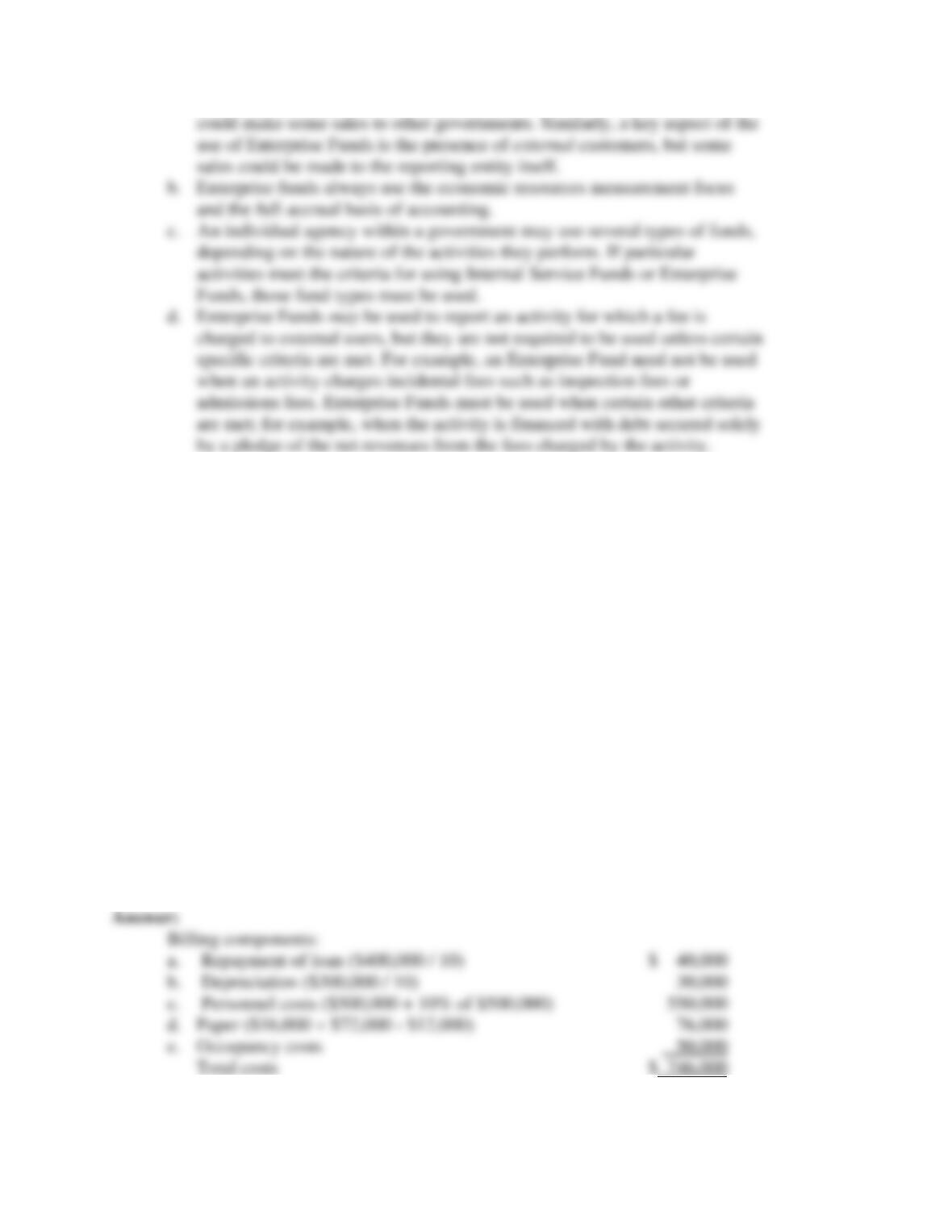
37. (Development of billing rate for an Internal Service Fund)
The City of Casa Cortez uses an Internal Service Fund (ISF) to provide centralized
printing services for all City agencies. City agencies are billed on a per-page basis
(number of pages in a document times the number of documents printed). The City
requires the ISF to develop its billing rate so as to recover all costs on the accrual
basis of accounting, plus the cost of repaying a start-up loan made by the City to the
ISF. Compute the rate per page to be charged by the ISF, based on the following
factors:
a. Start-up loan from City to ISF – $400,000 non-interest bearing loan, to be
repaid in equal payments over 10 years
b. Printing equipment – estimated to cost $300,000 and to have an average life
of 10 years
c. Personnel costs – Estimated salaries of $500,000, plus contribution to
Pension Trust Fund of 10% of salaries
d. Paper- Opening inventory of $16,000; expected purchases of $72,000;
expected ending inventory of $12,000
e. Occupancy costs – Estimated at $50,000 per year
f. Expected number of pages to be printed – 20 million
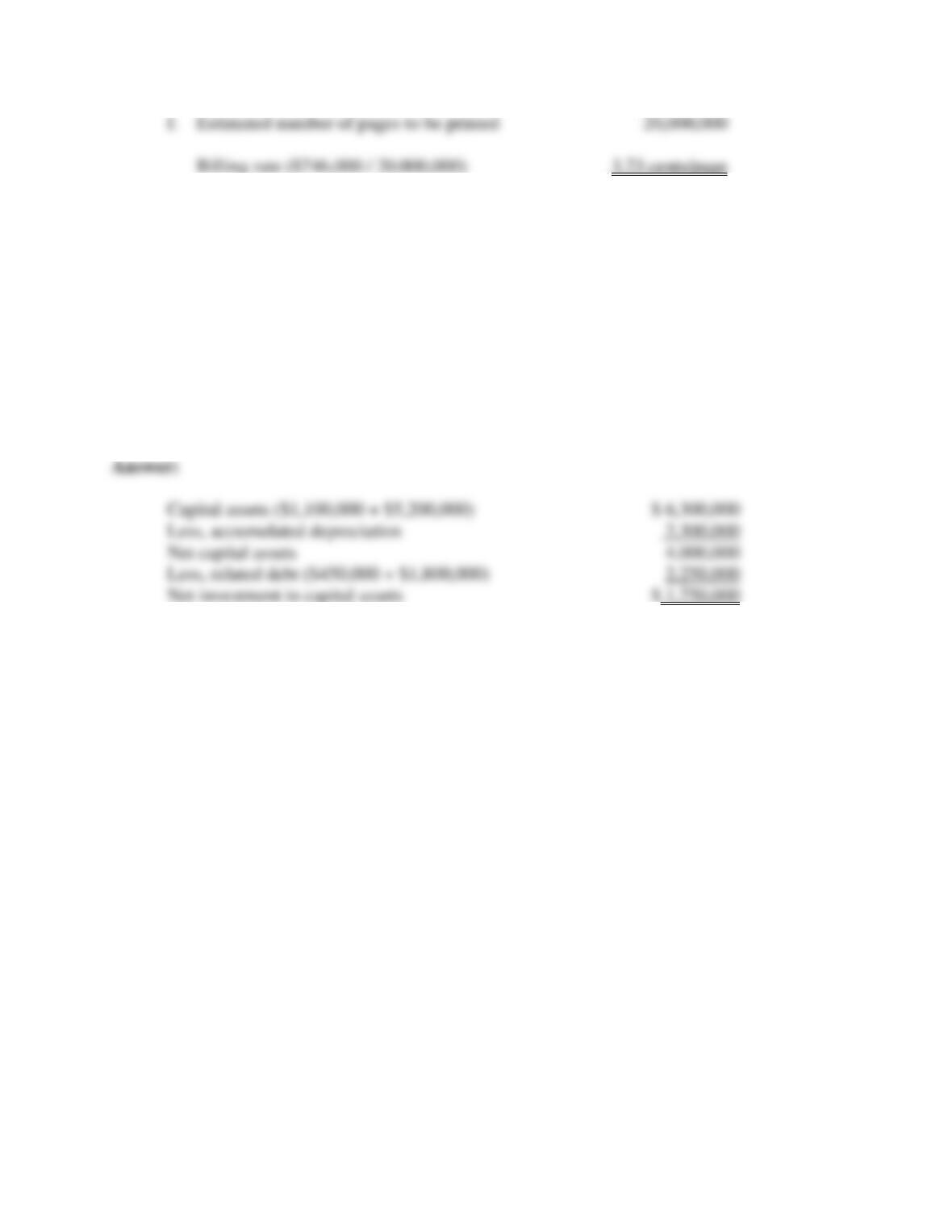
38.(Computation of net investment in capital assets)
The following information is taken from the financial statements of Corwin Water
District 2, an Enterprise Fund. The revenue bonds were issued to construct water
mains. Based on these data, compute the amount that the Fund should report on its
statement of net position, as net investment in capital assets.
Buildings $1,100,000
Water mains and equipment 5,200,000
Accumulated depreciation, capital assets 2,300,000
Current portion of revenue bonds payable 450,000
Long-term portion of revenue bonds payable 1,800,000
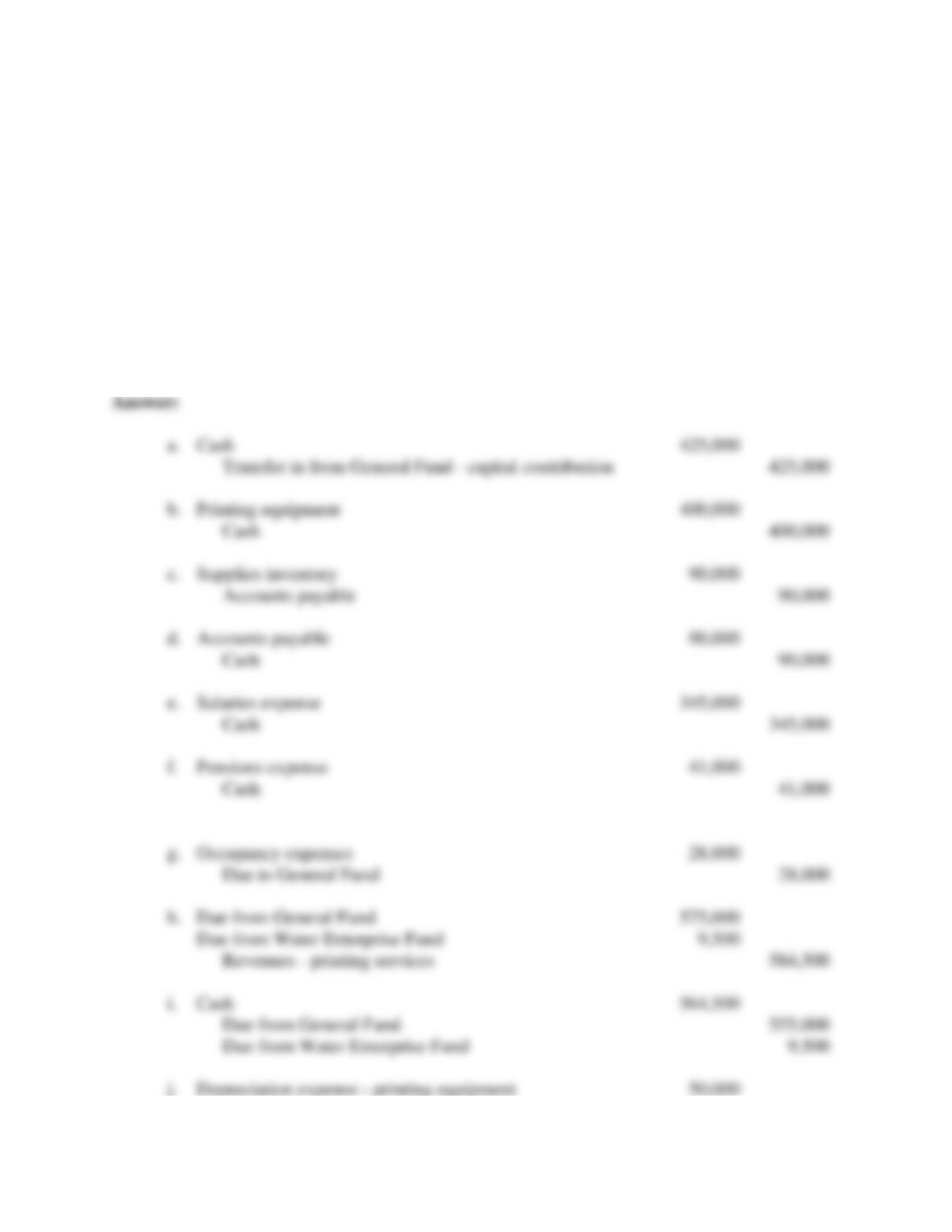
39. (Journal entries for an Internal Service Fund)
Corwin City establishes an Internal Service Fund (ISF) to account for the costs of
printing services that it will provide to the various City departments. Make journal
entries to record the following transactions in the ISF only.
a. The General Fund transfers $425,000 to the ISF as a contribution to start
the printing activity.
b. The ISF immediately uses $400,000 of the cash to purchase printing
equipment. (The printing equipment is estimated to have an average useful
life of 8 years.)
c. On various occasions during the year, the ISF buys paper and other supplies
in the amount of $90,000 on open account. The supplies are put into
inventory.
d. Invoices for the supplies purchased in c., above are paid.
e. Employee salaries for the year amounting to $345,000 are paid
f. The ISF makes a payment of $41,000 to the City’s Pension Trust Fund for
pensions applicable to the salaries of its personnel.
g. The ISF receives an invoice of $28,000 from the General Fund for
occupancy costs, which includes space and utility costs.
h. The ISF sends invoices throughout the year to several City agencies for
printing services, as follows:
(1) To General Fund departments $575,000
(2) To the Water Enterprise Fund 9,500
i. The ISF receives payments of $555,000 from General Fund agencies and
$9,500 from the Water Enterprise Fund.
To prepare its financial statements, the ISF makes adjusting entries to account for
the following:
j. To record one-year’s depreciation on the equipment purchased in b., above.
k. To record the expense of paper and supplies consumed during the year. A
year-end inventory showed unused paper and supplies amounting to $8,000.
(See c., above)
l. To record unpaid salaries of $13,500 and related pension expense of
$1,350.

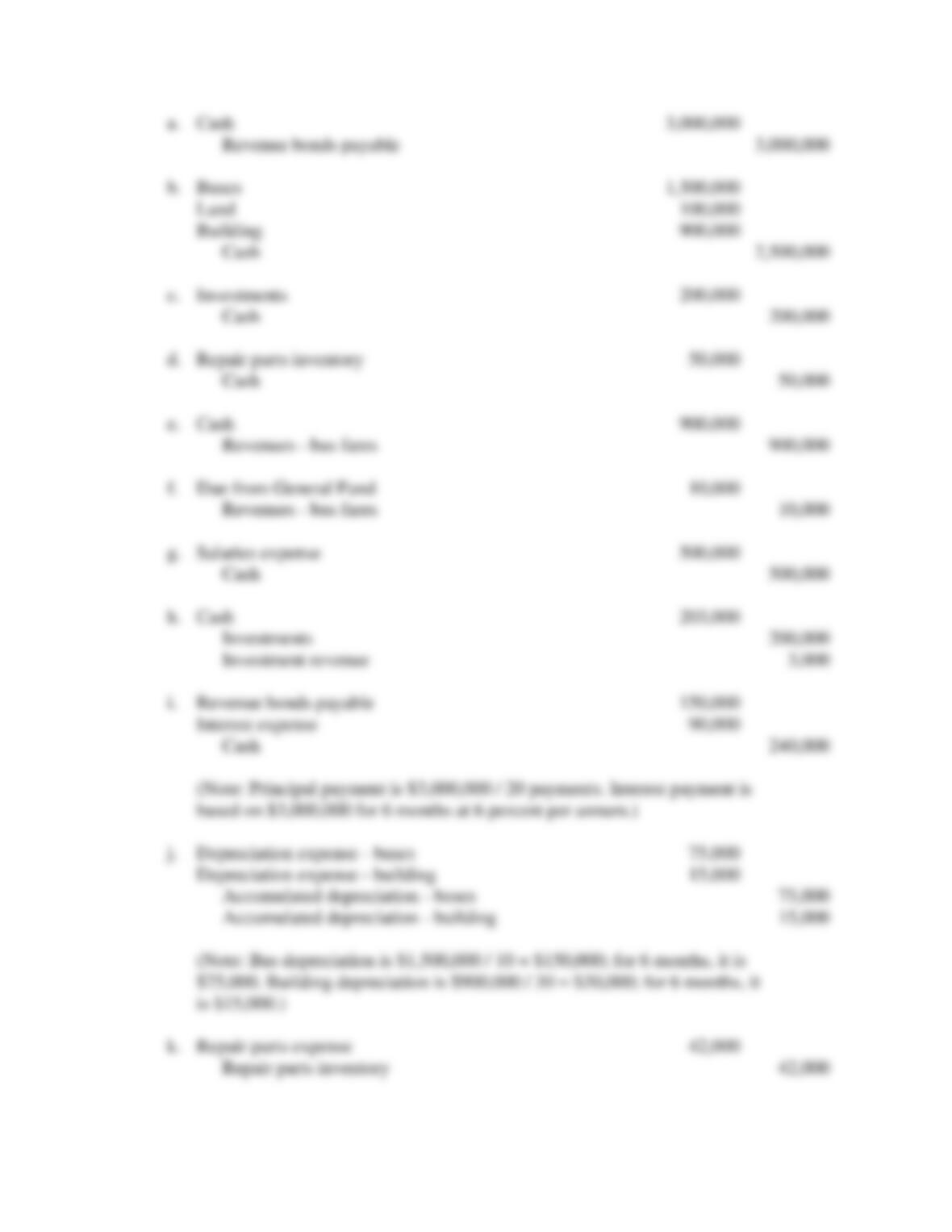
40. (Journal entries for an Enterprise Fund)
These transactions relate to Metro Bus, which provides transportation services to
residents of Parker County. Metro Bus is accounted for as a County Enterprise
Fund. Make journal entries to account for the following 2013 transactions in the
Enterprise Fund.
a. On April 1, 2013, Metro borrows $3,000,000 by issuing 10-year revenue
bonds. Bond principal is to be paid back in 20 equal semi-annual
installments, starting October 1, 2013, together with interest of 6% a year
on the unpaid principal.
b. On July 1, Metro pays cash for 10 buses costing $150,000 each. Metro also
pays cash for land costing $100,000 and a building costing $900,000 to
house its repair activity.
c. On July 1, Metro invests $200,000 of unused cash in a Certificate of
Deposit (CD).
d. Metro pays cash of $50,000 to acquire an inventory of repair parts.
e. Metro collects bus fares of $900,000, which it deposits in the bank.
f. Metro sends an invoice for $10,000 to the County Social Services Agency
for taking senior citizens on bus tours. The Agency receives appropriations
from the General Fund.
g. Metro pays salaries of $500,000 to its bus operators, mechanics, and
administrative staff.
h. The CD (transaction c.) matures and Metro receives a check for $203,000.
i. On October 1, 2013, Metro pays the first installment of principal and
interest on the revenue bonds in transaction a.
To prepare financial statements at December 31, 2013, Metro makes adjusting journal entries for
the following items:
j. To record six months’ depreciation on the buses and building bought in
transaction b. Estimated lives are: buses – 10 years; building – 30 years.
k. To record consumption of repair parts. A year-end physical inventory
shows repair parts on hand amounting to $8,000. (See transaction d.)
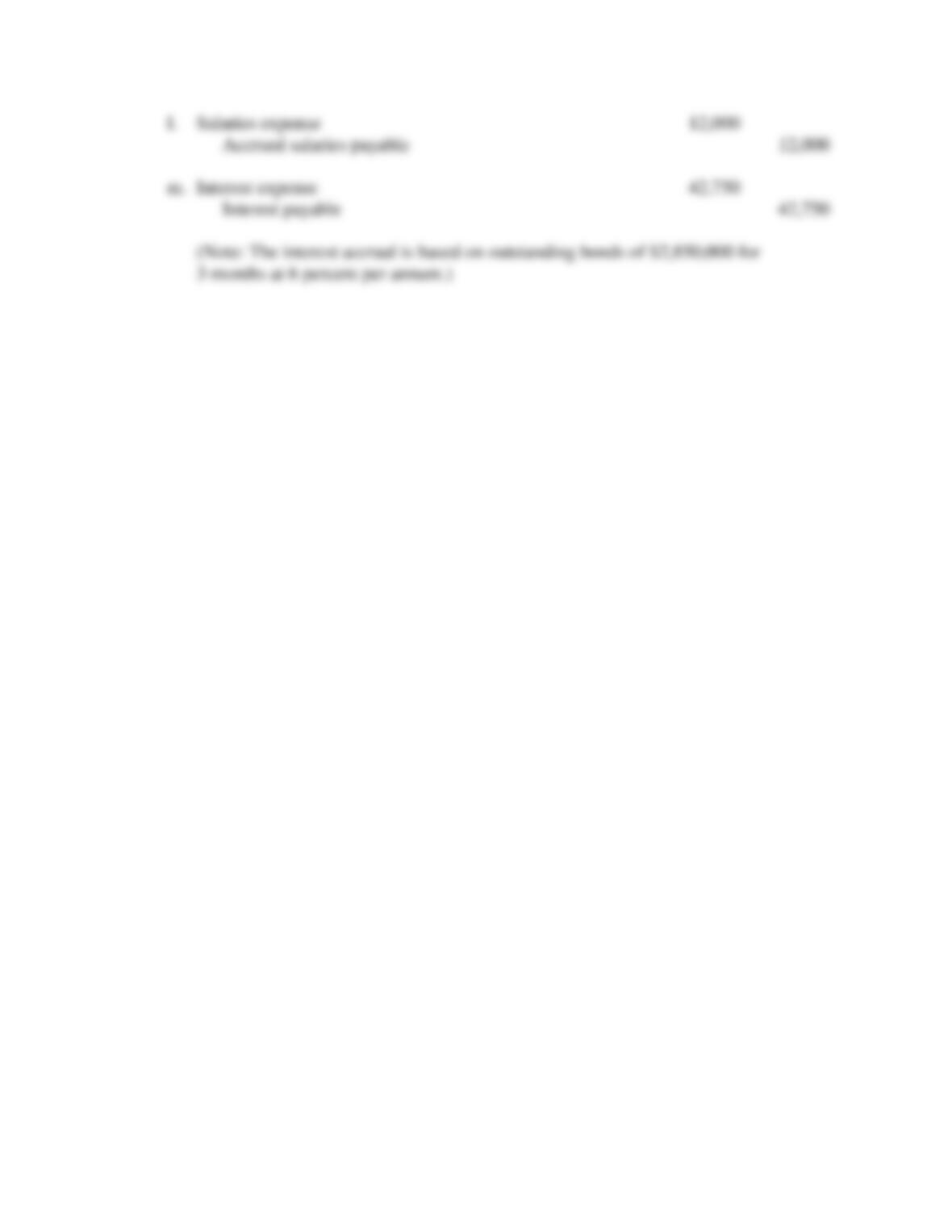
l. To accrue for unpaid salaries of $12,000.
m. To accrue interest on the revenue bonds outstanding at December 31, 2013.
(See transactions a. and i.)
Answer:
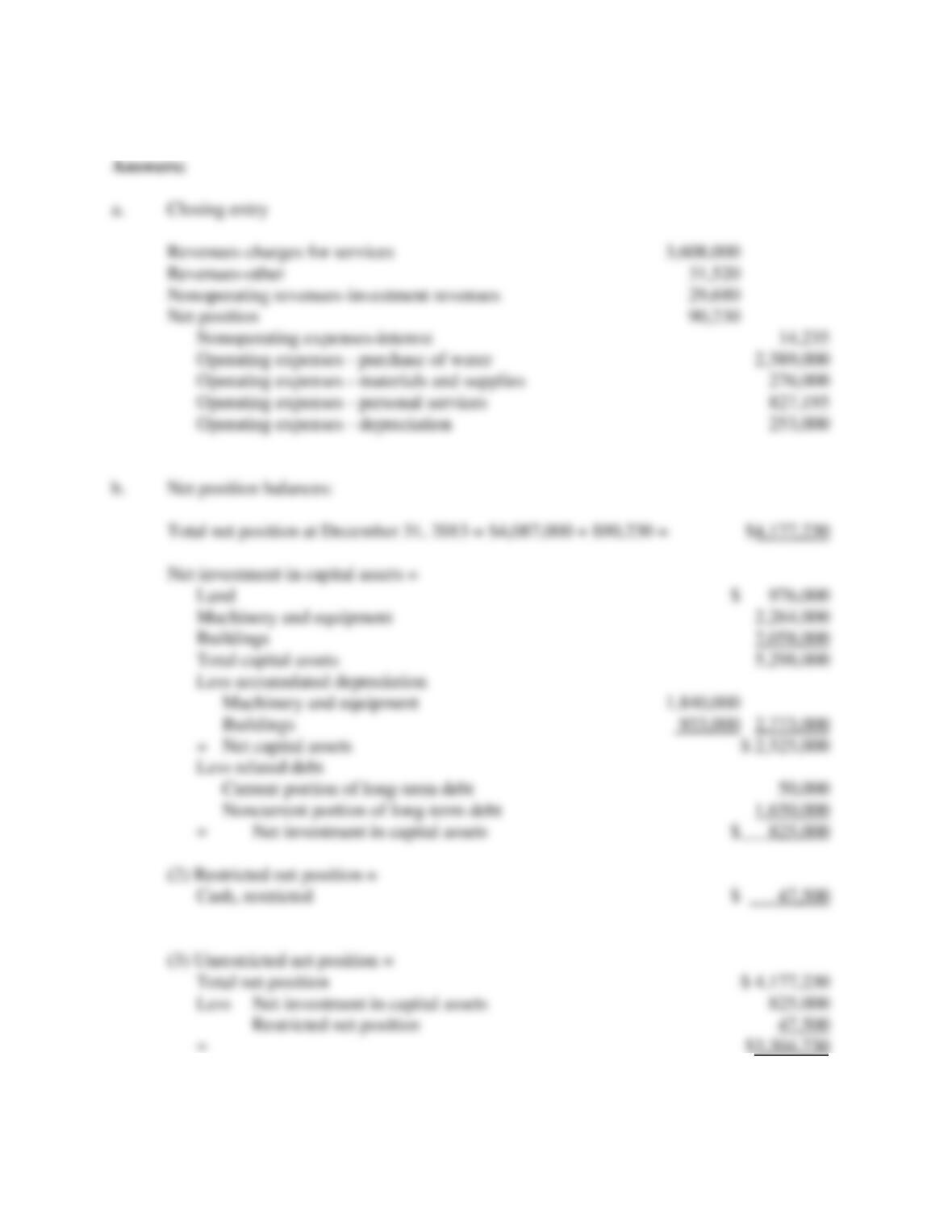
41 (Preparing closing entries and financial statements from a trial balance.)
Presented on the following page is the adjusted trial balance for the Water
Enterprise Fund of the City of Whitt at December 31, 2013, the end of the
fiscal year. Based on this information,
a. prepare the entry necessary to close the accounts
b. compute the ending balances for (1) net investment in capital assets, (2) restricted
net position, and (3) unrestricted net position
(Note: Debt related to the capital assets consists solely of the revenue bonds
payable.)

City of Whitt
Water Enterprise Fund
Adjusted Trial Balance
December 31, 2013
Cash and cash equivalents
$ 890,430
Cash, restricted
47,500
Investments
2,037,000
Due from other funds
595,000
Land
976,000
Machinery and equipment
2,264,000
Accumulated depreciation, machinery and equipment
$ 1,840,000
Buildings
2,058,000
Accumulated depreciation, buildings
933,000
Accounts payable
398,250
Revenue bonds payable, current portion
50,000
Revenue bonds payable, noncurrent portion
1,650,000
Net position
4,087,000
Revenues – charges for services
3,608,000
Revenues – other
31,520
Operating expenses – purchase of water
2,389,000
Operating expenses – materials and supplies
276,000
Operating expenses – personal services
827,195
Operating expenses – depreciation
253,000
Nonoperating revenues-investment revenues
29,680
Nonoperating expenses-interest
14,325
.
$12,627,450
$12,627,450