
101
Meester Corporation has an activity-based costing system with three activity cost
pools—Machining, Order Filling, and Other. In the first stage allocations, costs in the two
overhead accounts, equipment depreciation and supervisory expense, are allocated to three activity
cost pools based on resource consumption. Data used in the first stage allocations follow:
Overhead costs:
Equipment depreciation
$
96,000
Supervisory expense_
$8,000
Distribution of Resource Consumption Across Activity Cost Pools:
Activity Cost Pools
Machining
Order Filling
Other
Equipment depreciation
0.30
0.10
0.60
Supervisory expense
0.60
0.10
0.30
Machining costs are assigned to products using machine-hours (MHs) and Order Filling costs are
assigned to products using the number of orders. The costs in the Other activity cost pool are not
assigned to products. Activity data for the company’s two products follow:
Activity:
MHs (Machining)
Orders (Order Filling)
Product M0
4,500
400
Product H2
5,500
600
Total
10,000
1,000
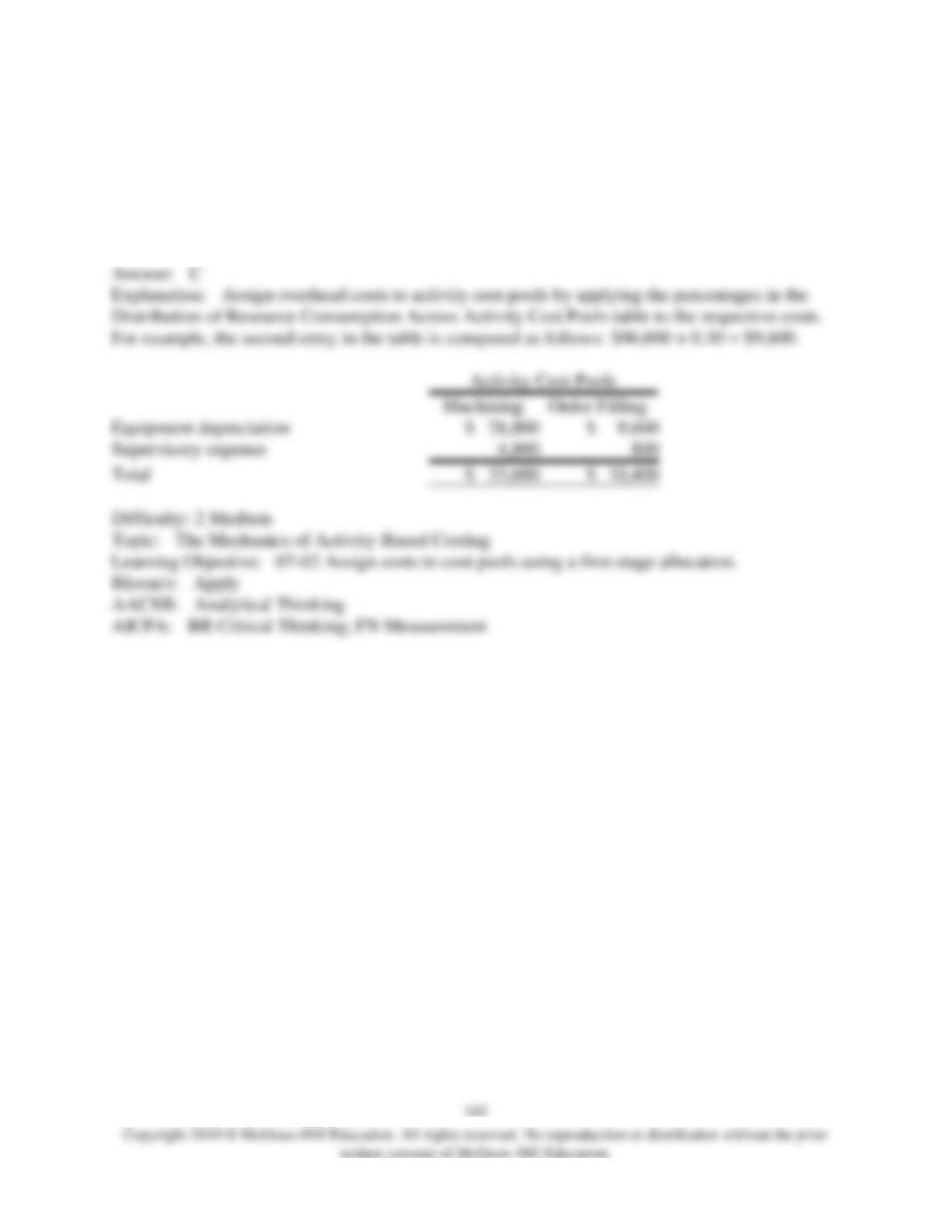
107) How much overhead cost is allocated to the Order Filling activity cost pool under
activity-based costing?
A) $60,000
B) $800
C) $10,400
D) $9,600
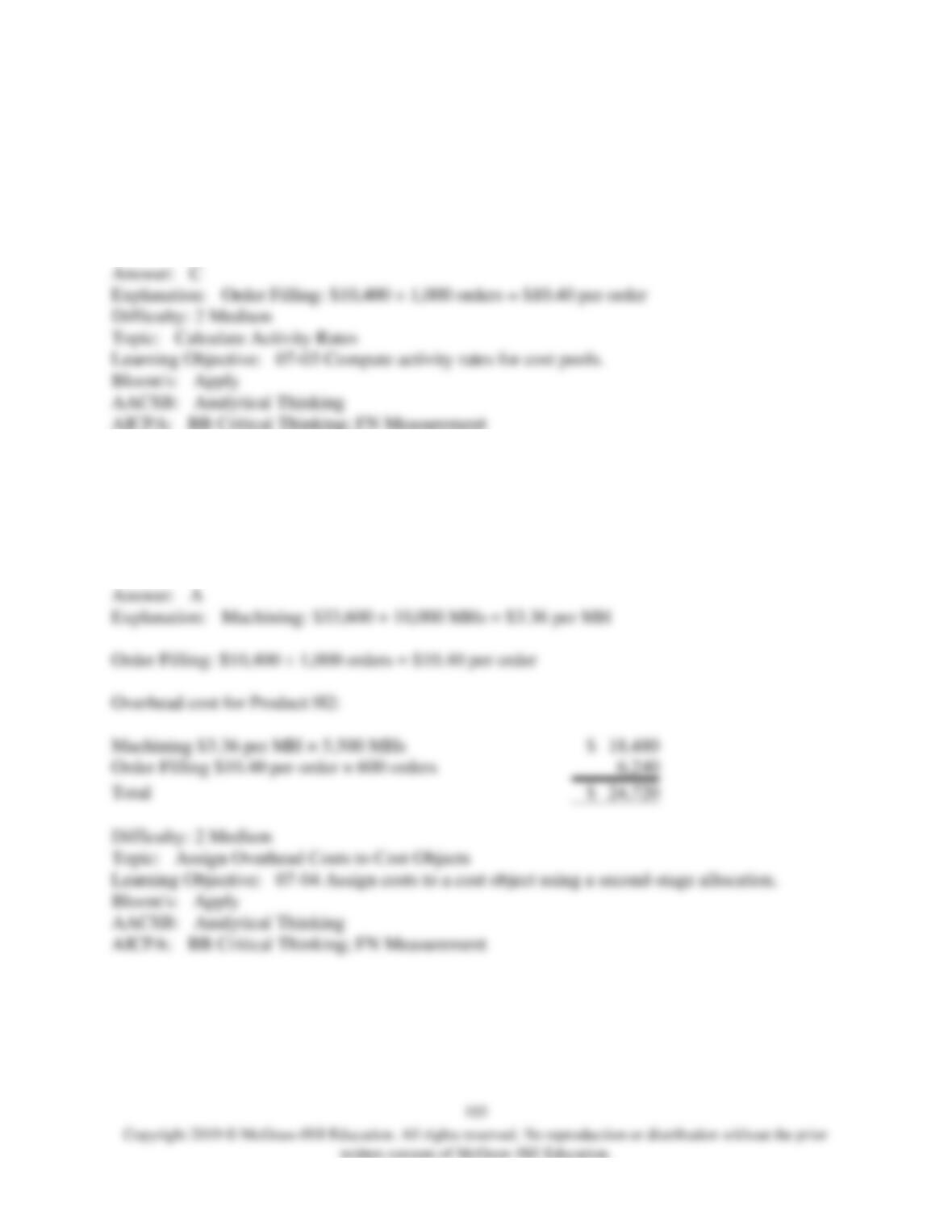
108) The activity rate for the Order Filling activity cost pool under activity-based costing is closest
to:
A) $8.00 per order
B) $13.33 per order
C) $10.40 per order
D) $104.00 per order
109) What is the overhead cost assigned to Product H2 under activity-based costing?
A) $24,720
B) $6,240
C) $18,480
D) $52,000

104
Bartow Corporation uses an activity-based costing system to assign overhead costs to products. In
the first stage, two overhead costs—equipment expense and indirect labor—are allocated to the
three activity cost pools—Processing, Supervising, and Other—based on resource consumption.
Data to perform these allocations appear below:
Overhead costs:
Equipment expense
$
29,000
Indirect labor_
$8,000
Distribution of Resource Consumption Across Activity Cost Pools:
Activity Cost Pools
Processing
Supervising
Other
Equipment expense
0.20
0.60
0.20
Indirect labor
0.50
0.30
0.20
In the second stage, Processing costs are assigned to products using machine-hours (MHs) and
Supervising costs are assigned to products using the number of batches. The costs in the Other
activity cost pool are not assigned to products. Activity data for the company’s two products
follow:
Activity:
MHs (Machining)
Orders (Order Filling)
Product H3
6,700
700
Product O5
3,300
1,300
Total
10,000
2,000
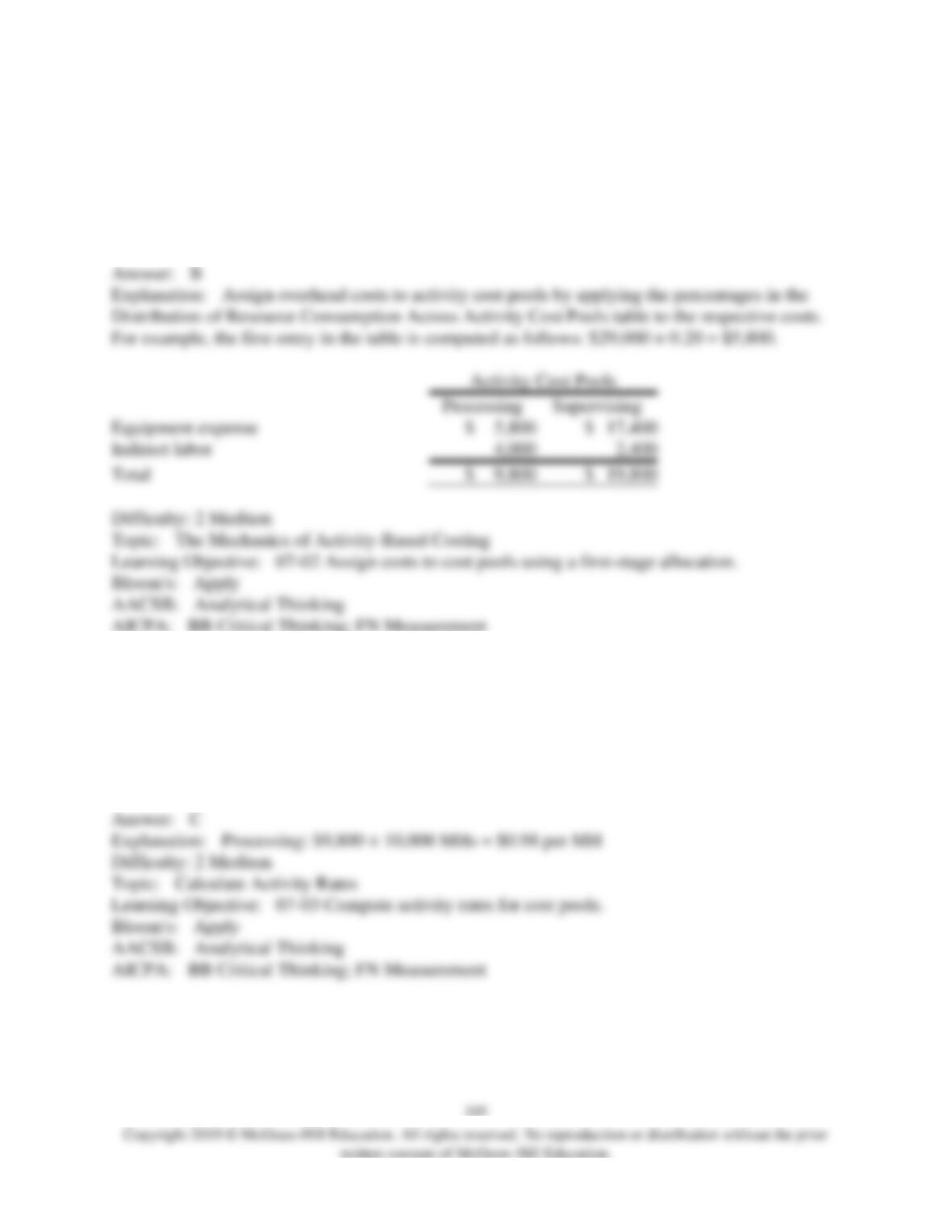
110) How much overhead cost is allocated to the Processing activity cost pool under activity-based
costing in the first stage of allocation?
A) $5,800
B) $9,800
C) $4,000
D) $7,400
111) The activity rate for the Processing activity cost pool under activity-based costing is closest
to:
A) $3.70 per MH
B) $5.71 per MH
C) $0.98 per MH
D) $0.58 per MH
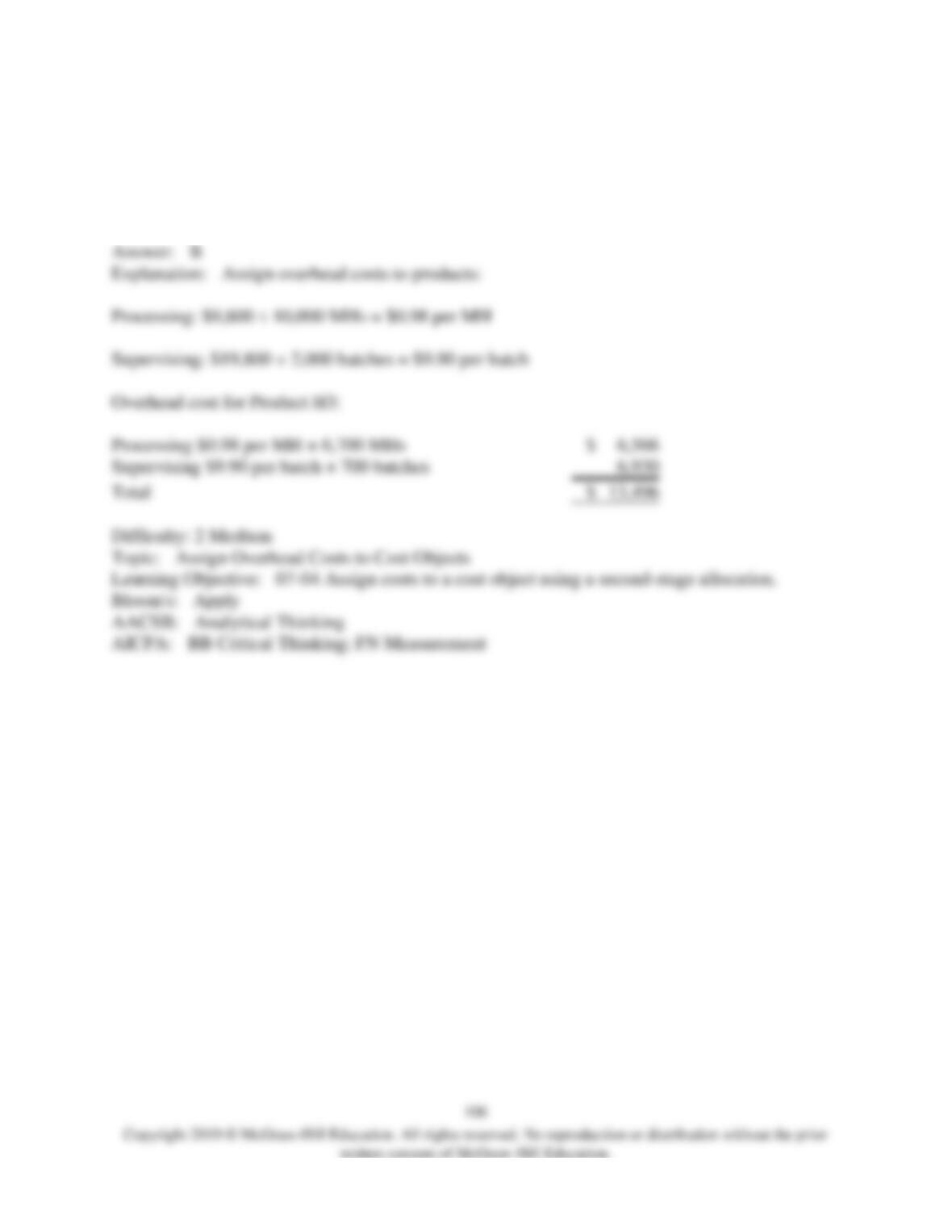
112) What is the overhead cost assigned to Product H3 under activity-based costing?
A) $6,930
B) $13,496
C) $18,500
D) $6,566

107
Deemer Corporation has an activity-based costing system with three activity cost
pools—Processing, Supervising, and Other. In the first stage allocations, costs in the two overhead
accounts, equipment expense and indirect labor, are allocated to the three activity cost pools based
on resource consumption. Data used in the first stage allocations follow:
Overhead costs:
Equipment expense
$
73,000
Indirect labor
$6,000
Distribution of Resource Consumption Across Activity Cost Pools:
Activity Cost Pools
Processing
Supervising
Other
Equipment expense
0.60
0.20
0.20
Indirect labor
0.40
0.20
0.40
Processing costs are assigned to products using machine-hours (MHs) and Supervising costs are
assigned to products using the number of batches. The costs in the Other activity cost pool are not
assigned to products. Activity data for the company’s two products follow:
Activity:
MHs (Processing)
Batches (Supervising)
Product F6
1,000
600
Product X0
9,000
400
Total
10,000
1,000
113) How much overhead cost is allocated to the Supervising activity cost pool under
activity-based costing?
A) $15,800
B) $1,200
C) $17,000
D) $14,600
114) The activity rate for the Supervising activity cost pool under activity-based costing is closest
to:
A) $15.00 per batch
B) $79.00 per batch
C) $15.80 per batch
D) $6.00 per batch
115) What is the overhead cost assigned to Product X0 under activity-based costing?
A) $41,580
B) $39,500
C) $47,900
D) $6,320

110
Goertz Corporation has an activity-based costing system with three activity cost
pools—Machining, Order Filling, and Other. In the first stage allocations, costs in the two
overhead accounts, equipment depreciation and supervisory expense, are allocated to the three
activity cost pools based on resource consumption. Data used in the first stage allocations follow:
Overhead costs:
Equipment depreciation
$
51,000
Supervisory expense
$3,000
Distribution of Resource Consumption Across Activity Cost Pools:
Activity Cost Pools
Machining
Order Filling
Other
Equipment depreciation
0.40
0.10
0.50
Supervisory expense
0.20
0.30
0.50
Machining costs are assigned to products using machine-hours (MHs) and Order Filling costs are
assigned to products using the number of orders. The costs in the Other activity cost pool are not
assigned to products. Activity data for the company’s two products follow:
Activity:
MHs (Machining)
Orders (Order Filling)
Product J3
9,100
100
Product F7
900
900
Total
10,000
1,000
Finally, the costs of Machining and Order Filling are combined with the following sales and direct
cost data to determine product margins.
Sales and Direct Cost Data:
Product J3
Product F7
Sales (total)
$
145,200
$
90,700
Direct materials (total)
$
81,400
$
38,600
Direct labor (total)
$
37,700
$
42,400
116) How much overhead cost is allocated to the Order Filling activity cost pool under
activity-based costing?
A) $5,100
B) $900
C) $27,000
D) $6,000
117) The activity rate for the Order Filling activity cost pool under activity-based costing is closest
to:
A) $3.33 per order
B) $3.00 per order
C) $54.00 per order
D) $6.00 per order
118) What is the overhead cost assigned to Product F7 under activity-based costing?
A) $5,400
B) $1,890
C) $27,000
D) $7,290
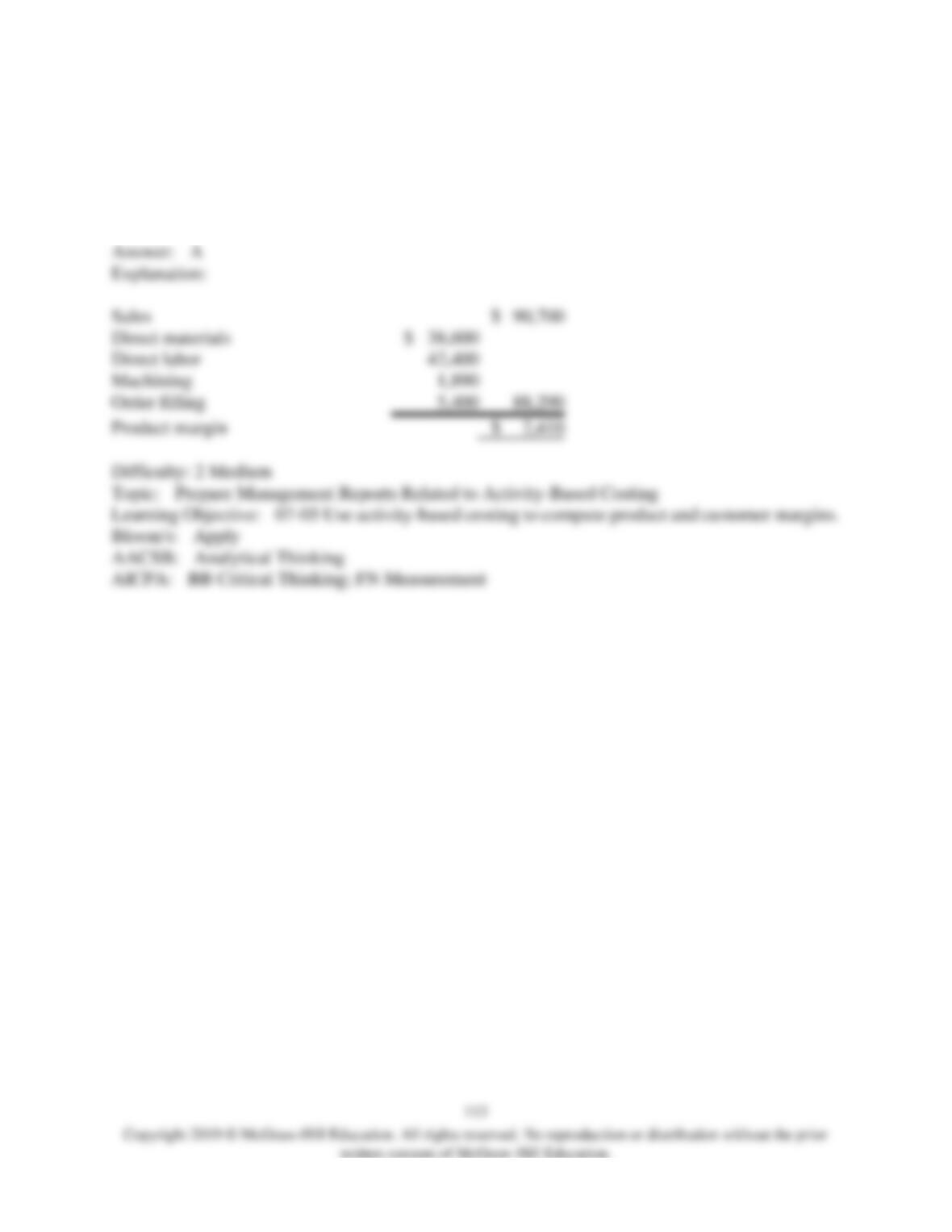
119) What is the product margin for Product F7 under activity-based costing?
A) $2,410
B) $2,710
C) $10,600
D) $9,700

114
Addleman Corporation has an activity-based costing system with three activity cost
pools—Processing, Supervising, and Other. In the first stage allocations, costs in the two overhead
accounts, equipment expense and indirect labor, are allocated to the three activity cost pools based
on resource consumption. Data used in the first stage allocations follow:
Overhead costs:
Equipment expense
$
73,000
Indirect labor
$1,000
Distribution of Resource Consumption Across Activity Cost Pools:
Activity Cost Pools
Processing
Supervising
Other
Equipment expense
0.20
0.10
0.70
Indirect labor
0.20
0.20
0.60
Processing costs are assigned to products using machine-hours (MHs) and Supervising costs are
assigned to products using the number of batches. The costs in the Other activity cost pool are not
assigned to products. Activity data for the company’s two products follow:
Activity:
MHs (Processing)
Batches (Supervising)
Product W3
7,600
100
Product H3
2,400
900
Total
10,000
1,000
Finally, the costs of Processing and Supervising are combined with the following sales and direct
cost data to determine product margins.
Sales and Direct Cost Data:
Product W3
Product H3
Sales (total)
$
159,500
$
154,100
Direct materials (total)
$
66,300
$
55,300
Direct labor (total)
$
77,800
$
84,100
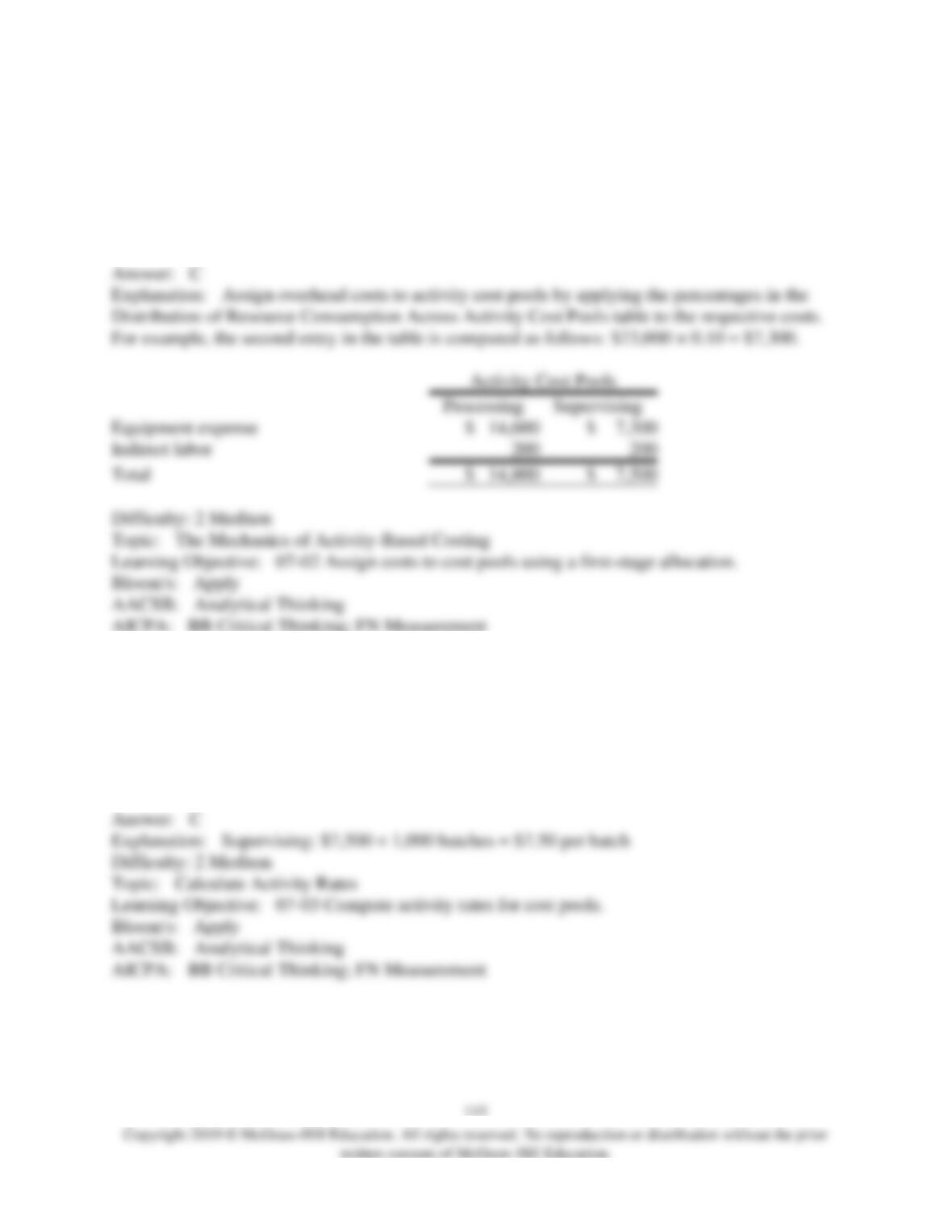
120) How much overhead cost is allocated to the Supervising activity cost pool under
activity-based costing?
A) $7,300
B) $51,700
C) $7,500
D) $200
121) The activity rate for the Supervising activity cost pool under activity-based costing is closest
to:
A) $1.00 per batch
B) $1.11 per batch
C) $7.50 per batch
D) $74.00 per batch
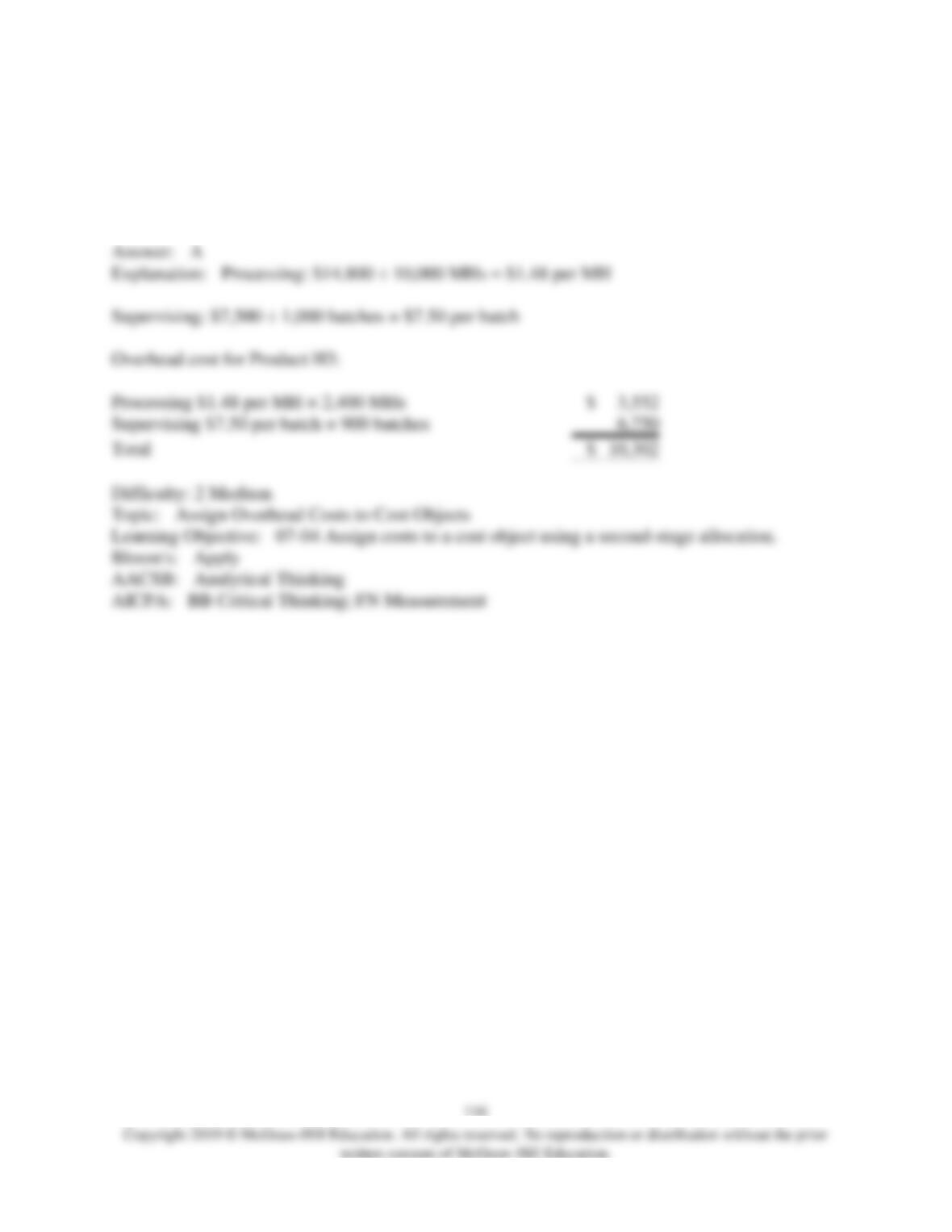
122) What is the overhead cost assigned to Product H3 under activity-based costing?
A) $10,302
B) $3,552
C) $37,000
D) $6,750
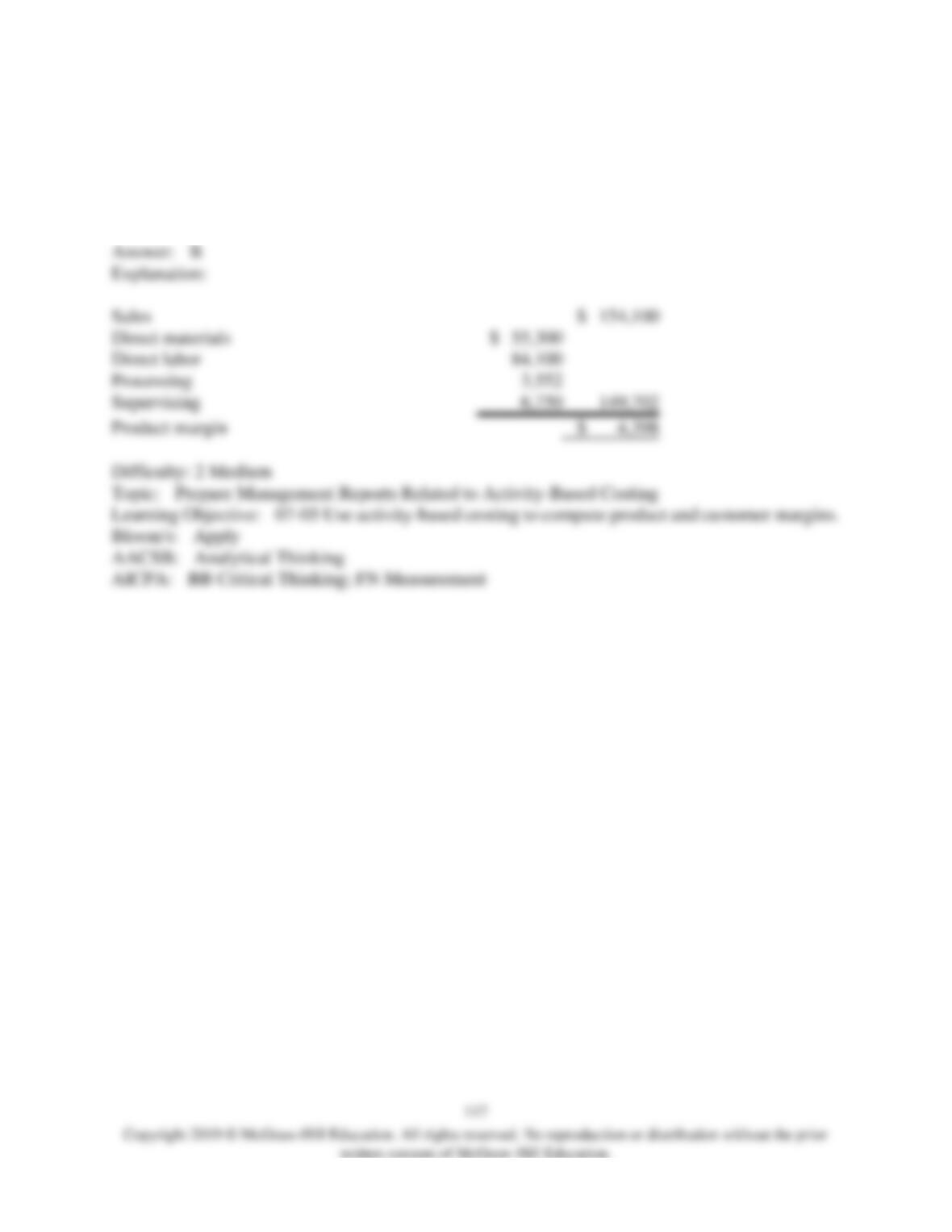
123) What is the product margin for Product H3 under activity-based costing?
A) $10,548
B) $4,398
C) $14,700
D) $36,300

118
Doede Corporation uses activity-based costing to compute product margins. In the first stage, the
activity-based costing system allocates two overhead accounts—equipment depreciation and
supervisory expense—to three activity cost pools—Machining, Order Filling, and Other—based
on resource consumption. Data to perform these allocations appear below:
Overhead costs:
Equipment depreciation
$
92,000
Supervisory expense
$4,000
Distribution of Resource Consumption Across Activity Cost Pools:
Activity Cost Pools
Machining
Order Filling
Other
Equipment depreciation
0.60
0.20
0.20
Supervisory expense
0.30
0.20
0.50
In the second stage, Machining costs are assigned to products using machine-hours (MHs) and
Order Filling costs are assigned to products using the number of orders. The costs in the Other
activity cost pool are not assigned to products.
Activity:
MHs (Machining)
Orders (Order Filling)
Product W1
4,200
800
Product M0
15,800
200
Total
20,000
1,000
Finally, sales and direct cost data are combined with Machining and Order Filling costs to
determine product margins.
Sales and Direct Cost Data:
Product W1
Product M0
Sales (total)
$
236,500
$
262,000
Direct materials (total)
$
90,900
$
123,900
Direct labor (total)
$
110,400
$
76,100
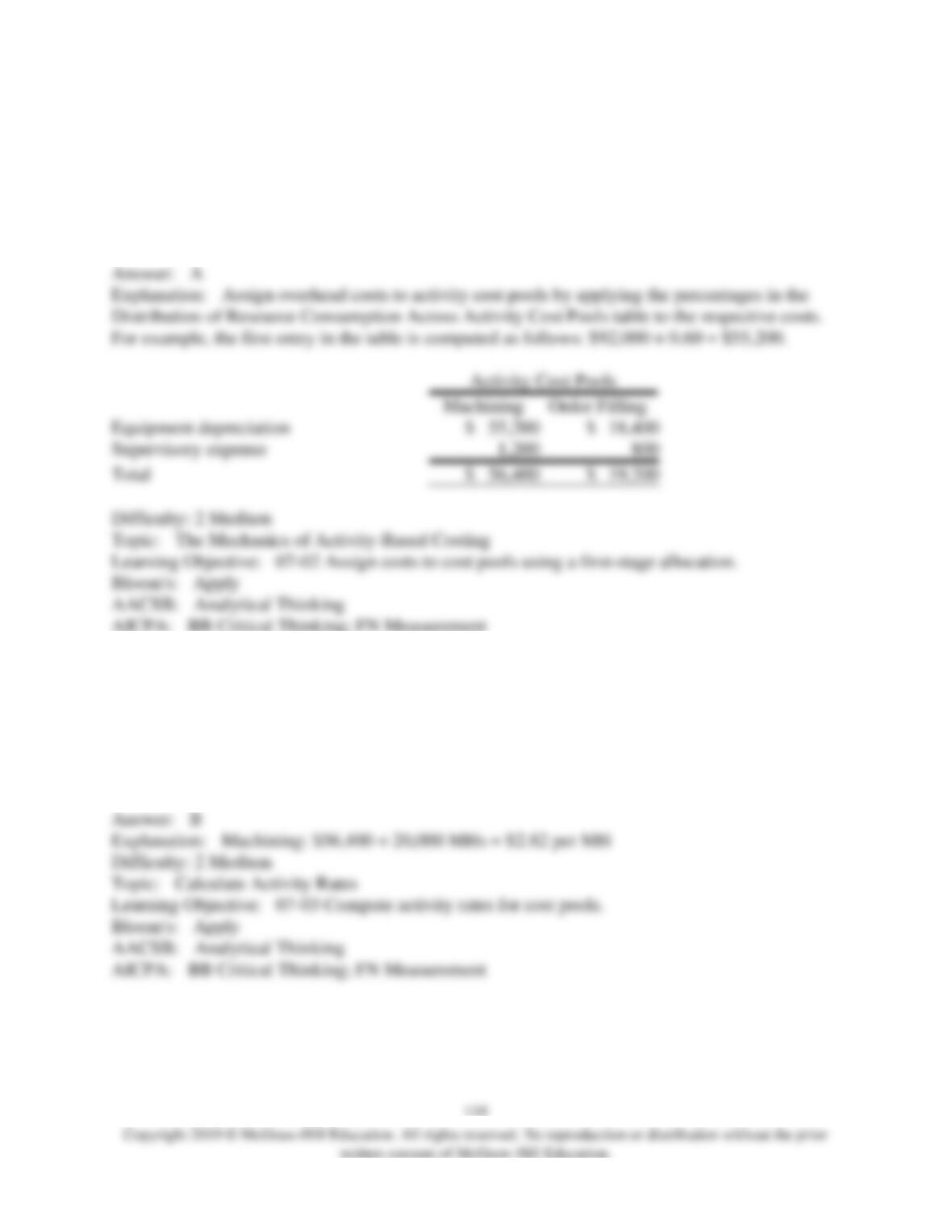
124) How much overhead cost is allocated to the Machining activity cost pool under activity-based
costing in the first stage of allocation?
A) $56,400
B) $20,400
C) $55,200
D) $1,200
125) The activity rate for the Machining activity cost pool under activity-based costing is closest
to:
A) $1.50 per MH
B) $2.82 per MH
C) $4.80 per MH
D) $2.76 per MH
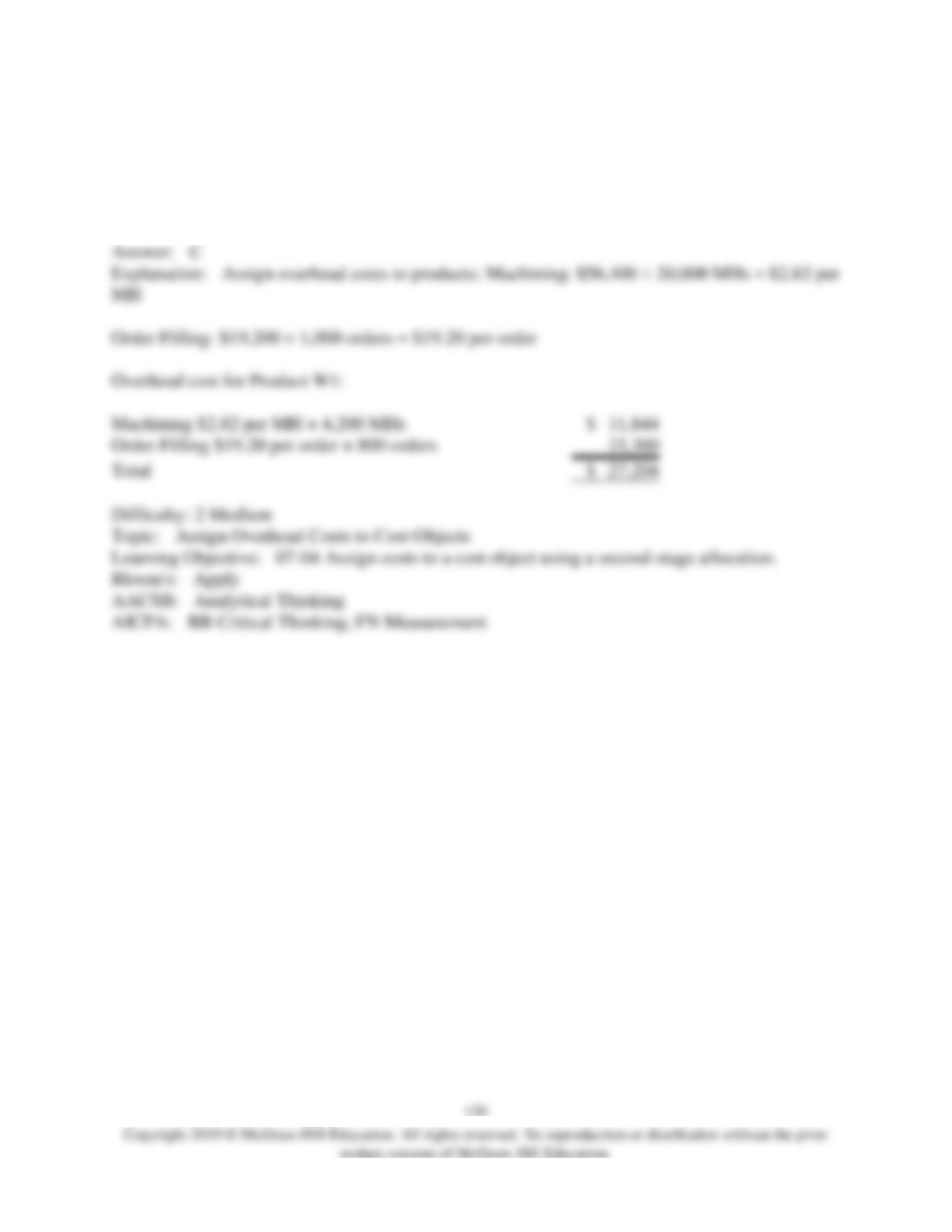
126) What is the overhead cost assigned to Product W1 under activity-based costing?
A) $15,360
B) $48,000
C) $27,204
D) $11,844