121) On July 1, 2018, Cromartie Furniture established a $150 petty cash fund. A check for $150
was made out to the petty cash custodian. During July, the petty cash custodian paid the
following bills from the petty cash fund:
Office supplies
$
36
Postage
22
Delivery charges
40
Bottled water
28
Total
$
126
At the end of July the petty cash fund was replenished.
The journal entry to replenish the petty cash fund includes:
A) A credit to petty cash and a debit to various expenses for $126.
B) A debit to petty cash and a credit to cash for $150.
C) A credit to cash and a debit to various expenses for $126.
D) None of these answer choices are correct.
122) Hazelton Manufacturing prepares a bank reconciliation at the end of every month. At the
end of May, the general ledger checking account showed a balance of $1,360 and the bank
statement showed a bank balance of $1,445. Outstanding checks totaled $350 and deposits in
transit were $150. The bank statement listed service charges of $30 and NSF checks totaling $85.
The corrected cash balance is:
A) $1,130.
B) $1,160.
C) $1,245.
D) $1,445.
123) Brockton Carpet Cleaning prepares a bank reconciliation at the end of every month. At the
end of July, the balance in the general ledger checking account was $2,750 and the bank balance
on the bank statement was $2,980. Outstanding checks totaled $680 and deposits in transited
were $400. The bank statement revealed that a check written for $120 was incorrectly recorded
by Brockton as a $220 disbursement. The bank statement listed service charges and NSF check
charges totaling $150. The corrected cash balance is:
A) $2,270.
B) $2,550.
C) $2,470.
D) $2,700.
124) Which of the following is true about accounting for a troubled debt restructuring?
A) If a receivable becomes impaired, it is remeasured at the discounted present value of the cash
flows that were originally expected to be collected, but at a revised discount rate.
B) Receivables are not remeasured; instead, fair values are obtained from reliable factors.
C) If a receivable is continued, but with modified terms, a loss is typically recorded.
D) Receivables are never settled outright at the time of a restructuring.
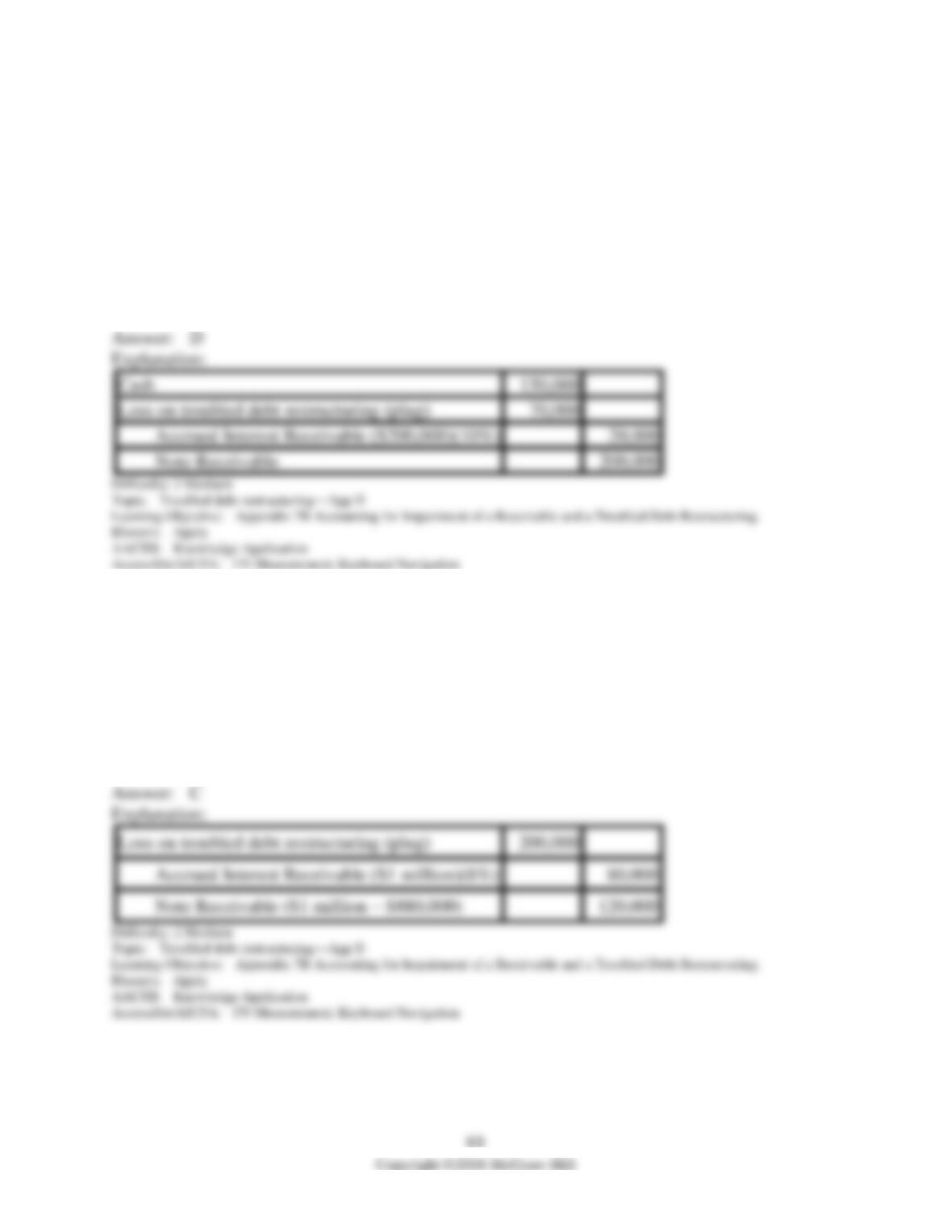
125) Brewer Inc. is owed $200,000 by Carol Co. under a 10% note with two years remaining to
maturity. Due to financial difficulties Carol Co. did not pay the prior year’s interest. Brewer
agrees to settle the receivable (and accrued interest) in exchange for a cash payment of $150,000.
The journal entry that Brewer would make to record this transaction would include a loss on
troubled debt restructuring of:
A) $0.
B) $20,000.
C) $50,000.
D) $70,000.
126) The O’Hara Group is owed $1,000,000 by Hilton Enterprises under an 8% note with three
years remaining to maturity. The prior year of interest was unpaid. O’Hara agrees to restructure
the note under terms that yield a present value of $880,000. The journal entry that O’Hara would
make to record this transaction would include a loss on troubled debt restructuring of:
A) $0.
B) $80,000.
C) $200,000.
D) $220,000.
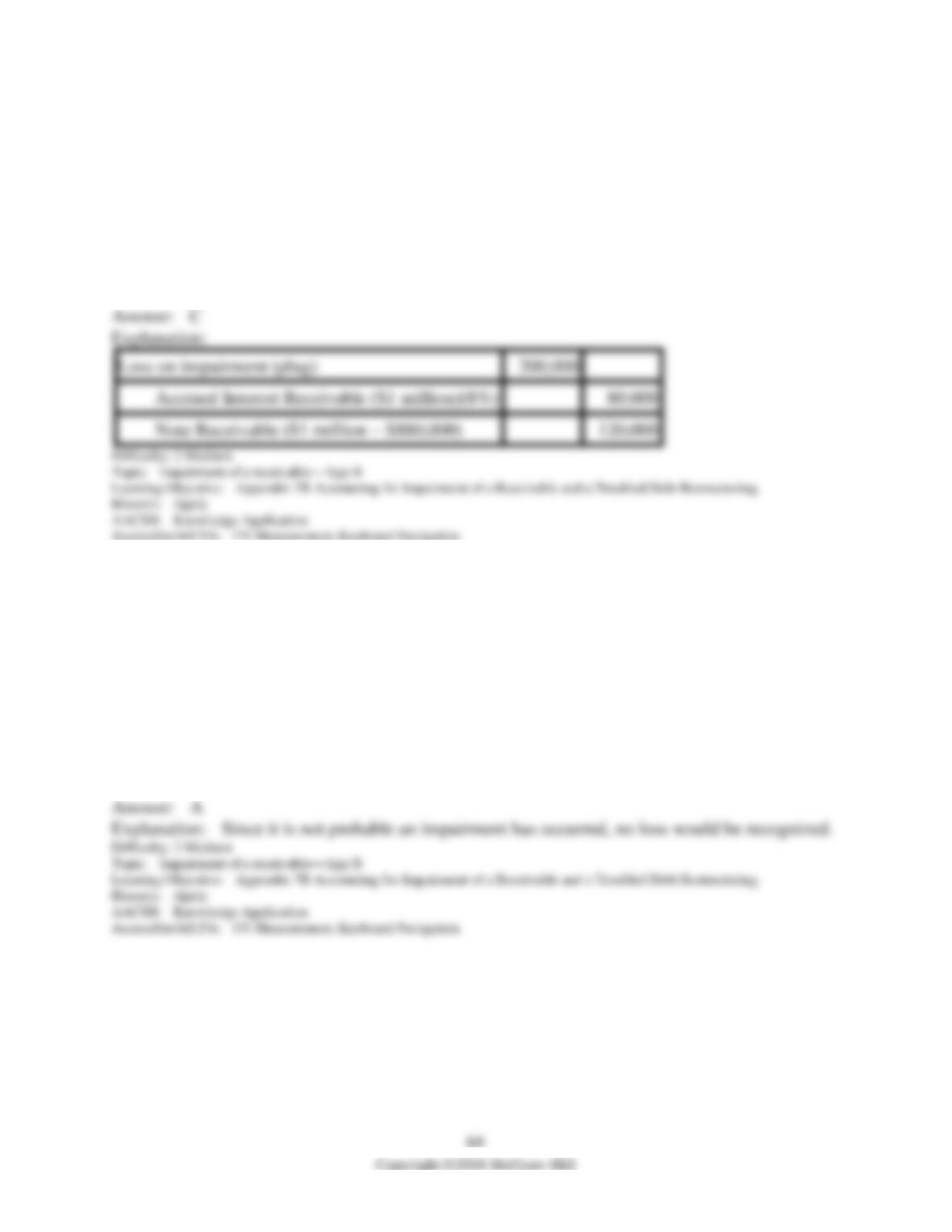
127) The Nile Group is owed $1,000,000 by Scorpion Enterprises under an 8% note with three
years remaining to maturity. The prior year of interest was unpaid. Nile estimates that it is
probable that it will only receive amounts equal to a present value of $880,000. The journal entry
that O’Hara would make to record this transaction would include an impairment loss of:
A) $0.
B) $80,000.
C) $200,000.
D) $220,000.
128) The GW Co. is owed $1,000,000 by Mason, Inc. under an 8% note with three years
remaining to maturity. The prior year of interest was unpaid. GW believes there is a 30% chance
that Mason will fail to pay GW all amounts that GW is owed. In that 30% case, GW believes it
will only receive amounts equal to a present value of $880,000.
If GW is reporting under current U.S. GAAP, it would recognize an impairment loss of:
A) $0.
B) $60,000.
C) $200,000.
D) $240,000.
129) The GW Co. is owed $1,000,000 by Mason, Inc. under an 8% note with three years
remaining to maturity. The prior year of interest was unpaid. GW believes there is a 30% chance
that Mason will fail to pay GW all amounts that GW is owed. In that 30% case, GW believes it
will only receive amounts equal to a present value of $880,000.
If GW is reporting under ASU 2016-13 and therefore using the CECL model, it would recognize
an impairment loss of:
A) $0.
B) $60,000.
C) $200,000.
D) $220,000.
130) The Salamander Company has evaluated its receivables, and has identified the following
possible impairments:
• Note #1 has recently deteriorated in credit quality. For Note #1, Salamander
estimates the present value of credit losses occurring in the next twelve months
is $50,000, and the present value of credit losses occurring after twelve months
is $20,000.
• Note #2 has not deteriorated in credit quality. For Note #2, Salamander estimates
the present value of credit losses occurring in the next twelve months is $5,000,
and the present value of credit losses occurring after twelve months is $10,000.
If Salamander is reporting under ASU 2016-13 and therefore using the CECL model, it would
recognize an impairment loss of:
A) $50,000.
B) $55,000.
C) $75,000.
D) $85,000.
131) The Salamander Company has evaluated its receivables, and has identified the following
possible impairments:
• Note #1 has recently deteriorated in credit quality. For Note #1, Salamander
estimates the present value of credit losses occurring in the next twelve months
is $50,000, and the present value of credit losses occurring after twelve months
is $20,000.
• Note #2 has not deteriorated in credit quality. For Note #2, Salamander estimates
the present value of credit losses occurring in the next twelve months is $5,000,
and the present value of credit losses occurring after twelve months is $10,000.
If Salamander is reporting under IFRS and therefore uses the ECL model, it would recognize an
impairment loss of:
A) $50,000.
B) $55,000.
C) $75,000.
D) $85,000.
132) Rebound Inc. reports under IFRS. In 2018 Rebound recognized an impairment of $200,000
due to a troubled debt restructuring. In 2019 Rebound was pleased to determine that more cash
flows would be received from the receivable than was previously thought, such that, if the total
impairment were to be calculated in 2019, it would be estimated as $150,000 rather than
$200,000. How should Rebound treat this in its 2019 income statement?
A) Rebound should ignore the change, given that recovery of its previous impairments is not
allowed under IFRS.
B) Rebound should make a prior period adjustment of 2018 income, given that the impairment
charge was in error.
C) Rebound should recognize an increase in 2019 net income of $50,000.
D) None of these answer choices are correct.
Listed below are five terms followed by a list of phrases that describe or characterize each of the
terms. Match each phrase with the correct term.
A) Is of vital importance for good internal control.
B) Determines bad debt expense by estimating the allowance for uncollectible accounts and
adjusting the balance accordingly.
C) Are reported at the amount expected to be received.
D) Has no effect on net receivables when using the allowance method.
E) Is a contra revenue account.
133) Write-off of accounts receivable
134) Sales returns
135) Separation of duties
136) Balance sheet approach
137) Accounts receivable
Listed below are five terms followed by a list of phrases that describe or characterize each of the
terms. Match each phrase with the correct term.
A) The risk of uncollectibility is retained by the seller.
B) Includes separation of duties.
C) Requires payment of principal plus interest.
D) Recognizes bad debts when accounts become uncollectible.
E) Bad debt expense is a percentage of credit sales.
138) Interest-bearing note
139) Direct write-off method
140) Factoring with recourse
141) Internal control
142) Income statement approach
Listed below are five terms followed by a list of phrases that describe or characterize each of the
terms. Match each phrase with the correct term.
A) The sale of accounts receivable to a financial institution.
B) Attempts to recognize bad debt expense in the same period as the related sale.
C) Receivables used as collateral for debt.
D) Offered to induce prompt payment.
E) Cash discount not taken increases net sales revenue.
143) Cash discounts
144) Net method
145) Factoring
146) Allowance method
147) Pledging of accounts receivable
Listed below are five terms followed by a list of phrases that describe or characterize each of the
terms. Match each phrase with the correct term.
A) An example of a restriction on cash.
B) Average number of days that accounts receivable are outstanding.
C) The sale of accounts receivable to a financial institution.
D) Deducted from list price.
E) The sale of a note receivable to a lender.
148) Average collection period
149) Factoring
150) Trade discounts
151) Compensating balance
152) Discounting
Listed below are ten terms followed by a list of phrases that describe or characterize each of the
terms. Match each phrase with the correct term.
A) Using receivables as collateral for a loan.
B) Grouping accounts receivable depending on the length of time outstanding.
C) Bad debt expense “plugged” by estimating allowance for uncollectible accounts.
D) When merchandise is returned for credit.
E) Reduces the amount paid by a credit customer if paid within a specified time.
F) Bad debt expense is recorded when receivables are written off.
G) Reduces carrying value of accounts receivable without knowing which specific customer
accounts are bad debts.
H) Buyer assumes the risk of uncollectibility.
I) An example of a restriction on cash.
J) Bad debt expense is a % of credit sales.
153) Direct write-off method
154) Cash discount
155) Accounts receivable aging schedule
156) Allowance method
157) Sales returns
158) Balance sheet approach
159) Income statement approach
160) Compensating balance
161) Pledging
162) Without recourse
Listed below are five terms followed by a list of phrases that describe or characterize each of the
terms. Match each phrase with the correct term.
A) Can be netted against positive cash balances on the balance sheet.
B) Secondary consideration for determining whether transfer of a receivable is a sale.
C) This accounting approach can be used for receivables if elected upon initial recognition.
D) Can be recovered to increase income if fair value increases.
E) Primary consideration for determining whether transfer of a receivable is a sale.
163) Available for sale
164) Overdraft
165) Impairment
166) Risks and rewards
167) Control
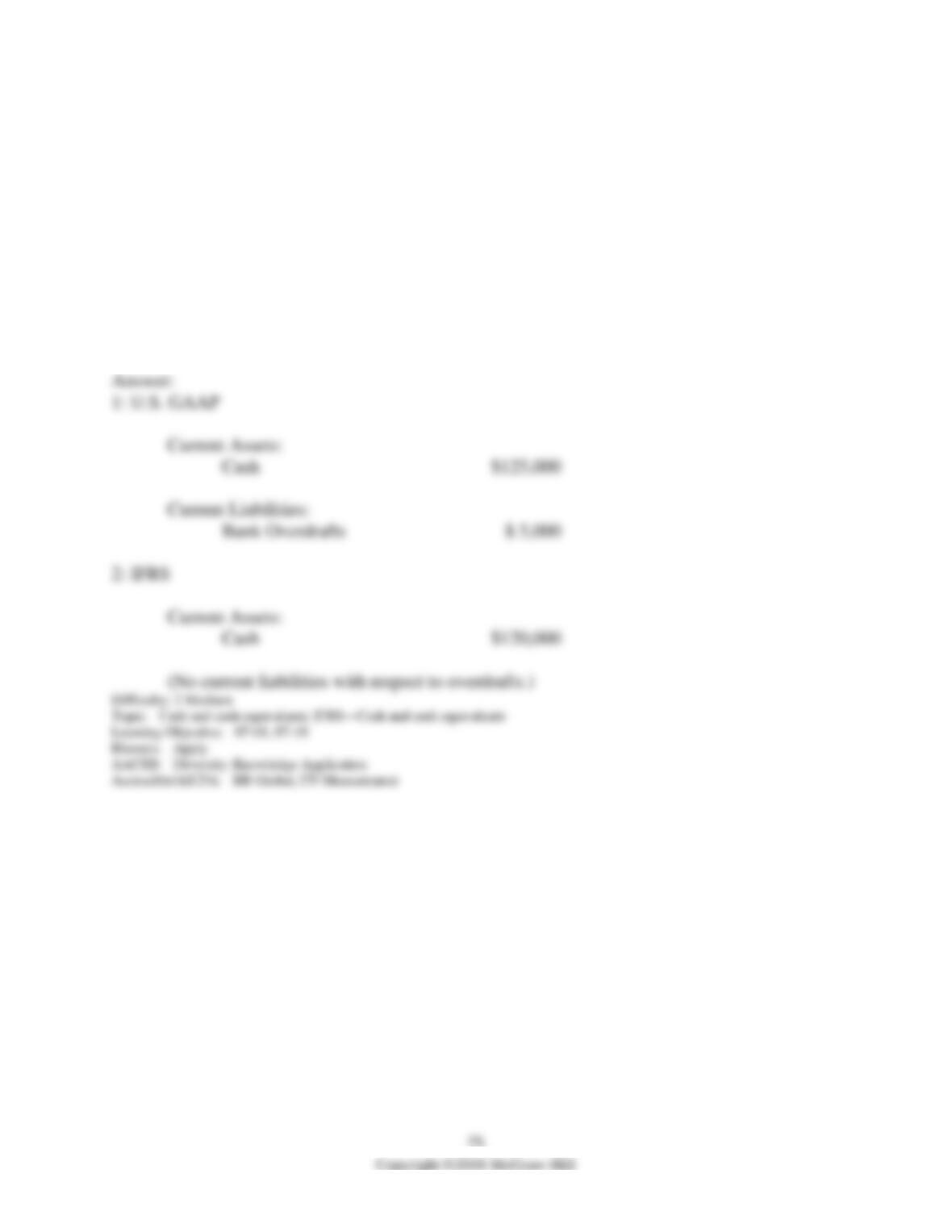
168) Costa Co. has the following cash balances at local banks as of 12/31/2018:
National Bank: $100,000
K&P Bank: 25,000
Insolvent Trust: (5,000)
Required:
1. Prepare the Current Assets and Current Liabilities section of Costa’s 2018 balance sheet,
assuming Parker reports under U.S. GAAP.
2. Prepare the Current Assets and Current Liabilities section of Costa’s 2018 balance sheet,
assuming Parker reports under IFRS.
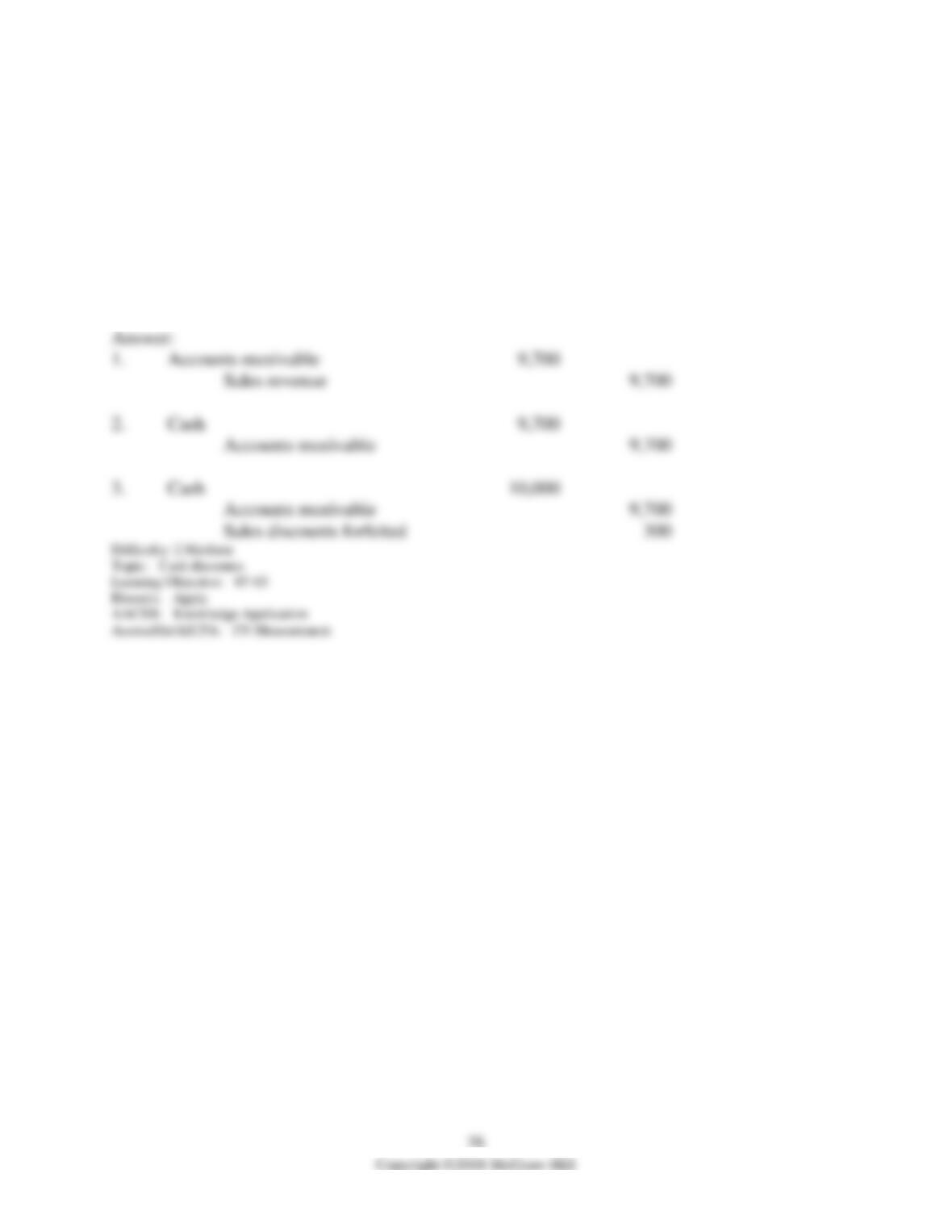
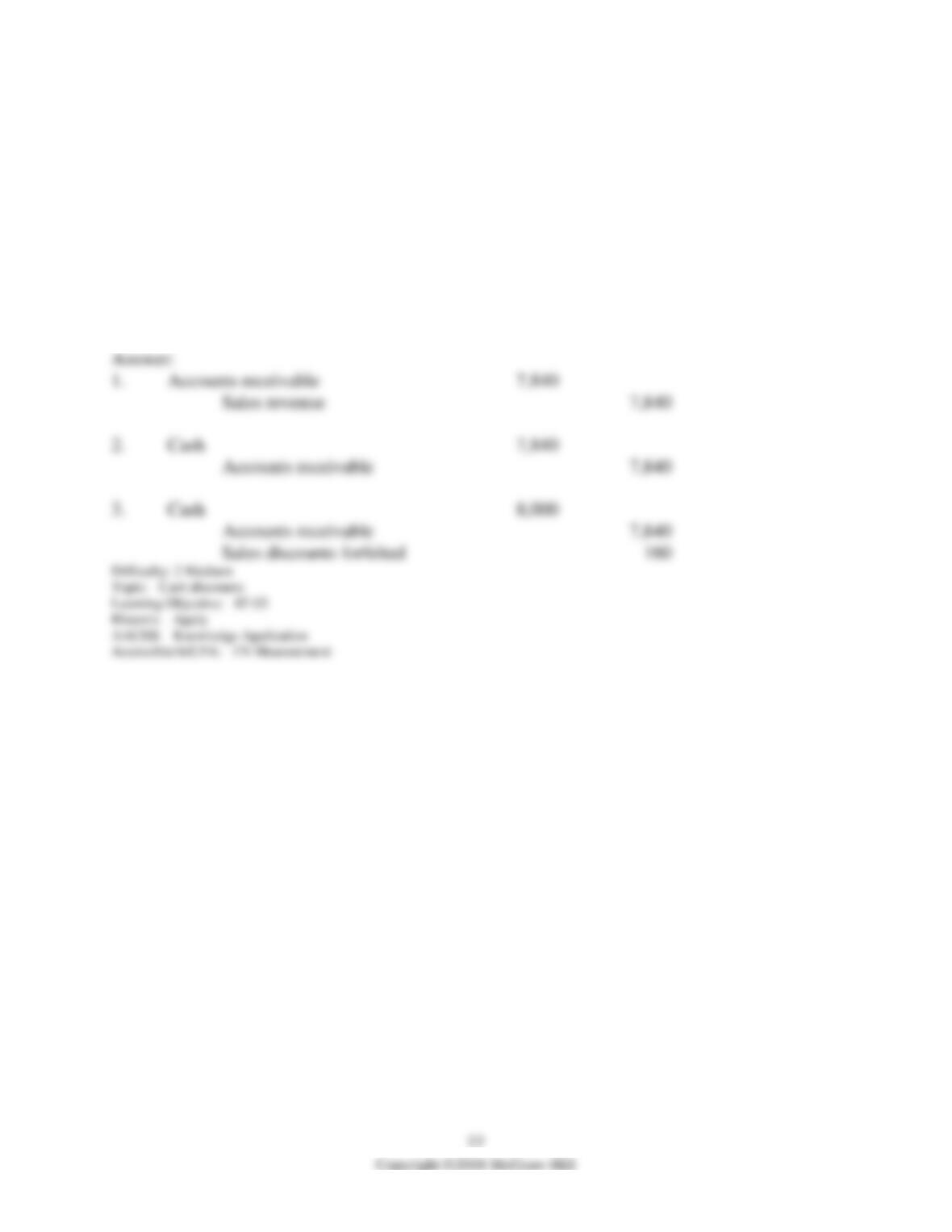
169) On May 12, 2018, Falwell Computing sold five computers to Computing Plus for $10,000,
subject to terms 3/10, n/30. Falwell uses the net method of accounting for sales discounts.
Required:
1. Prepare the journal entry to record the sale.
2. Prepare the journal entry to record receipt of the payment, assuming the correct amount
was received on May 20, 2018.
3. Prepare the journal entry to record receipt of the payment, assuming the correct amount
was received on June 5, 2018.
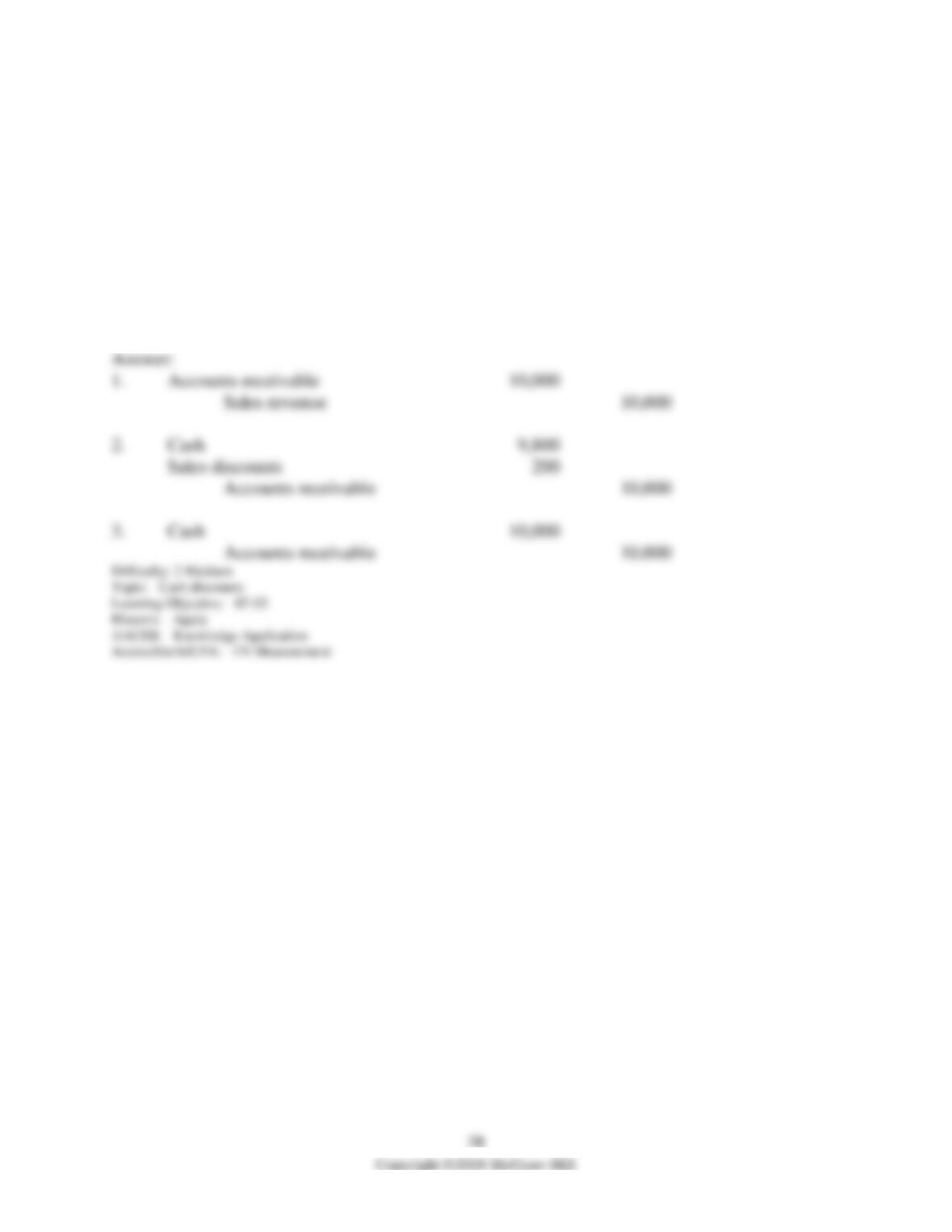
170) On July 18, 2018, Philly Furniture Factory sold 20 reclining rockers to Dave’s Discount
Furniture for $8,000, subject to terms 2/10, n/30. Philly uses the net method of accounting for
sales discounts.
Required:
1. Prepare the journal entry to record the sale.
2. Prepare the journal entry to record receipt of the payment, assuming the correct amount
was received on July 26, 2018.
3. Prepare the journal entry to record receipt of the payment assuming the correct amount
was received on August 15, 2018.
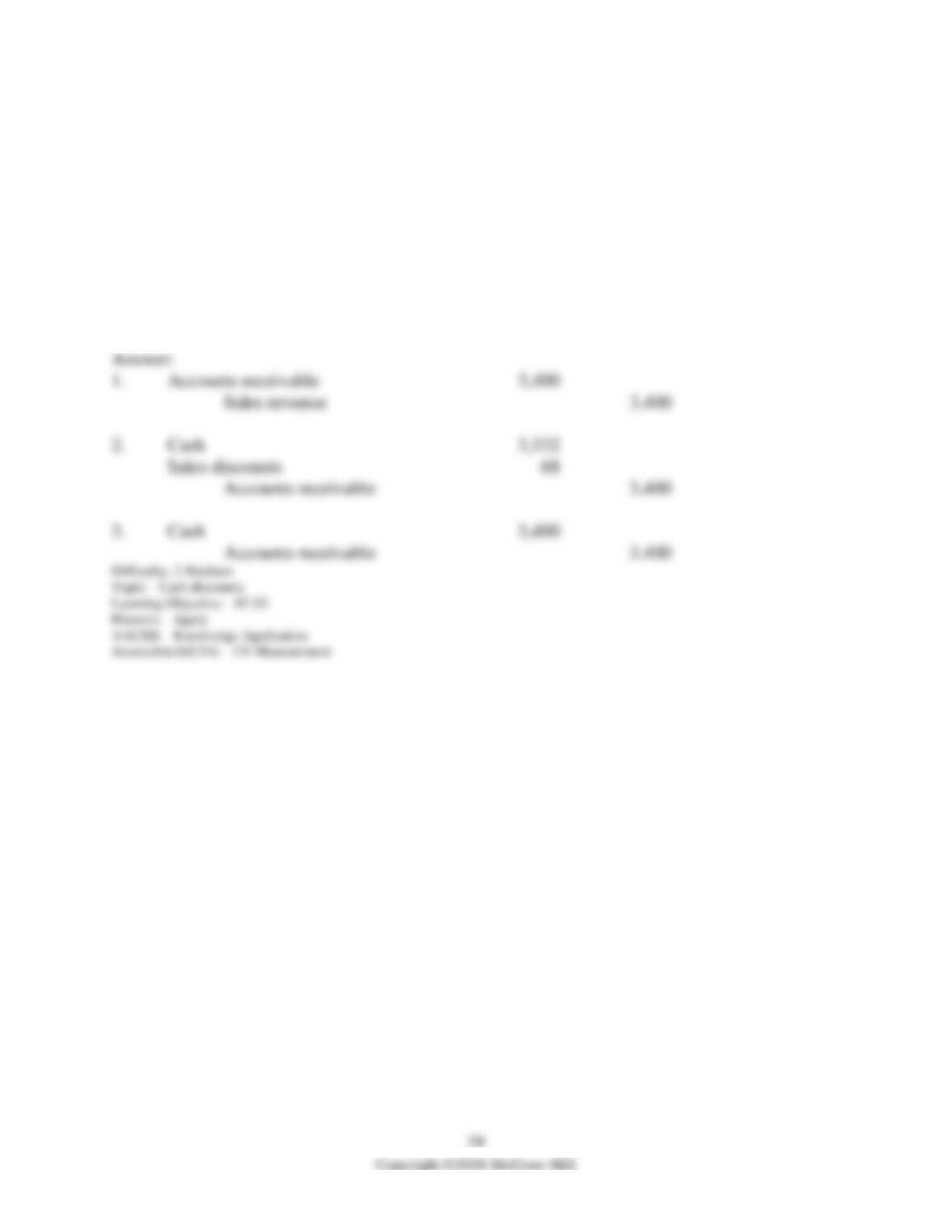
171) On March 12, 2018, Admiral Electronics sold 20 fax machines to Cool Stuff Co. for
$10,000, subject to terms 2/10, n/30. Admiral uses the gross method of accounting for sales
discounts.
Required:
1. Prepare the journal entry to record the sale.
2. Prepare the journal entry to record receipt of the payment, assuming the correct amount
was received on March 20, 2018.
3. Prepare the journal entry to record receipt of the payment, assuming the correct amount
was received on April 5, 2018.
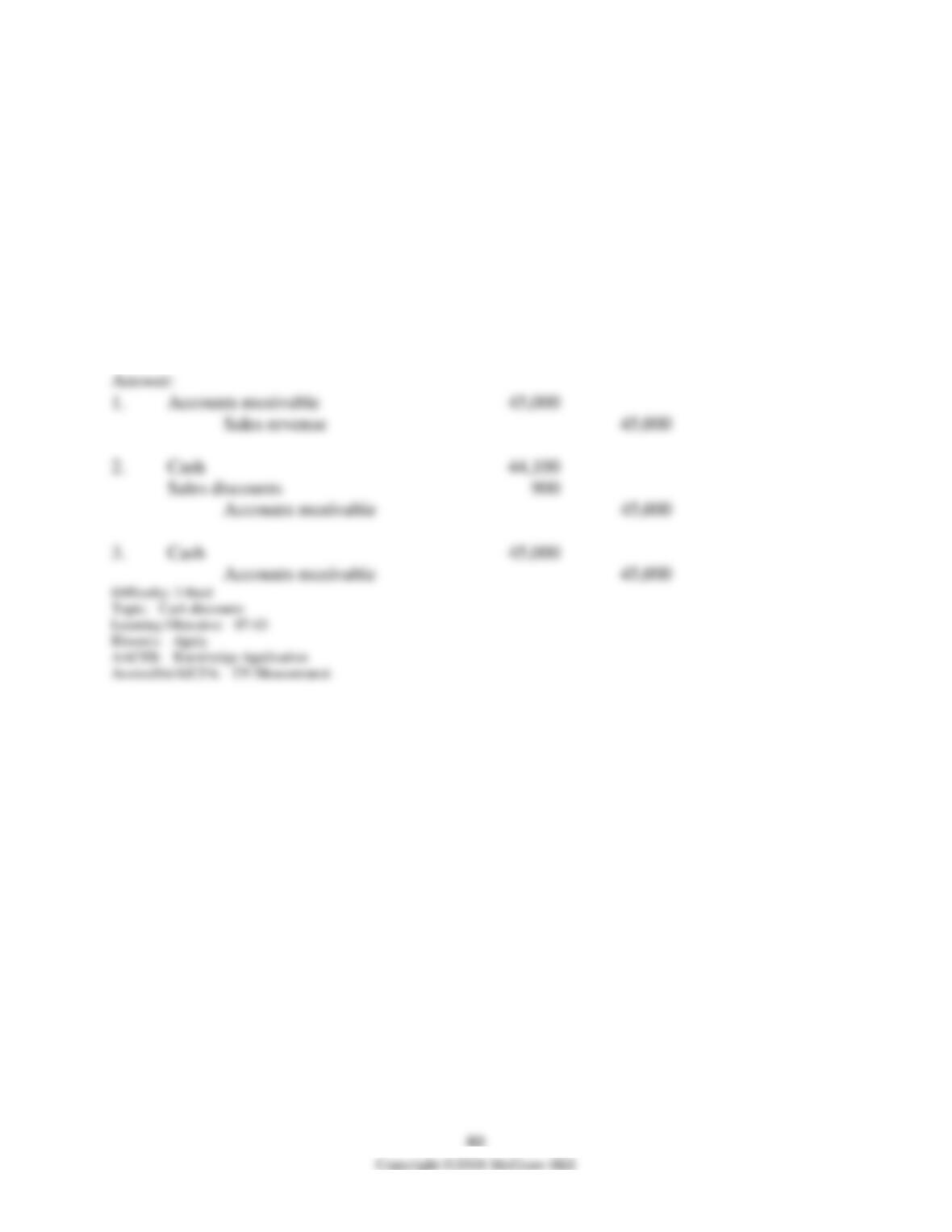
172) On October 18, 2018, Flying Chicken sold 2,000 pounds of chicken to Healthier Grocery
for $3,400, subject to terms 2/10, n/30. Flying Chicken uses the gross method of accounting for
sales discounts.
Required:
1. Prepare the journal entry to record the sale.
2. Prepare the journal entry to record receipt of the payment, assuming the correct amount
was received on October 26, 2018.
3. Prepare the journal entry to record receipt of the payment, assuming the correct amount
was received on November 15, 2018.
173) On June 14, 2018, Rumsfeld Company sold 100 air-conditioning units to Powell Heating
and Cooling. The units list for $600 each, but Powell was granted a 25% trade discount. All of
Rumfeld’s sales are subject to terms 2/10, n/30. Rumsfeld uses the gross method of accounting
for sales discounts.
Required:
1. Prepare the journal entry to record the sale.
2. Prepare the journal entry to record receipt of the payment, assuming the correct amount
was received on June 22, 2018.
3. Prepare the journal entry to record receipt of the payment, assuming the correct amount
was received on July 10, 2018.