75
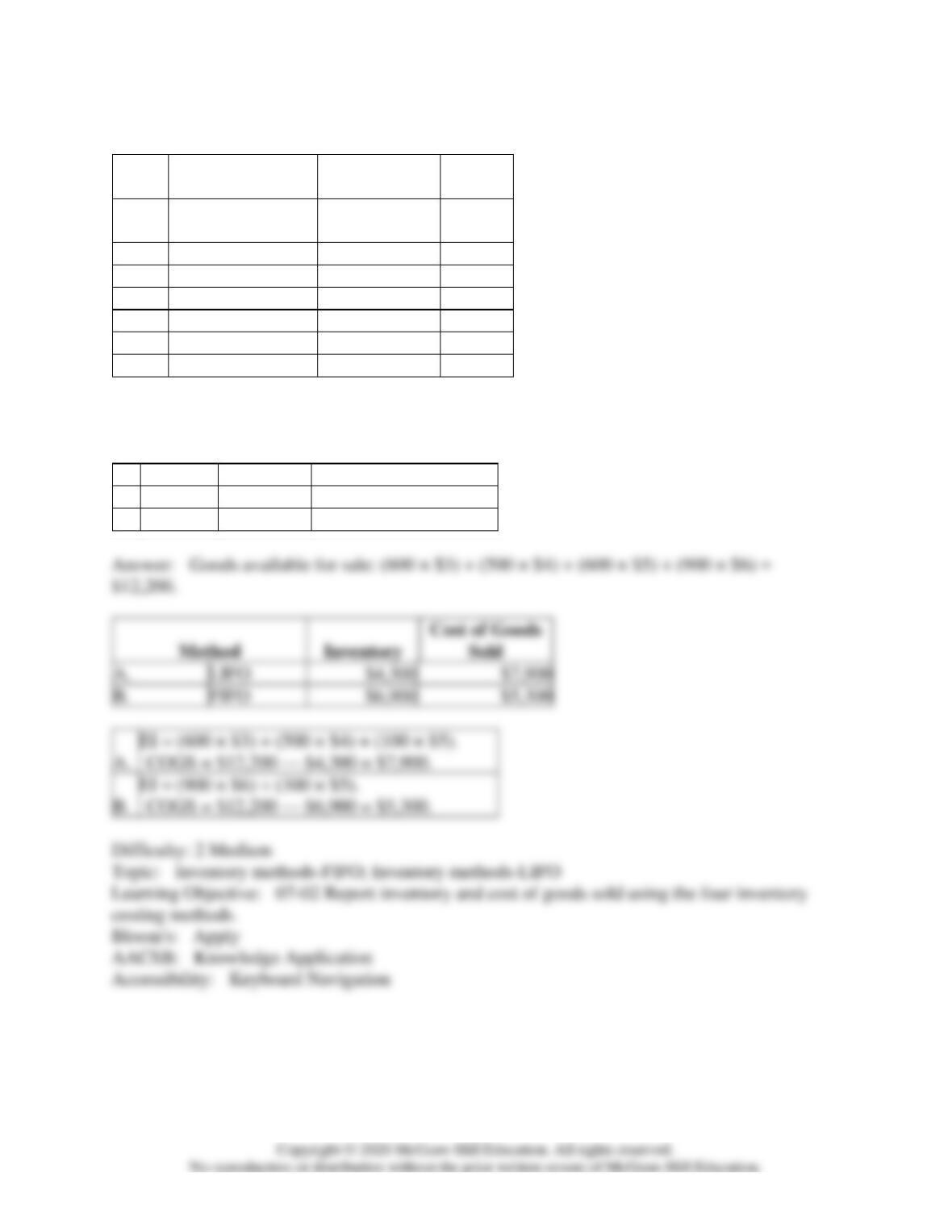
125) The records of Atlantis Company reflected the following for the month of February:
Date
Transaction
Number of
Units
Unit
Cost
2/1
Beginning
inventory
600
$3
2/2
Purchase No.1
500
$4
2/5
Sale No. 1
700
2/12
Purchase No. 2
600
$5
2/15
Sale No. 2
700
2/23
Purchase No. 3
900
$6
2/28
Ending inventory
?
Determine the amount of ending inventory and cost of goods sold using the following periodic
system inventory costing methods:
Method
Inventory
Cost of Goods Sold
A.
LIFO
$
$
B.
FIFO
$
$
A.
LIFO
B.
FIFO
A.
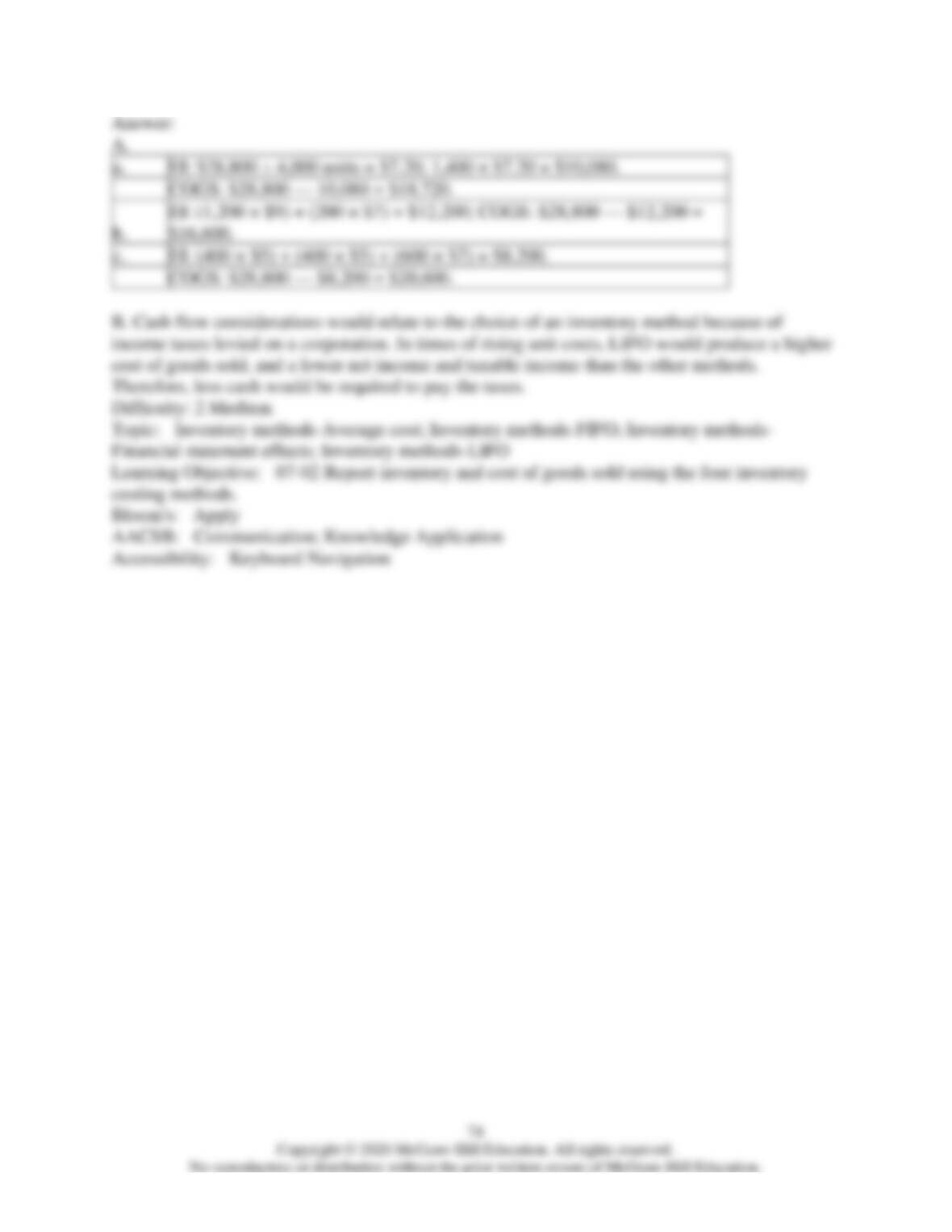
COGS = $12,200 — $4,300 = $7,900.
B.
EI = (900 × $6) + (300 × $5).
COGS = $12,200 — $6,900 = $5,300.
76
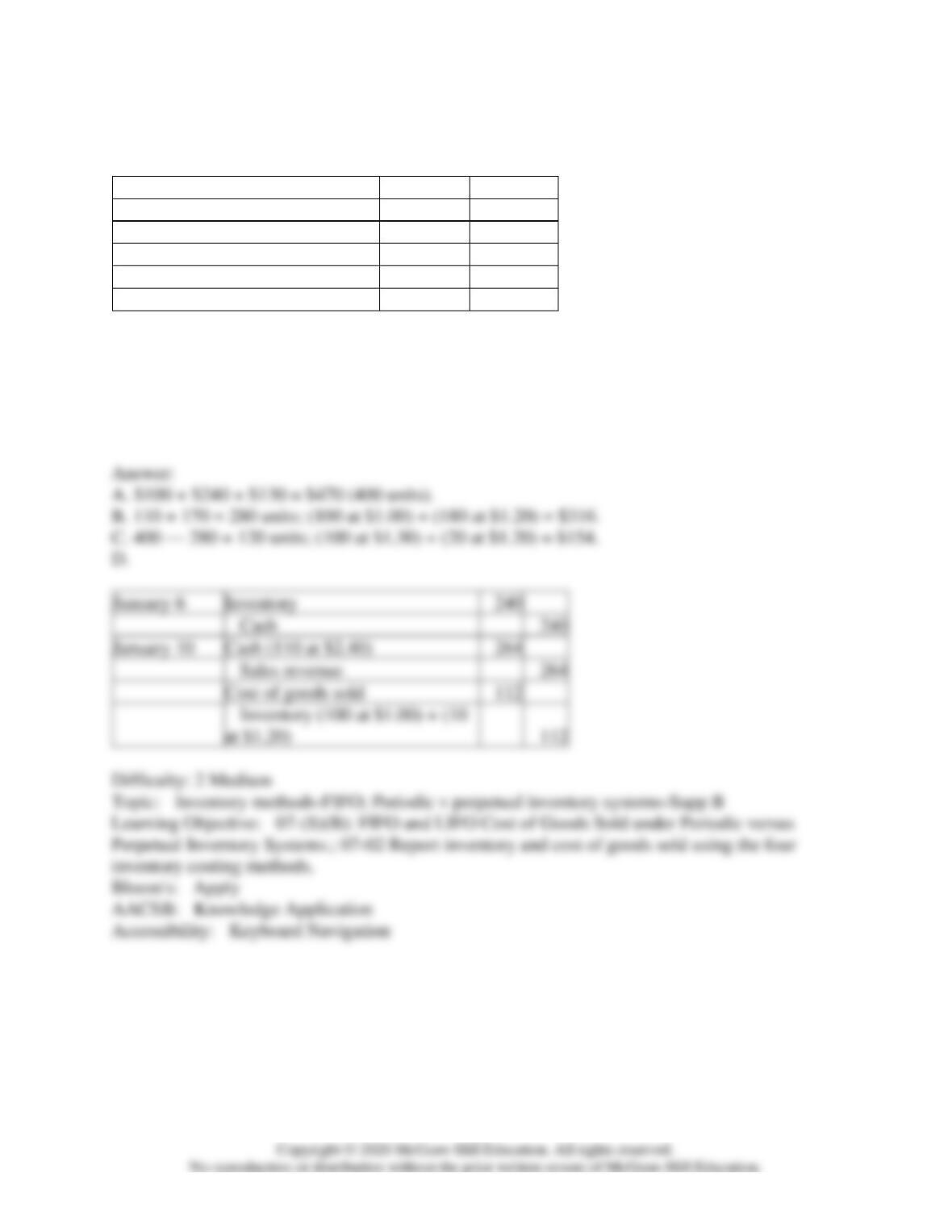
126) Rio Company uses the FIFO inventory costing method and has a perpetual inventory
system. All purchases and sales were cash transactions. The records reflected the following for
January, 2019:
Units
Unit Cost
Beginning inventory
100
$1.00
Purchase, January 6
200
1.20
Sale, January 10 (at $2.40 per unit)
110
Purchase, January 14
100
1.30
Sale, January 29 (at $2.60 per unit)
170
Determine the following:
A. 2019 cost of goods available for sale
B. 2019 cost of goods sold
C. 2019 ending inventory
D. The journal entries for January 6 and 10.
January 6
Inventory
January 10
Cash (110 at $2.40)
Cost of goods sold
at $1.20)
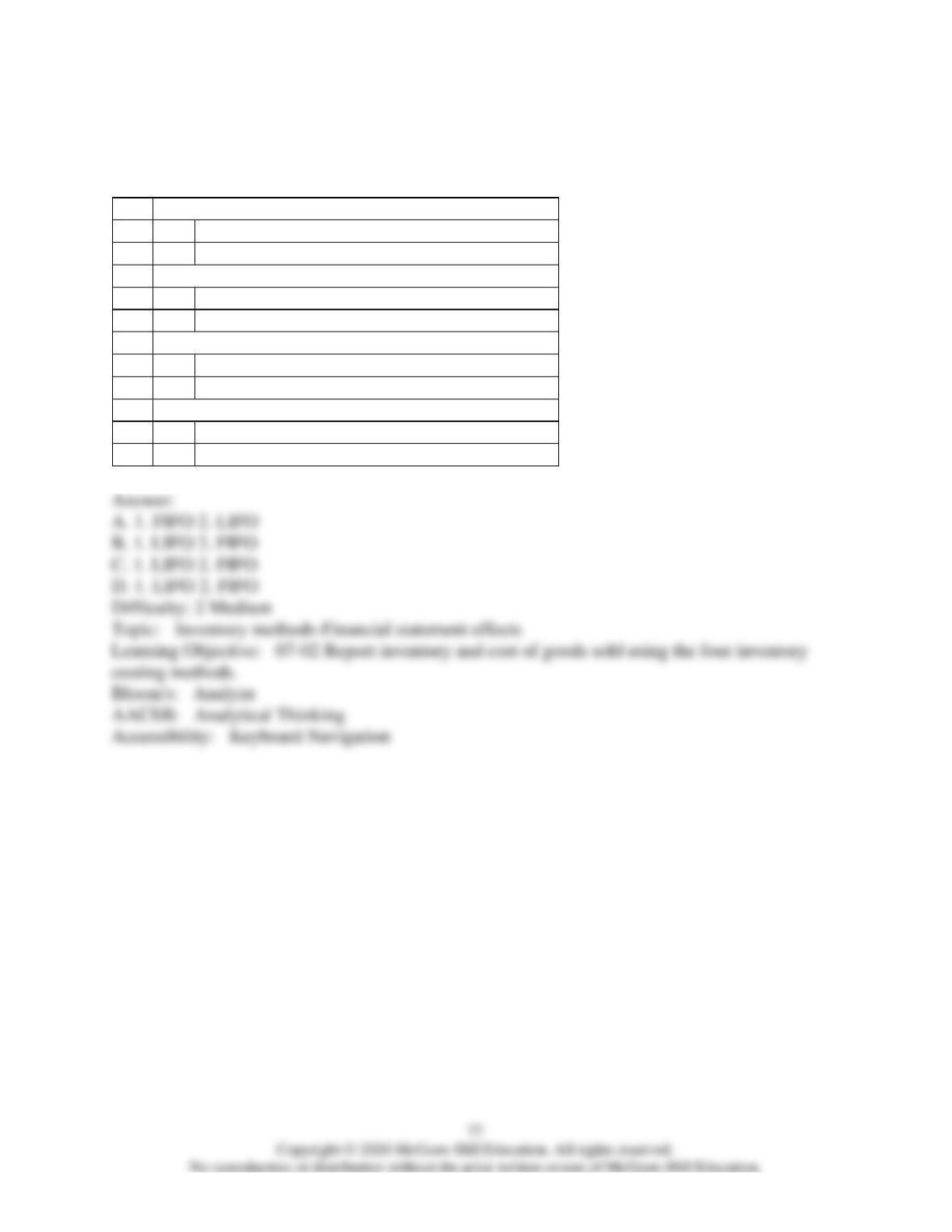
127) Given a particular set of facts and assumptions, the following pairs of amounts were
computed using FIFO and LIFO. For each pair of amounts, indicate which amount resulted from
applying FIFO, and which amount resulted from applying LIFO.
A.
Unit costs are increasing; ending inventory is:
1.
$20,650
2.
$19,400
B.
Unit costs are increasing; cost of goods sold is:
1.
$10,650
2.
$9,400
C.
Unit costs are decreasing; ending inventory is:
1.
$5,500
2.
$5,000
D.
Unit costs are decreasing; cost of goods sold is:
1.
$6,200
2.
$7,000
78
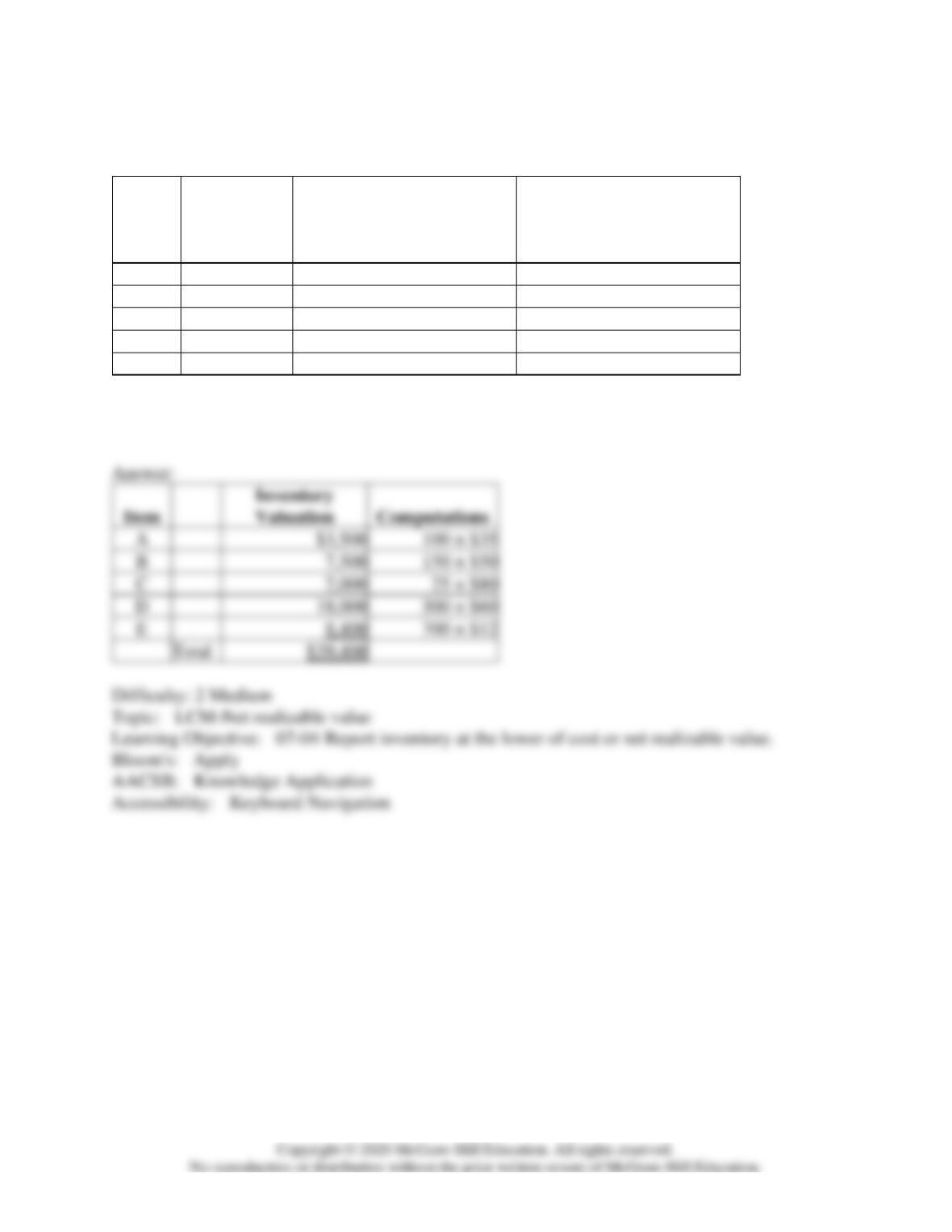
128) Boulder, Inc. is computing its inventory at December 31, 2019. The following information
relates to the five major inventory items regularly stocked for resale:
Item
Quantity on
Hand
Ending Inventory,
December 31, 2019
Unit Cost when
Acquired (FIFO)
Net Realizable Value
(Market) at December 31,
2019
A
100
$40
$35
B
150
$50
$52
C
25
$100
$80
D
300
$60
$62
E
700
$15
$12
Using the lower of cost or net realizable value, compute the total valuation for each inventory
item at December 31, 2019, and the total inventory valuation.
79
129) Cutting Edge Technologies reported the following information in its 2019 annual report:
(In millions)
Net sales revenue
$18,860
Cost of sales
11,010
December 31, 2018 inventory
1,840
December 31, 2019 inventory
1,550
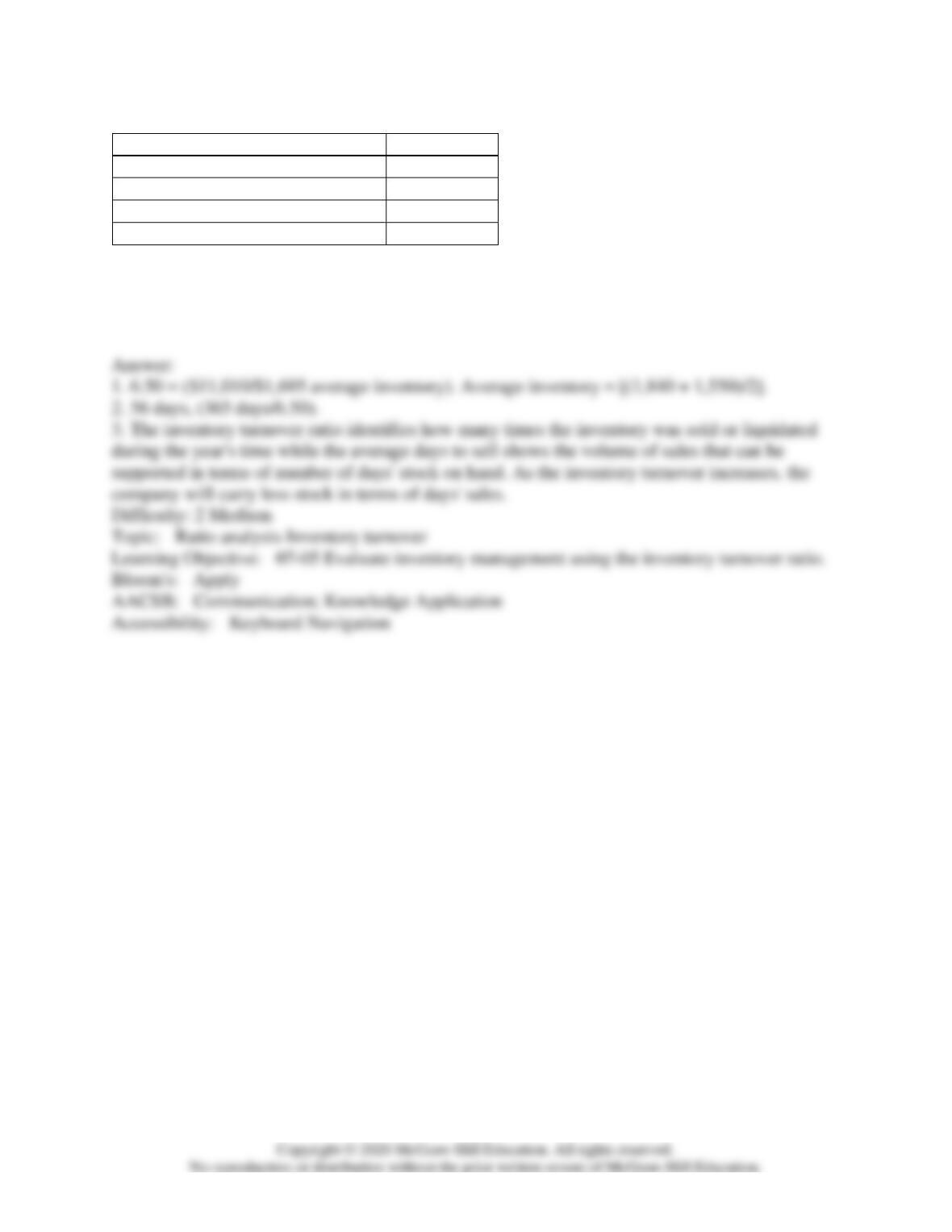
1. Determine the inventory turnover ratio. (Round your answer to two decimal places.)
2. Determine the average days to sell inventory. (Round your answer to a whole number.)
3. Explain the meaning of each ratio.
80
130) Quest Inc. provided the following disclosure note to the financial statements in its annual
report:
Inventories are stated at the lower of cost or market. The cost of inventories has been determined
using last in first out (LIFO) method. Cost of goods sold under LIFO costing were $22.2 billion
for 2019 and ending inventory under LIFO was $1.3 billion. Inventory in 2018 under LIFO
costing was $1.2 billion. The LIFO Reserve account carried a credit balance of $0.8 billion in
2019 and $0.6 billion in 2018.
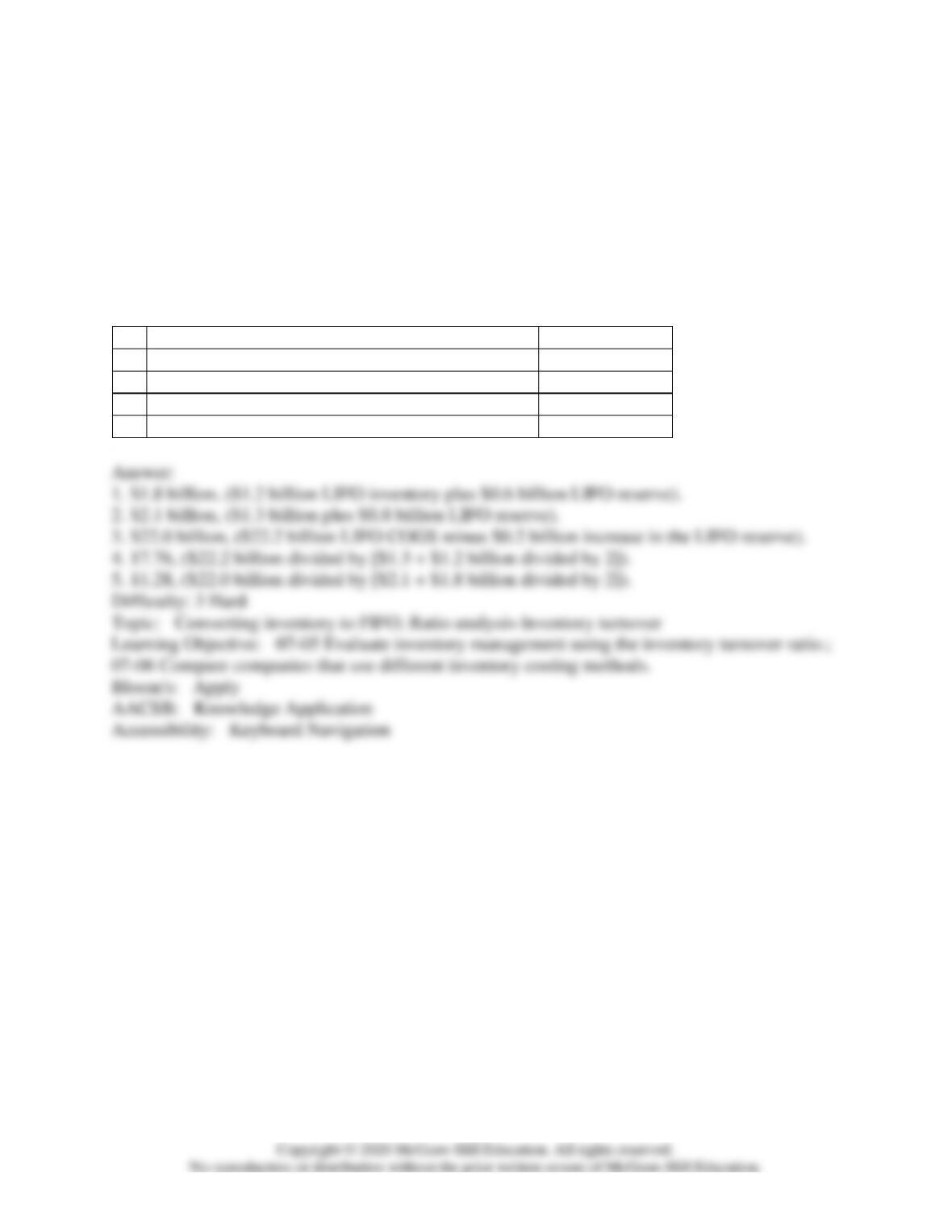
Compute the following:
1.
FIFO ending inventory balance at year end 2018
________
2.
FIFO ending inventory balance at year end 2019
________
3.
FIFO cost of goods sold for year end 2019
________
4.
Inventory turnover under LIFO costing for 2019
________
5.
Inventory turnover under FIFO costing for 2019
________
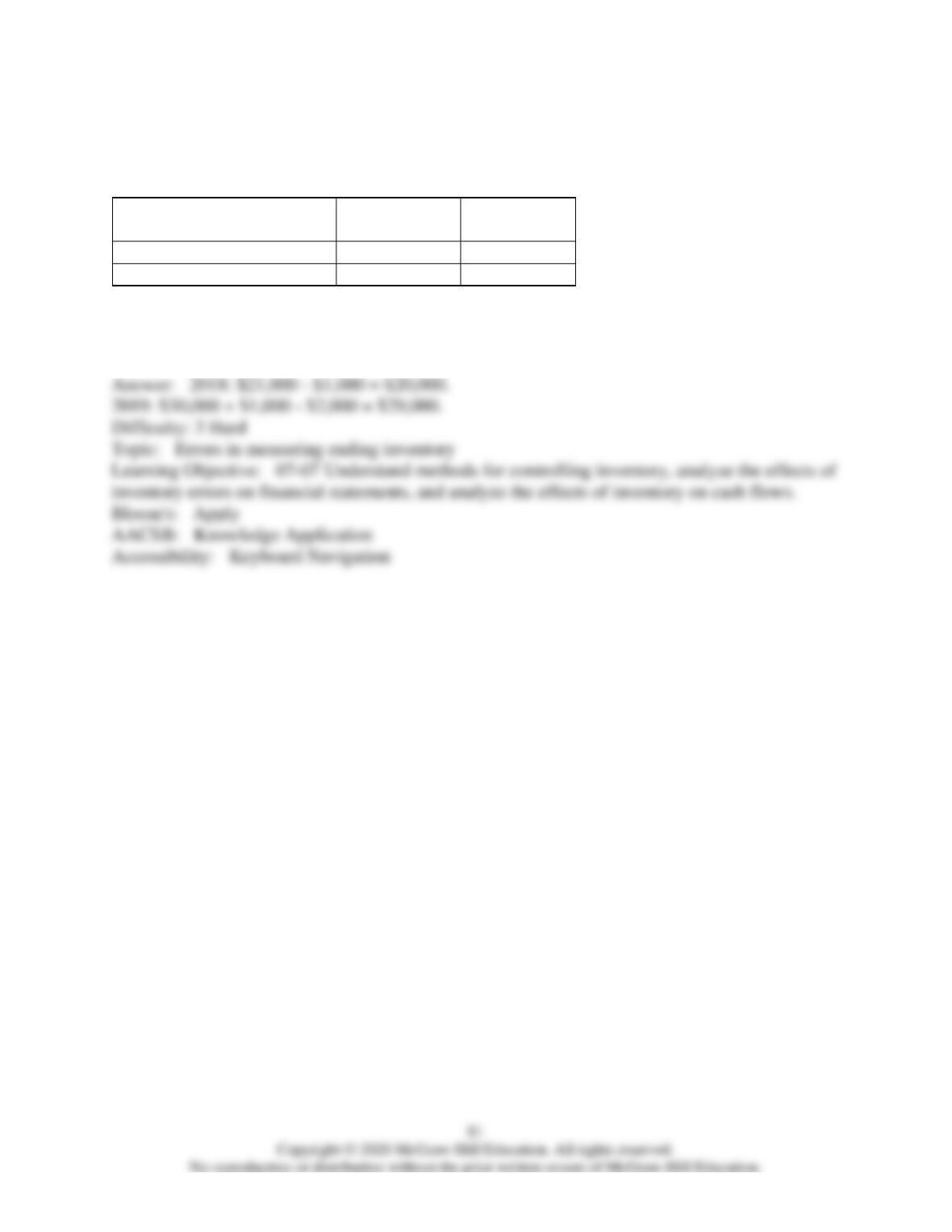
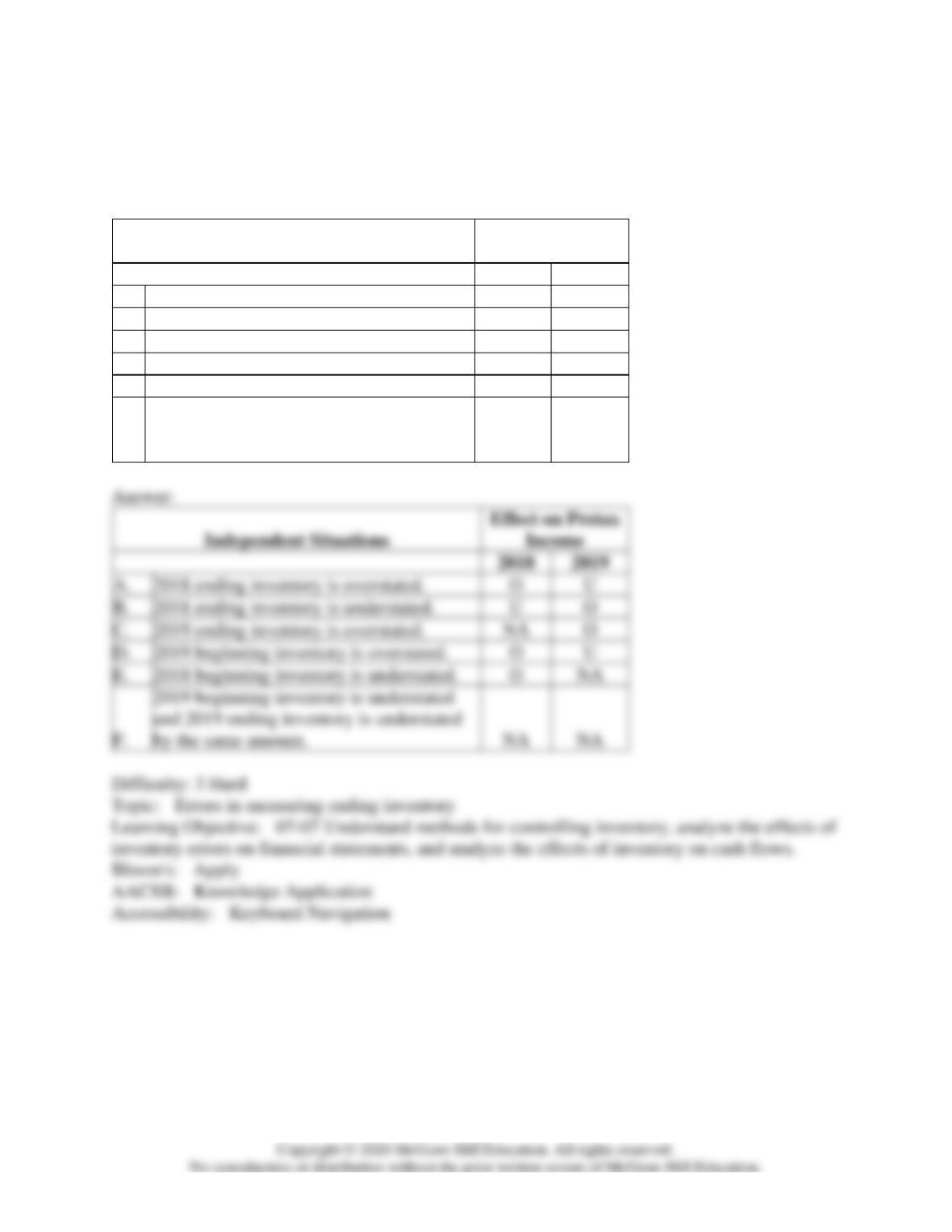
131) Dows Company prepared income statements that reflected pretax income of $21,000 for
2018 and $30,000 for 2019. An audit has determined that there were two errors in the inventory
amounts as follows:
Amount
Reported
Correct
Amount
Ending inventory, 2018
$15,000
$14,000
Ending inventory, 2019
18,000
16,000
Determine the correct pretax income amount for each year (show computations; assume the
errors were not corrected):
82
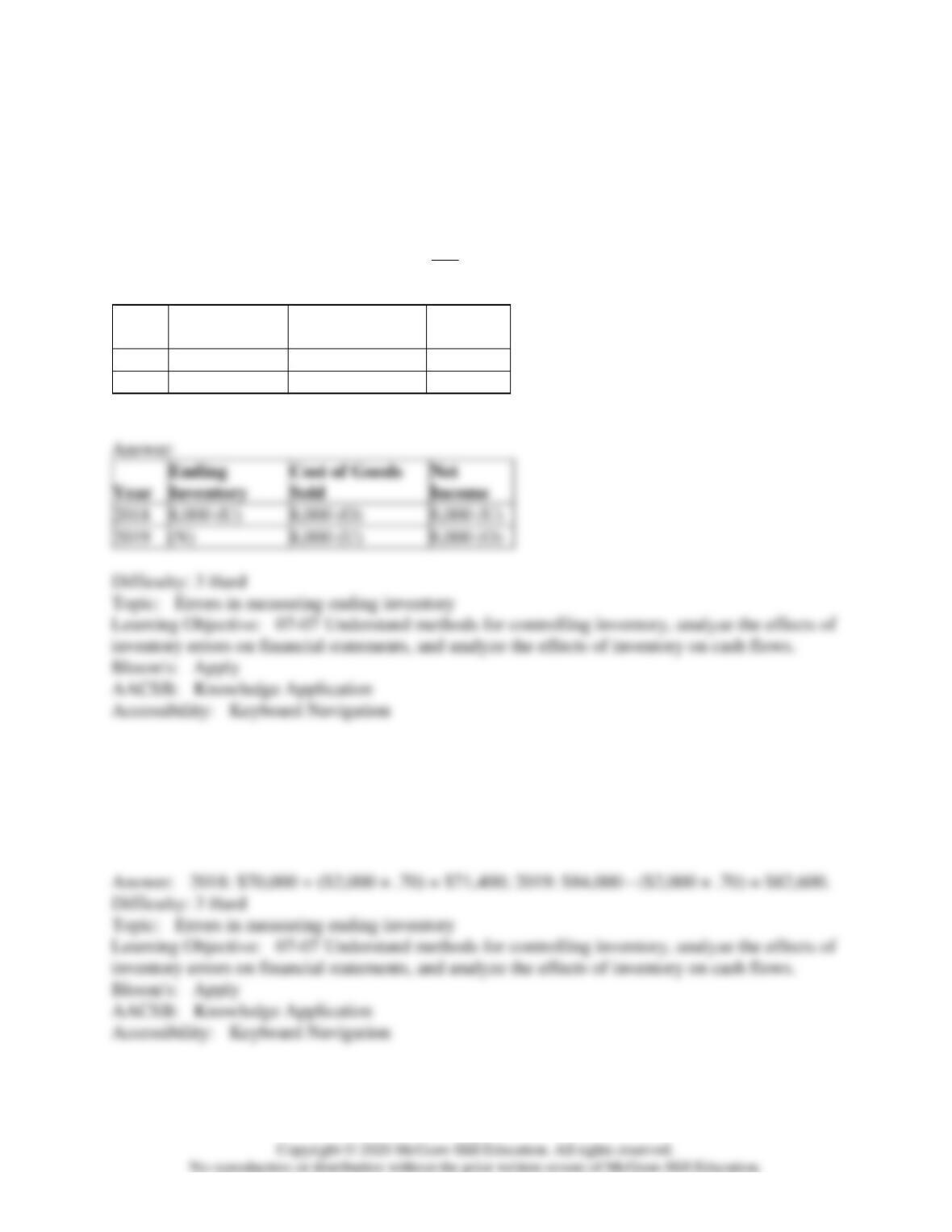
132) For each independent situation given below, determine the effect on pretax income for each.
Enter “O” to indicate pretax income is overstated, “U” to indicate pretax income is understated,
or “NA” to indicate that pretax income is not affected.
Independent Situations
Effect on Pretax
Income
2018
2019
A.
2018 ending inventory is overstated.
B.
2018 ending inventory is understated.
C.
2019 ending inventory is overstated.
D.
2019 beginning inventory is overstated.
E.
2018 beginning inventory is understated.
F.
2019 beginning inventory is understated
and 2019 ending inventory is understated
by the same amount.
2019
A.
2018 ending inventory is overstated.
B.
2018 ending inventory is understated.
C.
2019 ending inventory is overstated.
D.
2019 beginning inventory is overstated.
E.
2018 beginning inventory is understated.
F.
2019 beginning inventory is understated
and 2019 ending inventory is understated
by the same amount.
83
133) Redford Company hired a new store manager in October 2018, who determined the ending
inventory on December 31, 2018, to be $50,000. In March, 2019, the company discovered that
the December 31, 2018 ending inventory should have been $58,000. The December 31, 2019,
inventory was correct. Ignore income taxes.
Complete the following table to show the effects of the inventory error on the four amounts
listed. Give the amount of the discrepancy and indicate whether it was overstated (O),
understated (U), or had no effect (N).
Year
Ending
Inventory
Cost of Goods
Sold
Net
Income
2018
________
________
________
2019
________
________
________
Year
Ending
Inventory
Cost of Goods
Sold
Net
Income
2018
8,000 (U)
8,000 (O)
8,000 (U)
2019
(N)
8,000 (U)
8,000 (O)
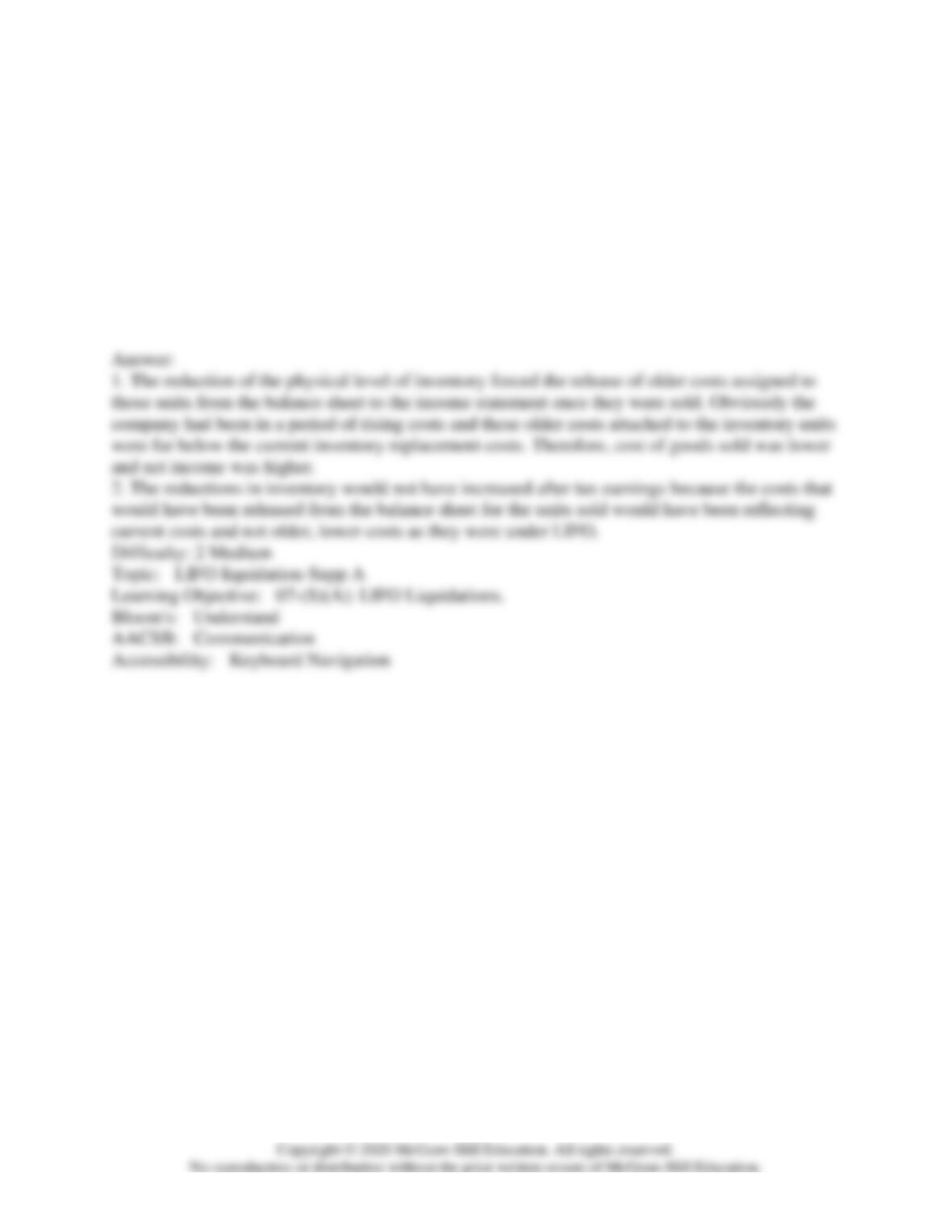
134) Sideline Company reported net income for 2018 of $70,000 and in 2019 of $84,000 (both
after income taxes at a 30% rate). It was discovered in 2019 that the ending inventory for 2018
was understated by $2,000 (before any income tax effect).
Calculate the correct net income (after income tax of 30%) for 2018 and 2019.
84
135) A company provided the following disclosure note to the financial statements in its newest
annual report:
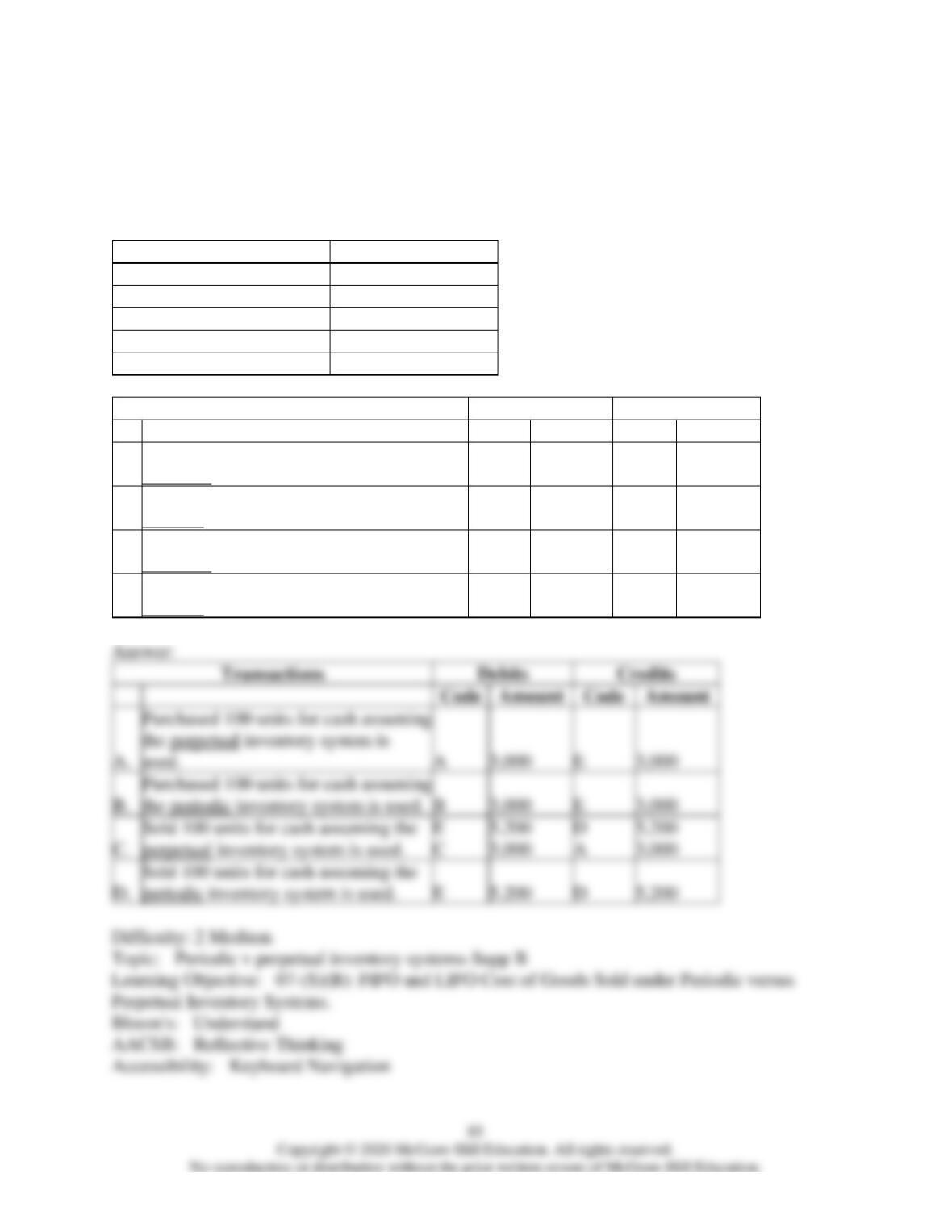
During the current and prior year, the company reduced certain inventory quantities that were
valued at lower LIFO costs prevailing in prior years. The effect of these physical reductions was
to increase after-tax earnings this year by $90 million, $.30 per share, and $98 million, or $.327
per share last year.
1. Explain why the reduction in inventory quantity increased after-tax earnings for this company.
2. If the company had been using FIFO costing, would the reductions in inventory quantity
during the two years have increased after-tax earnings? Explain.
136) Assume Webster Company buys bicycle helmets at a unit cost of $30 and sells them at a
unit price of $52. There was no inventory at the beginning of the period.
Provide the journal entries required below by entering the account code of the appropriate
account and the amount for each debit and credit:
Account Name
Account Code
Inventory
A
Purchases
B
Cost of goods sold
C
Sales revenue
D
Cash
E
Transactions
Debits
Credits
Code
Amount
Code
Amount
A.
Purchased 100 units for cash assuming the
perpetual inventory system is used.
B.
Purchased 100 units for cash assuming the
periodic inventory system is used.
C.
Sold 100 units for cash assuming the
perpetual inventory system is used.
D.
Sold 100 units for cash assuming the
periodic inventory system is used.
Credits
Code
Code
Amount
A.
used.
A
3,000
E
3,000
B.
Purchased 100 units for cash assuming
the periodic inventory system is used.
B
3,000
E
3,000
C.
Sold 100 units for cash assuming the
perpetual inventory system is used.
E
C
5,200
3,000
D
A
5,200
3,000
D.
Sold 100 units for cash assuming the
periodic inventory system is used.
E
5,200
D
5,200
86
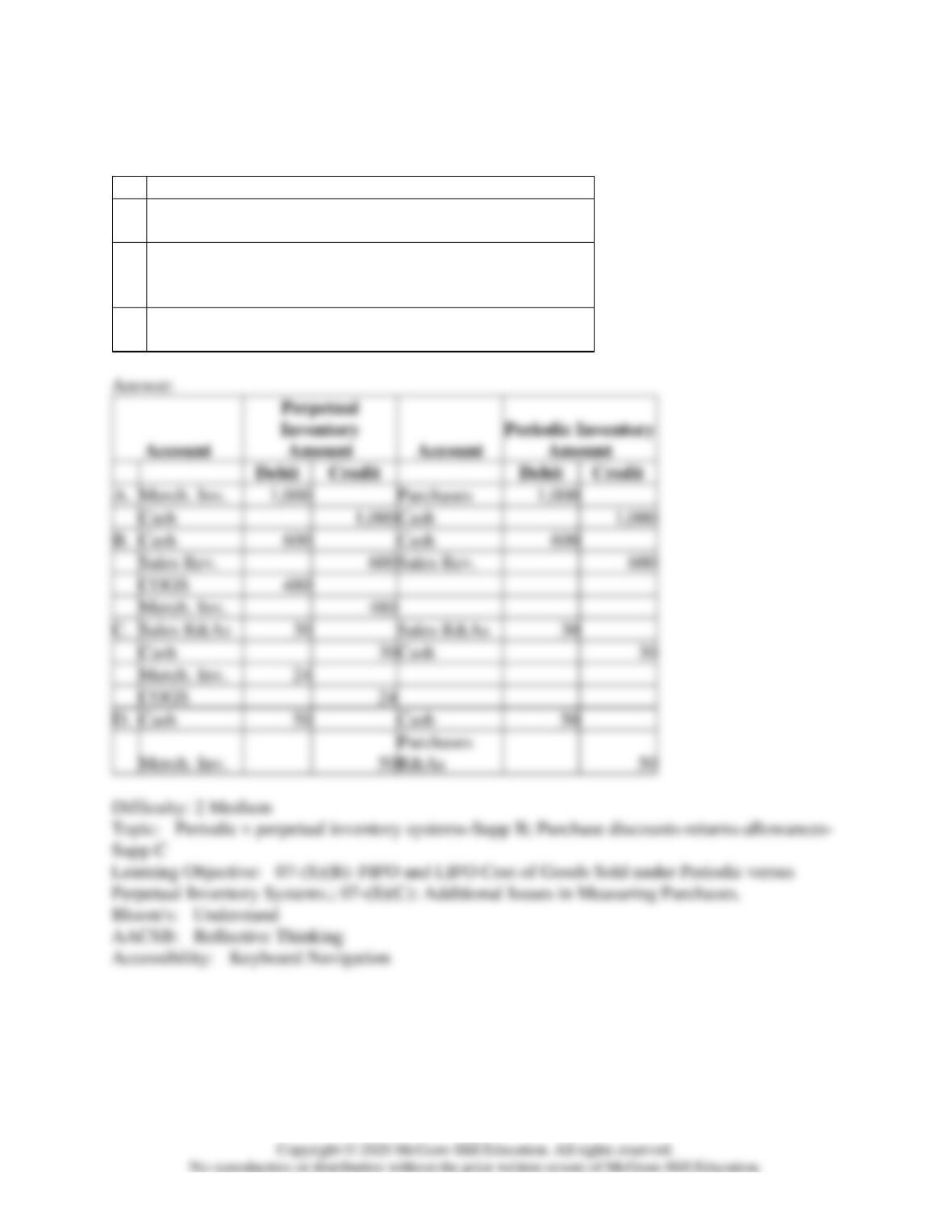
137) Prepare the journal entries for the transactions listed below under both the periodic
inventory system and the perpetual inventory system.
A.
Purchased merchandise for cash, $1,000.
B.
Sold merchandise for $600 cash that had cost $480 (cost is
80% of the sales price).
C.
Accepted a sales return from a customer: sales price $30. A
cash refund was given to the customer. The goods were
returned to regular inventory.
D.
Returned goods to the vendor because they did not meet
our specification; $50 cash refund was received.
A.
Merch. Inv.
Purchases
Cash
Cash
B.
Cash
Cash
Sales Rev.
Sales Rev.
COGS
Merch. Inv.
C.
Sales R&As
Sales R&As
Cash
Cash
Merch. Inv.
COGS
D.
Cash
Cash
Merch. Inv.
Purchases
R&As