50) On November 10 of the current year, Cherokee Industries sold materials to a customer for
$8,000 with credit terms 2/10, n/30. Cherokee uses the net method of accounting for cash
discounts.
What entry would Cherokee make on December 10, assuming the correct payment was received
on that date?
A)
Cash
8,000
Accounts receivable
7,840
Discounts revenue
160
B)
Cash
8,000
Accounts receivable
7,840
Sales discounts forfeited
160
C)
Cash
8,160
Accounts receivable
8,000
Sales discounts forfeited
160
D)
Cash
8,000
Accounts receivable
8,000
51) Harvey’s Wholesale Company sold supplies of $46,000 to Northeast Company on April 12 of
the current year, with terms 1/15, n/60. Harvey uses the net method of accounting for cash
discounts.
What entry would Harvey’s make on April 12?
A)
Accounts receivable
46,000
Sales
46,000
B)
Accounts receivable
46,000
Sales
45,540
Sales discounts
460
C)
Accounts receivable
45,540
Sales
45,540
D)
Accounts receivable
45,540
Sales discounts
460
Sales
46,000
52) Harvey’s Wholesale Company sold supplies of $46,000 to Northeast Company on April 12 of
the current year, with terms 1/15, n/60. Harvey uses the net method of accounting for cash
discounts.
What entry would Harvey’s make on April 23, assuming the customer made the correct payment
on that date?
A)
Cash
45,540
Sales
460
Accounts receivable
46,000
B)
Cash
46,000
Sales discounts
460
Accounts receivable
46,000
Sales discounts forfeited
460
C)
Cash
45,540
Sales discounts
460
Accounts receivable
46,000
D)
Cash
45,540
Accounts receivable
45,540
53) Harvey’s Wholesale Company sold supplies of $46,000 to Northeast Company on April 12 of
the current year, with terms 1/15, n/60. Harvey uses the net method of accounting for cash
discounts.
What entry would Harvey’s make on June 10, assuming the customer made the correct payment
on that date?
A)
Cash
46,000
Accounts receivable
45,540
Discounts revenue
460
B)
Cash
46,000
Accounts receivable
45,540
Sales discounts forfeited
460
C)
Cash
46,000
Accounts receivable
46,000
D)
Cash
46,460
Accounts receivable
46,000
Sales discounts forfeited
460
54) Gershwin Wallcovering Inc. shipped the wrong shade of paint to a customer. The customer
agreed to keep the paint upon being offered a 15% price reduction. Gershwin would record this
reduction by crediting accounts receivable and debiting:
A) Sales.
B) Sales discounts.
C) Sales returns.
D) Sales allowances.
55) Tom’s Textiles shipped the wrong material to a customer, who refused to accept the order.
Upon receipt of the material, Tom’s would credit accounts receivable and debit:
A) Sales.
B) Sales discount.
C) Sales returns.
D) Sales allowances.
56) Memorex Disks sells computer disk drives with right-of-return privileges. Returns are
material and reasonably predictable. Memorex should:
A) Not record sales until the right to return has expired.
B) Record an allowance for sales returns in the year of the sale.
C) Debit sales returns in the period of the return.
D) Debit sales in the period of the return.
57) Galaxy sells used videogames for cash and provides a one-week return right. Returns are
material and reasonably predictable. Galaxy should:
A) Not record sales until the right to return has expired.
B) Record a contra-receivable in the year of the sale.
C) Recognize a refund liability associated with estimated returns.
D) Credit sales in the period of the return.
58) False Value Hardware began 2018 with a credit balance of $32,000 in the allowance for sales
returns account. Sales and cash collections from customers during the year were $650,000 and
$610,000, respectively. False Value estimates that 6% of all sales will be returned. During 2018,
customers returned merchandise for credit of $28,000 to their accounts.
What is the balance in the allowance for sales returns account at the end of 2018?
A) $11,000.
B) $39,000.
C) $43,000.
D) $21,000.
59) False Value Hardware began 2018 with a credit balance of $32,000 in the allowance for sales
returns account. Sales and cash collections from customers during the year were $650,000 and
$610,000, respectively. False Value estimates that 6% of all sales will be returned. During 2018,
customers returned merchandise for credit of $28,000 to their accounts.
False Value Hardware’s 2018 income statement would report net sales of:
A) $622,000.
B) $607,000.
C) $646,000.
D) $611,000.
60) Rusty Hardware makes only cash sales. It began 2018 with a credit balance of $32,000 in the
refund liability account. Sales during 2018 were $600,000. Rusty estimates that 6% of all sales
will be returned. During 2018, customers returned merchandise for credit of $28,000 to their
accounts.
What is the balance in the allowance for sales returns account at the end of 2018?
A) $32,000.
B) $39,000.
C) $43,000.
D) $40,000.
61) Rusty Hardware makes only cash sales. It began 2018 with a credit balance of $32,000 in the
refund liability account. Sales during 2018 were $600,000. Rusty estimates that 6% of all sales
will be returned. During 2018, customers returned merchandise for credit of $28,000 to their
accounts.
Rusty’s 2018 income statement would report net sales of:
A) $600,000.
B) $564,000.
C) $568,000.
D) $604,000.
62) Accounts receivable are normally reported at the:
A) Present value of future cash receipts.
B) Current value plus accrued interest.
C) Expected amount to be received.
D) Current value less expected collection costs.
63) The allowance for uncollectible accounts is a:
A) Deferred charge to expense.
B) Contra asset account.
C) Deferred revenue account.
D) Quasi-liability account.
64) A company uses the allowance method to account for bad debts. What is the effect on each
of the following accounts of the collection of an account previously written off?
Allowance for
Accounts
Uncollectible Accounts
Receivable
a.
Increase
Decrease
b.
No effect
Decrease
c.
Increase
No effect
d.
No effect
No effect
A) Option a.
B) Option b.
C) Option c.
D) Option d.
65) Collection of accounts receivable that previously have been written off results in an increase
in cash and an increase in:
A) Accounts receivable.
B) Allowance for uncollectible accounts.
C) Bad debts expense.
D) Retained earnings.
66) Which of the following does not reduce the balance in accounts receivable?
A) Returns on credit sales.
B) Collections from customers.
C) Recognizing bad debts expense.
D) Write-offs.
67) Chez Fred Bakery estimates the allowance for uncollectible accounts at 3% of the ending
balance of accounts receivable. During 2018, Chez Fred’s credit sales and collections were
$125,000 and $131,000, respectively. What was the balance of accounts receivable on January 1,
2018, if $180 in accounts receivable were written off during 2018 and if the allowance account
had a balance of $750 on December 31, 2018?
A) $5,820.
B) $31,000.
C) $31,180.
D) None of these answer choices are correct.
Collections
(131,000
)
Write-offs
)
Credit sales
68) The following information relates to Halloran Co.’s accounts receivable for 2018:
Accounts receivable balance, 1/1/2018
$
840,000
Credit sales for 2018
3,300,000
Accounts receivable written off during 2018
70,000
Collections from customers during 2018
3,100,000
Allowance for uncollectible accounts balance, 12/31/2018
210,000
What amount should Halloran report for accounts receivable, before allowances, at December
31, 2018?
A) $1,040,000.
B) $970,000.
C) $760,000.
D) None of these answer choices are correct.
69) Calistoga Produce estimates bad debt expense at ½% of credit sales. The company reported
accounts receivable and allowance for uncollectible accounts of $471,000 and $1,650,
respectively, at December 31, 2017. During 2018, Calistoga’s credit sales and collections were
$315,000 and $319,000, respectively, and $1,720 in accounts receivable were written off.
Calistoga’s accounts receivable at December 31, 2018, are:
A) $467,000.
B) $473,280.
C) $465,280.
D) $469,280.
70) Calistoga Produce estimates bad debt expense at ½% of credit sales. The company reported
accounts receivable and allowance for uncollectible accounts of $471,000 and $1,650,
respectively, at December 31, 2017. During 2018, Calistoga’s credit sales and collections were
$315,000 and $319,000, respectively, and $1,720 in accounts receivable were written off.
Calistoga’s 2018 bad debt expense is:
A) $1,720.
B) $1,650.
C) $1,505.
D) $1,575.
71) Calistoga Produce estimates bad debt expense at ½% of credit sales. The company reported
accounts receivable and allowance for uncollectible accounts of $471,000 and $1,650,
respectively, at December 31, 2017. During 2018, Calistoga’s credit sales and collections were
$315,000 and $319,000, respectively, and $1,720 in accounts receivable were written off.
Calistoga’s final balance in its allowance for uncollectible accounts at December 31, 2018, is:
A) $1,575.
B) $1,505.
C) $1,650.
D) $1,720.
72) The balance in accounts receivable at the beginning of 2018 was $300. During 2018, $1,600
of credit sales were recorded. If the ending balance in accounts receivable was $250 and $100 in
accounts receivable were written off during the year, the amount of cash collected from
customers during 2018 was:
A) $1,600.
B) $1,650.
C) $1,550.
D) $1,900.
73) In the balance sheet at the end of its first year of operations, Dinty Inc. reported an allowance
for uncollectible accounts of $82,000. During the year, Dinty wrote off $32,000 of accounts
receivable it had attempted to collect and failed. Credit sales for the year were $2,200,000, and
cash collections from credit customers totaled $1,950,000.
What bad debt expense would Dinty report in its first-year income statement?
A) $50,000.
B) $82,000.
C) $114,000.
D) Can’t be determined from the given information
74) In the balance sheet at the end of its first year of operations, Dinty Inc. reported an allowance
for uncollectible accounts of $82,000. During the year, Dinty wrote off $32,000 of accounts
receivable it had attempted to collect and failed. Credit sales for the year were $2,200,000, and
cash collections from credit customers totaled $1,950,000.
What accounts receivable balance would Dinty report in its first year-end balance sheet?
A) $196,000.
B) $218,000.
C) $230,000.
D) None of these answer choices are correct.
75) In the balance sheet at the end of its first year of operations, Dinty Inc. reported an allowance
for uncollectible accounts of $82,000. During the year, Dinty wrote off $32,000 of accounts
receivable it had attempted to collect and failed. Credit sales for the year were $2,200,000, and
cash collections from credit customers totaled $1,950,000.
In Dinty’s adjusting entry for bad debts at year-end, which of these would be included?
A) Debit to bad debt expense for $114,000.
B) Credit to allowance for uncollectible accounts for $82,000.
C) Debit to accounts receivable for $32,000.
D) All of these answer choices are correct.
76) For 2018, Rahal’s Auto Parts estimates bad debt expense at 1% of credit sales. The company
reported accounts receivable and an allowance for uncollectible accounts of $86,500 and $2,100,
respectively, at December 31, 2017. During 2018, Rahal’s credit sales and collections were
$404,000 and $408,000, respectively, and $2,340 in accounts receivable were written off.
Rahal’s accounts receivable at December 31, 2018, are:
A) $90,500.
B) $88,160.
C) $82,500.
D) $80,160.
77) For 2018, Rahal’s Auto Parts estimates bad debt expense at 1% of credit sales. The company
reported accounts receivable and an allowance for uncollectible accounts of $86,500 and $2,100,
respectively, at December 31, 2017. During 2018, Rahal’s credit sales and collections were
$404,000 and $408,000, respectively, and $2,340 in accounts receivable were written off.
Rahal’s 2018 bad debt expense is:
A) $2,100.
B) $2,340.
C) $4,080.
D) None of these answer choices are correct.
78) For 2018, Rahal’s Auto Parts estimates bad debt expense at 1% of credit sales. The company
reported accounts receivable and an allowance for uncollectible accounts of $86,500 and $2,100,
respectively, at December 31, 2017. During 2018, Rahal’s credit sales and collections were
$404,000 and $408,000, respectively, and $2,340 in accounts receivable were written off.
Rahal’s final balance in its allowance for uncollectible accounts at December 31, 2018, is:
A) $4,340.
B) $4,100.
C) $3,800.
D) $4,040.
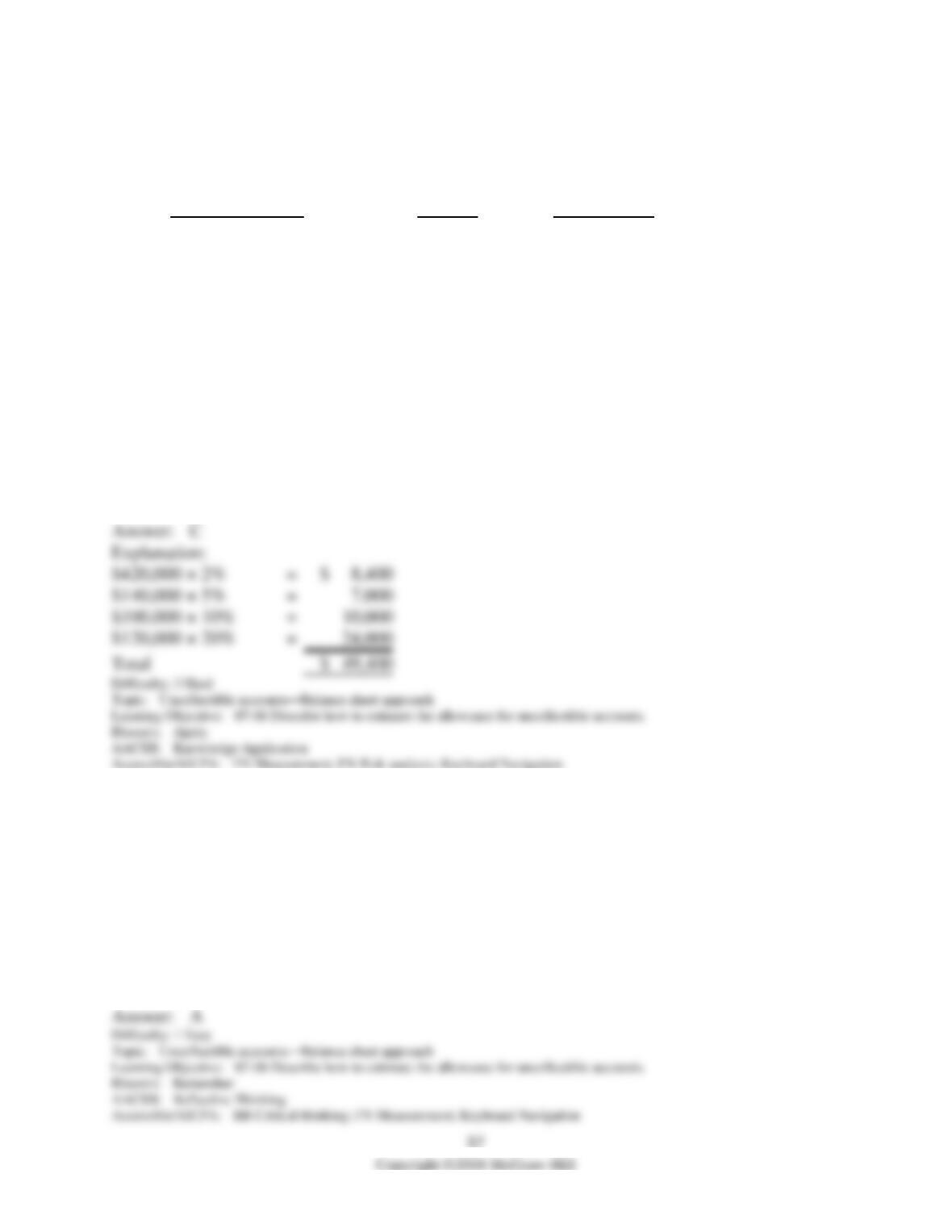
79) The following aging information pertains to Jacobsen Co.’s accounts receivable at December
31, 2018:
Days Outstanding
Amount
Estimated %
Uncollectible
0-30
$
420,000
2
%
31-60
140,000
5
%
61-120
100,000
10
%
Over 120
120,000
20
%
During 2018, Jacobsen wrote off $18,000 in receivables and recovered $6,000 that had been
written off in prior years. Jacobsen’s December 31, 2017, allowance for uncollectible accounts
was $40,000. Using the balance sheet approach, what amount of allowance for uncollectible
accounts should Jacobsen report at December 31, 2018?
A) $55,400.
B) $28,000.
C) $49,400.
D) $31,400.
$420,000 × 2%
8,400
$140,000 × 5%
7,000
$100,000 × 10%
10,000
$120,000 × 20%
24,000
Total
49,400
80) When you use an aging schedule approach for estimating uncollectible accounts:
A) Bad debts expense is measured indirectly, and the allowance for uncollectible accounts
balance is measured directly.
B) Bad debts expense is measured indirectly, and the allowance for uncollectible accounts
balance is measured indirectly.
C) Bad debts expense is measured directly, and the allowance for uncollectible accounts balance
is measured directly.
D) Bad debts expense is measured directly, and the allowance for uncollectible accounts balance
is measured indirectly.
81) Which of the following is recorded by a credit to accounts receivable?
A) Sale of inventory on account.
B) Estimating the annual allowance for uncollectible accounts.
C) Estimating annual sales returns.
D) Write-off of bad debts.
82) If a company uses the balance sheet approach to estimate bad debt expense, bad debt expense
for a period can be determined by:
A) Multiplying net credit sales by the bad debt experience ratio.
B) Adding the beginning balance in the allowance for uncollectible accounts to the provision for
uncollectible accounts and deducting the desired ending balance in the allowance for
uncollectible accounts.
C) Multiplying ending accounts receivable in each age category by the expected loss ratio for
each age category.
D) Taking the difference between the unadjusted balance in the allowance account and the
desired balance of the allowance account.
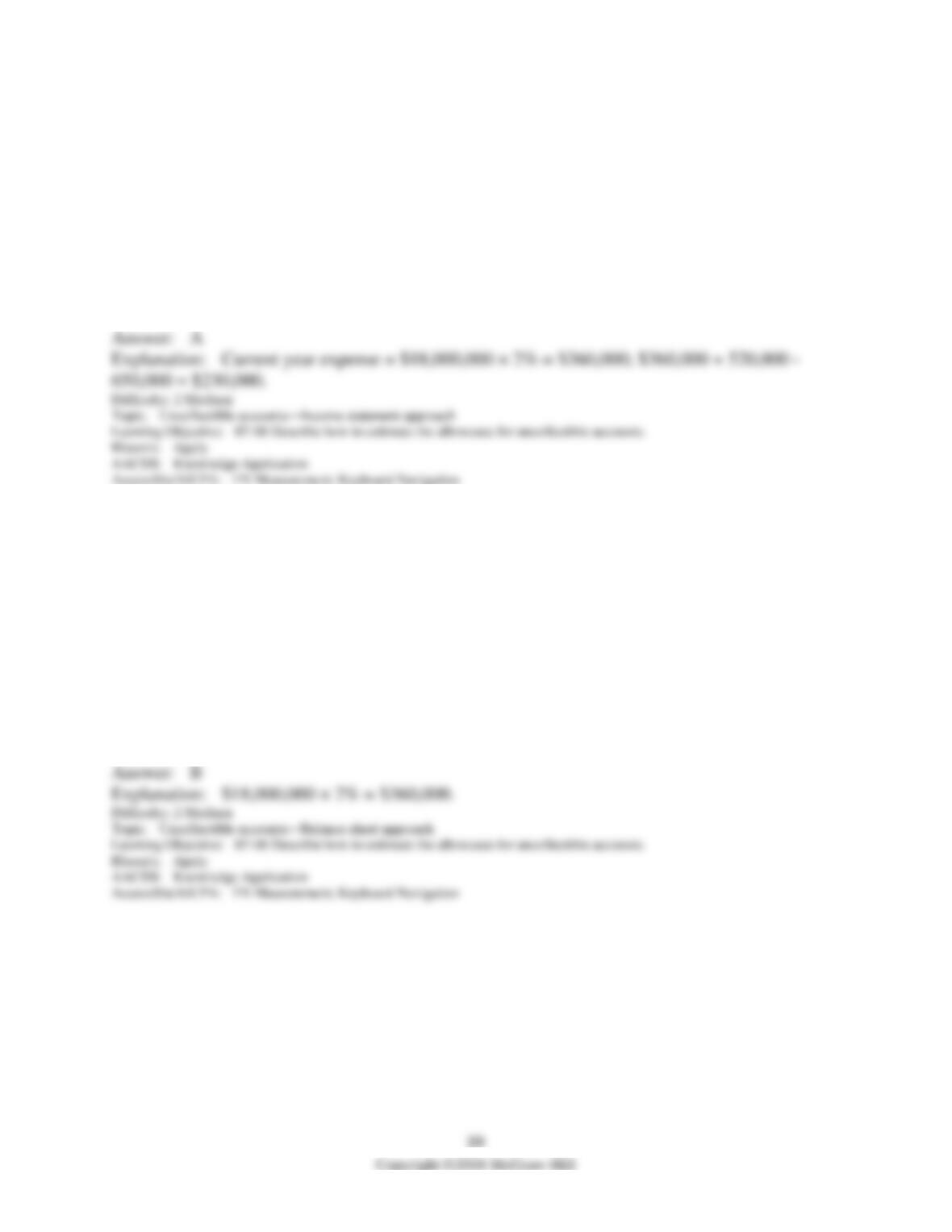
83) As of January 1, 2018, Farley Co. had a credit balance of $520,000 in its allowance for
uncollectible accounts. Based on experience, 2% of Farley’s credit sales have been uncollectible.
During 2018, Farley wrote off $650,000 of accounts receivable. Credit sales for 2018 were
$18,000,000. In its December 31, 2018, balance sheet, what amount should Farley report as
allowance for uncollectible accounts?
A) $230,000.
B) $360,000.
C) $590,000.
D) $880,000.
84) As of January 1, 2018, Barley Co. had a credit balance of $520,000 in its allowance for
uncollectible accounts. Based on experience, 2% of Farley’s gross accounts receivable have been
uncollectible. During 2018, Farley wrote off $650,000 of accounts receivable. Barley’s gross
accounts receivable as December 31, 2018 is $18,000,000.
In its December 31, 2018, balance sheet, what amount should Farley report as allowance for
uncollectible accounts?
A) $230,000.
B) $360,000.
C) $490,000.
D) $880,000.
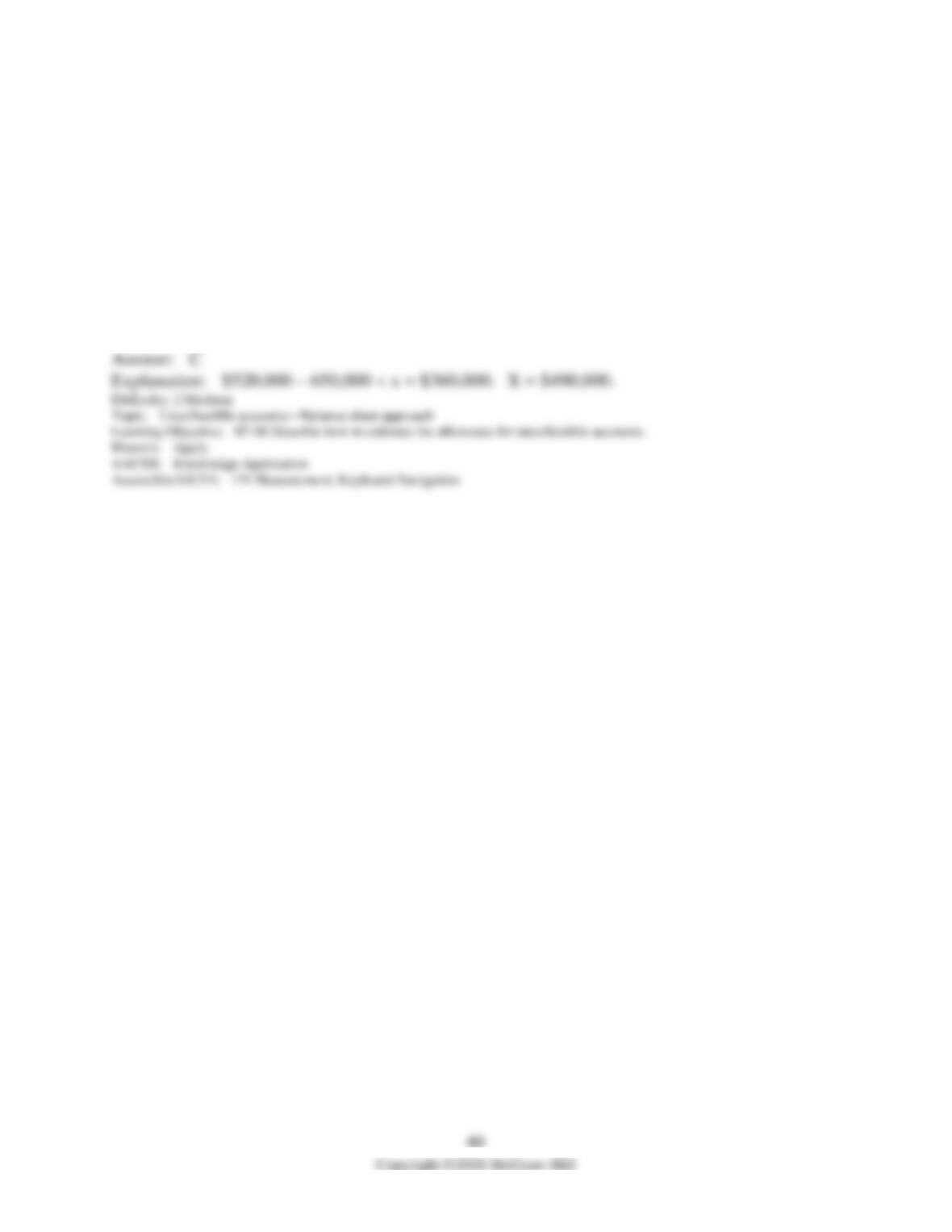
85) As of January 1, 2018, Barley Co. had a credit balance of $520,000 in its allowance for
uncollectible accounts. Based on experience, 2% of Farley’s gross accounts receivable have been
uncollectible. During 2018, Farley wrote off $650,000 of accounts receivable. Barley’s gross
accounts receivable as December 31, 2018 is $18,000,000.
How much bad debts expense should Barley record for 2018?
A) $230,000.
B) $360,000.
C) $490,000.
D) $880,000.