
Name:
Class:
Date:
chapter 7
Indicate whether the statement is true or false.
1. If ending inventory for the year is overstated, owner’s equity reported on the balance sheet at the end of the year is
understated.
a.
True
b.
False
2. One negative effect of carrying too much inventory is risk that customers will change their buying habits.
a.
True
b.
False
3. Use of the retail inventory method requires taking a physical count of inventory.
a.
True
b.
False
4. Under the periodic inventory system, a physical inventory is taken to determine the cost of the inventory on hand and
the cost of the merchandise sold.
a.
True
b.
False
5. Direct disposal costs do not include special advertising or sales commissions.
a.
True
b.
False
6. During periods of rapidly rising costs, the use of the LIFO method results in illusory or inventory profits.
a.
True
b.
False
7. “Market” as used in the phrase “lower of cost or market” for valuing inventory, refers to the price at which the
inventory is being offered for sale by its owner.
a.
True
b.
False
8. Safeguarding inventory and proper reporting of the inventory in the financial statements are the reasons for controlling
the inventory.
a.
True
b.
False
9. The use of the lower-of-cost-or-market method of inventory valuation increases net income for the period in which the
inventory replacement price declined.
a.
True
b.
False
10. During periods of increasing costs, an advantage of the LIFO inventory cost method is that it matches more recent
costs against current revenues.
a.
True

Name:
Class:
Date:
chapter 7
b.
False
11. Generally, the lower the days’ sales in inventory, the better.
a.
True
b.
False
12. A purchase order establishes an initial record of the receipt of the inventory.
a.
True
b.
False
13. During periods of increasing costs, the use of the FIFO method of costing inventory will yield an inventory amount for
the balance sheet that is higher than LIFO would produce.
a.
True
b.
False
14. The three inventory costing methods will normally each yield different amounts of net income.
a.
True
b.
False
15. A consignor who has goods out on consignment with an agent should include the goods in ending inventory even
though they are not in the possession of the consignor.
a.
True
b.
False
16. Average inventory is computed by adding the inventory at the beginning of the period to the inventory at the end of
the period and dividing by 2.
a.
True
b.
False
17. The lower-of-cost-or-market method of determining the value of ending inventory can be applied on an item-by-item
basis or to the total inventory.
a.
True
b.
False
18. A physical inventory should be taken at the end of every month.
a.
True
b.
False
19. Inventory errors, if not discovered, will self-correct within two years.
a.
True
b.
False
20. The choice of an inventory costing method has no significant impact on the financial statements.
a.
True
b.
False

Name:
Class:
Date:
chapter 7
21. A perpetual inventory system is an effective means of control over inventory.
a.
True
b.
False
22. During periods of increasing costs, the use of the FIFO method of costing inventory will result in a greater amount of
net income than would result from the use of the LIFO cost method.
a.
True
b.
False
23. The specific identification inventory method should be used when the inventory consists of identical, low-cost units
that are purchased and sold frequently.
a.
True
b.
False
24. When using the FIFO inventory costing method, the most recent costs are assigned to the cost of merchandise sold.
a.
True
b.
False
25. FIFO is the inventory costing method that follows the physical flow of the goods.
a.
True
b.
False
26. The weighted average cost method will always yield results between FIFO and LIFO.
a.
True
b.
False
27. If the perpetual inventory system is used, the merchandise inventory account is debited for purchases of merchandise.
a.
True
b.
False
28. It is not unusual for large companies to use different inventory costing methods for different segments of their
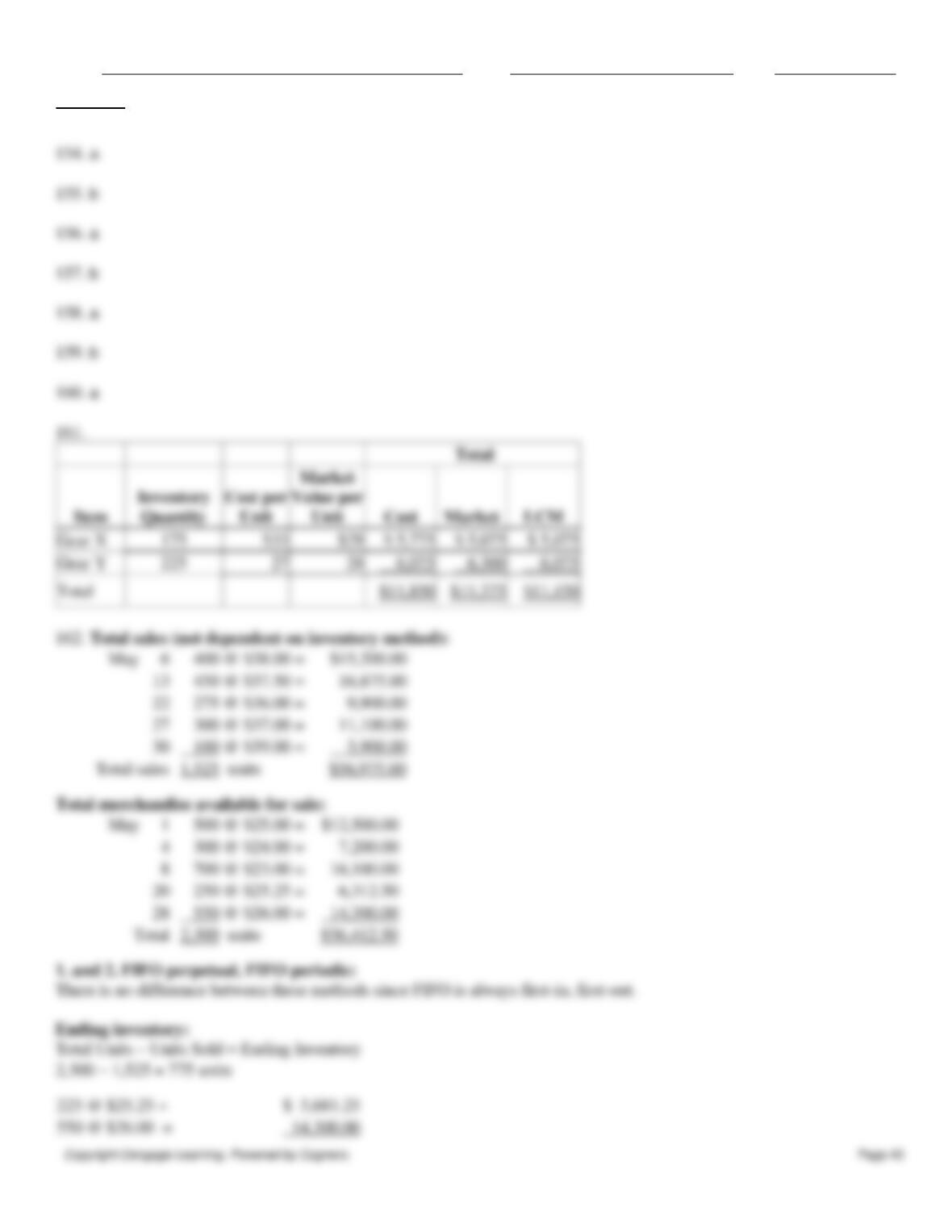
inventory.
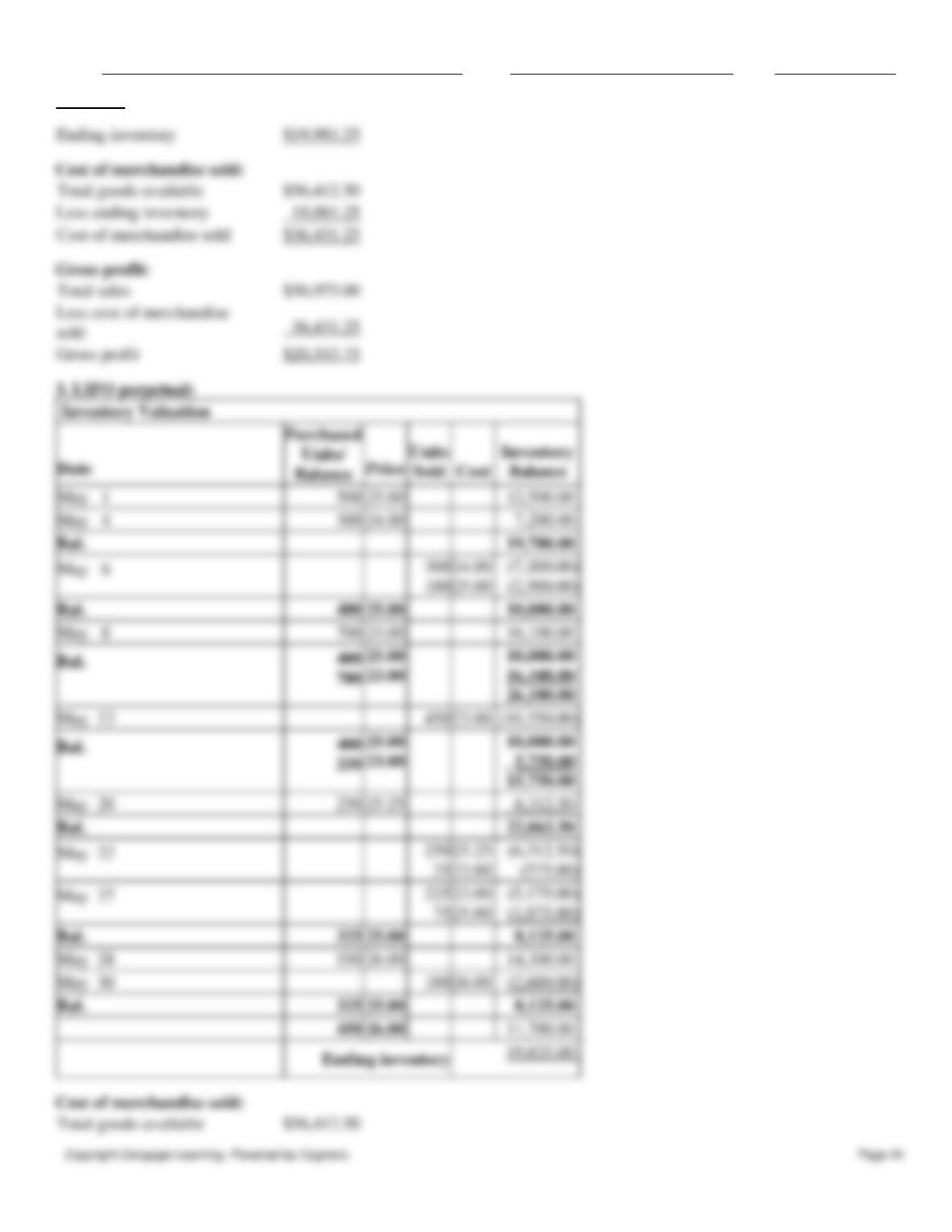
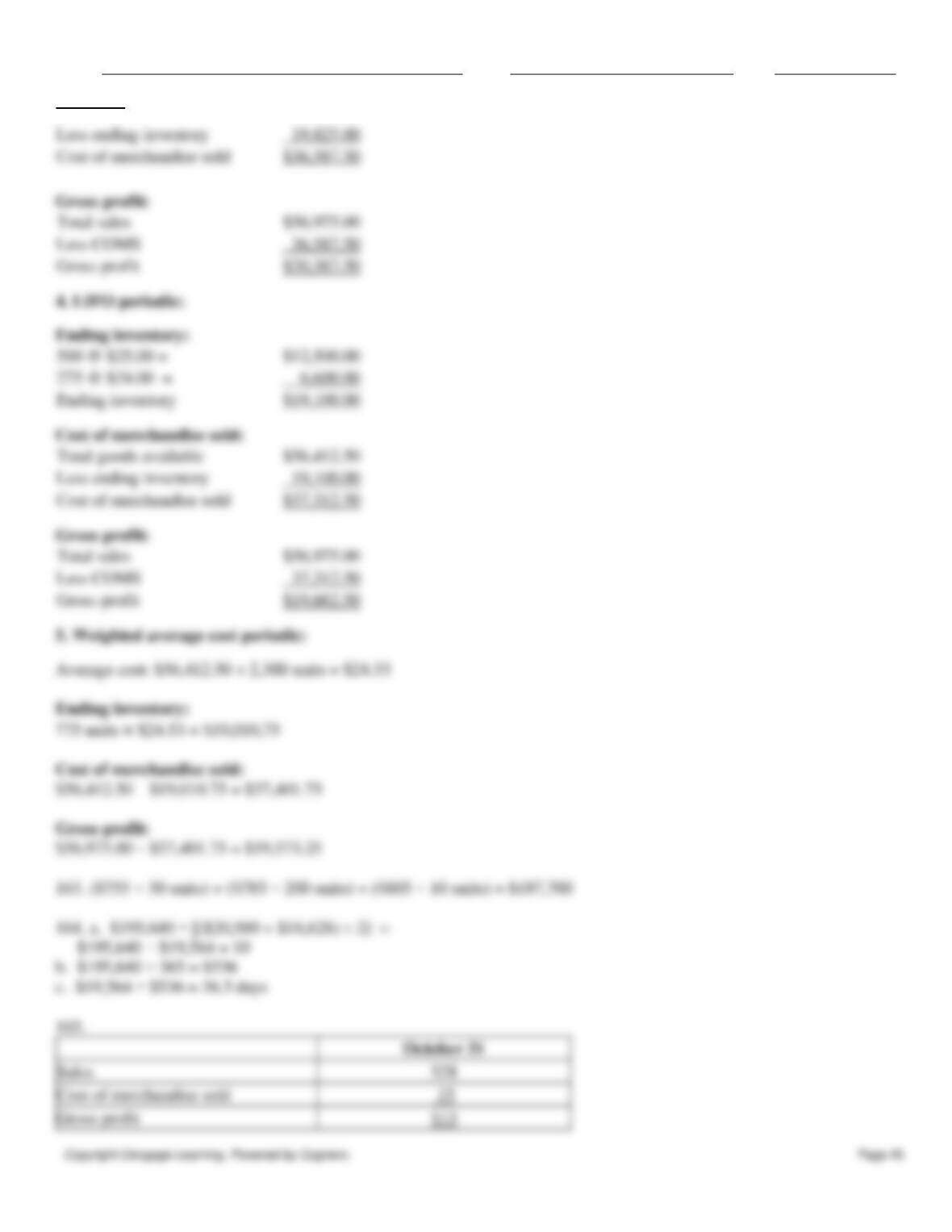
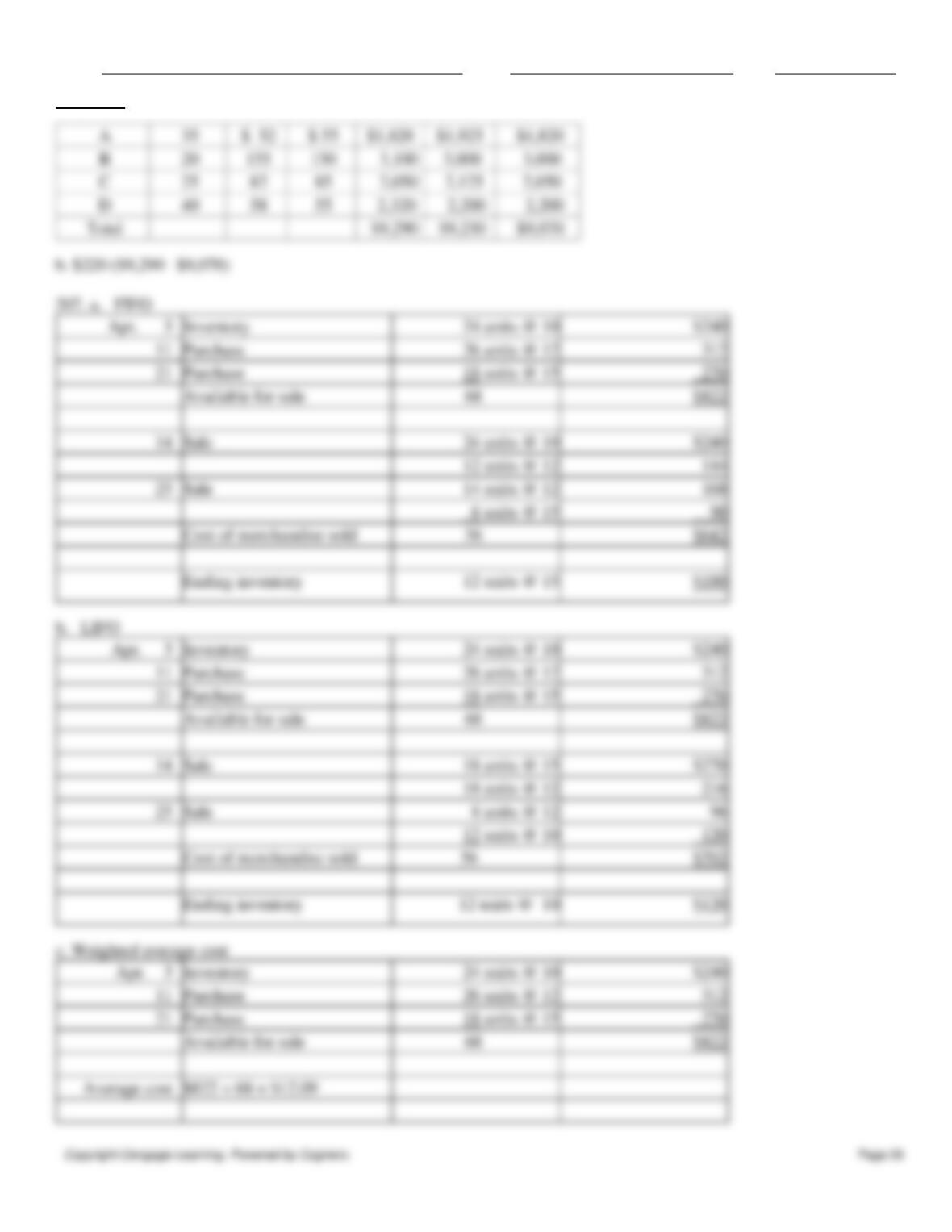
a.
True
b.
False
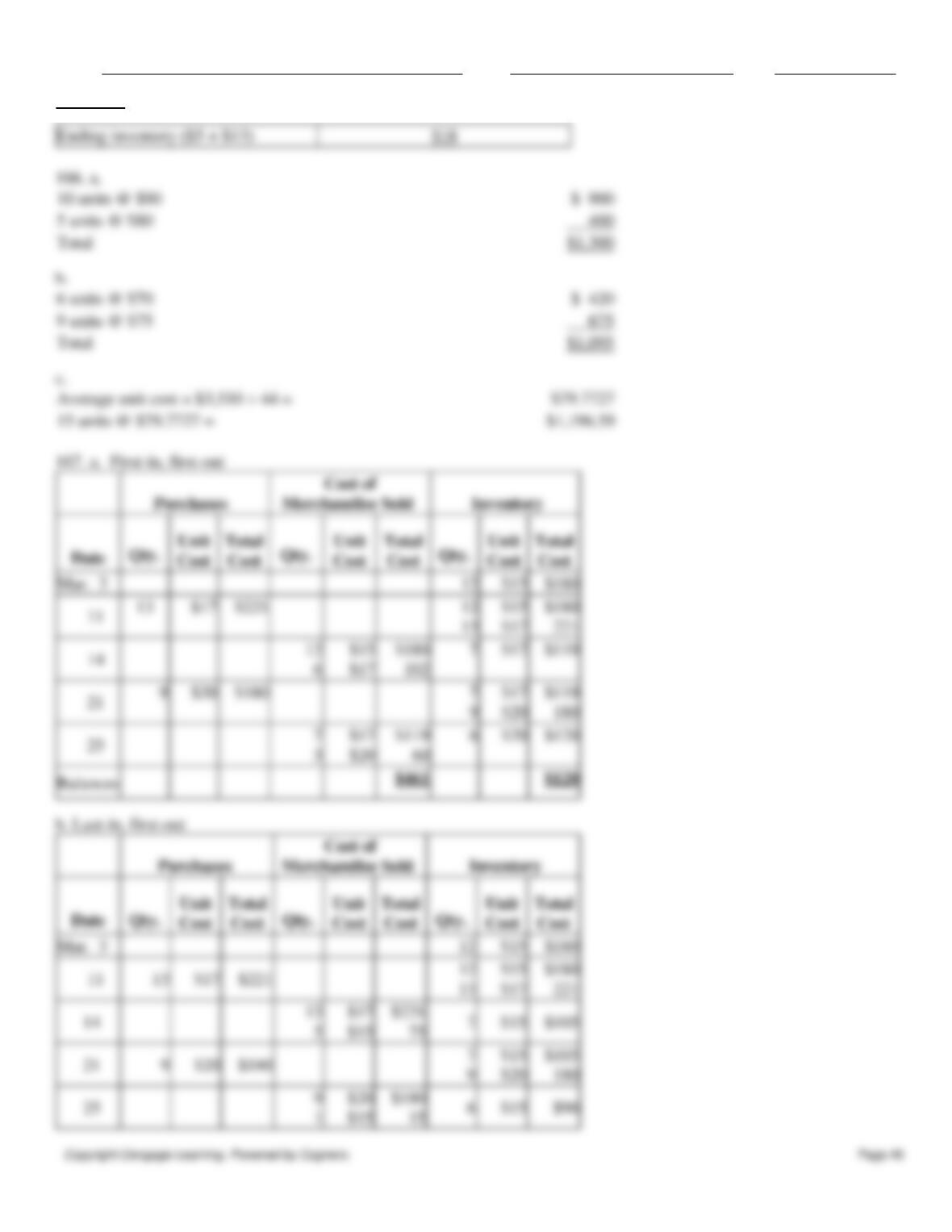
29. When merchandise inventory is shown on the balance sheet, both the method of determining the cost of the inventory
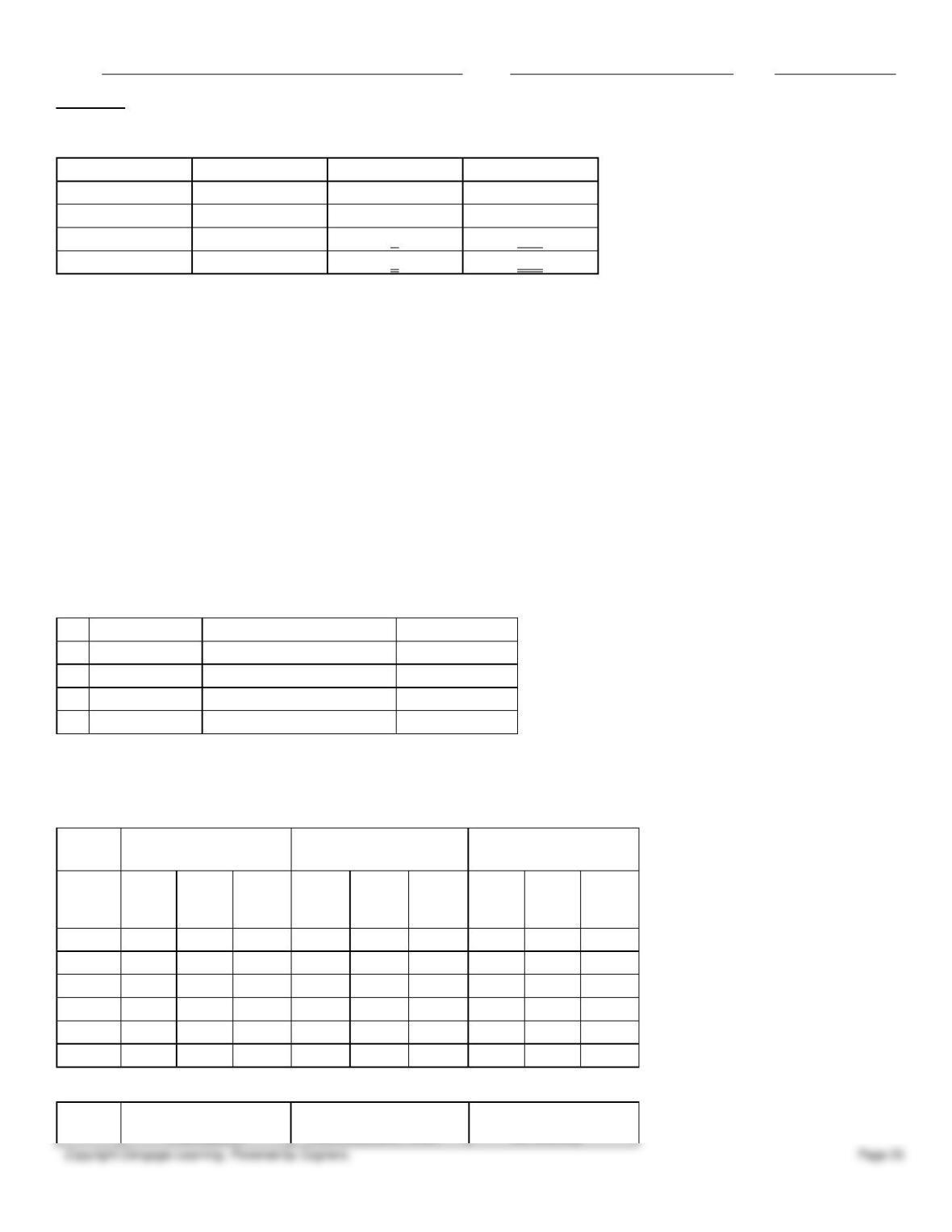
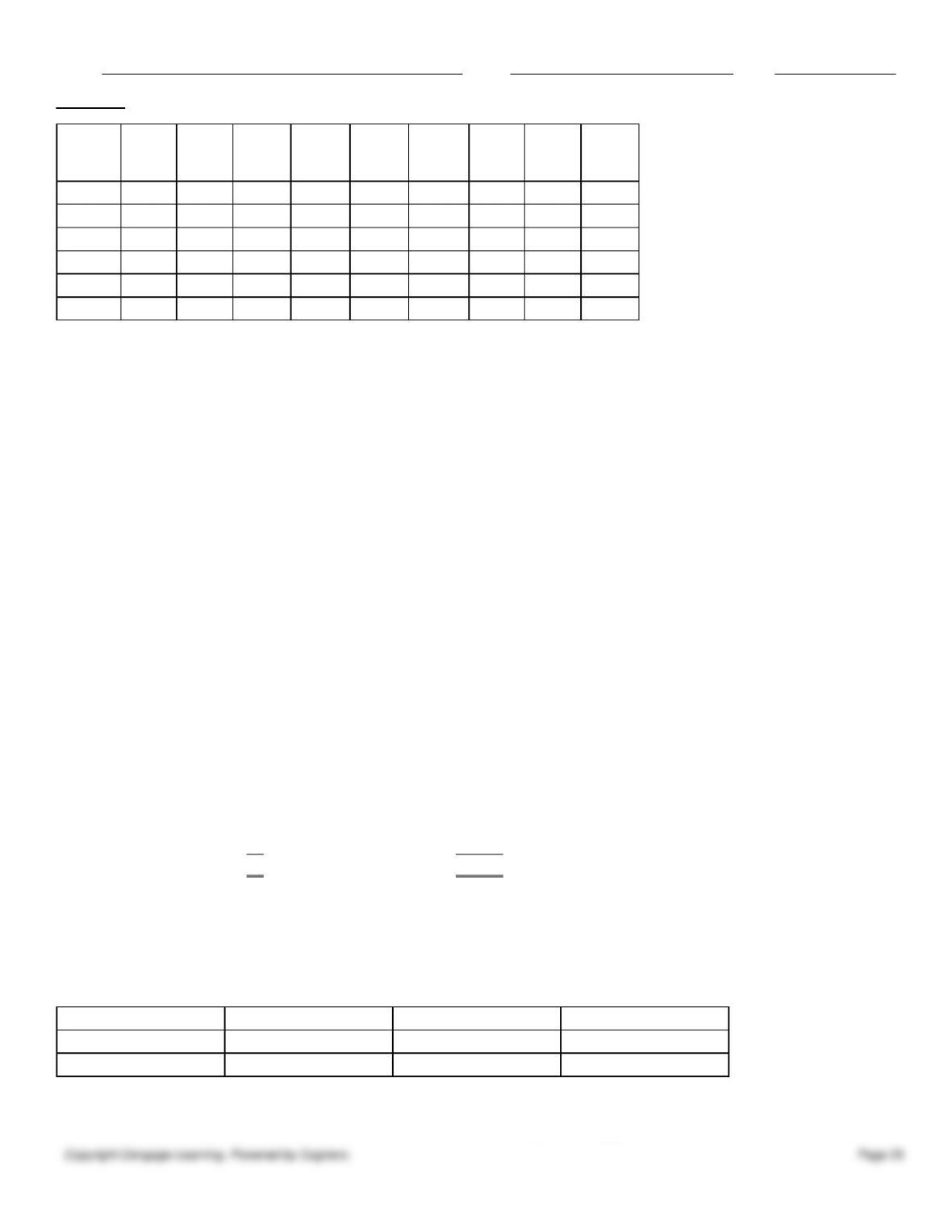
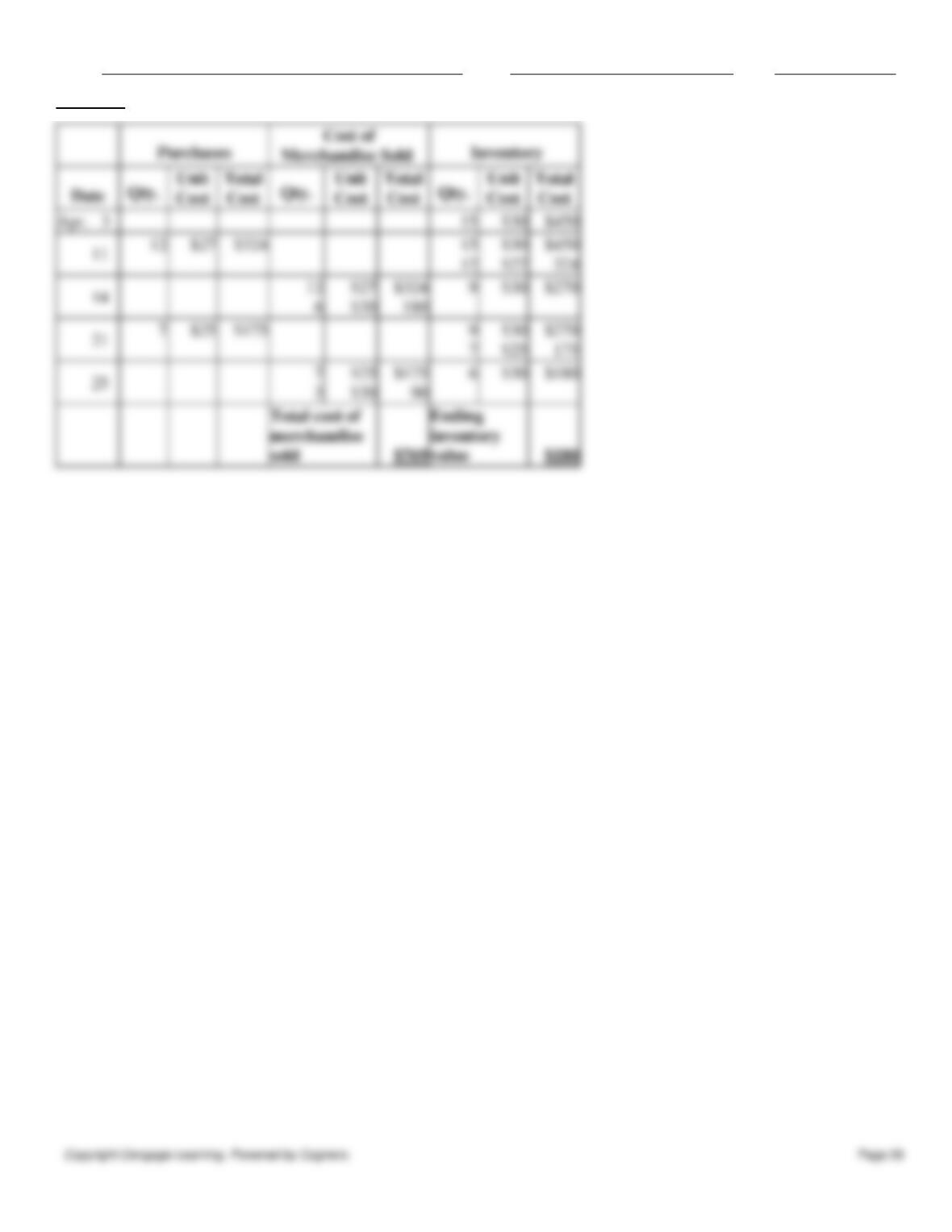
and the method of valuing the inventory should be shown.
a.
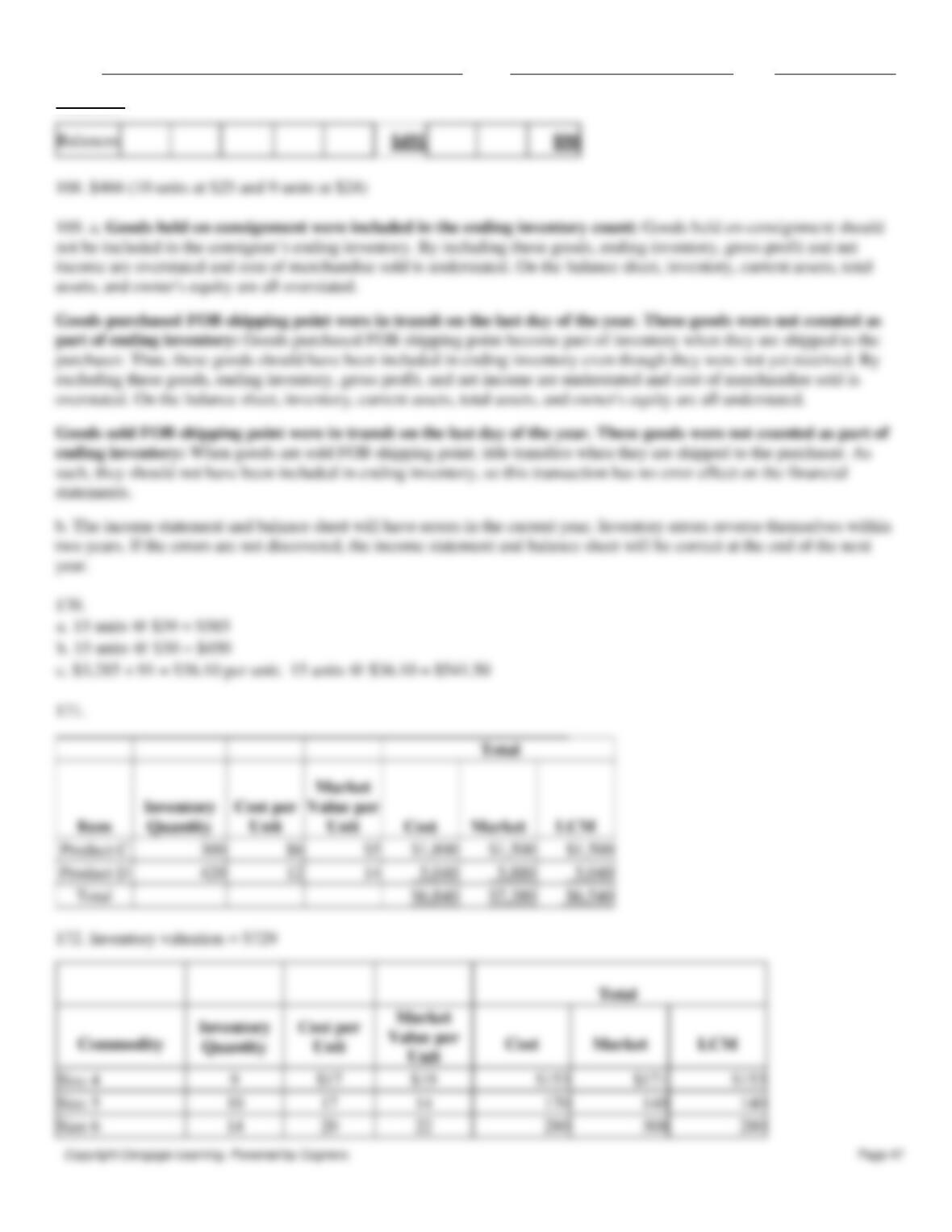
True
b.
False
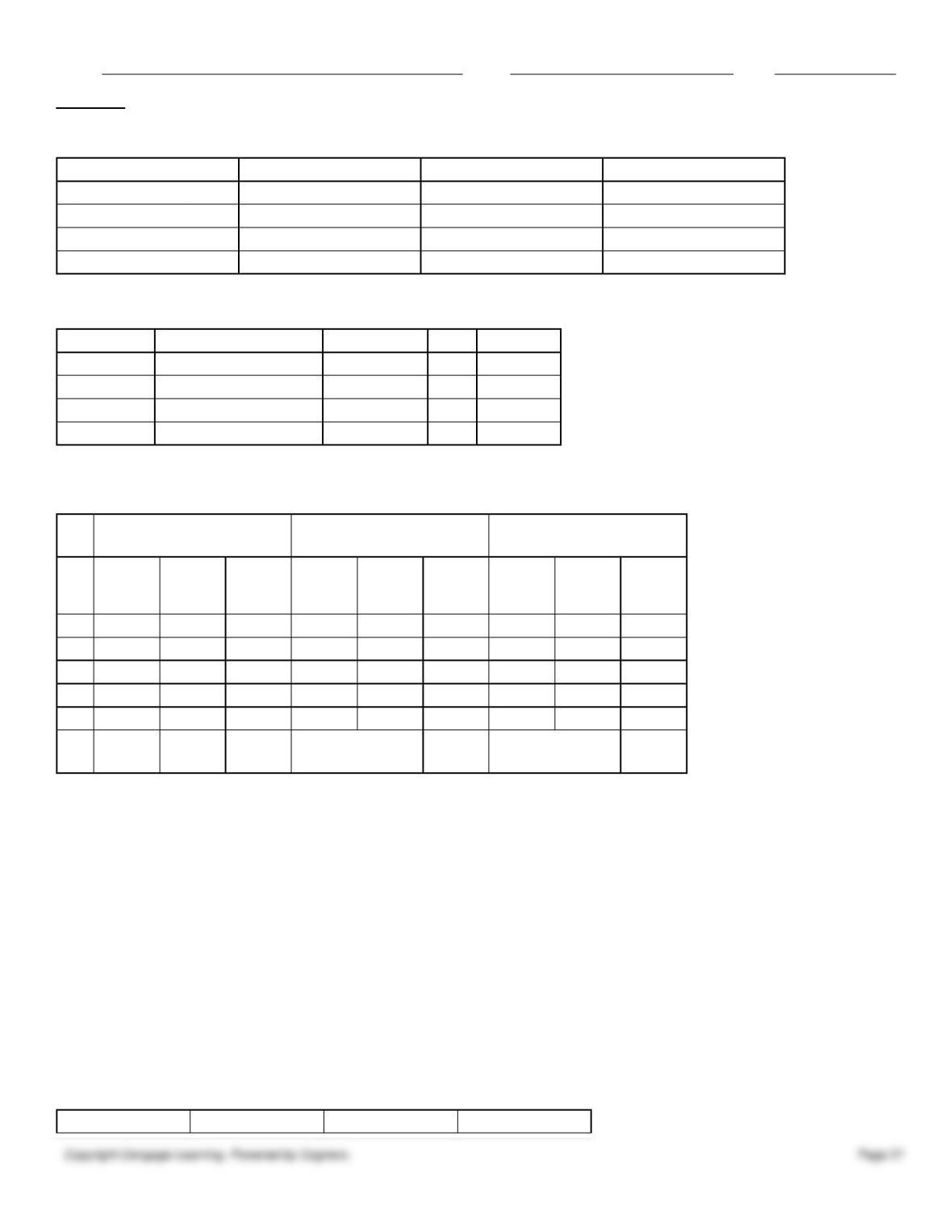
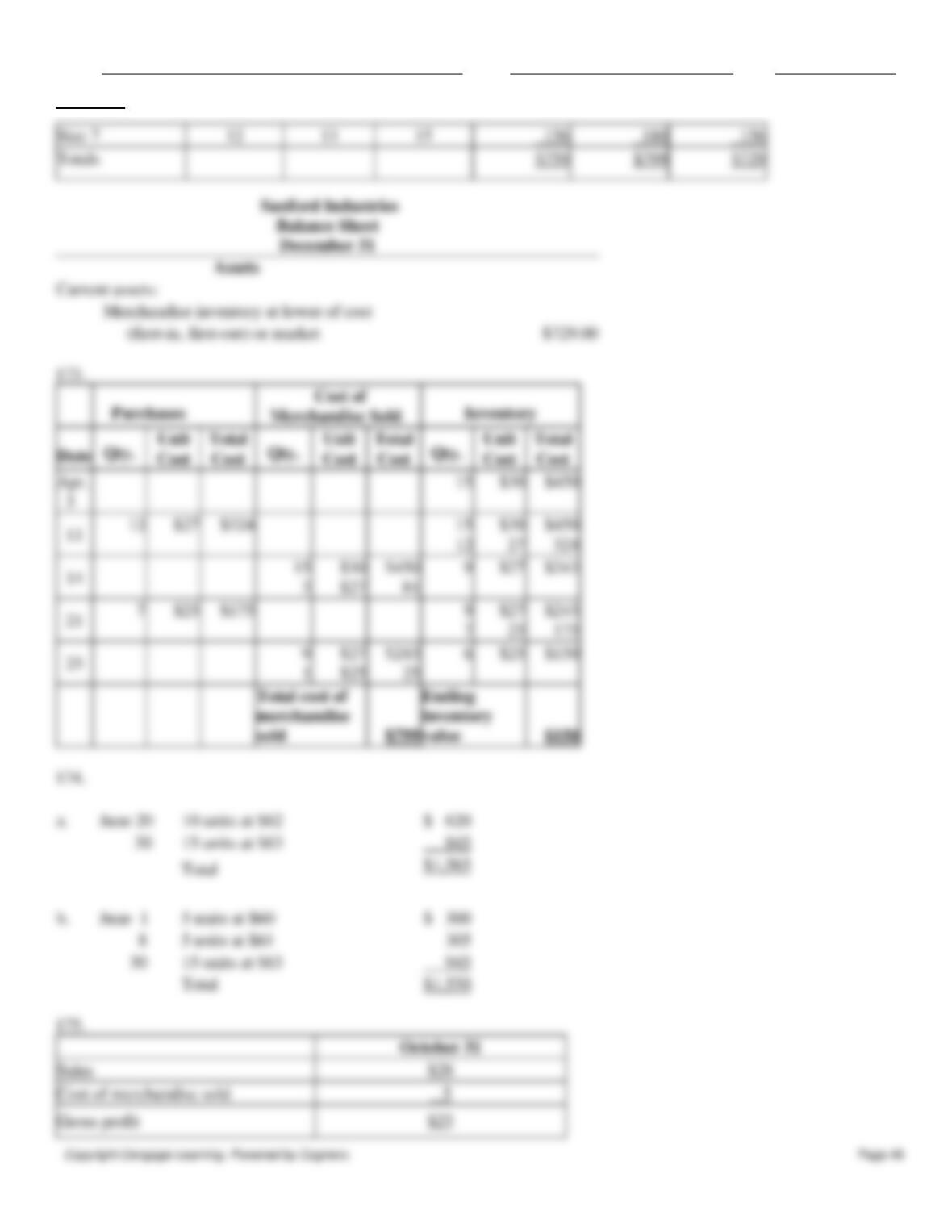
30. The lower of cost or market is a method of inventory valuation.
a.
True
b.
False
31. In the retail inventory method, the cost to retail ratio is equal to the cost of merchandise sold divided by the retail price
of the merchandise sold.

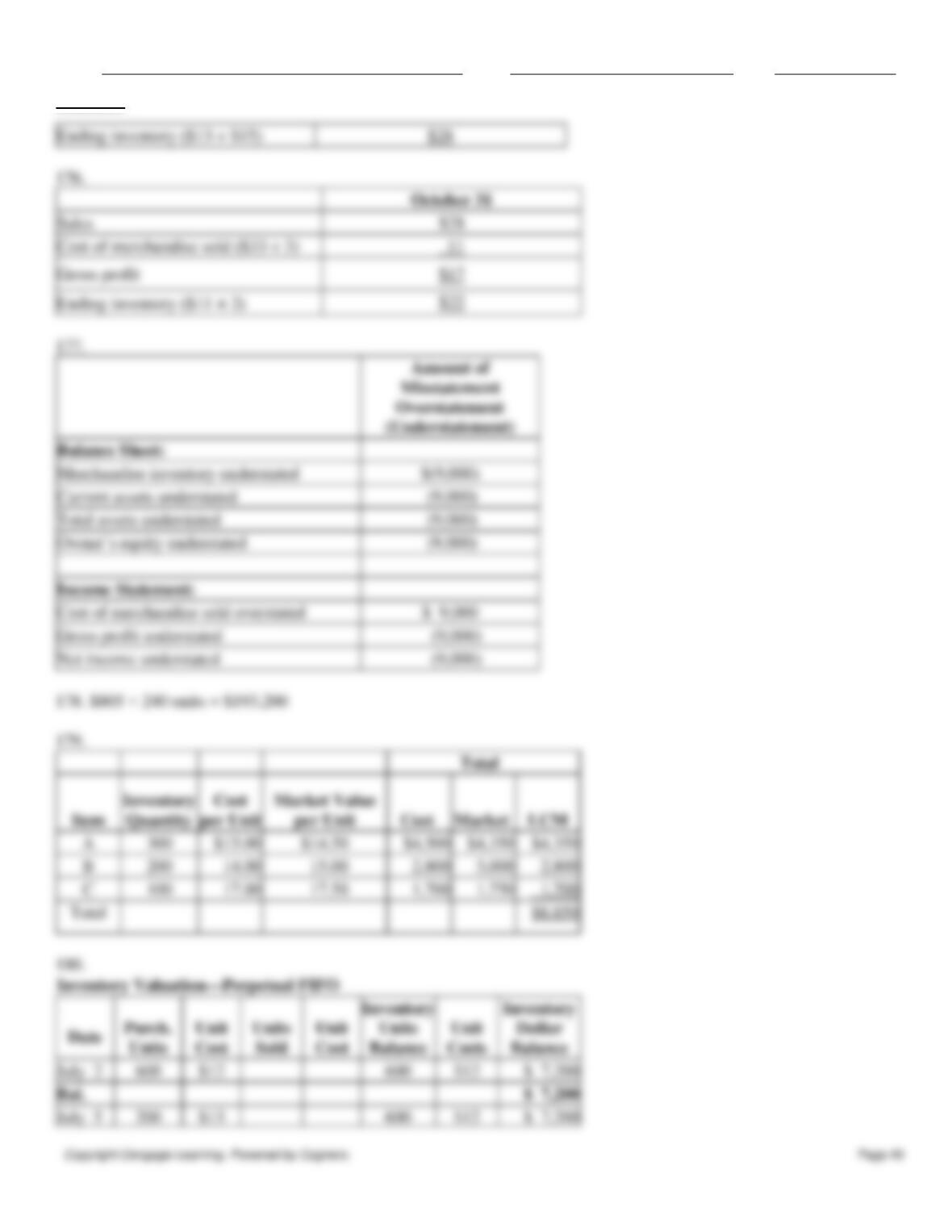
Name:
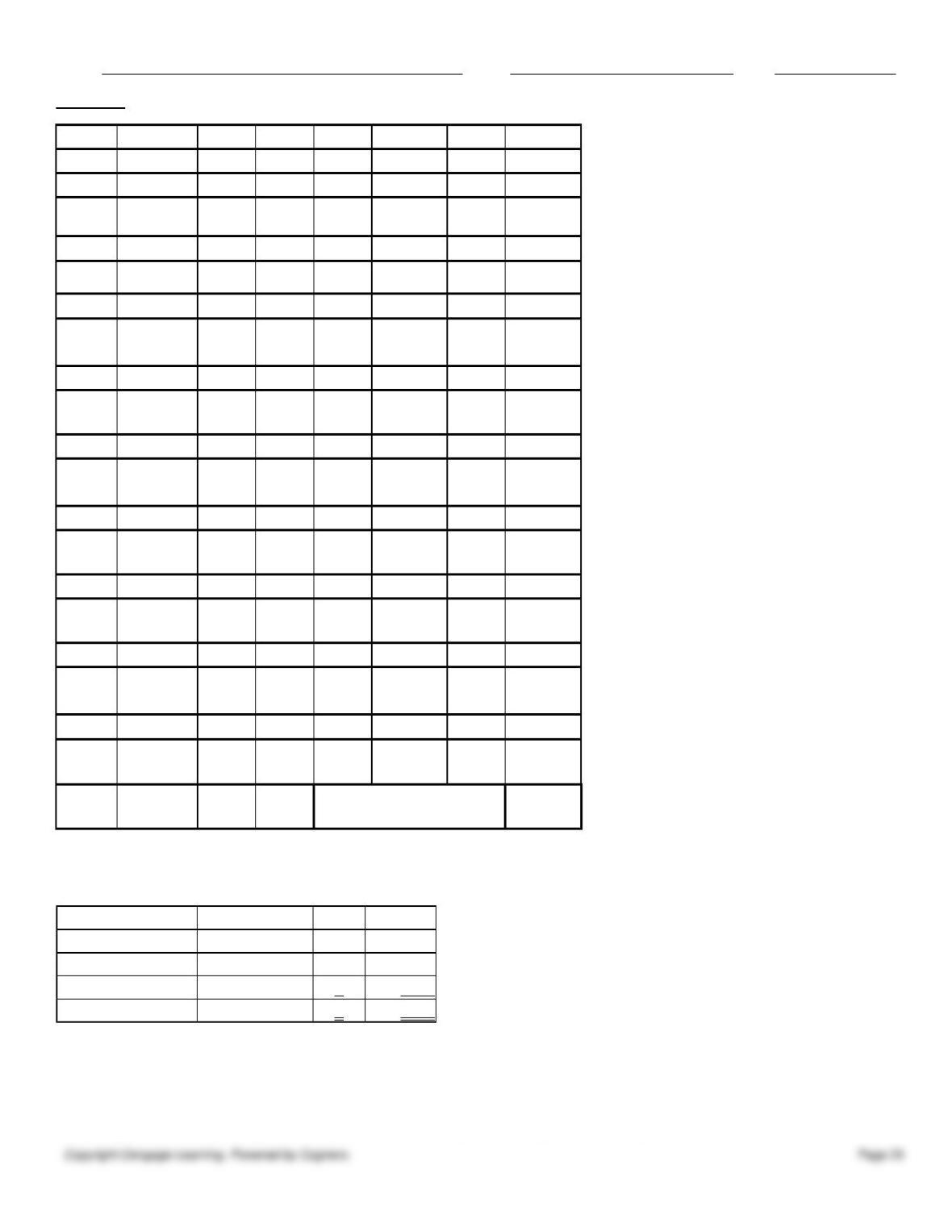
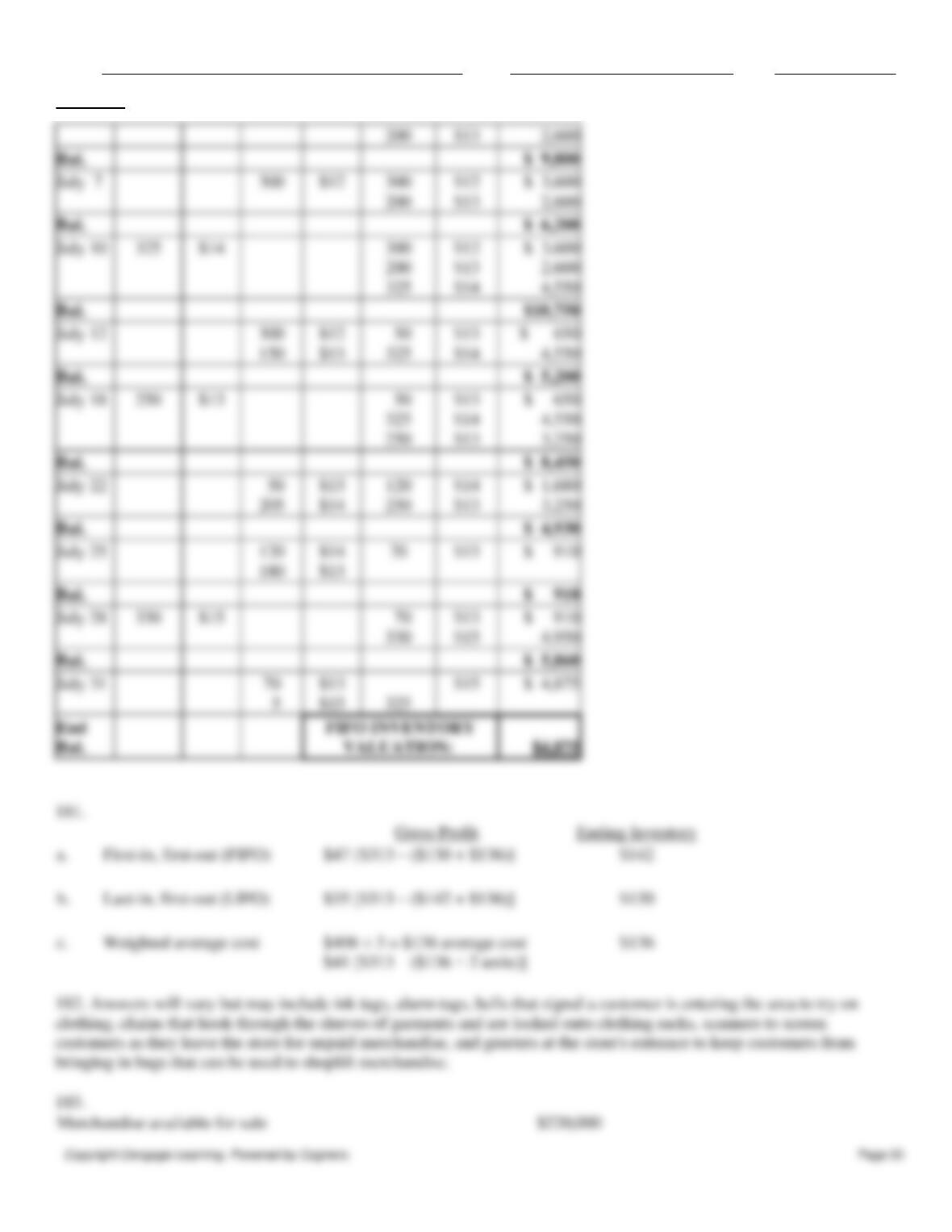
Class:
Date:
chapter 7
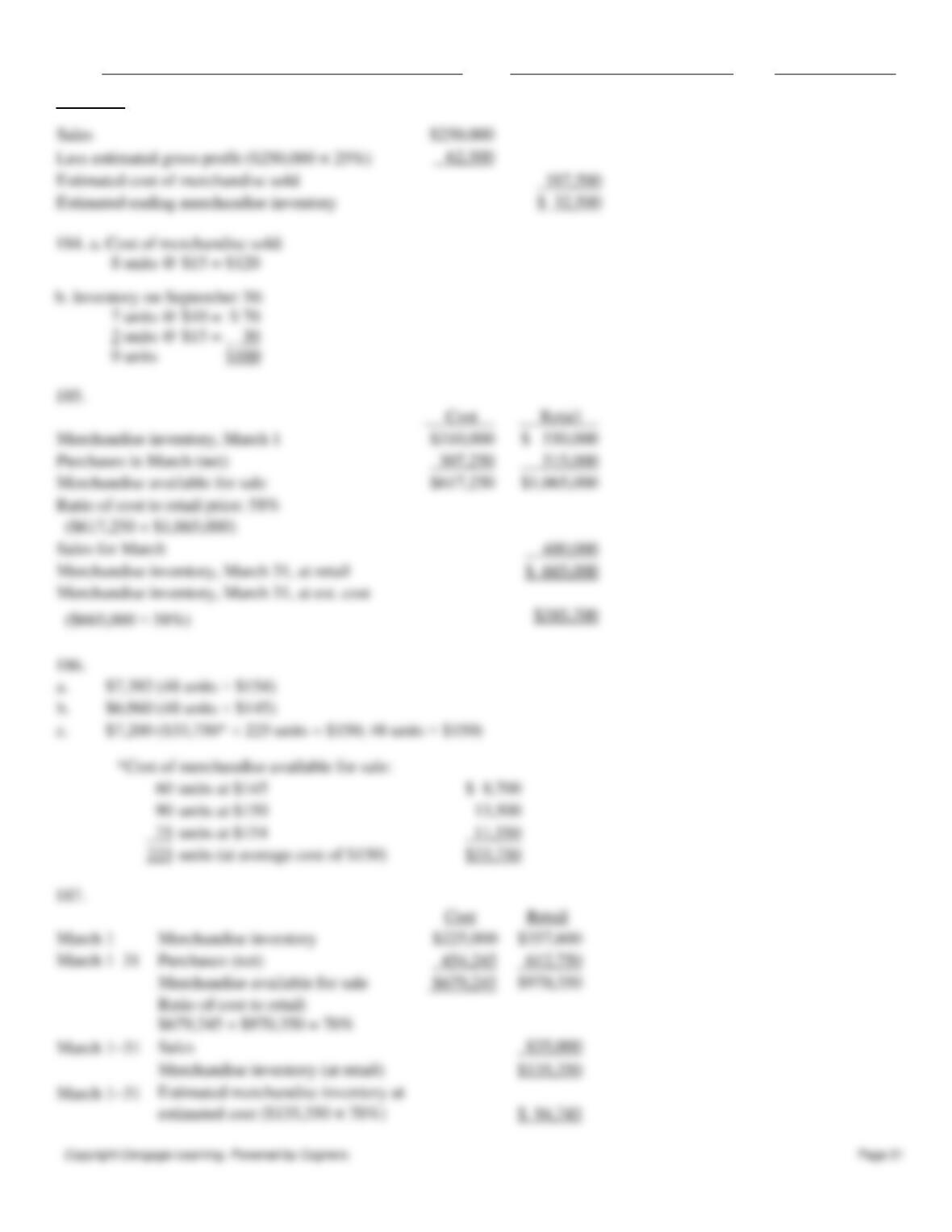
a.
True
b.
False
32. In valuing merchandise for inventory purposes, net realizable value is the estimated selling price less any direct costs
of disposal.
a.
True
b.
False
33. Under the LIFO inventory costing method, the most recent costs are assigned to ending inventory.
a.
True
b.
False
34. The weighted average inventory cost flow method is the least used of the inventory costing methods.
a.
True
b.
False
35. Of the three widely used inventory costing methods (FIFO, LIFO, and weighted average cost), the LIFO method of
costing inventory assumes costs are charged based on the most recent purchases first.
a.
True
b.
False
36. Inventory turnover measures the length of time it takes to acquire, sell, and replace the inventory.
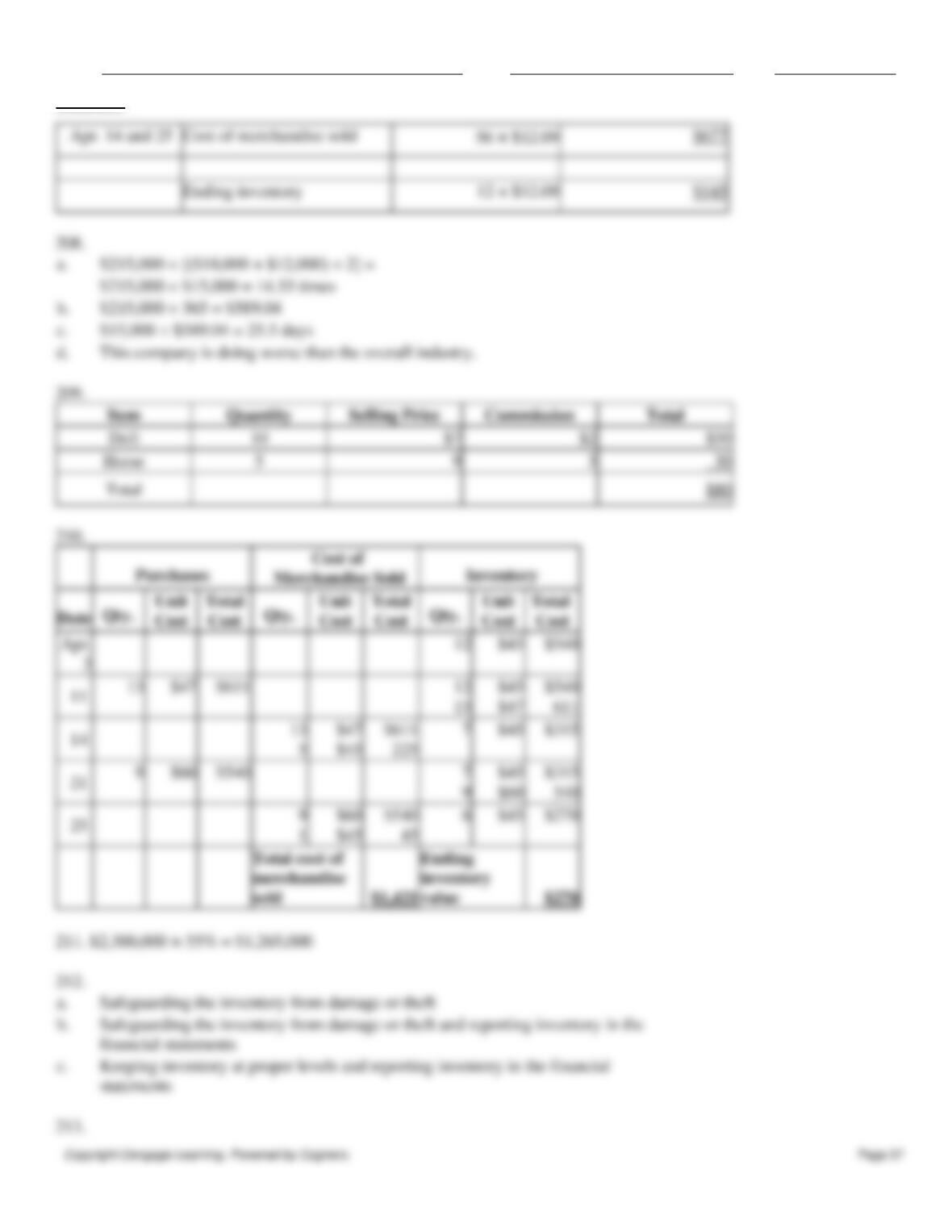
a.
True
b.
False
37. If ending inventory for the year is understated, net income for the year is overstated.
a.
True
b.
False
38. During periods of decreasing costs, the use of the LIFO method of costing inventory will result in a lower amount of
net income than would result from the use of the FIFO method.
a.
True
b.
False
39. Unsold consigned merchandise should be included in the consignee’s inventory.
a.
True
b.
False
40. Inventory controls start when the merchandise is shelved in the store area.
a.
True
b.
False
41. A subsidiary inventory ledger can be an aid in maintaining inventory quantities at their proper levels.
a.
True
b.
False

Name:
Class:
Date:
chapter 7
42. Under the periodic inventory system, the merchandise inventory account continuously discloses the amount of
inventory on hand.
a.
True
b.
False
43. If a fire destroys the merchandise inventory, the gross profit method can be used to estimate the cost of merchandise
destroyed.
a.
True
b.
False
44. If a company uses a periodic inventory system, the gross profit method can be used to estimate inventory for
monthly or quarterly statements.
a.
True
b.
False
45. One of the two primary objectives of internal control procedures over inventory is to properly report inventory on the
financial statements.
a.
True
b.
False
Indicate the answer choice that best completes the statement or answers the question.
46. For the year ended December 31, Depot Max’s cost of merchandise sold was $56,900. Inventory at the beginning of
the year was $6,540. Ending inventory was $7,250. Compute Depot Max’s inventory turnover for the year.
a.
8.7
b.
7.8
c.
8.3
d.
44.0
47. Ending inventory is made up of the oldest purchases when a company uses
a.
first-in, first-out
b.
last-in, first-out
c.
weighted average cost
d.
retail method
48. Control of inventory should begin as soon as the inventory is ordered. Which of the following internal control steps is
not done to meet this goal?
a.
check the invoice to the receiving report
b.
check the invoice to the purchase order
c.
check the invoice with the person who specifically purchased the item
d.
check the invoice for mathematical accuracy
49. Excess inventory results in all of the following except
a.
tied-up funds that could be used to improve operations
b.
lost sales
c.
increased storage expense
Name:
Class:
Date:
chapter 7
d.
increased risk of loss due to damage
Use this information to answer the following questions.
Boxwood Company sells blankets for $60 each. The following was taken from the inventory records during May. The
company had no beginning inventory on May 1.
Date
Blankets
Units
Cost
May 3
Purchase
5
$20
10
Sale
3
17
Purchase
10
24
20
Sale
6
23
Sale
3
30
Purchase
10
30
50. Assuming that the company uses the perpetual inventory system, determine the gross profit for the sale of May 23
using the FIFO inventory cost method.
a.
$108
b.
$120
c.
$72
d.
$180
51. The inventory data for an item for November are:
Nov. 1
Inventory
20 units at $19
4
Sale
10 units
10
Purchase
30 units at $20
17
Sale
20 units
30
Purchase
10 units at $21
Using a perpetual system, what is the cost of merchandise sold for November if the company uses LIFO?
a.
$610
b.
$600
c.
$590
d.
$580
52. The inventory costing method that reports the earliest costs in ending inventory is
a.
FIFO
b.
LIFO
c.
weighted average cost
d.
specific identification
53. During the taking of its physical inventory on December 31, Barry’s Bike Shop incorrectly counted its inventory as
$350,000 instead of the correct amount of $280,000. The effect on the balance sheet and income statement would be
a.
assets overstated by $70,000; retained earnings understated by $70,000; and net income statement understated
by $70,000
b.
assets overstated by $70,000; retained earnings understated by $70,000; and no effect on the income statement

Name:
Class:
Date:
chapter 7
c.
assets, retained earnings, and net income all overstated by $70,000
d.
assets and retained earnings overstated by $70,000 and net income understated by $70,000
54. When merchandise sold is assumed to be in the order in which the purchases were made, the company is using
a.
first-in, last-out
b.
last-in, first-out
c.
first-in, first-out
d.
weighted average cost
55. If the revenues are correctly reported and the gross profit of a company is understated, what is the effect on owner’s
equity?
a.
understated
b.
overstated
c.
correctly stated
d.
None of these choices
Use this information to answer the following questions.
These lots of a particular commodity were available for sale during the year:
Beginning inventory
5 units at $61
First purchase
15 units at $63
Second purchase
10 units at $74
Third purchase
10 units at $77
The firm uses the periodic system, and there are 20 units of the commodity on hand at the end of the year.
56. What is the amount of cost of merchandise sold for the year according to the FIFO method?
a.
$1,380
b.
$1,375
c.
$1,510
d.
$1,250
57. The inventory method that assigns the most recent costs to cost of merchandise sold is
a.
FIFO
b.
LIFO
c.
weighted average cost
d.
specific identification
58. Stevens Company started the year with an inventory cost of $145,000. During the month of January, Stevens
purchased inventory that cost $53,000. January sales totaled $140,000. Estimated gross profit is 35%. The estimated
ending inventory as of January 31 is
a.
$58,000
b.
$91,000
c.
$107,000
d.
$69,300

Name:
Class:
Date:
chapter 7
59. During a period of falling prices, which of the following inventory methods generally results in the lowest balance
sheet amount for inventory?
a.
weighted average cost method
b.
LIFO method
c.
FIFO method
d.
cannot tell without more information
Use this information to answer the following questions.
These lots of a particular commodity were available for sale during the year:
Beginning inventory
10 units at $30
First purchase
25 units at $32
Second purchase
30 units at $34
Third purchase
10 units at $35
60. The firm uses the periodic system, and there are 20 units of the commodity on hand at the end of the year. What is the
amount of inventory at the end of the year according to the FIFO method?
a.
$655
b.
$620
c.
$690
d.
$659
61. If the cost of an item of inventory is $60 and the current replacement cost is $75, the amount included in inventory
according to the lower-of-cost-or-market method is
a.
$15
b.
$60
c.
$75
d.
$135
62. Too much inventory on hand causes
a.
funds to be tied up that could be used to improve operations
b.
an increase to the cost of safeguarding assets
c.
an increase to the losses caused by price declines
d.
All of these choices
63. Which of the following methods is appropriate for a business whose inventory consists of a relatively small number of
unique, high-cost items?
a.
FIFO
b.
LIFO
c.
weighted average cost
d.
specific identification
64. Cost flow is in the order in which costs were incurred when using
a.
weighted average cost
b.
last-in, first-out

Name:
Class:
Date:
chapter 7
c.
first-in, first-out
d.
first-in, last-out
65. Which of the following is used to analyze the efficiency and effectiveness of inventory management?
a.
inventory turnover only
b.
days’ sales in inventory only
c.
both inventory turnover and days’ sales in inventory
d.
neither inventory turnover nor days’ sales in inventory
66. Determine the total value of the merchandise using net realizable value.
Item
Quantity
Selling Price
Commission
Doll
10
$7
$2
Horse
5
9
3
a.
$35
b.
$80
c.
$115
d.
$25
67. FIFO reports higher gross profit and net income than the LIFO method when
a.
prices are increasing
b.
prices are decreasing
c.
prices remain stable
d.
prices are reduced by 50%
68. Garrison Company uses the retail method of inventory costing. It started the year with an inventory that had a retail
cost of $45,000. During the year, Garrison purchased an inventory with a retail sales value of $300,000. After performing
a physical inventory, Garrison found the inventory at retail to be $80,000. The markup is 100% of cost. Determine the
ending inventory at its estimated cost.
a.
$160,000
b.
$80,000
c.
$40,000
d.
$45,000
69. If a manufacturer ships merchandise to a retailer on consignment, the unsold merchandise should be included in the
inventory of the
a.
consignee
b.
retailer
c.
manufacturer
d.
shipper
70. A company will most likely use an estimated method of determining inventory when
a.
the company decides not to do a physical inventory
b.
a natural disaster has destroyed most of the inventory
c.
the company has not kept up with its inventory records

Name:
Class:
Date:
chapter 7
d.
the company is preparing annual financial statements
71. On the basis of the following data, what is the estimated cost of the merchandise inventory on May 31 using the retail
method?
Cost
Retail
May 1
Merchandise inventory
$125,000
$166,667
May 1–31
Purchases
235,000
313,333
May 1–31
Sales
230,000
a.
$250,000
b.
$360,000
c.
$172,500
d.
$187,500
72. Which of the following measures the length of time it takes to acquire, sell, and replace inventory?
a.
inventory turnover
b.
days’ sales in inventory
c.
retail method of inventory costing
d.
gross profit method of inventory costing
73. If a company mistakenly counts more items during a physical inventory than actually exist, how will the error affect
its bottom line?
a.
There will be no change to net income.
b.
Net income will be overstated.
c.
Net income will be understated.
d.
Only gross profit will be affected.
74. Under a periodic inventory system
a.
accounting records continuously disclose the amount of inventory
b.
a separate account for each type of merchandise is maintained in a subsidiary ledger
c.
a physical inventory is taken at the end of the period
d.
Merchandise Inventory is debited when goods are returned to vendors
Use this information to answer the following questions.
These lots of a particular commodity were available for sale during the year:
Beginning inventory
10 units at $30
First purchase
25 units at $32
Second purchase
30 units at $34
Third purchase
10 units at $35
75. The firm uses the periodic system, and there are 20 units of the commodity on hand at the end of the year. What is the
amount of inventory at the end of the year according to the LIFO method?
a.
$655
b.
$620

Name:
Class:
Date:
chapter 7
c.
$690
d.
$659
Use this information to answer the following questions.
These lots of a particular commodity were available for sale during the year:
Beginning inventory
10 units at $60
First purchase
25 units at $65
Second purchase
30 units at $68
Third purchase
15 units at $75
The firm uses the periodic system, and there are 25 units of the commodity on hand at the end of the year.
76. What is the amount of inventory at the end of the year rounded to the nearest dollar using the weighted average cost
method?
a.
$1,685
b.
$1,575
c.
$1,805
d.
$3,705
77. Merchandise inventory at the end of the year was understated. Which of the following statements correctly states the
effect of the error?
a.
Net income is understated.
b.
Net income is overstated.
c.
Cost of merchandise sold is understated.
d.
Merchandise inventory reported on the balance sheet is overstated.
Use this information to answer the following questions.
The following units of an inventory item were available for sale during the year:
Beginning inventory
10 units at $55
First purchase
25 units at $60
Second purchase
30 units at $65
Third purchase
15 units at $70
The firm uses the periodic inventory system. During the year, 60 units of the item were sold.
78. The value of ending inventory using LIFO is
a.
$1,250
b.
$1,350
c.
$1,375
d.
$1,150
79. Damaged merchandise that can be sold only at prices below cost should be valued at
a.
net realizable value
b.
LIFO

Name:
Class:
Date:
chapter 7
c.
FIFO
d.
weighted average cost
Use this information to answer the following questions.
The following units of an inventory item were available for sale during the year:
Beginning inventory
10 units at $55
First purchase
25 units at $60
Second purchase
30 units at $65
Third purchase
15 units at $70
The firm uses the periodic inventory system. During the year, 60 units of the item were sold.
80. The value of ending inventory rounded to the nearest dollar using the weighted average cost method is
a.
$1,353
b.
$1,263
c.
$1,375
d.
$1,150
Use this information to answer the following questions.
These lots of a particular commodity were available for sale during the year:
Beginning inventory
10 units at $60
First purchase
25 units at $65
Second purchase
30 units at $68
Third purchase
15 units at $75
The firm uses the periodic system, and there are 25 units of the commodity on hand at the end of the year.
81. What is the amount of inventory at the end of the year using the FIFO method?
a.
$1,685
b.
$1,575
c.
$1,805
d.
$3,585
82. If merchandise inventory is being valued at cost and the price level is steadily rising, the method of costing that will
yield the highest net income is
a.
periodic
b.
LIFO
c.
FIFO
d.
weighted average cost
83. If a company mistakenly counts less items during a physical inventory than actually exist, how will the error affect the
cost of merchandise sold?
a.
understated
b.
overstated

Name:
Class:
Date:
chapter 7
c.
no change
d.
only inventory will be affected
84. When using a perpetual inventory system, the journal entry for the cost of merchandise sold is
a.
debit Cost of Merchandise Sold; credit Sales
b.
debit Cost of Merchandise Sold; credit Merchandise Inventory
c.
debit Merchandise Inventory; credit Cost of Merchandise Sold
d.
No journal entry is necessary for the cost of merchandise sold.
Addison, Inc. uses a perpetual inventory system. The following is information about one inventory item for the month of
September:
Sept. 1
Inventory
20 units at $20
4
Sale
10 units
10
Purchase
30 units at $25
17
Sale
20 units
30
Purchase
10 units at $30
85. If Addison uses FIFO, the cost of the ending merchandise inventory on September 30 is
a.
$800
b.
$650
c.
$750
d.
$700
86. All of the following are reasons to use an estimated method of costing inventory except
a.
perpetual inventory records are not maintained
b.
purchase records are not maintained
c.
a disaster has destroyed the inventory records and the inventory
d.
interim financial statements are required but physical inventory is only taken at the end of the financial
accounting period
87. Which of the following is not an example of safeguarding inventory?
a.
storing inventory in restricted areas
b.
using physical devices such as two-way mirrors, cameras, and alarms
c.
matching receiving documents, purchase orders, and vendor’s invoice
d.
returning inventory that is defective or broken
Use this information to answer the following questions.
These lots of a particular commodity were available for sale during the year:
Beginning inventory
10 units at $60
First purchase
25 units at $65
Second purchase
30 units at $68
Third purchase
15 units at $75
The firm uses the periodic system, and there are 25 units of the commodity on hand at the end of the year.

Name:
Class:
Date:
chapter 7
88. What is the amount of inventory at the end of the year using the LIFO method?
a.
$1,685
b.
$1,575
c.
$1,805
d.
$3,815
89. The inventory costing method that reports the most current prices in ending inventory is
a.
FIFO
b.
specific identification
c.
LIFO
d.
weighted average cost
90. All of the following are documents used for inventory control except a
a.
petty cash voucher
b.
vendor’s invoice
c.
receiving report
d.
purchase order
91. If the estimated rate of gross profit is 30%, what is the estimated cost of the merchandise inventory on September 30,
based on the following data?
Sept. 1
Merchandise inventory (at cost)
$125,000
Sept. 1–30
Purchases, net (at cost)
300,000
Sept. 1–30
Sales
150,000
a.
$320,000
b.
$192,500
c.
$275,000
d.
$105,000
92. If merchandise inventory is being valued at cost and the purchase price is steadily falling, which method of costing
will yield the largest net income?
a.
specific identification
b.
LIFO
c.
FIFO
d.
weighted average cost
93. Taking a physical count of inventory
a.
is not necessary when a periodic inventory system is used
b.
should be done near year-end
c.
has no internal control relevance
d.
is not necessary when a perpetual inventory system is used
94. During times of rising prices, which of the following is not an accurate statement?
a.
Weighted average costing will yield results that are between those of FIFO and LIFO.

Name:
Class:
Date:
chapter 7
b.
LIFO will result in a higher cost of merchandise sold than FIFO.
c.
FIFO will result in a higher net income than LIFO.
d.
LIFO will result in higher income taxes than FIFO.
95. The inventory data for an item for November are:
Nov. 1
Inventory
20 units at $19
4
Sale
10 units
10
Purchase
30 units at $20
17
Sale
20 units
30
Purchase
10 units at $21
Using a perpetual system, what is the cost of merchandise sold for November if the company uses FIFO?
a.
$610
b.
$600
c.
$590
d.
$580
96. During a period of consistently rising prices, the method of inventory that will result in reporting the greatest cost of
merchandise sold is
a.
FIFO
b.
LIFO
c.
specific identification
d.
weighted average cost
Use this information to answer the following questions.
Boxwood Company sells blankets for $60 each. The following was taken from the inventory records during May. The
company had no beginning inventory on May 1.
Date
Blankets
Units
Cost
May 3
Purchase
5
$20
10
Sale
3
17
Purchase
10
24
20
Sale
6
23
Sale
3
30
Purchase
10
30
97. Assuming that the company uses the perpetual inventory system, determine the gross profit for the month of May
using the LIFO cost method.
a.
$348
b.
$452
c.
$444
d.
$356
Use this information to answer the following questions.

Name:
Class:
Date:
chapter 7
These lots of a particular commodity were available for sale during the year:
Beginning inventory
10 units at $30
First purchase
25 units at $32
Second purchase
30 units at $34
Third purchase
10 units at $35
98. The firm uses the periodic system, and there are 20 units of the commodity on hand at the end of the year. What is the
amount of inventory at the end of the year rounded to the nearest dollar according to the weighted average cost method?
a.
$655
b.
$620
c.
$690
d.
$659
Use this information to answer the following questions.
Boxwood Company sells blankets for $60 each. The following was taken from the inventory records during May. The
company had no beginning inventory on May 1.
Date
Blankets
Units
Cost
May 3
Purchase
5
$20
10
Sale
3
17
Purchase
10
24
20
Sale
6
23
Sale
3
30
Purchase
10
30
99. Assuming that the company uses the perpetual inventory system, determine the ending inventory for the month of
May using the LIFO inventory cost method.
a.
$324
b.
$372
c.
$320
d.
$364
100. Assuming that the company uses the perpetual inventory system, determine the cost of merchandise sold for the sale
of May 20 using the FIFO inventory cost method.
a.
$120
b.
$180
c.
$136
d.
$144
101. Which document authorizes the purchase of inventory from an approved vendor?
a.
purchase order
b.
petty cash voucher
c.
receiving report
d.
vendor’s invoice

Name:
Class:
Date:
chapter 7
102. Which document establishes an initial record of the receipt of inventory?
a.
receiving report
b.
vendor’s invoice
c.
purchase order
d.
petty cash voucher
103. The primary objectives of control over inventory are
a.
safeguarding the inventory from damage and maintaining constant observation of the inventory
b.
reporting inventory in the financial statements and taking a physical inventory
c.
maintaining constant observation of the inventory and reporting inventory in the financial statements
d.
safeguarding inventory from damage and reporting inventory in the financial statements
Addison, Inc. uses a perpetual inventory system. The following is information about one inventory item for the month of
September:
Sept. 1
Inventory
20 units at $20
4
Sale
10 units
10
Purchase
30 units at $25
17
Sale
20 units
30
Purchase
10 units at $30
104. Use the information for Addison, Inc. If Addison uses LIFO, the cost of the ending merchandise inventory on
September 30 is
a.
$800
b.
$650
c.
$750
d.
$700
105. Which of the following will be the same amount regardless of the cost flow assumption adopted?
a.
number of items ordered
b.
gross profit
c.
cost of merchandise sold
d.
ending merchandise inventory
106. If a company values inventory at the lower of cost or market, which of the following is the value of merchandise
inventory on the balance sheet? Apply the lower-of-cost-or-market method to inventory as a whole.
Item
Inventory Quantity
Unit Cost Price
Unit Market Price
Product C
420
$ 6
$ 5
Product D
370
12
14
a.
$6,960
b.
$7,700
c.
$6,540
d.
$7,280

Name:
Class:
Date:
chapter 7
107. For the year ended December 31, Depot Max’s cost of merchandise sold was $56,900. Inventory at the beginning of
the year was $6,540. Ending inventory was $7,250. Depot Max’s days’ sales in inventory is closest to
a.
42
b.
46
c.
8
d.
44
108. Merchandise inventory at the end of the year was inadvertently overstated. Which of the following statements
correctly states the effect of the error on net income, assets, and owner’s equity?
a.
Net income is overstated, assets are overstated, and owner’s equity is understated.
b.
Net income is overstated, assets are overstated, and owner’s equity is overstated.
c.
Net income is understated, assets are understated, and owner’s equity is understated.
d.
Net income is understated, assets are understated, and owner’s equity is overstated.
Use this information to answer the following questions.
The following units of an inventory item were available for sale during the year:
Beginning inventory
10 units at $55
First purchase
25 units at $60
Second purchase
30 units at $65
Third purchase
15 units at $70
The firm uses the periodic inventory system. During the year, 60 units of the item were sold.
109. The value of ending inventory using FIFO is
a.
$1,250
b.
$1,350
c.
$1,375
d.
$1,150
110. Cost flow is in the reverse order in which costs were incurred when using
a.
weighted average cost
b.
last-in, first-out
c.
first-in, first-out
d.
first-in, last-out
Use this information to answer the following questions.
These lots of a particular commodity were available for sale during the year:
Beginning inventory
5 units at $61
First purchase
15 units at $63
Second purchase
10 units at $74
Third purchase
10 units at $77
The firm uses the periodic system, and there are 20 units of the commodity on hand at the end of the year.

Name:
Class:
Date:
chapter 7
111. What is the amount of cost of merchandise sold for the year according to the LIFO method?
a.
$1,380
b.
$1,375
c.
$1,510
d.
$1,250
112. If Beginning Inventory (BI) + Purchases (P) – Ending Inventory (EI) = Cost of Merchandise Sold (COMS), an
equivalent equation can be written as
a.
BI + P = COMS – EI
b.
BI – P = COMS + EI
c.
BI + P = COMS + EI
d.
EI + P = COMS – BI
Use this information to answer the following questions.
Boxwood Company sells blankets for $60 each. The following was taken from the inventory records during May. The
company had no beginning inventory on May 1.
Date
Blankets
Units
Cost
May 3
Purchase
5
$20
10
Sale
3
17
Purchase
10
24
20
Sale
6
23
Sale
3
30
Purchase
10
30
113. Assuming that the company uses the perpetual inventory system, determine the ending inventory value for the month
of May using the FIFO inventory cost method.
a.
$364
b.
$372
c.
$324
d.
$320
114. The two most widely used methods for determining the cost of inventory are
a.
FIFO and LIFO
b.
FIFO and weighted average cost
c.
LIFO and weighted average cost
d.
gross profit and weighted average cost
115. Which of the following measures the relationship between cost of merchandise sold and the amount of inventory
carried during the period?
a.
inventory turnover
b.
fixed asset turnover
c.
retail method of inventory costing
d.
gross profit method of inventory costing

Name:
Class:
Date:
chapter 7
116. Under the _____ inventory method, accounting records maintain a continuously updated inventory value.
a.
retail
b.
periodic
c.
physical
d.
perpetual
117. Merchandise inventory at the end of the year is overstated. Which of the following statements correctly states the
effect of the error?
a.
Owner’s equity is overstated.
b.
Cost of merchandise sold is overstated.
c.
Gross profit is understated.
d.
Net income is understated.
Use this information to answer the following questions.
These lots of a particular commodity were available for sale during the year:
Beginning inventory
5 units at $61
First purchase
15 units at $63
Second purchase
10 units at $74
Third purchase
10 units at $77
The firm uses the periodic system, and there are 20 units of the commodity on hand at the end of the year.
118. What is the amount of cost of merchandise sold for the year according to the weighted average cost method?
a.
$1,380
b.
$1,375
c.
$1,510
d.
$1,250
119. The method of estimating inventory that uses records of the selling prices of the merchandise is called the
a.
retail method
b.
gross profit method
c.
inventory turnover method
d.
weighted average cost method
120. Under a perpetual inventory system, the amount of each type of merchandise on hand is available in the
a.
customer’s ledger
b.
creditor’s ledger
c.
inventory ledger
d.
purchase ledger
121. Which of the following companies would be more likely to use the specific identification inventory costing method?
a.
Gordon’s Jewelers
b.
Lowe’s
Name:
Class:
Date:
chapter 7
c.
Best Buy
d.
Walmart
Use this information to answer the following questions.
Boxwood Company sells blankets for $60 each. The following was taken from the inventory records during May. The
company had no beginning inventory on May 1.
Date
Blankets
Units
Cost
May 3
Purchase
5
$20
10
Sale
3
17
Purchase
10
24
20
Sale
6
23
Sale
3
30
Purchase
10
30
122. Assuming that the company uses the perpetual inventory system, determine the cost of merchandise sold for the sale
of May 20 using the LIFO inventory cost method.
a.
$136
b.
$144
c.
$180
d.
$120
123. Kristin’s Boutique has identified the following items for possible inclusion in its December 31 inventory. Which of
the following would not be included in the year-end inventory?
a.
Merchandise purchased FOB shipping point was picked up by the freight company but had still not arrived at
Kristin’s Boutique as of December 31.
b.
Kristin’s has merchandise on consignment from Abby Co. in its store.
c.
Kristin’s has sent merchandise to various retailers on a consignment basis.
d.
Kristin’s has merchandise on hand that has been returned by customers because of wrong size.
124. The days’ sales in inventory measures the
a.
length of time it takes to acquire, sell, and replace the inventory
b.
length of time it takes to acquire and receive payment for the inventory
c.
number of days inventory is on hand prior to sale
d.
number of days inventory takes to arrive after ordering
Match each of the following descriptions to the appropriate cost flow assumption (a–d).
a.
Weighted average cost
b.
First-in, first-out (FIFO)
c.
Last-in, first-out (LIFO)
d.
Specific identification
125. The cost of the units sold and in ending inventory is a weighted average of the purchase costs.

Name:
Class:
Date:
chapter 7
126. Cost flow is assumed to be in the reverse order of costs incurred.
127. Cost flow matches the unit sold to the unit purchased.
128. Cost flow is in the order in which the costs were incurred.
Match each of the following descriptions to the appropriate document used for inventory control (a–c).
a.
Receiving report
b.
Vendor’s invoice
c.
Purchase order
129. Last document in the chain, use to compare all three for accuracy
130. Authorizes the purchase of inventory from an approved vendor
131. Establishes an initial record of the receipt of inventory
Match each of the following descriptions to the appropriate cost flow assumption (a–c).
a.
FIFO
b.
LIFO
c.
Weighted average cost
132. Produces the same cost of merchandise sold under both the periodic and the perpetual inventory systems
133. Rarely used with a perpetual inventory system
134. Produces results that are similar to the specific identification method
135. Widely used for tax purposes
136. Never results in either the highest or lowest possible net income
137. Produces the highest gross profit when costs are decreasing
138. Produces the highest ending inventory when costs are increasing
139. Assigns the same value to all inventory units
140. Prohibited under International Financial Reporting Standards (IFRS)
141. Does not follow the physical flow of goods in most cases
142. Cost of the latest purchases are assigned to ending inventory
Match each of the following descriptions to the appropriate inventory system (a or b).
a.
Perpetual
b.
Periodic
143. This system can be costly and time consuming if not computerized.

Name:
Class:
Date:
chapter 7
160. Merchandise shipped to a customer FOB destination was picked up by the freight company on December 28 but had
144. Average cost is rarely used with this system.
145. Under this system, only revenue is recorded when sales are made.
146. When using this system, a physical inventory is necessary to determine cost of merchandise sold.
Match each of the following situations to its impact (a–c) on the current year’s net income.
a.
Net income for the current year will be overstated.
b.
Net income for the current year will be understated.
c.
There will be no error effect on net income.
147. Purchased merchandise was shipped FOB shipping point on the last day of the year. The cost of the merchandise was
not included in ending inventory.
148. Merchandise was purchased FOB destination on the last day of the year. The cost of the merchandise purchased was
not included in ending inventory.
149. Merchandise held on consignment was included in the count of ending inventory.
150. A consignor included merchandise in the hands of the consignee in ending inventory.
151. Beginning inventory was understated.
152. Merchandise that was sold and shipped FOB destination on the last day of the year was not included in the seller’s
ending inventory.
153. Merchandise that was sold and shipped FOB shipping point on the last day of the year was not included in the
seller’s ending inventory.
154. The beginning inventory was recorded as $10,000, when actual inventory on hand was $12,000.
Match each of the following merchandise items to its status (a or b) as part of Hampton Co.’s. current inventory.
a.
Include in inventory count
b.
Exclude from inventory count
155. Merchandise on hand had been sold earlier in the year but had been returned by customers for various warranty
repairs.
156. Hampton Co. sent merchandise on a consignment basis on December 31 just prior to the physical count.
157. On December 22, Hampton Co. ordered merchandise on FOB destination terms. The merchandise was shipped by
the supplier on December 30 but had not been received by December 31.
158. On December 27, Hampton Co. ordered merchandise on FOB shipping point terms. The merchandise was shipped on
December 29 but had not been received by December 31.
159. Merchandise sold FOB shipping point on December 31 was picked up by the freight company just before closing on
December 31.
Name:
Class:
Date:
chapter 7
not arrived at its destination as of December 31.
161. On the basis of the following data, determine the value of the inventory at the lower of cost or market. Apply lower
of cost or market to each inventory item. Show your work.
Item
Inventory Quantity
Unit Cost Price
Unit Market Price
Gear X
175
$33
$29
Gear Y
225
27
28
162. Brutus Corporation, a newly formed corporation, has the following transactions during May, its first month of
operations.
May 1 Purchased 500 units @ $25.00 each.
4 Purchased 300 units @ $24.00 each.
6 Sold 400 units @ $38.00 each.
8 Purchased 700 units @ $23.00 each.
13 Sold 450 units @ $37.50 each.
20 Purchased 250 units @ $25.25 each.
22 Sold 275 units @ $36.00 each.
27 Sold 300 units @ $37.00 each.
28 Purchased 550 units @ $26.00 each.
30 Sold 100 units @ $39.00 each.
Determine the total sales, cost of merchandise sold, gross profit, and ending inventory using each of the following
inventory methods:
1. FIFO perpetual
2. FIFO periodic
3. LIFO perpetual
4. LIFO periodic
5. Weighted average cost periodic (round average to nearest cent)
163. Beginning inventory, purchases, and sales for an inventory item are as follows:
Beginning inventory
150 units @ $755
Sale
120 units
First purchase
400 units @ $785
Sale
200 units
Second purchase
300 units @ $805
Sale
290 units
The firm uses the perpetual inventory system and there are 240 units of the item on hand at the end of the year. What is
the total cost of ending inventory according to LIFO?
164. Based on the following information, compute (a) inventory turnover (b) average daily cost of merchandise sold using
a 365-day year and (c) days’ sales in inventory.
Cost of merchandise sold $195,640
Inventory:
Beginning 20,500
Ending 18,628
Name:
Class:
Date:
chapter 7
165. Assume that three identical units of merchandise were purchased during October, as follows:
Units
Cost
Oct. 5
Purchase
1
$ 5
12
Purchase
1
13
28
Purchase
1
15
Total
3
$33
Assume one unit is sold on October 31 for $28. Determine cost of merchandise sold, gross profit, and ending inventory
under the LIFO method.
166. The beginning inventory and purchases of an item for the period were as follows:
Beginning inventory
6 units at $70 each
First purchase
10 units at $75 each
Second purchase
18 units at $80 each
Third purchase
10 units at $90 each
The company uses the periodic system, and there were 15 units in the inventory at the end of the period. Determine the
cost of the 15 units in the inventory by each of the following methods, presenting details of your computations: (a) first-in,
first-out; (b) last-in, first-out; (c) weighted average cost. Do not round your intermediate computations. Round your final
answer to two decimal places.
167. Beginning inventory, purchases, and sales data for hammers are as follows:
Mar. 3
Inventory
12 units at $15
11
Purchase
13 units at $17
14
Sale
18 units
21
Purchase
9 units at $20
25
Sale
10 units
Assuming the business maintains a perpetual inventory system, complete the subsidiary inventory ledger and determine
the cost of merchandise sold and ending inventory under the following assumptions:
a. First-in, first-out
Purchases
Cost of
Merchandise Sold
Inventory
Date
Qty.
Unit
Cost
Total
Cost
Qty.
Unit
Cost
Total
Cost
Qty.
Unit
Cost
Total
Cost
Mar. 3
11
14
21
25
Balances
b. Last-in, first-out
Purchases
Cost of
Merchandise Sold
Inventory
Name:
Class:
Date:
chapter 7
Date
Qty.
Unit
Cost
Total
Cost
Qty.
Unit
Cost
Total
Cost
Qty.
Unit
Cost
Total
Cost
Mar. 3
11
14
21
25
Balances
168. The units of an item available for sale during the year were as follows:
Jan. 1
Inventory
10 units at $25
Apr. 4
Purchase
15 units at $24
May 20
Purchase
20 units at $28
Oct. 30
Purchase
18 units at $30
There are 19 units of the item in the physical inventory at December 31. The periodic inventory system is used. Determine
the ending inventory cost using LIFO.
169. a. Explain the effect of the following on the financial statements:
Goods held on consignment were included in the ending inventory count.
Goods purchased FOB shipping point were in transit on the last day of the year.
These goods were not counted as part of ending inventory.
Goods sold FOB shipping point were in transit on the last day of the year.
These goods were not counted as part of ending inventory.
b. What happens if inventory errors are not found and corrected?
170. The units of Manganese Plus available for sale during the year were as follows:
Mar. 1
Inventory
16 units
@ $30
$ 480
June 16
Purchase
30 units
@ $35
1,050
Nov. 28
Purchase
45 units
@ $39
1,755
91 units
$3,285
There are 15 units of the product in the physical inventory at November 30. The periodic inventory system is used.
Determine the inventory cost by the (a) FIFO, (b) LIFO, and (c) weighted average cost methods.
171. On the basis of the following data, determine the value of the inventory at the lower of cost or market. Apply lower
of cost or market to each inventory item. Show your work.
Item
Inventory Quantity
Unit Cost Price
Unit Market Price
Product C
300
$ 6
$ 5
Product D
420
12
14
172. On the basis of the following data for Sanford Industries as of December 31, determine the value of the inventory at
the lower of cost or market. Also, show how the merchandise inventory would appear on the balance sheet (assume that
Name:
Class:
Date:
chapter 7
the cost was determined by the FIFO method). Apply lower of cost or market to each inventory item.
Commodity
Inventory Quantity
Cost per Unit
Market Value per Unit
Size 4
9
$17
$19
Size 5
10
17
14
Size 6
14
20
22
Size 7
12
13
15
173. Beginning inventory, purchases, and sales data for widgets are as follows:
Apr. 3
Inventory
15 units
@
$30
11
Purchase
12 units
@
$27
14
Sale
18 units
21
Purchase
7 units
@
$25
25
Sale
10 units
Complete the subsidiary inventory ledger assuming the business maintains a perpetual inventory system and computes the
cost of merchandise sold and ending inventory using FIFO.
Purchases
Cost of
Merchandise Sold
Inventory
Date
Qty.
Unit
Cost
Total
Cost
Qty.
Unit
Cost
Total
Cost
Qty.
Unit
Cost
Total
Cost
Total cost of
merchandise sold
Ending inventory
value
174. The following data regarding purchases and sales of a commodity were taken from the related perpetual inventory
account:
June 1
Balance
25 units at $60
6
Sale
20 units
8
Purchase
20 units at $61
16
Sale
10 units
20
Purchase
20 units at $62
23
Sale
25 units
30
Purchase
15 units at $63
Determine the cost of the ending inventory at June 30, using (a) the first-in, first-out (FIFO) method and (b) the last-in,
first-out (LIFO) method. Identify the quantity, unit price, and total cost of each lot in the inventory.
175. Assume that three identical units of merchandise are purchased during October, as follows:
Units
Cost
Name:
Class:
Date:
chapter 7
Oct. 5
Purchase
1
$ 5
12
Purchase
1
13
28
Purchase
1
15
Total
3
$33
Assume one unit is sold on October 31 for $28. Determine cost of merchandise sold, gross profit, and ending inventory
under the FIFO method.
176. Assume that three identical units of merchandise were purchased during October, as follows:
Units
Cost
Oct. 5
Purchase
1
$ 5
12
Purchase
1
13
28
Purchase
1
15
Total
3
$33
Assume one unit is sold on October 31 for $28. Determine cost of merchandise sold, gross profit, and ending inventory
under the weighted average cost method.
177. During the taking of its physical inventory on December 31, Almond Supplies Company incorrectly counted its
inventory as $545,000 instead of the correct amount of $554,000. Indicate the effects of the misstatement on Almond
Supplies Company’s balance sheet and income statement for the year ended December 31.
178. Beginning inventory, purchases, and sales for an inventory item are as follows:
Beginning inventory
150 units @ $755
Sale
120 units
First purchase
400 units @ $785
Sale
200 units
Second purchase
300 units @ $805
Sale
290 units
The firm uses the perpetual inventory system and there are 240 units of the item on hand at the end of the year. What is
the total cost of ending inventory according to FIFO?
179. On the basis of the following data, determine the value of the inventory at the lower of cost or market. Apply lower
of cost or market to each inventory item.
Item
Inventory
Quantity
Cost per
Unit
Market
value per
Unit
Total
Cost
Total
Market
A
300
$15.00
$14.50
$4,500
$4,350
B
200
14.00
15.00
2,800
3,000
C
100
17.00
17.50
1,700
1,750
180. Complete the following subsidiary inventory ledger using the perpetual FIFO method of inventory flow.
Inventory Valuation—Perpetual FIFO
Purchased
Unit
Units
Unit
Inventory
Unit
Inventory
Name:
Class:
Date:
chapter 7
Date
Units
Cost
Sold
Cost
Balance
Costs
Balance
July 2
600
$12
Bal.
July 5
200
$13
Bal.
July 7
300
Bal.
July 10
325
$14
Bal.
July 12
300
150
Bal.
July 18
250
$13
Bal.
July 22
50
205
Bal.
July 25
120
180
Bal.
July 28
330
$15
Bal.
July 31
70
5
Ending
Balance
FIFO INVENTORY
VALUATION:
181. Three identical units of merchandise were purchased during May, as follows:
Units
Cost
May 3
Purchase
1
$130
10
Purchase
1
136
19
Purchase
1
142
Total
3
$408
Assume that two units are sold on May 23 for $313 total. Determine the gross profit for May and ending inventory on
May 31 using (a) FIFO, (b) LIFO, and (c) weighted average cost methods.
182. Safeguarding inventory from damage or theft is a primary objective for the control of inventory. If you were running
a clothing store, name three specific controls you would implement to guard inventory from theft.

Name:
Class:
Date:
chapter 7
this error affect the income statement?
183. Based on the following data, estimate the cost of ending merchandise inventory using the gross profit method.
Sales
$250,000
Estimated gross profit rate
25%
Beginning merchandise inventory
$ 9,000
Purchases (net)
211,000
Merchandise available for sale
$220,000
184. Beginning inventory, purchases, and sales for an inventory item are as follows:
Sept. 1
Beginning inventory
24 units
@
$10
5
Sale
17 units
17
Purchase
10 units
@
$15
30
Sale
8 units
Assuming a perpetual inventory system and the last-in, first-out method, determine (a) the cost of the merchandise sold
for the September 30 sale and (b) the inventory on September 30.
185. On the basis of the following data, determine the estimated cost of the inventory as of March 31 by the retail method,
presenting details of the computation in good order.
Cost
Retail
March
1
Merchandise inventory
$310,000
$550,000
March 1–
31
Purchases (net)
307,250
515,000
March 1–
31
Sales
400,000
186. The units of an item available for sale during the year were as follows:
January 11
Inventory
60 units @ $145
February 27
Purchase
90 units @ $150
November 21
Purchase
75 units @ $154
There are 48 units of the item in the physical inventory at December 31. The periodic inventory system is used. Determine
the inventory cost by (a) the first-in, first-out method, (b) the last-in, first-out method, and (c) the weighted average cost
method. Show your work.
187. Based on the following data, determine the estimated cost of the merchandise inventory on March 31 using the retail
method.
Cost
Retail
March 1
Merchandise inventory
$225,000
$357,600
March 1–31
Purchases (net)
454,245
612,750
March 1–31
Sales
835,000
188. While taking a physical inventory, a company counts its inventory as less than the actual amount on hand. How will
Name:
Class:
Date:
chapter 7
189. Three identical units of merchandise were purchased during March, as shown:
Units
Cost
Mar. 3
Purchase
1
$ 830
10
Purchase
1
840
19
Purchase
1
880
Total
3
$2,550
Assume that one unit is sold on March 23 for $1,125. Determine the gross profit for March and ending inventory on
March 31 using (a) FIFO, (b) LIFO, and (c) weighted average cost methods.
190. List three different security measures taken to safeguard inventory.
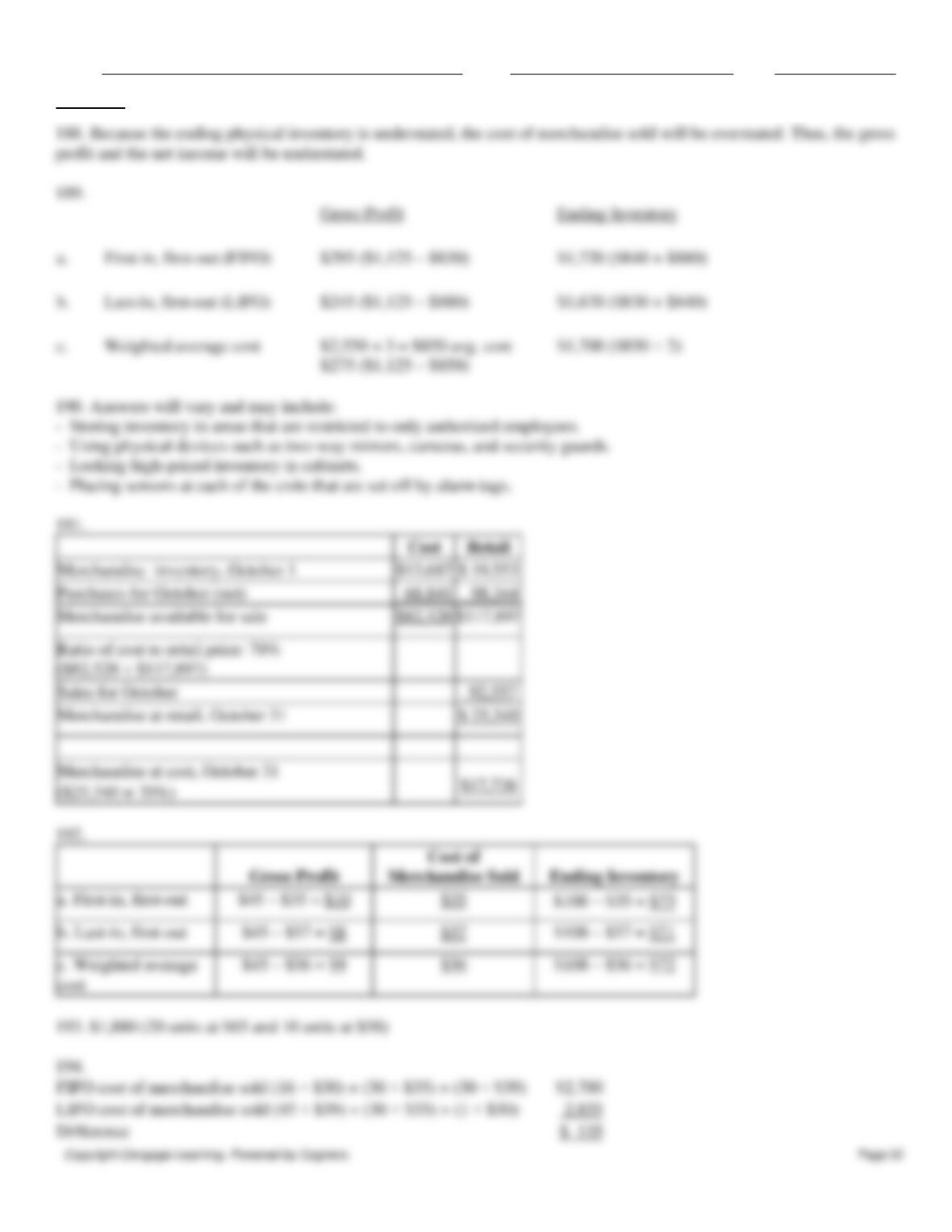
191. Fill in the missing amounts from the following chart regarding the determination of Bean Corporation’s estimated
inventory using the retail method of estimation.
Cost
Retail
Merchandise inventory, October 1
$13,687
$19,553
Purchases for October (net)
?
98,344
Merchandise available for sale
$82,528
$ ?
Ratio of cost to retail price: ?
Sales for October
?
Merchandise at retail, October 31
$25,340
Merchandise at cost, October 31
$ ?
192. Three identical units of merchandise were purchased during July, as follows:
Units
Cost
July 3
Purchase
1
$ 35
10
Purchase
1
36
24
Purchase
1
37
Total
3
$108
Average cost per unit
$36
Assume one unit sells on July 28 for $45.
Determine the gross profit, cost of merchandise sold, and ending inventory on July 31 using the (a) first-in, first-out, (b)
last-in, first-out, and (c) weighted average cost flow methods.
193. The units of an item available for sale during the year were as follows:
Jan. 1
Inventory
25 units at $45
Mar. 4
Purchase
15 units at $50
June 7
Purchase
35 units at $58
Nov. 15
Purchase
20 units at $65
Name:
Class:
Date:
chapter 7
There are 30 units of the item in the physical inventory at December 31. The periodic inventory system is used. Determine
the ending inventory cost using FIFO.
194. The units of Manganese Plus available for sale during the year were as follows:
Mar. 1
Inventory
16 units
@ $30
$ 480
June 16
Purchase
30 units
@ $35
1,050
Nov. 28
Purchase
45 units
@ $39
1,755
91 units
$3,285
There are 15 units of the product in the physical inventory at November 30. The periodic inventory system is used.
Determine the difference in gross profit between the LIFO and FIFO inventory cost systems.
195. The units of an item available for sale during the year were as follows:
January 10
Inventory
27 units @ $90
February 27
Purchase
54 units @ $98
July 11
Purchase
63 units @ $106
November 13
Purchase
36 units @ $115
There are 50 units of the item in the physical inventory at December 31. The periodic inventory system is used. Determine
the ending inventory cost by (a) the first-in, first-out method, (b) the last-in, first-out method, and (c) the weighted average
cost method. Show your work.
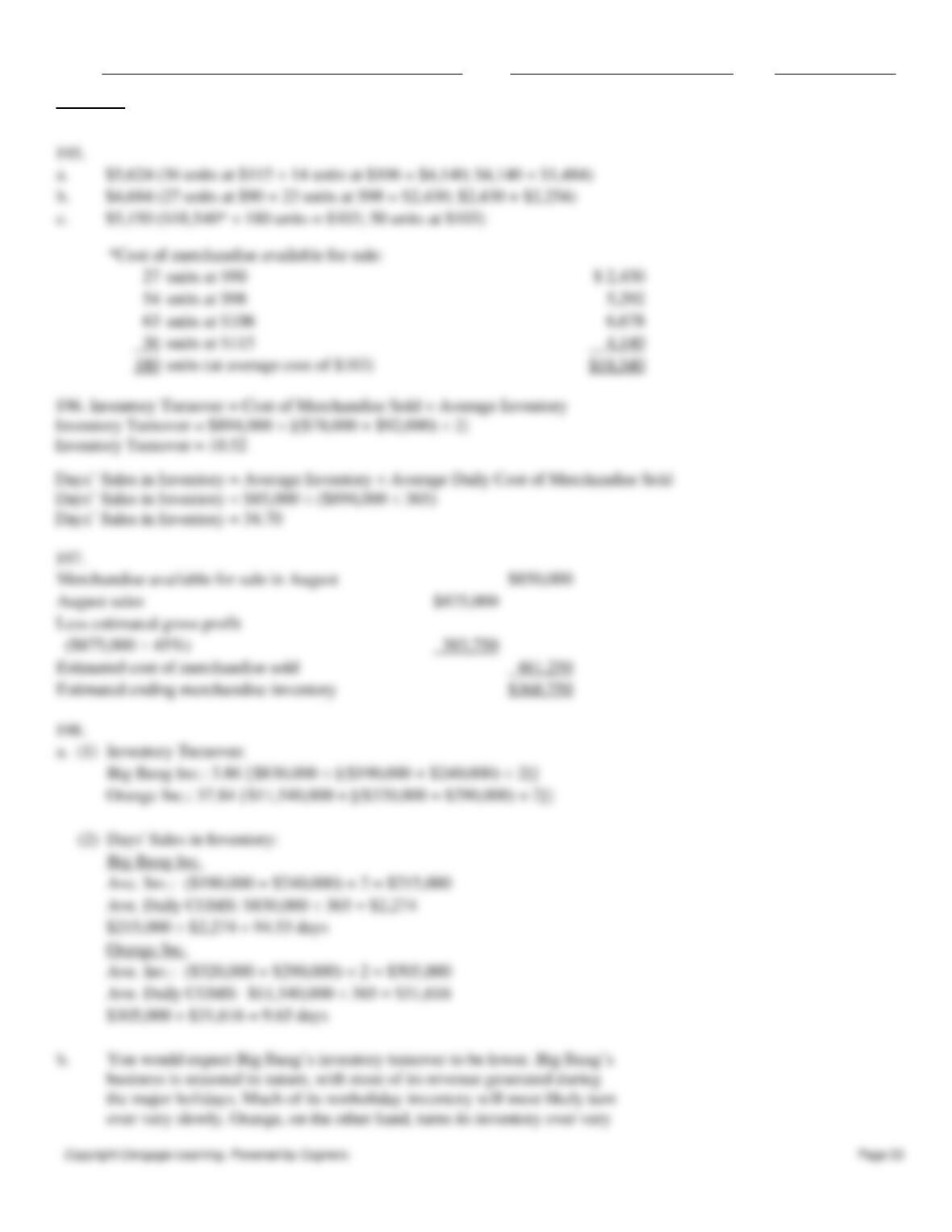
196. The following data were taken from Castle, Inc.:
Cost of merchandise sold
$894,000
Inventory, end of year
78,000
Inventory, beginning of the year
92,000
Determine the inventory turnover ratio and the days’ sales in inventory for Castle Inc. Round to two decimal places.
197. During August, the first month of the fiscal year, sales totaled $875,000 and the cost of merchandise available for
sale totaled $850,000. Estimate the cost of the merchandise inventory as of August 31, based on an estimated gross profit
rate of 45%.
198. The following data were taken from the annual reports of Big Bang Inc., a manufacturer of fireworks, and Orange
Inc., a manufacturer of computers.
Big Bang Inc.
Orange Inc.
Cost of merchandise sold
$830,000
$11,540,000
Inventory, end of year
190,000
320,000
Inventory, beginning of year
240,000
290,000
a. Determine the (1) inventory turnover and (2) days’ sales in inventory for Big Bang and Orange.
Round your answers to two decimal places.
b. How would you expect these measures to compare between the companies? Why?
199. Describe three inventory cost flow assumptions and how they impact the financial statements.
Name:
Class:
Date:
chapter 7
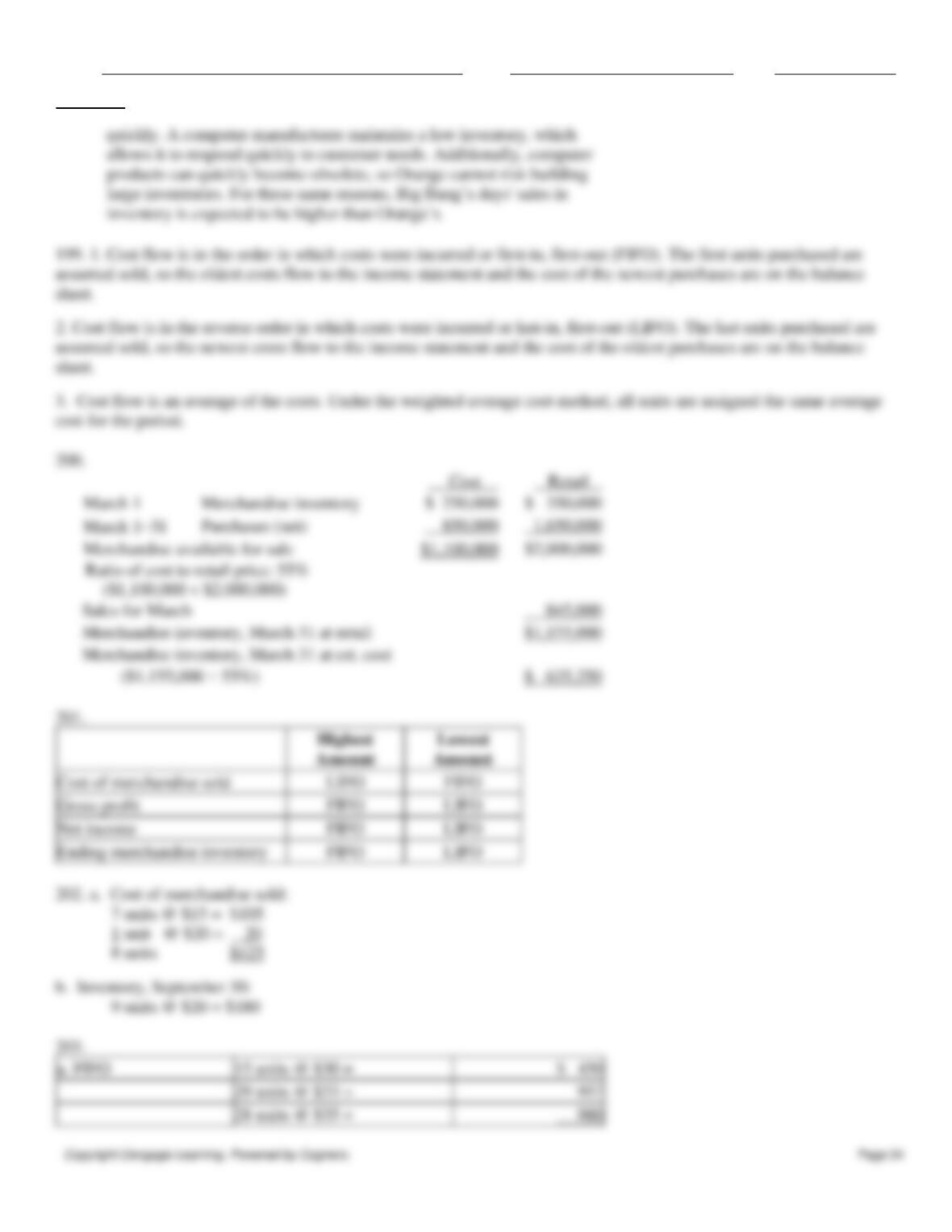
200. On the basis of the following data, estimate the cost of the merchandise inventory at March 31 by the retail method.
Cost
Retail
March 1
Merchandise inventory
$250,000
$ 350,000
March 1–31
Purchases (net)
850,000
1,650,000
March 1–31
Sales
845,000
201. Complete the chart, indicating whether LIFO or FIFO would give the highest and lowest amounts for each item,
assuming a period of increasing costs.
Highest Amount
Lowest Amount
Cost of merchandise sold
Gross profit
Net income
Ending merchandise inventory
202. Beginning inventory, purchases, and sales for an inventory item are as follows:
Sept. 1
Beginning inventory
24 units
@
$15
5
Sale
17 units
17
Purchase
10 units
@
$20
30
Sale
8 units
Assuming a perpetual inventory system and the first-in, first-out method, determine (a) the cost of the merchandise sold
for the September 30 sale and (b) the inventory on September 30.
203. The units of Product Green-2 available for sale during the year were as follows:
Apr. 1
Inventory
15 units
@
$30
June 16
Purchase
29 units
@
$33
Sept. 28
Purchase
45 units
@
$35
There are 17 units of the product in the physical inventory at September 30. The periodic inventory system is used.
Determine the cost of merchandise sold by the (a) FIFO, (b) LIFO, and (c) weighted average cost methods.
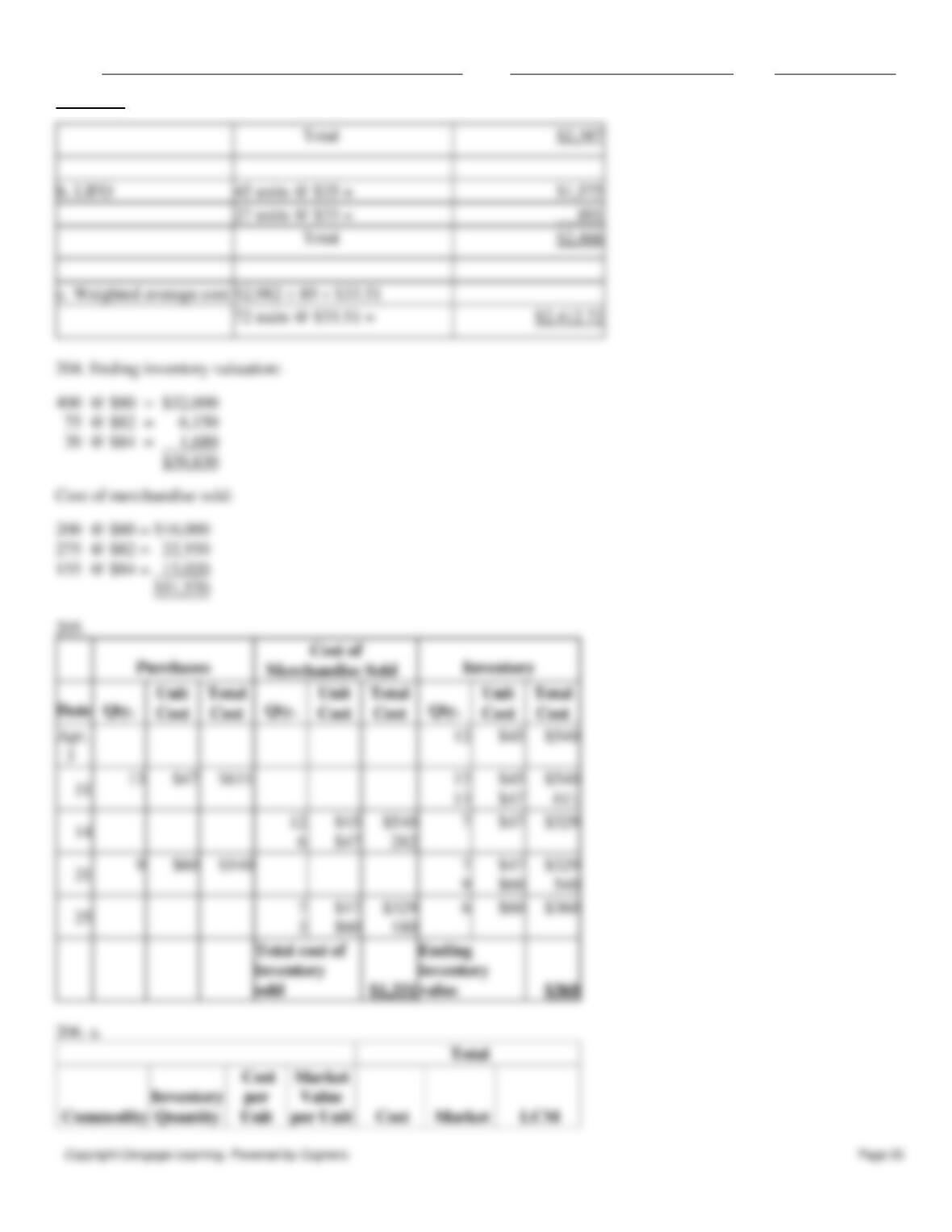
204. Using a LIFO perpetual cost flow and the following data for Beamer Company, determine the value of the ending
inventory and the cost of merchandise sold for the month of November.
Nov. 1 Purchase 600 units $80 each
4 Sale 200 units
11 Purchase 350 units $82 each
12 Sale 275 units
22 Purchase 175 units $84 each
23 Sale 155 units
Calculate the following:
(a) Inventory valuation at the end of November
(b) Cost of merchandise sold for November
205. Beginning inventory, purchases, and sales data for tennis rackets are as follows:
Apr. 3
Inventory
12 units
@
$45
Name:
Class:
Date:
chapter 7
11
Purchase
13 units
@
$47
14
Sale
18 units
21
Purchase
9 units
@
$60
25
Sale
10 units
Complete the subsidiary inventory ledger assuming the business maintains a perpetual inventory system and computes the
cost of merchandise sold and ending inventory using FIFO.
Purchases
Cost of
Merchandise Sold
Inventory
Date
Qty.
Unit
Cost
Total
Cost
Qty.
Unit
Cost
Total
Cost
Qty.
Unit
Cost
Total
Cost
Total cost of
merchandise sold
Ending inventory
value
206. The following basic inventory data for April 30 are for a business that employs the lower-of-cost-or-market basis of
inventory valuation to each item.
Total
Commodity
Inventory
Quantity
Cost per Unit
Market Value
per Unit
Cost
Market
LCM
A
35
$ 52
$ 55
_______
_______
_______
B
20
155
150
_______
_______
_______
C
25
82
85
_______
_______
_______
D
40
58
55
_______
_______
_______
a.
Complete the table.
b.
Determine the amount of reduction in the inventory at April 30 attributable to market
decline.
207. Beginning inventory and purchases and sales data for T-shirts are as follows:
Apr. 3
Inventory
24 units
@
$10
11
Purchase
26 units
@
$12
14
Sale
36 units
21
Purchase
18 units
@
$15
25
Sale
20 units
Assuming the business maintains a periodic inventory system, determine the cost of merchandise sold and ending
inventory under the following assumptions:
a. FIFO
b. LIFO
c. Weighted average cost (round cost of merchandise sold and ending inventory to the nearest dollar)
Name:
Class:
Date:
chapter 7
208. Based on the following information, compute (a) inventory turnover, (b) average daily cost of merchandise sold, and
(c) days’ sales in inventory for the current year. Use a 365-day year. (d) If an inventory turnover of 12 is average for the
industry, how is this company doing?
Item
Prior Year
Current Year
Cost of merchandise sold
$172,900
$215,000
Inventory
18,000
12,000
209. Determine the total value of the merchandise using net realizable value.
Item
Quantity
Selling Price
Commission
Doll
10
$7
$2
Horse
5
9
3
210. Beginning inventory, purchases, and sales data for tennis rackets are as follows:
Apr. 3
Inventory
12 units
@
$45
11
Purchase
13 units
@
$47
14
Sale
18 units
21
Purchase
9 units
@
$60
25
Sale
10 units
Complete the subsidiary inventory ledger assuming the business maintains a perpetual inventory system and computes the
cost of merchandise sold and ending inventory using LIFO.
Purchases
Cost of
Merchandise Sold
Inventory
Date
Qty.
Unit
Cost
Total
Cost
Qty.
Unit
Cost
Total
Cost
Qty.
Unit
Cost
Total
Cost
Total cost of
merchandise sold
Ending inventory
value
211. A business using the retail method of inventory costing determines that merchandise inventory at retail is $2,300,000.
If the ratio of cost to retail price is 55%, what is the amount of inventory to be reported on the financial statements?
212. List the internal control objectives illustrated by the following:
a.
Keeping the inventory storeroom locked
b.
Counting the inventory at the end of the accounting period and comparing it with the
inventory ledger clerk’s records
c.
Using subsidiary ledgers and a perpetual inventory system
213. Beginning inventory, purchases, and sales data for widgets are as follows:
Name:
Class:
Date:
chapter 7
Apr. 3
Inventory
15 units
@
$30
11
Purchase
12 units
@
$27
14
Sale
18 units
21
Purchase
7 units
@
$25
25
Sale
10 units
Complete the subsidiary inventory ledger assuming the business maintains a perpetual inventory system and computes the
cost of merchandise sold and ending inventory using LIFO.
Purchases
Cost of
Merchandise Sold
Inventory
Date
Qty.
Unit
Cost
Total
Cost
Qty.
Unit
Cost
Total
Cost
Qty.
Unit
Cost
Total
Cost
Total cost of
merchandise sold
Ending inventory
value
Name:
Class:
Date:
chapter 7
Answer Key

Name:
Class:
Date:
chapter 7
Name:
Class:
Date:
chapter 7
Name:
Class:
Date:
chapter 7
Name:
Class:
Date:
chapter 7
Name:
Class:
Date:
chapter 7
Name:
Class:
Date:
chapter 7
Name:
Class:
Date:
chapter 7
Name:
Class:
Date:
chapter 7
Name:
Class:
Date:
chapter 7
Name:
Class:
Date:
chapter 7
Name:
Class:
Date:
chapter 7
Name:
Class:
Date:
chapter 7
Name:
Class:
Date:
chapter 7
Name:
Class:
Date:
chapter 7
Name:
Class:
Date:
chapter 7
Name:
Class:
Date:
chapter 7
Name:
Class:
Date:
chapter 7
Name:
Class:
Date:
chapter 7
Name:
Class:
Date:
chapter 7
Name:
Class:
Date:
chapter 7
Name:
Class:
Date:
chapter 7