Intermediate Accounting, 9e (Spiceland)
Chapter 7 Cash and Receivables
1) Cash equivalents would include investments in marketable equity securities as long as
management intends to sell the securities in the next three months.
2) From a financial accounting perspective, the main purposes of a system of internal control are
to improve the accuracy and reliability of accounting information and to safeguard assets.
3) In a good system of internal control, the person who initiates a transaction should be allowed
to effectively control the processing of the transaction through its final inclusion in the
accounting records.
4) Depending on the circumstances, the classification of a compensating balance may be either
current or noncurrent, and the arrangement should be disclosed in the notes.
5) Under IFRS, an overdraft in a cash account at one bank can be offset against a positive
balance in the account at another bank for purposes of reporting cash on the company’s balance
sheet.
6) The net method of accounting for cash discounts requires adjusting entries for discounts taken.
7) Sales returns and cash discounts are both examples of variable consideration that must be
accounted for when receivables are recognized.
8) Sales returns and trade discounts are both examples of variable consideration that must be
accounted for when receivables are recognized.
9) Recognizing sales returns only when merchandise is returned could result in an overstatement
of income in the period of the related sale.
10) If cash has been collected from a customer, recognizing estimated sales returns results in
recognizing a refund liability.
11) The allowance method for estimating bad debts requires an adjusting entry at the end of the
period to reduce receivables to their appropriate carrying value.
12) Under IFRS, accounts receivable can be accounted for at fair value whenever company
management wants to do so.
13) Under IFRS, accounts receivable can be accounted for as “available for sale” if that approach
is elected upon initial recognition of the receivable.
14) Using the balance sheet approach, bad debt expense is an indirect result of estimating the
appropriate balance for the allowance for uncollectible accounts.
15) The income statement approach to calculating bad debt expense should not be used if it
results in a carrying value of accounts receivable that is materially different from what would be
obtained under a balance sheet approach.
16) The “income statement approach” and the “direct write-off method” are two ways to refer to
the same method for recognizing bad debts expense.
17) Discounts on notes receivable are recognized as interest earned over the term of the related
note.
18) If a long-term noninterest-bearing note is received in exchange for merchandise sold, the
amount of sales revenue recognized will be greater than the amount of the note.
19) Unless specific sales criteria are met, the factoring of accounts receivable with recourse is
accounted for as a loan.
20) Securitization of receivables is a type of secured borrowing.
21) Under IFRS, transfer of risks and rewards of ownership, rather than transfer of control, is the
primary factor determining whether a factored receivable can be treated as sold rather than as
part of a secured borrowing.
22) The receivables turnover ratio provides a way for an analyst to assess the effectiveness of a
company in managing its investment in receivables.
23) In a bank reconciliation, adjustments to the bank balance could include adding deposits in
transit and deducting bank service charges.
24) In a bank reconciliation, adjustments to the book balance could include adding or subtracting
company errors.
25) The journal entry to record the replenishment of a petty cash fund includes a credit to the
petty cash fund.
26) When a creditor’s receivable becomes impaired, the receivable is revalued based on the
discounted present value of currently expected cash flows at the loan’s original effective rate.
27) Under the CECL approach, impairments are only recognized when it is probable that the
receivable has been impaired.
28) Under the CECL approach used in U.S. GAAP, impairments are only recognized for losses
that occur more than a year in the future when a receivable has deteriorated in credit quality.
29) Under the ECL approach used in IFRS, impairments are only recognized for losses that occur
more than a year in the future when a receivable has deteriorated in credit quality.
30) Under IFRS, accounts receivable impairments are not recognized.
31) Important elements of an internal control system for cash disbursements include each of the
following except:
A) Only authorized personnel should sign checks.
B) All expenditures should be authorized before a check is prepared.
C) All disbursements, other than very small disbursements, should be made by check.
D) The same person that prepares the check should also record it in the proper journal.
32) COSO defines internal control as a process, affected by an entity’s board of directors,
management, and other personnel, designed to provide reasonable assurance regarding the
achievement of objectives in:
A) Effectiveness and efficiency of operations.
B) Reliability of financial advice.
C) Compliance with local ordinances.
D) All of these answer choices are correct.
33) Cashmere Soap Corporation had the following items listed in its trial balance at 12/31/2018:
Currency and coins
$
650
Balance in checking account
2,600
Customer checks waiting to be deposited
1,200
Treasury bills, purchased on 11/1/2018,
mature on 4/30/2019
3,000
Marketable equity securities
10,200
Commercial paper, purchased on 11/1/2018,
mature on 1/30/2019
5,000
What amount will Cashmere Soap include in its year-end balance sheet as cash and cash
equivalents?
A) $9,450.
B) $12,450.
C) $7,450.
D) $19,650.
34) Cash equivalents do not include:
A) Money market funds.
B) High grade marketable equity securities.
C) U.S. treasury bills.
D) Commercial paper.
35) Cash may not include:
A) Foreign currency.
B) Money orders.
C) Restricted cash.
D) Undeposited customer checks.
36) Compensating balances represent:
A) Funds in a bank account that can’t be spent.
B) Balances in a payroll checking account.
C) Accounts that are subject to bank service charges.
D) Accounts on which banks pay interest, e.g., NOW accounts.
37) Cash that is restricted and not available for current operations is reported in the balance sheet
as:
A) Equity.
B) Investments.
C) Liabilities.
D) A separate section between liabilities and equity.
38) Logistics Company had the following items listed in its trial balance at 12/31/2018:
Balance in checking account, Bank of the East
$
442,000
Treasury bills, purchased on 11/1/2018,
mature on 1/30/2019
20,000
Loan payable, long-term, Bank of the East
300,000
Included in the checking account balance is $50,000 of restricted cash that Bank of the East
requires as a compensating balance for the $300,000 note. What amount will Logistics include in
its year-end balance sheet as cash and cash equivalents?
A) $412,000.
B) $462,000.
C) $392,000.
D) $442,000.
39) Which of the following is true about reporting cash under IFRS?
A) Cash accounts include loans made to customers, but not to related parties.
B) Overdrafts typically cannot be offset against positive balance in other cash accounts on the
balance sheet.
C) Cash overdrafts are not allowed.
D) Overdrafts typically are not shown as current liabilities on the balance sheet.
40) Wilson Company had the following cash balance items listed in its trial balance at
12/31/2018:
Peterson Savings and Loan:
$
50,000
Right Bank:
(5,000
)
Clinton County Trust Bank:
10,000
If Wilson reports under IFRS, its 12/31/2018 balance sheet would show what cash balance?
A) ($5,000).
B) $55,000.
C) $60,000.
D) None of these answer choices are correct.
41) Wilson Company had the following cash balance items listed in its trial balance at
12/31/2018:
Peterson Savings and Loan:
$
50,000
Right Bank:
(5,000
)
Clinton County Trust Bank:
10,000
If Wilson reports under U.S. GAAP, its 12/31/2018 balance sheet would show what cash
balance?
A) ($5,000).
B) $55,000.
C) $60,000.
D) None these answer choices are correct.
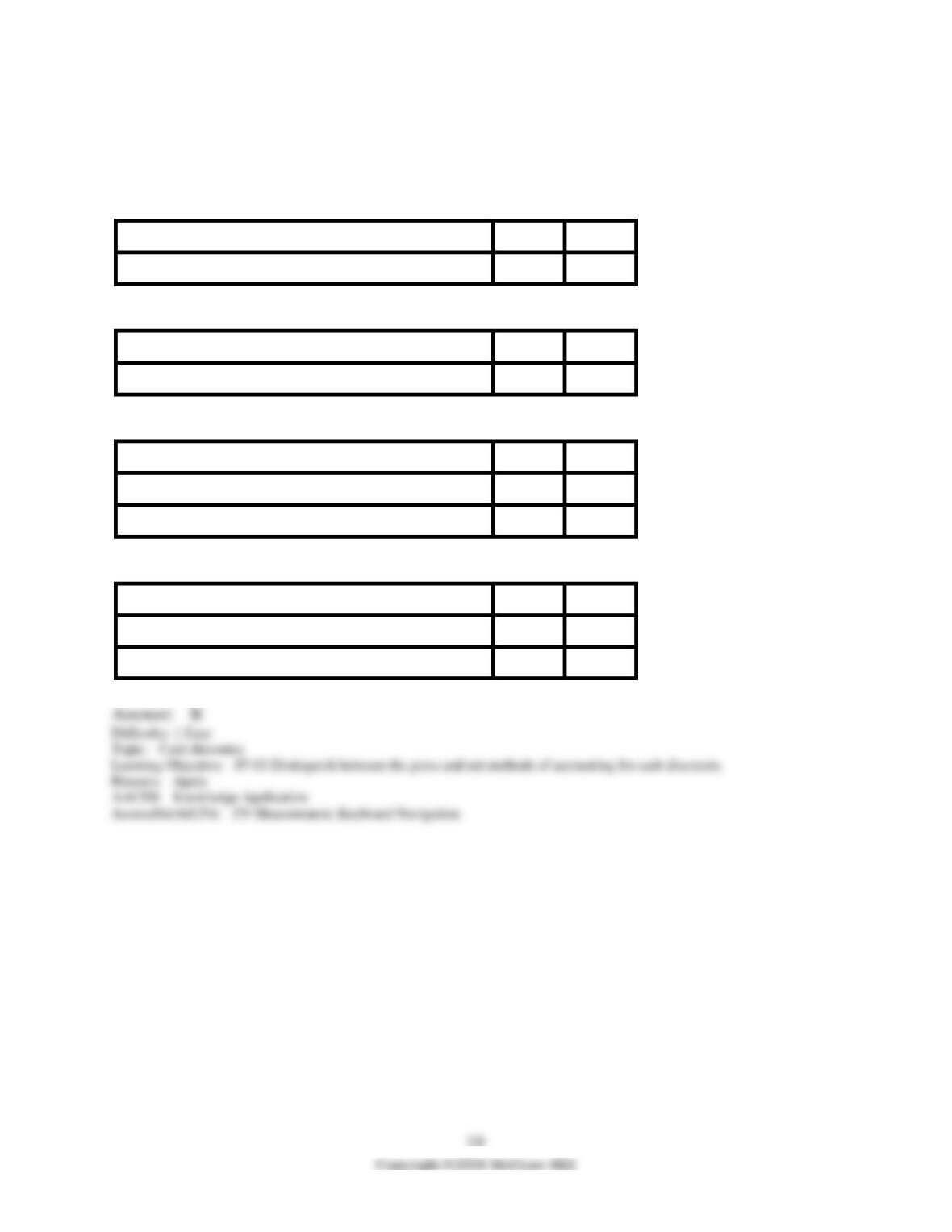
42) On November 10 of the current year, Flores Mills sold carpet to a customer for $8,000 with
credit terms 2/10, n/30. Flores uses the gross method of accounting for cash discounts.
What is the correct entry for Flores on November 10?
A)
Accounts receivable
7,840
Sales
7,840
B)
Accounts receivable
8,000
Sales
8,000
C)
Accounts receivable
7,840
Cash discounts
160
Sales
8,000
D)
Accounts receivable
8,000
Cash discounts
160
Sales
7,840
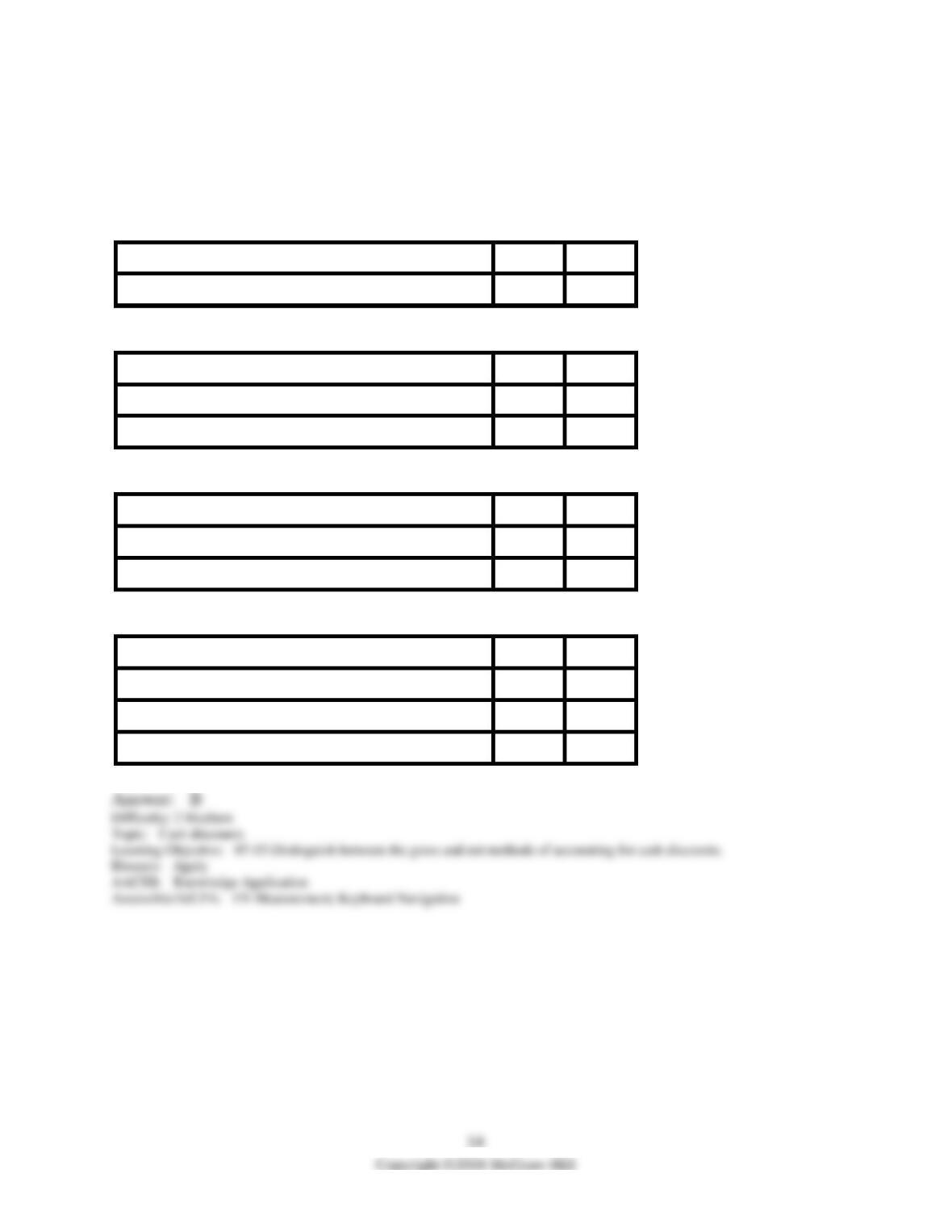
43) On November 10 of the current year, Flores Mills sold carpet to a customer for $8,000 with
credit terms 2/10, n/30. Flores uses the gross method of accounting for cash discounts.
What is the correct entry for Flores on November 17, assuming the correct payment was received
on that date?
A)
Cash
7,840
Accounts receivable
7,840
B)
Cash
7,840
Sales discounts
160
Accounts receivable
8,000
C)
Cash
7,840
Sales
160
Accounts receivable
8,000
D)
Cash
8,000
Sales discounts
160
Accounts receivable
8,000
Sales
160
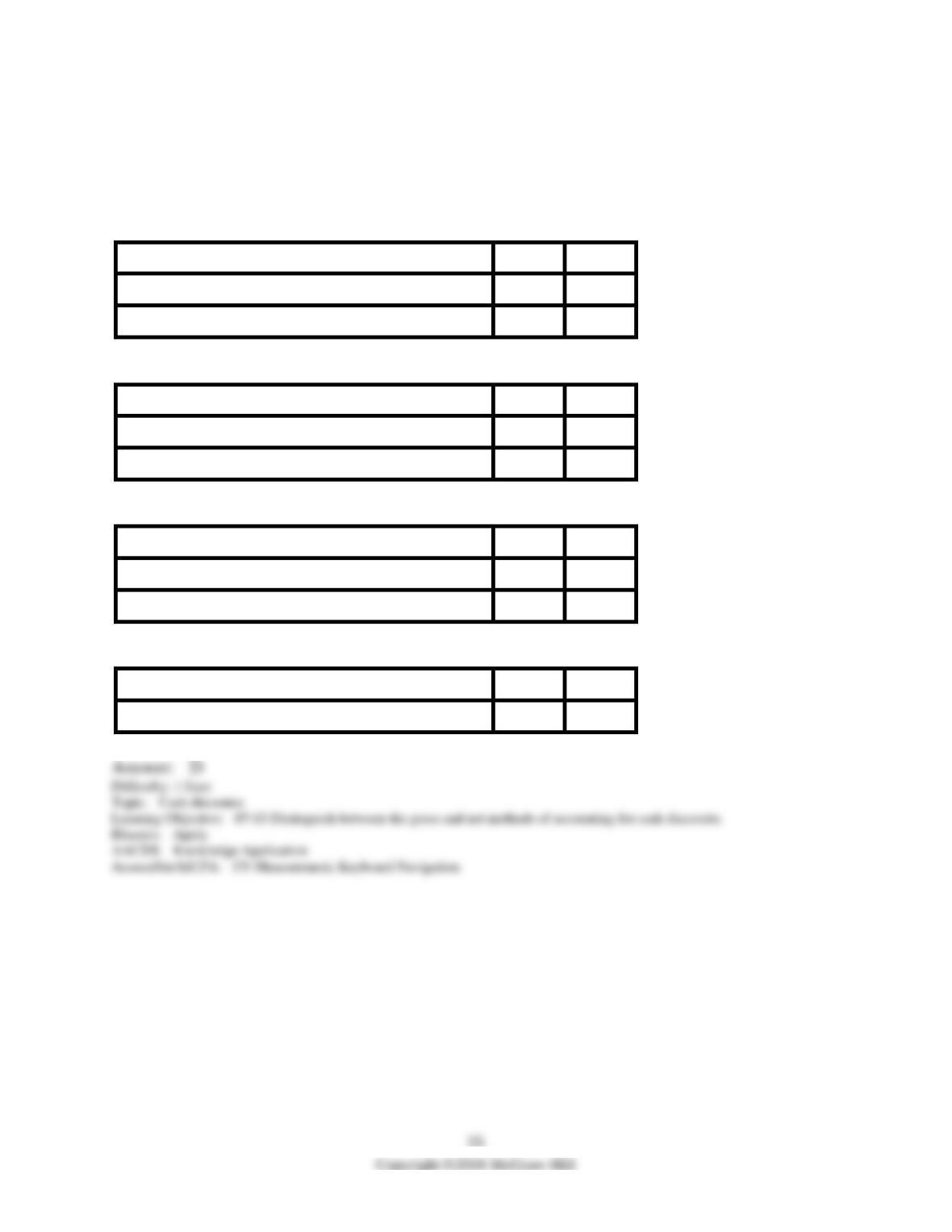
44) On November 10 of the current year, Flores Mills sold carpet to a customer for $8,000 with
credit terms 2/10, n/30. Flores uses the gross method of accounting for cash discounts.
What is the correct entry for Flores on December 5, assuming the correct payment was received
on that date?
A)
Cash
8,000
Accounts receivable
7,840
Discounts revenue
160
B)
Cash
8,000
Accounts receivable
7,840
Interest revenue
160
C)
Cash
8,160
Accounts receivable
8,000
Interest revenue
160
D)
Cash
8,000
Accounts receivable
8,000
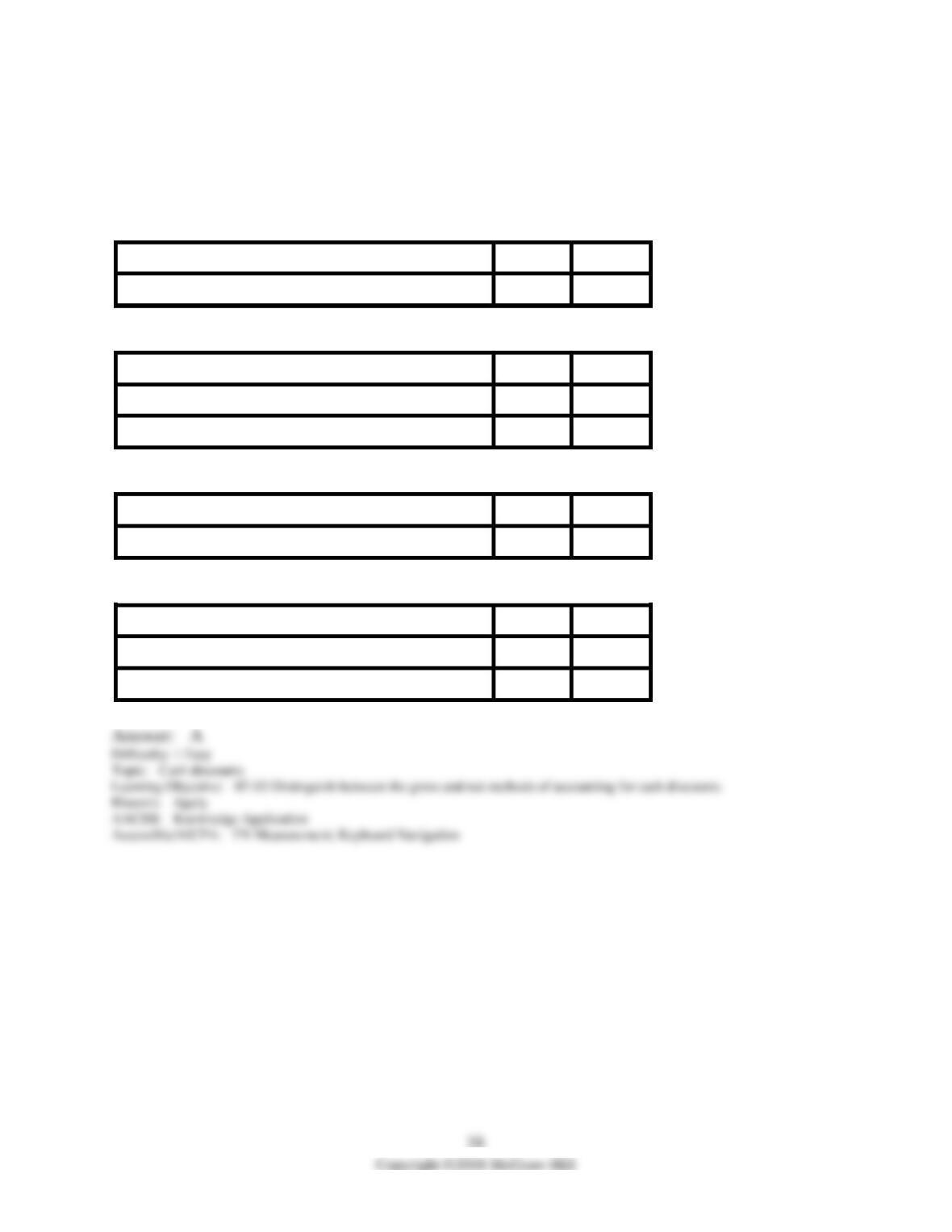
45) Oswego Clay Pipe Company sold $46,000 of pipe to Southeast Water District #45 on April
12 of the current year with terms 1/15, n/60. Oswego uses the gross method of accounting for
cash discounts.
What entry would Oswego make on April 12?
A)
Accounts receivable
46,000
Sales
46,000
B)
Accounts receivable
46,000
Sales
45,540
Sales discounts
460
C)
Accounts receivable
45,540
Sales
45,540
D)
Accounts receivable
45,540
Sales discounts
460
Sales
46,000
46) Oswego Clay Pipe Company sold $46,000 of pipe to Southeast Water District #45 on April
12 of the current year with terms 1/15, n/60. Oswego uses the gross method of accounting for
cash discounts.
What entry would Oswego make on April 23, assuming the customer made the correct payment
on that date?
A)
Cash
45,540
Sales
460
Accounts receivable
46,000
B)
Cash
46,000
Sales discounts
460
Accounts receivable
46,000
Sales discounts forfeited
460
C)
Cash
45,540
Sales discounts
460
Accounts receivable
46,000
D)
Cash
46,000
Accounts receivable
45,540
Sales
460
47) Oswego Clay Pipe Company sold $46,000 of pipe to Southeast Water District #45 on April
12 of the current year with terms 1/15, n/60. Oswego uses the gross method of accounting for
cash discounts.
What entry would Oswego make on June 10, assuming the customer made the correct payment
on that date?
A)
Cash
46,000
Accounts receivable
45,540
Discounts receivable
460
B)
Cash
46,000
Accounts receivable
45,540
Sales discounts forfeited
460
C)
Cash
46,000
Accounts receivable
46,000
D)
Cash
46,460
Accounts receivable
46,000
Sales discounts forfeited
460
48) On November 10 of the current year, Cherokee Industries sold materials to a customer for
$8,000 with credit terms 2/10, n/30. Cherokee uses the net method of accounting for cash
discounts.
What entry would Cherokee make on November 10?
A)
Accounts receivable
7,840
Sales
7,840
B)
Accounts receivable
8,000
Sales
8,000
C)
Accounts receivable
7,840
Cash discounts
160
Sales
8,000
D)
Accounts receivable
8,000
Cash discounts
160
Sales
7,840
49) On November 10 of the current year, Cherokee Industries sold materials to a customer for
$8,000 with credit terms 2/10, n/30. Cherokee uses the net method of accounting for cash
discounts.
What entry would Cherokee make on November 17, assuming the correct payment was received
on that date?
A)
Cash
7,840
Accounts receivable
7,840
B)
Cash
7,840
Sales discounts
160
Accounts receivable
8,000
C)
Cash
7,840
Sales
160
Accounts receivable
8,000
D)
Cash
8,000
Sales discounts
160
Accounts receivable
8,000
Sales
160