CHAPTER 7
CASH AND RECEIVABLES
CHAPTER LEARNING OBJECTIVES
1. Indicate how to report cash and related items.
2. Define receivables and explain the accounting issues related to their recognition.
3. Explain accounting issues related to valuation of accounts receivable.
4. Explain accounting issues related to recognition and valuation of notes receivable.
5. Explain additional accounting issues related to accounts and notes receivable.
6. Explain common techniques employed to control cash.

Test Bank for Intermediate Accounting: IFRS Edition, 3e
7 – 2
TRUE-FALSE—Conceptual
1. Savings accounts are usually classified as cash on the statement of financial position.
2. Certificates of deposit are usually classified as cash on the statement of financial position.
3. Companies include postdated checks and petty cash funds as cash.
4. Cash equivalents are investments with original maturities of six months or less.
5. Bank overdrafts are always included as part of cash in the statement of financial position.
6. Short-term, highly liquid investments may be included with cash on the statement of
financial position.
7. Receivables are classified in the statement of financial position as either trade or non-trade
receivables.
8. Trade receivables include notes receivable and advances to officers and employees.
9. Trade discounts are used to avoid frequent changes in catalogs and to alter prices for
different quantities purchased.
10. In the gross method, sales discounts are reported as a deduction from sales.
11. Ideally, a company should measure receivables in terms of their present value, that is, the
discounted value of the cash to be received in the future.
12. The International Accounting Standard Board requires that companies assess their
receivables for impairment each reporting period and begin the impairment assessment by
considering whether objective evidence indicates that one or more loss events have
occurred.
13. The International Accounting Standard Board requires that when performing an impairment
assessment, all receivables that are individually significant should be considered for
impairment separately.
14. The percentage-of-receivables approach of estimating uncollectible accounts emphasizes
matching over valuation of accounts receivable.
15. The percentage-of-sales method results in a more accurate valuation of receivables on the
balance sheet.
16. Companies record and report long-term notes receivable on a discounted basis.
17. When the stated rate of interest exceeds the effective rate, the present value of the note
receivable will be less than its face value.
18. When buying receivables with recourse, the purchaser assumes the risk of collectibility and
absorbs any credit loss.
Cash and Receivables
7 – 3
19. If substantially all the risks and rewards of ownership of the receivables are transferred,
then they are derecognised.
20. The International Accounting Standards Board believes that historical cost for financial
instruments provides more relevant and understandable information than fair value.
21. Under IFRS, a company may select the fair value option or amortized cost for valuing a
group of receivables at each statement of financial position date.
22. Under IFRS, a company will derecognize its receivables when it elects to use the fair value
option for a receivable.
23. Under IFRS, a company will derecognize its receivables when the contractual rights to the
cash flows of the receivable no longer exist.
24. Under IFRS de-recognition of a receivable is determined by using lack of control as the
primary criterion.
25. The accounts receivable turnover is computed by dividing net sales by the ending net
receivables.
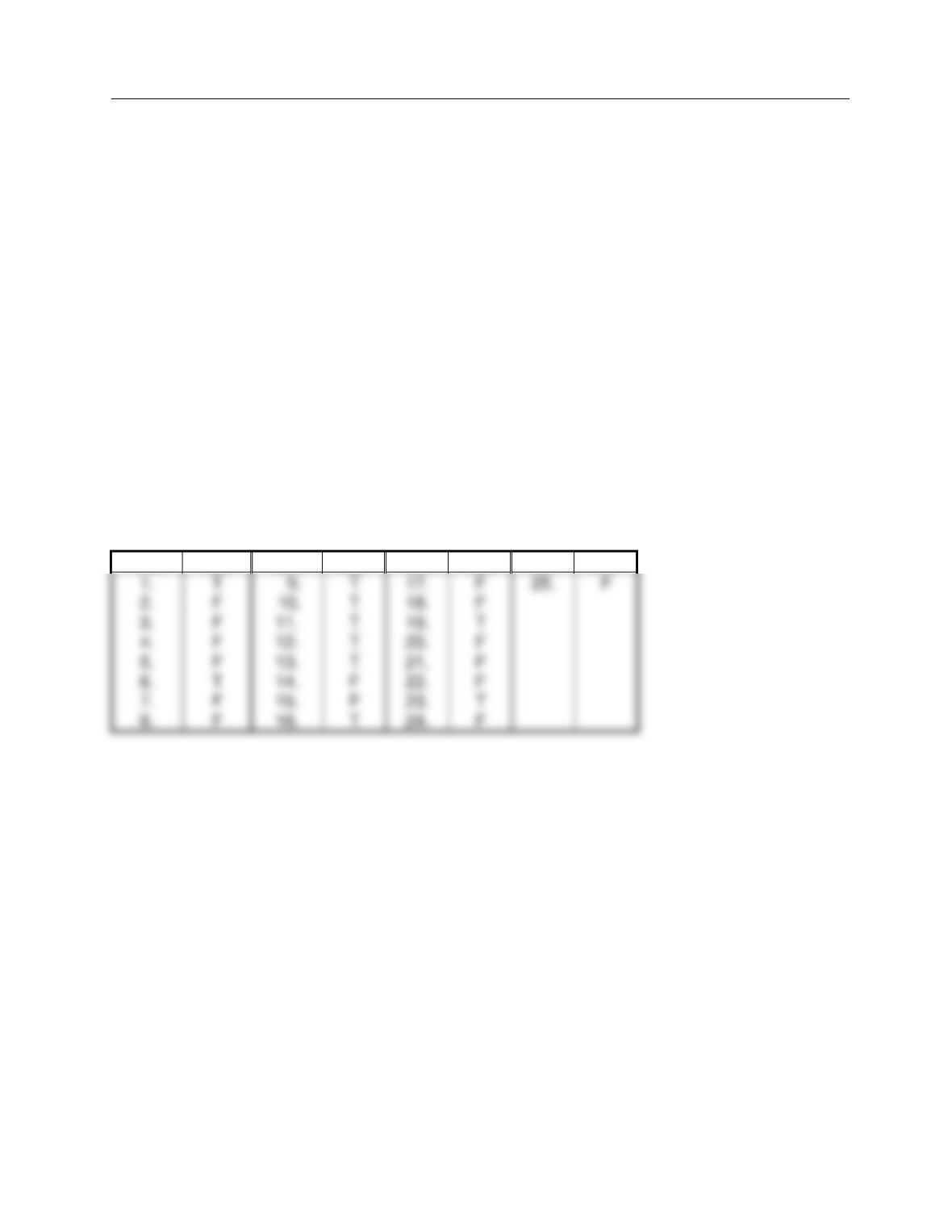
True False Answers—Conceptual
Item
Ans.
Item
Ans.
Item
Ans.
Item
Ans.

Test Bank for Intermediate Accounting: IFRS Edition, 3e
7 – 4
MULTIPLE CHOICE—Conceptual
26. Which of the following is not considered cash for financial reporting purposes?
a. Petty cash funds and change funds
b. Money orders, certified checks, and personal checks
c. Coin, currency, and available funds
d. Postdated checks and I.O.U.’s
27. Which of the following is considered cash?
a. Certificates of deposit (CDs)
b. Money orders
c. Money market savings certificates
d. Postdated checks
28. Travel advances should be reported as
a. supplies.
b. cash because they represent the equivalent of money.
c. investments.
d. None of these answer choices are correct.
P29. Which of the following items should not be included in the Cash caption on the statement
of financial position
a. Coins and currency in the cash register
b. Checks from other parties presently in the cash register
c. Amounts on deposit in checking account at the bank
d. Postage stamps on hand
30. All of the following may be included under the heading of “cash” except
a. currency.
b. money market funds.
c. checking account balance.
d. savings account balance.
31. In which account are post-dated checks received classified?
a. Receivables
b. Prepaid expenses
c. Cash
d. Payables
32. In which account are postage stamps classified?
a. Cash
b. Supplies
c. Receivables
d. Inventory
33. What is a compensating balance?
a. Savings account balances
b. Margin accounts held with brokers
c. Temporary investments serving as collateral for outstanding loans
d. Minimum deposits required to be maintained in connection with a borrowing
arrangement

Cash and Receivables
7 – 5
34. Under which section of the statement of financial position is “cash restricted for plant
expansion” reported?
a. Current assets
b. Non-current assets
c. Current liabilities
d. Equity
S35. A cash equivalent is a short-term, highly liquid investment that is readily convertible into
known amounts of cash and
a. is acceptable as a means to pay current liabilities.
b. has a current market value that is greater than its original cost.
c. bears an interest rate that is at least equal to the prime rate of interest at the date of
liquidation.
d. is so near its maturity that it presents insignificant risk of changes in interest rates.
36. Bank overdrafts generally should be
a. reported as a deduction from the current asset section.
b. reported as a deduction from cash.
c. netted against cash and a net cash amount reported.
d. reported as a current liability.
37. Deposits held as compensating balances
a. usually do not earn interest.
b. if legally restricted and held against short-term credit may be included as cash.
c. if legally restricted and held against long-term credit may be included among current
assets.
d. None of these answer choices are correct.
38. The category “trade receivables” includes
a. advances to officers and employees.
b. income tax refunds receivable.
c. claims against insurance companies for casualties sustained.
d. None of these answer choices are correct.
39. Which of the following should be recorded in Accounts Receivable?
a. Receivables from officers
b. Receivables from subsidiaries
c. Dividends receivable
d. None of these answer choices are correct.
S40. What is the preferable presentation of accounts receivable from officers, employees, or
affiliated companies on a statement of financial position?
a. As offsets to equity
b. By means of footnotes only
c. As assets but separately from other receivables
d. As trade notes and accounts receivable if they otherwise qualify as current assets

Test Bank for Intermediate Accounting: IFRS Edition, 3e
7 – 6
41. Which of the following statement is incorrect regarding receivables on the statement of
financial position?
a. Receivables are a financial asset.
b. Receivables are financial instruments.
c. Non-trade receivables are generally reported as separate items in the statement of
financial position.
d. Accounts receivable are written promises of the purchaser to pay for goods or
services.
S42. When a customer purchases merchandise inventory from a business organization, she
may be given a discount which is designed to induce prompt payment. Such a discount is
called a(n)
a. trade discount.
b. nominal discount.
c. enhancement discount.
d. cash discount.
P43. Trade discounts are
a. not recorded in the accounts; rather they are a means of computing a price.
b. used to avoid frequent changes in catalogues.
c. used to quote different prices for different quantities purchased.
d. All of these answer choices are correct.
44. If a company employs the gross method of recording accounts receivable from customers,
then sales discounts taken should be reported as
a. a deduction from sales in the income statement.
b. an item of “other income and expense” in the income statement.
c. a deduction from accounts receivable in determining the net realizable value of
accounts receivable.
d. sales discounts forfeited in the cost of goods sold section of the income statement.
45. Why do companies provide trade discounts?
a. To avoid frequent changes in catalogs only
b. To induce prompt payment
c. To easily alter prices for different customers only
d. To avoid frequent changes in catalogs and to easily alter prices
46. Of the approaches to record cash discounts related to accounts receivable, which is more
theoretically correct?
a. Net approach
b. Gross approach
c. Allowance approach
d. All three approaches are theoretically correct.
47. All of the following are problems associated with the valuation of accounts receivable
except for
a. uncollectible accounts.
b. returns.
c. cash discounts under the net method.
d. allowances granted.

Cash and Receivables
7 – 7
48. Why is the allowance method preferred over the direct write-off method of accounting for
bad debts?
a. Allowance method is used for tax purposes
b. Estimates are used
c. Determining worthless accounts under direct write-off method is difficult to do
d. Improved matching of bad debt expense with revenue
49. Which of the following concepts relates to using the allowance method in accounting for
accounts receivable?
a. Bad debt expense is an estimate that is based on historical and prospective
information.
b. Bad debt expense is based on the actual amounts determined to be uncollectible.
c. Bad debt expense is an estimate that is based only on an analysis of the receivables
aging.
d. Bad debt expense is management’s determination of which accounts will be sent to
the attorney for collection.
50. How can accounting for bad debts be used for earnings management?
a. Determining which accounts to write-off
b. Changing the percentage of sales recorded as bad debt expense
c. Using an aging of the accounts receivable balance to determine bad debt expense
d. Reversing previous write-offs
51. What is the normal journal entry for recording bad debt expense under the allowance
method?
a. Debit Allowance for Doubtful Accounts, credit Accounts Receivable
b. Debit Allowance for Doubtful Accounts, credit Bad Debt Expense
c. Debit Bad Debt Expense, credit Allowance for Doubtful Accounts
d. Debit Accounts Receivable, credit Allowance for Doubtful Accounts
52. What is the normal journal entry when writing-off an account as uncollectible under the
allowance method?
a. Debit Allowance for Doubtful Accounts, credit Accounts Receivable
b. Debit Allowance for Doubtful Accounts, credit Bad Debt Expense
c. Debit Bad Debt Expense, credit Allowance for Doubtful Accounts
d. Debit Accounts Receivable, credit Allowance for Doubtful Accounts
53. Which of the following is included in the normal journal entry to record the collection of
accounts receivable previously written off when using the allowance method?
a. Debit Allowance for Doubtful Accounts, credit Accounts Receivable
b. Debit Allowance for Doubtful Accounts, credit Bad Debt Expense
c. Debit Bad Debt Expense, credit Allowance for Doubtful Accounts
d. Debit Accounts Receivable, credit Allowance for Doubtful Accounts
54. Assuming that the ideal measure of short-term receivables in the statement of financial
position is the discounted value of the cash to be received in the future, failure to follow
this practice usually does not make the statement of financial position misleading
because
a. most short-term receivables are not interest-bearing.
b. the allowance for uncollectible accounts includes a discount element.
c. the amount of the discount is not material.
d. most receivables can be sold to a bank or factor.

Test Bank for Intermediate Accounting: IFRS Edition, 3e
7 – 8
55. Which of the following methods of determining bad debt expense does not properly match
expense and revenue?
a. Charging bad debts with a percentage of sales under the allowance method
b. Charging bad debts with an amount derived from a percentage of accounts receivable
under the allowance method
c. Charging bad debts with an amount derived from aging accounts receivable under the
allowance method
d. Charging bad debts as accounts are written off as uncollectible
56. Which of the following methods of determining annual bad debt expense best achieves
the matching concept?
a. Percentage of sales
b. Percentage of ending accounts receivable
c. Percentage of average accounts receivable
d. Direct write-off
57. Which of the following is a generally accepted method of determining the amount of the
adjustment to bad debt expense?
a. A percentage of sales adjusted for the balance in the allowance
b. A percentage of sales not adjusted for the balance in the allowance
c. A percentage of accounts receivable not adjusted for the balance in the allowance
d. An amount derived from aging accounts receivable and not adjusted for the balance in
the allowance
58. The advantage of relating a company’s bad debt expense to its outstanding accounts
receivable is that this approach
a. gives a reasonably correct statement of receivables in the statement of financial
position.
b. best relates bad debt expense to the period of sale.
c. is the only generally accepted method for valuing accounts receivable.
d. makes estimates of uncollectible accounts unnecessary.
59. Under IFRS, which of the following is not permitted for accounting for material amounts of
uncollectable accounts receivable?
a. Percentage of receivables, allowance method
b. Percentage of sales, allowance method
c. Direct write-off method
d. All of these answer choices are acceptable under IFRS
60. Which of the following statement is incorrect regarding how the IASB requires that the
impairment assessment be performed?
a. Receivables that are individually significant should be considered for impairment
separately, if impaired, the company recognizes it.
b. Receivables that are not individually significant are assessed individually. If impaired,
the company recognizes it.
c. Any receivable individually assessed that is not considered impaired should be
included with a group of assets with similar credit-risk characteristics and collectively
assessed for impairment.
d. Any receivables not individually assessed should be collectively assessed for
impairment.

Cash and Receivables
7 – 9
61. At the beginning of 2017, Gannon Company received a three-year zero-interest-bearing
€1,000 trade note. The market rate for equivalent notes was 8% at that time. Gannon
reported this note as a €1,000 trade note receivable on its 2017 year-end statement of
financial position and €1,000 as sales revenue for 2017. What effect did this accounting
for the note have on Gannon’s net earnings for 2017, 2018, 2019, and its retained
earnings at the end of 2019, respectively?
a. Overstate, overstate, understate, zero
b. Overstate, understate, understate, understate
c. Overstate, overstate, overstate, overstate
d. None of these answer choices are correct.
62. What is imputed interest?
a. Interest based on the stated interest rate
b. Interest based on the implicit interest rate
c. Interest based on the average interest rate
d. Interest based on the coupon rate
63. Why would a company sell receivables to another company?
a. To improve the quality of its credit granting process
b. To limit its legal liability
c. To accelerate access to amounts collected
d. To comply with customer agreements
64. Which of the following is true when accounts receivable are factored without recourse?
a. The transaction may be accounted for either as a secured borrowing or as a sale,
depending upon the substance of the transaction.
b. The receivables are used as collateral for a promissory note issued to the factor by the
owner of the receivables.
c. The factor assumes the risk of collectibility and absorbs any credit losses in collecting
the receivables.
d. The financing cost (interest expense) should be recognized ratably over the collection
period of the receivables.
S65. Which of the following statements is incorrect regarding the classification of accounts and
notes receivable?
a. Segregation of the different types of receivables is required if they are material.
b. Disclose any loss contingencies that exist on the receivables.
c. Any discount or premium resulting from the determination of present value in notes
receivable transactions is an asset or liability respectively.
d. Valuation accounts should be appropriately offset against the proper receivable
accounts.
66. Which of the following statements is incorrect when a company chooses the fair value
option for its receivables?
a. Receivables are recorded at fair value in the statement of financial position.
b. Unrealized holding gains and losses from fair value adjustments are reported as a
component of comprehensive income.
c. The International Accounting Standards Board believes that fair value measurement
for financial instruments provides more relevant and understandable information than
historical cost.
d. An unrealized holding gain or loss is the net change in the fair value of the receivable
from one period to another, exclusive of interest revenue recognized but not recorded.

Test Bank for Intermediate Accounting: IFRS Edition, 3e
7 – 10
67. Morley Manufacturing has notes receivable that have a fair value of €810,000 and a
carrying amount of €620,000. Morley decides on December 31, 2019, to use the fair value
option for these recently-acquired receivables. Which of the following statements is
correct regarding the election of the fair value option by Morley?
a. Morley can elect to use the fair value option or amortized cost for these notes at each
statement of financial position date.
b. Morley reports the receivables at fair value, with any unrealized holding gains and
losses reported as a separate component of comprehensive income.
c. The unrealized holding gain is the difference between the fair value and the carrying
amount.
d. All of the choices are correct regarding the fair value option.
68. Under IFRS Morley Manufacturing will derecognize its receivables in all of the following
cases except
a. When Morley elects to use the fair value option for a receivable.
b. When the contractual rights to the cash flows of the receivable no longer exist; for
example when one of Morley’s customers declares bankruptcy.
c. When Morley collects a receivable when due.
d. All of these answer choices require Morley Manufacturing to derecognize its
receivables.
69. On December 31, 2018, Hunter Corporation has elected to use the fair value option for
one of its notes receivable. The note was accepted in late September, 2018 from a
customer who was unable to pay its accounts receivable. The transaction with the
customer had been delivery of accounting services valued at €25,000. The customer
made a partial payment, resulting in a carrying value for the note of €22,000. At year-end,
Hunter Corporation estimates the fair value of the note to be €17,500. Which of the
following is incorrect regarding this note?
a. Hunter will report the note on its statement of financial position at €17,500.
b. Hunter will report an unrealized loss of €7,500 in its income statement for the year
ended December 31, 2018.
c. Hunter will be required to use the fair value option for this note for the duration of its
existence.
d. In 2019, Hunter will calculate the unrealized holding gain or loss as the net change in
the fair value of the receivable from 2018 to 2019, exclusive of interest revenue
recognized but not recorded.
70. IFRS requires all of the following when classifying receivables except
a. Indicate the receivables classified as current and non-current in the statement of
financial position.
b. Disclose any receivables pledged as collateral.
c. Disclose all significant concentrations of credit risk arising from receivables.
d. All of these answer choices are required by IFRS when classifying receivables.

Cash and Receivables
7 – 11
71. Which of the following is correct regarding differences between IFRS and U.S. GAAP with
regard to receivables?
a. Under IFRS de-recognition of a receivable is determined by using lack of control as
the primary criterion.
b. U.S. GAAP permits the reversal of impairment losses, with the reversal limited to the
asset‘s amortized cost before the impairment.
c. Under IFRS the fair value option is subject to certain qualifying criteria not in U.S.
GAAP.
d. All of these answer choices are differences between IFRS and U.S. GAAP for
receivables.
P72. The accounts receivable turnover measures the
a. number of times the average balance of accounts receivable is collected during the
period.
b. percentage of accounts receivable turned over to a collection agency during the
period.
c. percentage of accounts receivable arising during certain seasons.
d. number of times the average balance of inventory is sold during the period.
73. The accounts receivable turnover is computed by dividing
a. gross sales by ending net receivables.
b. gross sales by average net receivables.
c. net sales by ending net receivables.
d. net sales by average net receivables.
74. Which of the following items affect the accounts receivable amount reported on the
statement of financial position?
a. Notes receivable
b. Interest receivable
c. Allowance for doubtful accounts
d. Advances to related parties and officers
75. How is days to collect accounts receivable determined?
a. 365 days divided by accounts receivable turnover
b. Net sales divided by 365
c. Net sales divided by average net trade receivables
d. Accounts receivable turnover divided by 365 days
76. What is a possible reason for accounts receivable turnover to increase from one year to
the next year?
a. Decreased credit sales during a recession
b. Write-off uncollectible receivables
c. Granting credit to customers with lower credit quality
d. Improved collection process
*77. Which of the following is an appropriate reconciling item to the balance per bank in a
bank reconciliation?
a. Bank service charge
b. Deposit in transit
c. Bank interest
d. Chargeback for NSF check
Test Bank for Intermediate Accounting: IFRS Edition, 3e
7 – 12
*78. Which of the following is not true?
a. The imprest petty cash system in effect adheres to the rule of disbursement by check.
b. Entries are made to the Petty Cash account only to increase or decrease the size of
the fund or to adjust the balance if not replenished at year-end.
c. The Petty Cash account is debited when the fund is replenished.
d. All of these answer choices are not true.
*79. A Cash Over and Short account
a. is not generally accepted.
b. is debited when the petty cash fund proves out over.
c. is debited when the petty cash fund proves out short.
d. is a contra account to Cash.
*80. The journal entries for a bank reconciliation
a. are taken from the “balance per bank” section only.
b. may include a debit to Office Expense for bank service charges.
c. may include a credit to Accounts Receivable for an NSF check.
d. may include a debit to Accounts Payable for an NSF check.
*81. When preparing a bank reconciliation, bank credits are
a. added to the bank statement balance.
b. deducted from the bank statement balance.
c. added to the balance per books.
d. deducted from the balance per books.
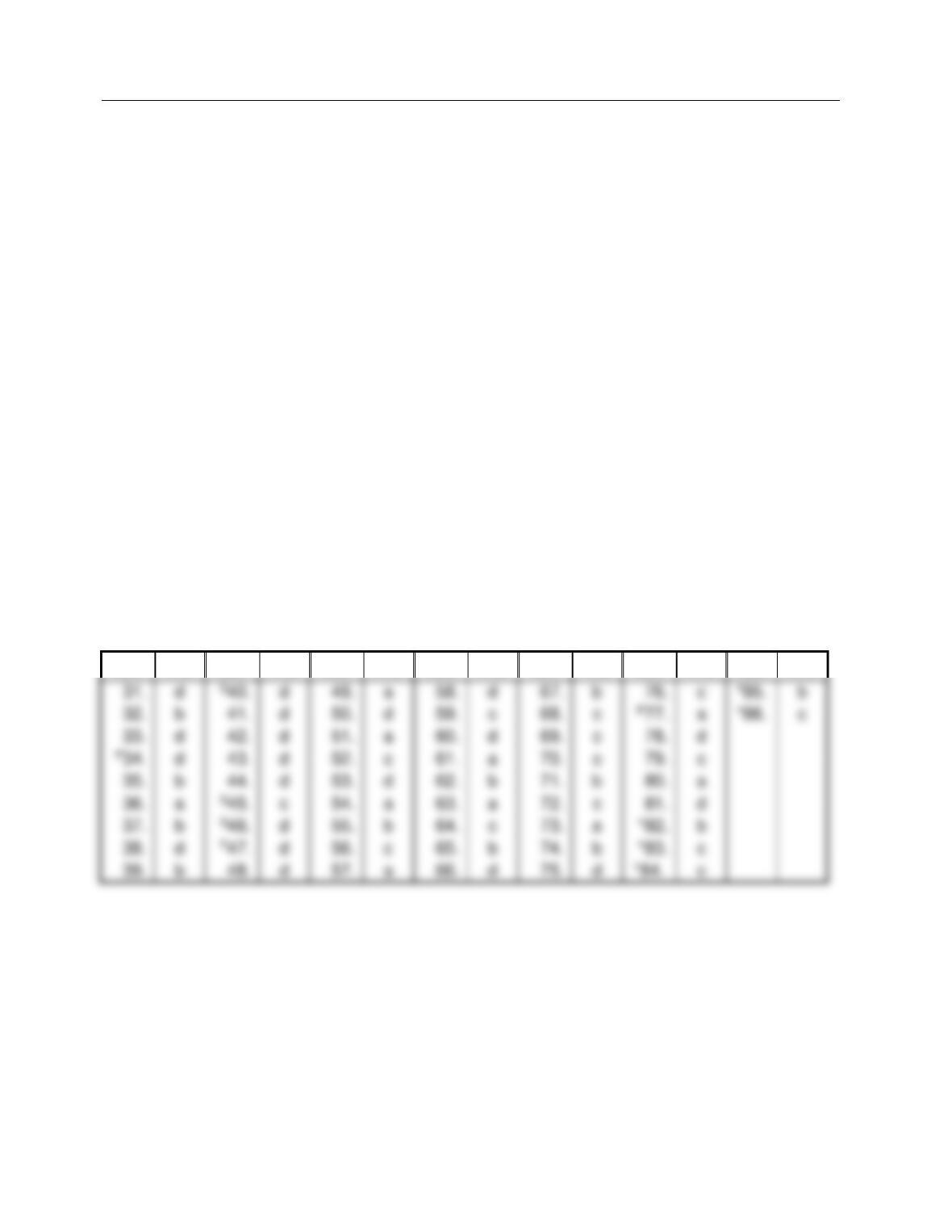
Multiple Choice Answers—Conceptual
Item
Ans.
Item
Ans.
Item
Ans.
Item
Ans.
Item
Ans.
Item
Ans.
Item
Ans.
Solutions to those Multiple Choice questions for which the answer is “none of these.”
33. As receivables.
42. Many answers are possible.
43. Open accounts resulting from short-term extensions of credit to customers.
44. Open accounts resulting from short-term extensions of credit to customers.
66. Overstate, understate, understate, zero.

Cash and Receivables
7 – 13
MULTIPLE CHOICE—Computational
82. Consider the following: Cash in Bank – checking account of €13,500, Cash on hand of
€500, Post-dated checks received totaling €3,500, and Certificates of deposit totaling
€124,000. How much should be reported as cash in the statement of financial position?
a. € 13,500.
b. € 14,000.
c. € 17,500.
d. €131,500.
83. On January 1, 2019, Lynn Company borrows €2,000,000 from National Bank at 11%
annual interest. In addition, Lynn is required to keep a compensatory balance of $200,000
on deposit at National Bank which will earn interest at 5%. The effective interest that Lynn
pays on its €2,000,000 loan is
a. 10.0%.
b. 11.0%.
c. 11.5%.
d. 11.6%.
84. Kennison Company has cash in bank of £10,000, restricted cash in a separate account of
£3,000, and a bank overdraft in an account at another bank of £1,000. Kennison should
report cash of
a. £9,000.
b. £10,000.
c. £12,000.
d. £13,000.
85. Kaniper Company has the following items at year-end:
Cash in bank €20,000
Petty cash 300
Commercial paper with maturity of 2 months 5,500
Postdated checks 1,400
Kaniper should report cash and cash equivalents of
a. €20,000.
b. €20,300.
c. €25,800.
d. €27,200.
86. Lawrence Company has cash in bank of €15,000, restricted cash in a separate account of
€4,000, and a bank overdraft in an account at another bank of €2,000. Lawrence should
report cash of
a. €13,000.
b. €15,000.
c. €18,000.
d. €19,000.

Test Bank for Intermediate Accounting: IFRS Edition, 3e
7 – 14
87. Steinert Company has the following items at year-end:
Cash in bank £30,000
Petty cash 500
Commercial paper with maturity of 2 months 8,200
Postdated checks 2,100
Steinert should report cash and cash equivalents of
a. £30,000.
b. £30,500.
c. £38,700.
d. £40,800.
88. If a company purchases merchandise on terms of 1/10, n/30, the cash discount available
is equivalent to what effective annual rate of interest (assuming a 360-day year)?
a. 1%
b. 12%
c. 18%
d. 30%
89. AG Inc. made a €10,000 sale on account with the following terms: 1/15, n/30. If the
company uses the net method to record sales made on credit, how much should be
recorded as sales revenue?
a. € 9,800
b. € 9,900
c. €10,000
d. €10,100
90. AG Inc. made a €10,000 sale on account with the following terms: 1/15, n/30. If the
company uses the gross method to record sales made on credit, what is/are the debit(s) in
the journal entry to record the sale?
a. Debit Accounts Receivable for €9,900
b. Debit Accounts Receivable for €9,900 and Sales Discounts for €100
c. Debit Accounts Receivable for €10,000
d. Debit Accounts Receivable for €10,000 and Sales Discounts for €100
91. AG Inc. made a €10,000 sale on account with the following terms: 2/10, n/30. If the
company uses the net method to record sales made on credit, what is/are the debit(s) in
the journal entry to record the sale?
a. Debit Accounts Receivable for €9,800
b. Debit Accounts Receivable for €9,800 and Sales Discounts for €200
c. Debit Accounts Receivable for €10,000
d. Debit Accounts Receivable for €10,000 and Sales Discounts for €200
92. Rosalie Co. uses the gross method to record sales made on credit. On June 10, 2019, it
made sales of £100,000 with terms 2/10, n/30 to Finley Farms, Inc. On June 19, 2019,
Rosalie received payment for 1/2 the amount due from Finley Farms. Rosalie’s fiscal year
end is on June 30, 2019. What amount will be reported in the statement of financial
position for the accounts receivable due from Finley Farms, Inc.?
a. £49,000
b. £50,000
c. £48,000
d. £51,000

Cash and Receivables
7 – 15
93. Vivian, Inc had net sales in 2019 of €700,000. At December 31, 2019, before adjusting
entries, the balances in selected accounts were: accounts receivable €125,000 debit, and
allowance for doubtful accounts €1,200 credit. Vivian estimates that 2% of its net sales will
prove to be uncollectable. What is the cash realizable value of the receivables reported on
the statement of financial position at December 31, 2019?
a. €112,200
b. €122,500
c. €111,000
d. €109,800
94. Vivian, Inc had net sales in 2019 of €700,000. At December 31, 2019, before adjusting
entries, the balances in selected accounts were: accounts receivable €125,000 debit, and
allowance for doubtful accounts €1,200 debit. Vivian estimates that 2% of its net accounts
receivable will prove to be uncollectable. What is the cash realizable value of the
receivables reported on the statement of financial position at December 31, 2019?
a. €112,200
b. €122,500
c. €111,000
d. €109,800
95. Rosalie Corporation does business throughout Europe. The company builds and sells
equipment used in manufacturing pharmaceuticals. On December 31, 2019, Rosalie’s
accounts receivable are as follows:
Individually significant receivables
Finley Company € 80,000
Rios, Inc. 200,000
Rafael Co. 120,000
Hunter, Inc. 100,000
All other receivables 500,000
Total €1,000,000
Rosalie Corporation determines that Finley Company’s receivable is impaired by $40,000
and Hunter, Inc.’s receivable is totally impaired. The other receivables from Rafael and
Rios are not considered impaired. Rosalie determines that a composite rate of 2% is
appropriate to measure impairment on all other receivables. What is the total impairment
of receivables for Rosalie Corporation for 2019?
a. €156,400
b. €140,000
c. €150,000
d. €123,600
96. Wave Crest Hotels is located in Canada, but manages an extensive network of boutique
hotels in the United States. Wave Crest has significant receivables from 3 customers,
$480,000 due from Stephanie Inn, $900,000 due from Warren House, and $760,000 due
from Hallmark Hotels. Wave Crest has other receivables totaling $440,000.
Wave Crest determines that the Warren House receivable is impaired by $160,000 and
the Hallmark Hotels receivable is impaired by $200,000. The receivable from the
Stephanie Inn is not considered impaired. Wave Crest determines that a composite rate of

Test Bank for Intermediate Accounting: IFRS Edition, 3e
7 – 16
5% is appropriate to measure impairment on all other receivables. What is the total
impairment of receivables for Wave Crest for 2019?

Cash and Receivables
7 – 17
a. $382,000
b. $314,000
c. $406,000
d. $360,000
97. Wellington Corp. has outstanding accounts receivable totaling €2.54 million as of
December 31 and sales on credit during the year of €12.8 million. There is also a debit
balance of €6,000 in the allowance for doubtful accounts. If the company estimates that
1% of its net credit sales will be uncollectible, what will be the balance in the allowance for
doubtful accounts after the year-end adjustment to record bad debt expense?
a. € 25,400
b. € 31,400
c. €122,000
d. €134,000
98. Wellington Corp. has outstanding accounts receivable totaling €6.5 million as of
December 31 and sales on credit during the year of €24 million. There is also a credit
balance of €12,000 in the allowance for doubtful accounts. If the company estimates that
8% of its outstanding receivables will be uncollectible, what will be the amount of bad debt
expense recognized for the year?
a. € 532,000
b. € 520,000
c. €1,920,000
d. € 508,000
99. Wellington Corp. has outstanding accounts receivable totaling €3 million as of
December 31 and sales on credit during the year of €15 million. There is also a debit
balance of €12,000 in the allowance for doubtful accounts. If the company estimates that
8% of its outstanding receivables will be uncollectible, what will be the balance in the
allowance for doubtful accounts after the year-end adjustment to record bad debt
expense?
a. €1,200,000
b. € 228,000
c. € 240,000
d. € 252,000
100. At the close of its first year of operations, December 31, 2019, Ming Company had
accounts receivable of ¥540,000, after deducting the related allowance for doubtful
accounts. During 2019, the company had charges to bad debt expense of ¥90,000 and
wrote off, as uncollectible, accounts receivable of ¥40,000. What should the company
report on its statement of financial position at December 31, 2019, as accounts receivable
before the allowance for doubtful accounts?
a. ¥670,000
b. ¥590,000
c. ¥490,000
d. ¥440,000

Test Bank for Intermediate Accounting: IFRS Edition, 3e
7 – 18
101. Before year-end adjusting entries, Dunn Company’s account balances at December 31,
2019, for accounts receivable and the related allowance for uncollectible accounts were
£600,000 and £45,000, respectively. An aging of accounts receivable indicated that
£62,500 of the December 31 receivables are expected to be uncollectible. The cash
realizable value of accounts receivable after adjustment is
a. £582,500.
b. £537,500.
c. £492,500.
d. £555,000.
102. During the year, Kiner Company made an entry to write off a €4,000 uncollectible account.
Before this entry was made, the balance in accounts receivable was €50,000 and the
balance in the allowance account was €4,500. The cash realizable value of accounts
receivable after the write–off entry was
a. €50,000.
b. €49,500.
c. €41,500.
d. €45,500.
103. The following information is available for Murphy Company:
Allowance for doubtful accounts at December 31, 2018 £ 8,000
Credit sales during 2019 400,000
Accounts receivable deemed worthless and written off during 2019 9,000
As a result of a review and aging of accounts receivable in early January 2020, however,
it has been determined that an allowance for doubtful accounts of £5,500 is needed at
December 31, 2019. What amount should Murphy record as “bad debt expense” for the
year ended December 31, 2019?
a. £4,500
b. £5,500
c. £6,500
d. £13,500
Use the following information for questions 104 and 105.
A trial balance before adjustments included the following:
Debit Credit
Sales €425,000
Sales returns and allowance €14,000
Accounts receivable 43,000
Allowance for doubtful accounts 760
104. If the estimate of uncollectibles is made by taking 2% of net sales, the amount of the
adjustment is
a. €6,700.
b. €8,220.
c. €8,500.
d. €9,740.

Cash and Receivables
7 – 19
105. If the estimate of uncollectibles is made by taking 10% of gross account receivables, the
amount of the adjustment is
a. €3,540.
b. €4,300.
c. €4,224.
d. €5,060.
106. Lankton Company has the following account balances at year–end:
Accounts receivable £60,000
Allowance for doubtful accounts 3,600
Sales discounts 2,400
Lankton should report accounts receivable at a net amount of
a. £54,000.
b. £56,400.
c. £57,600.
d. £60,000.
107. Smithson Corporation had a 1/1/19 balance in the Allowance for Doubtful Accounts of
€10,000. During 2019, it wrote off €7,200 of accounts and collected €2,100 on accounts
previously written off. The balance in Accounts Receivable was €200,000 at 1/1 and
€240,000 at 12/31. At 12/31/19, Smithson estimates that 5% of accounts receivable will
prove to be uncollectible. What is Bad Debt Expense for 2019?
a. €2,000
b. €7,100
c. €9,200
d. €12,000
108. Black Corporation had a 1/1/19 balance in the Allowance for Doubtful Accounts of
£12,000. During 2019, it wrote off £8,640 of accounts and collected £2,520 on accounts
previously written off. The balance in Accounts Receivable was £240,000 at 1/1 and
£288,000 at 12/31. At 12/31/19, Black estimates that 5% of accounts receivable will prove
to be uncollectible. What should Black report as its Allowance for Doubtful Accounts at
12/31/19?
a. £5,760
b. £5,880
c. £8,280
d. £14,400
109. Shelton Company has the following account balances at year–end:
Accounts receivable €80,000
Allowance for doubtful accounts 4,800
Sales discounts 3,200
Shelton should report accounts receivable at a net amount of
a. €72,000.
b. €75,200.
c. €76,800.
d. €80,000.

Test Bank for Intermediate Accounting: IFRS Edition, 3e
7 – 20
110. Vasguez Corporation had a 1/1/19 balance in the Allowance for Doubtful Accounts of
€20,000. During 2019, it wrote off €14,400 of accounts and collected €4,200 on accounts
previously written off. The balance in Accounts Receivable was €400,000 at 1/1 and
€480,000 at 12/31. At 12/31/19, Vasguez estimates that 5% of accounts receivable will
prove to be uncollectible. What is Bad Debt Expense for 2019?
a. €4,000
b. €14,200
c. €18,400
d. €24,000
111. McGlone Corporation had a 1/1/19 balance in the Allowance for Doubtful Accounts of
€15,000. During 2019, it wrote off €10,800 of accounts and collected €3,150 on accounts
previously written off. The balance in Accounts Receivable was €300,000 at 1/1 and
€360,000 at 12/31. At 12/31/19, McGlone estimates that 5% of accounts receivable will
prove to be uncollectible. What should McGlone report as its Allowance for Doubtful
Accounts at 12/31/19?
a. €7,200
b. €7,350
c. €10,350
d. €18,000
112. Lester Company received a seven-year zero-interest-bearing note on February 22, 2018,
in exchange for property it sold to Porter Company. There was no established exchange
price for this property and the note has no ready market. The prevailing rate of interest for
a note of this type was 7% on February 22, 2018, 7.5% on December 31, 2018, 7.7% on
February 22, 2019, and 8% on December 31, 2019. What interest rate should be used to
calculate the interest revenue from this transaction for the years ended December 31,
2018 and 2016, respectively?
a. 0% and 0%
b. 7% and 7%
c. 7% and 7.7%
d. 7.5% and 8%
113. On December 31, 2019, Flint Corporation sold for €75,000 an old machine having an
original cost of €135,000 and a book value of €60,000. The terms of the sale were as
follows:
€15,000 down payment
€30,000 payable on December 31 each of the next two years
The agreement of sale made no mention of interest; however, 9% would be a fair rate for
this type of transaction. What should be the amount of the notes receivable net of the
unamortized discount on December 31, 2019 rounded to the nearest dollar? (The present
value of an ordinary annuity of 1 at 9% for 2 years is 1.75911.)
a. €52,773
b. €67,773
c. €60,000
d. €105,546

Cash and Receivables
7 – 21
114. Assume Royal Palm Corp., an equipment distributor, sells a piece of machinery with a list
price of £800,000 to Arch Inc. Arch Inc. will pay £850,000 in one year. Royal Palm Corp.
normally sells this type of equipment for 90% of list price. How much should be recorded
as sales revenue?
a. £720,000
b. £765,000
c. £800,000
d. £850,000
115. Equestrain Roads sold €50,000 of goods and accepted the customer’s €50,000 10%
1-year note receivable in exchange. Assuming 10% approximates the market rate of
return, what would be the debit in this journal entry to record the sale?
a. No journal entry until cash is collected
b. Debit Notes Receivable for €50,000
c. Debit Accounts Receivable for €50,000
d. Debit Notes Receivable for €45,000
116. Equestrain Roads sold €50,000 of goods and accepted the customer’s €50,000 10%
1-year note in exchange. Assuming 10% approximates the market rate of return, how
much interest would be recorded for the year ending December 31 if the sale was made
on June 30?
a. €0
b. €1,250
c. €2,500
d. €5,000
117. Equestrain Roads accepted a customer’s €50,000 zero-interest-bearing six-month note in
a sales transaction. The product sold normally sells for €46,000. If the sale was made on
June 30, how much interest revenue from this transaction would be recorded for the year
ending December 31?
a. €0
b. €2,000
c. €4,000
d. €5,000
118. Assuming the market interest rate is 10% per annum, how much would Green Co. record
as a note payable if the terms of the loan with a bank are that it would have to make one
£60,000 payment in two years?
a. £60,000
b. £54,422
c. £54,545
d. £49,587
119. Sun Inc. factors €2,000,000 of its accounts receivables without guarantee (recourse) for a
finance charge of 5%. The finance company retains an amount equal to 10% of the
accounts receivable for possible adjustments. What would be recorded by Sun as a gain
(loss) on the transfer of receivables?
a. Loss of €100,000
b. Gain of €100,000
c. Loss of €300,000
d. Loss of €200,000

Test Bank for Intermediate Accounting: IFRS Edition, 3e
7 – 22
120. Sun Inc. factors €2,000,000 of its accounts receivables with guarantee (recourse) for a
finance charge of 3%. The finance company retains an amount equal to 10% of the
accounts receivable for possible adjustments. What would be recorded as a gain (loss) on
the transfer of receivables?
a. Gain of €60,000
b. Loss of €60,000
c. Loss of €260,000
d. €0
121. Sun Inc assigns €2,000,000 of its accounts receivables as collateral for a €1 million 8%
loan with a bank. Sun Inc. also pays a finance fee of 1% on the transaction upfront. What
would be recorded as a gain (loss) on the transfer of receivables?
a. Loss of €20,000
b. Loss of €160,000
c. Loss of €180,000
d. €0
122. Moon Inc. factors €1,000,000 of its accounts receivables with guarantee (recourse) for a
finance charge of 4%. The finance company retains an amount equal to 8% of the
accounts receivable for possible adjustments. What would be the debit to Cash in the
journal entry to record this transaction?
a. €1,000,000
b. €960,000
c. €880,000
d. €780,000
123. Moon Inc assigns €1,500,000 of its accounts receivables as collateral for a €1 million loan
with a bank. The bank assesses a 3% finance fee and charges interest on the note at 6%.
What would be the journal entry to record this transaction?
a. Debit Cash for €970,000, debit Interest Expense for €30,000, and credit Notes
Payable for €1,000,000.
b. Debit Cash for €970,000, debit Interest Expense for €30,000, and credit Accounts
Receivable for €1,000,000.
c. Debit Cash for €970,000, debit Interest Expense for €30,000, debit Due from Bank for
€500,000, and credit Accounts Receivable for €1,500,000.
d. Debit Cash for €910,000, debit Interest Expense for €90,000, and credit Notes
Payable for €1,000,000.
Use the following information for questions 124 and 125.
Geary Co. assigned £400,000 of accounts receivable to Kwik Finance Co. as security for a loan
of £335,000. Kwik charged a 2% commission on the amount of the loan; the interest rate on the
note was 10%. During the first month, Geary collected £110,000 on assigned accounts after
deducting £380 of discounts. Geary accepted returns worth £1,350 and wrote off assigned
accounts totaling £2,980.
124. The amount of cash Geary received from Kwik at the time of the transfer was
a. £301,500.
b. £327,000.
c. £328,300.
d. £335,000.

Cash and Receivables
7 – 23
125. Entries during the first month would include a
a. debit to Cash of £110,380.
b. debit to Bad Debt Expense of £2,980.
c. debit to Allowance for Doubtful Accounts of £2,980.
d. debit to Accounts Receivable of £114,710.
Use the following information for questions 126 and 127.
On February 1, 2019, Henson Company factored receivables with a carrying amount of €300,000
to Agee Company. Agee Company assesses a finance charge of 3% of the receivables and
retains 5% of the receivables. Relative to this transaction, you are to determine the amount of
loss on sale to be reported in the income statement of Henson Company for February.
126. Assume that Henson factors the receivables on a without guarantee (recourse) basis. The
loss to be reported is
a. €0.
b. €9,000.
c. €15,000.
d. €24,000.
127. Assume that Henson factors the receivables on a with guarantee (recourse) basis. The
amount of cash received is
a. €285,000.
b. €276,000.
c. €291,000.
d. €300,000.
128. Maxwell Corporation factored, with guarantee (recourse), £100,000 of accounts receivable
with Huskie Financing. The finance charge is 3%, and 5% was retained to cover sales
discounts, sales returns, and sales allowances. What amount of cash would Maxwell
receive on the sale of receivables?
a. £97,000
b. £95,000
c. £92,000
d. £100,000
129. Wilkinson Corporation factored, with guarantee (recourse), €400,000 of accounts
receivable with Huskie Financing. The finance charge is 3%, and 5% was retained to
cover sales discounts, sales returns, and sales allowances. What amount of cash would
Wilkinson receive on the sale of receivables?
a. €388,000
b. €380,000
c. €368,000
d. €400,000
130. Remington Corporation had accounts receivable of €100,000 at 1/1. The only transactions
affecting accounts receivable were sales of €600,000 and cash collections of €550,000.
The accounts receivable turnover is
a. 4.0.
b. 4.4.
c. 4.8.
d. 6.0.

Test Bank for Intermediate Accounting: IFRS Edition, 3e
7 – 24
131. Laventhol Corporation had accounts receivable of €100,000 at 1/1. The only transactions
affecting accounts receivable were sales of €900,000 and cash collections of €850,000.
The accounts receivable turnover is
a. 6.0.
b. 6.6.
c. 7.2.
d. 9.0.
*132. If a petty cash fund is established in the amount of £250, and contains £150 in cash and
£95 in receipts for disbursements when it is replenished, the journal entry to record
replenishment should include credits to the following accounts
a. Petty Cash, £75.
b. Petty Cash, £100.
c. Cash, £95; Cash Over and Short, £5.
d. Cash, £100.
*133. If the month-end bank statement shows a balance of €36,000, outstanding checks are
€12,000, a deposit of €4,000 was in transit at month end, and a check for €500 was
erroneously charged by the bank against the account, the correct balance in the bank
account at month end is
a. €27,500.
b. €28,500.
c. €20,500.
d. €43,500.
*134. In preparing its bank reconciliation for the month of April 2019, Henke, Inc. has available
the following information.
Balance per bank statement, 4/30/19 €39,140
NSF check returned with 4/30/19 bank statement 450
Deposits in transit, 4/30/19 5,000
Outstanding checks, 4/30/19 5,200
Bank service charges for April 20
What should be the correct balance of cash at April 30, 2019?
a. €39,370
b. €38,940
c. €38,490
d. €38,470
*135. Finley, Inc.’s checkbook balance on December 31, 2019 was €21,200. In addition, Finley
held the following items in its safe on December 31.
(1) A check for €450 from Peters, Inc. received December 30, 2019, which was not
included in the checkbook balance.
(2) An NSF check from Garner Company in the amount of €900 that had been
deposited at the bank, but was returned for lack of sufficient funds on December
29. The check was to be redeposited on January 3, 2020. The original deposit
has been included in the December 31 checkbook balance.
(3) Coin and currency on hand amounted to €1,450.
Cash and Receivables
7 – 25
The proper amount to be reported on Finley’s statement of financial position for cash at
December 31, 2019 is
a. €21,300.
b. €20,400.
c. €22,200.
d. €21,750.
*136. The cash account shows a balance of £45,000 before reconciliation. The bank statement
does not include a deposit of £2,300 made on the last day of the month. The bank
statement shows a collection by the bank of £940 and a customer’s check for £320 was
returned because it was NSF. A customer’s check for £450 was recorded on the books as
£540, and a check written for £79 was recorded as £97. The correct balance in the cash
account was
a. £45,512.
b. £45,548.
c. £45,728.
d. £47,848.
*137. In preparing its May 31, 2019 bank reconciliation, Catt Co. has the following information
available:
Balance per bank statement, 5/31/19 €30,000
Deposit in transit, 5/31/19 5,400
Outstanding checks, 5/31/19 4,900
Note collected by bank in May 1,250
The correct balance of cash at May 31, 2019 is
a. €35,400.
b. €29,250.
c. €30,500.
d. €31,750.
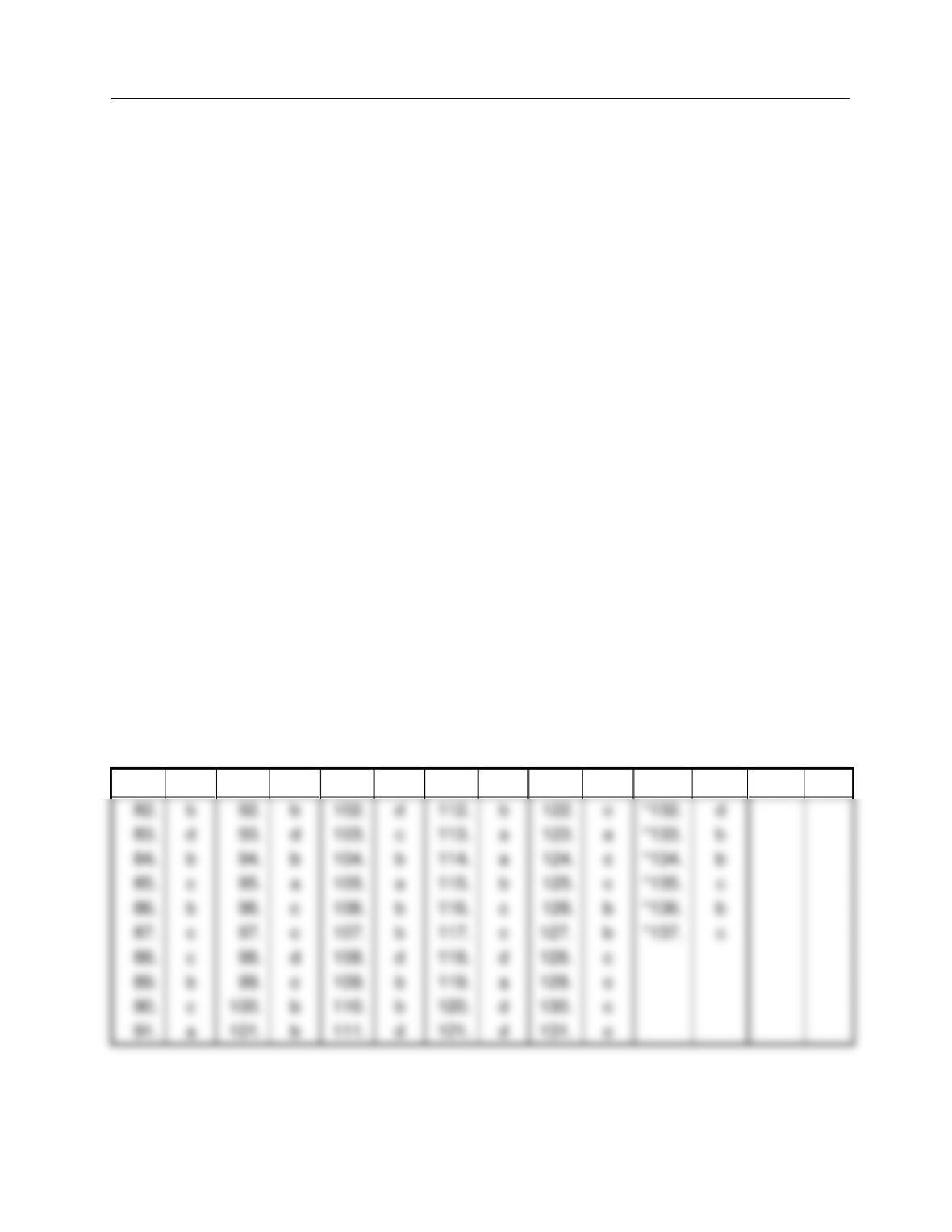
Multiple Choice Answers—Computational
Item
Ans.
Item
Ans.
Item
Ans.
Item
Ans.
Item
Ans.
Item
Ans.
Item
Ans

Test Bank for Intermediate Accounting: IFRS Edition, 3e
7 – 26
MULTIPLE CHOICE—CPA Adapted
138. On the December 31, 2019 statement of financial position of Vanoy Co., the current
receivables consisted of the following:
Trade accounts receivable € 75,000
Allowance for uncollectible accounts (2,000)
Claim against shipper for goods lost in transit (November 2019) 3,000
Selling price of unsold goods sent by Vanoy on consignment
at 130% of cost (not included in Vanoy ‘s ending inventory) 26,000
Security deposit on lease of warehouse used for storing
some inventories 30,000
Total €132,000
At December 31, 2019, the correct total of Vanoy’s current net receivables was
a. €76,000.
b. €102,000.
c. €106,000.
d. €132,000.
139. Ace Co. prepared an aging of its accounts receivable at December 31, 2019 and
determined that the net realizable value of the receivables was £300,000. Additional
information is available as follows:
Allowance for uncollectible accounts at 1/1/19—credit balance £ 34,000
Accounts written off as uncollectible during 2019 23,000
Accounts receivable at 12/31/19 325,000
Uncollectible accounts recovered during 2019 5,000
For the year ended December 31, 2019, Ace’s bad debt expense would be
a. £25,000.
b. £23,000.
c. £16,000.
d. £9,000.
140. For the year ended December 31, 2019, Dent Co. estimated its allowance for uncollectible
accounts using the year-end aging of accounts receivable. The following data are available:
Allowance for uncollectible accounts, 1/1/19 €56,000
Provision for uncollectible accounts during 2019
(2% on credit sales of €2,000,000) 40,000
Uncollectible accounts written off, 11/30/19 46,000
Estimated uncollectible accounts per aging, 12/31/19 69,000
After year-end adjustment, the uncollectible accounts expense for 2019 should be
a. €46,000.
b. €62,000.
c. €69,000.
d. €59,000.

Cash and Receivables
7 – 27
141. Nenn Co.’s allowance for uncollectible accounts was €95,000 at the end of 2019 and
€90,000 at the end of 2018. For the year ended December 31, 2019, Nenn reported bad
debt expense of €13,000 in its income statement. What amount did Nenn debit to the
appropriate account in 2019 to write off actual bad debts?
a. €5,000
b. €8,000
c. €13,000
d. €18,000
142. Under the allowance method of recognizing uncollectible accounts, the entry to write off
an uncollectible account
a. increases the allowance for uncollectible accounts.
b. has no effect on the allowance for uncollectible accounts.
c. has no effect on net income.
d. decreases net income.
143. The following accounts were abstracted from Starr Co.’s unadjusted trial balance at
December 31, 2019:
Debit Credit
Accounts receivable €750,000
Allowance for uncollectible accounts 8,000
Net credit sales $3,000,000
Starr estimates that 2% of the gross accounts receivable will become uncollectible. After
adjustment at December 31, 2019, the allowance for uncollectible accounts should have a
credit balance of
a. €60,000.
b. €52,000.
c. €23,000.
d. €15,000.
144. On January 1, 2018, West Co. exchanged equipment for a £400,000 zero-interest-bearing
note due on January 1, 2021. The prevailing rate of interest for a note of this type at
January 1, 2018 was 10%. The present value of $1 at 10% for three periods is 0.75. What
amount of interest revenue should be included in West’s 2019 income statement?
a. £0
b. £30,000
c. £33,000
d. £40,000
145. On June 1, 2018, Yang Corp. loaned Gant €300,000 on a 12% note, payable in five
annual installments of €60,000 beginning January 2, 2019. In connection with this loan,
Gant was required to deposit €3,000 in a zero-interest-bearing escrow account. The
amount held in escrow is to be returned to Gant after all principal and interest payments
have been made. Interest on the note is payable on the first day of each month beginning
July 1, 2018. Gant made timely payments through November 1, 2018. On January 2, 2019,
Yang received payment of the first principal installment plus all interest due. At
December 31, 2018, Yang’s interest receivable on the loan to Gant should be
a. €0.
b. €3,000.
c. €6,000.
d. €9,000.

Test Bank for Intermediate Accounting: IFRS Edition, 3e
7 – 28
146. Which of the following is a method to generate cash from accounts receivable?
Assignment Factoring
a. Yes No
b. Yes Yes
c. No Yes
d. No No
*147. In preparing its August 31, 2019 bank reconciliation, Bing Corp. has available the
following information:
Balance per bank statement, 8/31/19 €21,650
Deposit in transit, 8/31/19 3,900
Return of customer’s check for insufficient funds, 8/30/19 600
Outstanding checks, 8/31/19 2,750
Bank service charges for August 100
At August 31, 2019, Bing’s correct cash balance is
a. €22,800.
b. €22,200.
c. €22,100.
d. €20,500.
*148. Tresh, Inc. had the following bank reconciliation at March 31, 2019:
Balance per bank statement, 3/31/19 £37,200
Add: Deposit in transit 10,300
47,500
Less: Outstanding checks 12,600
Balance per books, 3/31/19 £34,900
Data per bank for the month of April 2019 follow:
Deposits £46,700
Disbursements 49,700
All reconciling items at March 31, 2019 cleared the bank in April. Outstanding checks at
April 30, 2019 totaled £6,000. There were no deposits in transit at April 30, 2019. What is
the cash balance per books at April 30, 2019?
a. £28,200
b. £31,900
c. £34,200
d. £38,500
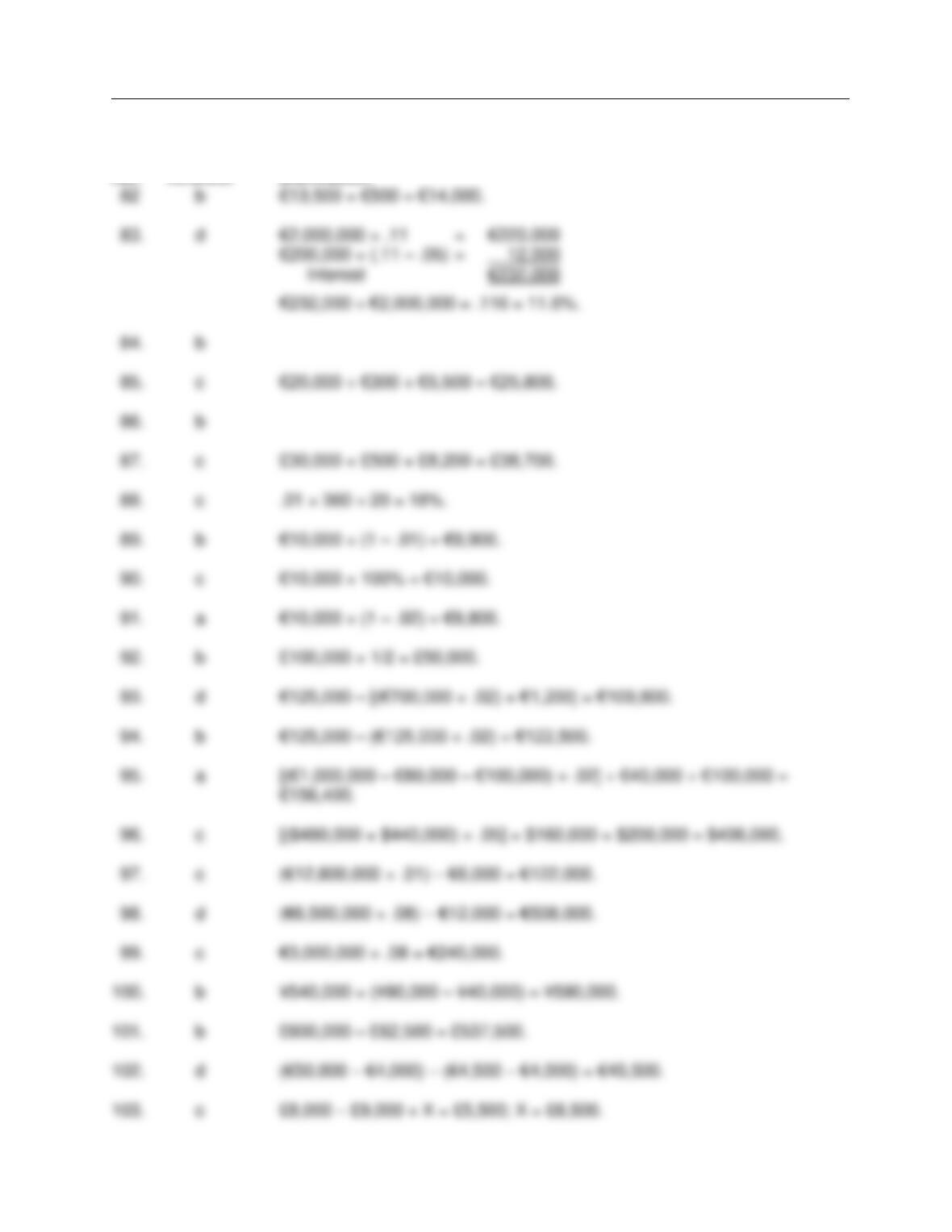
Multiple Choice Answers—CPA Adapted
Item
Ans.
Item
Ans.
Item
Ans.
Item
Ans.
Item
Ans.
Item
Ans.
Cash and Receivables
7 – 29
DERIVATIONS — Computational
No. Answer Derivation

Test Bank for Intermediate Accounting: IFRS Edition, 3e
7 – 30
Cash and Receivables
7 – 31

Test Bank for Intermediate Accounting: IFRS Edition, 3e
7 – 32
Cash and Receivables
7 – 33
DERIVATIONS — CPA Adapted
No. Answer Derivation

Test Bank for Intermediate Accounting: IFRS Edition, 3e
7 – 34
EXERCISES
Ex. 7-149—Asset classification.
Below is a list of items. Classify each into one of the following statement of financial position
categories:
a. Cash c. Short-term Investments
b. Receivables d. Other
___ 1. Compensating balances held in long-term borrowing arrangements
___ 2. Savings account
___ 3. Money market funds
___ 4. Checking account
___ 5. Postage stamps
___ 6. Treasury bills maturing in six months
___ 7. Post-dated checks from customers
___ 8. Certificate of deposit maturing in five years
___ 9. Ordinary shares of another company (to be sold by December 31, this year)
___ 10. Petty cash
Solution 7-149
Ex. 7-150—Allowance for doubtful accounts.
When a company has a policy of making sales for which credit is extended, it is reasonable to
expect a portion of those sales to be uncollectible. As a result of this, a company must recognize
bad debt expense. There are basically two methods of recognizing bad debt expense: (1) direct
write-off method, and (2) allowance method.
Instructions
(a) Describe fully both the direct write-off method and the allowance method of recognizing bad
debt expense.
(b) Discuss the reasons why one of the above methods is preferable to the other and the reasons
why the other method is not usually in accordance with IFRS.
Cash and Receivables
7 – 35
Solution 7-150
Ex. 7-151—Entry for bad debt expense.
A trial balance before adjustment included the following:
Debit Credit
Accounts receivable €80,000
Allowance for doubtful accounts 730
Sales €340,000
Sales returns and allowances 8,000
Give journal entries assuming that the estimate of uncollectibles is determined by taking 5% of
gross accounts receivable.
Solution 7-151
Test Bank for Intermediate Accounting: IFRS Edition, 3e
7 – 36
Ex. 7-152—Accounts receivable assigned.
Accounts receivable in the amount of £250,000 were assigned to the Fast Finance Company by
Marsh, Inc., as security for a loan of £200,000. The finance company charged a 4% commission
on the face amount of the loan, and the note bears interest at 9% per year.
During the first month, Marsh collected £130,000 on assigned accounts. This amount was
remitted to the finance company along with one month’s interest on the note.
Instructions
Make all the entries for Marsh Inc. associated with the assignment of the accounts receivable, the
loan, and the remittance to the finance company.
Solution 7-152
Ex. 7-153—Fair Value Option.
Ellison Company sells large store-rack systems and frequently accepts notes receivable from
customers as payment. Ellison conducts a thorough credit check on its customers, and it charges
a fairly low interest rate (½ of 1% payable monthly) on these notes. Ellison has elected to use the
fair value option for one of these notes and has the following data related to the carrying and fair
value for this note.
Carrying Value Fair Value
December 31, 2015 €88,000 €85,000
December 31, 2016 72,000 76,000
Instructions
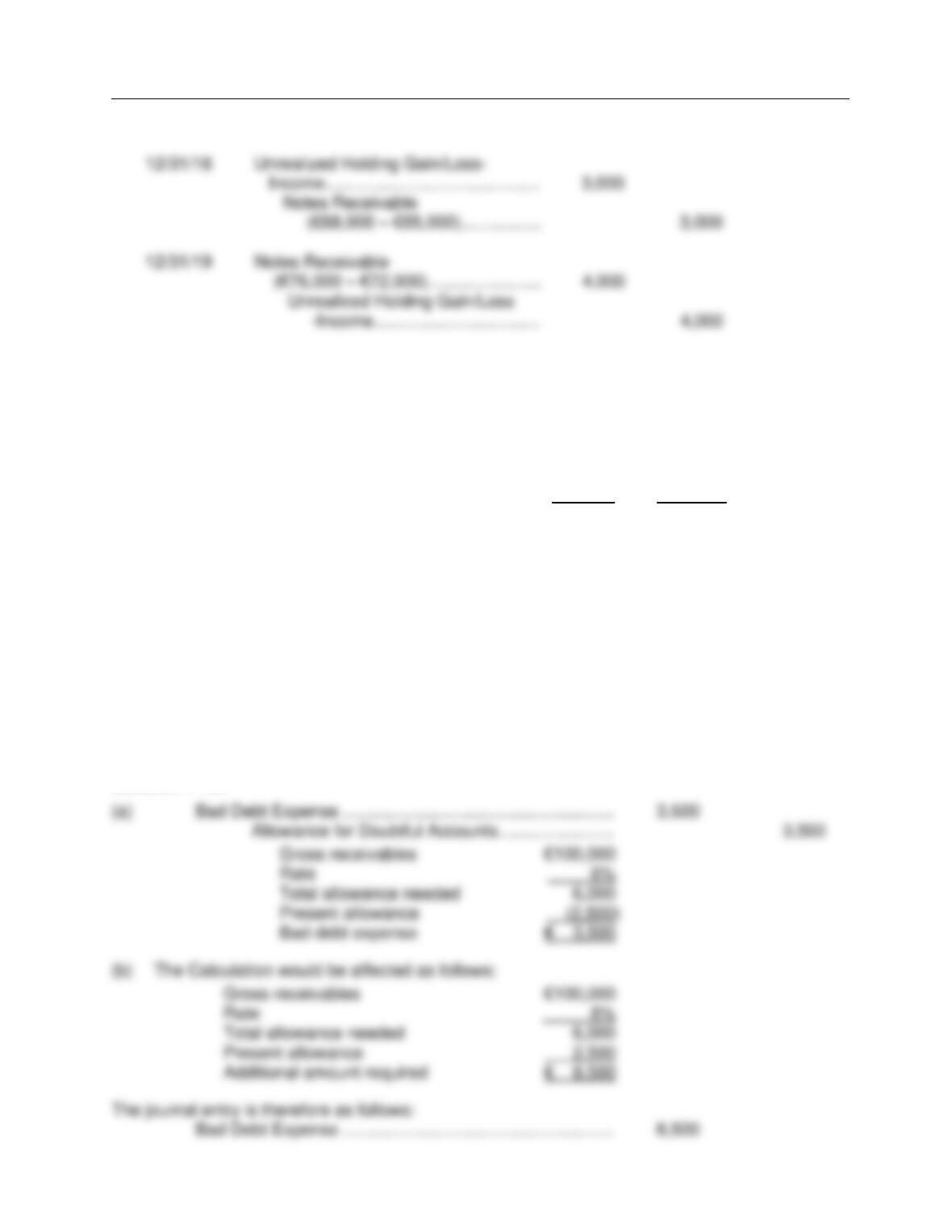
Prepare the journal entry at December 31 (Ellison’s Year-end) for 2018, and 2019, to record the
fair value option for these notes.
Cash and Receivables
7 – 37
Solution 7-153
PROBLEMS
Pr. 7-154—Entries for bad debt expense.
The trial balance before adjustment of Risen Company reports the following balances:
Dr. Cr.
Accounts receivable €100,000
Allowance for doubtful accounts € 2,500
Sales (all on credit) 750,000
Sales returns and allowances 40,000
Instructions
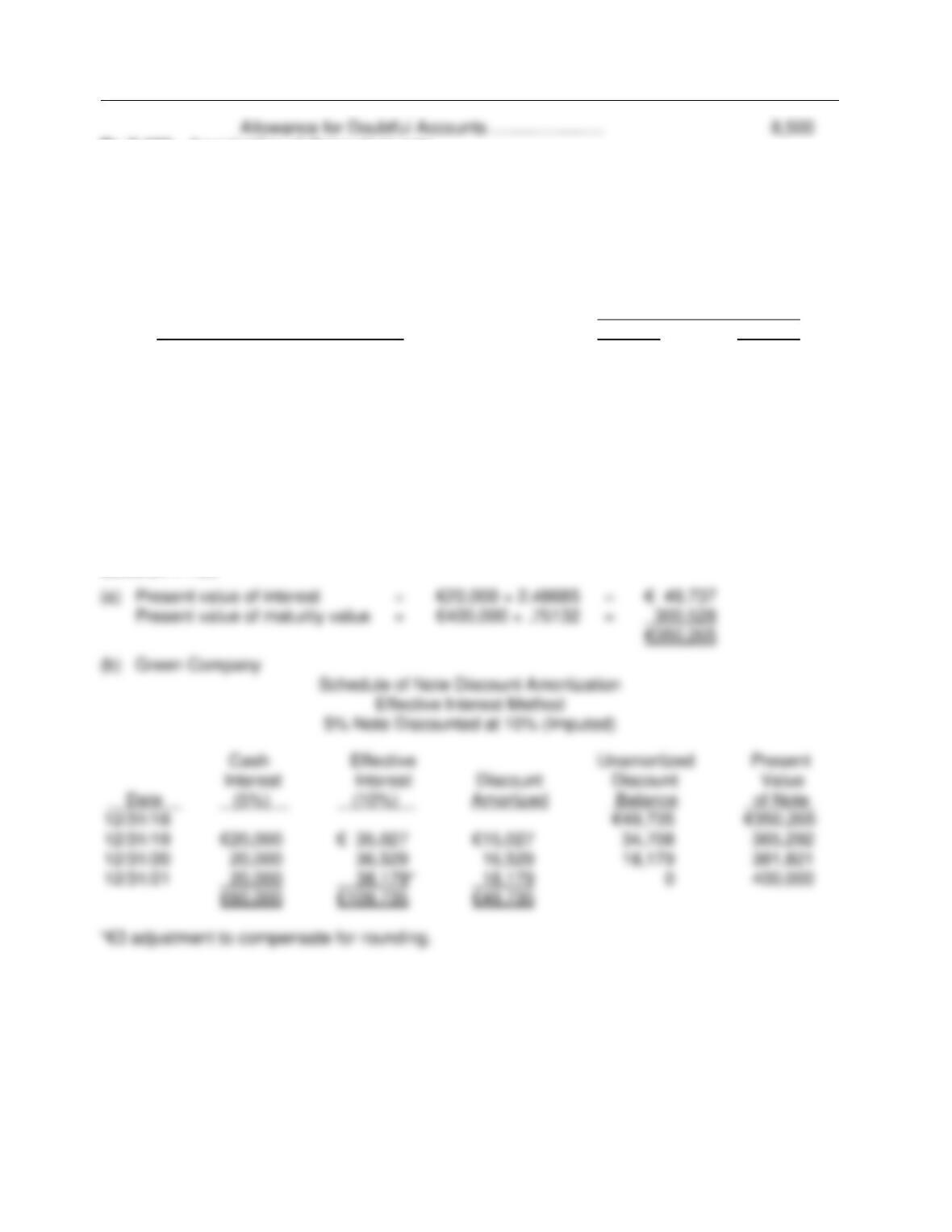
(a) Prepare the entry for estimated bad debts assuming that doubtful accounts are estimated to
be 6% of gross accounts receivable.
(b) Assume that all the information above is the same, except that the Allowance for Doubtful
Accounts has a debit balance of €2,500 instead of a credit balance. How will this difference
affect the journal entry in part (a)?
Solution 7-154
Test Bank for Intermediate Accounting: IFRS Edition, 3e
7 – 38
Pr. 7-155—Amortization of discount on note.
On December 31, 2018, Green Company finished consultation services and accepted in
exchange a promissory note with a face value of €400,000, a due date of December 31, 2021,
and a stated rate of 5%, with interest receivable at the end of each year. The fair value of the
services is not readily determinable and the note is not readily marketable. Under the
circumstances, the note is considered to have an appropriate imputed rate of interest of 10%.
The following interest factors are provided:
Interest Rate
Table Factors For Three Periods 5% 10%
Future Value of 1 1.15763 1.33100
Present Value of 1 .86384 .75132
Future Value of Ordinary Annuity of 1 3.15250 3.31000
Present Value of Ordinary Annuity of 1 2.72325 2.48685
Instructions
(a) Determine the present value of the note.
(b) Prepare a Schedule of Note Discount Amortization for Green Company under the effective
interest method. (Round to whole dollars.)
Solution 7-155
Pr. 7-156—Accounts receivable assigned.
Prepare journal entries for Mars Co. for:
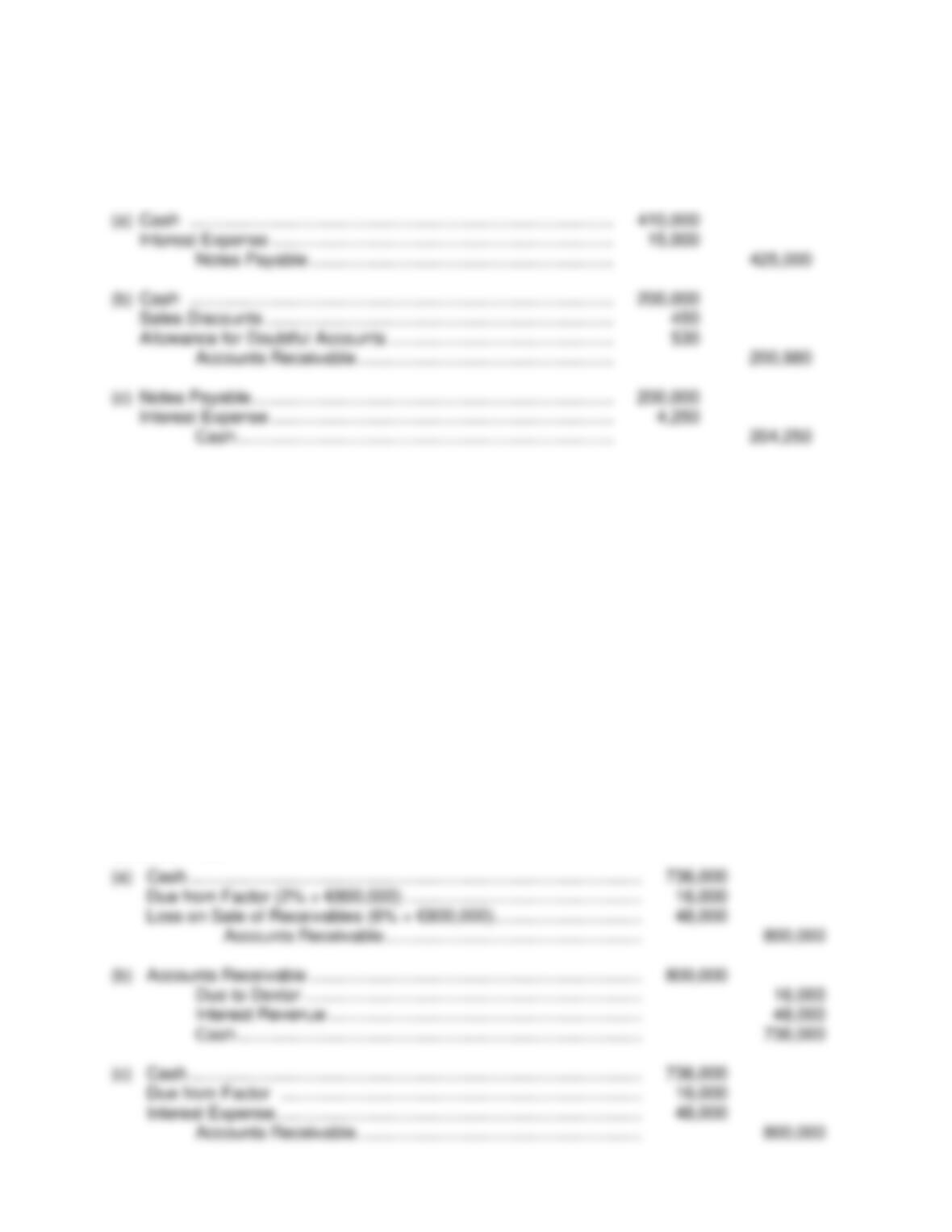
(a) Accounts receivable in the amount of £500,000 were assigned to Utley Finance Co. by Mars
as security for a loan of £425,000. Utley charged a 3% commission on the accounts; the
interest rate on the note is 12%.
Cash and Receivables
7 – 39
(b) During the first month, Mars collected £200,000 on assigned accounts after deducting £450 of
discounts. Mars wrote off a £530 assigned account.
(c) Mars paid to Utley the amount collected plus one month’s interest on the note.
Solution 7-156
Pr. 7-157—Factoring Accounts Receivable.
On May 1, Dexter, Inc. factored €800,000 of accounts receivable with Quick Finance on a without
recourse basis. Under the arrangement, Dexter was to handle disputes concerning service, and
Quick Finance was to make the collections, handle the sales discounts, and absorb the credit
losses. Quick Finance assessed a finance charge of 6% of the total accounts receivable factored
and retained an amount equal to 2% of the total receivables to cover sales discounts.
Instructions
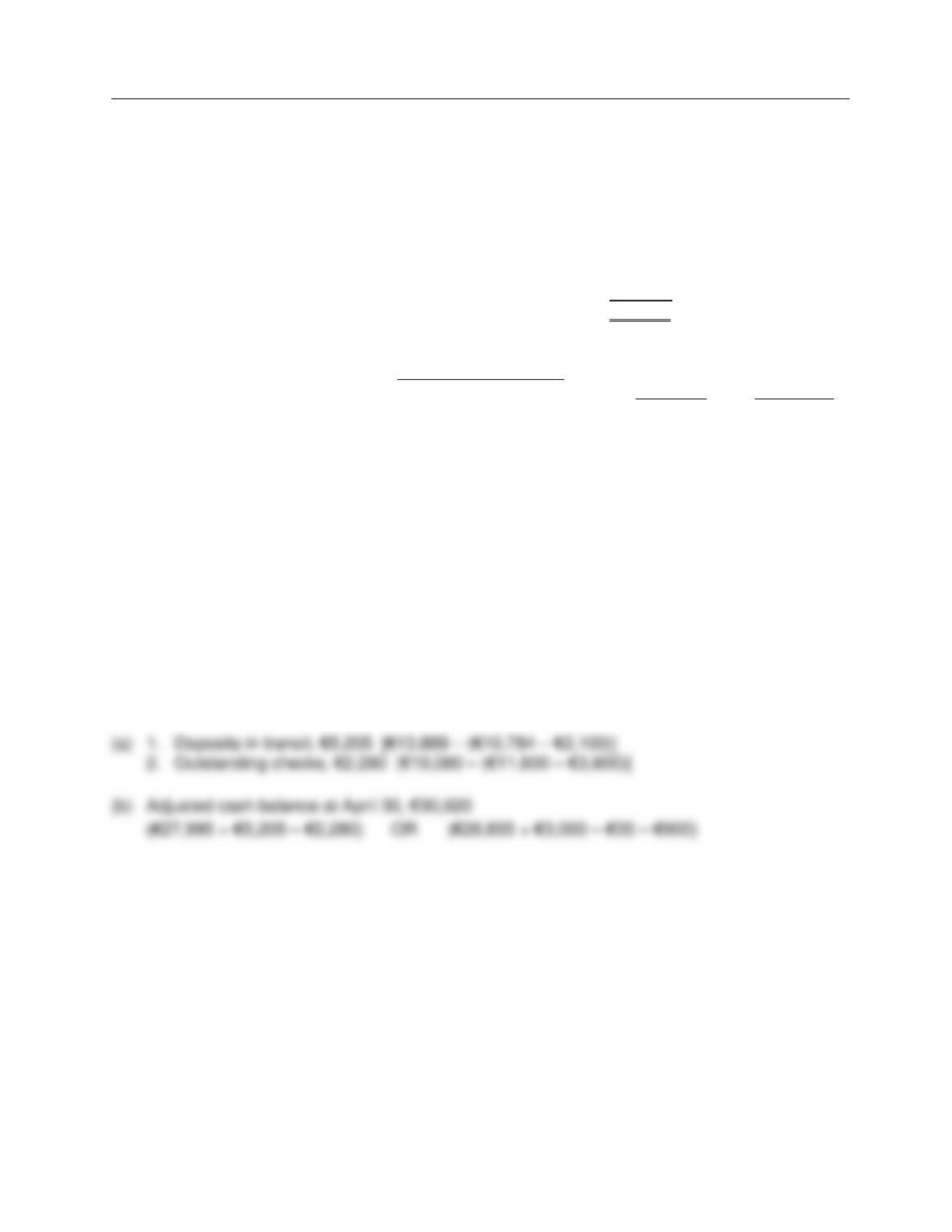
(a) Prepare the journal entry required on Dexter’s books on May 1.
(b) Prepare the journal entry required on Quick Finance’s books on May 1.
(c) Assume Dexter factors the €800,000 of accounts receivable with Quick Finance on a with
recourse basis instead. Prepare the journal entry required on Dexter’s books on May 1.
Solution 7-157

Test Bank for Intermediate Accounting: IFRS Edition, 3e
7 – 40
Cash and Receivables
7 – 41
*Pr. 7-158—Bank reconciliation.
Benson Plastics Company deposits all receipts and makes all payments by check. The following
information is available from the cash records:
MARCH 31 BANK RECONCILIATION
Balance per bank €26,746
Add: Deposits in transit 2,100
Deduct: Outstanding checks (3,800)
Balance per books €25,046
Month of April Results
Per Bank Per Books
Balance April 30 €27,995 €28,855
April deposits 10,784 13,889
April checks 11,600 10,080
April note collected (not included in April deposits) 3,000 -0-
April bank service charge 35 -0-
April NSF check of a customer returned by the bank
(recorded by bank as a charge) 900 -0-
Instructions
(a) Calculate the amount of the April 30:
1. Deposits in transit
2. Outstanding checks
(b) What is the April 30 adjusted cash balance? Show all work.
*Solution 7-158