Chapter 07 Reporting and Analyzing Receivables Answer Key
True / False Questions
1.
A receivable is an amount due from another party.
2.
Credit sales are recorded by crediting an Accounts Receivable.
3.
As long as a company accurately records total credit sales information, it is not necessary
to have an accounts receivable ledger with separate accounts for specific customers.
4.
If a customer owes interest on accounts receivable, Interest Receivable is debited and
Accounts Receivable is credited.
5.
If a credit card sale is made, the seller can either debit Cash or debit Accounts Receivable
at the time of the sale, depending on the type of credit card.
6.
Installment Accounts Receivable are classified as non-current assets if the installment
period is more than one year, even if the seller regularly offers customers such terms.
7.
Companies can report credit card expense as a discount deducted from sales or as a
selling expense.
8.
BizCom’s customer, Redding, paid off an $8,300 balance on its account receivable. BizCom
should record the transaction as a debit to Accounts Receivable—Redding and a credit to
Cash.
9.
The maturity date of a note refers to the date the note must be repaid.
10.
A promissory note is a written promise to pay a specified amount of money either on
demand or at a definite future date.
11.
The formula for computing interest on a note is: Principal of the note × Annual interest
rate × Time expressed in fraction of year.
12.
The person that borrows money and signs a promissory note is called the maker.
13.
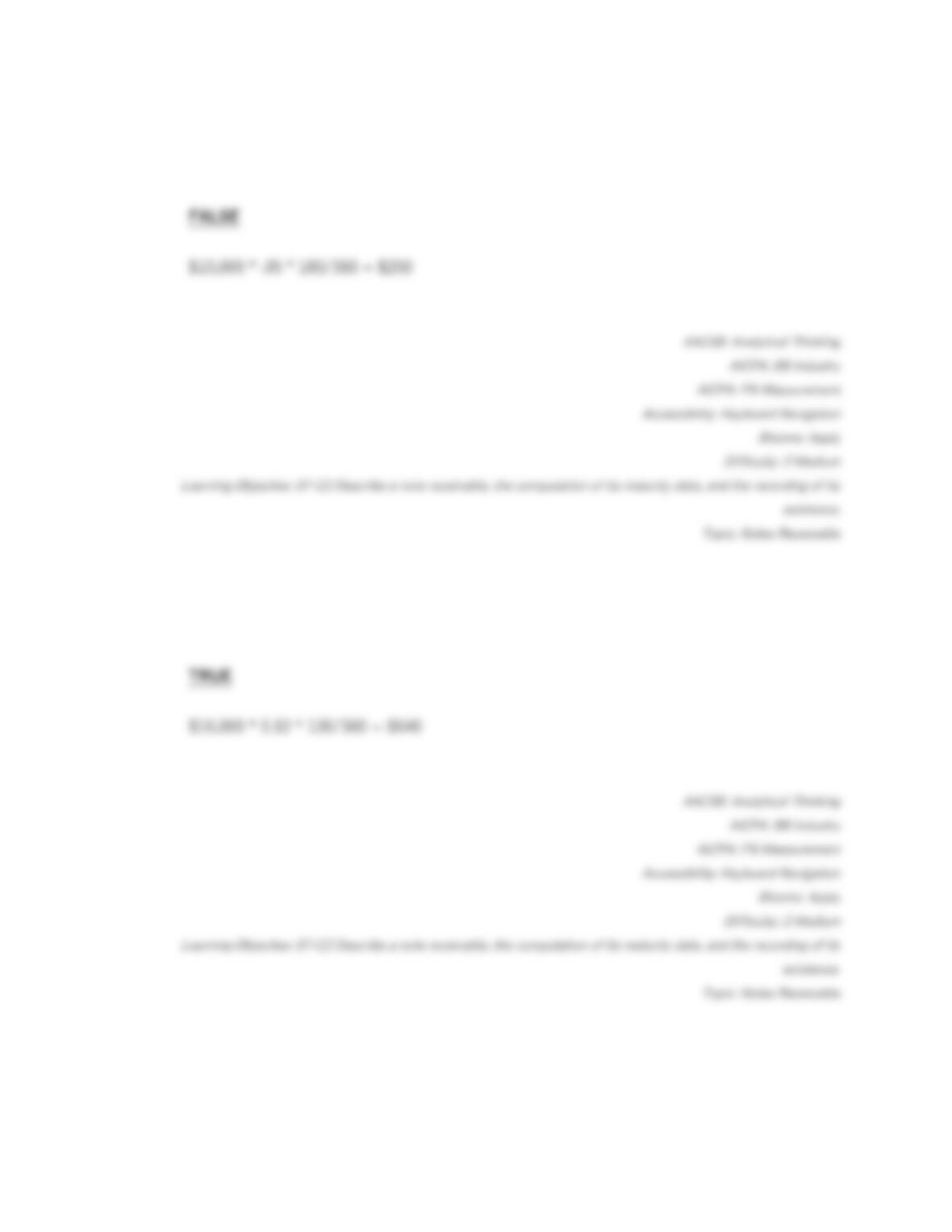
A company borrowed $10,000 by signing a 180-day promissory note at 5% interest. The
total amount of interest is $25.
14.
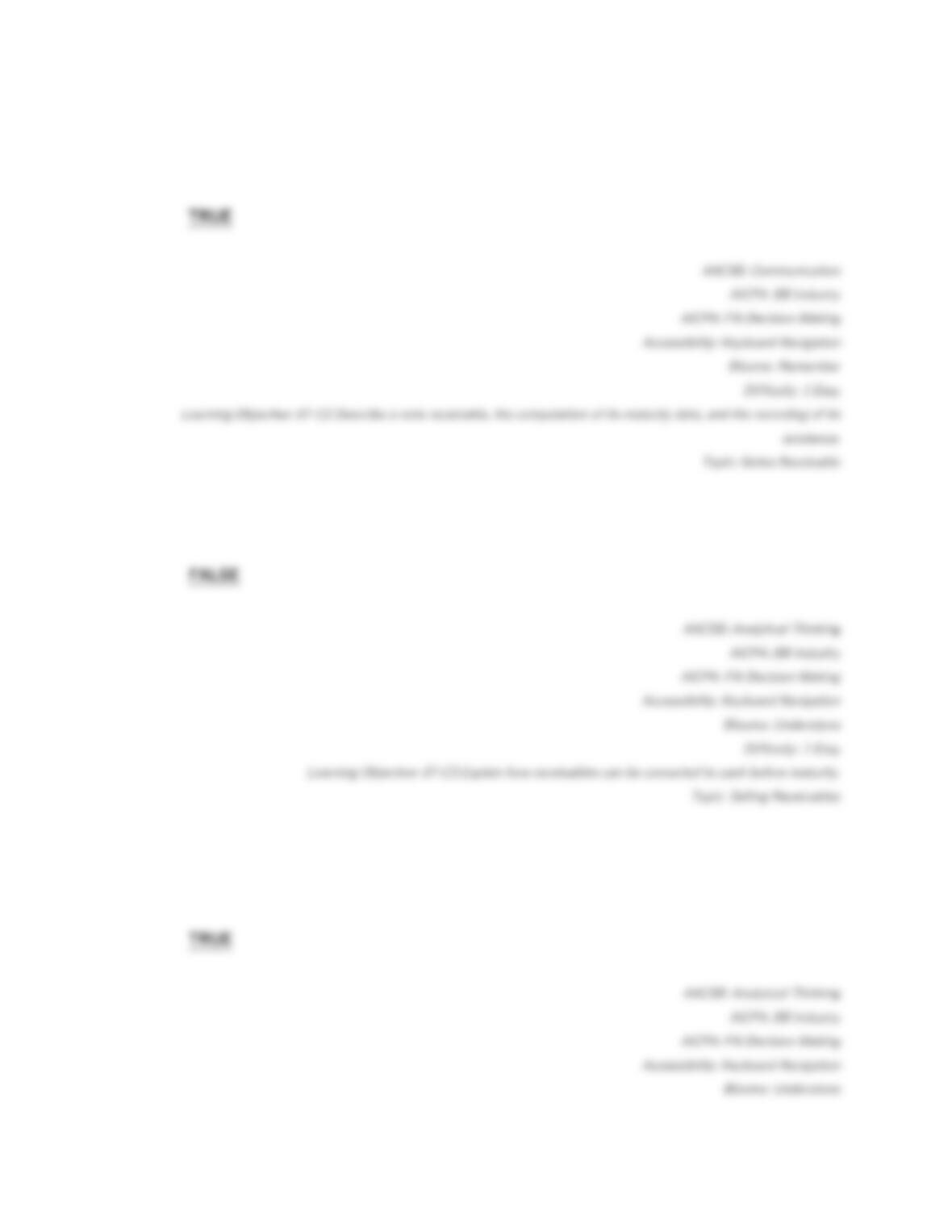
A company borrowed $16,000 by signing a 120-day promissory note at 12%. The total
interest on the note is $640.
15.
Sellers generally prefer to receive notes receivable rather than accounts receivable when
the credit period is long and the receivable is for a large amount.
16.
Federal laws prohibit the selling of accounts receivables to factors.
17.
The process of using accounts receivable as security for a loan is known as pledging
accounts receivable.
18.
Since pledged accounts receivables only serve as collateral for a loan and are not sold, it
is not necessary to disclose the pledging.
19.
A company factored $30,000 of its accounts receivable and was charged a 2% factoring
fee. The journal entry to record this transaction would include a debit to Cash of $30,000,
a debit to Factoring Fee Expense of $600, and credit to Accounts Receivable of $30,600.
20.
The
quality
of
receivables
refers to the likelihood of collection without loss.
21.
The accounts receivable turnover indicates how often, on average, accounts receivable are
received and collected during the period.
22.
A high accounts receivable turnover in comparison with competitors suggests that the firm
should tighten its credit policy.
23.
The accounts receivable turnover is calculated by dividing average accounts receivable by
net sales.
24.
A company had net sales of $550,000 and an average accounts receivable of $110,000. Its
accounts receivable turnover equals 5.0.
25.
A Company had net sales of $23,000 million, and its average account receivables were
$5,700 million. Its accounts receivable turnover is 0.24.
26.
The direct write-off method of accounting for bad debts records the loss from an
uncollectible account receivable when it is determined to be uncollectible.
27.
The matching principle requires use of the allowance method of accounting for bad debts.
28.
Companies follow both the matching principle and the materiality constraint when
applying the direct write-off method.
29.
The use of the direct write-off method is allowed under the materiality constraint.
30.
The advantage of the allowance method of accounting for bad debts is that it identifies
the specific customers who will not pay their bills.
31.
Companies use two methods to account for uncollectible accounts, the direct write–off
method and the allowance method.
32.
No attempt is made to estimate bad debts expense under the allowance method of
accounting for uncollectible accounts receivable.
33.
The matching principle permits the use of the direct write-off method of accounting for
uncollectible accounts when bad debts are very large in relation to a company’s other
financial statement items such as sales and net income.
34.
When using the allowance method of accounting for uncollectible accounts, the entry to
record the estimated bad debts expense is a debit to Bad Debts Expense and a credit to
Allowance for Doubtful Accounts.
35.
After adjustment, the balance in the Allowance for Doubtful Accounts has the effect of
reducing Accounts Receivable to its estimated realizable value.
36.
When using the allowance method of accounting for uncollectible accounts, the entry to
write off Macie’s uncollectible account is a debit to Allowance for Doubtful Accounts and a
credit to Accounts Receivable—Macie.
37.
When using the allowance method of accounting for uncollectible accounts, the recovery
of a bad debt would be recorded as a debit to Cash and a credit to Bad Debts Expense.
38.
The aging of accounts receivable involves classifying each account receivable by how long
it is past its due date and estimating the percent of each uncollectible class.
39.
Installment accounts receivable is another name for aging of accounts receivable.
40.
The accounts receivable method to estimate bad debts obtains the estimated balance in
the Allowance for Doubtful Accounts in one of two ways: (1) computing the percent
uncollectible from the total accounts receivable or (2) aging accounts receivable.
41.
The percent of sales method for estimating bad debts assumes that a given percent of a
company’s credit sales for the period are uncollectible.
42.
The percent of sales method for bad debts estimation uses only income statement
account balances to estimate bad debts.
43.
The aging method of determining bad debts expense is based on the knowledge that the
longer a receivable is past due, the higher the likelihood of collection.
44.
A company has $80,000 in outstanding accounts receivable and it uses the allowance
method to account for uncollectible accounts. Experience suggests that 6% of outstanding
receivables are uncollectible. The current credit balance (before adjustments) in the
allowance for doubtful accounts is $1,200. The journal entry to record the adjustment to
the allowance account includes a debit to Bad Debts Expense for $4,800.
45.
A company using the percentage of sales method for estimating bad debts has sales of
$350,000 and estimates that 1.0% of its sales are uncollectible. The estimated amount of
bad debts expense is $3,500.
46.
The percent of sales method of estimating bad debts focuses more on the realizable value
of accounts receivable than on matching.
47.
If a company holds a large number of notes receivable it sometimes sets up a controlling
account and a subsidiary ledger for notes.