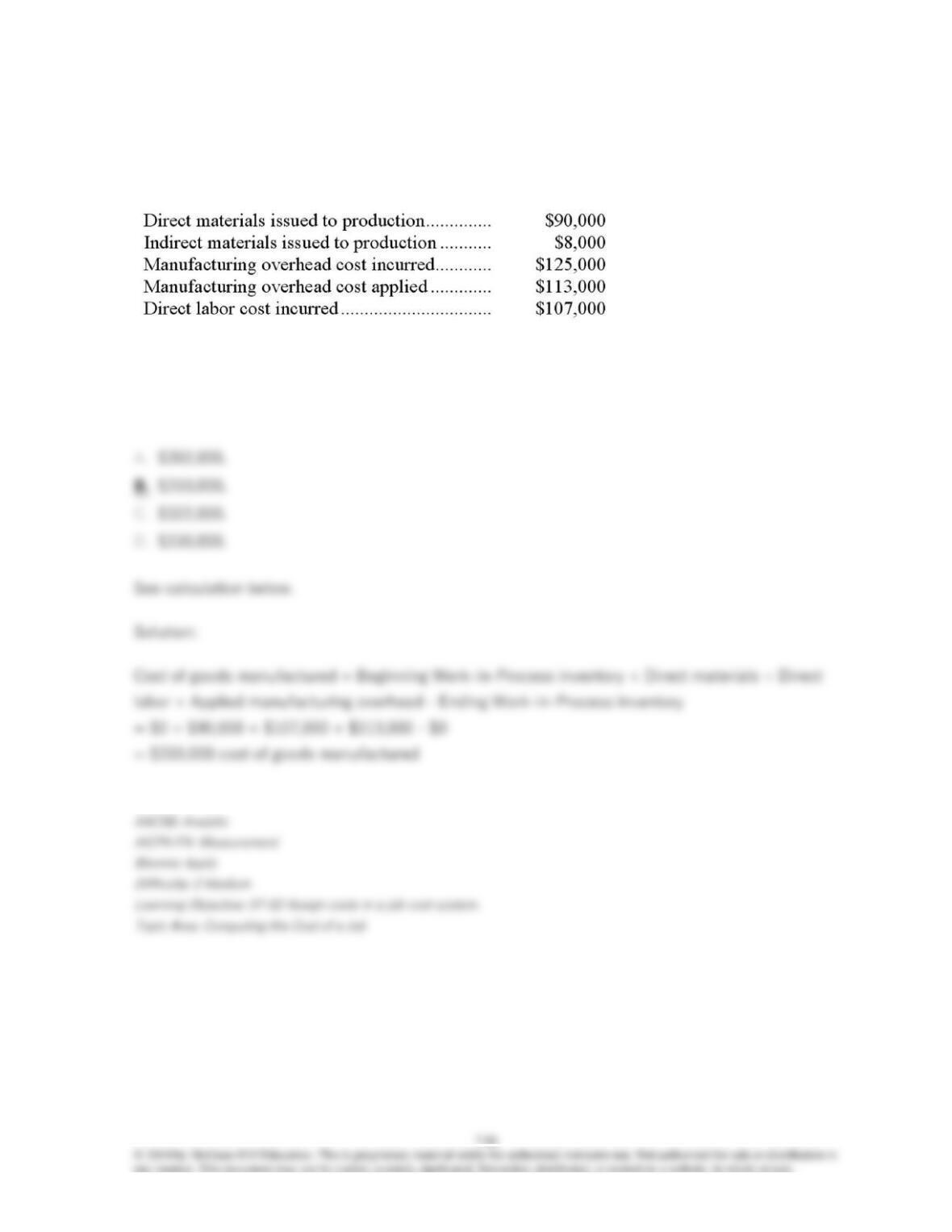
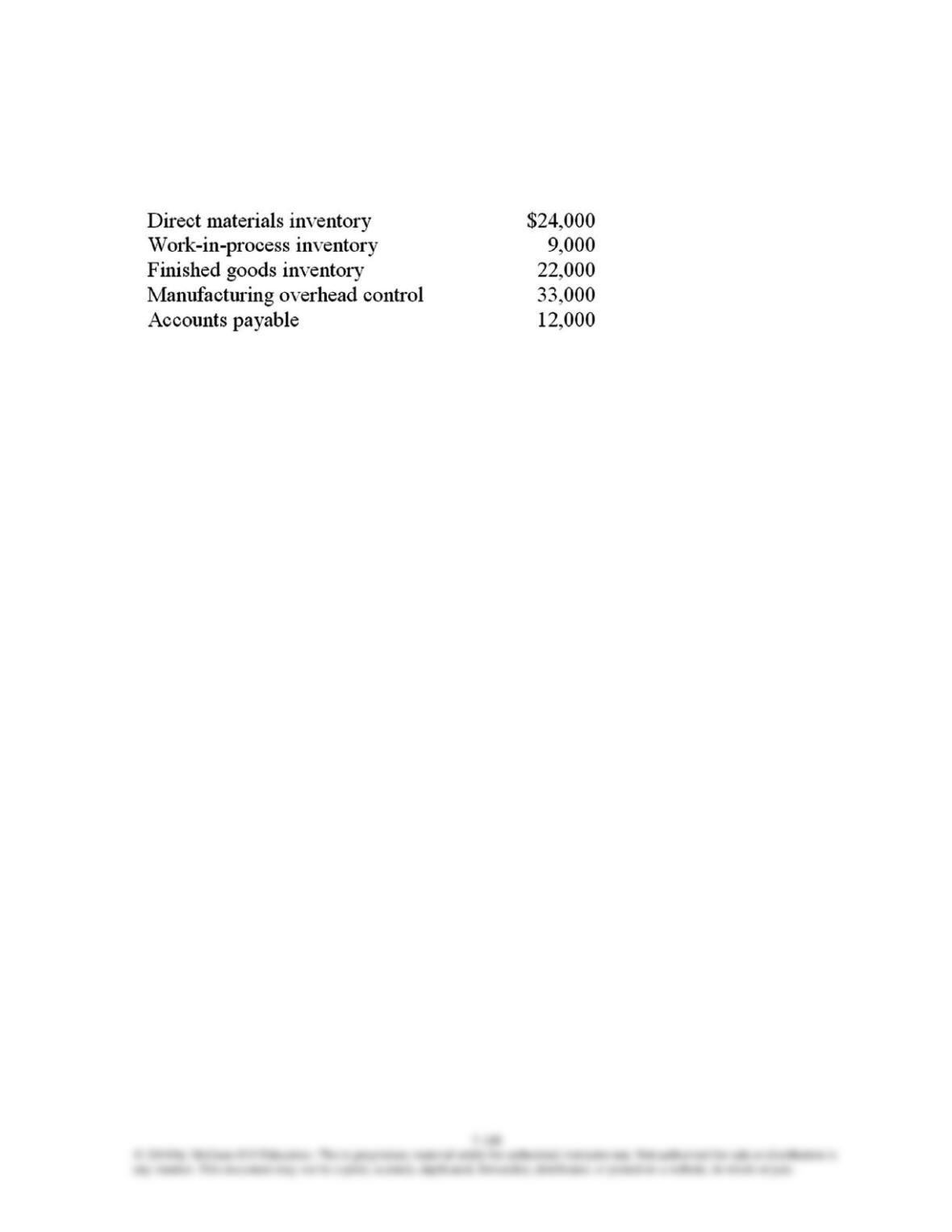
109. Under Lamprey Company’s job-order costing system, manufacturing overhead is applied
to Work-in-Process inventory using a predetermined overhead rate. During January, Lamprey’s
transactions included the following:
Lamprey Company had no beginning or ending inventories. What was the cost of goods
manufactured for January? (CMA adapted)
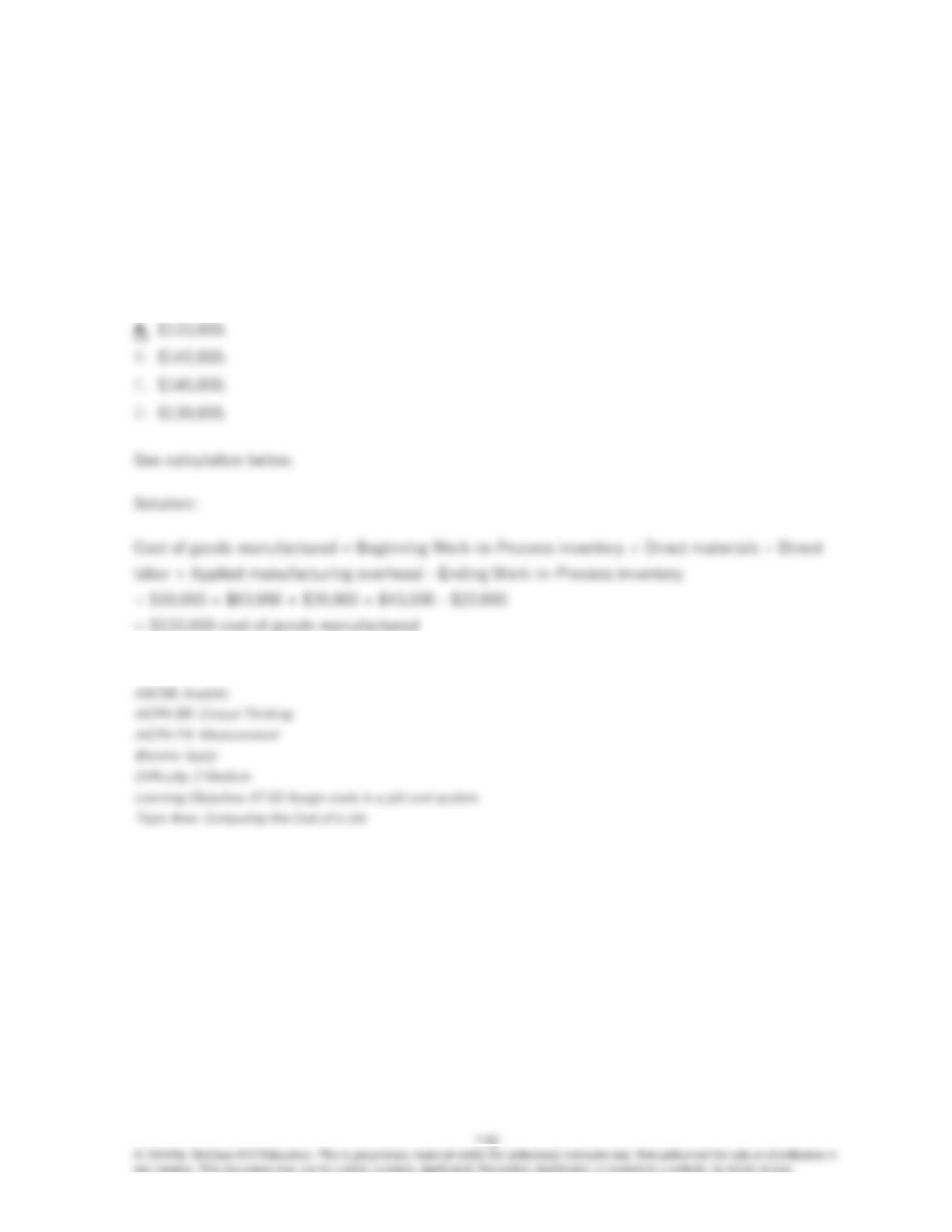
110. Desrevisseau Inc., a manufacturing company, has provided the following data for the
month of August. The balance in the Work–in-Process inventory account was $10,000 at the
beginning of the month and $22,000 at the end of the month. During the month, the company
incurred direct materials cost of $63,000 and direct labor cost of $39,000. The actual
manufacturing overhead cost incurred was $40,000. The manufacturing overhead cost applied to
Work-in-Process was $43,000. The cost of goods manufactured for August was:
7-83
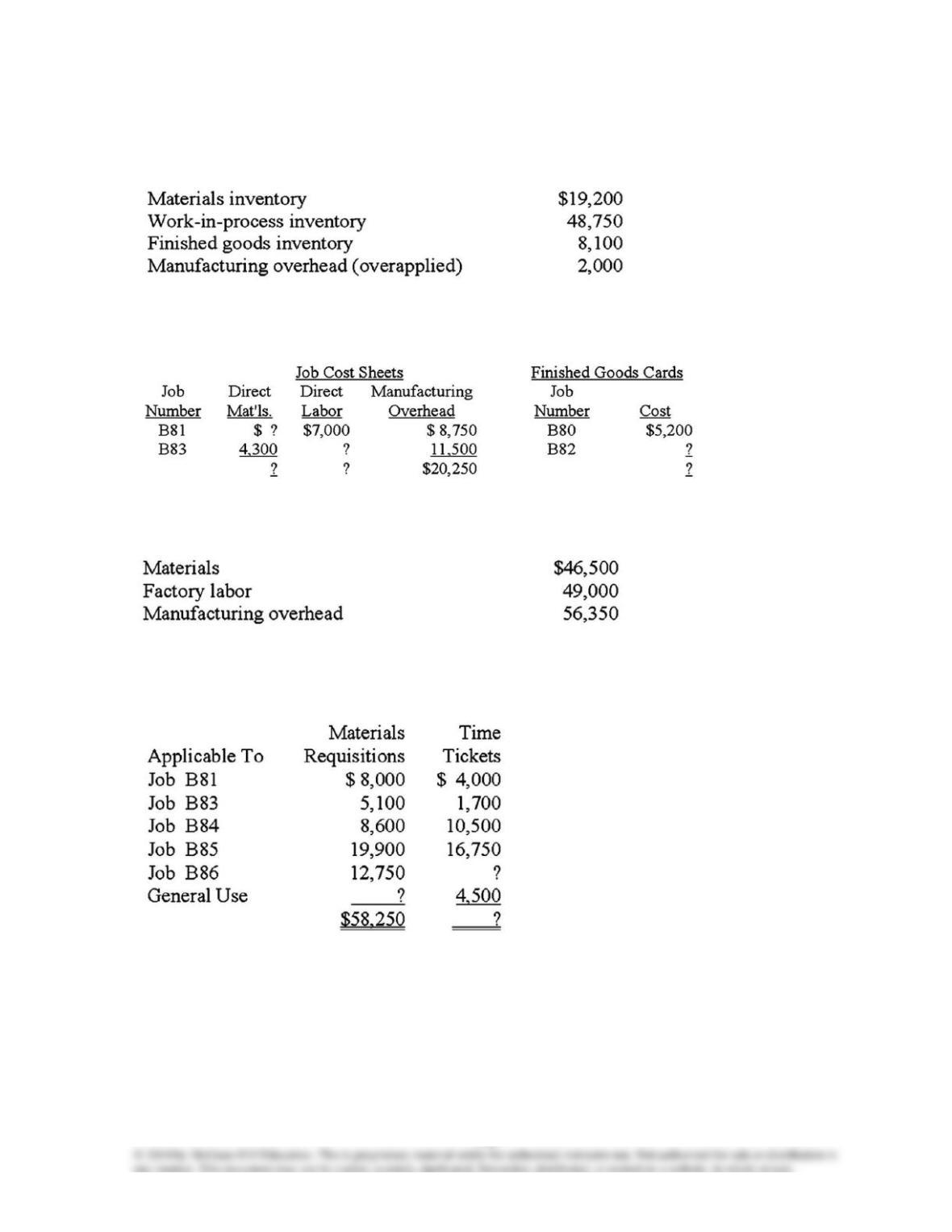
111. On October 1, the general ledger of Slipshod Company had the following accounts and
balances:
The subsidiary ledgers had the following information on October 1:
During October, the following costs were incurred on account:
A summary of the materials requisition slips and the labor time tickets for the month revealed the
following distribution:
Overhead is applied based upon direct labor cost. Jobs B81, B83, and B84 were for 8,000, 6,000
and 4,800 units of product, respectively, and were completed during October. Jobs B80, B81, B82,
and B83 were sold on account for $150,000.
Required:

7-84
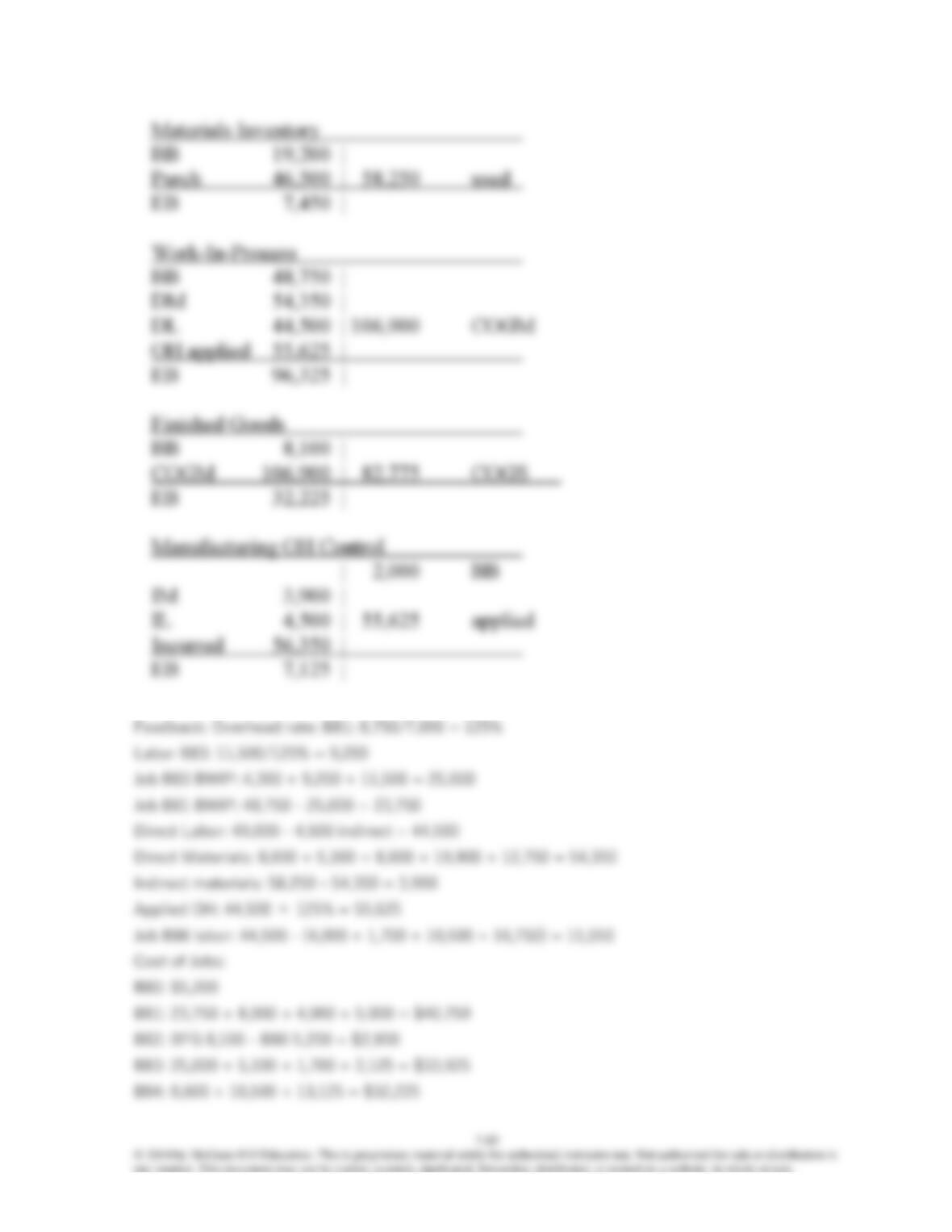
Prepare T-accounts for a job order cost system, posting the beginning balances and all
transactions for the month. Clearly indicate the ending balances for the accounts and label the
‘cost of goods manufactured’ and ‘cost of goods sold’ amounts.
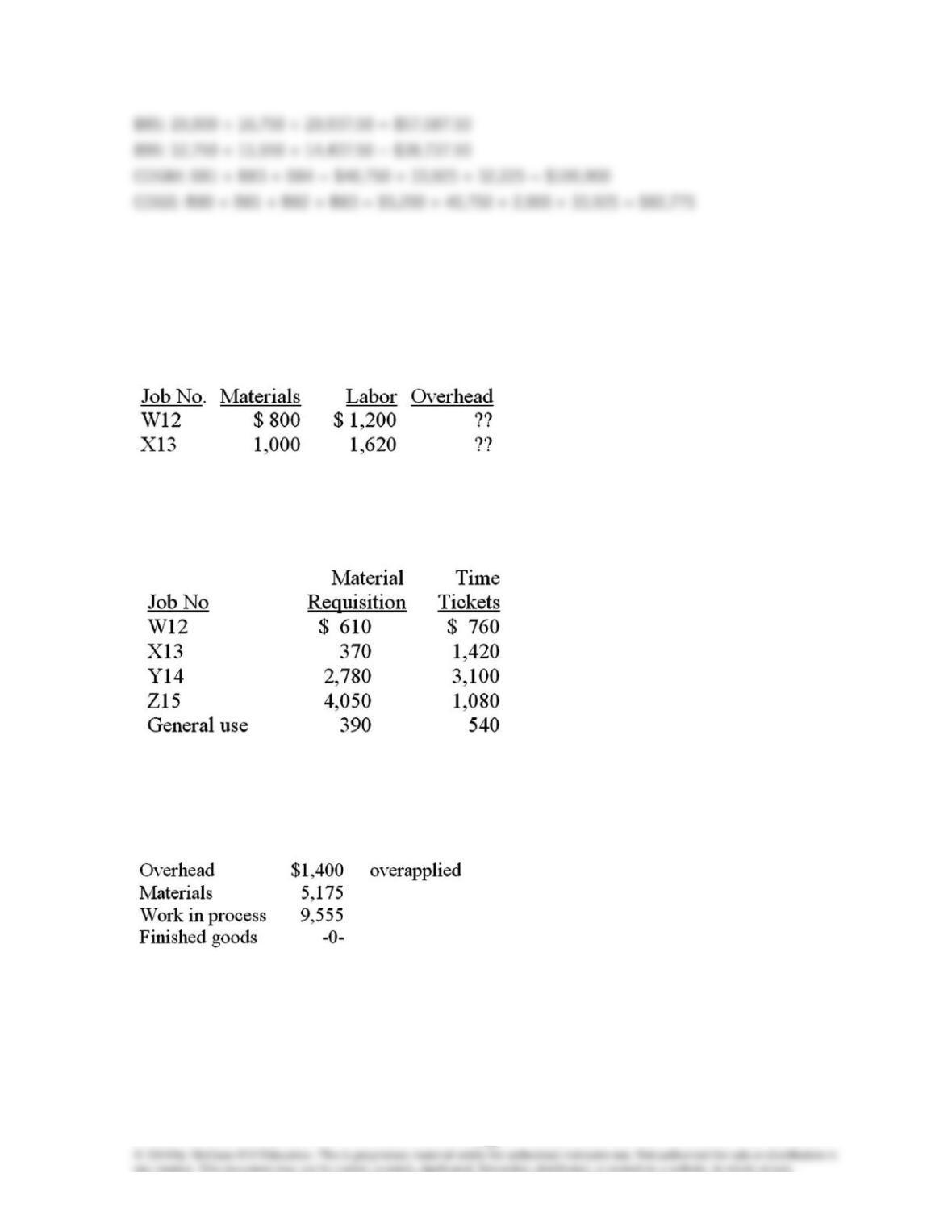
7-86
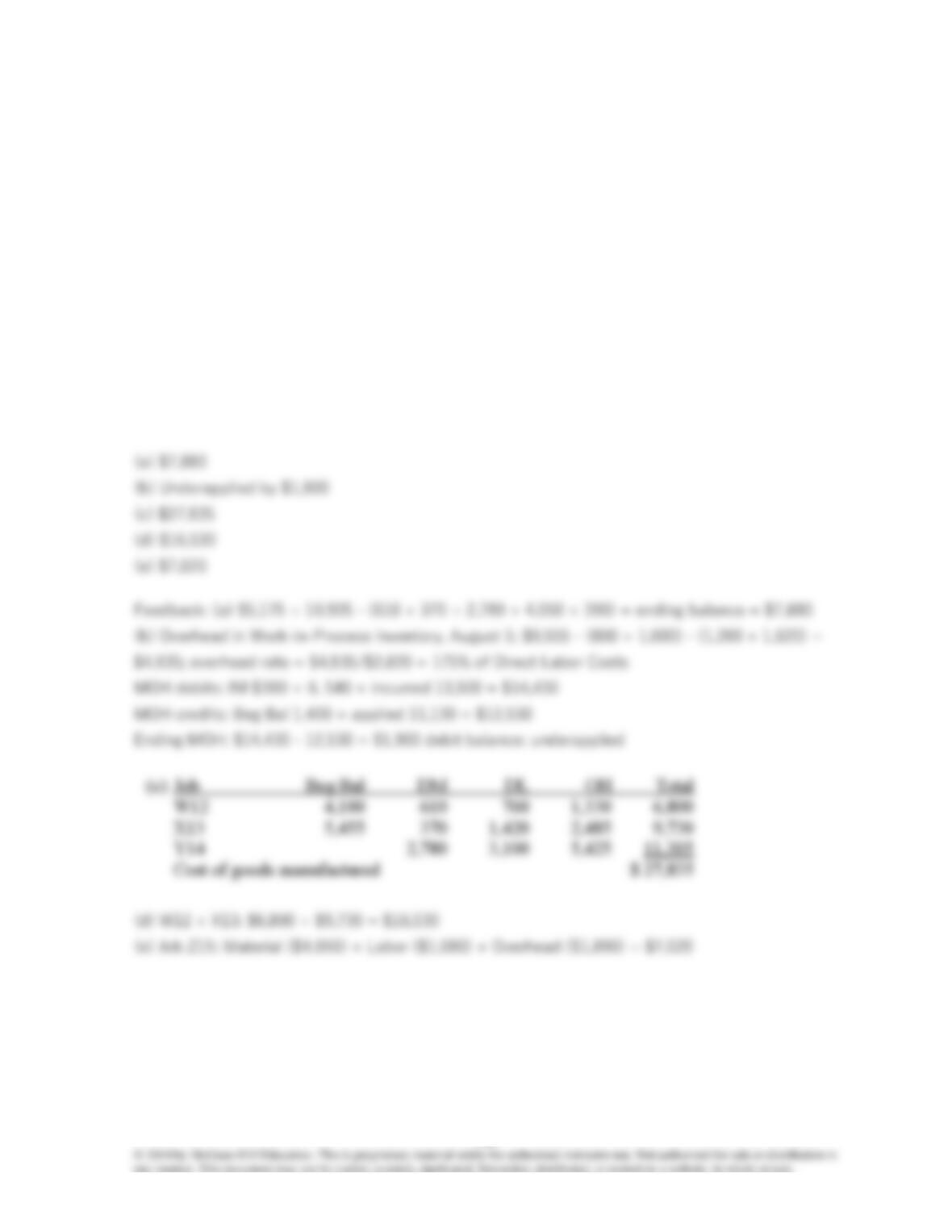
112. The following selected data were taken from the records of the Bixby Box Company. The
company uses a job costing system to account for its manufacturing costs. Bixby’s fiscal year runs
from January 1 to December 31; manufacturing overhead is closed out only at the end of the fiscal
year. The following information relates to August operations.
(1.) Jobs in process on August 1.
(2.) Jobs completed during August: W12, X13, Y14.
(3.) Material requisitions and labor time tickets indicated the following:
(4.) Jobs sold during August: W12, X13.
(5.) Bixby applies overhead to production based upon labor costs.
(6.) Selected account balances on August 1 were:
7-87
(7.) Various overhead incurred (excluding indirect materials and indirect labor) during August,
$13,500.
(8.) Materials (direct and indirect) purchased during August, $10,905.
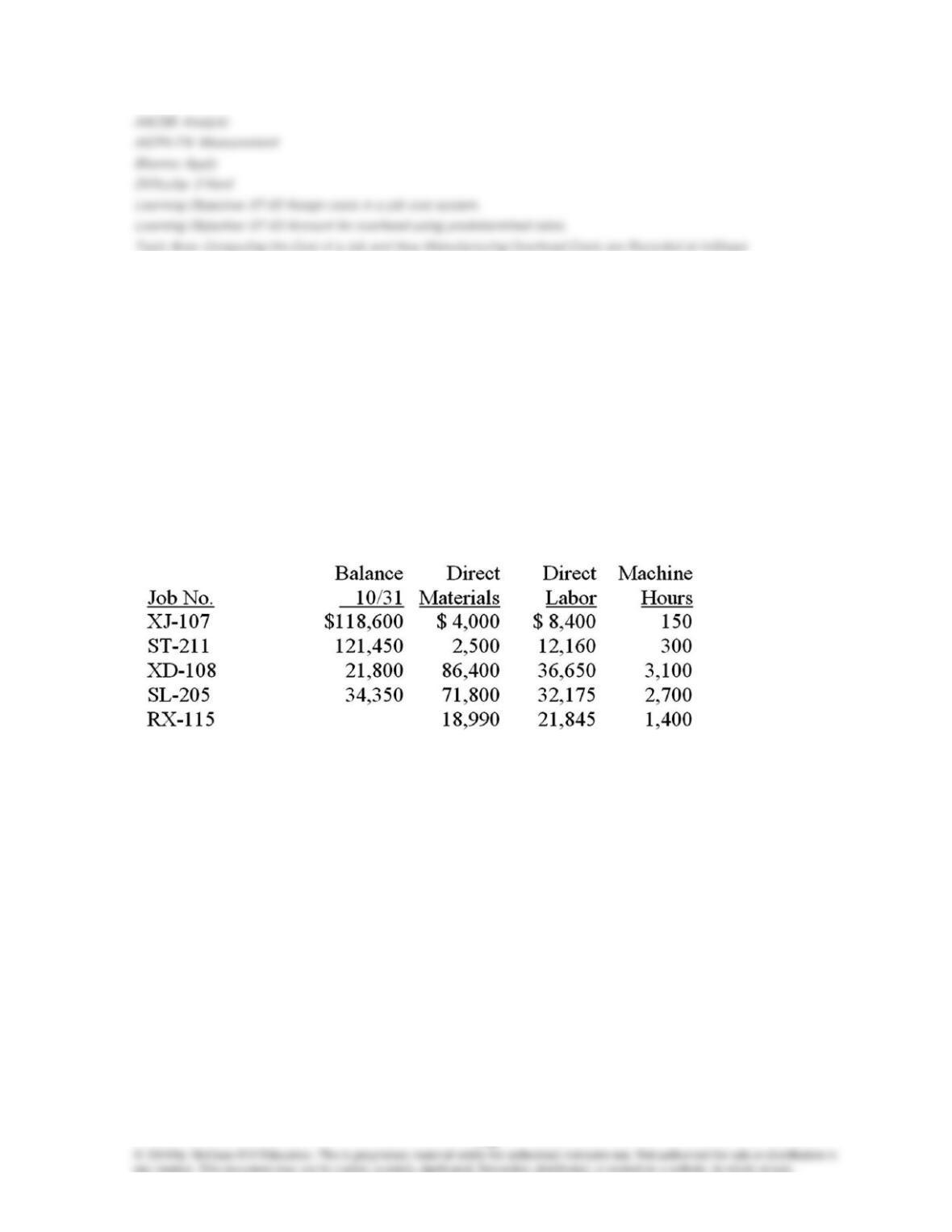
Required:
(a) What is the balance in the Material Inventory account on August 31?
(b) Is the manufacturing overhead account Over- or underapplied on August 31? By how much?
(c) Compute the cost of goods manufactured for August.
(d) Compute the cost of goods sold for August.
(e) What is the balance of the Work–in-Process Inventory account on August 31?
7-88
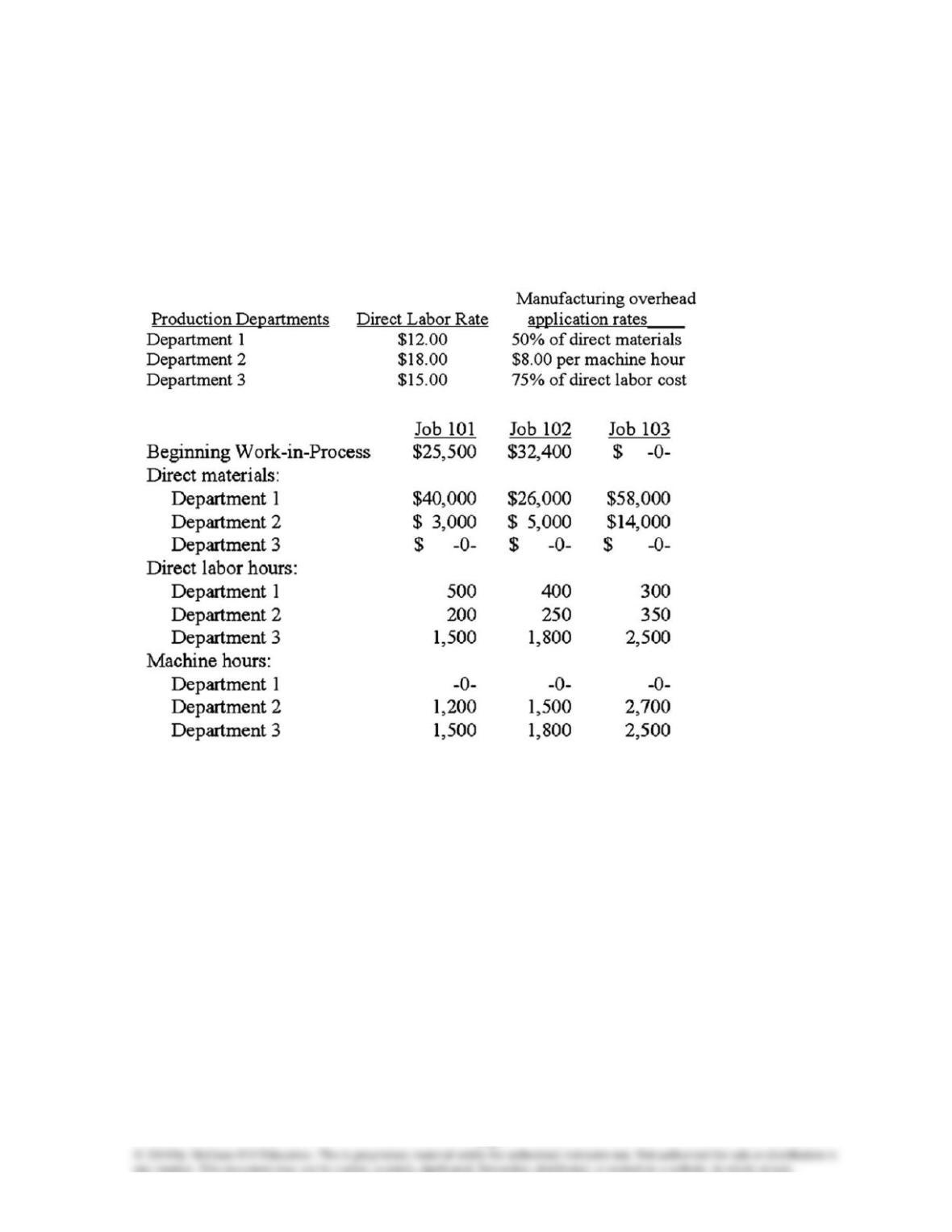
113. Carver Test Systems manufactures automated test systems that perform quality
inspections during and at the completion of the manufacturing process. As most manufacturing
processes are unique, Carver’s test equipment is designed to customer specifications, and each
system has a selling price in excess of $300,000. The company uses a job-order cost system
based on the full absorption of actual costs and applies overhead on the basis of machine hours
using a predetermined overhead rate. For the fiscal year ended November 30 budgeted
manufacturing overhead was $1,960,000, and the expected activity level was 98,000 machine
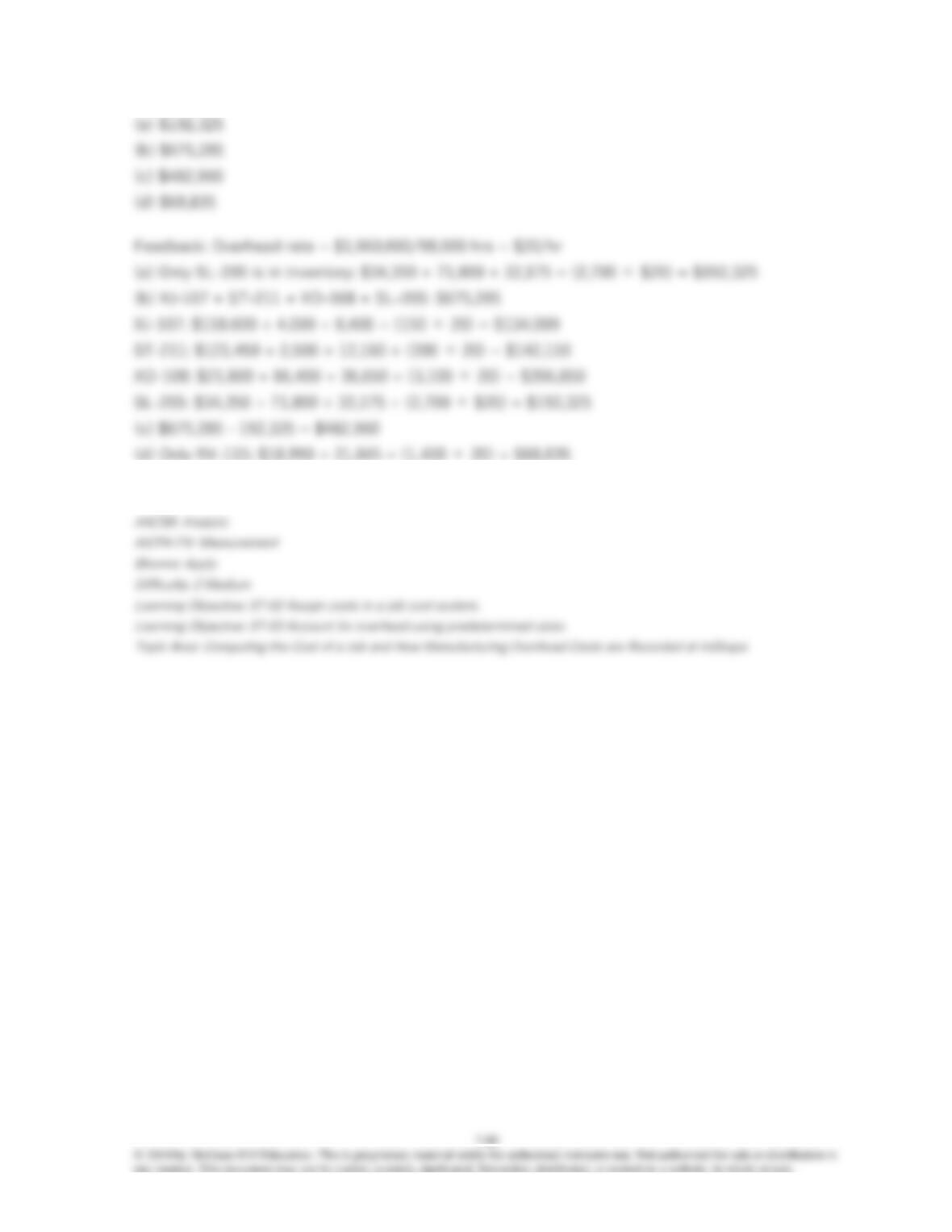
hours. Data regarding several jobs at Carver are presented below.
By the end of November all jobs but RX-115 were completed, and all completed jobs had been
delivered to customers with the exception of SL–205.
Required:
(a) Determine the balance in the Finished Goods Inventory on November 30.
(b) Compute the cost of goods manufactured for November.
(c) Compute the Cost of Goods Sold for November.
(d) Determine the balance in Work-In-Process Inventory on November 30.
7-90
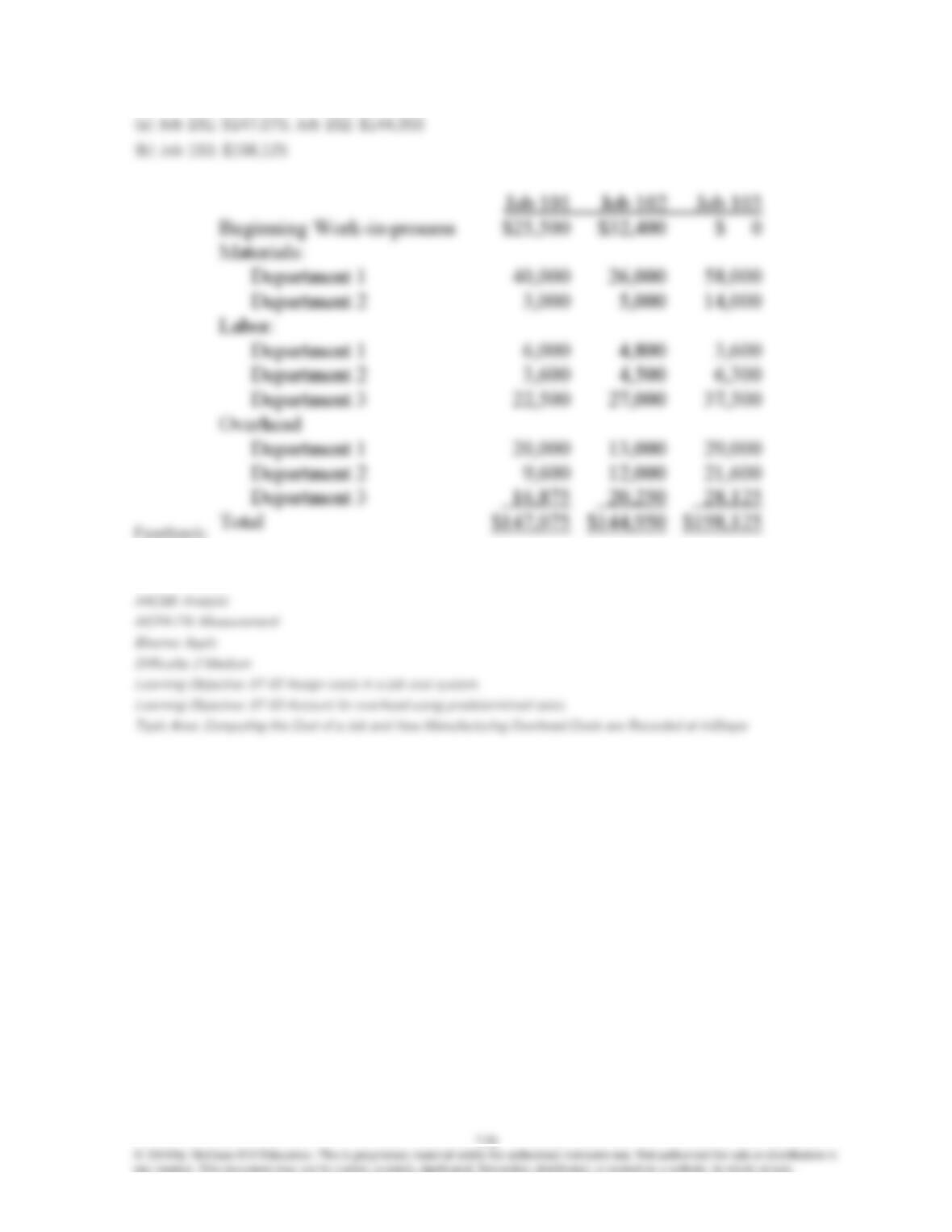
114. A manufacturing company employs job costing to account for its costs. There are three
production departments, and separate departmental overhead application rates are employed
because the operations of the departments are so different. All jobs generally pass through all
three production departments. Data regarding the hourly direct labor rates, overhead application
rates, and three jobs on which work was done during the month appear below. Job 101 and Job
102 were completed during the current month. (CIA Examination adapted)
Required:
(a) Compute the completed costs of Job 101 and Job 102.
(b) Compute the value of the Work–in-Process Inventory at the end of the month.
7-92
115. Baby Care Manufacturing Company is a manufacturer of furnishings for infants and
children. The company uses job costing and employs a full absorption accounting method for cost
accumulation. Baby Care’s Work-in-Process Inventory on April 30 consisted of the following jobs:
Baby Care applies manufacturing overhead on the basis of direct labor-hours. The company’s
estimated manufacturing overhead for the period ending May 31 totals $4,500,000; the company
estimated it would use 600,000 direct labor-hours during the year.
At the end of April, the balance in Baby Care’s Materials Inventory, which includes both materials
and purchased parts, was $668,000. Additions to, and requisitions from, the materials inventory
during the month of May included the following:
During the month of May, Baby Care’s factory payroll consisted of the following:
Listed below are the jobs that were completed and the units that were sold during the month of
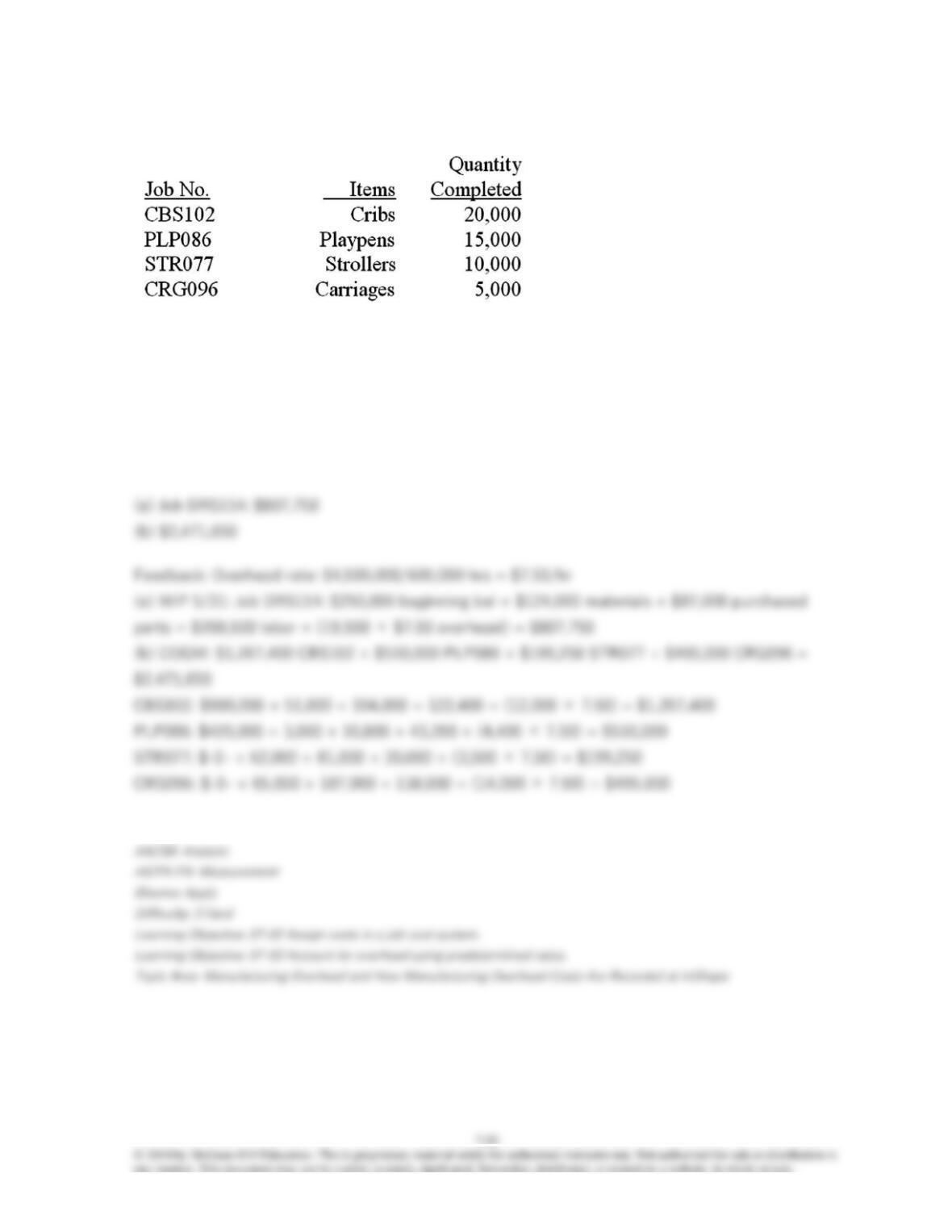
May.
Required:
(a) Compute the value of Baby Care’s Work–in-Process Inventory on May 31.
(b) Compute the value of Baby Care’s Cost of Goods Manufactured for May.
7-94
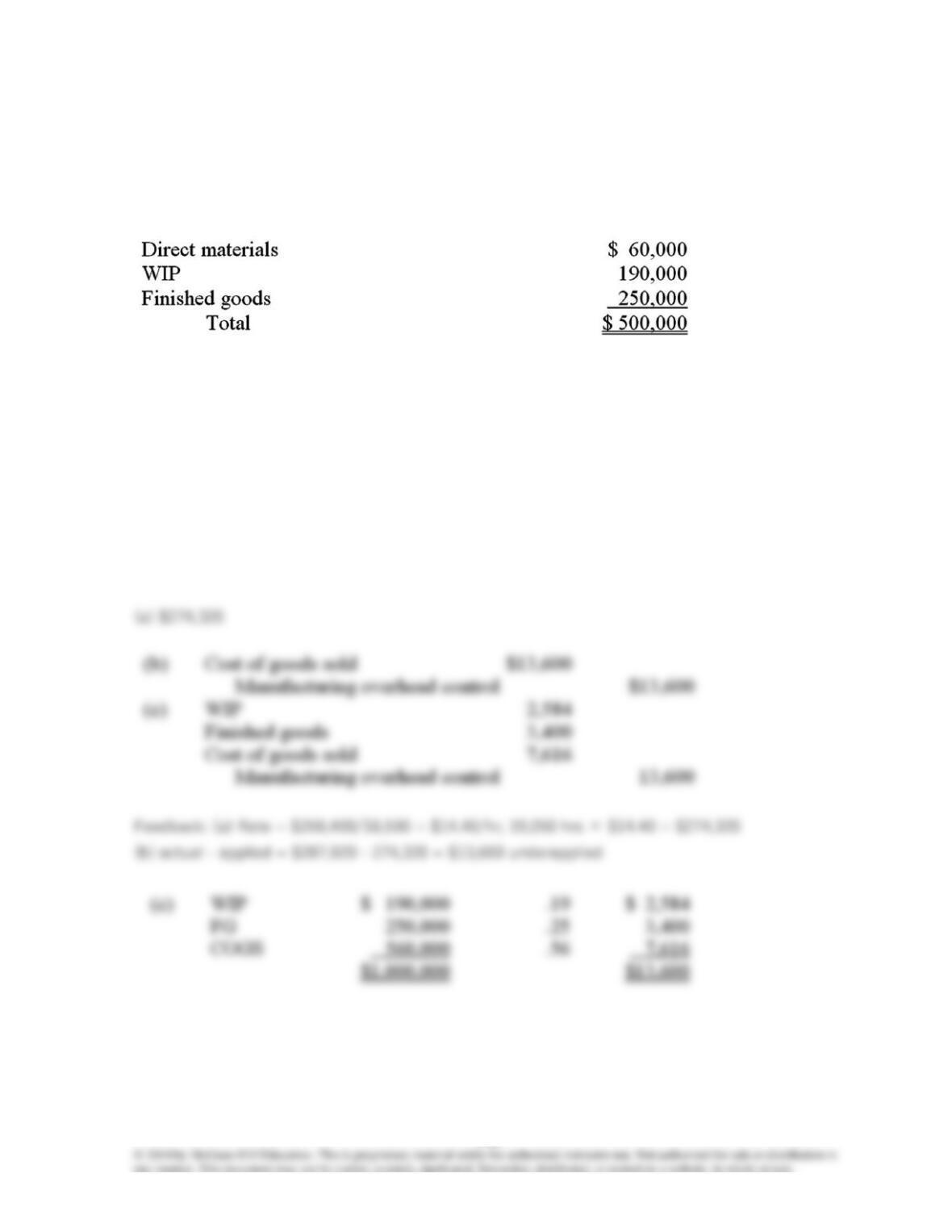
116. Shawano Corporation applies overhead based upon machine-hours. Budgeted factory
overhead was $266,400 and budgeted machine-hours were 18,500. Actual factory overhead was
$287,920 and actual machine-hours were 19,050. Before disposition of Over– or underapplied
overhead, the cost of goods sold was $560,000 and ending inventories were as follows:
Required:
a. Compute the amount of overhead applied to production.
b. Prepare the journal entry to dispose of the over/under-applied overhead using the write-off to
cost of goods sold approach.
c. Prepare the journal entry to dispose of the over/under-applied overhead using the proration
approach.
7-95
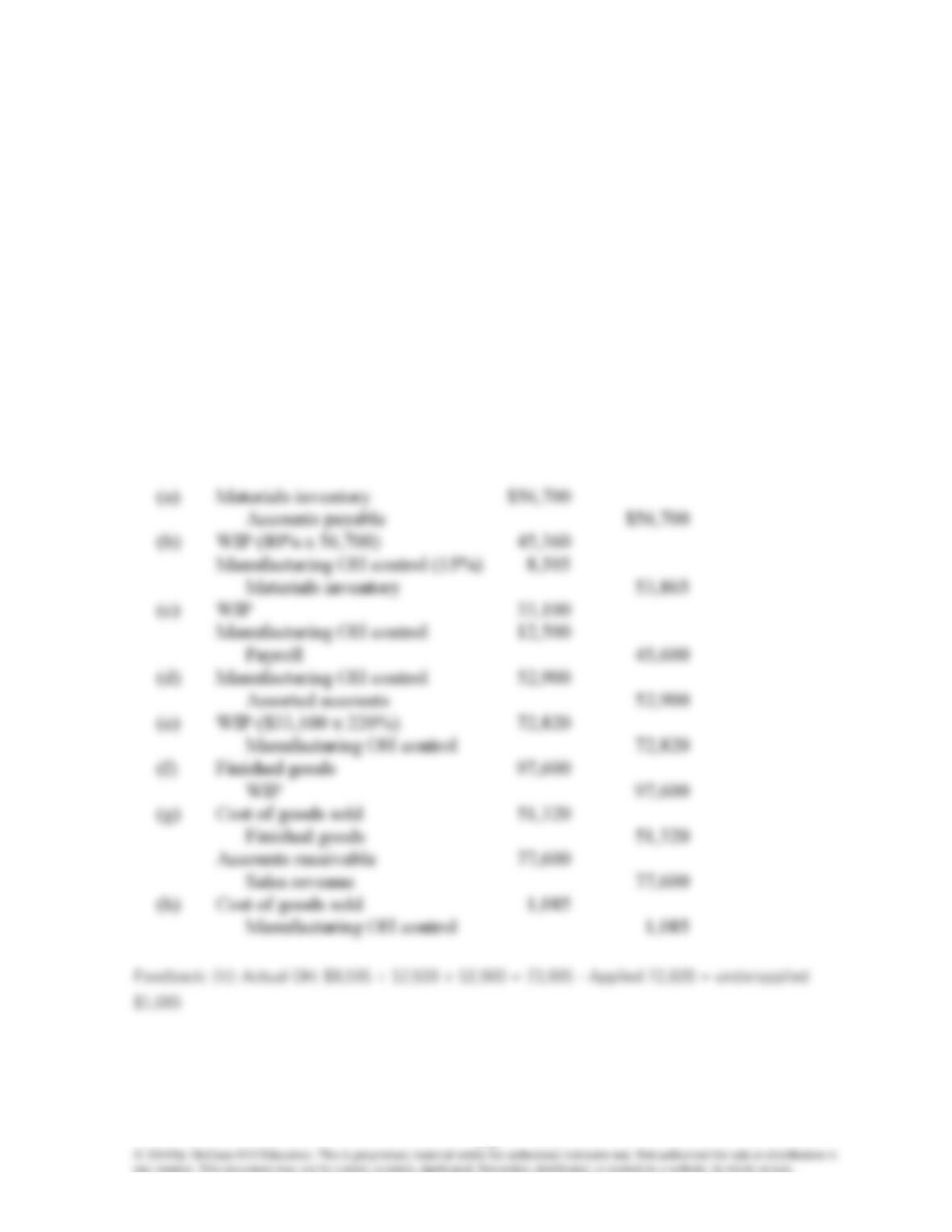
117. Prepare the necessary journal entries from the following information for Beaulieu
Company.
a. Purchased materials on account, $56,700.
b. Requisitioned materials for production as follows: direct materials – 80 percent of purchases,
indirect materials – 15 percent of purchases
c. Direct labor for production is $33,100, indirect labor is $12,500.
d. Overhead incurred (not including materials or overhead): $52,900.
e. Overhead is applied to production based on direct labor cost at the rate of 220 percent.
f. Goods costing $97,600 were completed during the period.
g. Goods costing $51,320 were sold on account for $77,600.
h. Close the overhead control account to Cost of Goods Sold.
118. Danner Corporation applies overhead based upon machine-hours. Budgeted factory
overhead was $375,000 and budgeted machine-hours were 12,500. Actual factory overhead was
$387,920 and actual machine-hours were 13,150.
Required:
a. Compute the overhead application rate.
b. Compute the amount of overhead applied to production.
c. Determine the amount of Over– or underapplied overhead.
7-97
119. The following selected data were taken from the books of the Bixby Box Company. The
company uses job costing to account for manufacturing costs. The data relate to June operations.
A) Materials and supplies were requisitioned from the stores clerk as follows:
Job 405, material X, $7,000.
Job 406, material X, $3,000; material Y, $6,000.
Job 407, material X, $7,000; material Y, $3,200.
For general factory use: materials A, B, and C, $2,300.
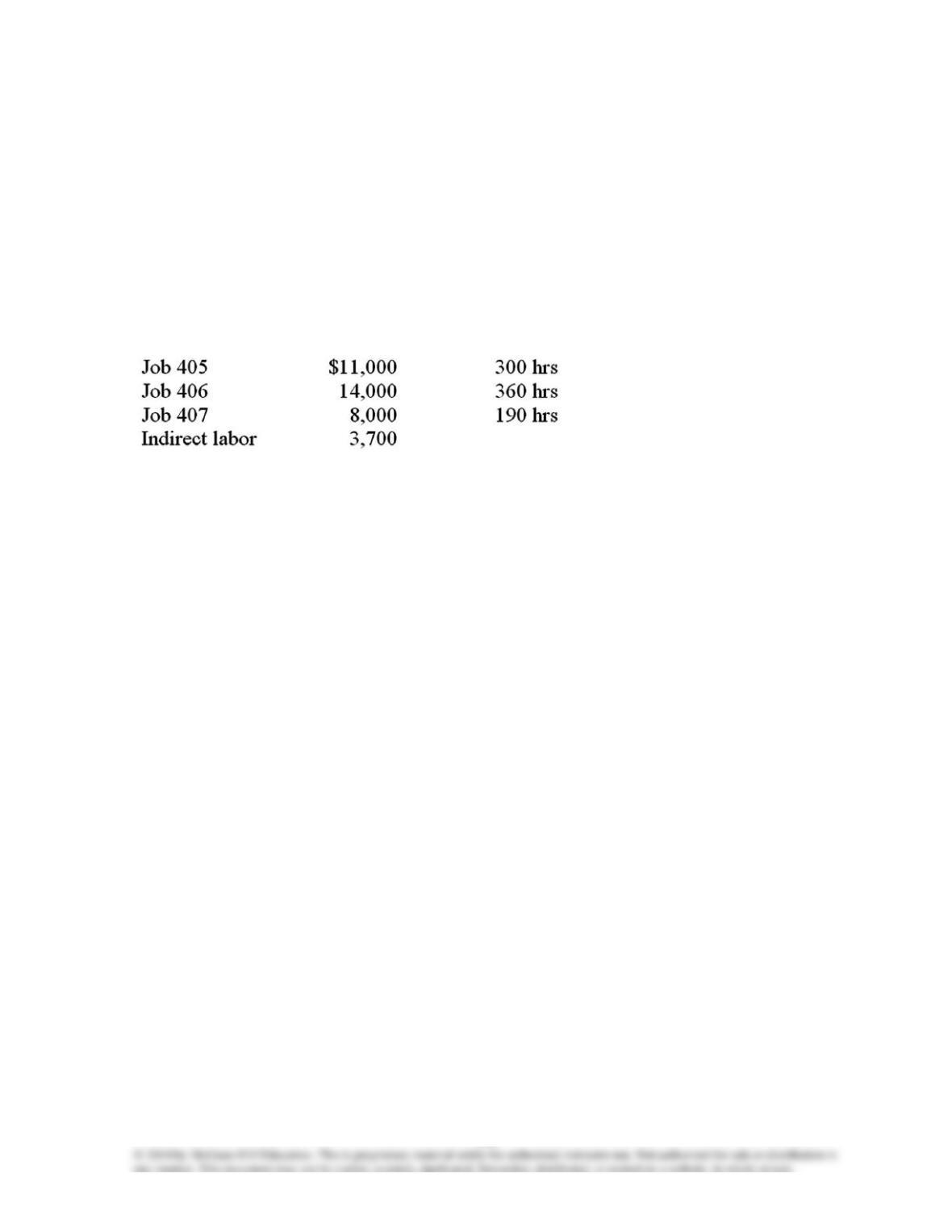
B) Time tickets for the month were chargeable as follows:
C) Other information:
Beginning work-in-process, June 1, $-0–
Factory paychecks for $36,700 were issued during the month.
Various factory overhead charges of $19,400 were incurred on account.
Depreciation of factory equipment for the month was $5,400.
Factory overhead was applied to jobs at the rate of $35.00 per direct labor hour.
Job orders completed during the month: Job 405 and Job 406.
Selling and administrative costs were $2,100.
Factory overhead is closed out only at the end of the year.
Required:
(a) Determine the ending work-in-process balance on June 30.
(b) Determine the cost of goods manufactured for June.
(c) Is factory overhead Over- or underapplied for June? What is the monthly value?
120. Rosebud Manufacturing uses actual costing. The following events took place during the
current year:
(1) Purchased $95,000 in direct materials.
(2) Incurred labor costs as follows: (a) direct, $56,000 and (b) indirect, $13,600.
(3) Other manufacturing overhead was $107,000, excluding indirect labor.
(4) Transferred 80% of the materials to the manufacturing assembly line.
(5) Completed 65% of the Work-in–Process during the year.
(6) Sold 85% of the completed goods.
(7) There were no beginning inventories.
Required:
(a) Determine the ending Direct Materials Inventory balance.
(b) Determine the ending Work-in-Process Inventory balance.
(c) Determine the ending Finished Goods Inventory balance.
(d) Determine the Cost of Goods Manufactured.
121. The Cedar Company does not maintain backup documents for its computer files. In June,
some of the current data were lost, and you have been asked to help reconstruct the data. The
following beginning balances are known:
Reviewing old documents and interviewing selected employees have generated the following
additional information:
The production superintendent’s job cost sheets indicated that materials of $5,200 were included
in the June 30 Work–in-Process Inventory. Also, 300 direct labor-hours had been paid at $12.00
per hour for the jobs in process on June 30.
The Accounts Payable account is only for direct material purchases. The clerk remembers clearly
that the balance in the Accounts Payable on June 30 was $16,000. An analysis of canceled checks
indicated payments of $80,000 were made to suppliers during June.
Payroll records indicate that 5,200 direct labor-hours were recorded for June. It was verified that
there were no variations in pay rates among employees during June.
Records at the warehouse indicate that the Finished Goods Inventory totaled $32,000 on June 30.
Another record kept manually indicates that the Cost of Goods Sold in June totaled $168,000.
The predetermined overhead rate was based on an estimated 60,000 direct labor-hours for the
year and an estimated $360,000 in manufacturing overhead costs.
Required:
(a) Compute the Cost of Goods Manufactured.
(b) Compute the ending Work-in-process inventory balance.
(c) Compute the ending Direct Materials Inventory balance.