27) CBS Corporation acquired a patent for $2,000,000. The patent has a legal life of 50 years. Because of
changing technology, this patent is expected to generate revenue for only 10 years and have no residual
value. The annual amortization expense for the patent is: (Round your final answer to the nearest dollar.)
A) $0
B) $2,000,000
C) $40,000
D) $200,000
28) In 2017, First Company purchased Second Company for $19,000,000 cash. At the time of purchase,
Second Company’s assets had a market value of $25,000,000 and the liabilities had a market value of
$18,000,000. At the time of purchase, Second Company’s assets had a book value of $15,000,000 and the
liabilities had a book value of $10,000,000. What amount of goodwill is recorded?
A) $12,000,000
B) $7,000,000
C) $6,000,000
D) $18,000,000
29) On January 1, 2017, Plenty of Oil, Inc. purchased an oil field that is estimated to have 15,000,000
barrels of oil for $45,000,000. In 2017, 1,500,000 barrels of oil were extracted and sold. In 2018, 1,800,000
barrels of oil were extracted and sold. The oil field will have no residual value. What is the book value
of the oil reserves that will be reported on the balance sheet as of December 31, 2018?
A) $9,900,000
B) $35,100,000
C) $39,600,000
D) $45,000,000
30) If a natural resource is extracted and not sold, which of the following accounts are debited and
credited?
A) debit Depletion Expense and credit Accumulated Depletion
B) debit Cost of Goods Sold and credit Inventory
C) debit Accumulated Depletion and credit Natural Resource
D) debit Inventory and credit Natural Resource
31) If a natural resource is extracted and then immediately sold, which of the following accounts are
debited and credited?
A) debit Cost of Goods Sold and credit Inventory
B) debit Natural Resource and credit Accumulated Depletion
C) debit Depletion Expense and credit Accumulated Depletion
D) debit Depreciation Expense and credit Accumulated Depreciation

59
32) In 2016, the Best Diamond Company purchased mineral rights for a diamond mine (industrial grade
diamonds) by signing a promissory note for $7,000,000. In addition to the purchase price, Best paid cash
of $100,000 for a geological survey and $20,000 for a license fee to the country where the mine is located.
It is estimated that there will be no residual value when the mine is fully depleted and that the mine
contains 1,000,000 carats of diamonds.
During the first year of mining, Best Diamond extracted 50,000 carats of diamonds which were not sold
after they were extracted. In 2017, the company extracted 250,000 carats of diamonds and sold 200,000
carats of diamonds from its inventory.
Required:
Prepare the journal entry without explanations to:
1. Record the purchase of the diamond mineral rights.
2. Record depletion for 2016.
3a. Record depletion for 2017.
3b. Record cost of goods sold for 2017.
Date
Account
DR
CR

33) For each of the following, match the intangible asset with its definition.
Copyright
A
Federal government grants the holder the exclusive
right for 20 years to produce and sell an invention.
Franchises
B
A distinctive identification of a product or service.
Goodwill
C
Excess of the cost of an acquired company over the sum
of the market values of its net assets.
Patent
D
Exclusive right issued by the federal government to
reproduce and sell a book, musical composition, film or
other work of art extending for 70 years beyond the
author’s life.
Trademark
E
Privileges granted by a private business to sell a product
or service in accordance with specified conditions.
Copyright
Franchises
Goodwill
Patent
Trademark
Copyright
D
Franchises
E
Goodwill
C
Patent
A
Trademark
B
34) 1. On June 1, 2017, Fox Company purchased Wolf Corporation for $26,000,000 cash. At the time of
the purchase, the market value of Wolf Corporation’s assets and liabilities were $30,000,000 and
$5,000,000, respectively. The book value of Wolf Corporation’s assets and liabilities were $10,000,000
and $6,000,000, respectively. Record the journal entry for the acquisition by Fox Company.
2. By December 31, 2017, Fox Company discovered that the goodwill associated with Wolf Corporation
is impaired and is worthless. Wolf Corporation is on the brink of bankruptcy. Record the journal entry
needed by Fox Company.
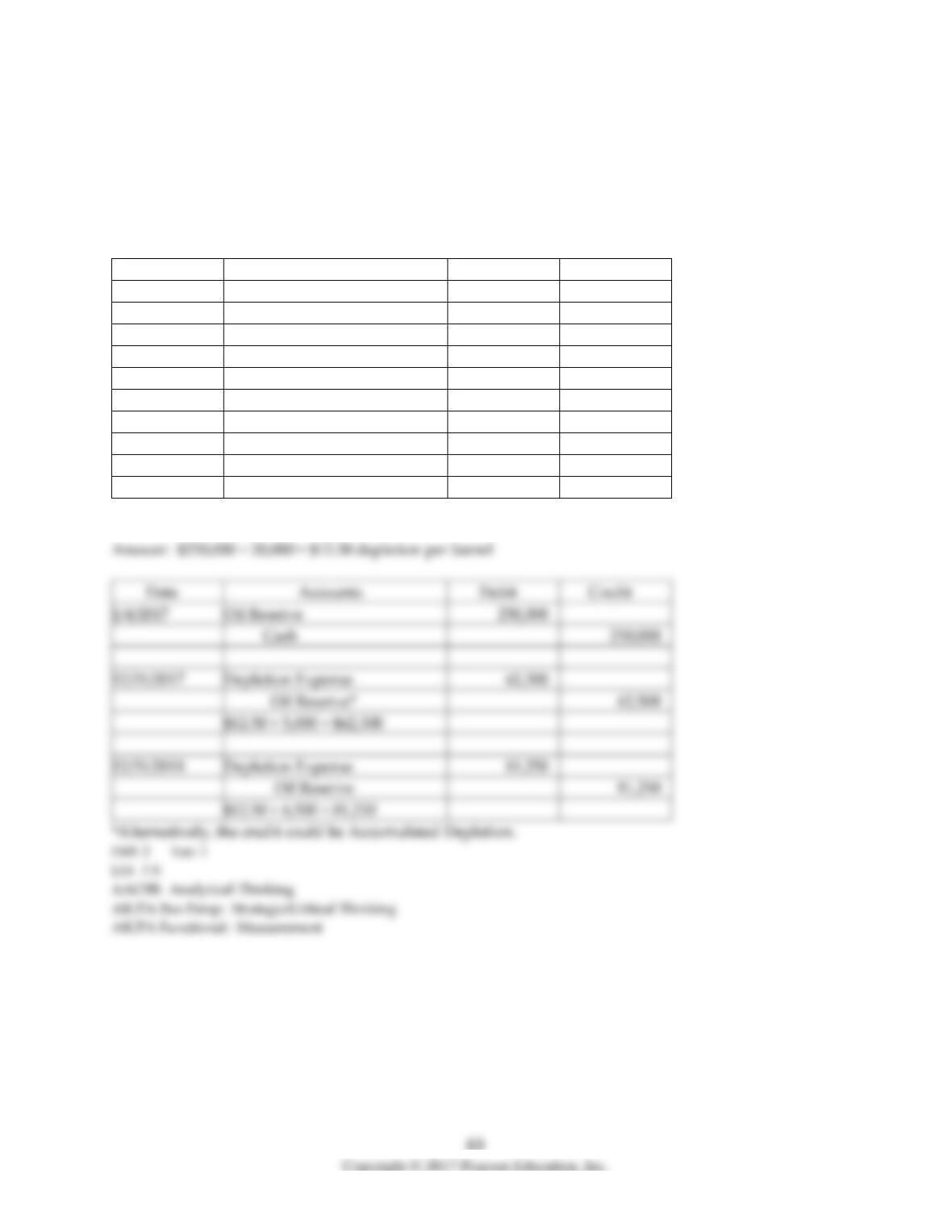
35) On January 4, 2017, David Company paid $250,000 for an oil field that contains an estimated 20,000
barrels of oil. The oil field has no residual value. 5,000 barrels are extracted and sold in 2017 and 6,500
barrels are extracted and sold in 2018.
Required:
Prepare all journal entries. Explanations are not required.
Date
Accounts
Debit
Credit
Date
Accounts
Debit
Credit
1/4/2017
Oil Reserve
12/31/2017
Depletion Expense
$12.50 × 5,000 = $62,500
12/31/2018
Depletion Expense
$12.50 × 6,500 = 81,250
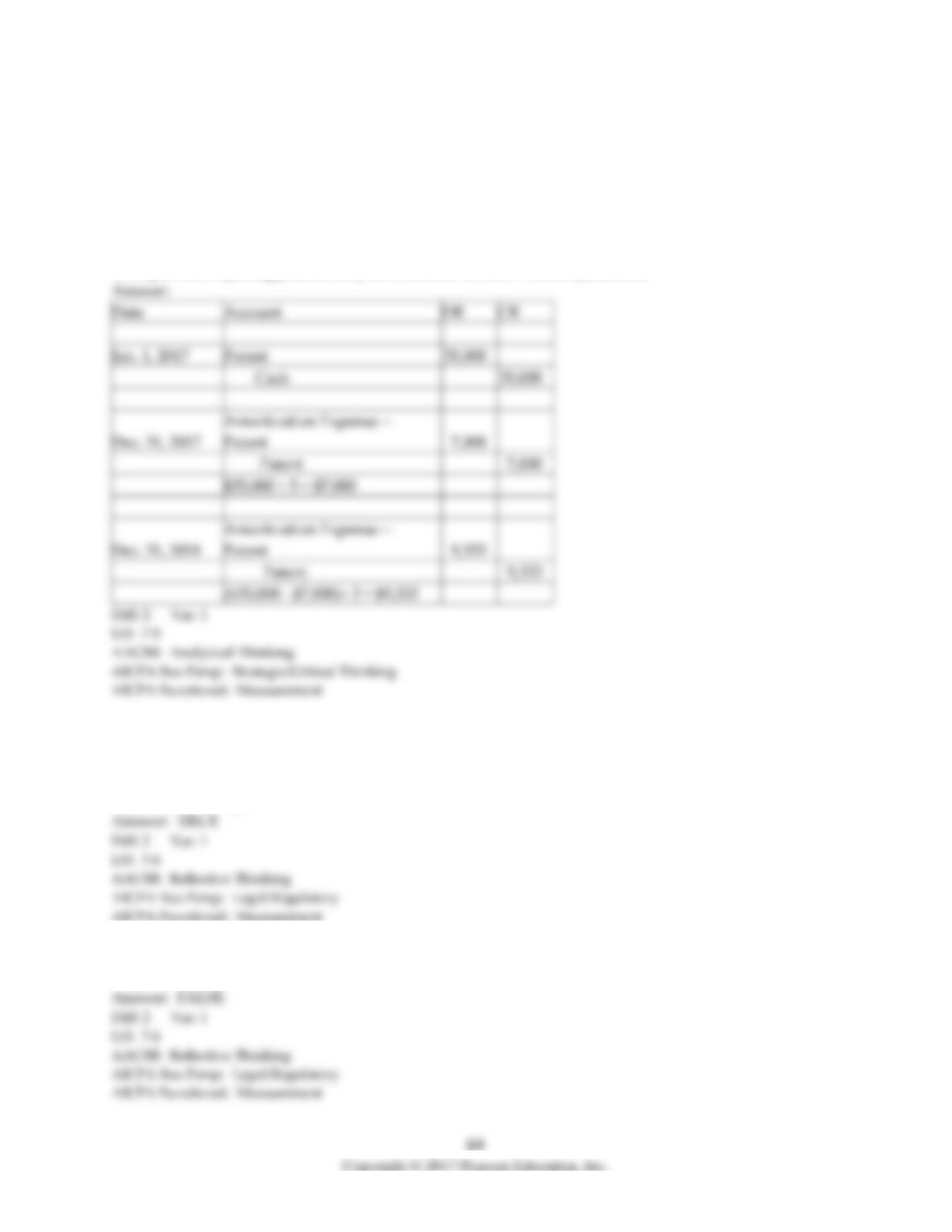
36) New Tech Company acquired a patent on January 1, 2017 for $35,000. The residual value of the
patent is $0. The patent is expected to benefit New Tech Company for 5 years. After using the patent
one year, it was discovered that the patent would only be useful for 3 more years.
Required:
1. Prepare the journal entry to record the acquisition of the patent. Omit explanations.
2. Prepare the adjusting journal entry at December 31, 2017. Omit explanation.
3. Prepare the adjusting journal entry at December 31, 2018. Omit explanation.
6 Learning Objective 7-6
1) If a long-term plant asset is impaired, generally accepted accounting principles require the owner to
adjust the carrying value downward from its book value to its fair value.
2) Like U.S. GAAP, asset impairments under IFRS may be reversed in future periods for all types of
long-term assets.
3) If an asset is impaired, estimated future cash flows will exceed the net book value.
4) Which of the following is a CORRECT statement about asset impairment?
A) An asset is impaired if the net book value is less than the expected future cash flows.
B) If an asset is impaired, the expected future cash flows will exceed the net book value.
C) Under U.S. GAAP, an asset that has been written down because of impairment can be written back
up if it increases in value in the future.
D) If an asset is impaired, the impairment loss is the difference between the net book value and the fair
value.
5) Sylvia Company has a long-term plant asset with the following information as of the end of the year:
Net book value
$87,300
Estimated future cash flows
$69,000
Fair value
$67,000
The amount of the impairment loss is:
A) $18,300.
B) $2000.
C) $156,300.
D) $20,300.
6) Samson Company has a machine with the following data:
Net book value
$960,000
Estimated future cash flows
$780,000
Fair value
$67,000
Is the machine impaired?
A) No, the net book value of the machine exceeds the estimated future cash flows from the machine.
B) No, the estimated future cash flows from the machine exceed the fair value of the machine.
C) Yes, the fair value of the machine is less than the net book value of the machine.
D) Yes, the estimated future cash flows from the machine are less than the net book value of the
machine.
7) U.S. GAAP differs from IFRS in the accounting treatment of:
A) research and development costs.
B) capitalization of internally generated intangible assets.
C) reversals of write-downs due to the impairment of plant assets.
D) all of the above.
8) What is the impairment test for long-term plant assets?
A) Is the net book value greater than the fair value?
B) Is the fair value greater than the net book value?
C) Is the net book value greater than the estimated future cash flows?
D) Are the estimated future cash flows greater than the net book value?
9) The impairment test for long-term assets applies to:
A) tangible long-term assets.
B) intangible long-term assets.
C) all assets.
D) A and B.
10) The impairment loss on long-term plant assets equals:
A) net book value minus fair value.
B) net book value minus estimated future cash flows.
C) estimated future cash flows minus fair value.
D) estimated future cash flows minus net book value.
11) For each of the following scenarios, use the two step approach to determine whether a long–term
asset has been impaired and, if so, the amount of loss that should be recorded.
a. Equipment
Net book value: $450,000
Estimated future cash flows: $400,000
Fair value: $425,000
b. Patent
Net book value: $650,000
Estimated future cash flows: $750,000
Fair value: $700,000
7 Learning Objective 7-7
1) Return on assets measures how profitably management has used its assets.
2) When determining the rate of return on assets:
A) the DuPont model breaks return on assets down into three component ratios that drive it.
B) the DuPont model calculates the rate of return on assets as the net profit margin ratio times total asset
turnover.
C) it is important for companies to develop strategies to decrease total asset turnover.
D) total asset turnover measures how much every sales dollar generates in profit.
3) Calculate Company Y’s total asset turnover based on the following information for the current year:
(Round your final answer to two decimal places.)
Net income
$800,000
Assets at the beginning of the year
$100,000
Assets at the end of the year
$120,000
Net sales
$900,000
A) 7.50
B) 7.27
C) 8.18
D) 9.00
4) The records of Milwaukee Sprinkler Systems report net sales of $360,000, net income of $180,000 and
average total assets of $350,000. Using DuPont analysis, calculate the two ratios used for return on
assets. (Round your final answer to two decimal places.)
A) Net profit margin ratio is 1.94; Total asset turnover is 50%.
B) Net profit margin ratio is 50%; Total asset turnover is 1.03.
C) Net profit margin ratio is 51%; Total asset turnover is 2.00.
D) Net profit margin ratio is 1.50; Total asset turnover is 51%.
5) Return on assets measures:
A) how much the entity earned for each dollar of assets invested by both stockholders and creditors.
B) return on sales times total asset turnover.
C) profitability of a company’s core business operations.
D) A and B.
6) a. What does total asset turnover measure?
b. List three ways in which asset turnover can be increased.
7) a. What does the net profit margin ratio measure?
b. List three ways in which this ratio can be increased.
Answer:
8 Learning Objective 7-8
1) The disposition of a plant asset is reported on the statement of cash flows as a financing activity.
2) Acquisitions and sales of long-term assets are reported as investing activities on the statement of cash
flows.
3) Equipment is acquired by issuing a note payable for $50,000 and a making a down payment of
$20,000. The statement of cash flows will report a:
A) $20,000 outflow in the operating activities section.
B) $70,000 outflow in the investing activities section.
C) $50,000 inflow in the financing activities section.
D) $20,000 outflow in the investing activities section.
4) Equipment with a book value of $8000 is sold for $1000 cash. The statement of cash flows will report
a:
A) $1000 cash inflow in the operating activities section
B) $1000 cash inflow in the investing activities section.
C) $7000 cash outflow in the operating activities section.
D) $7000 cash outflow in the financing activities section.
5) Each of the following transactions appear on the statement of cash flows, EXCEPT:
A) acquiring long-lived assets.
B) depreciating long-lived assets.
C) junking long-lived assets.
D) selling long-lived assets.