95) Golden Corporation uses direct labor-hours in its predetermined overhead rate. At the
beginning of the year, the estimated direct labor-hours were 21,600 hours. At the end of the year,
actual direct labor-hours for the year were 20,400 hours, the actual manufacturing overhead for
the year was $506,920, and manufacturing overhead for the year was underapplied by $23,440.
The estimated manufacturing overhead at the beginning of the year used to calculate the
predetermined overhead rate must have been:
A) $501,920.
B) $531,445.
C) $483,480.
D) $511,920.
96) Fortune Company uses a predetermined overhead rate based on direct labor-hours to apply
manufacturing overhead to jobs.
On October 1, the estimates for the month were:
Manufacturing overhead $ 17,000
Direct labor-hours 13,600
During October, the actual results were:
Manufacturing overhead $ 18,500
Direct labor-hours 12,000
The cost records for October will show:
A) Overapplied overhead of $1,500.
B) Underapplied overhead of $1,500.
C) Overapplied overhead of $3,500.
D) Underapplied overhead of $3,500.
97) The Work-in-Process Inventory account of a manufacturing firm shows a balance of $3,000
at the end of an accounting period. The job cost sheets of two uncompleted jobs show charges of
$500 and $300 for materials, and charges of $400 and $600 for direct labor. From this
information, it appears that the company is using a predetermined overhead rate, as a percentage
of direct labor costs, of:
A) 83%.
B) 120%.
C) 40%.
D) 300%.
98) Faucette Corporation has provided the following data concerning manufacturing overhead
for January:
Actual manufacturing overhead incurred $ 52,000
Manufacturing overhead applied to Work-in-Process $ 75,000
The company’s Cost of Goods Sold was $369,000 prior to closing out its Manufacturing
Overhead account. The company closes out its Manufacturing Overhead account to Cost of
Goods Sold. Which of the following statements is true?
A) Manufacturing overhead was underapplied by $23,000; Cost of Goods Sold after closing out
the Manufacturing Overhead account is $392,000.
B) Manufacturing overhead was underapplied by $23,000; Cost of Goods Sold after closing out
the Manufacturing Overhead account is $346,000.
C) Manufacturing overhead was overapplied by $23,000; Cost of Goods Sold after closing out
the Manufacturing Overhead account is $346,000.
D) Manufacturing overhead was overapplied by $23,000; Cost of Goods Sold after closing out
the Manufacturing Overhead account is $392,000.
99) In computing its predetermined overhead rate, Marple Company inadvertently left its indirect
labor costs out of the computation. This oversight will cause:
A) Manufacturing Overhead to be overapplied.
B) the Cost of Goods Manufactured to be understated.
C) the debits to the Manufacturing Overhead account to be understated.
D) the ending balance in Work-in-Process to be overstated.
100) Which of the following is the correct formula to compute the predetermined overhead rate?
A) Estimated total units in the allocation base divided by estimated total manufacturing overhead
costs.
B) Estimated total manufacturing overhead costs divided by estimated total units in the
allocation base.
C) Actual total manufacturing overhead costs divided by estimated total units in the allocation
base.
D) Estimated total manufacturing overhead costs divided by actual total units in the allocation
base.
101) The Work-in-Process Inventory account of a manufacturing firm has a balance of $2,400 at
the end of an accounting period. The job cost sheets of two uncompleted jobs show charges of
$400 and $200 for materials used, and charges of $300 and $500 for direct labor used. Overhead
is applied as a percentage of direct labor costs. The predetermined rate is:
A) 41.7%.
B) 80.0%.
C) 125.0%.
D) 240.0%.
102) Midwest Corporation has provided the following data concerning manufacturing overhead
for 2020:
Estimated manufacturing overhead for the year $ 30,000
Estimated direct labor hours for the year 2,000
Two jobs were worked on during the year: Job A-101 and Job A-102. The number of direct
labor-hours spent on Job A-101 and Job A-102 were 1,200 and 1,000, respectively. The actual
manufacturing overhead was $37,000.
What is the predetermined manufacturing overhead rate per direct labor hour for the year?
A) $15.
B) $20.
C) $25.
D) $30.
103) Midwest Corporation has provided the following data concerning manufacturing overhead
for 2020:
Estimated manufacturing overhead for the year $ 30,000
Estimated direct labor hours for the year 2,000
Two jobs were worked on during the year: Job A-101 and Job A-102. The number of direct
labor-hours spent on Job A-101 and Job A-102 were 1,200 and 1,000, respectively. The actual
manufacturing overhead was $37,000.
What was the amount of manufacturing overhead applied to Job A-101?
A) $16,000.
B) $18,000.
C) $24,000.
D) $44,000.
104) Midwest Corporation has provided the following data concerning manufacturing
overhead for 2020:
Estimated manufacturing overhead for the year $ 30,000
Estimated direct labor hours for the year 2,000
Two jobs were worked on during the year: Job A-101 and Job A-102. The number of direct
labor-hours spent on Job A-101 and Job A-102 were 1,200 and 1,000, respectively. The actual
manufacturing overhead was $37,000.
What is the amount of the under- or overapplied manufacturing overhead?
A) $1,000 underapplied.
B) $3,000 overapplied.
C) $4,000 underapplied.
D) $7,000 overapplied.
105) In a traditional job costing system, the issuance of indirect materials to a production
department increases: (CPA adapted)
A) Stores Control.
B) Work-in-Process Control.
C) Manufacturing Overhead Control.
D) Manufacturing Overhead Applied.
106) One of the primary differences between job costing for service firms and job costing for
manufacturing companies is service firms generally:
A) use fewer direct materials.
B) have less direct labor.
C) do not use predetermined overhead rates.
D) have no Work-in-Process Inventory.
107) Which of the following is not a difference between job costing for service firms and job
costing for manufacturing companies?
A) Service firms generally use fewer direct materials than manufacturing companies.
B) Service firms’ overhead accounts have slightly different titles (e.g., Applied Service
Overhead).
C) Service firms’ finished jobs are charged to Cost of Services Billed instead of Cost of Goods
Sold.
D) Service firms’ costs are immediately expensed since all work is completed during a period.
70
108) The journal entry to record the completion of a contract in a job costing system for a service
firm is:
A. Cost of Services Billed xxx
Wages Payable xxx
B. Work-In-Process Inventory xxx
Wages Payable xxx
C. Cost of Services Billed xxx
Work-In-Process Inventory xxx
D. Finished Goods Inventory xxx
Work-In-Process Inventory xxx
A) Option A
B) Option B
C) Option C
D) Option D
109) Complex jobs that take multiple time periods and require the work of many different
departments, divisions, or subcontractors are called:
A) clients.
B) projects.
C) customers.
D) contracts.
110) The financial records for the Lazer Manufacturing Company have been destroyed in a
flood. The following information has been obtained from a separate set of books maintained by
the cost accountant. The cost accountant now asks for your assistance in computing the missing
amounts.
Beginning $ Ending $
Direct materials $ 8,000 $ 6,400
Work-in-process 7,500 ???
Finished goods ??? 4,200
Other information:
Direct materials used $ 18,000
Direct labor 13,500
Overhead applied 8,000
Cost of goods manufactured 39,500
Cost of goods sold 57,000
Required:
Compute the following:
(a) Direct materials purchased.
(b) Ending Work-in-process inventory.
(c) Beginning Finished goods inventory.
111) The Duggart Company had the following transactions and events during its first year of
operations. Estimated overhead for the year was $770,000; estimated direct labor cost for the
year was $350,000.
1. Purchased materials on account, $567,000.
2. Requisitioned materials for production as follows: direct materials – 85 percent of purchases,
indirect materials – 12 percent of purchases.
3. Direct labor for production is $331,000, indirect labor is $125,000.
4. Overhead incurred (not including materials or labor): $529,000.
5. Overhead is applied to production based on direct labor cost at the rate of ________.
6. Goods costing $976,000 were completed during the period.
7. Goods costing $513,200 were sold on account for $776,000.
Required:
Determine the ending balances for:
(a) Materials Inventory
(b) Work-in-Process Inventory
(c) Finished Goods Inventory
112) Mirror Lake Corporation recorded the following transactions for the just completed month:
1. $60,000 in raw materials were purchased on account.
2. $51,000 in raw materials were requisitioned for use in production. Of this amount, $42,000
was for direct materials and the remainder was for indirect materials.
3. Total labor wages of $92,000 were incurred and paid. Of this amount, $81,000 was for direct
labor and the remainder was for indirect labor.
4. Additional manufacturing overhead cost of $155,000 were incurred. All were on account.
Required:
Record the above transactions in journal entries.
113) During April, Orbitz Corporation incurred $64,000 of actual manufacturing overhead costs.
During the same period, the manufacturing overhead applied to Work-in-Process was $66,000.
Required:
Prepare journal entries to record the incurrence of manufacturing overhead and the application of
manufacturing overhead to Work-in-Process.
75
114) The following cost data relate to the manufacturing activities of Falco Industries during the
just completed year:
Total actual manufacturing overhead costs incurred (including $15,000 of indirect materials)
$ 353,000
Purchases of raw materials (both direct and indirect) $ 250,000
Direct labor cost $ 135,000
Inventories:
Raw materials, beginning $ 10,000
Raw materials, ending $ 15,000
Work-in-Process, beginning $ 20,000
Work-in-Process, ending $ 35,000
The company uses a predetermined overhead rate to apply manufacturing overhead cost to
production. The predetermined overhead rate for the year was $15 per machine-hour. A total of
23,000 machine-hours was recorded for the year.
Required:
a. Compute the amount of underapplied or overapplied overhead cost for the year.
b. Prepare a Schedule of Cost of Goods Manufactured for the year.
115) The following selected data were taken from the books of the Fisher Foil Company. The
company uses job costing to account for manufacturing costs. The data relate to June operations.
(1) Materials and supplies were requisitioned from the stores clerk as follows:
Job 405, material X, $7,000.
Job 406, material X, $3,000; material Y, $6,000.
Job 407, material X, $7,000; material Y, $3,200.
For general factory use: materials A, B, and C, $2,300.
(2) Time tickets for the month were chargeable as follows:
Job 405 $ 11,000 300 hrs
Job 406 14,000 360 hrs
Job 407 8,000 190 hrs
Indirect labor 3,700
(3) Other information:
There was no beginning work-in-process inventory.
Factory paychecks for $36,700 were issued during the month.
Various factory overhead charges of $19,400 were incurred on account.
Depreciation of factory equipment for the month was $5,400.
Factory overhead was applied to jobs at the rate of $35.00 per direct labor hour.
Job orders completed during the month: Job 405 and Job 406.
Selling and administrative costs were $2,100.
Factory overhead is closed out only at the end of the year.
Required:
(a) Determine the ending work-in-process balance on June 30.
(b) Determine the cost of goods manufactured for June.
(c) Is factory overhead over- or underapplied for June? What is the monthly value?
78
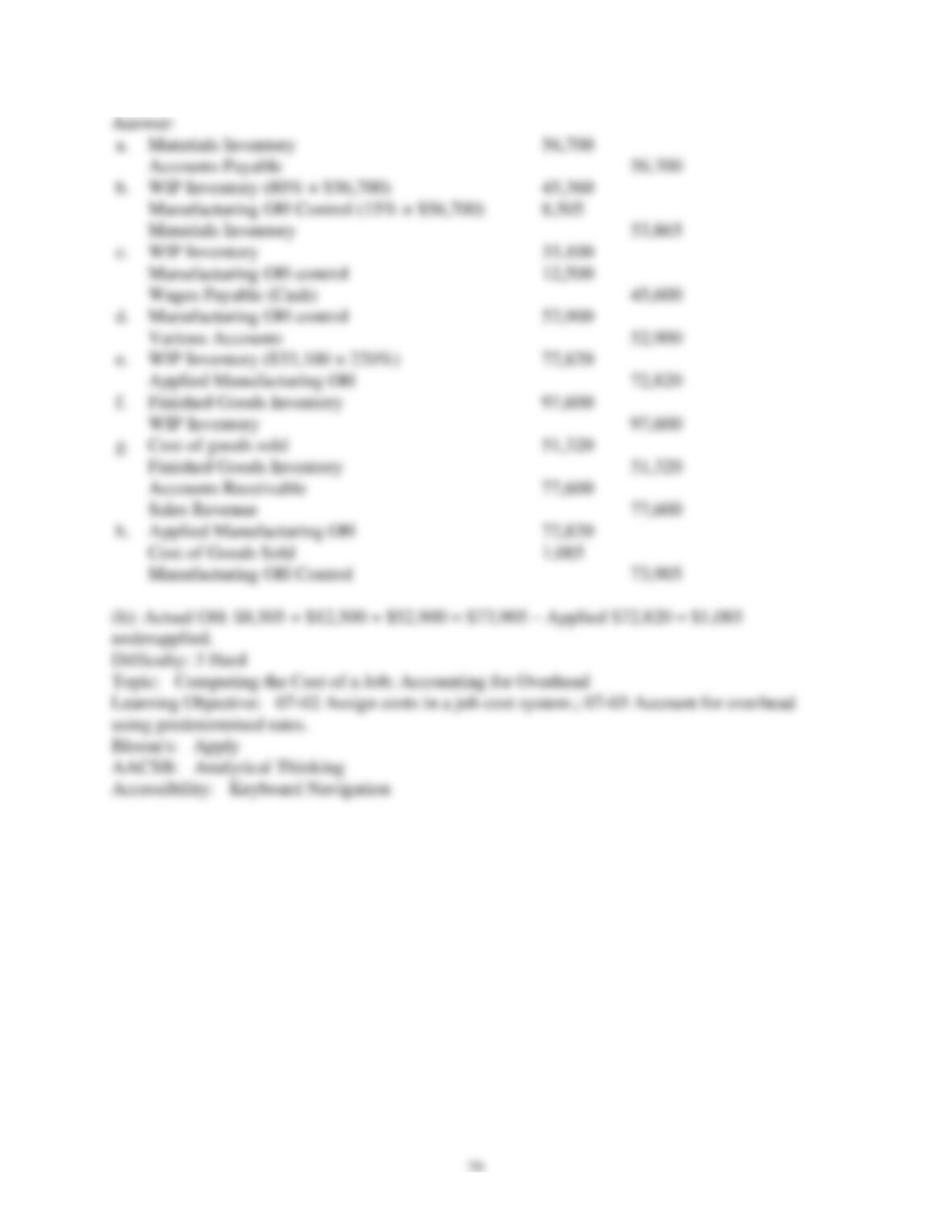
116) Prepare the necessary journal entries from the following information for Blalock Company.
a. Purchased materials on account, $56,700.
b. Requisitioned materials for production as follows: direct materials – 80 percent of purchases,
indirect materials – 15 percent of purchases.
c. Direct labor for production is $33,100, indirect labor is $12,500.
d. Overhead incurred (not including indirect materials or indirect labor): $52,900.
e. Overhead is applied to production based on direct labor cost at the rate of 220 percent.
f. Goods costing $97,600 were completed during the period.
g. Goods costing $51,320 were sold on account for $77,600.
h. Close the overhead control account to Cost of Goods Sold.
80
117) On October 1, the general ledger of Morgan Industries had the following accounts and
balances:
Materials inventory $ 19,200
Work-in-process inventory 48,750
Finished goods inventory 8,100
Manufacturing overhead (overapplied) 2,000
The subsidiary ledgers had the following information on October 1:
Job Cost Sheets Finished Goods Cards
Job Number Direct
Materials Direct Labor Manufacturing Overhead Job Number
Cost
B81 $ ? $ 7,000 $ 8,750 B80 $ 5,200
B83 4,300 ? 11,500 B82 ?
? ? $ 20,250 ?
During October, the following costs were incurred on account:
Materials $ 46,500
Factory labor 49,000
Manufacturing overhead 56,350
A summary of the materials requisition slips and the labor time tickets for the month revealed the
following distribution:
Applicable To Materials Requisitions Time Tickets
Job B81 $ 8,000 $ 4,000
Job B83 5,100 1,700
Job B84 8,600 10,500
Job B85 19,900 16,750
Job B86 12,750 ?
General Use ? 4,500
$ 58,250 ?
Overhead is applied based upon direct labor cost. Jobs B81, B83, and B84 were for 8,000, 6,000
and 4,800 units of product, respectively, and were completed during October. Jobs B80, B81,
B82, and B83 were sold on account for $150,000.
Required:
Prepare T-accounts for a job costing system, posting the beginning balances and all transactions
for the month. Clearly indicate the ending balances for the accounts and label the ‘cost of goods
manufactured’ and ‘cost of goods sold’ amounts.